In the Ivory Coast, Nationalist Chinese experts are helping African farmers boost rice production. In Ethiopia and Chad, Chinese veterinarians are advising farmers.…. Project Vanguard, run with little publicity on a shoestring budget of $5,000,000 a year, today has 1,239 technical experts in 27 countries. Peking, Taiwan's rival, currently offers assistance to 24 countries, with at least 1,000 technicians.…. The Nationalists deny that political dividends are their main objective. But Vanguard's efforts quite clearly have a bearing on Taiwan's annual United Nations battle to keep itself in the world forum and the Communist Chinese out. Last year, the vote was 58 to 45 … So far, Taipei leads Peking 20 to 13 in the battle for recognition by African nations. Taiwan's main effort is built on sharing its own hard-won know-how in intensive rice and vegetable cultivation. In the Ivory Coast, for example, Chinese experts have managed to increase rice output tenfold per annum in their pilot plot.…. So well known has the program become in Africa that recently the Taiwanese were asked to extend their existence to gastronomy: at the request of President Mobutu, two Taipei chefs flew off to Kinshasa to impress the Congolese with their skills – TIME, October 1968
When our technicians went to Burkina Faso,…. they chose a dry and rocky wasteland called Bagre and helped locals grow paddy rice on it. Three years later … Bagre, thanks to the direction of the Taiwanese technical mission, has become a green rice field. This is the highlight of green miracles in Africa – Wu Zhaoxie (吳釗燮), Taiwan's representative to the US, May 2007
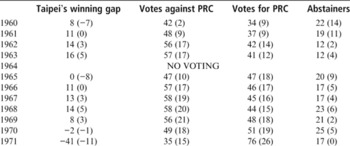
Forty years ago, with the rise of the African independence movement, the People's Republic of China (PRC) and the Republic of China on Taiwan (ROC) started to provide agricultural assistance to the increasingly numerous African states for their respective political needs. Beijing was interested in Africa primarily because it wished to create an arena in which to achieve its ideological objectives, to oppose the Soviet Union and to promote the PRC as the sole legitimate Chinese government.Footnote 1 Taipei's interest in Africa was simpler: to compete with Beijing for Chinese legitimacy in order to protect the ROC's seat in the UN. The number of African states was critical for UN voting (see Table 1), so to Taipei, African support in the international arena became “a matter of political life and death.”Footnote 2
Vote Distribution of Chinese Representation in the UN Votings

Notes: African votes are in parentheses and Taiwan was not expelled in 1970 because UN members agreed to make the Chinese representation issue an “important question,” and so a 2/3 majority was required to replace Taipei with Beijing.
The body of investigations on Beijing's agricultural aid programme is relatively sophisticated. Initially its reliability was questionable because of scholars' dependency on state-issued information. Early studies of the PRC's agricultural aid mostly focused on China's strategic objectives or compiled lists of assistance projects,Footnote 3 with no general consensus on the effectiveness of the aid.Footnote 4 Then, in the 1990s, Deborah Brautigam revolutionized the field by collecting physical evidence of Chinese agricultural aid in West Africa. Her field research illustrated the PRC's successful and unsuccessful experiences through the relationships between assistance, politics, ideology and institutions.Footnote 5 Some PRC scholars subsequently began to indicate that Beijing's assistance confronted a variety of problems such as Africa's natural conditions, small markets, lack of infrastructure and capital, unco-operative peasants and governments, and absent social frameworks.Footnote 6 Other studies further questioned the sustainability of the PRC technology transfer, concluding that “China has implemented many agricultural aid projects in Africa, and almost all of them without exception have gone through the odd circle of quick starting, quick results and quick decline.”Footnote 7 Such a comment is particularly apt to describe the assistance from 1959 to the late 1970s when political demands were high.Footnote 8
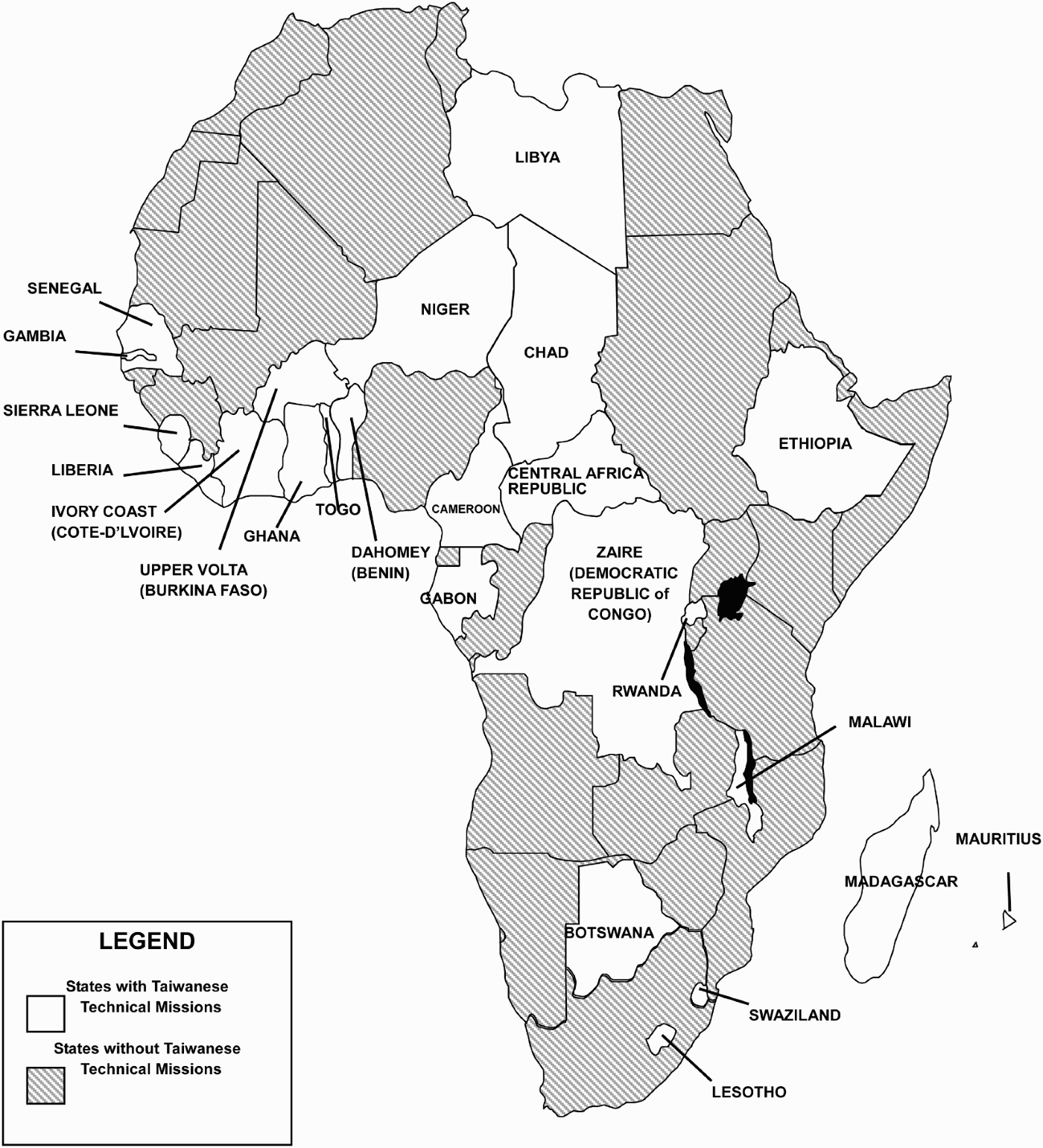
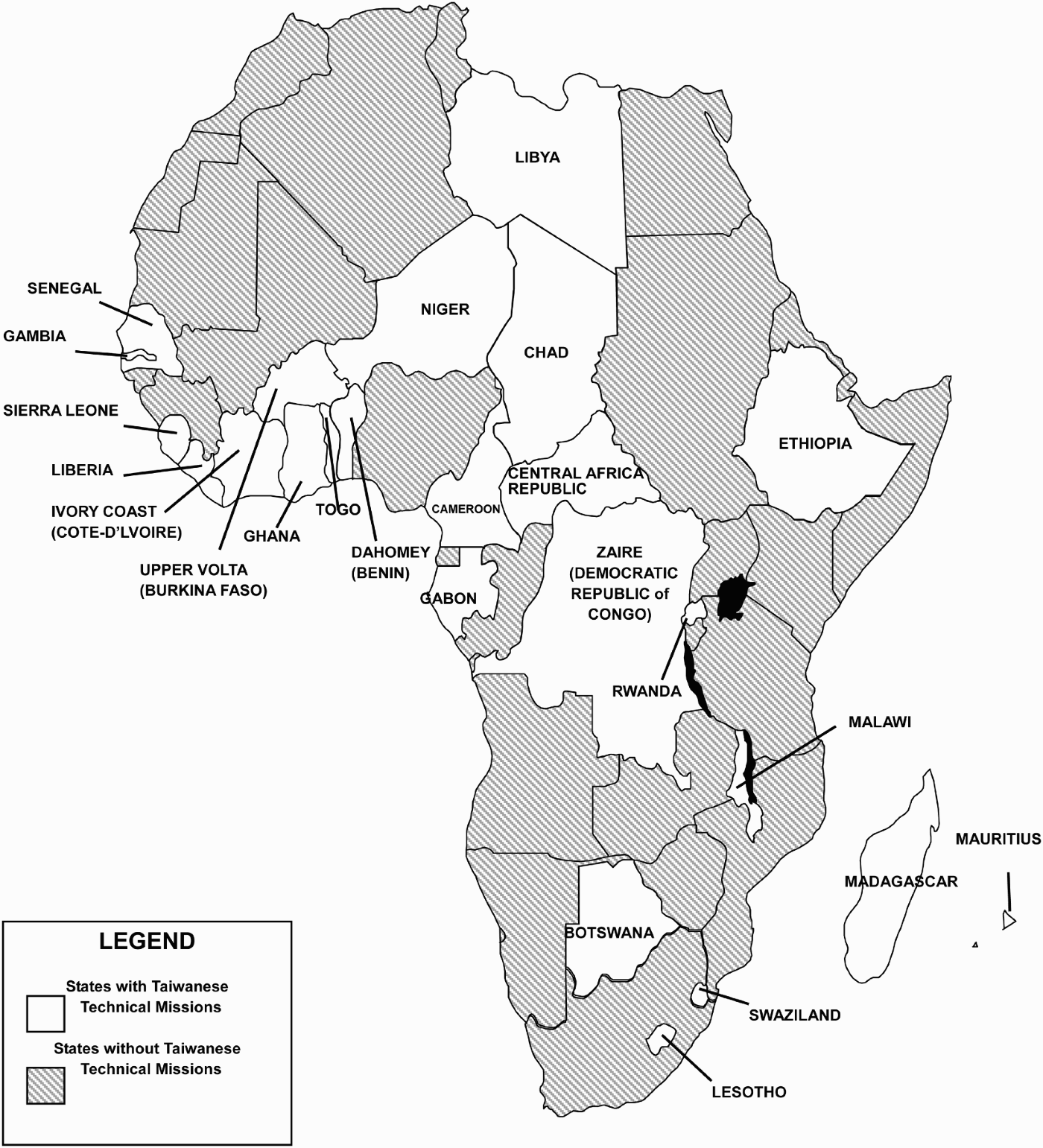
Like Beijing, Taiwan also sent aid to Africa through the Vanguard Project (see Figure 1). But research on this assistance programme is in its infancy compared to that on the PRC's efforts. Taiwan's political interests are always at the core of these studies, and, without substantial evidence, most existing literature reflects positively on Taiwan's agricultural endeavours in Africa.Footnote 9 As a result of declassified documents from Washington and Taipei, recent studies have been able to expose America's financial sponsorship behind the Vanguard Project.Footnote 10 It was not until 2004 that scholars questioned the effectiveness of Taiwan's assistance, when two British scholars published a study on the contemporary development of a Gambian farm.Footnote 11 Although political needs launched the ROC–Africa agricultural co-operation, academia has not given the same attention to the politics–sustainability relationship in the Taiwanese transfer of aid.
Taiwanese Agricultural Assistance to Africa in the 1960s
This article reviews the ROC's assistance to Africa that began in the 1960s, and focuses on how the Taiwanese, in a “political life and death” situation, applied their Chinese agricultural techniques to Africa's various environments. Drawing heavily on primary resources, I hope to supplement the history of Chinese agricultural involvement in Africa, and provide some insight into the impediments to and prerequisites for successful African agricultural transformation.
Africa's Agriculture: Theory and History
Scholars have varying explanations for Africa's delayed agricultural development. Robert E. Clute argues that Africa does not have an ideal agricultural environment. Although traditional cropping patterns and fallowing systems were sufficient for a sparse population, with population growth Africa's agricultural situation faces a crisis. Clute contends that African governments have failed to respond to its needs with modern farming skills.Footnote 12 Sara S. Berry, on the other hand, opines that policy changes alone are insufficient remedies: there is no universal cure for the African food deficit and farmers need more access to economic opportunities and productive resources. John M. Staatz and Niama Nango Dembele believe that African agriculture suffers from weathered soils, weak infrastructure (partially due to low population density), poor governance, limited market scale, international competition, lack of research abilities and insufficient investments. They find that the size and diversity of Africa's agro-ecological environments lead to a wide range of farming patterns and reliance on a broad number of staples. Similar to Berry, they therefore believe that the path to productivity growth in Africa is not singular and cannot mirror that of an Asian-style green revolution.Footnote 13
Challenged by “inhospitable”Footnote 14 natural conditions that range from dry deserts to rainforests, many places in Africa traditionally either discourage cultivation or use extensive farming. The practice of shifting cultivation, alternately known as the slash-and-burn method, is a particularly popular technique invented to suit Africa's ecological needs. Following this method, farmers grow several types of crops on the same piece of land to ensure a relatively stable food supply because different plants can tap the nutrients of various soil layers without exhausting any individual nutrient. Mixed-cropping further shields farmers from unfavourable natural conditions by distributing the risks posed by weather, pests and disease.
Extensive farming is not a lucrative method of agriculture, so Africa's colonialists encouraged the cultivation and export of cash crops to compensate for their governing expenses. They consequently forced African peasants to farm monoculturally on land originally meant for food production. As a result Africa used much of what it earned from cash crops to import ever-increasing percentages of foreign foods. Some places in West Africa, for example, were well-suited for growing rice,Footnote 15 but following the colonialist cash-crop model, they grew other products and unfortunately became a rice importer. By 1956, about 25 per cent of West Africa's food import was rice.Footnote 16
The newly increased population further exacerbated the need for imported food. These new mouths were easily affected by the West, as changes in their consumption patterns demonstrate. Rice thus became a popular staple during the colonialist period. Local cereals such as maize and sorghum, as well as some root crops like cassava, yams and sweet potatoes gradually became unpopular. Over time, the increasing African population ate less and less of what grew naturally in Africa. As Maxwell Owusu puts it, Africa's agricultural dilemma is that it “produces what it does not consume, and consumes what it does not produce.”Footnote 17
Although Africa needed rice and had rice production potential, it was caught in a dangerous cycle: as long as the cash crops continued to fetch good prices on the global market, the revenue from these exports could support the needs of its domestic market. But trading on the international market is highly unpredictable. Since many African countries depended on the revenue from one or two cash crops, it was risky for them to rely on this fluctuating income to purchase food for a rising population. Thus, newly independent African states that had the potential to grow rice domestically needed training in intensive farming skills. They needed to increase the volume of land dedicated to rice cultivation, increase the quantity of production per unit of land, or both, to augment its rice production. Unfortunately, because staple foods (like rice) were a low priority during the colonialist era, there were few local agricultural specialists that could teach peasants such techniques.
Roots of the Taiwan–Africa Collaboration
Contrary to Africa's extensive cultivating tradition, China's high population density required Chinese peasants to make the most of each inch of soil: farmers saved all human and animal excrement and corpses to fertilize every inch of land and still produced only enough to feed the multitude of mouths. In the Qing dynasty, the Chinese population was so large that human labour was worth less than animal force. Thus China began to export labour worldwide. In Africa, for example, Chinese workers supplemented local human resources and helped build infrastructure and grow cash crops. From the mid-1700s to 1910, Africa contracted approximately 142,000 Chinese labourers.Footnote 18
Feeling the pressures of overcrowding, many Chinese emigrated to nearby Taiwan. Farmers in Taiwan not only inherited the Chinese tradition of intensive and meticulous farming, but, after Japanese rule, they also became accustomed to using chemical fertilizers and modern irrigation systems. Since the Japanese had intended to make Taiwan their granary, Taiwan rarely experienced food shortages. Despite the influx of two million immigrants and Nationalist troops from the Mainland in 1949, Taiwan was able to maintain a steady food supply for its eight million citizens thanks to American-financed agricultural reform and infrastructure left by the Japanese.
Taiwan's successful accommodation of an additional two million refugees in 1949 was proof of its exceptional agricultural techniques, particularly in rice cultivation. At the peak of the Cold War, both communist and non-communist blocs were eager to provide aid to newly independent African states, so Washington called upon Taiwan's rice-growing skills as a form of foreign assistance. Consequently, the Vanguard Project was born to transplant the Chinese intensive farming tradition to Africa.
Everyone stood to benefit from this trilateral co-operation. Washington could advance its ideological war against the Communists. Africa could obtain the agricultural training it needed. And if Taipei could satisfy Africa's lack of domestic food resources the project would, Taiwan hoped, cause African states to appreciate the ROC and support its bid for Chinese representation in the UN. Motivated by this potential political lifeline, Taiwan in the 1960s was very ambitious about its rice diplomacy. Zou Yunting 鄒雲亭, a ranking official from the ROC Foreign Ministry, even boasted that Taiwan would “make rice replace cassava and maize, make Africans change their dietary habits, and make rice become the African staple.”Footnote 19
The Myth of the “Rice Saints”
Similar to the one in TIME, successful stories about how the Taiwanese overcame the African environment abounded in Africa. In Gbedin, Liberia, American farming technicians had abandoned their rice project. Gbedin peasants initially did not believe in the difference Taiwanese technicians could make, but when these specialists made Gbedin's rice yield surpass even Taiwan's domestic harvest, the peasants forgot their scepticism and greeted the Taiwanese with respect and affection.Footnote 20 In Togo, technicians cropped 5,000 kg of rice per hectare – approximately nine times the original harvest – and peasants thanked the Taiwanese officials for the “Chinese” government's advanced agricultural expertise that so substantially improved their living standards.Footnote 21 A Gambian domestic newspaper anxiously predicted Gambia's transformation into a “land of plenty” if it followed the footsteps of other Taiwan-assisted African countries.Footnote 22 The impact of Taiwanese technicians was epic: an American journalist found that Libyan locals had affixed a sign to the Taiwanese farmer's house that read “THESE ARE THE SAINTS.”Footnote 23
Considering the obstacles scholars articulate about Africa's agricultural development, it seems inconceivable that the financially strapped Taiwan of the 1960s would have been able to resolve Africa's food crisis. TIME's retelling of Taiwan's extraordinary contribution to the Ivory Coast's rice output suggests that Taiwan greatly improved Africa's food shortage, but this rapid metamorphosis contradicts the scholarship on Africa's agricultural development needs. Given the radically different agro-ecological conditions, Goran Djurfelt postulates that a sustainable African “green revolution” must employ mixed-crop technologies instead of Asia's rice-based skills, especially because Africa is far less irrigated than Asia.Footnote 24 The seeming dichotomy between Taiwan's field successes and Djurfelt's theory calls for a careful review of Taiwan's “solutions” to Africa's longstanding agricultural development dilemma. It may be that Taiwan's aid programmes were as much a response to a political agenda as they were agriculturally motivated.
Despite all of the positive reactions to Taiwan's endeavours in Africa, not everyone was satisfied with the “green miracles.” Taiwanese technicians produced astonishingly impressive rice harvests for their carefully chosen projects, but in many areas African peasants were not in a position to adopt the same processes. A significant suspicion of Taiwan's aid effectiveness was that the missions were able to choose showcase fields that were already conducive to cultivation. Even though Taiwan exhibited its farming techniques in sites found in more than half of Africa, most of its farming showcases could only function in limited areas because American-sponsored assistance funds were only enough to pay for short-term capital investments. Taiwanese technicians therefore had to choose locations that could produce the greatest yield with the least capital input. The practice of pre-selecting particularly arable showcase fields is probably why some Sierra Leonean officials remained unconvinced that Taiwan's techniques could apply more generally to their country.Footnote 25
However, these criticisms, while well-founded, do not mean that the Taiwanese technicians were only able to produce rice under perfect circumstances. In the case of Libya, they successfully made rice flourish even in a Saharan Desert oasis. Taiwanese still seemed to be able to overcome Africa's agricultural environment.
Taiwan's Experience of Africa's Delay
As their experience with foreign aid to Africa grew, Taiwanese technicians began to remark that some of the challenges they faced ran much deeper than anything their agricultural assistance alone could overcome in the short term. These obstacles can broadly be split into three categories: labour shortages, capital shortages and a lack of governmental co-operation. The field experiences of Taiwanese technicians began to align with the opinions of scholars like Berry, Staatz and Dembele who insist that there is no singular solution to Africa's variety of agro-ecological and economic-political environments. Although Taiwan could bring great quantities of rice to Africa, it had not found a way to do it sustainably.
Labour
Regardless of how arable the field, rice cultivation is a labour-intensive venture and there was rarely enough manual labour available. In much the same way as the Chinese have traditionally compensated for poor conditions by using more manpower, in the absence of convenient showcase fields, Taiwanese missions substituted labour to overcome the obstacles the host country presented. In a Saharan oasis, where the sandy soil is naturally unarable, the technical team to Libya that won the title of “SAINTS” left the following recordFootnote 26: “The temperature here usually remains at 45–46C, so some rice plants that were green in the morning dry up by the afternoon. Therefore, we must irrigate as much as possible. Each rice plant probably needs to be watered 300 times in its lifetime. This is probably the most frequently irrigated area in the world.” In this way, Taiwanese technicians overcame an unnatural rice cultivation environment with labour. They did the same when they lacked basic farming tools. When tilling machines were unavailable, technicians had to resort to “primitive instruments, with three people hauling and two holding the tool”Footnote 27 – this was a technique reminiscent of the ancient days of over-populated China when animal labour cost more than human labour.
There were physical thresholds to Taiwanese technicians' labour input. At times there were so few workers that the mission turned to forced labour. The Taiwanese discovered that manual labour was disproportionately costly and were frustrated that they needed to use “much of the manpower … to fight off birds [not to grow rice].”Footnote 28 Technicians in Congo (Kinshasa), for instance, reported low population density and labour shortages as a fundamental problem.Footnote 29 It was often necessary to relocate additional labourers to the showcase field, and thus forced labour became one solution to the shortage. In Niger, for example, technicians asked local government for its prisoners to supplement the lack of workers.Footnote 30 In Malawi, the Taiwanese team solved labour problems by using prisoners because they were “cheap and effective.”Footnote 31
Making prisoners work the rice fields, however, echoed Africa's colonial history. Throwbacks to slavery being counter to the very basis of foreign agricultural aid to Africa, artificial labour became Taiwan's main method of meeting its worker requirements.
Capital
In some cases, Taiwanese missions overcame host countries' agro-ecological obstacles with capital-intensive cultivation techniques that made locals sceptical about how long the “green miracle” would last. The technicians used machines to clear the land, chemical fertilizers to enrich the soil, pesticides to protect against blight and seed tests to adapt crops to the different soil compositions. If fields had insufficient natural water sources, technicians constructed irrigation facilities. This was how the Chinese could harvest two to three times per year.
Mechanization was the critical element of artificial labour. Like the Swaziland mission reported, “to solve the [labour] problem, it is necessary for [missions] to use tractors.”Footnote 32 But, while a great solution in principle, dependency on machines produced two more obstacles: first, “peasants in most African countries are not able to purchase heavy machines; those in poor countries cannot even afford light ones,” and second, “machines all need to be imported, so their maintenance will present serious challenges.”Footnote 33 A peasant in the Ivory Coast, where both the PRC and the ROC introduced their skills, therefore told Brautigam that “Chinese farming is for capitalists. We can never afford to buy these machines.”Footnote 34
Called “Chinese miracles,” the Taiwanese successes were in actuality a farming set-up that required funding that was difficult for African governments and peasants to copy. Taipei was torn as to how to overcome the barriers it faced. After the showcasing period, technicians began to popularize the machinery-reliant techniques with African peasants at large, but Taiwan knew that “after a certain period of time, the farming machines' supply, operation, repairs and maintenance [would] inevitably become extremely difficult problems to solve.”Footnote 35 Its methods were flawed, but they were necessary for the continuation of the Taiwan–Africa agricultural (and political) co-operation. Eventually, technicians decided to continue down the imperfect path of mechanization using the logic that “labour supply and land arability vary from country to country. We cannot work without machines.”Footnote 36
Governmental support
Another major challenge was the politics of rice marketability. Applying Taiwan's farming techniques entailed high costs that made domestically grown paddy rice expensive to cultivate. Even with the benefit of increased rice production, there were limited markets that gave peasants enough profit to justify their labour costs, so this type of rice cultivation did not become popular among the locals. For this reason, despite the high yields in Gbedin, the US State Department still considered the Taiwanese mission a failure; here, imported rice was much less expensive and much more popular than the rice produced in Gbedin.Footnote 37 Taiwanese technicians needed local governments' help to create a market for rice produced by their skills.
When the governments of host countries made policy decisions supporting agricultural assistance programmes, technicians saw good results. In a report investigating the “green revolution” in developing nations, Newsweek recorded the following Taiwan technician's experience in the Ivory CoastFootnote 38:
We got the government to set up a rice-procurement program that gave the peasants a fair price, and I remember that last March, there was so much rice that for a while the government ran out of money. You should have heard the farmers complain. They said they had to meet tuition payments for their children's schooling. Before, the children did not even go to school.
Here, Taiwan's rice diplomacy was able to affect the locals' quality of living directly because of the local government's collaboration in policy-setting.
Unfortunately, not all administrations were equally keen to help the technicians. The above-mentioned Newsweek report on the Ivory Coast implied that farmers might lose their will to cultivate without a sound rice procurement programme. Economically speaking, to encourage peasants to cultivate rice, showcase host governments should have maintained a high market price for rice, at least until domestic rice production became competitive. But not all host states were willing to adopt this strategy out of apprehension that high rice prices would affect the government's stability. In Dahomey (Benin), for example, a Taiwanese project failed because the Dahomey Economic Ministry refused to co-operate with the Agricultural Ministry which asked for a protectionism policy.Footnote 39 Taiwanese technicians could not force the creation of local economic policies to promote rice cultivation, and so a Taiwanese foreign aid policy maker concluded that local politics, not questions of technique, were Taiwan's major obstacles to advancing Africa's agricultural development.Footnote 40
Many Taiwanese policy makers did not understand why field technicians repeatedly cited labour shortages, insufficient capital and unco-operative governments as insurmountable obstacles. To each complaint, policy makers referred technicians to the Rwandan example. Rwanda, in Taipei's view, was a success story because the Taiwanese team produced a lot of rice without many machines. But Rwanda was the most populated area in Africa, and therefore labour supply was a relative non-issue. Furthermore, the Rwandan government was very co-operative in rice price-setting, and the use of Malagasy rice seeds, instead of the vulnerable Taiwanese varieties, also contributed to Taiwan's success here.Footnote 41 The case of Rwanda, in fact, reinforces the idea that Taiwanese missions could not use aid alone to approach the agricultural development challenges that the diversity of African agro-ecological and political-economical settings present.
Political Acrobatics
Wenlong Wang's research indicates that the Libyan technicians ultimately harvested five to seven tons of rice per hectare, breaking even Taiwan's average productivity statistics.Footnote 42 Nevertheless, harvesting more rice in the Sahara than in Taiwan was more the result of political acrobatics than labour input and technical expertise. Since Taiwan's technical assistance to Libya “depended entirely on political concerns,”Footnote 43 one can anticipate a good deal of embellishment in the project's records. Accordingly, upon closer examination, there are problems with the documentation of the Libyan mission: in reality the technicians only produced two tons per hectare, and the figures from the calculation of fertilization expenses and labours cost are skewed to mask the extreme cost inefficiency of this project.Footnote 44
Although the Libyan aid records reveal the project's ineffectiveness, the ROC's international reputation trumped the importance of sustainability and cost efficiency that, in principle, governs aid projects. Taipei was not shy about its intentions. The ROC ambassador to Libya reported that “[Libya] is short on labour and the people are naïve … we should help them extend their rice paddies … this will keep up our appearances.”Footnote 45
In a “life and death” political situation, nationalism served as motivation for the Taiwanese. Policy makers promoted “exhibiting Chinese national spirit … as important as demonstrating farming skills.”Footnote 46 Taiwanese technicians knew that the land was unsuitable for rice cultivation, but their political passion motivated their extra labour contributions because demonstrating that Taipei was the legitimate Chinese government was their utmost goal. Although “irrigation is very laborious,” they also felt that “for [their] country, [they] must endure,” because their troubles “demonstrated the Chinese people's spirit of overcoming difficulty.”Footnote 47 This national zeal was so noticeable that it attracted the comments of third parties. Observing how nationalistic drive redoubled the Taiwanese technicians' labour input, a UN official commented, “[with this spirit] they could grow rice even on the roof of the UN building.”Footnote 48
Supplementing Inefficiency: The Peasant Lobbyists
Taipei's efforts and monetary investments could overcome nature in limited areas but were futile solutions to the African food problem. Although achieving agricultural efficiency was not within the Taiwanese technicians' reach, the ROC's international reputation was still in high demand. Taipei had to focus its limited energies on accomplishing political efficiency. It therefore concentrated its resources on Africa's political elites to fulfil its diplomatic goals more efficiently and have the African people recognize its efforts.
Since domestic political support was such an important component of success, Taiwan, like many other external powers involved in Africa, was unable to avoid corruption and gift-giving to gate-keeping elites. Consequently, Taiwan's aid sometimes functioned as personal gifts as well as political assets to host governments. As Robert Bates points out, agricultural projects gave African governments numerous political resources because many of these projects were in fact targeting local political support.Footnote 49 In more than one situation, Taipei's aid to Africa was synonymous to putting agricultural subsidies at the disposal of African state leaders.
African governments assigned many farming showcases to locations where the land's suitability for rice cultivation was not the primary concern. Taiwan had to accept these unreasonable sites because “this is what [African] ruling parties have to do to maintain harmonious relations with local political forces.”Footnote 50 The Liberian government, for instance, requested additional Taiwanese technicians because unevenly distributed technical missions were resulting in rising domestic political problems.Footnote 51 In a similar example, soon after Taiwan's Gambian mission sent a group to Basse in 1967, Dawda Jawara (premier 1962–70 and president 1970–94) praised this Basse division as the most efficient among foreign aid units because “Basse is the opposition's base and has traditionally been against the government. However, since [the mission] successfully cultivated rice there, these opponents have changed their position and now support the Gambian government.”Footnote 52
Apart from political opponents, African politicians also had personal considerations. In Africa, gift-giving is a moral economy, a social norm and a tradition of mutual assistance within clans.Footnote 53 In the 1960s, regardless of how the African political elites assumed their posts, they were undoubtedly among the most outstanding of their hometowns, so they were bound to return some wealth to their fellow community members.
Many Taiwanese technical teams therefore became the “gifts” of these politicians. Showcase fields implied employment opportunities and wealth for the village in which they were stationed, as well as power and fortune for the associated politician. The location of the official's personal farm was usually his hometown. In Niger, Taiwan's technicians tended the private farms of the president, the chair of the Supreme Court, eight cabinet members, and the housekeeper and chief bodyguard of the president. In Madagascar, in addition to the farms of the president and the foreign minister, Taiwanese technicians worked the fields of the president's wife (Mrs Tsiranana) and the ambassador to China (Taiwan).Footnote 54
Taiwan concentrated its favours on African elites in hopes of the benefits of personal relationships. As a Gambian official told Brautigam, what Taiwan really wanted was for the local elite to speak for its agricultural achievements.Footnote 55 Since Taiwan was desperate for Africa's political assistance, African politicians were not in the least concerned about the suitability of their hometowns as rice farms.
President Mobutu of Congo (Kinshasa), as TIME mentions, provides one such instance. The team stationed in Mobutu's fields, where Belgian technicians had just failed to produce any results, left the following record in 1966Footnote 56:
The soil here is in fact small grains of sand that are devoid of nutrients. Even during the rainy season, only scattered weeds can grow. During the dry season, the whole terrain is withered and yellow, and can easily catch fire. On sunny days, the sun makes workers unable to stand in the fields and the burning sand can almost fry peanuts. The conditions are terrible, particularly the almost complete lack of a water supply. [The team leader] was paralysed with shock and could not understand why the President had chosen this kind of land for a farm. … To make a miracle on this infertile hill of sand, we will need an unrelenting spirit in addition to great amounts of water and fertilization. We found a little bit of water seeping from a small grove in the corner of the farm, and we pumped it uphill … To improve this sandy land, … in all sorts of weather, [technicians] frequent far-away pastures to collect cow dung as well as chicken farms several dozen kilometres away to carry back chicken droppings.
Civilian records supplement with a more vivid description of the same farmFootnote 57:
[The technicians] found a sliver of a water source, and then carefully pumped it uphill and stored it … With their bare hands, they held dirty and disgusting clumps of dung that they sowed piece by piece into the land, with flies crawling all over their bodies. Their clothes were sweat-soaked, and blood streamed from their arms and legs.
But, within a few months, the technicians produced another miracle. President Mobutu was so excited that he ordered all agricultural professors in Kinshasa to learn from the team.
These showcases were highly profitable to recipients because Taipei covered all production costs. A technician who worked in Mobutu's 500-hectare farm told me that the crops harvested from the farm were sold to the market and the profits were given to his wife. While I currently do not have enough data on the income Mobutu's farm generated, I do have the statistics from the private farm of the President of the Ivory Coast. Felix Houpuhouet-Boigny's farm was 375 hectares in size and netted approximately US$11,000 monthly.Footnote 58 Such high profits explain why, after seeing the green miracles of other presidential farms, President Francois Tombalbaye of Chad insisted that the Taiwanese establish the same rice fields in his hometown Bessada, an area that French technicians had deemed unsuitable for cultivation.Footnote 59
Obviously, if Mobutu ever lost his position, it would be unlikely that his successor, or local peasants, would dedicate as much effort to the maintenance of a showcase farm such as this.Footnote 60 Although I did not have the chance to visit either Mobutu's or Houphouet-Boigny's farms, I did visit that of former first lady Mrs Tsiranana in Itaosy, Madagascar. The Taiwanese-managed rice paddy was abandoned over three decades ago, but an empty pump station still stands in the centre of the field. Local elders have clear recollections of the teams of “Chinese” technicians and local prisoners working this four-hectare field:
When Chinese technicians were here, we received rice for free all the time. They were very good. They could harvest three times a year and we could only harvest once a year, but we know they were good because that pump could control water. If we had that machine, we would be able to do the same. However, when they left,Footnote 61 they disassembled the pump. No one has cultivated there since.
Under the pressure of “political life and death” and facing the difficulty of turning Africa's myriad of agro-economic realities into an Asian-style green revolution, Taiwan prioritized its effort on African leaders. Showcases became indirect bribes because turning a profit was the primary goal for political leaders' lands. Taiwan's efficiency quickly gained substantial African diplomatic recognition, but because the farms ceased to function upon the technicians' departure, it was a failure in terms of technology transfer.
The “Chinese” Method Today and the Case of Burkina Faso
Taipei had lost most of its African allies by 1971 when Beijing officially replaced Taipei as the legitimate China in the UN. Following that change, Taipei further lost the American financial sponsorship that had previously funded its exploration of diplomatic recognition in Africa. Today, Taiwan still needs diplomatic recognition, but since it has stopped competing for Beijing's Chinese legitimacy, its foreign policy priority is to maintain relationships with its handful of allies. In the 1960s, losing one friend might have risked the ROC's UN seat, but now, losing one ally is not as critical and even leaves more resources to distribute to the rest.
Therefore, as Taipei gradually understood that it does not represent China and needs to rely on its own resources to manage diplomatic recognitions, it became more practical in the management of its farming assistance policy. Unlike many previous assistance projects, Taipei has now learned how to adjust its agricultural aid to achieve better results for the host country.
Taiwanese technicians started to design projects that fit Africa's agricultural conditions on a case-by-case basis. Taiwan's foreign aid administration, the International Co-operation and Development Fund, has long since abandoned the notion of having rice replace cassava and maize, of changing African eating habits and of turning rice into the African staple. It admitted that the first 30 years of agricultural assistance to Malawi was a failure and that it should modify its assistance to include maize cultivation because growing rice locally is expensive.Footnote 62 In Sao Tome and Principe, the International Co-operation and Development Fund also gave up planting paddy rice, a task at which North Korea and the PRC have also failed. Instead, it sowed a combination of dry rice mixed with maize and cassava that is easier for local people to cultivate.Footnote 63
In the end, despite its multitude of endeavours, Taiwan could not overcome all of Africa's agro-ecological variables. Soon after the two British scholars completed their research on a Taiwanese-sponsored garden near Banjul,Footnote 64 the Gambia, I visited the same place and confirmed its sustainability was unlikely. This was an International Co-operation and Development Fund project tailored to suit local labour, market, government and ecological conditions. The farm was named “Chen Sui Bein Communal Garden” to symbolize the successful Taiwan–Gambia agricultural co-operation, but ironically the peasant women unanimously related that this farm that once employed 300 people now had fewer than 100. When the Taiwanese left the farm, all costs and maintenance tasks became their responsibility, so their farm failed to compete with others that farmed extensively. The existence of a failed agricultural aid project named after a Taiwanese president is an indication that Taiwan no longer considers its international pressure “a matter of political life and death,” and is now more relaxed about the immediate results of its agricultural assistance.
Less than 1,000 miles east of the Gambia lies Burkina Faso, a valuable case study that illustrates how changes in Taiwan's political pressure directly affected its administration of agricultural aid to the benefit and the detriment of the host country. Burkina Faso had strong diplomatic relations with Taiwan during the 1960s which it terminated in 1973 and then resumed in 1994. During the 1960s, Taiwan had three assistance projects in Burkina Faso in Boulbi, Louda and Kou River. Since 1994, Taiwan has also been managing Bagre, which is what Taiwan's American representative Wu Zhaoxie advertised in this article's opening. I have visited each project location except Louda, which, according to Taiwanese technicians in Burkina Faso, has lost its 1960s brightness.
Boulbi, too, has lost its allure. Only 14 kilometres south of Burkina Faso's capital, Ouagadougou, the village was the site of Taiwan's first assistance project to Burkina Faso. Between 1965 and 1973, Boulbi attracted many local and external visitors. Here, Taiwanese technicians fortified a defunct little reservoir left by the French, used heavy machines imported from Taiwan to explore this 80-hectare field, and encouraged local peasants to plant paddy rice by providing them with free rice, fertilizer and mechanic tools, and gifts like raincoats, clothes and furniture. Taiwanese techniques and rice seeds soon gave Boulbi two harvests per year and enjoyed copious applause from its visitors.
Local elders recall that these technicians worked hard, but soon after they left, their machinery broke down and their irrigation system did not succeed in maintaining a sufficient water supply. Finally, they had no choice but to abandon Taiwanese seeds and re-adopt the local variety of rice that required much less water but that only yielded one harvest per year. When I visited Boulbi, even though the Taiwanese-designed field ridges still existed, the land was dry and yellow and the broken, desiccated ditches were waiting for another rainy season.
About 300 miles west of Ouagoudougou, the Kou River rice paddy that Taiwanese technicians established between 1967 and 1973 was a dramatically different scene from the one in Boulbi. The field was about 1,200 hectares in size – much bigger and more difficult to maintain than Boulbi. Here, even during the dry season, irrigation ditches keep the land green, Kou River locals continue to plant the more productive paddy rice seeds that give two harvests per year, and they expressed much more appreciation of the 1970s Taiwanese assistance than did the Boulbi denizens. For them, the Taiwanese constructed an irrigation reservoir and waterways, taught them how to plant paddy rice and brought them wealth for generations.
Being closer to the capital, Boulbi was of more political importance than Kou River, so Taiwanese technicians during the 1960s would have been likely to pay it a substantial amount of attention, especially since it was relatively small. It was a result of politics that this field was unsustainable. Taiwan had limited funds for foreign assistance, but was desperate for reputation boosts and political support. Therefore, each of its projects strived to deliver the maximum in the smallest amount of time possible to prove the ROC's ability to solve Africa's food problem. Unfortunately, speed often implied a short-term investment, so Boulbi's hopes for long-term rice production were built on nothing more than a fragile little French reservoir, temporary economic incentives for peasant labourers, and imported machinery and irrigation tools.
The success of Kou River arose from a much more auspicious combination of circumstances. This town relied on a reservoir and miles of irrigation ditches that took the Taiwanese more than three years to construct. During the 1960s, even with American help, the Taiwanese did not have the funds to establish this kind of infrastructure. Therefore, Burkina Faso (then Upper Volta) sought UN financing and paid Taiwan to launch the project. Burkina Faso also helped with the labour supply. Prior to the arrival of Taiwanese technicians, it had relocated enough migrants to this area to ensure a labour supply for building the reservoir, the waterways and the semi-annual rice harvests. Today, the whole field seems to be run well and is low-maintenance because the irrigation system functions mainly using gravity and a few gates. The town centre, which did not exist 40 years ago, is prosperous enough today to support the basic maintenance needs of the farmers.
In terms of Taiwanese assistance, the major difference between Kou River and Boulbi lay in the lack of political pressure. With less pressure, Taiwan and the host government had more time to assure peasants' access to productive resources. The Boulbi project started in the initial stage of Taiwan and Burkina Faso's relationship while the Kou River programme was launched two years later when Taipei was less nervous about its Chinese legitimacy. Since there was no immediate diplomatic crisis, Kou River had time for aid provider and aid recipient to supplement each other's deficiencies. Burkina Faso obtained sufficient funds from the UN and relocated enough people to Kou River so that Taiwan could concentrate on building a long-lasting irrigation system and popularizing paddy rice skills. Less pressure from the political arena resulted in better co-operation, a stronger infrastructure, a greater labour supply, and finally sustainable agricultural production and a longer legacy for Taiwan's reputation.
Kou River was not the only assistance project to equate sustainable aid and long-term image-building for Taiwan. Bagre is a paddy rice project (1,800 hectares and growing) that was an unprecedented foreign assistance challenge for Taiwan. It started in 1994 when Taiwan re-established a political relationship with Burkina Faso. Reaping approximately ten tons per hectare annually, Bagre remains a success, but it was not exactly the “dry and rocky wasteland” that Ambassador Wu Zhaoxie described. The Taiwanese could not have afforded to construct major foundational infrastructure, but the French left a large dam that supplies water and electricity to Bagre. The Burkina Faso government lends its co-operation by securing the labour supply, and has been relocating people to this area since the late 1980s. For 12 years now, Taiwan has carefully cultivated these two prerequisites and spent tens of millions of dollars making this area prosperous with a delicate watering system, highly-productive seeds and hard-working technicians. To improve Bagre's chances of long-term success, Taiwanese technicians also minimize the use of high-maintenance machinery and encourage the use of green manure over costly chemical fertilizers.
Years of co-operation enhanced both countries' confidence, so Taipei is now planning for Burkina Faso's long-term rice supply. Considering this country's natural conditions, Taiwanese aid promotes dry rice over paddy rice even though the yield is far smaller. Dry rice fields are more quickly established, are more suitable to Burkina Faso's environment, and can be intercropped with vegetables and supplemental staple foods. This 7,000-hectare dry rice field honours Africa's tradition of mix-cropping.
Conclusion
Taiwan and the PRC shared problems of cost efficiency and project continuity in their assistance history to Africa. Many projects could be characterized as “quick starting, quick results and quick decline.” When Beijing's specialists revisited a Guinean paddy rice farm, they were heartbroken to see that the land had gone to waste and that most of their machinery had been discarded. In Ghana, when PRC technicians were present, rice fields yielded abundant harvests, but once the technicians left, local peasants soon reverted to the slash-and-burn method.Footnote 65 Brautigam explained that, without subsidies, traditional crops are all generally more profitable for the average African farmer than the laborious cultivation of Asian irrigation rice.Footnote 66
The same analysis also applies to Taiwan's endeavours. Generally speaking, Taiwan's agricultural aid to Africa during the 1960s was a subsidy for African peasants. Even if this aid generated profits for the peasants, without sufficient infrastructural investment, local cultures and environments were unlikely to adopt Taiwan's efforts, and these showcases easily became temporary green miracles. The difference between Beijing and Taipei was that Taipei, with far fewer resources and much greater political pressure, tended to need short-term results more desperately. Thus it tended to offer missions to political elites as bribes or domestic power-balancing plays rather than a pure agricultural development project.
Taiwan's creation of short-term green miracles exemplifies the ROC's dilemma in the international community. Taiwan simply could not afford to build major infrastructure. Even if it could, the investment may have been in vain (politically) since there was no guarantee that Taiwan's allies would continue to recognize the ROC's statehood. Liberia, for one, has shifted its allegiance between Taipei and Beijing five times since 1957. To be cost-effective, Taiwan took any ready-made economic and natural conditions, appended its farming skills, and packaged everything into politically minded development assistance. In the absence of these circumstances, Taiwan resorted to using intensive labour and short-term investments to create artificial conditions that were unsustainable but valuable for its political reputation.
Today, with Taipei's more realistic understanding of its own status, its agricultural assistance to Africa has become more practical and much less political. It has ceased to invest in intensive labour projects that produce short-term abundances of rice. Instead, Taiwan now focuses its technical assistance on the cultivation of local staple foods such as maize. Increasingly more areas are encouraged to cultivate dry rice, and, where conditions permit, technicians promote multicultural cropping practices that better align with African traditions. Finally, chemical fertilizer and machinery use has been minimized in response to the general shortage of capital in host countries.
Accordingly, Taiwan has disposed of its one-solution-fits-all mould of the 1960s. Instead of trying to create circumstances that are compatible to an intensive farming tradition, Taipei has begun to adopt a case-by-case design to maximize its capabilities and host countries' agro-ecological and economic-political realities. It appears that Taiwan has finally learned to use its skills to complement, not overcome, Africa's agricultural circumstances.