In 1894, Robert Neilson Stephens's play On the Bowery debuted at Haverly's Fourteenth Street Theatre in New York City, with Steve Brodie, who had won fame for purportedly jumping from the Brooklyn Bridge years earlier,Footnote 1 playing himself. Although Brodie's entrance is delayed until the second act, he rather quickly commandeers the plot and leads the rest of the characters through the Bowery and across the Brooklyn Bridge (where he reenacts his jump to enthusiastic audiences) to an East River pier, where he leaps into a burning building to rescue one of those perpetually distressed damsels from the 1890s. Naturally, mainstream newspapers were rather critical of On the Bowery’s literary merits. The New York Herald claimed that the play made “no dramatic pretensions,” and the Philadelphia Inquirer emphasized that it left the critic not “overly impressed with the play as a play.”Footnote 2 The New York Times took an especially harsh line. Lamenting the play's “threadbare plot” and “no originality,” and overreliance on Brodie's celebrity, its critic used the production as an opportunity to advance rigid delineations of highbrow and lowbrow, upper class and lower class, and literature and leisure.Footnote 3 For what this reviewer described as the “Brodie audience,” the working-class spectators who crowded the gallery and boisterously cheered Brodie's every feat, On the Bowery gratified a yearning for escapism and entertainment. On the Bowery was not, according to the Times, geared to what the reviewer described as the “Booth audience,” the middle- and upper-class spectators who normally prized Edwin Booth's Shakespearean performances: “even the management does not take [Brodie] seriously.” If box office success is any measure, however, many from both the Booth and Brodie audiences did take On the Bowery seriously. Productions of the play toured for nearly three years, and a number of plays emulated On the Bowery during the next five years. If Bruce McConachie is right that what is relevant is not “whether . . . melodramas were any good” but what audiences were watching and what meanings they were constructing from these plays, then theatre history should take On the Bowery seriously too.Footnote 4
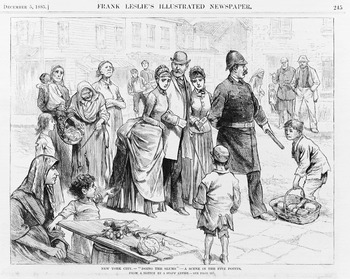
Despite the adamancy of the New York Times critic, the appeal of On the Bowery crossed class lines because of the growing fascination among the middle and upper classes during the Progressive Era with anything affiliated with the slums or slumming. As Keith Gandal demonstrates in The Virtues of the Vicious, “In the course of the 1890s, the slum emerged as a spectacle in the popular arts of representation,”Footnote 5 which ranged from sociological studies such as Jacob Riis's How the Other Half Lives (1890) to urban sketches such as Henry Cuyler Bunner's “The Bowery and Bohemia,” originally published in Scribner's Magazine (1894) and republished in Bunner's Jersey Street and Jersey Lane (1896); from novels such as William Dean Howells's A Hazard of New Fortunes (1889) to songs such as “The Bowery,” a feature in Charles H. Hoyt's play A Trip to Chinatown, which debuted in New York in 1891 and reached 657 performances. These works are merely a small sampling of the total number of cultural representations of slum life. They emerged from and contributed to what the New York Times predicted, in 1884, would become the latest “fashionable idiosyncrasy” among the upper classes of New York City: slumming, or the custom of touring working-class and immigrant neighborhoods in order to observe and at times indulge in the strangeness, exoticism, and vices that existed in slum life.Footnote 6 In truth, slumming had been practiced in New York City since the 1830s, primarily as a small-scale private enterprise documented in the engraving entitled “Doing the Slums” (Fig. 1). During the 1890s, however, slumming became a full-scale tourism industry with guidebooks and rubberneck wagons, organized tours with regular stops and even souvenirs, and, naturally, all kinds of publication for middle-class audiences eager to read about, see photographs of, and attend stereopticon lectures on slum life.Footnote 7 As literary and cultural historians have documented, this fascination with working-class and immigrant life were part of an emergent leisure economy predicated upon literal and literary slum tourism.Footnote 8
This engraving shows two women and one man accompanied by a police escort “doing the slums” in the Five Points district of New York City. Frank Leslie's Illustrated Newspaper, 5 December 1885. Prints and Photographs Division, Library of Congress.

On the Bowery was part of this outpouring of representations of slum life and likely was an attempt by its producers, Thomas H. Davis and William T. Keogh, to profit from this fascination with the slums. In fact, On the Bowery thematizes slumming as entertainment during the beginning of the second act (the first to take place in the Bowery), when an Irish drunk named Dismal Delaney makes the following proposal to Abner Higgins, who goes slumming in the play: “You buy the drinks and I'll show you the Bowery from Chatham Square to the Cooper Institute.”Footnote 9 Extending this proposal to the play's middle-class spectators, who might be defined as slumming audiences, On the Bowery moves from one slum destination to another: from Brodie's saloon at 114 Bowery (which, not incidentally, was a favorite stop on slum tours) to an East River pier to Chatham Square. While newspaper reviews disparaged the literary merits of On the Bowery, many of these reviews, which were published in mainstream newspapers with middle-class readerships, championed the representation of the sights/sites of the slums in ways that alerted audiences to the possibilities for entertainment inherent in tours such as the one Dismal Delaney proposed. Reviews of the touring production during the next three years took pains to reassure audiences that On the Bowery’s depiction of slum life did not include anything that might offend polite society, suggesting that the primary constituency for On the Bowery was (or would become) the middle class.Footnote 10 Certainly there was much about On the Bowery that entertained the Brodie audience, including the sensational scenes (though these could have been guilty pleasures for the Booth audience as well). Yet On the Bowery corresponded with what might be described as the sightseeing narrative that appealed to the middle and upper class's fascination with slum life, sightseeing that included but was not limited to Brodie. As Chad Heap demonstrates, the “staged spectaculars” of On the Bowery “permitted out-of-towners and timid New Yorkers alike to sample the raucous atmosphere of the Tenderloin and the Bowery without ever setting foot in one of the districts’ notorious resorts.”Footnote 11 In this respect, On the Bowery helped introduce a trend of theatregoing as a kind of slumming that would continue well into the twentieth century.Footnote 12
Naturally this conflation of theatregoing and slumming leads to McConachie's second question: What meanings did audiences construct from dramas such as On the Bowery? How did On the Bowery represent Bowery life? More notably, what ethics of engagement across class lines did On the Bowery prescribe for slumming audiences? Questions such as these are important because the 1890s were the decade when traditional definitions of the ethics of engagement with the working class (most of which emphasized moral salvation) were significantly revised. This was the decade when a “new slumming aesthetic” emerged that proposed that “there is nothing wrong with treating the poor as spectacles rather than with the traditional Christian brotherhood and moral severity.”Footnote 13 Absolved of any religious obligation toward the working classes or immigrants in New York, the slummer could enjoy the strangeness of slum life in ways that viewed the working class as morally abject and yet as facilitators of adventure and exoticism. These types of engagement are demonstrated in Ernest Ingersoll's A Week in New York (1891) and Bunner's “The Bowery and Bohemia.”Footnote 14 Yet the 1890s were also the beginning of progressive reformism in New York City, spearheaded by Riis's How the Other Half Lives, which endeavored to mobilize the consciousness of the middle class about the abysmal conditions of tenements. Lawrence Veiller's campaign for tenement reform, Lillian Wald's development of the Henry Street Settlement, and Edward T. Devine's expansion of the mission of the Charity Organization Society are all examples of Progressive Era reform in the city.Footnote 15 These types of reform contributed to what Alan Dawley describes as “the invention of a social conscience” that emphasized economic and social change.Footnote 16 During the 1890s, the strictly regimented engagements across class lines of the Victorian era were replaced with ambiguity, perplexity, and contradiction that extended into the next century. William Dean Howells demonstrates the new dynamic in Impressions and Experiences (1909), wherein he describes the ethical dilemmas people experienced while slumming: Should a person condemn a maimed tramp for his drunkenness or offer him charity? Should a person find entertainment in the spectacle of slum life or acknowledge the wretchedness of that life?Footnote 17
These compelling tensions between entertainment and ethics, representation and reception suggest why plays such as On the Bowery should be taken seriously in theatre history. As publications as different as George G. Foster's New York by Gas-Light (1849), Ingersoll's A Week in New York, and Howells's Impressions and Experiences confirm, theatre and slumming had the same constituencies of upper- and middle-class consumers, and slumming excursions often began after the theatres had closed for the night. Because of this, the ways that plays represented the Bowery and the ethics of engagement with the Bowery had implications beyond the theatre, especially with plays such as On the Bowery. It was perfectly reasonable, if not recommended, for audiences to observe Brodie's saloon at Haverly's Fourteenth Street Theatre and at 114 Bowery, all in the same night. More than mere escapism, then, the production of On the Bowery functioned as one site where the upper classes could negotiate the changing ethics of engagement across class lines during the 1890s. Put in terms of Ric Knowles's description of the cultural work theatrical productions can perform, On the Bowery offered the Booth audience the opportunity to instantiate and contest the social identities that were circulating through the discourses of slum tourism and progressive reform.Footnote 18 Consideration of three complementary aspects of the production—the typescript, the performative event, and the public discourse that surrounded the production—shows that On the Bowery can be located on the conservative end of the continuum Knowles describes from “radical intervention” to “radical containment.”Footnote 19 More specifically, On the Bowery promoted the new aesthetic of slumming whereby the oddity, misery, and vices of slum life were transmuted into spectacles of amusement and titillation for middle- and upper-class audiences. Significantly, these depictions vitiated discourses of progressive reform, whether by endorsing Victorian definitions of pauperism or by caricaturing progressive efforts at social outreach/reform. In many ways, On the Bowery temporarily suspended the New York Times reviewer's delineations of highbrow–lowbrow, upper–lower class, and literature–leisure so as to gratify the fascination with slumming in ways that ultimately reaffirmed these delineations.
“Observin’ Life on the Bowery”
On the Bowery begins in the uptown home of Henry Drayton, a wealthy businessman. The conflict in the play initially centers on the marriage of Alice Drayton, whom Mr. Drayton has pledged to his business partner, Thurlow Bleekman, even though he knows that she is in love with Jack Hobart, a newspaperman. What Mr. Drayton does not know is that Bleekman is completely broke and is marrying his daughter only for her inheritance and that he has seduced and abandoned a young woman named Blanche, who finds Bleekman in the Drayton home and insists that he fulfill his matrimonial obligations under the threat of blackmail. As Bleekman ponders how to extricate himself from this double bind, Stephens introduces the key event that will send the characters to the Bowery. Two burglars, Monty and Boggs, enter the Drayton home and open the safe in the study as Bleekman hides behind a curtain, listening to them talk about their plans to spend the loot at Steve Brodie's saloon on the Bowery. Conveniently, they drop some of the money when they hear someone approaching and make a hasty escape. Recognizing this opportunity, Bleekman decides to use the dropped cash to pay the thieves to kill Blanche by throwing her off the Brooklyn Bridge. Moreover, Bleekman implicates Jack in the robbery and forces him to flee through the window. Unbeknownst to Bleekman, Jack takes refuge with Brodie, whom he knows from a story he wrote years earlier, likely at the time Brodie executed his bridge jump. But Stephens is not finished with complications; he introduces Abner Higgins, Blanche's father, who comes to Drayton, his friend from school, in his search for his daughter. When Drayton can supply no information, Higgins decides to do what others were doing during the 1890s: take in the sights of the Bowery before returning to the country. Thus, Stephens establishes narratives of abduction/murder (Blanche), exoneration (Jack), and sightseeing (Higgins), all of which will intersect on the Bowery.
Notably, On the Bowery privileges sightseeing rather than sensational narratives. Several vignettes that take place outside Brodie's saloon provide glimpses of working-class life on the Bowery. A man selling hot tamales shouts his wares. Moments later, Dismal Delaney is thrown out of the saloon. Then an argument ensues between a “tough” named Danny Gibbs and a prostitute named Mame Clancy. As they enter, Mame complains, “What's the good of a goyl having steady company if she can't go out wit’ him and get treated? Say, go on, Danny, treat me, won't you?” (2.1.2). When Gibbs complains that he has no money, Mame accuses him of holding out on her so that he can be with Lizzie Lawrence and threatens to go and find Tom Hickey, who “luffs de ground I walk on.” At this, he “draws off to strike” her but is stopped by the arrival of Brodie, who declares, “Don't you know it's dead wrong to soak a lady?” (2.1.2). Certainly this star entrance was a defining moment of On the Bowery for slumming audiences, since the play was marketed around Brodie. With this entrance, Stephens introduced Brodie with the Bowery parlance that the New York Times critic found so entertainingFootnote 20 and a mock-heroic gesture as a champion of women that anticipates his courageous rescue of Blanche in acts 3 and 4. Yet this scene likely would have entertained slumming audiences even without Brodie's chivalry because of what it represented about working-class life, beginning with the acceptability of drinking as a social entertainment, a contrast to the temperance values of a significant part of middle- and upper-class society. Before he threatens to strike Mame, Gibbs's main offense is not that he is a drunk but that he lacks the funds or generosity to buy Mame a drink. Along with this social freedom comes the insinuation of sexual freedom among the working class, initially through the love triangles of Gibbs–Mame–Lizzie and Mame–Gibbs–Tom, which probably titillated slumming audiences. Mame's repeated entreaty that Gibbs “treat” her was a reference to the well-known practice among working-class women of exchanging sexual favors for presents or nights out.Footnote 21
The intimation of social/sexual freedoms among the working class in this scene is corroborated once On the Bowery moves inside the saloon. When the scene opens, Gibbs and Mame are dancing, and when she asks again that he “treat” her, he grumbles momentarily but orders “two workingman's friends,” which are “two huge schooners of beer” (2.2.1). When Gibbs says, “Drink hearty,” and she does so, the implication is that the drinks will function as more than social lubricants (2.2.1). In fact, the Gibbs–Mame interaction is representative of male–female interactions throughout the second act of On the Bowery. The entrance of a well-dressed man named Percey Waite coincides with a plea from Lizzie Lawrence that Brodie “stake me a drink” (2.2.6). As Brodie chastises her, Waite says, “Why, Mr. Brodie, we cawn't let the girl suffer from thirst, you know. You bring us drinks, and I'll pay for them.” Brodie wryly notes, “Charitable young man, this” (2.2.6). When Gibbs begins to ignore Mame and she asks Waite to “introduce me to a shell o’ lager,” his reply is full of innuendo: “What would you do if I should open wine?” (2.2.12). At the least, Waite is slumming, that is, “observin’ life on the Bowery,” as the saloon's patrons say (2.2.14). Yet Waite could also be participating in the sporting culture of men, whereby wealthy young men would enter the slums to indulge in the vices there, including gambling, dancing, drinking, and prostitution.Footnote 22
In On the Bowery, Brodie's saloon was the appropriate locale for illicit encounters, as is demonstrated by the entrance of Mag Driscoll, a prostitute, with a sailor. Although Brodie initially chides her for bringing her client into the bar, his reprimand has nothing to do with prostitution in the bar; he is vexed because of Mag's habit of bringing in drunks with no money. When he learns that the sailor has just been paid, he happily serves them, and later, when Mag observes that it has begun raining, Brodie says reassuringly, “Don't you know I've always got umbrellas for the working girls?” (2.2.13). Inside Brodie's saloon, then, slumming audiences could observe many of the social and sexual freedoms that presented a contrast to the world of middle- and upper-class propriety.
Despite the highbrow–lowbrow distinction the New York Times reviewer advanced, it is apparent that many among the Booth audience delighted in the play's representations of Bowery life precisely because they corresponded with what one hoped to see while slumming. Although the New York Herald was highly disapproving of the lack of literary merit in On the Bowery, it conceded that as “an aggregation of familiar incidents to set off a stage of view of Bowery life,” the play was “sufficiently elastic to admit of anything for Brodie,” who speaks “a line now and then” and poses “behind his counter,” to the appreciation of audiences.Footnote 23 In fact, the Herald emphasized that the “scenic equipment of the play is remarkably fine,” especially its representation of the Brooklyn Bridge, and conceded that the “famous Bowery saloon is realistic to a degree.” Many reviews referred to Brodie's saloon in commendatory language, whether at 114 Bowery or at Haverly's Fourteenth Street Theatre. The Sunday News Tribune described it as “one of the sights of New York” where slummers could hear “the Bowery dialect” and “acquaint themselves with proper types of Bowery life.”Footnote 24 The Philadelphia Inquirer maintained that Stephens composed his working-class characters from “actual life and personal observation,” a claim that simultaneously suggests the realism of working-class scenes in the play and Stephens's firsthand research into working-class life.Footnote 25 The Inquirer review was suggesting that attending On the Bowery corresponded closely with what one would find while slumming at 114 Bowery—a claim corroborated in the New York Sun, which contended that On the Bowery “puts upon the stage some of the types always to be found on that famous New York thoroughfare of the Bowery.”Footnote 26 An editorial in the Philadelphia Inquirer went further and claimed that Brodie was involved in the casting of supernumeraries from act 2, many of whom were real drunks from the Bowery, the grimier the better, though neither the presence of these drunks nor Brodie's role in casting them is corroborated elsewhere.Footnote 27 Again and again, reviews described On the Bowery as deriving from and reproducing the entertainment of slumming, right in the comfort of the theatre.
Yet the real appeal of On the Bowery might have been its representations of Bowery life that went beyond what many from the Booth audience would want to find while slumming, beginning with the perceived belligerence of working-class life. Introduced when Gibbs nearly strikes Mame, this belligerence simmers during much of act 2, scene 2, mostly with regard to Gibbs, who nearly comes to blows with Delaney after the drunk collides with him and Mame on the dance floor. He also threatens Higgins when he spills his beer and comes to blows with the slummer Waite after trading insults with him. Slumming literature was full of apprehensions about the possibility of encountering violence among the working classes. Examples include Hoyt's A Trip to Chinatown, performed just three years before On the Bowery opened, and its song “The Bowery,” sung by hypochondriac Welland Strong, which describes one of the “devil's own nights,” featuring a saloon brawl that leaves Strong with “a black eye,” a “battered nose,” and a determination to “never go there any more!”Footnote 28 Suggesting the influence of A Trip to Chinatown and likely Benjamin A. Baker's A Glance at New York, which depicts another brawl, Stephens allows the belligerence to erupt after Bleekman, who is looking for the burglars, enters and, upon observing Jack Hobart, sends for the police. Alerted by Mame of the imminent raid, Brodie tells Jack, “Me boy, I said dey shouldn't take you here, and I'm going to keep me word” (2.2.21). When Bleekman and the police arrive, Brodie declares that he is “Steve Brodie, King of the Bowery” and initiates a melee in which Brodie wrestles the billy clubs from two officers and Mame pins a policeman on a table. Although the stage directions are minimal, the positions of characters at the end of the melee suggest that it involved overturned tables and chairs, thrown bottles and glasses—quite the exciting and entertaining spectacle for slumming audiences in Haverly's Fourteenth Street Theatre. At the same time, this event was precisely the experience that slummers would not want to have firsthand, since it risked bruises and blackened eyes.
The propensity for treachery and swindling among the working classes is demonstrated through Higgins's misadventures on the Bowery. After recognizing Jack Hobart from Drayton's home and agreeing to help exonerate him from the charge of burglary, Higgins consents to help find the missing woman, not yet knowing that she is his daughter. Brodie pulls her from the East River and hides her in an old building on the pier, and Higgins misdirects the approaching police officers and leads them back through the city, losing them and his hat right before he arrives in Chatham Square, which was well known for “combative merchandising,” where con men would try all manner of tricks on rubes.Footnote 29 When Higgins remarks that he has lost his hat, he is grabbed by Isadore Michelowsky, a Jewish peddler, who speaks in an exaggerated accent and says, “I'll sell you a hat. I'll sell you anything you vant to buy, sheap” (4.2.1). Among the items of clothing Michelowsky is determined to sell are a pair of trousers with one leg shorter than the other, which he says were “made fer President Cleveland, but he had to go to Washington by de first train to settle de tariff question.” Although Higgins wants only a hat, Michelowsky offers the hat for free if Higgins will buy the suit. Higgins reasons, “It must be a good suit of clothes, if it was made for the President” and consents to try it (4.2.1). When he returns wearing the suit, he recognizes the problem: “Here, gol darn it, one leg o’ these pants is shorter ’n t'other.” At this, Michelowsky demands, “Vy don't you stand right?” and pushes one of Higgins's shoulders down and the other up. The scene closes on this instance of comedy (4.2.3). Once again, this scene was likely amusing for the slumming audiences in the theatre in large part because of the warnings about being swindled that appeared in slumming literature, including guidebooks such as A Week in New York, which recommended that slummers leave their wallets home.
Rather shrewdly, On the Bowery manipulated the tensions between proximity and mediation that were inherent in slumming. Slumming required some proximity to the elements of slum life that fascinated the middle and upper classes, from impoverishment and overcrowding to drinking and depravity. Yet this proximity conflicted with what Howells described as the “distance” from slum life that would render it “pleasingly effective,” whether that distance was from the stenches Howells describes in Impressions and Experiences or the perils Strong experiences in “The Bowery.”Footnote 30 Although slumming in the theatre involved sacrificing some of the authenticity and excitement of slumming in the streets, it did so in ways that ensured entertainment and safeguarded the welfare of slumming audiences. Thus, On the Bowery profited from being marketed, reviewed, and probably conceived as subsidizing the slumming experience and yet suggested that the production could substitute for that experience altogether. The New York Sun approvingly emphasized this in its summary of the play. Although most of the incidents transpire on the Bowery, the reviewer observes, “the principal characters don't live there. They have homes in the aristocratic quarters further up town. . . . But in order to help the author out in this stirring story . . . they kindly consented to go down on the Bowery and be jostled against the ‘bum,’ ‘the tough,’ ‘the jay,’ ‘the fakir,’ and all the rest of them.”Footnote 31 Two things are significant from this description: the fear of physical contact, of being bumped or shoved in the crowds of the Bowery, and the fear of being forced or tricked into something. Both of these elements are present in the experiences of Higgins, who blunders from one misadventure to another, many of which would be anything but entertaining if experienced firsthand.
“At Once New York's Terror and Her Shame”
Just as slumming did, On the Bowery and the reviews of the play performed some of the cultural work of charting the changing nature of engagement across class lines in Progressive Era New York City. The play was doing more than just representing Bowery life; it was prescribing what can be defined as modes of ethical engagement with Bowery life for the middle and upper classes. In the case of the Brodie character, these prescriptions for engagement are rather straightforward. When Brodie in the play recreates his audacious achievement by jumping off the Brooklyn Bridge, the stage directions indicate that a “man in the flies” yells “Hurrah!”—as if audiences would need much prompting! Reviews of the play demonstrated fascination with Brodie's less dramatic activities, such as singing “The Bowery Girl,” serving schooners of beer, and posing behind the bar. Yet this engagement was mediated in two ways: (1) it intersected with Brodie's self-promoted celebrity, which benefited him through his salary during the production and the increased traffic in his saloon; and (2) it applied only to Brodie. By contrast, On the Bowery's representations of the immigrant “types” from the Bowery, specifically the Jewish peddler and the Irish drunk, had much broader and more consequential ideological implications for the changing ethics of cross-class engagement during the 1890s.
In the play, when Isadore Michelowsky enters the Drayton household during the first act, two things become abundantly clear: (1) his appearance in the play is completely tangential to the plot and serves merely to represent a “type” from Bowery life; and (2) this type corresponds with the insulting, even anti-Semitic depictions of the Jewish immigrant that were typical during this decade. While trying to get Bridget, the Drayton's maid, to buy his shoddy merchandise, Michelowsky ends up examining objects that Mr. Drayton is willing to sell to peddlers: “Dere's a piano I ought to buy for thirty dollars and sell for a hundred and eighty. Vy does people keep such beautiful goods in der house lyin’ idle ven goods is only made for buyin’ and sellin’?” (1.4). Here, Michelowsky demonstrates commonly caricatured traits of the Jewish immigrant, including an exaggerated, comical dialect and a mercenary ethos, that were introduced for the entertainment of audiences. To make certain that audiences would laugh at Michelowsky, producers Keogh and Davis cast Frank Bush to play the role. Bush was renowned during the 1880s and 1890s for his vaudeville portrayals of a Jewish figure clad in a rusty plug hat, a black coat, shabby pants, a long beard running to a point, and large glasses and his performance of a ridiculous song and dance, much to the delight of audiences.Footnote 32 Bush's vaudeville routine likely ghosted his performance in On the Bowery, particularly during scenes like the following one, which takes place outside Brodie's saloon. As Michelowsky stands on the corner, trying to decide how to sell eleven shoelaces, Monty and Boggs enter from behind and lightheartedly demand, “Your money or your life!” Without hesitation, Michelowsky declares, “Moses and Aaron. Take my life but spare my money!” before being cuffed across the head and fleeing from the stage, shouting “Poleetz, poleetz!” (2.1.6). This scene, which has nothing to do with the rest of On the Bowery, and others like it (along with the act 4 scene with Higgins) invited mockery of the Jewish peddler in ways that correspond with the caricaturing of the Jewish immigrant that Israel Zangwill would soon attempt to remedy with his play Children of the Ghetto (1899). Footnote 33
The Irish immigrant fares little better in On the Bowery. Although Delaney provides an opportunity for Higgins to slum when he offers to take him through the Bowery, he spends the majority of the play caricaturing the Irish drunk by trying one shenanigan after another to get another drink. As On the Bowery opens outside 114 Bowery, Delaney is thrown out of Brodie's saloon, and when he gathers his wits, he observes, “That's the third time I've been fired out of that saloon to-day.” Then he is squirted with seltzer from inside the saloon (2.1.1). This visual gag likely had something to do with the actor cast as Delaney, Lew Bloom, another vaudevillian, who was well known for having originated the “the tramp,” a clownish character who engaged in all manner of slapstick and pratfalls.Footnote 34 As with Bush, Bloom's vaudevillian acting was integrated into On the Bowery in ways that did not advance the plot but offered amusement for slumming audiences. Later, Delaney enters with a fully dressed mannequin, whom he introduces as the “cashier of the Garfield bank” with whom he has been “buggy-riding up to Central Park” (2.2.10). Somehow, Delaney's deception is convincing enough to get Brodie to pour drinks for everyone in the bar, which his “friend'll settle,” so that Delaney can down his drink and escape before Higgins discovers the subterfuge. “By gosh, it's a wire man!” Delaney exclaims (2.2.10). Later still, Delaney sticks his head in the doorway and announces, “Fire at Simpson's hock-shop,” an announcement that prompts everyone to run outside for the spectacle. Delaney then enters and drains all the mugs on the bar (2.2.17).What comes next is important for the ways that slumming audiences were encouraged to respond to Delaney's shenanigans. Because he is determined to finish the last drink, Delaney gets caught by Brodie and the others, who shampoo his “head with whisky” and squirt “seltzer bottles on [his] shoes” as punishment by humiliation, leaving Delaney to clean “himself with bar towels” and audiences with the freedom (if not the obligation) to laugh at his ridiculousness (2.2.17).
In these representations of Michelowsky and Delaney, On the Bowery conflates the anti-Semitism and nativism that Eastern European Jews and Irish immigrants confronted during these decades in order to lampoon the working-class, immigrant populations of the Bowery. Together, they demonstrate stereotypes about the perfidy of immigrants. Michelowsky often describes ways of manipulating his customers or simply attempts to exploit them (the eleven shoelaces, the uneven trousers), and Delaney constantly schemes to alleviate the “dry feeling” (4.2.2) he gets when he goes for a while without a drink (begging on the street, the wire man). Significantly, the nature of Michelowsky's and Delaney's scheming corresponds with caricatures of ethnic types: the money-hungry Jewish peddler who will do anything to make a profit and the Irish drunk who embraces any kind of humiliation if it will lead to a drink. However, the menace represented in On the Bowery is balanced by the absurdity of these characters. When Michelowsky responds to the jesting demand from Monty and Boggs that he sacrifice his life to save his money, he demonstrates significantly skewed values from the perspective of mainstream society, values that presented a comical corollary to the condescending and in places contemptuous arguments against Jewish immigrants in How the Other Half Lives and A Week in New York.Footnote 35 When Delaney finds himself squirted with seltzer and shampooed with whiskey because he has to have another drink, he demonstrates that he is at the mercy of “demon rum” in ways that corroborate stereotypes about the Irish immigrant population. Combined with scenes from Brodie's saloon, Michelowsky and Delaney represent Bowery life as distinctly different from the world of the Booth audience, a difference that would have been entertaining even as it validated ideological delineations.
On the Bowery, then, legitimated a distinctly conservative ethics of engagement across class and ethnic lines during this decade. In this model, the wealthy saw the working-class immigrant populations from the Bowery and elsewhere as ethical counterpoints to the rest of society, and encounters with this population functioned as the opportunity to “contrast themselves with the depravity and dilapidation” of working-class life.Footnote 36 Although On the Bowery likely prompted some titillation, the primary mode of engagement was laughter at the expense of the working-class immigrant population from the Bowery: laughter over their imprudence, their self-destructiveness, and their correspondence to caricatures of ethnic types. This laughter functioned to affirm the privilege of the wealthy, both the material privilege that divides the classes (and makes slumming and theatregoing possible) and the ideological privilege of determining such divisions. This cross-class engagement had a complex relationship with the Victorian discourses of poverty that preceded it. On the Bowery drew upon and affirmed the centrality of individual or moral theories of poverty, such as social Darwinism, which defined poverty as a pathological rather than a socioeconomic problem. There is little in On the Bowery to suggest that those such as Delaney could be rescued from “demon rum” or the poverty that forced him to beg in the streets. Instead, Delaney is clearly held responsible for his own wretchedness through the humiliating treatment he brings on himself. The play's privileging of laughter negates the Victorian assumption that the working poor could achieve spiritual salvation and thus absolves slumming audiences of any moral obligation to save sinners from their vices, much like the new slumming aesthetic Gandal describes.Footnote 37 In fact, On the Bowery represented the misery, crime, and vices of Bowery life as spectacles of amusement, complete with vaudevillian tropes that invited anything but concern for the spiritual well-being of individuals such as Michelowsky, Delaney, and Gibbs.
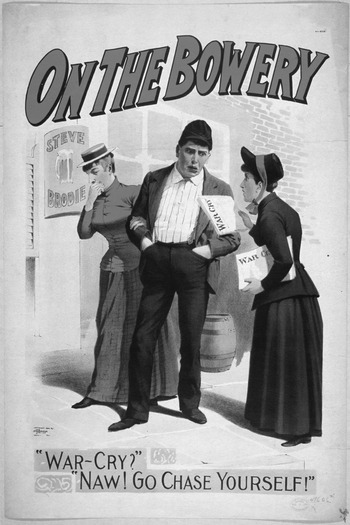
This type of cross-class engagement contrasted with the emerging ethic of progressive reform during this decade. Proponents of the new ethic included participants in the settlement house movement, which worked to help immigrants, and members of the Salvation Army, which attempted to assist the poor both materially and spiritually. In fact, On the Bowery undermined such reformism by lampooning the Salvation Army during two scenes set outside Brodie's saloon. As Gibbs and Mame approach the saloon, a Salvationist offers them the War Cry, the Salvation Army's newspaper, to the annoyance of Gibbs, who grumbles, “Aw, go chase yourself”Footnote 38 (2.1.1). Even though this scene lasted only a moment, it was depicted on posters for the play, which show Mame and Gibbs occupying the center, with the temptation of Brodie's saloon on one side and the Salvationist on the other (Fig. 2). Not only does the saloon win this battle for the soul of the working class, but the poster also suggests that the battle was always a lost cause for the Salvation Army. Gibbs responds with an oafish snarl, and Mame is turned away and laughing. In the play, Delaney appears moments later and makes it clear that audiences should be laughing at such social outreach too. When the Salvationist notices Delaney, she says harshly, “Don't you know whisky is your worst enemy?” (2.1.3). “Well, doesn't the Bible tell us to love our enemy?” he replies (2.1.4). Determined to persuade Delaney of the perils of alcohol, the Salvationist asks, “Don't you know that whisky destroyed two-thirds of the population of the country? Drink water, it's healthful and harmless.” Once again, Delaney is ready with a riposte: “Water is harmless? . . . I guess you don't remember the flood” (2.1.4). A key element of this scene is the vaudevillian rhythm of the argument, with the Salvationist playing the straight man to Delaney's clowning. Importantly, their argument concludes with Delaney requesting a “few cents toward a night's lodging.” When the Salvationist asks if he will “buy whisky,” he swears, “I'll never buy another drop of whisky as long as I live”—then adds, after the Salvationist leaves, “I'll buy gin” and enters the saloon (2.1.4). The implication of these scenes is that the working class is beyond philanthropy, and anyone attempting to intervene on their behalf is hopelessly naive and deserves ridicule.
Gibbs and Mame dismiss the Salvationist's War Cry outside Brodie's Saloon. Prints and Photographs Division, Library of Congress.

Ultimately, On the Bowery sends the message that the working-class immigrants of the Bowery could be enjoyed as spectacles of entertainment but only as corroborations of their difference from the wealthy. Reviews of On the Bowery did not include any mention of progressive reform or any kind of philanthropic obligation toward the residents of slums—even though such progressivism had been mentioned in the 1884 New York Times article that predicted the emergence of the slumming industry and was increasingly part of public discourses about immigration and poverty in New York City during the 1890s. Instead, the reviews fall into one of two categories. The great majority delighted in the many sights/sites from Bowery life that were represented in the play, including the locations and the “types” fundamental to slumming. A second, much smaller, group of reviews was critical of Bowery life. One example is the commentary published in the Sunday News Tribune during the run of On the Bowery. “On the Bowery, and in and around that famous street, is an atrocity of dirt, filth, and squalor almost incomprehensible to one who has never personally there wandered,” the Tribune maintained. “The Bowery stands synonym for that frightfully congested district of the East Side, at once New York's terror and her shame,” a place full of “cruel Shylockian pawnbrokers,” mercenary “Italian padrones” with their “child-slaves,” and “all the tramps in the United States” who make a “pilgrimage to the Bowery.”Footnote 39 Although this commentary contrasts with the enthusiasm for Bowery life that On the Bowery promoted, its conclusions about the Bowery itself are consistent with the representations in the play. On the Bowery legitimized derision of two of the three types described in the Tribune, the Jewish peddler and the Irish drunk. Moreover, On the Bowery suggested that slumming audiences should be apprehensive about going on the Bowery even while representing the criminals, con men, drunks, and prostitutes of this world as entertaining.
“Going to the Theatres . . . Is Like Going Slumming”
One year after the production of On the Bowery at Haverly's Fourteenth Street Theatre, Octavus Cohen published an article entitled “Drama for the Masses.” Describing Stephens as having written On the Bowery only as a way of financing his ambitions of writing serious plays, Cohen reaffirmed the highbrow–lowbrow, upper–lower class, literature–leisure delineations that had been evident in the New York Times review. Yet these supposed dichotomies were not always in operation in real life. Stephens himself told a story that illustrates this point. During the Chicago production of On the Bowery, a theatre reviewer told him that the play was “a rattling good show” but then proceeded to “‘roast’ it from the lofty point of view that it was his custom to take in his newspaper.” Moreover, the attempts of Cohen and Stephens to make clear demarcations between “hurrah plays for the masses” and “ambitious plays for the classes” one year after the premiere of On the Bowery demonstrates that these delineations were highly unstable.Footnote 40 There would have been little reason to advance them unless they were being threatened by the fact that many among the Booth audience, like the Chicago critic, enjoyed these “hurrah plays” precisely because they included the kind of lowbrow, lower-class leisure entertainments that the Brodie audiences enjoyed. In fact, On the Bowery’s commercial achievement prompted a flurry of knockoffs during the following years, including Edmund E. Price's In the Tenderloin (1894), Will R. Wilson's The Police Inspector (1895), Scott Marble's The Sidewalks of New York (1895), Joseph Jarrow's The Queen of Chinatown (1899), and Theodore Kremer's The Bowery after Dark (1899), which included many of the sights/sites of the slums. Around the turn of the century, plays were produced about Italian immigrants, the settlement house movement, the tenement house question, and the Salvation Army—all of which were produced in Broadway theatres for the Booth audience. By 1913, plays about slum life had become so common in New York City that Evening World drama critic Charles Darnton complained that “going to the theatres these nights is like going slumming.”Footnote 41
During the two decades between On the Bowery and the so-called vice plays that prompted Darnton's complaint, nearly forty plays about slum life were performed in New York City and elsewhere. Many became box office successes and featured star performers such as Minnie Maddern Fiske, Wilton Lackaye, and Olga Nethersole. Others made references to contemporary concerns such as tenement house neglect and the reclamation of fallen women; and a few became embroiled in high-profile obscenity cases because they were about topics such as prostitution, white slavery, and brothels.Footnote 42 Unfortunately, little has been written about these plays/productions in theatre history, perhaps because theatre historians have accepted the argument that plays such as On the Bowery are not worth taking seriously, particularly since they come right before what is usually defined as the beginning of modern US theatre with plays by Eugene O'Neill, companies such as the Provincetown Players, and the Little Theatre movement.Footnote 43 The disregard of these productions is troubling because a significant amount of material about some of the productions and slumming is available in cultural histories by Chad Heap, Benedict Giamo, Luc Sante, and others. The interdisciplinary study of literature and slumming is well established in the work of Giamo, Keith Gandal, Gavin Jones, and others but remains largely undeveloped in theatre studies, with the significant exception of Katie N. Johnson's exploration of brothel dramas, Sisters in Sin. More significantly, this disregard is troubling given that plays such as On the Bowery were immensely popular with the Booth audience because they provided the opportunity to determine the delineations of highbrow–lowbrow, upper–lower class, and literature–leisure during the 1890s and thereafter. They were places where middle-class slumming audiences could temporarily suspend such delineations to satisfy a fascination with slum life and either confirm or contest these delineations as part of the charting of epistemological and ideological boundaries in New York City during the Progressive Era. It is possible, then, to consider these theatrical productions as sites for the negotiation of wealth and poverty, privilege and obligation during the transition from Victorianism to modernity.