Implications
This study showed that dairy cows respond to protein supplementation even when the basal diet contains red clover silage and has relatively high CP concentration. However, the production decreased only 8% when a high level of protein supplementation (on average 2.9 kg dry matter per day) was compared with the control diet without protein supplementation showing that dairy production can be sustained at a high level even without external protein supplements. This study confirmed that rapeseed-based protein feeds are more suitable protein supplements for grass/red clover silage- and cereal-based diets than soya bean-based feeds.
Introduction
Dietary protein supplementation is an effective method to increase the supply of nutrients, which limit milk synthesis by dairy cows. On top of the feed-derived effects of increasing the flow of undegradable feed protein and altering the composition of undegradable feed amino acids (AA) available for absorption in the small intestine (Korhonen et al., Reference Korhonen, Vanhatalo, Varvikko and Huhtanen2002), the effects are at least partly mediated through increased ruminal microbial synthesis (Hoover, Reference Hoover1986), increased feed intake (Huhtanen et al., Reference Huhtanen, Rinne and Nousiainen2008a) and improved diet digestibility (Nousiainen et al., Reference Nousiainen, Huhtanen and Rinne2009). Protein supplements are, however, expensive and their use decreases the nitrogen use efficiency (NUE), which increases the environmental load of dairy production. Although NUE linearly decreases with increasing amounts of CP intake (Huhtanen et al., Reference Huhtanen, Nousiainen, Rinne, Kytölä and Khalili2008b), high-quality plant protein supplements have often produced linear increases in milk production responses up to relatively high levels of inclusion (Rinne et al., Reference Rinne, Jaakkola, Varvikko and Huhtanen1999; Shingfield et al., Reference Shingfield, Vanhatalo and Huhtanen2003), although curvilinear responses to protein supplementation have also been observed (Olmos Colmenero and Broderick, Reference Olmos Colmenero and Broderick2006).
Soya bean (Glycine max)-based feeds are widely used as protein supplements for dairy cows, but rapeseed (Brassica napus subsp. oleifera, Brassica rapa subsp. oleifera) provides an alternative source of high-quality plant protein for ruminant diets. Several studies have indicated that rapeseed-based feeds produce comparable or even higher responses in dairy cows than soya bean-based feeds (Shingfield et al., Reference Shingfield, Vanhatalo and Huhtanen2003; Brito and Broderick, Reference Brito and Broderick2007; Christen et al., Reference Christen, Schingoethe, Kalscheur, Hippen, Karges and Gibson2010). A meta-analysis by Huhtanen et al. (Reference Huhtanen, Hetta and Swensson2011) revealed that the milk protein production responses were greater when rapeseed meal was compared with soya bean meal (136 v. 98 g milk protein per kg increase in CP intake).
Ruminants depend on AA absorbed from the small intestine as substrates for milk synthesis. Protein supplements may influence the profile of absorbed AA (Korhonen et al., Reference Korhonen, Vanhatalo, Varvikko and Huhtanen2002) and thus have a role in complementing the AA supply from the basal diet and from microbial protein synthesized in the rumen. Rapeseed-based supplements increased the duodenal methionine and lysine supply compared with the control feeding, whereas soya bean-based feeds had no effect (Brito et al., Reference Brito, Broderick and Reynal2007; Robinson, Reference Robinson2010). Vanhatalo et al. (Reference Vanhatalo, Kuoppala, Ahvenjärvi and Rinne2009a) reported that substituting grass silage with red clover silage seemed to limit methionine supply to dairy cows. Thus, red clover-based diets may be even more susceptible to be limited in methionine supply if soya bean-based feeds are used as protein supplements.
The objective of the current experiment was to evaluate the effects of protein source (rapeseed v. soya bean) and level of supplementation on the amount of nutrients – particularly nitrogenous compounds – available to the dairy cow. The diets were formulated according to principles specific to organic milk production that promote predominant use of forages. Therefore, the level of concentrate supplementation was moderate (0.36 on a dry matter (DM) basis) and the silage used contained red clover. It was hypothesized that rapeseed-based protein supplementation complements the AA supply from the basal diet comprising cereals and grass-red clover silage better than soya bean-based protein supplementation.
Material and methods
Animals and diets
The effects of increasing dietary CP concentration using rapeseed expeller (RSE) or soya bean expeller (SBE) produced by Mildola Ltd (Kirkkonummi, Finland) and including a heat treatment were studied using five multiparous Nordic Red cows fitted with rumen cannulas (Bar Diamond Inc., Parma, ID, USA). The cows weighed 650 kg (s.d. 50.7) and were on average 51 (s.d. 12.6) days in milk at the beginning of the experiment. The experimental design was an incomplete Latin square (five diets and four 21-day periods). The cows were kept in tie stalls, fed four times daily at 0600, 0900, 1800 and 2000 h, and milked at 0700 and 1700 h.
The basal diet consisted of silage supplemented with a concentrate comprising a pelleted mixture of barley and oats (1:1). The silage was a 1:1 mixture on a DM basis of a pure red clover (Trifolium pratense) silage and a silage made from a mixed timothy (Phleum pratense) and meadow fescue (Festuca pratensis) sward. Both silages were made from first cut in 2004 at Jokioinen, Finland the harvesting dates being 22 July for the red clover and 15 June for the grass. The silages were wilted slightly (DM concentrations 198 and 262 g/kg for red clover and grass, respectively), precision-chopped and ensiled using a formic acid-based additive (AIV2 Plus; Kemira Oyj., Helsinki, Finland) at rates of 6.5 and 5.0 l/t for red clover and grass, respectively.
Silage was fed ad libitum during the first 15 days of each 21-day period allowing proportionally 0.05 to 0.10 for refusals. During the sampling period from days 16 to 21, the intake was restricted to 0.95 of the ad libitum intake to minimize daily fluctuations in feed intake. The five dietary treatments were the basal concentrate (7.9 kg DM/day; Control), which was gradually replaced with RSE or SBE at low or high levels of inclusion. Daily allowances of RSE were 1.8 and 3.6 kg DM/day and those of SBE 1.3 and 2.6 kg DM/day, respectively, to obtain isonitrogenous levels of supplementation. All diets were supplemented with 2 g/day of a trace mineral and vitamin premix (Cu 13500, Zn 73000, Mn 15000, Co 1250, Se 1000, I 1950 and vitamin E 19 000 g/kg, vitamin D3 1 500 000 and vitamin A 7 500 000 IU/kg, Kvarnbyfoder Ab, Staffanstorp, Sweden) and 100 g/day of NaCl. No other mineral supplementation was given.
The current animal experiment was managed under the guidance of the local Animal Use and Care committee according to the Finnish Animal Welfare Act (247/96), the Order of using vertebrate animals for scientific purposes (1076/85), and the European convention for the protection of vertebrate animals for experimental and other scientific purposes (Appendices A and B).
Experimental procedures and analyses
Feed intake and milk yield are reported from days 16 to 21 of each period. Representative feed samples were collected daily from each period and bulked for subsequent analyses of DM, ash, CP, NDF and indigestible NDF (iNDF). Silage samples were also analysed for pH, ammonia N and volatile fatty acids (VFA). Feed samples were analysed using standard procedures described by Ahvenjärvi et al. (Reference Ahvenjärvi, Vanhatalo and Huhtanen2002). To determine the iNDF concentration, feed samples were incubated for 12 days in the rumen of two dairy cows using bags made of polyethylene terephthalate with a pore size of 17 µm. Potentially digestible NDF (pdNDF) was determined as ‘NDF−iNDF’. Milk samples were taken on four consecutive milkings during days 18 to 20 and analysed for fat, protein and lactose using an infra-red analyser (Milko-Scan 605; Foss Electric, Hillerød, Denmark) and samples for urea analysis were taken on two consecutive milkings. Milk urea concentration was calculated from the difference in concentration of ammonia N between unhydrolysed samples and samples hydrolysed with urease, and ammonia N was analysed according to McCullough (Reference McCullough1967).
Rumen fluid was sampled on day 14 of each period by taking samples through the rumen fistula at 0600 h before morning feeding and seven times thereafter at 1.5 h intervals to cover the daytime feeding cycle. The pH was analysed immediately, but for ammonia N and VFA analyses, the samples were frozen at −20°C (for details of sample preparation, see Ahvenjärvi et al., (Reference Ahvenjärvi, Vanhatalo, Huhtanen and Varvikko1999)). After thawing, the samples from an individual cow per period were combined for the VFA analyses, but the ammonia N concentration was measured separately for each time point.
To determine digesta flow entering the omasal canal, a triple-marker system was used as previously described for the current experiment (Tuori et al., Reference Tuori, Rinne, Vanhatalo and Huhtanen2006). CrEDTA, Yb-acetate and iNDF were used as markers for digesta liquid, small particle and large particle phases, respectively. The digesta samples were obtained from the omasal canal three times daily during days 18 to 21 of each period to cover each hour of the 12 h daytime feeding cycle. The samples were frozen immediately after sampling, and kept at −20°C. After thawing, the samples were divided into liquid, small particle and large particle phases as described by Ahvenjärvi et al. (Reference Ahvenjärvi, Vanhatalo, Huhtanen and Varvikko2000) except for AA analyses, which were described by Korhonen et al. (Reference Korhonen, Vanhatalo, Varvikko and Huhtanen2000).
To determine the flow of microbial N from the rumen, 17.5 g/day of ammonium sulphate (Isotec Inc., Miamisburg, OH, USA) with 10% enrichment of 15N (371 mg of 15N/day) was administered into the rumen by continuous infusion to enrich rumen microbial N with 15N. Infusion of ammonium sulphate dissolved in the infusion solution of Yb-acetate started 48 h before the first sampling. Before the beginning of the marker infusion, samples of rumen contents from each cow were taken on day 11 during the first period to determine the background abundance of 15N. Samples for bacterial separation (500 ml) were taken from reticular digesta at 1500, 1200, 0900 and 0600 h on days 18, 19, 20 and 21, respectively. Immediately after collection, samples were centrifuged and the supernatant was decanted through two layers of cheesecloth. Differential centrifugation of these samples is described in detail by Ahvenjärvi et al. (Reference Ahvenjärvi, Vanhatalo, Huhtanen and Varvikko2000). Measurement of 15N enrichment in the bacterial pellet and omasal canal samples was similar to that reported by Ahvenjärvi et al. (Reference Ahvenjärvi, Vanhatalo and Huhtanen2002).
Blood samples were taken using evacuated blood collection tubes (Vacuette, Greiner Labortechnic GmbH, Krensmunster, Austria) containing Li-EDTA (for AA, glucose, non-esterified fatty acid (NEFA), and β-OH-butyric acid (BHBA) analyses) and Li-heparin (for acetic acid analysis) from one coccygeal vessel considered to be arterial blood at 0600, 0900 and 1200 h on d 21 of each period. Tubes were chilled in an ice bath and centrifuged (at 872×g and 4°C for 15 min) immediately after sampling. For analyses, the plasma samples were pooled across sampling times to provide a single sample per cow per period. Details of analysis of the plasma samples have been described by Korhonen et al. (Reference Korhonen, Vanhatalo, Varvikko and Huhtanen2000).
Diet digestibility was determined by total faecal collection on days 18 to 21 of each period. Urine was separated from faeces using a light harness attached around the vulva of each cow with an adhesive. Urine was drained into a container using a flexible tube. Urine pH was kept below 3 with 10 N H2SO4.
AA from the feeds were analysed according to European Commission (1998) and performed with Biochrom 20 amino acid analyser (Biochrom Ltd, Cambridge, UK) using a sodium buffer system. For the plasma samples, deproteinization before AA analysis was made with 12% 5-sulphosalicylic acid (final concentration 4%) and after centrifugation the samples were filtered through a 0.2 μm filter. Free AA were then determined with a Biochrom 20 AA analyser using a lithium buffer system.
Calculations and statistical analysis
The metabolizable energy (ME) concentration of the silages was calculated as D-value (g/kg DM)×0.016, and the D-value was determined in vitro using a pepsin–cellulase-based method (Huhtanen et al., Reference Huhtanen, Nousiainen and Rinne2006). The ME concentration of the concentrates was calculated from digestible nutrients using digestibility coefficients reported by Luke (2015). The concentrations of metabolizable protein (MP) and protein balance in the rumen (PBV) were calculated according to Luke (2015).
The flow of nutrients to the omasal canal was calculated as DM flow (kg/day)×nutrient concentration (g/kg DM) in omasal canal digesta. Apparent degradability in the rumen was calculated as a difference between nutrient intake and omasal canal flow, and that in the intestines as a difference between omasal canal flow and faecal output. Non-ammonia N flow entering the omasal canal was fractionated into microbial and non-microbial N based on 15N-atom% excess in the rumen microbes and reconstituted omasal canal digesta.
The statistical analyses were performed using the GLM procedure of the SAS software for Windows version 9.1.3 (SAS Institute Inc., Cary, NC, USA) using the following model:
 $$Y_{{ijk}} =\mu {\plus}A_{i} {\plus}P_{j} {\plus}D_{k} {\plus}e_{{ijk}} $$
where A, P and D are the animal, period and diet effects. The effect of experimental diets on variation in rumen pH and ammonia N was assessed using the MIXED procedure with a model for repeated measures, but as no diet×sampling time interaction was found, the mean of all sampling times for rumen pH and ammonia N are presented. Sums of squares of the diet effects were further divided into the following orthogonal comparisons: RSE v. SBE, linear and quadratic effects of protein supplementation and the interaction between the protein source and level of supplementation. The comparisons not reaching statistical significance have been omitted from the tables. The data presented in the tables are based on LS means. Probability values <0.05 were considered statistically significant and <0.10 to indicate a tendency for significance. Regression analyses were conducted using SAS proc REG.
Results
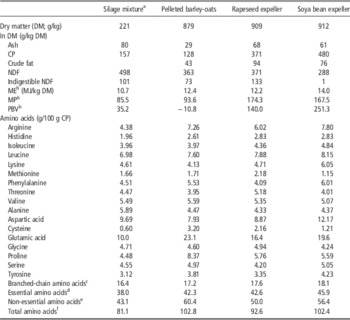
The experimental feeds had a typical composition for the types of feeds (Table 1). The silage used was prepared from a late cut red clover and early cut grass silage resulting in a good quality mixture in terms of energy and protein values, and with good fermentation quality. SBE had a higher CP but lower crude fat, NDF and especially iNDF concentration than RSE. Subsequently, the calculated ME concentration of SBE was higher than that of RSE, but the calculated MP concentrations were similar. The proportion of amino N in total N for the silage, basal concentrate, RSE and SBE were 0.84, 1.02, 0.93 and 1.02, respectively. RSE contained more methionine and less lysine than SBE.
Composition of the experimental feeds

a Silage fermentation quality: pH 3.95, ammonia N (g/kg total N) 52.9, lactic, acetic and butyric acids, ethanol and water soluble carbohydrates 29.3, 14.4, 0.27, 2.1 and 108 g/kg DM. Silage in vitro (pepsin cellulase; Huhtanen et al. Reference Huhtanen, Nousiainen and Rinne2006) organic matter digestibility 0.726.
b Metabolizable energy (ME), metabolizable protein (MP) and protein balance in the rumen (PBV) calculated according to Luke (2015).
c Valine, isoleucine and leucine.
d Arginine, histidine, isoleucine, leucine, lysine, methionine, phenylalanine, threonine and valine.
e Alanine, aspartic acid, cysteine, glutamic acid, glycine, proline, serine and tyrosine.
f Essential and non-essential amino acids.
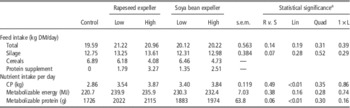
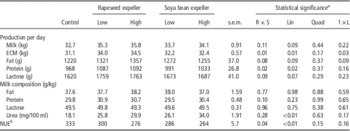
Protein supplementation did not affect silage nor total DM intake, but silage DM intake tended to be higher (P=0.07) for RSE-based diets compared with SBE diets (Table 2). Protein supplementation significantly increased (P<0.01) CP and MP intake and PBV, but did not affect ME intake. The cows responded to increased protein supplementation by increasing energy-corrected milk (ECM) and milk protein production linearly (P<0.01) and the effect was greater when RSE rather than SBE was fed (P<0.01; Table 3). For milk and milk fat production, the changes tended to be similar. Protein supplementation had no significant effects on milk composition except for milk urea concentration, which increased linearly (P<0.001). In spite of increased milk protein output, increasing protein supplementation significantly decreased NUE (P<0.01) and it was lower (P<0.05) when SBE rather than RSE was used.
The effects of the source and amount of protein supplementation on feed and nutrient intake of dairy cows fed red clover/grass silage-based diets

a P-values, contrasts: R v. S=rapeseed meal v. soya bean meal supplementation, Lin=linear effect of the amount of protein supplementation, Quad=quadratic effect of the amount of protein supplementation, 1×L=interaction between the protein source and the linear effect of the amount of protein supplementation.
The effects of the source and amount of protein supplementation on milk production of dairy cows fed red clover/grass silage-based diets

ECM=energy-corrected milk; NUE=N use efficiency.
a Contrasts: R v S=rapeseed meal v. soya bean meal supplementation, Lin=linear effect of the amount of protein supplementation, Quad=Quadratic effect of the amount of protein supplementation, 1×L=interaction between the protein source and the linear effect of the amount of protein supplementation.
b NUE (g/kg)=N excreted in milk (g)/feed N intake (kg).
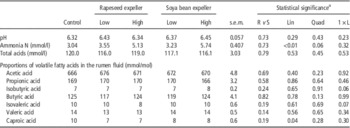
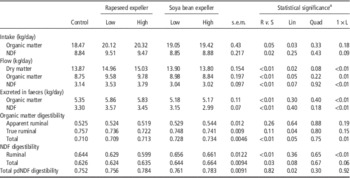
The effects of protein supplementation on rumen fermentation were minor except for linearly increasing rumen ammonia N concentration (P<0.01; Table 4). Organic matter (OM) intake and flow to the omasal canal increased with increasing protein supplementation (P<0.05; Table 5). SBE containing diets had higher ruminal and total NDF as well as apparent total OM digestibilities than RSE containing diets (P<0.05) but for apparent and true ruminal OM digestibilities and for pdNDF the differences were not significant. Protein supplementation increased linearly OM and pdNDF digestibility (P<0.05). For OM digestibility, the protein source×level of supplementation interaction was significant (P<0.01) as the increase was more evident for SBE diets.
The effects of the source and amount of protein supplementation on rumen fermentation of dairy cows fed red clover/grass silage-based diets

a Contrasts: R v. S=rapeseed meal v. soya bean meal supplementation; Lin=linear effect of the amount of protein supplementation; Quad=quadratic effect of the amount of protein supplementation; 1×L=interaction between the protein source and the linear effect of the amount of protein supplementation.
The effects of the source and amount of protein supplementation on organic matter, NDF and potentially digestible NDF (pdNDF) digestion of dairy cows fed red clover/grass silage-based diets

a Contrasts: R v. S=rapeseed meal v. soya bean meal supplementation; Lin=linear effect of the amount of protein supplementation; Quad=quadratic effect of the amount of protein supplementation; 1×L=intercation between the protein source and the linear effect of the amount of protein supplementation.
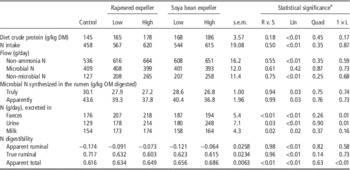
There were no differences between the protein supplements in N intake or the flow of different N fractions into the omasal canal, but increasing the protein supplementation linearly increased (P<0.01) total N and non-microbial N flow to the omasal canal (Table 6) simultaneously with decreased (P<0.05) microbial N synthesized per kg OM digested in the rumen. RSE supplementation resulted in higher (P<0.05) N excretion in both faeces and milk, but lower N excretion in urine. N excretion via all routes increased (P<0.05) with increasing protein supplementation. SBE-based diets had a higher (P<0.01) apparent total N digestibility than RSE-based diets, but no differences were found in apparent or true ruminal digestibility.
The effects of the source and amount of protein supplementation on N digestion of dairy cows fed red clover/grass silage-based diets

OM=organic matter.
a Contrasts: R v. S=rapeseed meal v. soya bean meal supplementation; Lin=linear effect of the amount of protein supplementation; Quad=quadratic effect of the amount of protein supplementation; 1×L=intercation between the protein source and the linear effect of the amount of protein supplementation.
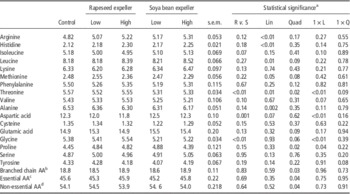
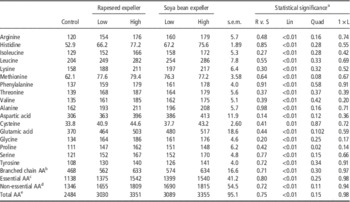
There were some differences in the AA profile of the omasal canal digesta between the treatments (Table 7). Concentrations of threonine and glycine were higher while that of aspartic acid was lower (P<0.01) for RSE diets compared with SBE diets. Protein supplementation linearly increased (P<0.01) concentrations of arginine, histidine and leucine in omasal canal digesta, while those of methionine, threonine and alanine decreased (P<0.05). Table 8 shows that there were no differences in the AA flows to the omasal canal between the protein supplements, but all flows increased (P<0.01) with increasing level of protein supplementation and for lysine the effect tended to be quadratic (P<0.1).
The effects of the source and amount of protein supplementation on AA profile (g/100 g AA) in omasal digesta of dairy cows fed red clover/grass silage-based diets

AA=amiono acids.
a Contrasts: R v. S=rapeseed meal v. soya bean meal supplementation; Lin=linear effect of the amount of protein supplementation; Quad=quadratic effect of the amount of protein supplementation; 1×L=intercation between the protein source and the linear effect of the amount of protein supplementation.
b Valine, isoleucine and leucine.
c Arginine, histidine, isoleucine, leucine, lysine, methionine, phenylalanine, threonine and valine.
d Alanine, aspartic acid, cysteine, glutamic acid, glycine, proline, serine and tyrosine.
The effects of the source and amount of protein supplementation on amino acid (AA) flows (g/day) to the omasal canal of dairy cows fed red clover/grass silage-based diets

a Contrasts: R v. S=rapeseed meal v. soya bean meal supplementation; Lin=linear effect of the amount of protein supplementation; Quad=quadratic effect of the amount of protein supplementation; 1×L=interaction between the protein source and the linear effect of the amount of protein supplementation.
b Valine, isoleucine and leucine.
c Arginine, histidine, isoleucine, leucine, lysine, methionine, phenylalanine, threonine and valine.
d Alanine, aspartic acid, cysteine, glutamic acid, glycine, proline, serine and tyrosine.
e Essential and non-essential AA.
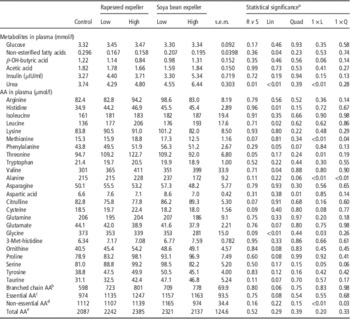
Protein supplementation did not affect plasma glucose, BHBA, acetic acid or insulin concentrations, but plasma urea was higher for SBE- than RSE-fed cows (P<0.05; Table 9). Increasing the protein supplementation linearly decreased (P<0.05) plasma NEFA and increased (P<0.01) urea concentration. Differences between protein supplements in plasma AA concentrations were relatively small, but methionine, cysteine and threonine concentrations tended (P<0.1) to be lower for SBE- than RSE-fed cows. However, there were interactions between protein source and level of supplementation for methionine, alanine and non-essential AA such that the concentrations of these AA for the highest SBE level were particularly low. Positive linear increases of protein supplementation were found for plasma histidine, leucine, phenylalanine and valine concentrations (P<0.05), while the concentration of glycine decreased (P<0.01).
The effects of the source and amount of protein supplementation on plasma metabolite and amino acid (AA) concentrations of dairy cows fed red clover/grass silage-based diets

a Contrasts: R v. S=rapeseed meal v. soya bean meal supplementation; Lin=linear effect of the amount of protein supplementation; Quad=quadratic effect of the amount of protein supplementation; 1×L=interaction between the protein source and the linear effect of the amount of protein supplementation; 1×Q=interaction between the protein source and the quadratic effect of the amount of protein supplementation.
b Valine, isoleucine and leucine.
c Arginine, histidine, isoleucine, leucine, lysine, methionine, phenylalanine, threonine and valine.
d Alanine, aspartic acid, cysteine, glutamic acid, glycine, proline, serine and tyrosine.
e Essential and non-essential AA.
Discussion
Milk production and NUE
The positive effects of protein supplementation on milk production are often partly mediated through increased feed intake and subsequent increases in energy and nutrient intakes. Huhtanen et al. (Reference Huhtanen, Rinne and Nousiainen2008a) estimated that increasing the concentrate CP concentration by 1 g by replacing energy concentrates with protein supplements, increased diet DM intake by 7.7 g. However, in the current experiment, increase in feed intake with increasing protein supplementation did not reach significance, but inclusion of RSE tended to increase silage DM intake compared with SBE.
The milk protein production responses per unit increase in CP intake (kg/day) were greater for RSE than for SBE diets. The marginal efficiencies of converting feed CP into milk protein were evaluated by regressing milk protein output against feed CP intake. The slopes of the regression equations were102 v. 55 g/kg for RSE and SBE, indicating that RSE was almost twice as efficient in eliciting milk protein production responses compared with SBE. The difference between the feeds was even greater than in the meta-analysis by Huhtanen et al. (Reference Huhtanen, Hetta and Swensson2011), who reported marginal efficiencies of 135 and 98 g/kg for rapeseed- and soya bean-based protein supplements, respectively, but the current responses were clearly lower. There are also reports where rapeseed- and soya bean-based feeds have been equally efficient (Brito and Broderick, Reference Brito and Broderick2007; Christen et al., Reference Christen, Schingoethe, Kalscheur, Hippen, Karges and Gibson2010), which may be caused by differences in basal diets as lucerne, maize silage and maize-based concentrates were used in those studies.
When the milk protein production responses to the two protein supplements were compared on the basis of MP concentration of the feeds, the differences in the slopes of the regression equations were smaller (0.257 v. 0.202) than when CP was used. This indicates that the Finnish feed protein evaluation system, which uses higher effective rumen degradability value for soya bean-based than rapeseed-based feeds (0.75 v. 0.60; Luke, 2015), in contrast to many other feed evaluation systems (NRC, 2001; NorFor, 2015), was able to improve the estimation of the true protein value of the supplements. The difference in the slopes was still rather large indicating lower efficiency of utilization of MP from SBE for milk production.
Positive linear responses attained at high levels of protein supplementation (Rinne et al., Reference Rinne, Jaakkola, Varvikko and Huhtanen1999; Shingfield et al., Reference Shingfield, Vanhatalo and Huhtanen2003) have indicated large potential to stimulate mammary protein synthesis either by higher total AA supply or by improved AA profile. Relatively high inclusion (652 g CP on low and 1222 g CP/day on high level of supplementation) from the protein supplements were used to find out if the response is curvilinear. The relationship between milk protein production and CP intake was quadratic in a meta-analysis conducted by Huhtanen and Nousiainen (Reference Huhtanen and Nousiainen2012) showing diminishing milk protein responses at high levels of CP supplementation. In the current experiment, increasing supplementation increased milk protein output linearly, although numerically the response for RSE levelled off at the highest level of supplementation.
Protein supplements have sometimes resulted in high marginal responses in energy utilization. Shingfield et al. (Reference Shingfield, Vanhatalo and Huhtanen2003) reported exceptionally high marginal efficiencies of 0.242 and 0.206 kg ECM per MJ ME for RSE and soya bean meal, respectively, and in a large data set compiled by Huhtanen et al. (Reference Huhtanen, Hetta and Swensson2011) they were ca. 0.173 and 0.155 kg ECM per MJ ME. In the current experiment, the marginal energetic efficiencies for RSE and SBE were lower (0.142 and 0.076 kg ECM per MJ ME, respectively), but again rapeseed containing diets showed higher marginal efficiency indicating that additional nutrients were used more efficiently for milk production.
The NUE in the current experiment was on average 283 g/kg, which is close to the average of 277 g/kg calculated by Huhtanen et al. (Reference Huhtanen, Nousiainen, Rinne, Kytölä and Khalili2008b) from a large (n=998) data set of milk production experiments. The NUE decreased linearly with increasing protein supplementation in spite of significant increases in N capture in milk protein. It seems inevitable that with incremental increases in dietary CP concentration, N is partitioned towards milk protein synthesis with diminishing efficiency (Huhtanen et al. Reference Huhtanen, Nousiainen, Rinne, Kytölä and Khalili2008b).
Milk protein output of cows on the control diet was 0.91 of that on the highest protein supplementation level, and for ECM the proportion was even higher (0.93), which may be considered a rather modest loss of production in a situation with no protein supplementation. Indeed, the use of high-quality protein supplementation of dairy cow diets has been questioned particularly from ecological sustainability point of view (Leiber, Reference Leiber2014). If, for example, in organic dairy production, availability or price of protein supplements is high, exclusion of them from the diets of the cows may be a viable option. However, the current study was conducted as a change-over design with changing dietary treatments and thus long-term effects could not be assessed.
Using rapeseed-based feeds for dairy cows compared with soya bean-based feeds seems to be more justified because of similar or even higher milk production responses obtained than when using soya bean-based feeds. Locally produced rapeseed feeds may also be more resilient and offer environmental benefits compared with soya bean-based feeds particularly in countries where soya bean cannot be cultivated (Hörtenhuber et al., Reference Hörtenhuber, Lindenthal and Zollitsch2011).
Rumen fermentation and diet digestion
Consistently with other reports (Brito and Broderick, Reference Brito and Broderick2007; Christen et al., Reference Christen, Schingoethe, Kalscheur, Hippen, Karges and Gibson2010), the type of protein supplementation had no effects on rumen VFA profile, ammonia N concentration nor pH. The effects of level of protein supplementation were restricted to changes in rumen ammonia N concentration, which agrees with Ahvenjärvi et al. (Reference Ahvenjärvi, Vanhatalo, Huhtanen and Varvikko1999).
Increasing diet CP concentration by good-quality protein supplementation is one of the few cases when positive dietary associative effects can be expected. The increased OM, CP and NDF and pdNDF digestibilities with increasing protein supplementation are in line with the meta-analysis of Nousiainen et al. (Reference Nousiainen, Huhtanen and Rinne2009). In that analysis, the effect of increasing protein supply on diet digestibility tended to be quadratic with predicted maximum digestibility at a dietary CP concentration of 220 g/kg DM. This is clearly higher than the highest dietary CP concentration of 195 g/kg DM (on high level of SBE supplementation) achieved in the current experiment. The higher total and ruminal NDF digestion of SBE-based diets is mainly caused by the lower iNDF concentration in SBE compared with RSE. No differences between the treatments were observed for pdNDF digestibility.
The increased apparent CP digestibility with increasing protein supplementation is an artefact of increased CP concentration. When the true protein digestibility was calculated using the Lucas principle, that is, regressing the dietary concentration of digestible CP against total CP, the true digestibilities of CP were 0.78 for RSE and 0.93 for SBE. These digestibilities are in line with those calculated from a larger data (Huhtanen et al., Reference Huhtanen, Hetta and Swensson2011), that is, 0.96 (s.e.=0.018; n=38) for soya bean-based feeds and 0.85 (s.e.=0.022; n=39) for heat-treated rapeseed feeds.
Ruminal N metabolism and microbial protein synthesis
The similar rumen ammonia N concentration and ruminal N digestibility for RSE and SBE diets indicate similar rumen degradability of rapeseed- and soya bean-based supplements as discussed by Huhtanen et al. (Reference Huhtanen, Hetta and Swensson2011). This contradicts the use of lower effective protein degradability for RSM compared with SBM (0.60 v. 0.75) as in the Finnish protein evaluation system (Luke, 2015), although this leads to a good empirical relationship between dietary MP supply and milk production. Probably some other factor than simply ruminal protein degradability is the cause for the difference, possibly the supply of individual AA as discussed in the next section.
The rumen ammonia N concentration on the control diet was clearly lower, 3.04 mmol/l, than with the protein-supplemented diets, but should have been adequate for microbial protein synthesis (Hoover, Reference Hoover1986). A dietary CP concentration of 147 g/kg DM and a positive PBV value in the control diet as well as milk urea concentration of 18.1 mg/100 ml all support the view that N availability was probably not restricting microbial growth in the rumen. However, the lowest rumen ammonia N concentrations during the feeding interval were close to or occasionally even below 2 mmol/l (data not shown). Even so, increased protein supplementation did not improve microbial protein production either in absolute terms nor when expressed relative to OM digested similarly as in the experiments of Ahvenjärvi et al. (Reference Ahvenjärvi, Vanhatalo, Huhtanen and Varvikko1999) and Korhonen et al. (Reference Korhonen, Vanhatalo, Varvikko and Huhtanen2002). However, the ammonia N concentration may have been somewhat marginal for the optimum fibre digestion because both NDF and pdNDF digestibility increased with increasing protein concentration of the diet in the current experiment.
Although protein supplementation elicited significant milk production responses in the current experiment, the level of production was rather high even when the control diet was fed. This emphasizes the role of microbial protein produced in the rumen as a substrate for milk protein synthesis. The proportion of microbial N in total N flow to the omasum decreased from 0.76 for the control diet to 0.66 and 0.60 for low and high levels of protein supplementation, respectively. It should be noted that even when the total NAN flow to the lower tract increases with increasing supplementary protein, the outcome may be dependent on the varying intestinal digestibility of individual AA either of microbial or dietary origin, which usually is in favour of microbial protein.
AA supply
According to Robinson (Reference Robinson2010), rapeseed-based feeds have increased the methionine and lysine supply to the duodenum of dairy cows, while this was not observed when soya bean-based feeds were used. In the current study, the protein supplements did not differ in the flow of AA into the omasal canal, but the higher plasma methionine concentrations indicates higher methionine availability to RSE-fed cows. The differences in the methionine concentration of the supplements obviously contributes to this. The higher methionine concentration of RSE compared with SBE is consistent with previous knowledge (Tuori, Reference Tuori1992; Vanhatalo et al., Reference Vanhatalo, Aronen and Varvikko1995; Luke, 2015). The difference in the current feeds was, however, even greater (2.2 v. 1.1 g/100 g CP for RSE and SBE, respectively) than reported, for example, by Luke (2015), where the corresponding values were 1.8 v. 1.4 g/100 g CP.
Methionine is often considered as the first-limiting AA in milk production particularly on maize-based diets, and commercial rumen-protected methionine supplements are available. Recently, two extensive reviews have been published evaluating the effects of rumen-protected methionine on milk production (Patton, Reference Patton2010; Robinson, Reference Robinson2010). Both analyses revealed that although some positive effects could be detected for feeding rumen-protected methionine, they were typically small and difficult to predict based on dietary characteristics. The lower milk protein output and a tendency for lower milk protein concentration of SBE-fed cows may be associated with shortage of methionine, as methionine supplements tend to increase milk protein concentration and output (Patton, Reference Patton2010). Histidine has been identified as the first-limiting AA in grass silage and cereal-based diets (Vanhatalo et al., Reference Vanhatalo, Huhtanen, Toivonen and Varvikko1999), but in this case, the histidine concentration of the control diet was rather high compared with previous studies (Vanhatalo et al., Reference Vanhatalo, Huhtanen, Toivonen and Varvikko1999; Korhonen et al., Reference Korhonen, Vanhatalo, Varvikko and Huhtanen2000), and it may not have played a great role.
Brito et al. (Reference Brito, Broderick and Reynal2007) reported a greater omasal canal flow of proline on rapeseed meal-based diets, while no other differences between rapeseed- and soya bean-based feeds were detected. In a milk production experiment, Shingfield et al. (Reference Shingfield, Vanhatalo and Huhtanen2003) found that methionine as well as several individual and branched-chain, essential and total AA were higher in plasma for RSE rather than for soya bean meal-fed cows.
There is relatively little information about protein supplementation responses on red clover-based diets. The basal diet plays an important role in providing AA to the animal, and our previous study indicated that red clover silage-based diets may be particularly poor in providing methionine to cows (Vanhatalo et al., Reference Vanhatalo, Kuoppala, Ahvenjärvi and Rinne2009a). In line with that, a tendency for lower methionine concentrations in plasma on SBE diets was detected in the present study, similar to the observations of Vanhatalo et al. (Reference Vanhatalo, Pursiainen, Tuori, Rinne and Jaakkola2009b), who compared SBE and RSE on red clover silage-based diet.
Red clover-based diets often have a relatively high CP concentration, and due to lower in-silo and ruminal CP degradation than in grasses (Vanhatalo et al. Reference Vanhatalo, Kuoppala, Ahvenjärvi and Rinne2009a), limited responses to protein supplementation could be anticipated. In the current study, and that reported by Heikkilä et al. (Reference Heikkilä, Toivonen and Mela1996), clear milk production responses were, however, obtained to protein supplementation, which indicates suboptimal AA supply from the basal diet. A study by Vanhatalo et al. (Reference Vanhatalo, Pursiainen, Tuori, Rinne and Jaakkola2009b) showed, however, only limited responses to protein supplementation.
One reason for the failure of red clover-based diets to provide ample AA for milk production in spite of often higher CP concentration and lower CP degradability compared with grasses could be reduced intestinal digestibility of CP or certain essential AA (Vanhatalo et al. Reference Vanhatalo, Kuoppala, Ahvenjärvi and Rinne2009a). Recalculation of the Finnish digestibility trial data (Huhtanen et al., Reference Huhtanen, Nousiainen and Rinne2006) showed that the true digestiblity of CP was 0.956 for grass silages (n=68) and 0.934 for red clover silages (n=23), and the metabolic N losses for them were 36 and 43 g/kg, respectively. The responses to protein supplementation are likely to depend on the supply of AA from the basal diet and, indeed, Patton (Reference Patton2010) reported that rumen-protected methionine was more effective when given with lucerne than with other forages.
Conclusions
The lower milk protein production responses to SBE than to RSE supplementation in the current study were possibly related to lower energy supply owing to lower silage DM intake and by the lower methionine supply, which was further amplified by the use of red clover in the basal diet. Although feed intake, diet digestion, AA supply and milk production were all consistently improved by protein supplementation, the NUE in milk production decreased clearly. Further, dairy cows fed good-quality basal feeds produce reasonable amounts of milk even without protein supplementation so that the economic and environmental aspects need to be carefully evaluated when decisions of protein supplementation for dairy cows are taken.
Acknowledgements
This work was financially supported by the Finnish Ministry of Agriculture and Forestry.