1. INTRODUCTION
In 1999, Mavis Mate wrote ‘More has been written about medieval women in the last fifteen years than in the previous one hundred and fifty’Footnote 1 and yet understanding of their lives remains partial, especially with regard to what women did with their property whilst they were married, the concern of this article. It is a truism that throughout their lives medieval women were defined in relation to the men of their families – primarily as daughter, wife and widow – and the documentary evidence is the product of, and witness to, the fundamentally unequal patriarchal society in which they lived. As a result, men tend to dominate the historical record. From the wealthy heiress to the peasant spinster, the lives of women were shaped by their relationships with men and by the common law of England, including that governing marriage, property and inheritance.Footnote 2 It is a generally accepted legal fiction for the pre-modern period that when a man and a woman married they became one; and for practical purposes that one was the husband.Footnote 3 He looked after his wife and her property but she retained her right (seisin) in her estates during the marriage. This paper presents the results of an investigation into married women and their landholdings using the documentary series known as the final concord (or fine for short), an agreement recorded in the king's court of Common Pleas.Footnote 4 Amongst other characteristic uses described below, the fine was the main way of ensuring the lawful transfer (conveyance) of the good title of a married woman's property and avoiding subsequent challenges.Footnote 5 As a result, it allowed her to manage the disposal of her freehold property, albeit whilst always acting jointly and in agreement with her husband. Whilst we will never know about the dynamics of the decision-making that lay behind the transaction, through this particular documentary lens we can see what she did with her property and obtain important insights into the activities of married women.
There is disagreement between historians on whether to emphasise the independence enjoyed by medieval women or to stress the constraints under which they operated.Footnote 6 Whatever evidence we employ, whether literary, manorial, or, as here, legal records, our conclusions remain tentative and open to a variety of interpretations. To give a classic example, we are all familiar with the paradoxes of Chaucer's portrayal of the Wife of Bath: the skilled independent cloth worker of the General Prologue, her apparent defence of women in the Prologue to her Tale, the notion of what a woman really wants in the Tale itself:

and yet the final outcome is a capitulation and reversion to the authoritative male stereotype.Footnote 8
Further, and as a result of recent research we have a clearer idea of the legal conditions regarding property and its transfer, but we are far less certain about the impact on women.Footnote 9 As Eileen Power commented long ago: ‘the position of women is one thing in theory, another in legal position, yet another in everyday life’.Footnote 10 There were a number of legal constraints on married women and their landholdings.Footnote 11 First, we must be clear that in the medieval period the ownership of land was never absolute in the modern sense; rather, land was ‘held’ subject to a system of feudal tenures and ultimately from the king.Footnote 12 What a man or woman owned was an estate of infinite duration (fee simple) in the property which they could alienate (give or sell) at will or otherwise it would pass to their heirs in perpetuity. It was their ‘right’ to their land that defined their possession. Throughout a marriage the husband and wife were seised in (possessed) her land in right of the wife. She retained her rights whether she had held the freehold property before the marriage, or the land had come to her during the marriage, and would recover them should she become a widow. While she remained married, however, she lost the ability to dispose of the land herself without the agreement of her husband, nor could she prevent him from conveying it to third parties for the duration of his lifetime, at least if they had no children. Nevertheless, they had to co-operate. Any challenges to her title to the land had to be acted upon jointly. For example, if a legal case (suit) needed to be brought to recover land to which the wife was entitled, husband and wife had to bring it jointly; and the same was true if a suit was brought claiming property that the husband held in the right of his wife. In order to sell or settle the land that a married woman had brought to the marriage, her consent was needed or else the conveyance could be found to be void at a later date. Any recipient of land from a married woman therefore needed to be certain that her consent had been properly secured and that there was no danger that her family would later question the validity of the conveyance.
It was the ability of the final concord (the fine) to protect the rights of married women in their property that underlies the findings of this paper. Indeed, Sir Frederick Pollock and Frederic William Maitland noted that by the time of Henry Bracton in the thirteenth century, the fine had become the main means of a married woman by which good title could be transferred.Footnote 13 ‘If her land was to be lawfully and effectually conveyed, she and her husband were made parties to an action, and before the “concord” was accepted by the court, the justices examined her and satisfied themselves that she was acting freely.’Footnote 14 Whilst married women had to act jointly with their husbands, and both had to be in agreement, nevertheless the evidence reveals their active participation in the process of conveying their property.Footnote 15
Women could acquire their land in two main ways. First, they did so through inheritance. The proportion of heiresses expanded during the fifteenth century, often, it has been argued, for demographic reasons.Footnote 16 The survival of several daughters increased the likelihood that property would be divided between co-heiresses in areas where female inheritance was partible, further increasing the number of women as landowners.Footnote 17 Second, women who were not heiresses could receive land as a marriage gift or maritagium, or, alternatively and increasingly from the fourteenth century, they might be provided with land as a marriage settlement called a ‘jointure’ together with their husbands.Footnote 18 Thus, the rights a married woman had in her land varied and these determined what was conveyed.
Given what was possible under the law, how did women avail themselves, and how widespread were the practices? Married women were present in large numbers as parties to the final concords in the court of Common Pleas and appear to have been actively and consciously involved in the process.Footnote 19 This should not be surprising, as the fine was the only means of lawfully conveying good title to the property of a married woman and avoid subsequent challenges whilst having the added advantage of producing a semi-public record.Footnote 20 Hence women could use fines as a means of securing their own objectives, but fines might also be insisted on as the appropriate form of conveyance when land was conveyed from women to men. Furthermore, these women freeholders came from different social backgrounds and their properties varied in size and could be as small as a single dwelling. In the dataset under consideration we are viewing the actions of women below the nobility, predominantly of the lesser gentry and freeholder status, the latter being a group whose landholdings have not been studied previously in great detail.
2. THE FINAL CONCORD OR FINE
A final agreement or concord was a secure means of ensuring good title to a property. It was considered by Pollock and Maitland to be ‘in substance a conveyance of land and in form a compromise of an action’.Footnote 21 Whilst their origins were found in real litigation of the twelfth century, by the early fourteenth century they were largely fictitious suits. Behind the final concord lies an allegation of a broken promise relating to the inter vivos transfer of freehold land.Footnote 22 The fine records the terms of agreement to which the two sides had come to resolve the situation, the names of the two parties, a description of the property, details of tenure (the terms under which the land was held), and sometimes a sum of money, known as the consideration (although this is not the actual purchase price).
It is generally assumed that the case was begun by the issuing of a writFootnote 23 summoning the two parties who may have previously, but not necessarily, conveyed the property in fee simple (that is, the right to the land forever), drawn up a deed and had it witnessed, and were employing the royal courts to record their final agreement.Footnote 24 The case took the form of a fictitious suit in the court of Common Pleas. Most commonly, the action was initiated by the recipient of the lands (the plaintiff) against the vendor or previous owner, known as the defendant (deforciant), and the one who had had the initial or ‘precedent right’ to the property. The parties' final agreement was drawn up by the court and written out three times and dividedFootnote 25 as an indentured tripartite chirograph, with one section going to each of the two parties and the final copy (the foot) being kept in the custody of the court, hence the phrase ‘feet of fine’, where it was available for inspection.Footnote 26
The advantages of the final concord over the charter (or in addition to the charter) were sufficient to persuade hundreds of individuals, both men and women, to expend the additional costs in time and money that were entailed in making a fine (although as will be demonstrated, the numbers of men acting as parties declined over time as, presumably, they had other means of securing their property). In the vast majority of cases a fine afforded incontestable evidence of the transaction and was legally binding on the parties.Footnote 27 Before 1360, a final concord barred claims to the property by people who were not party to the action and did not enter their claim within a year and a day.Footnote 28 This had been an attractive feature of the fine and, once removed, its usage declined. The bar to claimants was partially reinstated in 1489 with the proviso that a proclamation of the fine was made in open court and there was a corresponding increase in the number of fines made.Footnote 29 Fines were used on occasions where landowners desired to dispose of their freehold land as they wished, and thereby avoid the normal rules of inheritance by barring the right of persons who otherwise might have inherited or had a claim on the property. They might arrange for this to take effect after their deaths or to occur during their lifetimes. It might be beneficial in family settlements to obtain an interest in the property for the duration of a particular life (life estate) such as that of the vendor, or direct the sequence of those eligible to inherit, or limit the heirs (entail) for example to men (tail male).Footnote 30 In addition, a fine was useful in the conveyance of a reversion that would ensure the future return of the estate after the limited interest (usually a life) had expired. It is probably no coincidence that between 1360 and 1489 the chief use of the fine, as we shall demonstrate, lay in the secure conveyance of property of married women. As such, they form part of a more general search for secure forms of conveyancing at a time when land titles could be derailed by the discovery of claims of which purchasers were unaware at the time of their purchase.Footnote 31
More generally, changes in the law of property had an impact on married women but whether their effects were advantageous or not are a matter of interpretation and historians tend to differ. For example, it could be argued that women were disadvantaged by the development of tail male which could deprive them of their inheritance, and yet as we will see below, this was uncommon except at the highest social level. Women might benefit in terms of economic security through the jointure and improved terms of dower.Footnote 32 Joel Rosenthal, however, stressed the vulnerability of widows identifiable in cases of contested dower in the royal courts who argued that the widow had been unable to enter fully into her property.Footnote 33 It is clear that the evidence is open to different interpretation of the position of married women under the law. The arguments of this paper lean towards the positive side of the distribution.
Before we continue, a series of caveats is required. As we have seen, the law that underpinned the use of the fine changed twice, and for this reason the number of fines made shows sharp changes over time as well as being sensitive to short-term fluctuations of the economy. Fines do not record every transfer of freehold land even at the moments when they were at their greatest utility. It is impossible to say that all conveyances of married women's freehold land were accompanied by a fine, nor can we guess what proportion might have been, and what proportion not. The fines provide a lawyer's summary of the land conveyed rather than a surveyor's description; and were subject to changes in the law whilst the format and wording of the final concord remained unchanged. Their strength lies in their ability to quantify change as they survive in their thousands from 1195, provide comparisons across England, and their analysis produces large datasets and, we will argue, robust results.Footnote 34
3. THE INCIDENCE OF FINES
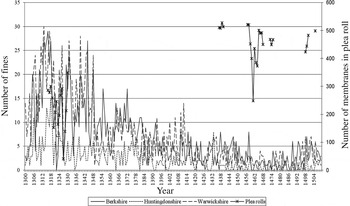
Before analysing the detailed evidence for married women employing fines we need to look more generally at the frequency with which people made a final concord. The incidence of fines varied over the period under examination, with a general decline in their numbers from the second half of the fourteenth century. This can be demonstrated by charting the number of fines that were made for three counties – Berkshire, Huntingdonshire and Warwickshire – selected as illustrative of areas within central southern England. Was this trend a result of the workings of the court generally, or of the use of the final concord? To investigate this question the number of fines is compared in Figure 1 with the number of membranes in the plea rolls of the court of Common Pleas for selected sample years. These record the cases heard in court and provide a contextual background level of activity as measured by the amount of documentation produced.Footnote 35 It is generally accepted that there was a general expansion in the remit and implementation of royal justice in the thirteenth century and before the period of this study.Footnote 36 The court of Common Pleas dealt with real actions, including those relating to the ownership and tenure of land, and also cases of debt, detinue, account and covenant.Footnote 37 The use of the court expanded further, as did its personnel, in the fourteenth century with the extension of the personal action of trespass which might include an attempt at the recovery of the loss of freehold land. The graph charts a significant rise in the business of the court between the first quarter of the fourteenth and the second half of the fifteenth centuries. Fines, on the other hand, show a marked decline after c.1350 in all three county distributions, which are remarkably similar.Footnote 38
Number of fines for the three counties of Berkshire, Huntingdonshire and Warwickshire compared with the number of membranes of the plea rolls of the court of Common Pleas, 1300–1509. (Sources: plea rolls: The National Archives, UK (TNA), CP40/213, 217, 221, 226, 233, 237, 242, 245, 250, 255, 260, 268, 272, 276, 280, 704, 708, 712, 716, 784, 788, 792, 796, 800, 803, 807, 811, 814, 818, 822, 826, 845, 849, 853, 943, 947, 951, 971; fines, Berkshire: TNA, CP25/1/9/36-41, CP25/1/10/42-55, CP25/1/11/56-68, CP25/1/12/69-80, CP25/1/13/81-89; fines, Huntingdonshire: G. J. Turner ed., Calendar of the feet of fines relating to the county of Huntingdon levied in the king's court, 1194–1603 (Cambridge Antiquarian Society, octavo series, 37, 1913); fines, Warwickshire: Warwickshire feet of fines, 2 vols. (Dugdale Society Publications, 15, 18, 1940–1943).)

Careful scrutiny of the data of all series reveals a number of fluctuations that can be related to shocks in the larger economy, for instance to the agrarian crises of 1315–1322,Footnote 39 and the arrival of the Black Death in 1348–1349.Footnote 40 What is paradoxical is the number of people who wished to register the inter vivos transfer of free land after so many had died, for whom sudden death overturned the expected descent of property. In addition, there appears to have been a marked reduction in both the number of fines and the activity of the court during the political crises of the 1320s and the 1460s, 1470s and early 1480s.Footnote 41 During periods of political crisis perhaps the threat of confiscation of property made buyers hesitate; or perhaps makers of final concords or their legal representatives were wary of travelling to London when political upheavals were threatened. From the evidence of the graph it would appear that the use of the royal court expanded over the period of this investigation and was remarkably resilient to exogenous shocks of famine and disease, but not to political crises when activity contracted markedly. It would appear that the relationship between legal institutions and economic performance provided a relatively stable framework that strengthened property rights on freehold land, especially through the registration of a final concord.
Nevertheless, the fall in the number of fines that coincided with an expansion in the business of the court requires explanation. Several factors may have influenced the number of final concords made: first, changes in the law of real property that have been mentioned previously; second, a decline in the size of the population in a period of sustained high mortality and low replacement rates;Footnote 42 third, a decline in the availability of freehold land for purchase (Christine Carpenter has shown this for fifteenth-century Warwickshire);Footnote 43 fourth, an alteration in the size and composition of the properties that were being conveyed, sometimes as a result of agricultural change;Footnote 44 and finally, the manipulation of the rules of inheritance, as outlined above, by families wishing to determine the descent of their properties. Of these, the chief reason is quite likely to be the first. The additional assurance the fine offered was diminished by the statute of 1360.Footnote 45 Thereafter, fines were no longer as useful in securing the security of conveyances between men. Instead, the final concord became a special device for the assurance of conveyances made by married women.
4. MARRIED WOMEN AND FINES IN BERKSHIRE
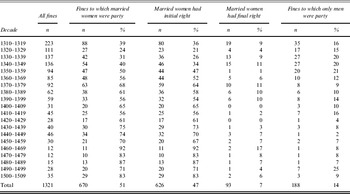
The focus of this inquiry narrows now to a case study of the evidence of married women from Berkshire, a county representative of the pattern of landholding in central England.Footnote 46 A systematic study of feet of fines for the county reveals how between 1310 and 1509 the majority, albeit a narrow one of 51 per cent, of final concords involved married women (Table 1).Footnote 47 Indeed, the proportion of fines without a woman present in either party (the ‘men only’ column in Table 1) is remarkable, accounting for 14 per cent of all fines. Married women came to dominate this form of suit, and fines made between male parties almost entirely disappeared. The absence of male parties is marked after 1360, but they returned in the 1490s, perhaps after the bar was partially reinstated in 1489.Footnote 48 In addition, dower did not play a prominent role in the final concords of Berkshire, being a matter of concern in only 44 fines.Footnote 49 It was married women, particularly when acting as defendants in the case (i.e. the vendors), who were dominant in this type of settlement. The number of single women and widows was small.Footnote 50
Fines to which married women were party in the conveyance of their property in Berkshire, 1310–1509

Sources: The National Archives, UK, CP25/1/9/36-41, CP25/1/10/42-55, CP25/1/11/56-68, CP25/1/12/69-80, CP25/1/13/81-89.
Whether the property was the married woman's at the outset of the final concord and, by inference, that she was initiating the process, albeit with her husband, can be established in those fines that specified that the married woman had the initial or ‘precedent right’ and was acting for her heirs in granting or quitclaiming (releasing all right she had in) the property and then warrantying the grant as a form of final guarantee (‘Initial right’ columns in Table 1). The admission of right was an important element in the concord, particularly if right was of a precedent or previous gift, because it meant that the estate in the land being transferred was complete (in the sense that the fee simple and totality of ownership was being conveyed). However, without it the person's right was only an estate in the property (a life interest, or a number of years).Footnote 51 In the first half of the fourteenth century women accounted for less than half of those having the initial right, with or without precedent gift, to the property. The proportion increased before the bar was raised in 1360 – so this trend was not entirely due to changes in the law – and continued to climb thereafter. A similar pattern was identified in Gloucestershire.Footnote 52 From the middle of the fifteenth century the right of women to the property at the outset dominated the transactions. The period 1460 to 1489 was one of few fines, and, of those, most were overwhelmingly initiated by women. In addition to the legal factors, one is left wondering to what extent this situation was being affected by demographic forces such as a lack of direct heirs.Footnote 53 In sum, nearly half of all fines were initiated by married women, demonstrating the importance of this legal instrument in the management of their property, either its succession or conveyance, and particularly in the fifteenth century.
At the completion of the final concord women's continuing or acquired right to the title, as exemplified by mention of their heirs, was much less: 93 fines (seven per cent of all fines) compared with 626 where the married woman held the initial right. Of these 93 fines, 50 referred to occasions where the women had both initial and final right. Of these, less than half also involved single women or widows: 22 of the 50. The decade 1375–1385 is known more generally as a time of crisis in male succession and there was a small increase in the number of fines.Footnote 54 It would appear that the fine was being employed less frequently as a method of conveying property to married women and their heirs than it was when married women initiated the process. Furthermore, these properties that were acquired by the women tended to be smaller than the wide range of land types and size of landholding, including complex holdings or manors, of the fines initiated by women. There were few instances (20 of the 93 final right fines) relating to manors and these were often held by heiresses such as Elizabeth Burton who held the manors of Hertrugge and Titcombe in Kintbury,Footnote 55 and Matilda Crosby who held Catmore and West Hanney in 1442 as heiress of Rawlin de Arches.Footnote 56 In both instances they were employing the fine to settle the succession to their manors. Grants or releases to a single man from a married woman accounted for 38.6 per cent of these fines and these may be taken to be sales. The remaining recipients were parties where at least one woman was present.Footnote 57
It is worth considering any evidence for fines being used to ensure that land passed to male and not female heirs (tail male). The Berkshire evidence confirms the findings of Simon Payling that this was done on only a negligible number of occasions.Footnote 58 Male heirs were only stipulated in 34 fines, of which 24 related to the period before the Black Death, and nine were specific to the de la Beche family between 1334 and 1343.Footnote 59 Only three fines in 1493, 1501 and 1506 included an additional grant-back clause that restricted inheritance to male heirs.Footnote 60
The paucity of fines in the period 1460–1490 is particularly noticeable. It is hard to explain such an extended drought by a period of political instability. In the 39 Berkshire fines made in these years (an average of less than 10 per decade and none at all in some years), the fines were dominated by married women disposing of their rights to specific properties (usually a manor or urban property) and conveying them to men.Footnote 61 There were only three cases of ‘men only’ during these years. Men had largely given up on employing fines and were, presumably, using alternative methods to secure the title of their acquisitions. Those that remained using the processes of the court were married women, arguably because their choice of alternative forms of conveyance was very limited. In terms of social groupings, the majority (23 of the 36 fines, or 64 per cent) of the women were below gentle status, with only six married to knights and five to esquires, again reinforcing our understanding of the social status of these women landowners.Footnote 62
There was, however, a large number of men who were members of the clergy; 84 in total. Their role was usually as plaintiffs, i.e. the person receiving the land. It is assumed that they, along with other groups of men, were acting as trustees or feoffees to uses. Feoffment became an increasingly popular way, particularly in the fifteenth century, of getting round the normal rules of inheritance and evading many of the financial exactions of feudal tenure.Footnote 63 In these instances landowners would grant all or a portion of their lands on trust to men of standing (the feoffees) whilst they enjoyed the ‘use’ of the income during their lifetimes and in anticipation that the trustees would re-grant the lands after their deaths in accordance with their wishes. Certainly clergy appear in the fines as individuals within the majority of these groups of men. The incidence of several men acting as plaintiffs occurred in 33 per cent of fines conveying land from married women between 1310 and 1509, and especially in the fifteenth century. The rise in family settlements along with these feoffments may account for this characteristic that was apparent from the mid-fourteenth century. All the indications are then that in the fifteenth century the final concord was a distinctive form of fictional suit exploited by married women, often to settle their estates.
5. MARRIED WOMEN'S USE OF THE FINE IN THE MANAGEMENT OF THEIR LANDHOLDINGS
Until now the fines themselves have been treated as uniform. In fact, the form of the agreement to the fictitious suit varied according to the different types of transaction that lay behind them, and these differences will be employed to investigate the activities of married women in more detail. In particular, we will distinguish between those conveyances of a complete or a limited estate in the land and identifiable by the admission of right as of a precedent gift, and then consider the underlying transaction that the fine was confirming. Here we use a typology based on one devised by C. A. F. Meekings, the pioneering editor of the Surrey feet of fines, which distinguishes between whether the fine marked the grant of the property, or the surrender of all right in the property by remise and quitclaim, or the grant of a reversion (usually a future interest in the land), or a double fine (where a grant that was followed by a grant back on different terms).Footnote 64 This last category will be subdivided further.
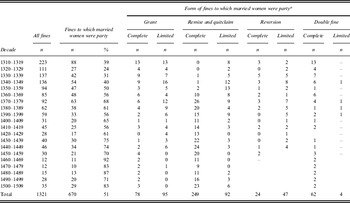
The majority of the fines of married women dealt with complete estates (the strongest title to the property and commonest form of the agreement) and in these instances the fine specified that the right was as a previous or precedent gift (64 per cent initial right and 65 per cent final right). Thus married women had a strong reason for levying a fine and this was the type of estate most sought after. A limited estate or interest in the property was a weaker form and there were marked differences in the ways in which these are revealed in the fines, as shown in Table 2. In particular, the grant of a reversionary interest (‘Reversion’ columns, Table 2), which would ensure the future return of the property, was more commonly found where there was a limited estate in the property (as Meekings had identified), and this type of transaction, as recorded by fine, ceased to be used after 1458.Footnote 65
The form of fines to which women were party, Berkshire, 1310–1509

a There is overlap between the different categories, as grants, especially, appear in several contexts. For definitions, see text.
Sources: The National Archives, UK, CP25/1/9/36-41, CP25/1/10/42-55, CP25/1/11/56-68, CP25/1/12/69-80, CP25/1/13/81-89.
It is worth reiterating that in each transaction set out in Table 2, the use of the fine was important to ensure that the property involving a married woman was lawfully and effectively conveyed. The majority of fines dealt with grants, or surrenders as remise and quitclaim, usually of a complete estate in the property and these became the predominant reason for levying a fine in the fifteenth century. Married women were relinquishing all their right to these properties, often in the form of a sale. For example, married women sold properties in Aldworth, Ashampstead, Basildon, Cookham, Frisham, Hampstead Norris and Yattendon to John Noreys when he was building up his estates in Berkshire between 1442 and 1449.Footnote 66 It was this type of event that lies behind the fine and in the majority of cases the recipients were men. Whether the women were operating freely, or were being coerced by their husbands, cannot be established and remains a matter of interpretation. Purchasers could have insisted that the conveyance was marked by a fine to achieve additional surety.
The actions of married women can be seen more clearly in the 66 cases of double fines.Footnote 67 The majority of these fines dealt with complete estates, as shown in Table 2. There were only three straightforward grants in fee simple and these occurred relatively early, the last in 1339. There were four fines that dealt with the conveyance of a money rent where the estate was retained. A large proportion (23 fines, that is 35 per cent of all double fines) conveyed the property to another party and then granted it back to the woman to be held as a life interest. For example, in 1343 Richard Baldewyne of Wokingham and Joan his wife held a messuage in Wokingham that belonged to Joan. They gave it to Adam atte Lake and Christina his wife who then granted the messuage back to Richard and Joan for Joan's lifetime and were to provide a red rose each year as a token payment.Footnote 68 The married woman was retaining her right to the property for so long as she had reason to value it; in other words, for the duration of her lifetime.
There were 10 fines between 1310 and 1509 where the property conveyed was either a fractional part of the whole (often a half) or some other partial interest was conveyed. These were predominantly related to fines involving several heiresses. The partible nature of female inheritance accounts for the number of cases of co-heiresses in the fines, often in the context of purchases by a man who was reuniting the fractured elements in his own hands. For example, between 1339 and 1343 Nicholas de la Beche acquired by fine the third parts of the manor of Yattendon which had been subdivided between three sisters, Joan the wife of Andrew Sackville, Isabel the wife of William fitz Ellis and Alice the wife of Robert Danvers who were the co-heirs of John de la Beche.Footnote 69 The manor of Eastbury is another example of a manor that had been divided between sisters in 1211 and was reunited in 1334 by members of the Wanting family.Footnote 70 Co-heiresses were a particular feature of the 1480s when they were appearing in the court together with their husbands and conveying their portion to an individual who was buying up the disparate parts. They are illustrative of wider trends in landholding generally, especially the engrossment and enlargement of properties and the building up of estates. For example, three sisters with their husbands (Marjorie and Richard Hulcote, Phillipa and John Hulcote, Cristina and John Erley) conveyed their shares of the manor of Brounze in Harwell and other properties to Thomas and William Danvers in 1484.Footnote 71
There were 26, or 39 per cent of double fines which were grants in fee simple but with conditions attached, usually a specific entail, and could form part of a more complex family settlement.Footnote 72 This type of fine was not seen before 1333. In 17 cases the married woman wished to protect her inheritance, to stipulate the sequence of succession should individuals die without heirs, and there was an acknowledgment that the property remained to her ‘right heirs’. Heiresses who married several times might use the fine to either include or exclude the interests of their husbands. For example, in 1496, Elizabeth, who had inherited the manor of North Moreton from her mother and married for the second time Sir John Fortescue, employed the fine, with her husband, to settle the manor specifically on the heirs of her body, not on their joint heirs. Should she have no direct heirs, then the manor would descend to her sister Joan Huddelston and her heirs.Footnote 73 Elizabeth married for the third time Sir Edward Howard and in 1501 settled the manor on her son by her first marriage, Francis Calthorpe.Footnote 74 This is a good example of a woman employing the fine to direct her inheritance as she wished in a way that may have been detrimental to the interest of her husband.
6. THE WOMEN WHO WERE PARTIES TO THE FINES
Finally, it is through detailed biographies of individual married women that we can observe their employment of the fine within the wider context of their landholdings and evaluate its significance. The following case study of Elizabeth Kingston who died in 1462 provides us with an excellent example of a married women and her use of the final concord.Footnote 75 She was born Elizabeth Childrey c.1377, the daughter and eldest co-heiress of Thomas Childrey (alias Chelrey). She inherited a half portion of the manors of South Fawley, and Frethornes in Childrey, some land in Westcote, and part of the rights to the churches of Childrey and Letcombe Bassett, the other halves of which she later purchased and recorded in a fine.Footnote 76 She married John Kingston and by final concord in 1394, perhaps on the occasion of their marriage, they had lands in Somerset settled on themselves that necessitated a final concord. Thomas Childrey may have acted as feoffee on that occasion.Footnote 77 In 1414 John, via intermediaries, settled his properties in Wiltshire and Berkshire by fine on them both.Footnote 78 He died c.1415 whilst their son Thomas was still a minor, but Thomas had become an adult by 1423. Elizabeth retained the Berkshire lands. Thomas married an heiress, Alice Poynings, and held the Wiltshire and Somerset manors but Elizabeth also seems to have acquired these, perhaps when he died, and certainly by 1439. His widow Alice held the family's Hampshire and probably Kent manors for nearly 20 years.Footnote 79 Meanwhile, Elizabeth married William Fynderne c.1418 who was a successful London lawyer and man of property. He is an excellent example of the socially aspiring individuals described by Kenneth McFarlane and Christine Carpenter whose careers ranged widely, combining politics, office holding – including serving as member of parliament (MP) for Berkshire – and the acquisition of lands and lordships.Footnote 80 During the fifteenth century, when there was a dearth of land available for purchase, women of property, such as Elizabeth, were attractive marriage partners. However, this may not have been as one-sided as would appear, as Elizabeth may have obtained invaluable legal insights and knowledge of the royal courts from living with William. During their marriage William and Elizabeth acquired land by fine, made settlements of lands on themselves and their son Thomas by fine, and William also acted as feoffee-to-uses for several of his acquaintances.Footnote 81 He died in 1445 and together with Elizabeth is commemorated in an elaborate brass that she commissioned in Childrey church.Footnote 82 Elizabeth appears to have resumed her first husband's name of Kingston shortly after the death of William, as two years later, in a fine of 1446, she was styled ‘Elizabeth who was the wife of John Kingston knight’ when she acquired an acre of land and the remaining portions of the advowsons from her nephew James Bekyngham armiger, the son of the other heiress Sibyl.Footnote 83 In 1449 as Elizabeth Kingston and with her son Thomas Fynderne and two other men, she acquired properties in Childrey and Sparsholt from William and Margaret Bonde as Margaret's right.Footnote 84 This provides us with an example of a married woman selling to another woman and using the fine. This was also the case in a fine of 1451 when Elizabeth, with others, acquired dispersed properties in central Berkshire from Joan and William Lamborne in the former's initial right.Footnote 85 Elizabeth died in 1462 and was styled Elizabeth Kingston in her inquisition post mortem of 1464 where she is recorded as holding lands in Berkshire, Somerset and Wiltshire.Footnote 86 Her heir was her grandson Thomas Kingston, his father having predeceased him. Elizabeth and Alice as widows had between them controlled the entire Kingston family estates in five counties which were reunited on the death of Elizabeth in Thomas's hands.Footnote 87 Elizabeth died a substantial landowner who had amassed property over the course of her lifetime through inheritance, marriage and purchase, a large proportion of which was confirmed by levying a fine.
7. CONCLUSION
In conclusion, we have demonstrated the extent to which married women were employing the process of final concord in the conveyance of their property and direction of their estates, particularly after 1360. Through a quantitative study of feet of fines we have obtained a lens, albeit partial, to view the activities of married women and their landholdings. This, given the constraints of the law at that time, is a significant achievement. However, it was because of efforts to circumvent the normal rules of inheritance and feudal tenure that it became increasingly important to ensure good title in the acquisition of property by both men and women. This was particularly the case if that land belonged to a married woman and the final concord provided this assurance. The fine had the additional attribute that it gave the recipients of the land from married women the security that the transaction had been made with the consent of the woman and would not be challenged subsequently.
In the majority of fines in the fifteenth century, married women, with their husbands, were conveying their lands either by grant, or by the sale of all right that they held in the property, not to other women, but to men. In those cases where the woman had a strong title to the property, that is a complete estate in the land, these were particularly attractive. As part of broader social trends there were aspiring individuals, such as William Fynderne, who were looking to purchase lands, especially if they contained a manor with its associated rights of lordship. For those wishing entry into landed society the property of a married woman was sought after and they were prepared to pay large sums for these valuable assets.Footnote 88 Men such as John Noreys were willing to buy up fractions of landholdings from co-heiresses and unite them again as part of their amassing of large landed estates. Who benefited financially from the sale of the married woman's property – wife, husband or both – will remain unknown; the true beneficiary from the fine was the purchaser of the property.
Nevertheless, as we saw in the case of Elizabeth Kingston, women were also active in the acquisition of property through inheritance, marriage and purchase and very adept in the management of their landed estates, in her case throughout the phases of her lifetime as heiress, wife and widow.
Further, and whilst not as numerous as grants and sales, married women were active in employing fines to stipulate the sequence of inheritance to their estates as in the examples of Elizabeth Fortescue, Elizabeth Burton and Matilda Crosby. In these cases they worked to ensure that their wishes for the future succession to their property would be fulfilled. Also important were those cases in Table 2 of ‘double fines’ containing clauses for the grant and grant back to the married woman of a life interest in her property. This ensured that adequate provision was made for the duration of her lifetime should she need it.
As with any single documentary source, we cannot reconstruct all the strategies that were being adopted by married women to manage their estates and the transfer of their freehold property. The fine needs to be employed with other evidence to fulfil its full potential and, as the case study of Elizabeth Kingston has demonstrated, this can be a rewarding exercise. Their decisions are important for our understanding of married women and the law, and the workings of the court of Common Pleas. Feet of fines, for all their limitations, are an important documentary source for married women and their property. The evidence presented in this paper suggests that we can be optimistic in our assessment of the ability of medieval married women to manage their affairs and their estates.
ACKNOWLEDGEMENTS
A version of this paper was delivered at the Fifteenth Century Conference in St Andrews (September 2009) and the Medieval Economic and Social History Seminar in Oxford (June 2010) and I thank the participants for their constructive observations. In addition, I must express my gratitude to Paul Brand for reading an earlier draft of this paper and for his careful comments on technical matters. Finally, I am indebted to my colleague Richard Hoyle for his help in revising this article. Any errors are entirely my own.