Introduction
The diversity of organisms on Earth has always fascinated humankind. Questions such as how many organisms live on Earth? How many fish are in the sea? Or how many microorganisms are in a drop of water? These are some of the many questions that biologists still have, and which are far from being answered. Species counts have always played an important role in understanding biodiversity. Thus, in order to undertake a biogeographic analysis or an assessment of biodiversity changes in a biome, either natural or of anthropogenic origin, a good inventory of species will be always necessary (Wilson & Peter, Reference Wilson and Peter1988; Parr et al., Reference Parr, Guralnick, Cellinese and Page2012). A loyal companion of free-living biodiversity is parasite biodiversity. Parasites have the potential to regulate host populations, host communities and even food-web stability (Poulin, Reference Poulin2007; Goater et al., Reference Goater, Goater and Esch2014). They play important roles in ecosystems, and high parasite species diversity is associated with healthier ecosystems (Thompson et al., Reference Thompson, Mouritsen and Poulin2005; Hudson et al., Reference Hudson, Dobson and Lafferty2006). However, due to the fact that parasites can be very specific towards their hosts, it has been estimated that they must be at least as diverse as their hosts, if not more so, since multiple parasite species can live in a single host species.
Several attempts to estimate helminth diversity in vertebrate hosts have been made (Hugot et al., Reference Hugot, Baujard and Morand2001; Poulin & Morand, Reference Poulin and Morand2004; Poulin, Reference Poulin2014), but less attention has been given to invertebrate hosts (Leung et al., Reference Leung, Mora, Rohde, Morand, Krasnov and Littlewood2015). Parasites that have complex life cycles require more than a single host to complete their development, which is the case for most members of the Trematoda, Cestoda, Acanthocephala and some members of the Nematoda (Combes, Reference Combes2005). Helminths with complex life cycles often use invertebrates as intermediate or paratenic hosts. For instance, most trematodes use molluscs as the first intermediate host, while many cestodes, acanthocephalans and nematodes can develop in a range of invertebrates, often parasitizing arthropods and other invertebrates living in the water column or sediment (Marcogliese, Reference Marcogliese1995; Rohde, Reference Rohde2005; Chubb et al., Reference Chubb, Ball and Parker2010). Invertebrates are also second intermediate hosts (where partial development and growth occur) or paratenic hosts (no development or growth observed) for many species of trematodes, cestodes, acanthocephalans and nematodes, enhancing the probability of reaching the definitive host (where the sexual reproduction take place) in time and space (Parker et al., Reference Parker, Chubb, Ball and Roberts2003, Reference Parker, Ball and Chubb2015; Britton & Andreou, Reference Britton and Andreou2016).
The transmission of helminth parasites from the invertebrate to the definitive host often implies a trophic relationship between those hosts, so that vertebrates eat the invertebrates with all the parasite fauna they have. In this way, the definitive host builds populations of specific helminth species or a complete community, depending on how frequently it feeds on specific invertebrates (Goater, Reference Goater1993; Goater et al., Reference Goater, Goss-Custard and Kennedy1995; Lefèvre et al., Reference Lefèvre, Lebarbenchon, Gauthier-Clerc, Missé, Poulin and Thomas2009; Orlofske et al., Reference Orlofske, Jadin and Johnson2015). It is for this reason that it has been suggested that helminth communities in invertebrate hosts can determine the structure of those in definitive vertebrate hosts (Bush & Aho, Reference Bush, Aho, Esch, Bush and Aho1990; Sousa, Reference Sousa1994). Therefore, a better knowledge of the processes structuring helminth parasite communities of invertebrates could provide a better understanding of the processes structuring parasite communities in definitive hosts (Williams & Esch, Reference Williams and Esch1991; Bush et al., Reference Bush, Heard and Overstreet1993).
Invertebrate hosts of helminths have largely been studied because of their involvement in the life cycle of those parasites that cause diseases in humans and/or animals of economic importance (Overstreet, 1978; Malek, Reference Malek1980; Bower et al., Reference Bower, McGladdery and Price1994). However, in recent years there has been a trend to study the role of helminths in invertebrates to understand the ecological and evolutionary implications of their presence in the ecosystems (e.g. food webs, predator–prey interactions and ecological networks) (Marcogliese, Reference Marcogliese1995; Thompson et al., Reference Thompson, Mouritsen and Poulin2005; Dunne et al., Reference Dunne, Lafferty, Dobson, Hechinger, Kuris, Martinez, McLaughlin, Mouritsen, Poulin, Reise, Stouffer, Thieltges, Williams and Zander2013).
Invertebrates as helminth intermediate hosts have not been studied as intensively as vertebrates, mainly because some are found with relatively low prevalence and because they involve developmental stages that are difficult to identify. In fact, experimental infections are required to obtain adult worms with enough taxonomical structures to reach complete taxonomic identification at species level, leaving helminth taxonomical identification in intermediate hosts at family or genus level most of the time. For example, from 60 helminth species known to infect Polychaeta only 36 have been identified at species level and eight at genus level, all the remaining were identified to family level (Peoples, Reference Peoples2013). Gastropods, for instance, are known to be infected mainly by trematodes (Ching, Reference Ching1991; Zbikowska & Nowak, Reference Zbikowska and Nowak2009) and that a host population can harbour many trematode taxa, but more than one taxon seldom infects an individual host (although several species can infect a snail host population in a locality) (Sousa, Reference Sousa1994). One of the reasons for such a pattern is the presence of intense interspecific competition and cannibalism in the gastropods (Kuris, Reference Kuris, Esch, Bush and Aho1990). Copepods, on the other hand, can often host a wide diversity of larval stages of cestodes and nematodes, with almost no records of interspecific competition in the individual hosts (Marcogliese, Reference Marcogliese1995).
Leung et al. (Reference Leung, Mora, Rohde, Morand, Krasnov and Littlewood2015) recently reviewed the parasites of invertebrate hosts in aquatic ecosystems (micro- and macroparasites included) with an emphasis on the marine environment. They observed that most of the aquatic invertebrates that have been investigated are limited to a handful of host taxa of either freshwater or intertidal marine habitats. A pattern they observed was that the most heterogeneous host groups of invertebrates (Crustacea, Mollusca, Echinodermata, Cnidaria) have the greatest variety of parasites, whereas the least heterogeneous (such as Priapulida) have the lowest. They also found that there are few studies testing biogeographic or latitudinal host–parasite distribution, or diversification hypotheses.
Although, in other parts of the world, studies on parasites of invertebrate hosts have been scarce (Leung et al., Reference Leung, Mora, Rohde, Morand, Krasnov and Littlewood2015), in Latin America and the Caribbean the information is even more limited. Our intention is to provide an overview of the studies undertaken on helminth parasites of invertebrates in Latin America. In this paper we also aim to provide a broad estimation of the biodiversity of helminth species in five major invertebrate groups (Mollusca, Arthropoda, Cnidaria, Ctenophora and Chaetognatha) in freshwater and marine environments. An expected trend is that countries with more published records will appear to have a more diverse helminth fauna, but this is not necessarily true. Also, we suspect that host taxa recorded over a wider geographical range will lead to more helminth taxa being recorded. For this study, we used all the literature that is accessible to us via internet sources or our private libraries. We are aware that many records published in local or regional journals may not have been available to us. However, since this is the first attempt to compile all the available information on the helminth parasites infecting invertebrate hosts in Latin America, we expect that many other parasitologists in the region will contribute to this effort in the near future.
We undertook a systematic review of the scientific literature on helminth parasites of invertebrate hosts of freshwater (FW) and marine–estuarine (ME) environments in Latin America including the Caribbean (LAC from now on) between 1900 and 2015. We classified the records obtained as: taxonomic, molecular, ecological and life-cycle studies of the main phyla of helminth parasites (Platyhelminthes, including Trematoda and Cestoda, Nematoda and Acanthocephala) that use aquatic invertebrates as first, second intermediate or paratenic hosts. We used web databases such as Google Scholar, Web of Science and Scopus. We used as keywords: helminth, Trematoda, Digenea, Cestoda, Acanthocephala, Nematoda + invertebrate; larval + cestodes, trematodes, nematodes; marine/freshwater invertebrates (arthropods, molluscs, ctenophores, cnidarians, chaetognaths and polychaetes) and all possible combinations between them.
The invertebrates were classified according to WoRMS (World Register of Marine Species) and ITIS (Integrated Taxonomic Information System). We grouped records in the major phyla (Arthropoda, Mollusca, Cnidaria, Ctenophora and Chaetognatha) or subphyla. A large percentage of the helminth taxa recorded in LAC invertebrate hosts remain identified only to genus or family level; we use ‘taxa’ to refer to a helminth that could have been identified at either family, genus or species level.
How many records are there in LAC?
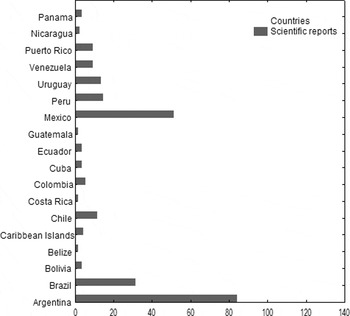
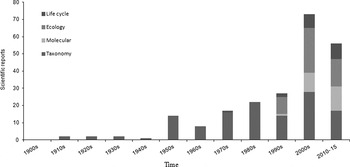
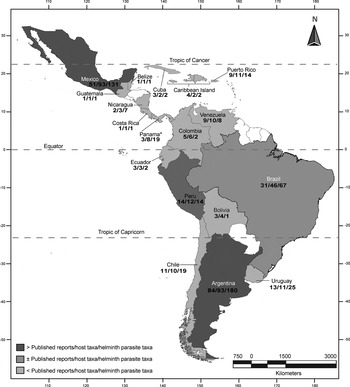
We identified 248 scientific papers reporting helminth parasites in aquatic invertebrate hosts from 18 LAC countries between 1900 and 2015 (fig. 1). The countries with the largest contributions in terms of the number of papers published were Argentina (84), Mexico (51), Brazil (31) and Peru (14) (fig. 1). More than 75% of these papers were published after the year 2000 (fig. 2). During most of the 20th century, all the studies of the different groups of helminths were on taxonomic aspects, then incorporated ecological, life-cycle and molecular studies (diagnoses) in the 1990s. Since the beginning of the 21st century there has been a noticeable increase of published studies, including taxonomy, with an increase between 2 and 6 times in the number of studies dealing with ecology and molecular approaches with respect to the end of the previous century (fig. 2). In general, countries with more published records accounted for a larger number of host species studied and, consequently, a larger number of helminth taxa reported (figs 2 and 3).
Number of research papers per country on helminths infecting aquatic invertebrates in Latin America.

Trend of the published records by research topic.

Published papers/host/helminth taxa recorded in Latin America per country. Map produced by http://www.naturalearthdata.com/, and modified in DIVA-GIS 7.5 (Hijmans et al., Reference Hijmans, Guarino and Mathur2012) (freely available through www.diva-gis.org).

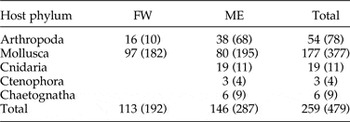
From the 248 scientific papers found, we obtained helminthological records for 113 freshwater (FW) and 146 marine–estuarine (ME) invertebrates belonging to five phyla: 68% molluscs, 21% arthropods, 7% cnidarians, 2% chaetognaths and 2% ctenophores (table 1). It is worth mentioning that cnidarians, chaetognaths and ctenophores are not found in freshwater environments. In both environments (FW and ME), the molluscs were the host group with most species studied (97 FW and 80 ME), followed by arthropods (16 FW and 38 ME). These two host phyla have the highest number of helminth taxa recorded for LAC (377 and 78, respectively; table 1).
Number of host species studied and their helminth records (in parentheses) from freshwater (FW) and marine–estuarine (ME) invertebrates from Latin America.

The records of helminths infecting aquatic invertebrates (FW and ME) in LAC (table 1) are poor compared to those obtained for vertebrates such as fishes (Luque et al., Reference Luque, Mouillot and Poulin2004; Luque & Poulin, Reference Luque and Poulin2007; Salgado-Maldonado, Reference Salgado-Maldonado2008; Pérez-Ponce de León et al., Reference Pérez-Ponce de León, García-Prieto, Mendoza-Garfias and Grillo2011). While we found 772 host–parasite relationships involving 259 host species for our dataset, Luque & Poulin (Reference Luque and Poulin2007) found 10,904 metazoan parasite–host associations involving 1660 marine and freshwater fish species for LAC. That means that for invertebrates we have less than 10% of the host–parasite relationships found in fish hosts, and just 15% of the number of fish host species studied. Regarding the number of invertebrate host species studied in LAC, our results demonstrate that only a limited number of species has been examined. Considering the estimated number of extant freshwater invertebrate species for the neotropics (Balian et al., Reference Balian, Segers, Lévéque and Martens2008), we may have data on helminth parasites for only 0.01% of the arthropods, and 1.18% of the molluscs known for the region. There is no estimation of the diversity of marine–estuarine invertebrate organisms in LAC, but from the estimates made by Leung et al. (Reference Leung, Mora, Rohde, Morand, Krasnov and Littlewood2015) on the diversity of marine invertebrates in the world, the hosts with helminth records for LAC would be 0.06% for the arthropods, 0.1% for molluscs, 0.2% for cnidarians and close to 2% for ctenophores and chaetognaths. Poulin (Reference Poulin2014) mentioned that, due to the current state of knowledge on helminth biodiversity, this field is in its infancy at global level. Thus, if we compare the knowledge acquired for the helminth parasites infecting fishes and mammals on a global scale, it is evident that in LAC we still have a long way to go.
Who is there?
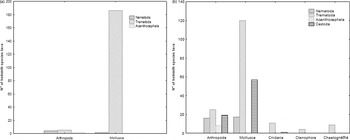
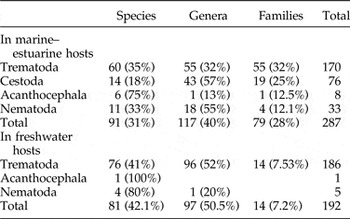
From 1900 to 2015 a total of 192 helminth taxa (186 Trematoda, 5 Nematoda and 1 Acanthocephala) have been recorded from freshwater invertebrates, while a total of 287 taxa (170 Trematoda, 76 Cestoda, 33 Nematoda and 8 Acanthocephala) have been recorded from marine–estuarine invertebrates (table 2, fig. 4). We did not find papers dealing with cestodes in freshwater invertebrates. Figure 4 shows the number of species of helminths in invertebrate host phyla in LAC. Trematoda was the only helminth group with records in all invertebrate host phyla, ranging from 4 taxa in the Ctenophora to 182 taxa in FW molluscs (fig. 4a). Marine Arthropoda was the only host phylum in which all four helminth groups occurred (fig. 4b).
Distribution of helminth groups in (a) freshwater (FW) and (b) marine–estuarine (ME) invertebrates of Latin America.

Identification status of the helminth taxa reported in aquatic invertebrate hosts from Latin America and the Caribbean.

The trematodes were the group with the most taxa reported (170 in ME hosts and 186 in FW hosts), but only 35% of the taxa have been determined to species level in ME hosts and 41% in FW hosts (table 2). The Acanthocephala, in contrast, is the group with fewest taxa recorded (9 in total), but 7 of the 9 taxa have been identified to species level (table 2).
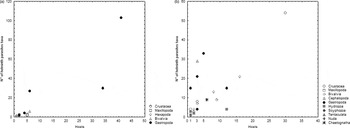
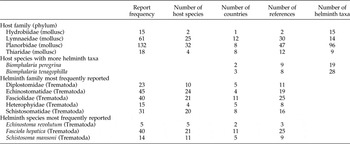
Supplementary tables S1 and S2 show a checklist of host–helminth species in LAC. In general, host phyla with a larger number of studies have also recorded a larger number of helminth taxa (fig. 5). Lymnaeidae and Planorbidae were the most studied host families among the FW invertebrates, with 25 and 32 host species coming from 12 and 8 countries, respectively. Ninety-six helminth taxa were recorded from the planorbids (all of them trematodes) and 14 from the lymnaeid hosts (table 3). Among the marine–estuarine invertebrates, the most studied host family was the Penaeidae, with 9 host species parasitized by 25 helminth taxa (table 4). Mytilidae and Ocypodidae were the next most studied host families with 8 and 7 host species each. Records in each case come from Mexico and Argentina for penaeids, Mexico and Argentina for Ocypodidae and Argentina, Brazil and Chile for the mytilids (table 4) (supplementary table S2). Fourteen helminth taxa were recorded in the mytilid hosts and 10 in the Ocypodidae.
Helminth parasite taxa recorded per host taxon studied in invertebrate hosts for Latin America and the Caribbean in (a) freshwater (FW) and (b) marine–estuarine (ME) environments.

Frequency of the most common host and helminth taxa reported in freshwater environments of Latin America.

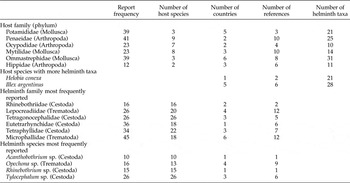
Report frequency of the most common host and helminth taxa in marine–estuarine environments of Latin America and the Caribbean.

The studies on helminths of invertebrates in LAC seem poor, apropos of the number of records, when they are compared with invertebrate studies from North America. Since trematodes were the most important group in terms of the number of species reported, the rest of this section focuses on this helminth group. In the only paper that can be directly compared with our review, Ching (Reference Ching1991) found for the North American Pacific coast (7 sites along USA and Canada) 73 trematode species from 23 gastropods, 1 scaphopod and 13 bivalves. If we compare the results of Ching (Reference Ching1991) with those from ME hosts in LAC, the average trematode species per host species examined was 1.97 trematode species for the former, while in LAC we would have 1.85. At first view these two numbers do not look too different, but it is almost certain that if we make a comparison not just with a single paper but with numbers coming from a specific literature review, the differences would be far greater, as North America surely has had a more sustained research effort in the quest for helminth parasites infecting aquatic invertebrate hosts. At this point, it is important to mention that, aside from the papers published by Ching et al. (Reference Ching1991) and Marcogliese (Reference Marcogliese1995) on zooplankton, we were not able to detect a published systematic review for North America compiling all the extant information on invertebrates as hosts of helminth parasites.
Large differences were found when the number of trematode species of freshwater molluscs between Europe and LAC were compared. Faltýnková et al. (Reference Faltýnková, Sures and Kostadinova2016) recently published a relevant paper including pulmonate (29 species), ‘prosobranch’ (15 species) and bivalve (11 species) freshwater molluscs from Europe. These molluscs were found to act as first intermediate hosts for 171 trematode species of 89 genera and 35 families (Faltýnková et al., Reference Faltýnková, Sures and Kostadinova2016), i.e. 5.3 trematode taxa per host species on average. In LAC we found that 97 freshwater mollusc species were reported as hosts of 73 species, 96 genera and 14 families of trematodes, which makes 1.9 trematode taxa per mollusc species. This result suggests again that the helminths in invertebrates in LAC are underrepresented due to a lack of sampling. It is not possible to attribute these results to a lower diversity of trematodes in LAC in comparison with Europe, as trematodes in molluscs have been studied in the Old World for the past two centuries (Zbikowska & Nowak, Reference Zbikowska and Nowak2009; Faltýnková et al., Reference Faltýnková, Sures and Kostadinova2016), making the results for Europe quite reliable.
It is not surprising that trematodes were the helminth group with the highest record of infection of both freshwater and marine–estuarine invertebrates in LAC, since this helminth group is considered the most diverse in vertebrate hosts from aquatic environments on a global scale (Cribb, Reference Cribb2016). Trematodes use invertebrates as first intermediate host (gastropods, bivalves and polychaetes), and any other invertebrate can be a second intermediate host where metacercariae can be found. They were the only helminth group with representatives in all host phyla, and the one where most life cycles have been studied, particularly in the families Diplostomidae, Heterophyidae, Microphallidae and Strigeidae from Argentina (Ostrowski de Nuñez, Reference Ostrowski de Núñez1973, Reference Ostrowski de Núñez1977, Reference Ostrowski de Núñez1989, Reference Ostrowski de Núñez1993; Martorelli, Reference Martorelli1986, Reference Martorelli1988; Martorelli et al., Reference Martorelli, Navone and Navone2000; Ostrowski de Nuñez & Quintana, Reference Ostrowski de Núñez and Quintana2008), and Cryptogonimidae and Apocreadiidae in Mexico (Scholz & Salgado-Maldonado, Reference Scholz and Salgado-Maldonado1994; Scholz et al., Reference Scholz, Lavadores, Vargas, Mendoza, Rodríguez and Vivás1994).
We did not find any records from freshwater invertebrates for Cestoda from LAC. It is possible to explain this ‘pattern of absence’ due to the fact that the major evolutionary diversification in cestodes occurred in marine environments (Littlewood et al., Reference Littlewood, Bray, Waeschenbach, Morand, Krasnov and Littlewood2015). On the other hand, sporadic records from other freshwater invertebrates (e.g. Temnocephaloidea; Lamothe-Argumedo, Reference Lamothe-Argumedo1981) support the fact that larval stages of cestodes are still likely to be found in poorly explored regions (e.g. LAC).
Who gets further?
The maximum number of helminth taxa recorded for a FW host species was 28 in Biomphalaria tenagophilla, with records coming from 3 countries (Argentina, Brazil and Uruguay), followed by the congeneric species Biomphalaria peregrina, with 19 helminth taxa from Argentina and Brazil (table 3). The ME host Illex argentinus was recorded as the intermediate host of 28 helminth taxa (table 4) from Argentina, Brazil, Chile, Nicaragua and Peru, followed by Helobia conexa, with 21 helminth taxa, all from Argentina. A host that is worth mentioning, due to its importance as an introduced species in the American Continent, is Melanoides tuberculata. This snail species has been recorded in seven countries (Brazil, Colombia, Costa Rica, Mexico, Panama, Peru and Venezuela), being infected by 5 trematode taxa, including Centrocestus formosanus and Haplorchis pumilio (supplementary table S1).
Table 3 shows the most frequent helminth families and helminth taxa recorded in freshwater aquatic invertebrate hosts from LAC. Fasciola hepatica was the helminth species reported with the widest geographical distribution in LAC, in 11 countries, from the largest number of host species (21 FW snails; supplementary table S1). Members of the Trematoda family Schistosomatidae (6 schistosome taxa) were also frequently recorded, infecting 20 host species from 8 countries, with Schistosoma mansoni as the most frequently reported taxon. Another helminth family that infected a large number of host species was the Echinostomatidae, with 11 echinostomid taxa recorded in 11 snail host species from Argentina, Brazil, Mexico and Uruguay (supplementary table S1).
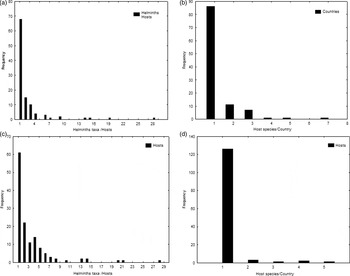
In the marine–estuarine hosts, there were six helminth families infecting 16–26 invertebrate host species (table 4). Four of these taxa were cestodes of the families Tetragonocephalidae (26 host species from Argentina, Brazil and Mexico), ‘Tetraphyllidae’ (22 host species from Argentina, Chile and Mexico), Eutetrarhynchidae (18 host species from Mexico) and Rhinebothriidae (15 host species from Mexico and one from Peru). Two trematode families were relevant in ME hosts: Microphallidae (18 host species from Mexico, Belize, Nicaragua, Panama, Peru and Argentina) and the Lepocreadiidae (20 host species from Argentina, Uruguay, Brazil and Mexico). The cestodes Tylocephalum sp., Rhinebothrium sp. and Acanthobothrium sp., together with the trematode Opechona sp., were the helminth taxa infecting the largest number of host species in LAC (table 4). None of the helminth taxa from marine–estuarine invertebrate hosts have been recorded in more than five countries in LAC (supplementary table S2). Figure 6 shows that only in a few host species have more than three helminth taxa been recorded, and for most studied hosts, only one or two helminth taxa are known (75% in FW hosts and 60% in ME). At the same time most host species have been recorded in just one country (77% in FW and 91% ME) and only a few have been studied in three or more countries (fig. 6).
Frequency distribution of helminth taxa per host (a) and frequency distribution of studied host species per country (b) in freshwater environments. Frequency distribution of helminth taxa per host (c) and frequency distribution of studied host species per country (d) in marine–estuarine environments.

It is not possible at this stage to draw reliable geographical distributions for the helminth parasites of aquatic invertebrates of LAC, since our knowledge is still poor and patchy. Besides, the geographical distribution of the different groups of invertebrates themselves is still poorly studied and uneven among countries across the region. The research that has been undertaken in this field in LAC has focused on helminth parasites of medical or veterinary importance. It was from these that some of the most studied host groups of molluscs across LAC were recognized to be members of the families Lymnaeidae and Planorbidae. The molluscs in these families are recognized as first intermediate hosts of F. hepatica (Lymnaeidae) and Schistosoma species (Planorbidae) (Kunz, Reference Kuntz1952; Flores-Barroeta & Castaneyra-Olea, Reference Flores-Barroeta and Castaneyra-Olea1962; Nassi & Bayssade-Dufour, Reference Nassi and Bayssade-Dufour1980; Nazir, Reference Nazir1980; Cruz-Mendoza et al., Reference Cruz-Mendoza, Velarde, Naranjo-García, Quintero-Martínez and Lecumberri-López2002; Bargues & Mas-Coma, Reference Bargues and Mas-Coma2005; Martorelli et al., Reference Martorelli, Alda, Marcotegui, La Sala and Montes2013). It is important to remark that for both invertebrates that are important in human health and those of natural history importance, very little is known about the historical biogeography of their parasites in LAC (Correa et al., Reference Correa, Escobar, Noyac, Velásquez, González-Ramírez, Hurtrez-Boussès and Pointier2011).
Among the marine–estuarine hosts, studies were strongly related to local commercially important host species (supplementary table S2). In consequence, there is a high variability in helminth taxa that have been recorded in such hosts, depending on the area. Shrimps, squids and some bivalves are some of the hosts with most helminth records (Feigenbaun, Reference Feigenbaum1975; Chávez-Sanchez et al., Reference Chávez-Sánchez, Hernández-Martínez, Abad-Rosales, Fajer-Ávila, Montoya-Rodríguez and Álvarez-Torres2002; Vidal-Martínez et al., Reference Vidal-Martínez, Aguirre-Macedo, Del Rio-Rodrıíguez, Gold-Bouchot, Rendón-von Osten and Miranda-Rosas2006; Aguirre-Macedo et al., Reference Aguirre-Macedo, Simá-Álvarez, Román-Magaña and Güemez-Ricalde2007; Jensen, Reference Jensen, Tunnell, Felder and Earle2009; Cremonte, Reference Cremonte, Figueras and Novoa2011; Zeidan et al., Reference Zeidan, Luz and Boehs2012). For ME hosts, we found only one study that has examined host species across different countries (Torchin et al., Reference Torchin, Miura and Hechinger2015). These authors tested trematode interactions at different latitudes using the trematodes of Cerithideopsis californica on the Pacific coast and those of Cerithidea pliculosa on the Atlantic coast as a study model. They collected samples from Panama, Nicaragua, Belize, Mexico, South California and Texas (USA). Contrary to what was expected, they found that the two host–trematode systems exhibit latitudinal gradients in species diversity, and that interaction strength increases from the tropics to the temperate zones. This finding casts doubt about the consistency of this pattern in other invertebrate host–helminth parasite systems because, in general, the patterns of diversity operate in the opposite direction (Rohde, Reference Rohde, Morand and Krasnov2010; Leung et al., Reference Leung, Mora, Rohde, Morand, Krasnov and Littlewood2015).
Although studies on helminth parasites in aquatic invertebrate hosts in LAC are still few in number, the increase of published records in the region in the past decade is notable. A search in the Web of Science demonstrated that countries such as Colombia, Ecuador, Panama and Venezuela are starting to contribute papers (e.g. Velásquez et al., Reference Velásquez, Bedoya, Areiza and Vélez2006; Rojas et al., Reference Rojas, Soto and Rojas2013; Siquier, Reference Siquier2014). However, there is still a long way to go. Systematics and morphological taxonomy were, and still are, the main subjects of the literature published during the past and the present century on helminths of invertebrates in LAC. However, modern approaches using molecular tools are beginning to support adult morphological identification in the region (Muñoz et al., Reference Muñóz, López and Cardenas2012; Alda et al., Reference Alda, Bonel, Panei, Cazzaniga and Martorelli2015; Cremonte et al., Reference Cremonte, Gilardoni, Pina, Rodrigues and Ituarte2015) and to link larval stages to adult forms found in vertebrate hosts (Iwagami et al., Reference Iwagami, Monroy, Rosas, Agatsuma and Agatsuma2003; Guillén-Hernández et al., Reference Guillén-Hernández, García-Varela and Pérez-Ponce De León2008; Davies et al., Reference Davies, Davies, Lauthier, Hamann and Ostrowski de Núñez2015). A confusing point related to the use of molecular tools concerns cryptic species. In fact, it is very difficult to appreciate the usefulness of this approach in the region for two main reasons. The first is that it is an expensive approach and, therefore, the use of this tool will concentrate published records even more on only a few countries (those with the tools). The second reason is that the number of cryptic species will increase based only on genetic sequences. Whether or not two morphologically identical species are truly different biological units (i.e. so-called cryptic species) is something that remains to be seen. In this sense, we agree with Poulin (Reference Poulin2014) that the use of this tool is opening ‘a can of cryptic worms’, given that in cases where limited or no morphological information on the helminth parasites of invertebrates exist, it may cause more problems than it provides solutions. On the other hand, it is necessary to include novel taxonomic information, such as state-of-the-art analyses of DNA sequences plus biological (i.e. behavioural, ecological, geographical distribution) and experimental evidence to establish species boundaries (Jörger & Schördl, Reference Jörger and Schördl2013; Karanovic et al., Reference Karanovic, Djurakic and Eberhard2015; Lajus et al., Reference Lajus, Sukhikh and Alekseev2015; Morard et al., Reference Morard, Escarguel, Weineri, Andre, Douady, Wade, Darliln, Ujiie, Seears, Quillevere, de Garidel-Thoron, de Vargas and Kucera2016). For example, a definite test of species limits would be to see whether or not viable offspring can be obtained by mixing gametes of the alleged cryptic species. Based on the idea that there is a reproductive barrier among species, we should expect that cryptic species should not be able to produce viable offspring.
Concluding remarks
The most important contribution of the present paper is the compilation of the extant information on helminths infecting invertebrate hosts in LAC. Recently, Poulin (Reference Poulin2014) suggested that ‘identifying patterns in the distribution of parasite diversity is the first step toward elucidating the underlying processes generating these patterns’. However, before identifying patterns, we need all the extant reliable information together. So, based on this information we can start to determine the kind of patterns suggested by Poulin (Reference Poulin2014) for LAC. We also realized that at this moment in history, it is not possible to produce a reliable estimation of the helminth species richness infecting invertebrates in LAC, since most of the information has been produced by just a handful of countries. In fact, countries such as Honduras, El Salvador, Paraguay, Guyana, Suriname and the French Guiana have not produced any published records at all, while 10 of 18 countries in LAC have 5 or fewer published records. In contrast, the largest numbers of published papers concerning the subject have come from Argentina, Brazil, Mexico and Peru (74%), where it was evident that a sustained effort on helminth parasitology has been undertaken since the beginning of the 20th century. These countries are also the ones with the oldest helminthological collections in Latin America, such as the Helminthological Collection of the Oswaldo Cruz Institute (CHIOC) established in 1917, the Colección Nacional de Helmintos de Mexico (CNHE) at the Institute of Biology-UNAM funded in 1932 and the Colección Helmintológica del Museo de La Plata (MLP) funded in 1970 (Lamothe-Argumedo et al., Reference Lamothe-Argumedo, Damborenea, García-Prieto, Lunaschi and Osorio-Sarabia2010). The laboratories holding these collections were initially established as part of the medical schools or as natural science laboratories to investigate helminth species related with human and veterinary diseases, which, over time, incorporated the study of helminths in other wild vertebrates, mainly fishes. At the same time, they promoted the foundation of other laboratories, expanding helminthological research in their respective countries. Similar patterns with respect to the scarcity of information on helminth parasites of wild animals, and especially in invertebrates, have been highlighted by Leung et al. (Reference Leung, Mora, Rohde, Morand, Krasnov and Littlewood2015) and Cribb (Reference Cribb2016).
How can the region contribute to solving questions related to helminth biodiversity in aquatic invertebrate hosts? In his last enlightening review on the subject, Poulin (Reference Poulin2014) posed four very clear questions related to helminth biodiversity on the global scale. (1) How many parasites are there? For LAC, the present contribution has compiled all the available information, from which it is clear that we need to increase the number of collaborations on morphological or molecular taxonomy among LAC countries for the different groups of helminth parasites. (2) Are there enough taxonomists to describe all the remaining species? Not in LAC, and probably the main reason for this is that young researchers can not foresee a viable future because academic positions are saturated. So, we must encourage young researchers to study parasite diversity, and at the same time urge funding organizations to allocate more money towards parasite diversity research. For instance, food fish aquaculture production expanded at an average annual rate of 10% in the period 2000–2012 in LAC (FAO, 2014). Based on this rate, it is reasonable to expect that sanitary problems will arise with an increase in the intensification of aquaculture in the region. This will be a great opportunity for young researchers to have a career in aquatic animal health and at the same time to obtain information on invertebrates as hosts of helminth parasites important in aquaculture. (3) How does parasite diversity vary across host species? Based on the information compiled in the present paper, this is a very difficult question to answer since the extant record is quite incomplete. However, something that has not been considered is the existence of information that is constantly produced by undergraduate and graduate theses in different countries in the region. It would be important to encourage both the students and supervisors to deposit their helminthological material in well-established collections in the region, such as the CHIOC, CNHE or MLP (Lamothe-Argumedo et al., Reference Lamothe-Argumedo, Damborenea, García-Prieto, Lunaschi and Osorio-Sarabia2010). (4) How does parasite diversity vary in geographical space? To tackle this question, a research strategy such as that applied by Torchin et al. (Reference Torchin, Miura and Hechinger2015) would be useful. It is also important to realize that mollusc species of the families Lymnaeidae and Planorbidae are very good candidates for this kind of study, since they have already been examined for parasites in several countries in the region. Finally, we concur with Poulin (Reference Poulin2014) in the need to use the information that we already have on helminth parasites of invertebrates of the region to tackle not only human health problems (e.g. Schistosoma) and conservation biology, but also sanitary problems related to the very dynamic growth of aquaculture in the region (Bush et al., Reference Bush, Heard and Overstreet1993).
Supplementary material
To view supplementary material for this article, please visit http://dx.doi.org/10.1017/S0022149X16000547
Acknowledgements
The authors wish to thank Victor M. Vidal-Martinez for early criticisms to this manuscript and two anonymous reviewers for their comments and criticisms which improved the manuscript. We thank Paul Jones (English teacher) for editing the English text.
Financial support
Financial support of A.L.M.-T. and A.M.-A. at the laboratory of Aquatic Pathology at CINVESTAV- IPN came from grant no. 201441-SENER-CONACYT.
Conflict of interest
None.