


Listening to a conversation between two bilinguals who are fluent in the same languages reveals that bilinguals do not exclusively use only one language during discourse. According to Grosjean and colleagues, a bilingual's language use can be viewed along a continuum, starting in a monolingual mode when only one language is used to a bilingual mode when communication is in both languages and there is a high likelihood of mixing the two languages (Grosjean, Reference Grosjean1982; Grosjean & Miller, Reference Grosjean and Miller1994). The bilingual mode is characterized by code-switching, loosely defined as the spontaneous switching from one language to another or the mixing of elements from two languages within a single speech event (Appel & Muysken, Reference Appel and Muysken1987). An example of English–Cantonese code-switching would be the sentence, “I want a sandwich but I don't like the gai (chicken)”. It is an informal speech style that reflects a natural and intentional performance by the bilingual, often in multilingual communities. Code-switching is driven by both linguistic and social factors, serving as part of a communicative strategy and an index to particular values and identities (Myers-Scotton, Reference Myers-Scotton1993). Nonetheless, code-switching is used to different degrees by individual bilingual speakers. The present study examines whether individual differences in code-switching use are related to flexibility in performing linguistic and non-linguistic tasks that require switching between mental sets.
There are different ways in which languages can come into contact in bilingual speech. In this study, we follow Muysken's (Reference Muysken2000) typology that differentiates between insertions and alternations. Similar to borrowing (where lone words are integrated into the other language's grammar and both languages constrain code-switching; Poplack & Meechan, Reference Poplack and Meechan1998), insertions are often single words incorporated into speech whereas alternations are likely to include several constituents that have greater length and complexity, implying that the speaker knows both languages and grammars well. Code-switching is not considered to be a hindrance to communication or effortful for the speaker when performed by stable and balanced bilinguals. Speakers who code-switch understand the underlying structure of each language and how they can be combined. Poplack (Reference Poplack1980) observed a relationship between language fluency and code-switching in which bilinguals who exhibited greater language proficiency preferred more difficult types of code-switches (i.e., intrasentential switches where linguistic boundaries are not overtly apparent than intersentential code-switching). Therefore, code-switching can be considered a strategic act, unlike interference or a lack of full language proficiency. This distinction becomes important in considering apparently contradictory results reported from different studies described below.
There is substantial evidence that for a bilingual, both languages remain active to some degree when one of them is being used, even in a monolingual context (Dijkstra, Van Jaarsveld & Ten Brinke, Reference Dijkstra, Van Jaarsveld and Ten Brinke1998; Marian & Spivey, Reference Marian and Spivey2003). For example, studies using a lexical decision task in which individuals must decide if a stimulus item is a valid word have shown that there are cross-language effects in which there is competition when items in the non-target language are presented as distracters (Van Heuven, Dijkstra & Grainger, Reference Van Heuven, Dijkstra and Grainger1998). Such results demonstrate that lexical access is not language-specific; lexical items are not only activated in the target language, but also in the non-target language where the word has a similar representation, supporting the idea of a non-selective access to an integrated lexicon (Brysbaert, Reference Brysbaert1998; Van Heuven et al., Reference Van Heuven, Dijkstra and Grainger1998). The joint activation of the bilingual's two languages leads to competition for selection that needs to be resolved, either at the level of whole language system (e.g., Kroll, Bobb & Wodniekca, Reference Kroll, Bobb and Wodniecka2006) or individual lexical item (e.g., Green, Reference Green1998). In both cases, a mechanism is needed to direct attention to manage the joint activation of the two languages (Abutalebi & Green, Reference Abutalebi and Green2008; Green, Reference Green1998). The mechanism is most likely found in the executive control system. The lifelong exercise of manipulating and controlling two languages results in modification of a range of cognitive functions.
Recent studies have demonstrated that bilinguals outperform their monolingual counterparts in executive functioning tasks involving processes such as inhibition, cognitive flexibility, and task switching (review in Bialystok, Craik, Green & Gollan, Reference Bialystok, Craik, Green and Gollan2009). The difference has been found across the lifespan, beginning in childhood (Bialystok & Martin, Reference Bialystok and Martin2004; Carlson & Meltzoff, Reference Carlson and Meltzoff2008), through adulthood (Costa, Hernández & Sebastián-Gallés, Reference Costa, Hernández and Sebastián-Gallés2008; Prior & MacWhinney, Reference Prior and MacWhinney2010) and continuing into older age (Bialystok, Craik, Klein & Viswanathan, Reference Bialystok, Craik, Klein and Viswanathan2004; Bialystok, Craik & Ryan, Reference Bialystok, Craik and Ryan2006; Salvatierra & Rosselli, Reference Salvatierra and Rosselli2010). This advantage has been examined not only in behavioral studies but also in studies using neuroimaging techniques (Luk, Anderson, Craik, Grady & Bialystok, Reference Luk, Anderson, Craik, Grady and Bialystok2010) showing structural changes in bilinguals for both grey matter thickness (Abutalebi, Della Rosa, Green, Hernandez, Scifo1, Keim, Cappa & Costa, Reference Abutalebi, Della Rosa, Green, Hernandez, Scifoone, Keim, Cappa and Costa2012) and white matter integrity (Luk, Bialystok, Craik & Grady, Reference Luk, Bialystok, Craik and Grady2011).
Task switching requires executive control (Monsell, Reference Monsell2003), but also resembles processes recruited by bilinguals when engaging in code-switching. Like natural code-switching, task switching requires keeping two sets of rules active and shifting attention between them so both tasks are performed correctly. This has a clear parallel to bilingual language use; the joint activation of two languages means that language processing for bilinguals is comparable to a constant “switch block” in a task-switching paradigm.
In a standard task-switching paradigm, participants are asked to perform two different tasks, such as classifying a stimulus picture by colour or by shape, first separately in non-switch blocks and then combined into a switch block where both tasks are required. In the non-switch blocks, participants learn two simple rules and those trials become a baseline for their performance. In switch blocks, individuals must keep both mental sets in mind as the two rules are mixed together. The task switching paradigm produces two types of costs. Global switch cost (or mixing cost) is the additional time required to complete non-switch trials (i.e., a trial that uses the same rule as the previous one) in switch blocks where both rules are possible compared to non-switch blocks, where only one rule is expected (Cepeda, Kramer & Gonzalez de Sather, Reference Cepeda, Kramer and Gonzalez de Sather2001). It reflects the efficiency of processes used for maintaining the two rules in memory and selecting the relevant one. Global switch costs decline through childhood then rise again in older age, indicating their reliance on resource-related aspects of the executive control system (Reimers & Maylor, Reference Reimers and Maylor2005). In contrast, a local switch cost represents the additional time required to perform a switch trial (i.e., the rule changes) versus a non-switch trial (i.e., the rule is unchanged from the previous trial) in the mixed blocks (Cepeda et al., Reference Cepeda, Kramer and Gonzalez de Sather2001). This cost assesses the effort needed to execute a response to accommodate a rule switch due to the change in stimulus–response mappings (Kramer & Kray, Reference Kramer, Kray, Bialystok and Craik2006). Unlike global switch costs, local switch costs are constant across the lifespan (Reimers & Maylor, Reference Reimers and Maylor2005).
Global switch costs rely on executive control, so bilinguals should show smaller global switch costs than monolinguals. However, in a recent study of non-verbal task switching, Prior and MacWhinney (Reference Prior and MacWhinney2010) reported that bilinguals displayed smaller local switch costs than monolinguals with no group difference in global switch costs. Yet, in studies of children (Barac & Bialystok, Reference Barac and Bialystok2012) and adults (Cepeda, Viswanathan & Bialystok, Reference Cepeda, Viswanathan and Bialystok2011), bilinguals have demonstrated smaller global switch costs than monolinguals with similar local switch costs for both groups. These discrepancies may reflect differences in tasks or differences in the language use patterns of the bilingual participants.
Linguistic factors affect performance as well. For example, language switching is a type of local switching that was found to be associated with asymmetrical costs. Meuter and Allport (Reference Meuter and Allport1999) investigated verbal task switching in bilinguals using a cued naming task and found larger costs for switching into the first language (L1) than into the second language (L2), but Calabria, Hernández, Branzi and Costa (Reference Calabria, Hernández, Branzi and Costa2012) found no differences in linguistic switching (i.e., symmetrical switch costs) with Catalan–Spanish bilinguals, and asymmetrical switch costs in the non-linguistic switching task.
A recent study examined verbal and non-verbal switching together in groups of younger and older Spanish–English bilinguals and showed different patterns of decline with aging for each (Weissberger, Wierenga, Bondi & Gollan, in press). They noted that language switching held up well with aging but non-verbal switching did not, a finding they used to conclude that different mechanisms of control were involved in each case. These findings are interesting but largely inferential because of other potential differences between groups. Therefore, a more direct study of the relation between language switching and non-verbal switching requires examining these abilities in the same participants in the context of a possible mechanism for switching performance. Specifically, if language experience generalizes to task switching, then individuals who engage in more code-switching will perform better on switching tasks than bilinguals who are more consistent in keeping their languages separate from each other in conversation. The relationship would be expected for both verbal and non-verbal switching tasks if the basis of these processes is similar. A more conservative prediction is that code-switching will only be related to verbal task switching.
Using this approach, Festman, Rodriguez-Fornells and Münte (Reference Festman, Rodriguez-Fornells and Münte2010) categorized late German–Russian bilinguals according to the amount of cross-language interference exhibited in a picture naming task. “Non-switchers” were those who made few language errors while “switchers” made many unintended and involuntary language switches. Non-switchers outperformed switchers in executive function tasks involving inhibition and problem solving, and the authors concluded that non-switchers had better executive control. However, the task instructions deemed language switching to be an error that needed to be avoided, so unintentional switching represented cross-language interference through lack of sufficient control over language selection; in this case, better executive control enabled participants to avoid these interference errors. In other words, the “switchers” were experiencing interference rather than performing code-switching, as described above.
In another study, Soveri, Rodriguez-Fornells and Laine (Reference Soveri, Rodriguez-Fornells and Laine2011) examined bilinguals' self-reports of language switching. Finnish–Swedish bilinguals completed several executive function tasks measuring inhibition and shifting as well as a questionnaire that asked them to estimate their language switching habits. Instead of measuring errors on a language test, language switching was determined through self-reports and bilinguals with a higher rate of language switching exhibited a smaller mixing cost (global cost), and more reported language switching was associated with better executive functioning.
Finally, self-reported language switching frequency was related to non-verbal switching in a study by Prior and Gollan (Reference Prior and Gollan2011) in which they tested two different bilingual groups. Spanish–English bilinguals who reported frequent language switching exhibited smaller non-verbal task switching costs than monolinguals, but Mandarin–English bilinguals who self-reported infrequent language switching did not. The authors concluded that differences in language switching were a possible link to greater efficiency in switching tasks, although other differences between the Spanish- and Mandarin-speaking groups may also have been involved.
The present study pursues the idea of a link between natural code-switching and executive functioning by considering that bilinguals who code-switch frequently are better able to control their languages and will demonstrate greater cognitive flexibility in task switching. We quantified bilinguals' code switching in a semi-structured conversation and assessed their ability to perform verbal and non-verbal switching tasks. This is in contrast to previous research that has relied exclusively on self-report questionnaires. The similarity between switching between two activated language systems (code-switching) and two activated rules (task switching) leads to the prediction that more experience in conversational code-switching will improve performance in task switching. A relation between code-switching and performance on both verbal and non-verbal switching tasks is possible if code-switching and task switching recruit the same general control processes. However, if control over switching is domain-specific, then code-switching will be related only to performance on verbal task switching. Additionally, if code-switching does not recruit executive control processes, there will be no relationship between the degree of code-switching and performance on task switching tests. The present study will contribute to understanding the association between bilinguals' code-switching and executive functioning.
Method
Participants
Participants were 78 Cantonese–English bilingual young adults 18 to 30 years old (M = 22.0, SD = 3.1) living in Toronto, Canada. Inclusion criteria were that participants were able to speak and understand Cantonese but did not need to be able to read or write. Compensation was in the form of course credit for their Introductory Psychology course or cash payment.
The sample included participants who were born in Canada (n = 42), Hong Kong (n = 20), China (n = 11), and elsewhere (n = 5). The mean length of residence in Canada for participants not born in Canada was 9.6 (SD = 6.2) years, ranging from 8 months to 22 years. Most participants reported English to be their dominant language for the past five years (n = 53).
Tasks
Background measures
A Language and Social Background Questionnaire was used to collect demographic information, including level of education, residence history, and language usage. Participants indicated the proportion of English and Cantonese used in daily life (i.e., at home vs. at school/work, with different interlocutors) on a numeric scale from 0 to 100, representing “No English” and “All English”, respectively. Participants also reported their proficiency level relative to a native speaker in both languages for each of speaking, understanding, reading, and writing, using a 0–100 scale again, representing “No Proficiency” to “Native-like Proficiency”. The questionnaire also elicited information about years of education, socioeconomic status as indicated by maternal education on a five-point Likert scale in which 1 indicated no high school and 5 indicated graduate or professional degree.
Non-verbal intelligence was measured by the Raven's Standard Progressive Matrices (Raven, Court & Raven, Reference Raven, Court and Raven1986). The task required participants to choose an item from a set of six or eight possibilities that best fits an overall visual pattern. There were five sets of 12 problems for a total of 60 and items became progressively more difficult. Correct responses were summed and then converted to IQ equivalents (Raven, Court & Raven, Reference Raven, Court and Raven1990).
The Peabody Picture Vocabulary Tasks–III (PPVT–III; Dunn & Dunn, Reference Dunn and Dunn1997) is a standardized measure of receptive vocabulary. The test required the participants to choose a picture (out of four possibilities) that best depicted a word named by the experimenter. Items became increasingly difficult, and the test was terminated when eight errors occurred in a block of twelve trials. There are two equivalent forms of the PPVT–III; Form IIIA was administered in English and Form IIIB in Cantonese using its translated equivalent (Bialystok, Luk & Kwan, Reference Bialystok, Luk and Kwan2005). Because the Cantonese version is not standardized, it cannot be directly compared with the PPVT–III in English but it can still give an approximation of Cantonese proficiency.
Conversation
Code-switching was assessed through a semi-structured conversation in which the participants discussed two life experiences with the experimenter: Chinese New Year (Chinese topic) and future career plans (English topic). The order was counterbalanced and the topics were introduced with the incongruent language (i.e., Chinese New Year was matched with English instructions and prompts) to maximize code-switching in an artificial laboratory setting within an English-dominant context. Both topics included a single-language prompt and two mixed-language prompts. In the single-language prompt, the experimenter introduced the topic and asked about the participants' experiences (e.g., “Most people do something special to celebrate Chinese New Year. I was wondering if you did anything special.”). The mixed-language prompts included an example from the experimenter and asked whether they were in a similar situation, for example (Cantonese code-switching in italics), “I usually celebrate with my family and my grandmother comes over to cook. Because only she can make the really delicious pork and vegetable buns during this holiday. Do you know of some of the traditions and things that people do to celebrate Chinese New Year?” Responses were recorded using a handheld digital tape recorder and Audacity, an audio editing and recording computer program (Mazzoni & Dannenberg, Reference Mazzoni and Dannenberg1999). Code-switches were identified for all speech excerpts and classified following Muysken's (Reference Muysken2000) framework.
Verbal task switching
Verbal task switching was based on the category fluency condition of the verbal fluency task in which individuals are given 60 seconds to generate items that conform to a semantic category, such as clothing or sports. Participants completed this task once in each language. Following this, they were given an adaptation of the task that included language switching. Participants were given a category and told which language to begin with, and were required to continue generating exemplars by alternating between languages without repeating concepts. For example, if the category was animals and the starting language was English, the participant may respond with dog in English, “cat” in Cantonese, lion in English, and so forth, with the restriction that no item could be named in both languages. There were four trials using the categories animals, fruits and vegetables, clothing, and sports. The categories were not repeated and were counterbalanced for order and language. The first two trials followed the standard instructions using a single language (blocked-language condition), with the order of Cantonese and English counterbalanced. The last two trials were the mixed-language condition, counterbalanced by the starting language. The mixed-language trials always followed the blocked-language trials. This alternating condition allowed a verbal switch cost to be calculated as the difference between the number of correct responses in the blocked-language condition and the number of correct responses in the mixed-language condition for each participant. This is similar to the calculation of a global switch cost but in this case there are no non-switch trials in the mixed block so the estimate is perhaps less precise. Scores were calculated by subtracting category errors (responses that do not belong in the category), repetition errors, and language errors (responses that were not in the specified language) from the total number of responses generated. Responses were recorded using a handheld digital tape recorder and Audacity.
Non-verbal task switching
Two non-verbal tasks were used to assess executive control: the 2D switching task (Barac & Bialystok, Reference Barac and Bialystok2012) and the Faces task (Bialystok et al., Reference Bialystok, Craik and Ryan2006). In the 2D switching task, participants saw pictures of red horses and blue cows and matched each picture to one of two targets, a red cow or a blue horse, according to a cue that appeared with the picture (see Figure 1). For colour matches, the cue was a small colour wheel appearing above the stimulus picture, and for shape (animal) matches, the cue was an irregular shape. Participants responded by pointing to one of the target pictures on the touch screen monitor. The first two blocks were non-switch and used only one of the sorting dimensions, with the order counterbalanced. These were followed by a practice switch block and eight experimental switch blocks. Each switch block contained 25 task-switch trials and on average 25 non-switch trials. Because colour and shape trials were generated randomly by the program with a 50% chance for a rule change, the number of trials differed slightly for each subject. There was an interval of one second between trials. Reaction time (RT) and accuracy were recorded for each trial. Global switch cost was calculated as the difference between the mean RT for non-switch trials in switch blocks and non-switch blocks. Local switch cost was calculated as the difference between mean RT for switch and non-switch trials in the mixed blocks.
The 2D switching task requires individuals to classify a stimulus picture by two dimensions, shape or colour. In this example of a shape classification trial, the correct response is to choose the cow on the right side because the cue indicates the shape rule. The task is based on Barac and Bialystok (Reference Barac and Bialystok2012), and Cepeda et al. (Reference Cepeda, Viswanathan and Bialystok2011).

In the Faces task, a schematic face was presented for 1000 ms in the center of the screen with a box on each side of the monitor (see Figure 2). The eyes then turned either green or red for 500 ms, and then the face disappeared, leaving a blank screen. After 200 ms, an asterisk appeared in one of the boxes for 150 ms, and participants pressed a key to indicate the location of the asterisk according to a colour-based rule. If the eyes had been green, they pressed the key on the same side as the asterisk had appeared; if the eyes had been red, they pressed the key on the opposite side. There were two conditions: the eyes looking straight ahead or the eyes gazing to the left or right side boxes. These gaze shifts could either be congruent with the response in that they led the participant to the correct response key or incongruent as they led to the opposite side. Thus, the gaze shift condition added distraction in that the participants had to ignore the irrelevant gaze. For both conditions, there was one block of green eyes (24 trials), one block of red eyes (24 trials), and one mixed block of green and red eyes (48 trials). For the shifting gaze condition, there was an additional mixed block of green and red eyes (48 trials). The order of trials was random within the mixed blocks. Eight practice trials preceded each block and more were provided if needed. RT and accuracy were recorded for each trial. RTs were used to calculate costs for response suppression, inhibitory control, and switching. Response suppression was calculated as the mean RT difference between green eye trials and red eye trials. Inhibitory control was calculated as the mean RT difference between mixed trials in the straight gaze condition and mixed trials in the shifting gaze condition. Switch cost was calculated as the mean RT difference between blocked and mixed trials (see Bialystok & Viswanathan, Reference Bialystok and Viswanathan2009).
The Faces task requires individuals to respond to the relative position of an asterisk, depending on the colour of the eyes in the cartoon face. In this example, the correct response is to press the key on the right-hand side because the red eyes require responses to be made on the opposite side of the asterisk. The task is based on Bialystok et al. (Reference Bialystok, Craik and Ryan2006).

Procedures
Participants completed a language background questionnaire through oral discussion with the experimenter. Order of presentation of the PPVT–III in the two languages and the two non-verbal switching tasks was counterbalanced. The verbal task switching measure was administered between the two PPVT–III and two non-verbal switching tasks, so that one PPVT–III and one non-verbal task always preceded and followed it. The session was conducted in English, with Cantonese used in the Cantonese PPVT–III and parts of the verbal switching task. Participants were told they could use either of their languages and were permitted to switch languages during the study, unless explicitly directed not to (e.g., PPVT–III, verbal switching). Code-switching was used strategically by the experimenter in the background questionnaire and conversation task to model this instruction and to establish a bilingual setting.
Results
Background
Participants had a mean of 15.2 (SD = 2.2) years of education and a mean standard IQ score of 95.5 (SD = 11.4). Maternal education had a mean of 2.4 (SD = 1.2), indicating the participants' mothers were typically high school graduates with a college diploma or some college experience.
Most of the participants acquired Cantonese and English as their L1 or L2 (n = 65) sequentially but seven participants indicated that they acquired both languages simultaneously. Cantonese was reported as the L1 for the majority (n = 59), followed by English (n = 7) and Mandarin and other Chinese dialects (n = 5). Individuals who did not acquire Cantonese or English as their L1 or L2 learned the language as L3 (n = 13 for English and n = 2 for Cantonese). The median age of Cantonese or English acquisition (when not acquired as L1) was 4.0 years (SD = 2.7). On average, participants' self-reported their level of bilingualism to be 4.1 (SD = .81) on a five-point Likert scale, describing themselves as practical bilinguals who could converse fluently in their L2 but may not use it every day.
Participants self-rated their proficiency in English and Cantonese on a 100-point scale and showed high competence in oral uses of both languages, as shown in Table 1. English and Cantonese scores on the PPVT–III confirmed proficiency in both languages. The English PPVT–III raw score was 165.3 (SD = 19.1) and the standard score was 95.6 (SD = 13.8). The mean raw PPVT–III score for Cantonese was 180.0 (SD = 17.6), out of a possible maximum score of 204. No standard score was calculated for the Cantonese PPVT–III.
Means and standard deviations of participants' reported proficiency out of a maximum of 100 in English and Cantonese (n = 78).

Conversation
The total speaking time for each participant was measured in seconds and summed across topic and excerpt. Participants spoke for an average of 92.4 seconds (SD = .92). To calculate a code-switching score, the number of switches performed by each participant was divided by the total time of speaking and then multiplied by 60 to estimate the average number of switches performed per minute. Seven participants did not code-switch during the conversation and received a code-switching score of 0. The mean code-switching score was 5.0 (SD = 4.0) switches per minute. This score was not correlated with proficiency scores in English, r = –.11, ns, or Cantonese, r = .10, ns.
Verbal task switching
Performance on the verbal fluency task by language is presented in Table 2. Participants produced significantly fewer items in the mixed-language condition than in the blocked-language condition, t(76) = 9.4, p < .001. For the blocked condition, a repeated-samples t-test showed that participants generated significantly more correct items in English than in Cantonese, t(76) = –4.44, p < .001. For the mixed condition, a repeated-samples t-test revealed that participants produced significantly more correct items when they were asked to start a trial in English than in Cantonese, t(76) = –2.69, p < .01. Table 2 also presents the mean number of correct items produced in the mixed-language trials separated by language of response. A two-way repeated-measures ANOVA conducted for mixed trials (starting with Cantonese, starting with English) and language of responses (Cantonese, English) showed a significant interaction between trial and language, F(1,76) = 44.02, p < .001. Participants produced more correct English items in the mixed-language trial when they began with English than when they began with Cantonese, but there was no difference in the number of Cantonese items generated in the two mixed trials.
Mean number of correct responses (and standard deviations) produced in the blocked- and mixed-language conditions of the verbal switching task (n = 77a).

a One participant was excluded due to a problem with the recording equipment.
The relationship between language proficiency and performance in the verbal fluency task are summarized in Table 3. PPVT–III English scores were related to the generation of words in the English blocked-language condition but not to the other three scores. Chinese scores were more broadly related to performance in the verbal switching task.
Correlations between PPVT–III performance and number of correct responses produced in the blocked-language and mixed-language conditions of the verbal switching task (n = 77a).

* p < .01; ** p < .001
a One participant was excluded from the verbal switching task due to a problem with the recording equipment.
The number of words produced in the two blocked-language conditions were averaged to create a non-switch score (M = 14.8, SD = 3.8), and the number of words produced in the two mixed-language conditions produced an overall language switch score (M = 10.6, SD = 2.7). The difference between the switch and non-switch score was considered to be verbal switching cost. The mean verbal switching cost was 4.2 (SD = 3.9). The verbal switching cost was not associated with IQ, r = .10, ns, or PPVT–III performance in English, r = .20, ns, or in Cantonese, r = –.04, ns.
Non-verbal task switching
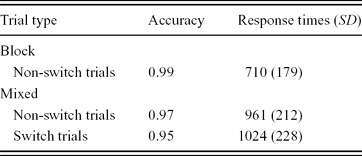
Mean accuracy and RT for the 2D switching task and Faces task are presented in Table 4 and Table 5, respectively. RTs were used to calculate global and local costs for the 2D switching task and costs for response suppression, inhibitory control, and switching in the Faces task. These costs are presented in Table 6 with data from two other studies using those tasks with samples of monolingual and bilingual young adults from the same population. IQ was not correlated to any of the costs in the 2D switching task (global cost, r = –.04, ns; local cost, r = –.10, ns) or the Faces task (response suppression, r = –.15, ns; inhibitory control, r = –.08, ns; switching, r = –.02, ns). For the 2D switching task, there was a relation between the English PPVT–III and global cost (r = .24, p < .05; local, r = –.09, ns), but no relation between the Cantonese PPVT–III and non-verbal costs (global, r = –.11, ns; local, r = –.02, ns). No significant correlations were detected for the Faces task and PPVT–III in English (response suppression, r = –.03, ns; inhibitory control, r = –.12, ns; switching, r = .11, ns) and Cantonese (response suppression, r = –.17, ns; inhibitory control, r = .12, ns; switching, r = –.17, ns).
Mean accuracy rates and mean response times in milliseconds (and standard deviations) for the 2D switching task (n = 76a).
a Two participants' data were excluded due to an error in recording.
Mean accuracy rates and mean response times in milliseconds (and standard deviations) for all trial types in the Faces task (n = 78).

Mean switch costs in milliseconds (and standard deviations) in the 2D switching task and Faces task, along with results obtained from the same tasks used in other studies.

a In the study by Bialystok et al. (Reference Bialystok, Craik and Ryan2006), inhibitory control was calculated using a different formula. These data have been recalculated from the original data using the formula applied in the present study.
The 2D switching task data are compared to those obtained from Cepeda et al. (Reference Cepeda, Viswanathan and Bialystok2011) in which the same task was administered to 37 monolingual and 31 bilingual young adults. Participants in the two language groups in the Cepeda et al. study were matched on background measures, and the bilinguals spoke English plus one of 19 different languages. Analyses revealed a significant bilingual advantage in global switch cost with no group difference in local switch cost. Even without formal statistical analysis it is clear that the bilinguals in the present study performed similarly to the bilinguals in the study by Cepeda et al. (Reference Cepeda, Viswanathan and Bialystok2011). Also in Table 6, the costs for response suppression, inhibitory control, and switching for the Faces task are reported with data obtained from the same task in a previous study (Bialystok et al., Reference Bialystok, Craik and Ryan2006). In that study which included 24 monolingual and 24 heterogeneous bilingual young adults (again matched on background measures), the costs for response suppression and switching were significantly smaller for the bilingual participants than for the monolinguals. Again, the data in Table 6 show that the bilinguals in the present study performed similarly to those bilinguals in the previous study.
Relationships between code-switching and task switching
Prior to testing for the relationship between code-switching and task switching, the data were examined for potential multivariate outliers. Scatterplots were generated to identify potential outliers and each such observation was tested for extreme leverage, discrepancy, and influence using Hat values, Studentized Deleted Residuals, and Cook's Distance statistics, respectively. A conservative approach was taken for excluding extreme values. Omitted outliers were statistically significant extreme leverage and influential cases where the values were more than two times greater than the calculated cutoffs. Five outliers were detected and omitted.
There was a significant negative correlation between conversational code-switching and verbal switching cost, r = –43, p < .001. Thus, participants who produced more code-switches during the conversation task exhibited a reduced cost in the verbal switching task. The relationship persisted after controlling for Cantonese and English proficiency (measured by the PPVT–III), r = –.43, p < .001 (see Figure 3).
Scatterplot showing correlation between average number of code-switches in conversation and verbal switching cost (n = 72).

There was no relationship between code-switching and non-verbal task switching. The correlation between conversational code-switching and global cost, r = .13, ns, and local cost, r = .01, ns, in the 2D switching task were both nonsignificant. Similarly, the correlation between code-switching and the three costs from the Faces task (response suppression, r = .13, ns; inhibitory control, r = –.18, ns; switching, r = .00, ns) were all nonsignificant.
Discussion
The main goal of the present study was to investigate the relationship between code-switching and verbal and non-verbal task switching. The rationale was that maintaining two languages in mind, as bilinguals do routinely, is similar to the demands of performing in a task switching situation. Therefore, the hypothesis was that natural language switching in conversation would influence executive functioning so that more frequent code-switching would be beneficial to task switching performance in bilingual young adults. This hypothesis was partly confirmed: there was a negative relationship between code-switching and verbal switching cost, indicating smaller costs for bilinguals who engaged in more conversational code-switching. However, there was no relationship between the degree of code-switching and non-verbal task switching, although the Cantonese–English bilinguals in the present study performed similarly to bilinguals tested on these non-verbal tasks in previous studies (Bialystok et al, Reference Bialystok, Craik and Ryan2006; Cepeda et al., Reference Cepeda, Viswanathan and Bialystok2011). These results support a dissociation between the mechanism by which code-switching influences verbal and non-verbal task switching.
The results confirmed a relation between natural code-switching and verbal task switching, an association that remained after controlling for language proficiency, signifying that verbal switching was not limited by proficiency. Therefore, code-switching is distinct from formal language proficiency and it is not simply related to vocabulary but also to language use. To understand the relationship between code-switching and verbal task switching, it is first necessary to consider the demands of the verbal switching task. The blocked-language and mixed-language conditions of the verbal switching task both depend on linguistic and cognitive resources but in different degrees. Performance in the blocked-language condition is largely related to language proficiency and places demands on vocabulary knowledge and semantic associations as shown in the pattern of correlations in Table 3. Producing words within a semantic category is a well-developed process and largely automatic (Luo, Luk & Bialystok, Reference Luo, Luk and Bialystok2010), and aside from the need to avoid repetitions, the executive demands for this condition are minimal. In contrast, the mixed-language condition assesses both language proficiency and executive control. The continuous monitoring demanded by the forced switching is somewhat analogous to natural code-switching, where bilinguals must monitor the appropriateness of their mixed code with morphosyntactic and sociolinguistic constraints. Thus, both the mixed-language condition (involving forced switching) and conversational code-switching require executive control to monitor language selection and output. The present results cannot confirm the direction of the relationship: individuals who engage in more code-switching may have developed a better ability to perform the verbal switching task, or individuals who have a high degree of executive control may simply do both of these tasks well. Importantly, the present results show that both code-switching and verbal task switching have a common reliance on executive control.
The results for non-verbal task switching are different from those for verbal task switching. Our results also appear to be different from those reported by Festman et al. (Reference Festman, Rodriguez-Fornells and Münte2010) but these differences are more apparent than real. First, switchers in the Festman et al. (Reference Festman, Rodriguez-Fornells and Münte2010) study were defined as bilinguals who were unable to prevent the interference of a non-target language and so were individuals with poor language control. This is in contrast to the bilingual participants in our study who made deliberate code-switches that were explicitly acceptable and at times required in our verbal tasks, demonstrating a strong communicative competence in both languages (Romaine, Reference Romaine1995). Second, bilinguals in the Festman et al. (Reference Festman, Rodriguez-Fornells and Münte2010) study were categorically classified into two groups; our quantitative approach defined code-switching as a continuous variable so provided a more nuanced depiction of linguistic behavior derived from performance in a conversation. Lastly, not only is language switching sensitive to different measurement methods, but also the differences in task demands and task sensitivity in the two studies may account for some of the variation.
The key finding in the present study is that individuals who were more linguistically flexible and engaged in more conversational code-switching were also better able to manage the required language switches in the verbal switching task. Moreover, facility with the required languages switches in the experimental task was significantly related to the extent to which the participant engaged in code switching in natural conversation. The switch costs found for the bilinguals in the non-verbal switching tasks in the present study are in line with performance of bilinguals in our previous research, but the effect does not emerge as an individual difference relating the degree of conversational language switching to facilitation in non-verbal switching as it does for the verbal switching task. Thus, we can infer a bilingual advantage on non-verbal switching tasks from these data but that advantage is not mediated by the extent to which bilinguals engage in language switching (conversation task) or perform on a controlled test of verbal switching (verbal fluency task). Our conclusion is that bilingualism is associated with a general advantage in switching that applies to both verbal and non-verbal tasks, but the absence of a relation to conversational switching in the latter case suggests that the mechanism for each might be different. For example, following the influential model of the subcomponents of executive control by Miyake, Friedman, Emerson, Witzki, Howerter and Wagner (Reference Miyake, Friedman, Emerson, Witzki, Howerter and Wager2000), the advantages for verbal and non-verbal switching may depend on different configurations of those components.
As a final point, we have argued that non-verbal task switching should produce bilingual advantages in global but not local switch costs, a point demonstrated in previous research (e.g., Cepeda et al., Reference Cepeda, Viswanathan and Bialystok2011; Costa et al., Reference Costa, Hernández and Sebastián-Gallés2008). To recap, global costs reflect the additional effort required to perform a task when two rule sets must be actively available compared to only needing one rule set, and local costs reflect the added effort to change a response within the context of two active rule sets. If a language system is regarded as a rule set as we have assumed, then language use in bilinguals involves two active sets; in other words, language processing can be considered to be a global switch cost and the actual switching between two languages to be a local switch cost. Therefore, it may be that practice in bilingual language use, especially for individuals who engage in highly frequent code-switching, provides benefits to both global switch costs (through the general exercise of executive control) and local switch costs (through specific training in response switching). The present study cannot adjudicate this point because it is ultimately not possible to obtain verbal switching costs for monolingual participants. Our view is that switching between languages is fundamentally different from the intralingual switching that is part of monolingual speech. However, our data confirm that the degree to which an individual engages in code-switching does not incrementally enhance performance on non-verbal task switching as it does for verbal task switching. The present study not only contributes to a more precise understanding of the role that bilingual experience plays in executive functioning in young adults, but also demonstrates how individual differences in language use are related to switching tasks that are both linguistic and non-linguistic in nature. The reliance on executive control for conversational code-switching makes this a fruitful area for understanding the relationships between linguistic experience and cognitive performance of bilinguals.



