I. INTRODUCTION
Borates have attracted more and more attention during the last several decades due to their interesting structures and promising applications in nonlinear optical materials (NLO), birefringent materials, ferroelectric and piezoelectric materials, and luminophores. Reference Becker1–Reference Ding and Miura5 Especially, the β-BaB2O4 (β-BBO), Reference Chen, Wu, Jiang and You6 LiB3O5 (LBO), Reference Chen, Wu, Jiang, Wu, You, Li and Lin7 CsLiB6O10 (CLBO), Reference Mori, Kuroda, Nakajima, Sasaki and Nakai8 and KBe2BO3F2 (KBBF) Reference Wu, Tang, Ye and Chen9 are outstanding NLO materials for efficient second harmonic generation (SHG) of Nd:YAG lasers significantly used in UV or deep-UV wave length. Since the crystal structures directly affect the properties of materials, many strategies were used to synthesize promising optical materials. Reference Yu, Wu, Pan, Yang, Hou, Su, Jing, Poeppelmeier and Rondinelli10–Reference Zhang, Su, Pan, Wang, Zhang, Yang, Zhang, Dong, Wang, Zhang and Yang16 Recently, some novel aluminum borate crystals with excellent NLO properties have been reported, such as K2Al2B2O7, Reference Hu, Higashiyama, Yoshimura, Yap, Mori and Sasaki17,Reference Liu, Liu, Wang, Hu, Li and Chen18 BaAl2B2O7, Reference Liu, Liu, Wang, Hu, Li and Chen18 and BaAlBO3F2. Reference Zhou, Yue, Wang, Yang, Cheng, Cui, Peng, Hu and Xu19 With rapid development of science and technology, the researchers still endeavor to design new NLO materials.
According to the anionic group theory, Reference Chen, Lin and Wang20 coplanar and aligned NLO-active BO3 groups in the structure will give rise to a relatively large SHG response and a sufficient birefringence for the generation of deep-UV coherent light. Based on the research of Becker, Reference Becker1 isolated BO3 groups could exist in the ratio of cations:boron > 1, which means that it is feasible to obtain borates with isolated BO3 groups by increasing the proportion of cations in experiments. It is noteworthy that the introduction of cations with strong bonding (such as Be2+, Al3+, Mg2+, Zn2+, Si4+, etc) Reference Wu, Tang, Ye and Chen9,Reference Yu, Wu, Pan, Yang, Hou, Su, Jing, Poeppelmeier and Rondinelli10,Reference Lu and Godbole13,Reference Hu, Higashiyama, Yoshimura, Yap, Mori and Sasaki17–Reference Zhou, Yue, Wang, Yang, Cheng, Cui, Peng, Hu and Xu19,Reference Zhou, Fang, Rong and Yang21 can inhibit the polymerization of B–O groups. Hence, the UV-favorable system, Al–B–O, was chosen and anticipated to find new borate with excellent NLO property. In addition, the bonds between B–O and Al–O are covalent, and it is interesting to investigating the structure–optical property. Extensive efforts in the Al2O3–B2O3 system led to a new NLO crystal of Al5BO9.
The structure of Al5BO9 was first reported by Sokolova et al. in 1978. Reference Sokolova, Azizov, Simonov, Leonyuk and Belov22 Recently, Gatta et al. Reference Gatta, Lotti, Merlini, Liermann, Fisch, Rotiroti and Armbruster23 researched behavior and phase stability of Al5BO9 in high-pressure condition, and Ok et al. Reference Shin, Lee, Hong, Kawk and Ok24 analyzed the SHG properties of Al5−x Ga x BO9 (0.0 ≤ x ≤ 0.5) solid solutions. Moreover, a centrosymmetric Al5BO9 (space group Pbam; unit cell parameters a = 7.621 Å, b = 7.621 Å, c = 2.833 Å, V = 164.54 Å3, and Z = 1) were reported by Mazza et al. Reference Mazza, Vallino and Busca25 in 1992. However, the origin of the NLO response, especially the contribution from the Al–O polyhedra, was not analyzed. Herein, we report the crystal preparation, thermal behavior, linear and nonlinear optical properties of the title compound, and the ab-initio calculations have been used to research the structure–properties relationship.
II. EXPERIMENTAL PROCEDURES
A. Synthesis
The single crystals of Al5BO9 were prepared by high-temperature solution method using LaF3–B2O3 as the flux system. All reagents (99%) were used as received. A mixture of Al2O3, B2O3 and LaF3 at a molar ratio of 5:4:2 was prepared and loaded into a platinum crucible. The crucible was calcined at 400 °C for 4 h to eliminate the water and further to 1300 °C for 10 h to ensure the powder melted into solution completely and mixed homogeneously, then the furnace was slowly cooled down to 1000 °C at a rate of 2 °C/h, further cooling to 900 °C at 5 °C/h, followed by cooling to room temperature at a rate of 20 °C/h. The transparent and colorless needle-like single crystals were obtained on the surface of crucible.
The title compound was synthesized by conventional solid–state reaction. Stoichiometric mixture of Al2O3 and B2O3 (99.99%) was ground homogeneously and gradually heated to 970 °C, held for 5 days with several intermediate grindings and mixings until stable phase obtained.
B. Structure determination
A prefect single crystal of Al5BO9 with dimensions 0.255 mm × 0.133 mm × 0.076 mm was selected for the structure determination. The crystal structure of Al5BO9 was determined by single crystal x-ray diffraction on an APEX II CCD diffractometer using monochromatic Mo Kα radiation (λ = 0.71073 Å) at 296(2) K and integrated with the SAINT program. And numerical absorption corrections were carried out using the SCALE program for area detector. All calculations were performed with programs from the SHELXTL
Reference Sheldrick26
crystallographic software package. The structure was checked for missing symmetry elements with PLATON.
Reference Spek27
All atoms were refined using full matrix least-squares techniques with anisotropic thermal parameters, final least-squares refinement is on
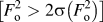
 $F_{\rm{o}}^2$
with data having
 $F_{\rm{o}}^2 \ge 2\sigma \left( {F_{\rm{o}}^2} \right)$
. The final difference Fourier synthesis map showed maximum and minimum peaks at 0.517 and −0.553 e Å−3, respectively.
C. Thermal analysis
The thermal gravimetric (TG) analysis and differential scanning calorimetry (DSC) of Al5BO9 were studied on the NETZSCH STA 449C simultaneous thermal analyzer (Selb, Germany), the sample is heated from 40 to 1400 °C at a rate of 10 °C/min in an atmosphere of flowing nitrogen gas.
D. Vibrational spectroscopy and optical properties
The UV–vis–NIR diffuse reflectance spectrum of Al5BO9 was measured at room temperature with Shimadzu SolidSpec-3700DUV spectrophotometer (Kyoto, Japan). Data were collected at the measurement range extended from 190 to 2500 nm. And the reflectance spectrum was converted to absorbance using the Kubelka–Munk function. Reference Kubelka and Munk28
An infrared spectrum was carried out on a Shimadzu IR Affinity-1 (Kyoto, Japan) in the range of 400–4000 cm−1 with a resolution of 2 cm−1. The sample was mixed thoroughly (500 mg of dried KBr and 5 mg Al5BO9) and compressed into 1 cm diameter translucent plate.
E. Second-order NLO measurements
The powder SHG test was carried out on the ground Al5BO9 single crystal by the Kurtz–Perry method. Reference Kurtz and Perry29 A pulsed Nd:YAG laser with a wave length of 1064 nm was used as light resource, and the intensity of the frequency-doubled output from the sample using a photomultiplier tube was measured. Since the SHG efficiency of powders has been shown to depend strongly on particle size, the amounts of single crystal were ground and sieved into distinct particle size ranges, <20, 20–38, 38–55, 55–88, 88–105, 105–150, and 150–200 μm. For comparison, well-known SHG material, crystalline KH2PO4 (KDP) samples, was used as references.
F. Details of calculations
Geometry optimization, electrons structure, and optical properties were calculated by CASTEP Reference Clark, Segall, Pickard, Hasnip, Probert, Rrfson and Payne30 via plane-wave pseudopotential method. Reference Payne, Teter, Allan, Arias and Joannopoulos31 The exchange correlation interaction was treated by the local density approximation (LDA) with the Ceperley and Alder–Perdew and Zunger functional (CA–PZ). Reference Rashkeev, Lambrecht and Segall32 The ion–electron interactions were modeled by the optimized normal-conserving pseudopotential for all elements. Reference Rappe, Rabe and Kaxiras33 The energy cutoff of the plane-wave was set at 780.0 eV, and the numerical integration of the Brillouin zone was performed using a 5 × 5 × 3 Monkhorst–Packk point sampling. It was considered to be converged when the residual forces on the atoms were less than 0.01 eV·Å−1, the displacements of atoms were less than 5 × 10⁻⁴ Å, and the energy change was less than 5.0 × 10⁻⁶ eV per atom. The electronic structure and the optical properties were calculated on the basis of the optimized geometry.
III. RESULTS AND DISCUSSION
A. Crystal structure
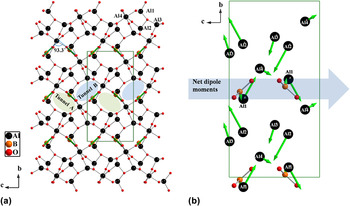
Al5BO9 crystallizes in orthorhombic noncentrosymmetric space group Cmc21, the asymmetric units are composed of four unique Al atoms, one unique B atom, and seven unique O atoms (Table I, Table S1 in the Supporting Information). The fundamental building block in Al5BO9 [Fig. 1(a)] is isolated BO3 triangle, and the angle between the adjacent BO3 planes is 93.3°. Four unique Al atoms have two kinds of coordinations: Al1, Al2, and Al3 atoms are four-coordinated forming isolated AlO4 tetrahedra, and the Al4 atoms bond with six oxygens to form straight
 $_\infty ^1{\left[ {{\rm{Al}}4{{\rm{O}}_4}} \right]^{5 - }}$
chains by edge-sharing. The isolated Al1O4, Al2O4, Al3O4 tetrahedra, and
 $_\infty ^1{\left[ {{\rm{Al}}4{{\rm{O}}_4}} \right]^{5 - }}$
chains further connect with each other to form a three-dimensional network, which consists of tunnels along the a direction, and the isolated BO3 is located in the tunnel.
Crystal data and structure refinement for Al5BO9.

a
 ${R_1} = {{\sum {\left\‖ {{F_{\rm{o}}}\left| - \right|{F_{\rm{c}}}} \right\‖} } \mathord{\left/ {\vphantom {{\sum {\left\| {{F_{\rm{o}}}\left| - \right|{F_{\rm{c}}}} \right\|} } {\sum {\left| {{F_{\rm{o}}}} \right|} }}} \right. \kern-\nulldelimiterspace} {\sum {\left| {{F_{\rm{o}}}} \right|} }}$
and
 $w{R_2} = {\left[ {{{\sum {w{{\left( {F_{\rm{o}}^2 - F_{\rm{c}}^2} \right)}^2}} } \mathord{\left/ {\vphantom {{\sum {w{{\left( {F_{\rm{o}}^2 - F_{\rm{c}}^2} \right)}^2}} } {\sum {wF_{\rm{o}}^4} }}} \right. \kern-\nulldelimiterspace} {\sum {wF_{\rm{o}}^4} }}} \right]^{{1 \mathord{\left/ {\vphantom {1 2}} \right. \kern-\nulldelimiterspace} 2}}}$
for
 $F_{\rm{o}}^2 > 2\sigma \left( {F_{\rm{o}}^2} \right)$
and
 ${w^{ - 1}} = {\sigma ^2}\left( {F_{\rm{o}}^2} \right) + {\left( {0.0427P} \right)^2} + 0.34P$
where
 $P = {{\left( {F_{\rm{o}}^2 + 2F_{\rm{c}}^2} \right)} \mathord{\left/ {\vphantom {{\left( {F_{\rm{o}}^2 + 2F_{\rm{c}}^2} \right)} 3}} \right. \kern-\nulldelimiterspace} 3}$
(a) The crystal structure of Al5BO9 and (b) the direction of the local dipole moments for polyhedra.

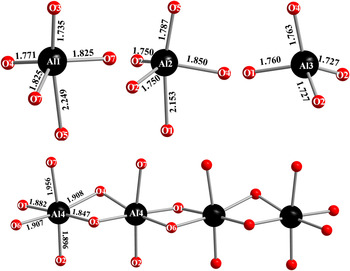
In the structure of Al5BO9, the B–O distances are in the range of 1.349–1.380 Å, which agrees well with the literature. Reference Chen, Wu, Jiang and You6,Reference Chen, Wu, Jiang, Wu, You, Li and Lin7 The bond lengths of Al–O only have small variation (Fig. 2, Table S2 in the Supporting Information), the distances are at the range of 1.735–1.825 Å (average = 1.789 Å) for Al1 atoms, 1.750–1.850 Å (average = 1.784 Å) for Al2 atoms, 1.727–1.763 Å (average = 1.744 Å) for Al3 atoms, and 1.874–1.956 Å (average = 1.899 Å) for Al(4) atoms. Based on the electron population calculated using the ab initio density functional theory (DFT) method, the electron population of Al1–O5 bond (0.13, 2.249 Å) is obviously smaller than other four Al1–O bonds (0.39–0.48), and the value of Al2–O1 is equal to 0.12 (2.153 Å). Hence, it is reasonable to hold that Al1 and Al2 are both four-coordinated. The bond valance sum (BVS) Reference Brown and Altermatt34 of all atoms calculated by Brown's formula is reasonable, verifying the coordination scheme. The slightly smaller BVS of Al1 and Al2 cations, compared to the expected oxidation states, is the weak contribution from the relatively longer bond of Al1–O5 and Al2–O1, respectively.
The coordination of the Al atoms.

Several aluminum borates were reported in Al–B–O system, such as AlBO3 (Ref. Reference Vegas, Cano and Garcis-Blance35) and Al4B6O15. Reference Ju, Yang, Li, Liao, Wang, You and Lin36 In addition, stoichiometric Al18B4O33 was reported, Reference Cheng, Tang, Ding, Huang, Huang, Qi, Hu and Li37–Reference Li, Li, Qi and Oy39 and Fisch et al. Reference Fisch, Armbrustera, Rentsch, Libowitzky and Pettke40 deemed that the Al18B4O33 compound should be reported as Al5−x B1+x O9 with x < 0.038(6), which is close to Al5BO9. Above crystal structures are all composed of Al–O three-dimensional framework and isolated B–O groups. However, the basic units in AlBO3 and Al4B6O15 are coplanar BO3 and isolated B2O5, respectively. In addition, the coordination of Al in the two compounds is AlO6 octahedra, and all Al–O bond length is equal to 1.923 Å in AlBO3, which is from 1.824 to 1.966 Å in Al4B6O15.
B. Thermal behavior and crystal growth
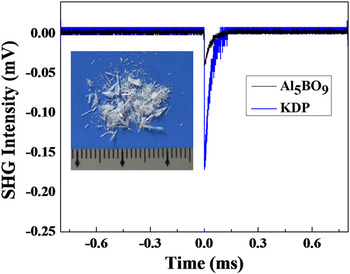
The polycrystalline of title compound was synthesized by conventional solid–state reaction, and the purity of the sample was confirmed by powder x-ray diffraction (Fig. S1 in the Supporting Information). The TG-DSC curves of the compound show that there is no observed endothermic or exothermic peak; a slight mass loss is found when the temperature is higher than 1200 °C and the mixture did not melt at 1400 °C (Fig. S2 in the Supporting Information). Hence, the fluxes should be introduced to decrease the crystal growth temperature. Single crystals of Al5BO9 were obtained from a high-temperature solution method using LaF3–B2O3 as the flux system, and the saturation temperature is about 980 °C. After the spontaneous crystallization, the needle-like crystal with size up to 1 mm × 1 mm × 5 mm was obtained. (Inset of Fig. 3)
SHG intensities of Al5BO9 and commercial KDP with particle in 38–55 μm. (Inset is the photographs of the Al5BO9 crystal).

C. Optical spectrum
The diffuse reflectance spectrum of Al5BO9 is shown in Fig. S3 in the Supporting Information, an obvious absorption peak is found around 240 nm, which is possibly due to the impurity introduced by reagents, a similar situation is also occurred in the crystal of K3B6O10Br Reference Zhang, Su, Pan, Wang, Zhang, Yang, Zhang, Dong, Wang, Zhang and Yang16 and K2Al2B2O7. Reference Hu, Higashiyama, Yoshimura, Yap, Mori and Sasaki17,Reference Liu, Liu, Wang, Hu, Li and Chen18 Liu et al. Reference Liu, Liu, Wang, Hu, Li and Chen18 further researched the impact of Fe3+ on UV absorption bands of K2Al2B2O7 and deduced that the UV absorption is strongly correlated with iron impurity at parts per million (ppm) level. Hence, the practical experimental band gap is 6.14 eV corresponding to the absorption edge of 202 nm.
To specify the coordination of boron in Al5BO9, the infrared spectrum was measured (Fig. S4 in the Supporting Information). The main peaks at about 1300 and 1180 cm−1 can be attributed to the BO3 group antisymmetric stretching vibrations, the bands at about 836 cm−1 should be assigned to out of plane bending modes of BO3. Bands with the lowest frequencies below 619 cm−1 mainly originate from the lattice dynamic modes.
D. Second-order NLO measurements
Al5BO9 crystallizes in a noncentrosymmetric space group, which is the basic condition for a potential SHG material. The powder SHG test was carried out on the ground Al5BO9 single crystal by the Kurtz–Perry method. Reference Kurtz and Perry29 The results indicate that the SHG intensity of Al5BO9 is about 1/5 times that of KDP in 38–55 μm (Fig. 3) and which is not phase-matchable (Fig. S5 in the Supporting Information), the result is comparable to the results reported by Ref. Reference Sheldrick26.
According to the structure symmetry and the Kleinman symmetry condition, there are three nonzero components of SHG coefficients, i.e., d
15, d
24, and d
33. The calculated values of d
15, d
24, and d
33 are 0.30, 0.18, and 0.03 pm/V, respectively, which are 0.76, 0.46, and 0.06 times that of KDP
 $\left( {\left| {d_{{\rm{eff}}}^{{\rm{SHG}}}\left( {1064\,{\rm{nm}}} \right) \approx 0.39\,{{{\rm{pm}}} \mathord{\left{\vphantom {{{\rm{pm}}} {\rm{V}}}} \right\kern-\nulldelimiterspace} {\rm{V}}}} \right|} \right)$
. The calculated values are qualitatively consistent with the experimental measurements as effective NLO constant is significantly dependent on the d
15 and d
24 for the structure with mm2 point group.
Reference Van der Mooren, Rasing and Bluyssen41
E. Structure–properties relationship
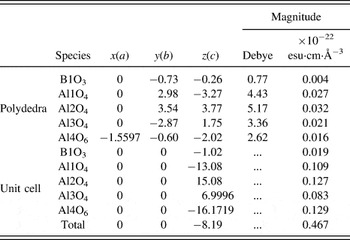
The dipole moments of the polyhedra were calculated by the Debye equation [Table II, Fig. 1(b)] to explain the relationship between the functional units and the SHG response. Reference Debye42–Reference Zhang, Zhang, Zhang, Zheng, Sun, Zhang and Tao44 The dipole moment calculation results show that Al1O4 and Al4O6 polyhedra are mainly attributed to the SHG response, and the net dipole moments of all polyhedra in the unit cell are along c axis. The net dipole moments of BO3 triangles are canceled out due to the noncoplanar manner of BO3 groups and make small contribution for SHG response.
Distortion magnitudes of polyhedra in Al5BO9.

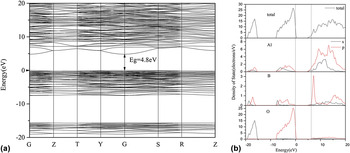
To gain further insight into the structure–property relationship, the first-principles calculations based on the DFT Reference Mori-Sanchez, Cohen and Yang45–Reference Reshak, Chen, Auluck, Kamarudin, Chyský, Wojciechowski and Kityk48 have been used to analyze the structural and electronic properties of Al5BO9. Figure 4(a) shows the calculated band structure of Al5BO9 along the high-symmetry lines in the Brillouin zone. Al5BO9 is a direct band gap compound with the calculated band gap equal to 4.8 eV, which is smaller than the experimental value (6.2 eV). As is known to all, the band gap is generally underestimated in the band structure calculation with DFT in LDA of Kohn–Sham implementation. Reference Mori-Sanchez, Cohen and Yang45,Reference Cohen, Mori-Sanchez and Yang46
(a) The band structure and (b) PDOS of Al5BO9.

Partial density of state (PDOS) of Al5BO9 is shown in Fig. 4(b), the different regions in the valence bands (VB) and conduction bands (CB) can be observed. It is well known that electron transition near the Fermi surface determines optical properties, hence herein the author would just consider about the electron states at the vicinity of the Fermi surface. From −10 to 0 eV below Fermi level, there are O-2p states, Al-sp mixed states, and B-p states, and the dominant component of the VB top is O-2p states. At the bottom of the CB, the contribution comes from O-2p states, Al-sp mixed states, and B-sp mixed states. Therefore, it is expected that both of the BO3 groups and Al–O polyhedra may make the contribution for SHG response.
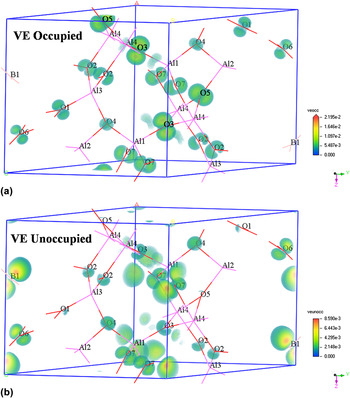
The SHG density method was adopted to analyze the origin of the NLO response of Al5BO9. Reference Chen, Lin and Wang20 The SHG density can be divided into occupied and unoccupied states of virtual-electron (VE) and virtual-hole, respectively. For Al5BO9, the VE process is analyzed because it has dominant contributions to the SHG effects. From the SHG density of Al5BO9, oxygen, especially for O3 and O5, is the dominant contributor for producing microscopic second-order NLO susceptibilities in occupied states [Fig. 5(a)]; other oxygen also makes a little contribution to the SHG effect. In addition, it shows [Fig. 5(b)] that three-coordinated B atoms are the major sources of SHG in unoccupied states, which are apparently smaller than occupied states; O4 and O7 make a slight contribution. Hence, the O anions (especially for O3 and O5) resulting from Al1 and Al4 polyhedra dominate the SHG contribution, the BO3 triangles also make a little contribution. The conclusion agrees well with the calculation of dipole moments.
(a) The VE-occupied and (b) VE-unoccupied SHG density of B and Al cations and O anions in Al5BO9.

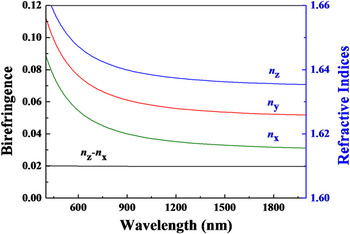
Curves of refractive indexes versus wave length are shown in Fig. 6, where the correlations between crystallographic and crystallophysical axes are x//a, y//c, and z//b based on the rule of n x < n y < n z , the results present birefringence Δn (n z − n x ) and are about 0.02 at visible region. Hence, the nonphase-matching behavior of Al5BO9 at 1064 nm is due to the relatively small birefringence, which is verified by the SHG experiment.
Calculated refractive indices and birefringence of Al5BO9.

IV. CONCLUSIONS
In conclusion, the Al5BO9 crystal has been obtained by high-temperature solution method. The SHG intensity of Al5BO9 is about 1/5 times that of KDP, and it is not phase-matchable due to the relatively small birefringence. Based on the calculation of dipole moments and SHG density, the O anions (especially for O3 and O5) resulting from Al1 and Al4 polyhedra dominate the SHG effect, and the BO3 triangles make contribution less, which is anticipated to open a window for the search and design of new inorganic materials. The exploration of novel aluminum borate with potential NLO properties is underway.
Supplementary Material
To view supplementary material for this article, please visit http://dx.doi.org/jmr.2015.204.
ACKNOWLEDGMENTS
This work was supported by the Special Fund for Xinjiang Key Laboratories (Grant No. 2014KL009), Graduate Research and Innovation Program in Xinjiang Uygur Autonomous Region of China (XJGRI2014151), Key Laboratory of Functional Materials and Devices for Special Environments of CAS (2013DP173196-2013-01).