Introduction
In New Zealand, non-communicable diseases (NCDs) account for 89% of deaths annually, with around 7000 of these occurring prematurely, i.e. prior to 70 years of age 1,2 . These preventable diseases are major factors underpinning ethnic and socio-economic health inequalities in New Zealand Reference Tobias, Blakely, Matheson, Rasanathan and Atkinson3 . Two-thirds (66.8%) of adult New Zealanders are classified as overweight (body mass index [BMI] 25–29.9 kg/m2, 34.6%) or obese (BMI >30 kg/m2, 32.2%) 4 . Closely associated with obesity is type 2 diabetes mellitus, which increasingly affects New Zealand children and adolescents at an earlier age, particularly in lower socio-economic groups and Pacific, Maori, Asian and Middle Eastern populations Reference Sjardin, Reed and Albert5 .
While interventions to counter the growing global prevalence of NCDs have traditionally focused on treating established disease and improving health outcomes for affected individuals, research in the field of Developmental Origins of Health and Disease (DOHaD) provides substantial evidence in favour of a preventative approach. It has been shown that environmental influences in the early life period affect susceptibility to NCDs in adulthood. It is becoming increasingly clear that maternal factors in combination with the postnatal environment can increase a child’s risk of developing obesity, insulin resistance and diabetes, hypertension and ischaemic heart disease in later life Reference Heindel, Balbus and Birnbaum6 . The period comprising the first 1000 days of life – from conception until the child’s second birthday – has been identified as a key developmental window, laying the foundations of epigenetic programming which can impact on gene expression and function, predisposing an individual to a future of health or disease Reference Hanson, Low and Gluckman7,Reference Martorell8 .
A mother’s health and nutritional status both prior to, and during pregnancy can have significant consequences for the lifelong health of her child Reference Gluckman, Hanson and Beedle9 . However, even women who intend to become pregnant often do not begin to seek nutrition-related information until pregnancy is established Reference Gormack, Peek, Derraik, Gluckman, Young and Cutfield10 . Nutrition knowledge and adherence to dietary guidelines amongst pregnant women in New Zealand are already low, and this is reflected most notably in lower socio-economic groups and ethnic minorities, perpetuating health inequalities from one generation to the next Reference Wall, Gammon, Bandara, Grant, Atatoa Carr and Morton11 . Data from the longitudinal Growing Up In New Zealand study shows that only 3% of the 5664 mothers for whom dietary data were collected at 28 weeks of pregnancy met the recommendations for all four food groups during pregnancy Reference Morton, Grant and Wall12 . A 2016 Australian study found that 65% of 400 pregnant women surveyed were unfamiliar with even the basic pregnancy nutrition guidelines, particularly those in the lower education, household income, language skills and age demographics Reference Bookari, Yeatman and Williamson13 .
One initiative to address this problem in New Zealand and Australia is the publication of a concise, consumer-focused booklet containing evidence-based recommendations for parental and child nutrition from pre-conception to toddlerhood. This booklet, entitled First 1000 Days: Nutrition Matters For Lifelong Health was based on the findings of a 2016 paper compiled by a group of academics known as the Australia and New Zealand Early Life Nutrition Working Party Reference Davies, Funder and Palmer14 . The research paper outlines up-to-date best practices for pregnancy and early life nutrition in accordance with the principles of DOHaD.
First 1000 Days has been widely distributed more-or-less in its present format to new parents in New Zealand since 2016, via the ‘Bounty Bag’ – a gift bag of commercial samples and non-commercial pregnancy information typically supplied to women by midwives (most commonly the primary providers of maternity care in New Zealand) and other health professionals in early pregnancy. Prior to the current study, no data has been collected regarding the dissemination or reception of the booklet amongst New Zealand parents. Therefore, the focus of this brief qualitative pilot study was to explore the perceptions of first-time New Zealand mothers regarding the effectiveness of this intervention and determine how best to proceed with any future development of the resource. The following objectives were identified:
-
1. To gain an understanding of how women relate to the information contained in the booklet and how it compares to other nutrition information they may have received.
-
2. To begin to assess the appropriateness of the booklet for the intended audience and identify further steps which could be taken to improve it for future use.
Methods
Selection and recruitment of participants
First-time mothers and mothers-to-be were identified as suitable participants due to their recent transition to motherhood and experiences with making food- and nutrition-related decisions in pregnancy. Women prior to 20 weeks’ gestation were excluded from participation as it was felt they would not yet have encountered some of the concepts and challenges relating to nutrition in later pregnancy, although there is no indication that they are necessarily any less engaged with nutrition information Reference Szwajcer, Hiddink, Koelen and van Woerkum15 . There was no upper limit specified for post-partum eligibility, aside from the use of the term ‘new mum’ in the recruitment material, leaving the decision up to the women as to whether they self-identified with that title. Mothers of second or subsequent children were excluded on the basis of being less engaged with the available health information, although it must be recognised that this is not always necessarily the case, and their opinions may prove valuable in future research Reference Nasuti, Blanchard and Naylor16 . Fathers and other caregivers were excluded due to the time constraints of the study, while noting that it would likewise be interesting to include their perspectives at a later date.
Data collection took place in the larger metropolitan area of Auckland, New Zealand’s most populated city and an ethnically diverse region encompassing a broad spectrum of household incomes and economic situations. Nine first-time mothers and mothers-to-be were recruited via posters, social media and third-party antenatal classes to participate in either a small focus group or face-to-face interview with a researcher. Social media outreach included Twitter announcements in addition to paid advertising across the Facebook platform and ‘community bulletin-board’ style postings in local community-based Facebook groups. Sessions took place between September and December 2019 and were offered on different days of the week across a range of community locations throughout Auckland with the goal of attracting a variety of participants from different socio-economic and cultural backgrounds. Meeting rooms for existing antenatal/childbirth education classes were used as venues, as it was thought these would be suitable for the purpose while also allowing class members to participate in the study at a familiar location.
Data collection
A semi-structured interviewing approach was used both for focus groups and individual interviews. To maintain consistency, an initial set of open-ended questions was formulated to provide a basis for discussion, while also allowing flexibility for the participants to introduce related topics of particular relevance to their situation. The length of the sessions averaged around 40 min, 5 min of which was allocated to the women familiarising themselves with the booklet before beginning the discussion.
Some of the questions asked included:
-
Could you sum up what you think the overall message of the booklet is?
-
What is your impression of the booklet’s presentation?
-
What do you think about the way the booklet is distributed?
-
How does the information in this booklet compare with what you have come across elsewhere?
-
For those who previously received the booklet, did you discuss it with anyone? Who?
-
Did reading the booklet change anything about the way you ate during pregnancy?
-
Where would you look/ask if you need help with anything mentioned in the booklet?
The discussion sessions were audio-recorded and later transcribed for analysis.
Thematic analysis
Thematic analysis in the form described by Braun and Clarke was used to code and identify themes in the data Reference Braun and Clarke17 . Following de-identification of the data, the transcripts were reviewed for familiarisation and coded by the lead researcher, using an inductive approach to identify patterns and candidate themes. This approach, centred on the philosophical framework of critical realism, was chosen to reduce the possibility of researcher bias influencing interpretation of the data, while acknowledging that the research team comes to this task with knowledge of existing literature Reference Terry, Hayfield, Clarke, Braun, Willig and Rogers18 . The coding process was repeated by senior members of the research team in order to gain consensus regarding the pertinence of potential themes to the research question. Each of the women agreed to the use of a pseudonym for reporting purposes and several of them opted to select the name themselves.
Ethics
Ethical approval to undertake the research as described was granted by the University of Auckland Human Participants Ethics Committee (UAHPEC; ref #022990).
Results
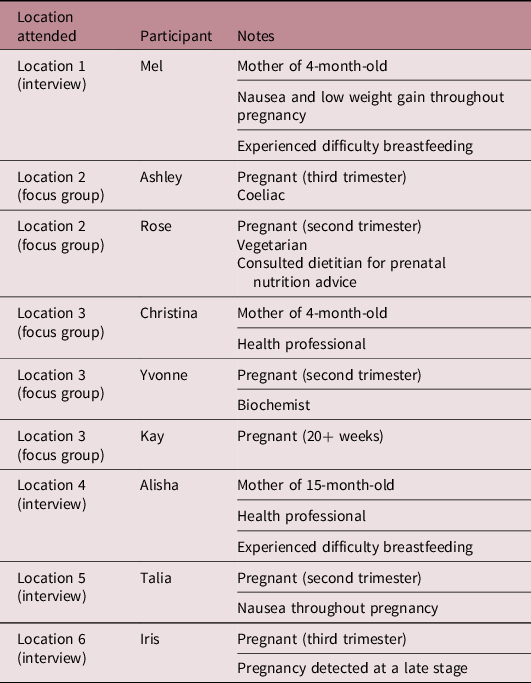
Although demographic information was not formally requested from the participants, information volunteered during the discussions suggested the women interviewed were from a diverse range of ethnic backgrounds, socio-economic groups and education levels. Three were post-partum, with infants ranging in age from 4 to 15 months. The remainder were in the second or third trimester of their pregnancy. Table 1 provides brief details about each participant, including the pseudonym used to identify their contributions.
Details and pseudonyms of study participants

While the initial aim of the research was to assess the suitability of the booklet for communicating nutrition information from the women’s perspectives, it quickly became apparent that the participants wished to explore some of the deeper issues underlying maternal nutrition choices and behaviour. In addition to surface-level discussions concerning presentation and readability of the booklet, three themes were identified as being salient in terms of the research question. The first, entitled To Inform or Educate: What’s the Goal? explores how the women’s relationships with the First 1000 Days booklet varied depending on their educational background and communication preferences. The second theme, Who’s Really in Charge Here? relates to decision-making in pregnancy and some of the factors driving women’s food choices. Finally, a closely related theme, What if I don’t Follow the Rules? examines the question of maternal blame and guilt.
To Inform or Educate: What’s the Goal?
While all but one of the participants agreed that the booklet felt attractive, inviting and appeared to be a suitable length, it was clear from their language choices that the women came from a wide range of different educational backgrounds – from the interviewee who confidently used terms such as ‘predisposition’ and ‘chronic conditions’ to the one who admitted she struggled to read the word ‘nutrition’ in the booklet’s title. Six of the nine participants exhibited a high degree of health literacy, paired with a tendency towards information-seeking behaviour. This was most apparent in their enthusiasm for the booklet’s checklists, included at the end of each section:
Rose: I quite like checklists. I like anything that’s got a checklist in it, especially…cos being pregnant’s like a whole new world for me—just so much new information and so many things to kinda do and think about and research.
Most of these six were familiar with the guidelines contained in the booklet, despite only two having received a copy via their maternity carer prior to participating in the study. While several of these women indicated they had not been provided with nutritional advice or resources from a health professional during their pregnancy, they had evidently taken it upon themselves to locate this information. Although the DOHaD concept was not something they were able to easily articulate, the principles of healthy eating and moderate weight gain during pregnancy were well-accepted, and the booklet effectively functioned as an authoritative confirmation of their prior understanding of maternal nutrition.
Yvonne: It is a really nice summary of everything that I’ve kind of found in a lot of other sources, like the apps I’ve got on my phone and the healthy eating, you know, what not to eat kind of, what to eat. This is a much nicer, concise version of it. It would make me happy to keep it around, you know, and refer to it further on…because it does look pretty, and it’s not going to look out of place if I stick it on the bookshelf or something.
In short, their view of the First 1000 Days booklet was that it was useful as a quick reference, however, it did not contain much novel information.
The attitudes of the remaining three mothers provided a contrasting perspective. One dismissed the resource as irrelevant to her situation, commenting that there were ‘too much words’ and that she suspected most people would not read it. Another said that while she was interested in reading the booklet, she was comfortable to ‘mostly just rely on God’. Two of these women indicated that they would also prefer to receive nutrition information verbally from a health professional rather than engage with the text themselves:
Mel: It’s not so useful for people like me, you know, who never finished school, never did much reading… I’m probably just going to go ask the midwife, you know, I would definitely pick it up and read it if I thought it was going to be life-threatening, you know, save a life or something, but… If the midwife’s told me, like, what’s the point of reading a book then?
Mel further explained that if her midwife was unavailable for any reason, she would prefer to seek guidance from her mother, later modifying her statement to clarify that in fact, her parents would be her first option in preference to her midwife.
These differences in attitudes towards the booklet demonstrate that communication methods suitable for conveying evidence-based nutrition guidelines are not one-size-fits-all, and that a tension exists between merely providing reference material, versus actively educating those who are less inclined to seek information for themselves.
Who’s Really in Charge Here?
The women’s interest in the booklet’s checklists was striking in that it highlighted a readiness to accept an idealistic notion that pregnancy nutrition can be reduced down to a list of rules to follow, and checked off when completed. This is perhaps unsurprising considering the lack of professional guidance the women received in terms of making food-related decisions. Alisha’s experience was typical of the group:
Alisha: I don’t think the midwife talked anything about nutrition… no one talked to me about nutrition during pregnancy. When I used to go for my doctor’s appointment…all the follow-ups were just mainly, to the point… But I think no one discussed nutrition. Not the GPs (general practitioners), I don’t think the midwife did.
The participants commented they felt that they were left to obtain nutrition information themselves, prompting them to search online or consult with family members and friends. Conflicting advice was identified as a problem, as was determining the credibility of information sources. The women also pointed out that much of the available information in terms of food choices related to restricting consumption of potentially unsafe foods, which was another source of confusion and frustration. Eating outside of the home posed a particular problem due to uncertainty around how the food was prepared and stored; however, the participants observed that many of the foods they were supposed to be avoiding for safety reasons were otherwise healthy options. Often they felt they were faced with the choice of eating something potentially hazardous in terms of food safety, versus a fast-food option loaded with fat, sugar and sodium.
The reasoning behind many of the food restrictions was not always clear to the women as they appeared to differ across various countries and at different times.
Yvonne: I think both of my sisters there in Aussie have said “oh no, hummus was fine when we were…” and now hummus is “NOOOO, absolutely not! Not even packaged, not even fresh…”
All of the women reported feeling that their food choices were judged by others around them. For Kay, a significant barrier to following the pregnancy food safety guidelines involved navigating the cultural and traditional expectations of her family members:
Kay: But I have struggled with, like for me, some of my Tongan family. I mean like, “oh, we didn’t avoid anything, you guys came out all right…” “I ate this when I was pregnant with so and so… and I’m fine, and they’re fine, and…” It’s a bit hard to argue with that…
Clarification of the degree of risk involved with eating ‘forbidden’ foods featured strongly in the women’s suggestions for improvement of the First 1000 Days resource. Although the booklet currently does not contain any food safety recommendations, several of the study participants felt that this would enhance its usefulness and help them to feel more confident in taking charge of their own food choices.
What if I don’t Follow the Rules?
With the ‘rules’ for eating during pregnancy firmly established in their minds, the women were interested also in talking about what happens when things do not go according to plan. Several of them hinted at feeling out of control with their eating:
Kay: Sometimes what I KNOW is good, doesn’t match up with what I want to eat. A lot of the time. But yeah, I think, junk food, sweet stuff… not good… um, but, yeah, sometimes I find it just… that’s what I want to eat.
Aside from succumbing to cravings, some of the women also felt their food choices were controlled by other factors outside their influence, such as nausea. Weight gain was another aspect of pregnancy that most of the women said they felt unable to control. Most participants were keenly aware of how much weight they were expected to gain, but hitting the target proved elusive for all but one of the women, who described her pregnancy as ‘by-the-books’. That they felt pressured to get this ‘right’ was clear, despite acknowledging that many factors were largely outside of their control. Due to this, there was a sense of guilt when actions were taken that were perceived to be within the women’s control but ran contrary to their ideals of a healthy pregnancy:
Ashley: I don’t know, you kind of get like a bit of, I dunno, guilt as well. Cos you can feel like you’re not doing enough. So like I mean, I’ve tried to take probiotics, and I’ve eaten salmon and fish, and I’ve taken my iodine and everything, but then again, like, completely honest, I’ve eaten chocolate as well, like it’s going out of fashion.
For one of the women, feelings of guilt and a subsequent lack of support struck very close to home as she revealed that her experiences with breastfeeding her child had resulted in intense depression and feelings of failure as a mother:
Alisha: I wanted to breastfeed, I was REALLY excited about breastfeeding, and, somehow it didn’t work for me. And I felt like, like, a failure. And I– I don’t think I should have felt like that. Because I DID give it a shot. And I… did my very, very best to breastfeed my baby.
Compounding the feelings of failure and guilt for this mum was the feeling of isolation, and the belief that her experience was unique, or at least relatively rare:
Alisha: I didn’t even know that breastfeeding can be so hard. Cos I thought that, it’s just supposed to be normal, isn’t it, like mums have been breastfeeding for ages and ages and ages, and, so… and no one talks about it! … I think there needs to be more awareness around… breastfeeding, what you should be doing, what you should be expecting. …I think there’s, there’s not too much information for how to deal with it after, and that’s why a lot of women do go through postnatal depression. Because there’s just too much happening, and just too overwhelming…
Eventually, Alisha sought and was able to find support from other mothers in online forums, where she realised that her experiences were in fact quite common – highlighting a clear need for educational materials such as First 1000 Days to in some way address breastfeeding difficulties and provide support, rather than simply advising mothers of the benefits of breastfeeding.
Discussion
The three key themes identified via analysis of the data suggested that early life nutrition resources such as First 1000 Days have a key role to play in supporting healthy pregnancies to reduce future NCD risk. However, further consideration should be given as to how these messages are communicated and how they are being received by the women they are targeting.
To Inform or Educate: What’s the Goal?
For the majority of the study participants, whose contribution to the focus group or interviews suggested a reasonable level of prenatal nutrition knowledge, this resource is useful as a quick-guide or reference manual, but where does this leave those who are not so health-literate?
A disparity exists in the motivation to seek out nutrition information – because reading pregnancy information is obviously voluntary, those who do so are likely to have greater motivation towards following the nutrition guidelines Reference Copelton19 . A woman’s motivation and ability to understand the information and use it to guide her eating choices in pregnancy is seen as a function of her degree of health literacy Reference Renkert and Nutbeam20 . Health literacy is associated with general literacy, implying that those with lower levels of education will be less likely to – and capable of – seeking out, comprehending and evaluating health information in order for their health to benefit from it Reference Sorensen, Van den Broucke and Fullam21 . Although the study participants were not asked about their formal education history, it was evident there was a clear difference between those who felt comfortable reading the booklet and were very active in their pursuit of information, and those who preferred verbal communication and tended to have a more passive approach, relying more on their midwife or health professional to provide advice. A 2004 survey of 150 under-resourced pregnant women indicated that, like 3 of this study’s participants, these women preferred to obtain their pregnancy information from other people, most commonly their mother Reference Lewallen22 . Therefore, a resource that acts as a catalyst for internal reflection and discussion with others has greater potential to result in a shift in the individual’s perspective leading to the possibility of behaviour change Reference Kroth, Cranton and Mayo23 .
Many of the women’s suggestions for improvement of the booklet were offered with the goal of achieving completeness, so that the resource could become a ‘one-stop guide’ to all their nutritional information needs. From this perception that prenatal nutrition knowledge resembles a finite list of facts, follows the idea that it can easily be communicated from one person to another, and then acted upon in a rational and logical way Reference Ingold24 . However knowing is not the same as doing, and the simple one-way transmission of information from health experts is not sufficient to provide a foundation for changing habits and behaviours Reference Lupton25 . With this in mind, it was recognised that a more interactive resource such as a smartphone application might have the potential to support women in making healthier choices, and many of the mothers agreed that they would find this useful, although it was suggested that any such application should be designed to accompany, rather than replace the printed resource. The development of a digital companion resource is a possible avenue for future exploration, as this study clearly shows that a health promotion booklet such as First 1000 Days is just one of many formats through which prenatal nutrition education could take place.
Who’s Really in Charge Here?
Many women fear that pregnancy is a particularly dangerous time, and that they themselves may pose a danger to their fetus. Well-meaning friends, family and even strangers may contribute to this feeling of risk by voicing their concerns regarding the pregnant woman’s food choices Reference Gregg26 . Swedish women in a qualitative study conducted by Wennberg et al. reported feeling monitored by the people around them, including healthcare personnel, and that they were targets for criticism and unwanted advice, a perspective that mirrored the experiences of the participants in this study. Despite being unsure of which specific foods they should avoid, the Swedish women understood that eating the ‘wrong’ thing could potentially harm their baby Reference Wennberg, Lundqvist, Hogberg, Sandstrom and Hamberg27 . In addition, the information-seeking behaviour and reliance on checklists exhibited by many of this study’s participants paralleled the experiences of women in Harper and Rail’s 2012 study, who reported an increased dependence on expert recommendations in order to successfully navigate a ‘healthy’ pregnancy Reference Harper and Rail28 .
The sacrifice of the mother’s food preferences in favour of the perceived needs of the fetus is one of the first steps towards constructing a woman’s social identity as a ‘good mother’, according to Copelton, who draws on the experiences of 55 middle-class White women in the upper midwest USA Reference Copelton19 . The media’s tendency to portray food as functional, rather than as part of a larger picture including social and emotional experiences, also contributes to a woman’s ‘confusing’ and ‘joyless’ relationship with food throughout pregnancy Reference Dodds and Chamberlain29 . However, women, for the most part, seem to accept this as their lot in pregnancy and take food safety advice on board without question, unwilling to weigh up the risks or countenance the possibility of alternative options, despite their uncertainty as to the trustworthiness of some of the information Reference House and Coveney30 .
The need for a more positive approach to nutrition education has also been identified by Paterson et al. and Rosenfeld, who both agree that disease prevention and avoidance of ‘bad’ foods have been the dominant focus of maternal health promotion messages for too long Reference Paterson, Hay-Smith and Treharne31,Reference Rosenfeld32 . Highlighting particular behaviours and food choices as being supportive of lifelong health and well-being, rather than demonising those that are less optimal, may assist women in redirecting their perspective away from a focus on avoiding potential harm to their child, to an attitude of providing nourishment and a strong foundation for health.
Empowering women to exercise more control over their own choices during pregnancy would help to alleviate some of the pressure. Two ways in which a booklet such as First 1000 Days could be beneficial have been identified – first, by focusing on the positive aspects of prenatal nutrition, and second, by providing mothers with the information necessary to evaluate the risks and prioritise their food choices accordingly.
What if I don’t Follow the Rules?
Closely related to the theme of decision-making in pregnancy is that of guilt and blame when less-than-perfect behaviour leads to less-than-desirable outcomes Reference Jette and Rail33 . While a woman’s food choices in pregnancy may be affected by many functional and structural constraints such as finances, time, skill, education, social support and personal health, if she is not seen to be prioritising the needs of the fetus over her own needs in a self-sacrificial way, she risks losing the social epithet of ‘good mother’ – whether by her own judgement or that of society Reference Copelton19,Reference Harper and Rail28 . This is problematic as control of food intake during pregnancy is driven by hormonal factors, not entirely subject to rational and logical thought processes to the degree which pregnancy nutrition information might lead one to believe, leaving many women, including some of this study’s participants, feeling guilt and failure over weight gain they feel powerless to control Reference Bianchi, Huneau, Le Goff, Verger, Mariotti and Gurviez34,Reference Augustine, Ladyman and Grattan35 . Nausea affects pregnant women’s food intake as well, and has been linked with a decrease in the quality of women’s diets as compared with their pre-pregnancy intake Reference Crozier, Inskip, Godfrey, Cooper and Robinson36 .
Aside from guilt associated with food choices in pregnancy, breastfeeding – or rather, failure to breastfeed – was a contentious issue for two out of the three study participants who had already birthed their baby. The message that ‘breast is best’ features prominently in pregnancy health literature, including First 1000 Days, and the lists of breastfeeding benefits rival only the food restriction lists in length. It is clear that an ability to breastfeed one’s child for the recommended minimum time is strongly equated with being a ‘good mother’, and that women feel they have even less control over this aspect of mothering than they do over their food intake Reference Marshall, Godfrey and Renfrew37,Reference Lee38 . What this suggests is that while the advice may be well-intended, prenatal education resources are unwittingly setting women up for failure by leaving them unprepared to cope when breastfeeding does not go according to plan. By espousing only the benefits of breastfeeding and not acknowledging the challenges, women are led to feel as though it should be easy, when in reality, it often is not Reference Ahluwalia, Morrow and Hsia39 .
It should be pointed out that most of the feelings of guilt and confusion discussed by participants in this study were not experienced specifically as a result of reading First 1000 Days, but rather in relation to the sum total of pregnancy messages received both explicitly via educational materials and interactions with health professionals, and implicitly due to cultural norms and the women’s own beliefs. However, the booklet could be used to address the problem of guilt by acknowledging the complex and diverse issues faced by women when attempting to adhere to best-practice guidelines, explicitly recognising the structural constraints which often stand in the way of ‘ideal’ behaviour Reference Jette and Rail33 , promoting discussion both with health professionals and amongst family and friends, and providing links to further resources and support for women who may be experiencing difficult situations.
Strengths and limitations
The greatest challenge encountered during this research was the difficulty in recruiting participants. During the recruitment period, a nationwide measles outbreak almost certainly affected the willingness of new mothers to participate, given the potential health implications for children too young to immunise. In light of this situation, we are especially grateful to those women who did engage with the research despite their anxieties.
While focus groups were originally chosen as the method of data collection in order to encourage participants to build on each other’s ideas and perspectives, recruitment difficulties resulted in several one-on-one interviews as well. Unexpectedly, these became a strength of the research as the women interviewed alone were noticeably more candid in sharing their views than those who participated in a group setting. This was a valuable discovery to make in this early stage of the research, leading to the recommendation that future recruitment strategies should enable participants to choose whether they would prefer to engage with the researcher individually or as part of a small group.
The sample size of this pilot study reflects that used in qualitative research where the intention is to provide insight into a range of participant experiences rather than generalise the findings to a wider population. However, if further research is undertaken in future for the purposes of developing the First 1000 Days resource, it will be important to build on this initial data in order to reach saturation, and by explicitly collecting demographic information from participants to establish a better understanding of their personal characteristics and educational backgrounds. As the booklet includes a section focusing on paternal health, it would be beneficial also to extend the breadth of the research to explore fathers’ views of the resource. Next steps for this research could involve working with the community and other stakeholders in New Zealand and Australia to co-construct a revised version of the First 1000 Days resource with their views and perspectives in mind Reference Tu’akoi, Tamarua-Herman, Tairea, Vickers, Aung and Bay40 .
Conclusion
This brief glimpse into the experiences and perceptions of first-time mothers in relation to a pregnancy nutrition resource provides a small indicator of some of the issues and concerns affecting their food choices during the prenatal period. While some recommendations have been made for the potential improvement of the First 1000 Days booklet, further research is needed to refute or establish a strong basis for the suggested changes. In order to maximise the potential applicability of the booklet, any future updates must be supported by solicitation of a larger, more representative sample of opinions and perspectives. In addition to first-time mothers, this might also be expanded to include multiparous women, and to fathers and other family members such as grandparents, whose support of a healthy pregnancy should not be understated.
Acknowledgements
The authors wish to acknowledge and thank all participants who contributed to this study. We also acknowledge: (1) the authors of the First 1000 Days resource; (2) the advice provided by Adrienne Priday and Isabella Smart regarding the development of the study; (3) the contribution of Alvina Pauuvale who conducted two interviews that contributed data to this study.
Financial support
JRH was supported by a Sir Mont Liggins Memorial Scholarship.
Conflicts of interest
None.
Ethical standards
Ethical approval to undertake the research as described was granted by the University of Auckland Human Participants Ethics Committee (UAHPEC; ref #022990).