The last decade has witnessed a sharp increase in the number of disaster declarations. In 2011, there were 99 major disaster declarations domestically compared to an average of 65 per year in the previous 10 years. As a result, concerns have included the long-term and complex course of behavioral recovery in disasters, suggesting a need for greater intervention breadth and capacity.Reference Chandra and Acosta 1 – 7
Psychological first aid (PFA) is an evidence-informed, best practice intervention for responders to provide practical and social support with linkages to mental health treatment for children and adults. PFA is designed to reduce disaster-induced stress by prompt provision of social support, linkage to resources, and promotion of effective coping strategies and coping self-efficacy. 8 – 11 In spite of international endorsement,Reference Van Emmerik, Kamphuis, Hulsbosch and Emmelkamp 12 , Reference Van Ommeren, Saxena and Saraceno 13 to our knowledge, no rigorous outcome studies have been conducted.Reference Patterson 14 The Department of Health and Human Services’ disaster behavioral health concept of operations recommends the training of first responders in PFA, and the American Red Cross and other disaster organizations are implementing PFA training for their employees and volunteers. Listen, protect, and connect (LPC)Reference Gurwitch and Schreiber 15 – Reference Forbes, Lewis and Varker 18 is one PFA model that has been developed for lay persons and first responders, and its simple framework may be appropriate for surge responders such as the Medical Reserve Corps (MRC).
Early analyses demonstrate that PFA increases self-efficacy and confidence in working with children and adults,Reference Allen, Brymer and Steinberg 19 – Reference Moran and Britton 21 but limited data are available on specific uptake of PFA training in surge responders who are critical to broader community response. The MRC is not a traditional first responder group, but is a “ready force of public health, medical, and non-medical volunteers who are ready, willing, and able to support a variety of preparedness, emergency, and public health activities and initiatives.” 22 , 23 To our knowledge, no studies have been performed on how MRC could be deployed to implement PFA.
We believe that this study is the first description of PFA training of the MRC using both self-administered surveys and discussions from focus groups. We aimed to (1) understand the impacts of brief PFA training on knowledge, attitudes/comfort, and intended practices of MRC members; and (2) explore perceived facilitators and barriers to using PFA and the feasibility and success of PFA, from the perspective of participants, to improve future trainings.
Methods
The study employed a mixed-methods approach to assess the impact of PFA training using LPC on MRC members in Los Angeles County. LPC training is based on a model adapted by one of us (M.S.) for the Los Angeles County Department of Public Health Emergency Preparedness and Response Program to train community members to help each other in times of disaster. This course was developed as a basic, 2-hour version of PFA to reinforce that providing social support is one of the most important interventions for family, friends, and neighbors.
The first part of training, an interactive slide presentation, described how to effectively deliver PFA through the 3 components of LPC: listen to the individual and understand both verbal and nonverbal cues; protect the individual by determining realistic ways to help and provide reassurance, support, and encouragement; and connect the individual to family, friends, and resources in the community. The training ended with video scenarios of past and hypothetical disasters. This latter section of the training allowed participants to apply newly learned strategies and increase their capacity in providing PFA while receiving feedback (from M.S.).
In the afternoon, the facilitators led a train-the-trainer workshop using a model developed in New Orleans for postdisaster recovery.Reference Wells, Sherbourne and Schoenbaum 24 , Reference Wennerstrom, Vannoy and Allen 25 The afternoon session again included question-and-answer and role-play sessions. We added these discussion components to enhance LPC practice after the 2-hour training session.
Recruitment
MRC members were invited to attend the training through emails from their unit coordinators. One unit covers the entire county of approximately 10 million residents (total of n = 1362 volunteers); a second unit covered a city of 465 576 residents (n = 132 volunteers); and another unit covered 3 cities comprising 122 272 residents (n = 104 volunteers). 26 , Reference Everly 27 Participation in the training was not required but met one of the core competencies identified by the Division of the Civilian Volunteer Medical Reserve Corps and training requirements to permit deployment from local jurisdictions.
Data Collection
Data were collected with a self-administered survey and field notes from discussion groups. The short survey was administered directly before and immediately after the morning session. The questionnaire assessed demographics and professional training, years with MRC, experience with disaster response, and application of PFA to address psychological distress issues. We created subscales for PFA knowledge items (number correct); items included 5 true/false statements (eg, It is fine to express doubt when someone is sharing how they feel emotionally). The survey also included questions about barriers to addressing psychological issues (count up to 3 barriers each for lack of training, access, and comfort/stigma). The lack of training subscale included items such as the dearth of tools to use with clients; access issues included items such as an insufficient number of mental health providers; and comfort items included the concern that clients do not want PFA.
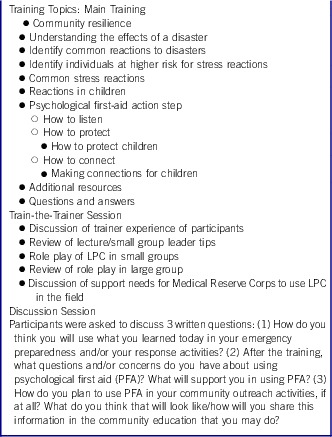
The second component of data collection was field notes taken by staff members during the focus groups, which took place during lunch. A volunteer group member assisted by study staff members facilitated these discussions (Table 1). For the afternoon train-the-trainer sessions, staff members took field notes on the discussion. This afternoon session was voluntary and included about two-thirds of the morning participants.
Listen, Protect, Connect (LPC) Training Overview

Data Analysis
Descriptive and bivariate analyses examined characteristics of participants and pre- to post-training test changes in knowledge and attitude items and scale scores. We used stratified analyses to examine whether improvement from pre- to post-training test results differed by previous PFA or disaster experience and by length of MRC engagement (<2 vs ≥2 years). For qualitative analyses of group discussions, 3 researchers independently read the data and noted frequent and significant statements without predefined themes in mind. Themes that arose from the analyses were discussed and compared for each of the main discussion questions across groups; agreement was reached by consensus on main themes and subthemes. RAND's Human Subjects Protection Committee reviewed the study.
Results
We present the survey findings first and summarize some themes from the discussion groups.
Sample
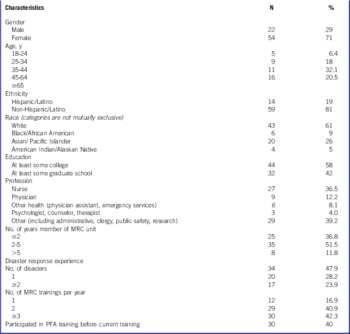
A total of 76 MRC members attended the training, and all participants completed the pre- and post-training survey. The participants were predominately women; most were between the ages of 35 and 64 years (Table 2). Approximately 20% of participants self-identified as Hispanic/Latino and nearly two-thirds as white. Most participants had been with the program for less than 5 years (88%), and yet nearly half had not been part of a disaster or emergency response (48%), which may be expected for surge responders.
Sample Demographic Characteristics

Forty percent of respondents had participated in PFA training before, 68% reported completing a class on behavioral health, and 41% noted training in delivering behavioral health services. Only 10% had supported someone experiencing behavioral or psychological health symptoms related to a disaster or emergency. Those respondents reported several approaches to aid someone in psychological distress, from “listening to let the individual tell his/her story” to “referral to mental health services.”
Survey Findings
Before the training, approximately 78% of respondents noted that they were somewhat to very comfortable in addressing psychological distress issues, and 71% thought that they were somewhat to very capable to help those in need. Approximately 64% reported they could use PFA skills to aid individuals in distress, and nearly 94% reported that the PFA training was important to their current MRC role.
Figure 1 illustrates reported barriers to providing psychological support, organized in 3 subscales (lack of training, access issues, and concerns about comfort or stigma). Lack of training (68% reported at least 1 barrier) and access issues (52% reported at least 1 barrier) were the most frequent barriers noted.
Barriers to Providing Psychological First Aid (Pre-Training Survey Only).

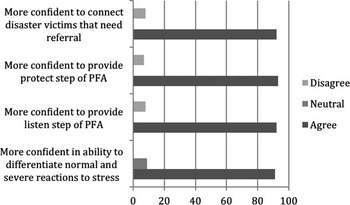
Before training, only 43% responded correctly to all 5 knowledge items, while after training, 49% responded correctly. No significant differences in the count of correct answers were noted between the pre- and post-survey results. While knowledge changes were modest, perceived capability in using PFA improved. Compared to the pre-survey (71%), 90% of participants reported after the training that they felt somewhat or very capable of using PFA with individuals who experience distress (P < .01). In addition, participants felt more confident along a series of dimensions, including knowing how to differentiate normal from severe reactions to stress and using the steps of LPC in PFA (Figure 2). Improvements in perceived capability were greater among those who had no previous disaster experience (mean change in score of 0.61 on the scale) compared to those who had previous disaster experience (mean change in score of 0.40; P < .01) and among those who had no PFA training (mean change of 0.66) compared to those who had previous PFA training (mean change of 0.33, P = .005).
Confidence in Using Psychological First Aid (Post-Training Survey Only).

Before the training, 55% of respondents noted that they would use PFA infrequently and only as indicated, and 40% responded that they would use PFA as part of routine activities. After the training, 54% noted that they would use PFA routinely, while the remainder would use it only as indicated (P < .05). This finding did not vary by previous PFA experience, MRC tenure, or previous disaster experience.
Discussion Group Themes
The 83 attendees (76 MRC volunteers, 7 research team staff who took notes or led the discussion) comprised 13 tables of 5 to 8 participants (mostly 6) per discussion group.
Discussions revealed a favorable view of the training. One participant said, “They're not asking us to do anything outside of our human nature.” Many participants commented on a renewed awareness of the importance of nonverbal communication as a result of the training. Listening was noted as a key skill to gain information about the client, “You first have to listen carefully in order to best assess the situation.” Simply listening to what an affected individual has to say was also useful to impart comfort, as reflected by the comment, “You can be supportive and quiet at the same time.”
Another theme that prevailed was the training's applicability in diverse locations and populations, specifically in schools with children. Some expressed that they were better prepared for dealing with children as a result of the training. One respondent noted, “Community outreach activities at elementary schools would be effective. Volunteers can give information to the families who may be more inclined to accept the information because they are concerned about their kids.”
In addition, 68% of participants noted they planned to use PFA in all of their work assignments because the training will help them communicate better with those in distress: “I will be sure to be a more reflective listener and provide resource options for the community members that I serve.” Participants described how they would share information about LPC with other community groups, including neighborhood associations, businesses with employee training opportunities, disaster training programs for nurses, and community emergency response team (CERT) members.
Participants also voiced hesitancy about whether they were sufficiently prepared to apply these skills in a role outside of their daily personal and professional context. Many expressed a need for further experiential learning opportunities to practice LPCs, including situational practice scenarios in which skills can be applied to different emergency-based scenarios with diverse populations, cultures, and emergency responders. In addition, participants noted concerns about translating lessons to the larger community, including the importance of understanding the different cultures of those served during an emergency. More discussion of cultural differences in psychological distress and intervention appropriateness was requested in future trainings.
Concerns about use of PFA or barriers to use were also noted. For example, information was requested on the boundaries of responders’ role in responding to psychological distress, and aids to recognize when to link distressed individuals to existing resources. Different groups also expressed the concern that during a disaster scenario, physical injuries would take priority and resources may not be available to care for the mental health of victims. “The problem with committing a lot of resources to psychological trauma is that you're committing resources that you might be able to use more effectively to physical trauma.”
To address these concerns, some participants believed that an interactive response tool to bridge the gap between knowledge and action in applying PFA to various situations would be helpful. Examples included an online back-up information system with referral resources, PFA tips, lecture slides for presentations, and evaluation tools to use with community audiences in preparedness trainings. Suggestions regarding tools that would help them to use PFA included a laminated resource card or checklists similar to those they routinely used for physical emergencies. In the post-survey responses, 65% of participants reported interest in testing a mobile PFA tool.
Discussion
This report described the initial responses of MRC members to a brief training in LPC, a manualized PFA model suitable for lay persons and professional responders. While pre- and post-training changes on quantitative surveys were modest, the training resulted in greater reported confidence and capability in addressing the needs of those in psychological distress. This finding suggested that PFA training is feasible and potentially useful for preparing a surge workforce as part of their emergency response. The qualitative data found that participants were consistently enthusiastic about the value of the training, which extended to their perceived knowledge of PFA and how to implement it, for which there were no significant changes in the quantitative survey. Given the unique context for surge responders, which may include long periods without being used in an emergency and more occasional leadership of community preparedness trainings, the discussions across the 13 discussion groups about barriers and facilitators to use of PFA were particularly of interest. Not surprisingly, the greatest increase in confidence occurred among those with less previous experience and background in response and behavioral issues. Some of the limited change in knowledge may be because LPC, by design, is a fairly simple intervention, and this well-educated responder group may already have some exposure to basic principles for which this training was a reinforcement. We chose LPC for its brevity and potential use for other stakeholders. Also, we wanted to test whether the MRC participants could, in turn, train others in the community in LPC. Although it was not the primary purpose of the training, assessing feasibility was a secondary objective.
Additional research is needed to determine how knowledge of PFA and confidence and competence in its use affect actual use and effectiveness in disasters, and which of these intermediate factors are the most important to improve through PFA trainings. While the LPC version of PFA was developed to be simple, this group of medical reservists, who are relatively sophisticated in emergency preparedness issues, may benefit from a more intermediate level of PFA or more intensive practice opportunities during training across a range of disaster scenarios. Given that actual knowledge of LPC was moderate rather than high even post-training, a stronger interactive didactic approach may be needed in trainings.
An important limitation of this descriptive feasibility study with simple pre-and post-survey evaluations and discussion groups is that it was not representative of the full MRC population. Findings were based on self-report and focused on perceived improvement in ability. An additional, objective or peer assessment of skill demonstrated in role-playing could be included in future trainings. In spite of these limitations, the study demonstrated that at least a simple version of PFA training of the MRC in LPC is feasible and acceptable and is associated with an increase in confidence in using this approach, suggesting that such efforts may help expand the psychological response capacity of the surge responder workforce.
Funding and Support
This work was supported by Centers for Disease Control and Prevention grant 2U90TP917012-11 and National Institutes of Health research grant P30MH082760 funded by the National Institute of Mental Health.
Acknowledgment
Lily Zhang provided manuscript analysis.