




No CrossRef data available.
Article contents
Psychosocial outcome of TBI in children with unilateral frontal lesions
Published online by Cambridge University Press: 01 May 2004
Abstract
To evaluate effects of unilateral frontal lesions on psychosocial and global outcome of traumatic brain injury (TBI) in children, Study 1 compared matched groups of 22 school aged children who had sustained TBI either with or without unilateral frontal lesions. Study 2 evaluated effects of unilateral extrafrontal lesions in 18 TBI patients as compared with 18 nonlesional TBI patients. Communication, Daily Living, and Socialization domains and the Maladaptive Behavior Scale of the Vineland Adaptive Behavior Scales (VABS) were used to assess psychosocial outcome, and the Glasgow Outcome Scale (GOS) measured global outcome. All patients underwent magnetic resonance imaging at least 3 months post injury. Children with frontal lesions had worse scores on the Daily Living and Socialization domains and a higher frequency of maladaptive behavior than those without frontal lesions, but there was no difference in cognitive function. Disability was twice as common in the frontal lesion group relative to children without frontal lesions. Volume of frontal lesion was related to the Socialization domain. Side of lesion had no effect, nor did presence of an extrafrontal lesion (Study 2). Unilateral frontal lesions adversely affect late psychosocial outcome of TBI in children. (JINS, 2004, 10, 305–316.)
Information
- Type
- Research Article
- Information
- Journal of the International Neuropsychological Society , Volume 10 , Issue 3 , May 2004 , pp. 305 - 316
- Copyright
- © 2004 The International Neuropsychological Society
INTRODUCTION
Ventromedial frontal and orbitofrontal lesions arising from various etiologies can result in socially inappropriate behavior, compromised decision making, impaired social cognition (e.g., identifying facial expression of emotions) and poor self-regulation. These deficits have been documented despite relatively preserved intelligence in case reports of adults and children (Blair & Cipolotti, 2000; Eslinger et al., 1992; Marlowe, 1992) and series of patients selected from brain lesion registries (Barrash et al., 2000). Although bilateral orbitofrontal and ventromedial frontal lesions have been frequently implicated in the pathogenesis of this behavioral disturbance (Barrash et al., 2000; Eslinger & Damasio, 1985) cases of right orbitofrontal/ventromedial injury with similar sequelae have been described (Blair & Cipolotti, 2000; Marlowe, 1992; Rolls et al., 1994). Tranel et al. (2002) recently reported that social and interpersonal behavior, employment status, and decision making on a laboratory task were impaired in a group of adults studied at least three years after sustaining right ventromedial prefrontal cortical lesions, whereas these sequelae were not present in three adults who had homologous left sided lesions. The patients with right ventromedial prefrontal lesions also failed to exhibit normal anticipatory skin conductance responses on the decision making task.
Proposed explanations of acquired social comportment deficits vary in detail, but each account emphasizes an inability or rigidity in integrating affective valence with a social situation. Mechanisms proposed include ventromedial frontal dysfunction in linking somatic markers to representations of situations that arouse fear or other emotional reactions (Damasio, 1996) and orbitofrontal disturbance in mediating response reversal (Blair et al., 1999). According to the somatic marker theory (Damasio, 1996), ventromedial prefrontal cortex (orbitofrontal and medial frontal cortex) holds dispositional linkages between knowledge about situations and events and the emotions paired with these experiences. These linkages are thus essential for reactivating emotions when similar situations recur, thereby alerting the individual that a specific action is likely to produce a good or bad outcome, and bias the individual toward the most appropriate action. Blair et al. (1999) have emphasized the specialization of orbitofrontal cortex in response reversal based on social cues (Blair & Cipolotti, 2000), such as inhibition of aggression toward another person who displays signs of fear or submission. Consistent with Blair's response reversal hypothesis, functional brain imaging studies of adults have supported the role of right orbitofrontal and inferior frontal cortex in processing angry facial expressions (Blair et al., 1999). In addition to processing emotional material and other aspects of social cognition, infrahuman primate models, studies of patients with focal brain lesions, and functional brain imaging implicate orbitofrontal/ventromedial, and inferior frontal cortex in reward-mediated learning (Francis et al., 1999) and practical decision making (Bechara et al., 2000).
Both the somatic marker and response reversal postulations predict that patients sustaining traumatic brain injury (TBI) complicated by orbitofrontal/ventromedial lesions will have increased risk of psychosocial sequelae. This is because of aberrant function of the neural system that links cognition and affect. Both hypotheses also suggest that ventromedial frontal lesions occurring during infancy or during preschool years should have marked psychosocial effects. One reason is that frontal lesions interfere with the development of rule-governed behavior and with the learned integration of affect and social cognition. Another reason is that children have less well-established inhibitory capacity and rule-based behavior, which, in adults, can mitigate the effects of frontal lesions (Blair & Cipolotti, 2000).
The empirical data support the idea that early frontal lobe lesions disrupt social cognition and psychosocial function. Children sustaining orbitofrontal and ventromedial frontal lesions, particularly bilateral lesions prior to age 5 years, have been found to exhibit disruptive behavior, failure to follow rules, deficient empathy, and a lack of moral reasoning which were refractory to repeated instruction, treatment, and punishment (Anderson et al., 1999). In comparison with adults sustaining orbitofrontal and ventromedial frontal lesions, children with early onset of prefrontal lesions are more likely to engage in theft, violent acts against property, and other blatantly antisocial behavior (Damasio, 1996; Price et al., 1990). Although bilateral ventromedial frontal lesions have been frequently noted in pediatric studies of early frontal injury, right frontal cases (Marlowe, 1992) and a child with left frontal lesion (Eslinger & Damasio, 1985; Eslinger et al., 1992) displaying these sequelae have been described (Marlowe, 1992). Anderson et al. (1999) inferred that medial prefrontal dysfunction, whether resulting from direct injury or by white matter disconnection, is the key feature. Social cognitive deficits, including difficulty in processing deceptive affect, sarcastic criticism, and empathic praise have been reported in cross-sectional samples of children who sustained a TBI (Dennis et al., 2001; Price et al., 1990). However, the presence of focal brain lesions was not evaluated with MRI in these studies of TBI patients. Finally, the effects of unilateral focal frontal lesions on psychosocial outcome of nonpenetrating pediatric TBI are not well understood.
In this initial paper concerning how focal frontal lesions affect psychosocial outcome in children who sustain TBI due to closed head injury, we have searched both cohorts of an ongoing project and identified a group of patients with unilateral frontal lesions seen on MRI. With diffuse axonal injury and excitotoxicity putatively present to a varying extent during the acute injury period in these patients (Graham et al., 1989), we postulated that they were at risk for ventromedial/orbitofrontal dysfunction, possibly through a disconnection effect of diffuse axonal injury causing disruption of interconnections among frontal subregions (e.g., orbitofrontal–dorsolateral frontal) and between the orbitofrontal region and the limbic system (Rolls et al., 1994). We predicted that TBI that included frontal lesions would more adversely affect psychosocial outcome in children than injuries of comparable severity without frontal lesions. In the context of child and adult studies implicating nontraumatic orbitofrontal and ventromedial frontal lesions in the pathogenesis of acquired sociopathy (Anderson et al., 1999; Barrash et al., 2000; Price et al., 1990), as well as postulations that these frontal subregions link cognition with emotional modulation (Blair & Cipolotti, 2000; Damasio, 1996), we explored the relationship of lesion site, lesion volume, and lateralization to psychosocial outcome in Study 1. To facilitate comparison with neurosurgical outcome studies of pediatric TBI, we also analyzed global outcome using the Glasgow Outcome Scale (GOS; Jennett & Bond, 1975). Good recovery according to the GOS in this study reflected return to regular classes in school, scholastic achievement comparable to preinjury, and no persistent social or physical sequelae. Moderate disability reflected residual physical, cognitive, or psychosocial impairment based on the interview findings and a decline from age-appropriate preinjury level. Children who returned to school and were referred for resource classes, other remediation, or treatment, but had generally recovered to a level of independence approximating age expectation were considered moderately disabled on the GOS.
In addition, we compared the cognitive outcomes of children with frontal lesions to a matched, nonfrontal TBI group using measures of declarative memory (Delis et al., 1994), expressive language (Semel et al., 1995), and processing speed (Wechsler, 1991). To differentiate the nonspecific effects of a brain lesion complicating TBI in children, in Study 2 we compared the psychosocial outcome of children with extrafrontal lesions to the findings in matched patients whose MRI showed no areas of abnormal intensity.
STUDY 1
Methods
Research Participants
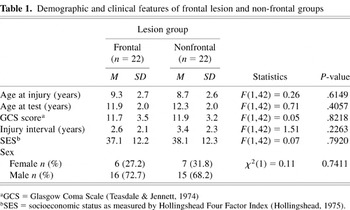
Participants were selected from prospective pediatric admissions for TBI due to closed head injury during the period 1991–2001 at academic medical centers in Dallas, Houston, and Toronto. Participation of human subjects in this study was approved by the Institutional Review Board at each of these centers. Although no constraint was imposed on severity of TBI, all patients had been hospitalized for acute neurosurgical treatment at one of the participating institutions, their level of consciousness was defined by the lowest postresuscitation Glasgow Coma Scale (GCS) score (Teasdale & Jennett, 1974) as recorded by an attending or resident neurosurgeon in the emergency room or on the neurosurgical unit, and they cooperated with follow-up assessment. The data reported in this study were collected as part of a larger project concerning neurobehavioral outcome of mild, moderate, or severe TBI arising from closed head trauma. This project included recruitment and serial two year followup of children, 5 to 15 years old, during their initial hospitalization for TBI (longitudinal cohort) and enrollment of children at least 2 years following hospitalization for TBI (cross-sectional cohort) at the same institutions who were 5 to 18 years old at the time of assessment, but were possibly younger than 5 years at the time of injury. Children in the cross-sectional cohort were identified through medical record searches and from the longitudinal cohort of a previous cycle of this project. Recruitment of the cross-sectional and longitudinal cohorts did not include referrals from clinics or medical legal sources and was independent of their outcome provided that the child recovered to a conscious level. By the time that we analyzed the data, 266 patients had consented to participate in the project and 251 patients provided outcome data. Of the 15 patients with missing data, 12 were lost to follow-up, 1 patient was found later to be ineligible, and the parents of 2 patients refused to continue. These longitudinal and cross-sectional cohorts were studied concurrently using similar eligibility criteria apart from the time of injury and age at injury. Mild TBI was defined by a brief loss of consciousness limited to 15 min, a GCS score of 13–15 after the child reached the emergency center, no subsequent neurologic deterioration to a GCS score below 13, and normal neurologic findings, and normal computed tomographic (CT) findings within 24 hr after injury. Moderate TBI was defined by a postresuscitation GCS score of 9–12 without subsequent neurologic deterioration to a GCS score below 9 regardless of CT results. Severe TBI corresponded to a lowest postresuscitation GCS score of 8 or less regardless of CT findings. Investigation of the sequelae of severe and moderate TBI was the focus of the project and recruitment of mildly injured patients was designed mainly to provide a comparison group. With the majority of pediatric TBI patients sustaining mild injuries, it was not feasible to recruit all children who were admitted for mild TBI. Consequently, recruitment of the mildly injured patients was based in part on obtaining distributions of demographic features that were similar to those of the more seriously injured children. Exclusion criteria included intentional injury, history of documented child abuse or neglect, penetrating gunshot wound of the brain, preinjury history of neurologic disorder, psychosis, or mental retardation. In addition, children with contraindications to undergoing MRI (e.g., presence of metallic implants) were excluded as were non-English speakers, and children in whom medical records pertaining to their acute injuries were unavailable. All children underwent MRI using a research protocol that included coronal fluid level attenuated inversion recovery (FLAIR), sagittal T1, and 1.5 mm slice thickness 3D volumetric sequences. MRI was performed within 2 weeks of psychosocial assessment in patients studied at least 2 years post injury and at 3 months post injury in the patients enrolled during their initial hospitalization. We have previously reported that the frequency and neuroanatomic distribution of focal brain lesions are similar in patients imaged in the longitudinal and cross-sectional cohorts (Levin et al., 1997). The 3-month post-injury interval for MRI in the longitudinal cohort was selected because it is sufficiently long for resolution of transient changes such as edema and the first major outome assessment, including evaluation of psychosocial function, was performed at that occasion. The MRI findings, which were interpreted and coded by a project neuroradiologist at each center without access to the outcome data, were used to identify 22 children with unilateral frontal lesions (11 left and 11 right hemisphere) and a comparison group of 22 TBI patients without frontal lesions in the 5 to 15 year age range (Table 1). Search criteria for identifying the children in the frontal group included the presence of a unilateral frontal lesion on MRI either with or without an ipsilateral extrafrontal lesion regardless of lesion size or TBI severity. Of the 22 children in the frontal lesion group, 3 had ipsilateral extrafrontal lesions including 2 patients in whom the extrafrontal lesion volume was larger than the frontal lesion volume.
Demographic and clinical features of frontal lesion and non-frontal groups

Each nonfrontal patient was selected from the pool of patients without frontal lesions based on matching a frontal lesion patient on lowest postresuscitation GCS score, age at injury (within 1 year), and age at test (within 1 year). With the exception of a single pair of patients, the frontal and nonfrontal patients in each pair also had the same gender. Although the design of the study initially specified a comparison group of children who had unilateral extrafrontal lesions, it was not possible to control for age at assessment using this approach. As reflected in 1 and 7, children in the frontal lesion group tended to be older than patients with extrafrontal lesions. Due to the relatively few children with unilateral focal brain lesions not involving the frontal lobes, selection criteria for patients in the nonfrontal group were expanded so that the presence of a brain lesion identified by MRI was not a requirement. Although including patients without brain lesions in the nonfrontal group did not control for the nonspecific effects of brain lesions in the frontal group, Study 2 (see below) was designed to address this confound. Table 1 summarizes the demographic and clinical features of the frontal and nonfrontal samples and shows that there were no significant group differences.
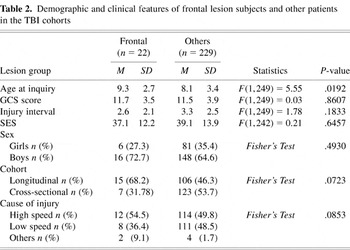
To evaluate the representativeness of the children with frontal lesions, we compared their clinical and demographic features and proportions of patients who were participants in the cross-sectional versus longitudinal cohorts to the other pediatric TBI patients enrolled in project (Table 2). Although there is a trend toward a higher percentage of children with frontal lesions sustaining TBI in a high velocity injury such as a motor vehicle crash and being selected from the longitudinal cohort relative to other patients in the project, significant differences were limited to older age at injury in the children with unilateral frontal lesion group.
Demographic and clinical features of frontal lesion subjects and other patients in the TBI cohorts

Procedures
Assessment of psychosocial outcome. Follow-up assessments were obtained beginning at 3 months post injury and the latest assessment was performed at 2 years after injury in the longitudinal cohort. The latest assessment of each child in the longitudinal cohort was selected for analysis to provide a relatively stable measure of psychosocial outcome. All assessments were performed as part of a larger project rather than selecting subgroups of patients to undergo psychosocial evaluation. A licensed psychologist or an experienced psychometrist administered the semi-structured interview for the VABS (VABS; Sparrow et al., 1984) to a parent, usually the child's mother. Parents rated whether their child was never, sometimes, or usually able to perform specific behaviors. The domains of the VABS assessed included Communication (e.g., Expressive and Receptive Language, Written Language), Daily Living Skills (e.g., Personal, Domestic, Community), and Socialization (e.g., Interpersonal Relationships, Playing and Leisure, Coping Skill), which provided standard scores. The validity of these scales has been supported by factor analytic studies of typically developing children and of various clinical populations of children (Sattler, 2002; Sparrow et al., 1984). Prospective longitudinal outcome studies have documented the sensitivity of these VABS domains to pediatric TBI (Fletcher et al., 1990; Taylor et al., 2002) with psychosocial functioning declining over the year following severe injury relative to children who sustain mild TBI or uninjured controls (Fletcher et al., 1990). We also evaluated the presence or absence of maladaptive behavior based on the parent's responses to 27 items on the Maladaptive Behavior Scale of the VABS. The interviewer coded the VABS results for validity. Analysis was restricted to data coded as valid. This stipulation necessitated selection of the 12-month rather than the 24-month outcome data for one child because the final VABS interview was rated by the examiner as invalid.
Lesion analysis
Volumetric image analysis. Digital versions of all MRI images were transferred by internet file transfer protocol (ftp) to the image analysis laboratory at Baylor College of Medicine. Guided by lesion coding and marking performed by the neuroradiologist at each center, an operator outlined each lesion using the MEDx medical image processing software package (Sensor Systems, Sterling, VA). Marked sets of images were composed into a three-dimensional volume, normalized to account for intersubject differences in brain size, registered to the Talairach template, and exported as a single file containing the entire brain volume in Talairach coordinate space. The file with the marked and normalized brain volume was used as input for a program, written using the Interactive Data Language (IDL), which reported a volume in mm3 for each lesion.
Interobserver reliability in measuring lesion volumes on MRI. Images from 8 children with CHI were analyzed independently by two observers using MEDx and IDL (see Volumetric Image Analysis). Each operator marked a total of 10 lesions (2 cases had 2 lesions) on three separate occasions to assess both intra- and interrater reliability. The mean age of patients included in the reliability study was 10.6 years (SD = 2.0), the mean postresuscitation GCS score was 11.9 (SD = 3.1), and the mean interval between the injury and MRI scan was 1.8 years (SD = 2.8). Neuroradiologists first examined hard copies of the FLAIR images and marked the location of all identified lesions on the film. Using the marked films as a guide, each operator used tools within the MEDx software package to outline areas of abnormal signal intensity on the digital image sets. Marked image volumes created within MEDx were then exported to the IDL program to obtain the lesion volumes. Intraclass correlations for intra-rater reliability for the first operator were .992 between Trials 1 and 2 (M difference = 0.4%) and .998 between Trials 2 and 3 (M difference = 1.1%). For the second operator the intraclass correlation coefficients for repeated lesion measurements were .995 between Trials 1 and 2 (M difference = 8.1%) and .998 between Trials 2 and 3 (M difference = 5.5%). The intraclass coefficient to assess interrater reliability was .999 (M difference between raters = 2.8%).
Global outcome and cognitive function. To characterize global outcome using the GOS, a structured interview was completed with the parent or guardian that encompassed the child's educational placement, psychosocial adjustment, and the child's cognitive, behavioral, or physical limitations following the injury. Criteria for the GOS categories were modified for use with children.
Cognitive testing was performed to evaluate whether the effects of frontal lesions were specific to psychosocial function or broader with impact on cognition. In addition, cognitive assessment using measures that did not emphasize executive function provided another criterion for evaluating the comparability of TBI severity in the frontal lesion and nonfrontal groups. The selection of cognitive measures was constrained by the protocol used in the larger project which included standardized tests of episodic memory, processing speed, and expressive language, domains which are sensitive to TBI in children (Catroppa et al., 1999; Ewing-Cobbs et al.,1987; Yeates et al., 1995). Declarative memory was measured by the Children's Version of the California Verbal Learning Test (CVLT–C) of Delis et al. (1994), expressive language by the Formulated Sentences subtest of the Clinical Evaluation of Language Fundamentals–Third Edition (Semel et al., 1995), and processing speed was based on a composite derived from the Coding and Symbol Search subtests of the WISC–III (Wechsler, 1991).
Statistics
We analyzed standard scores on the Communication, Daily Living, and Socialization domains of the VABS using a t test for matched pairs. In view of the exploratory nature of this study, we did not apply statistical correction for multiple comparisons. Fisher's Exact Test was used to compare the proportions of children in the frontal and nonfrontal groups whose VABS findings were indicative of alterations in adaptive behavior and to compare proportions of categories on the GOS. To explore whether lesion volume was related to specific aspects of adaptive and social functioning, regression analysis was used to analyze the relationship of frontal lesion volume to the standard scores and subdomain raw scores for those domains of the VABS which were found to differentiate the frontal lesion and nonfrontal groups. In addition, the frontal lesion volume of patients with significant vs nonsignificant psychosocial disturbance was reported using the parameter estimation to indicate the direction of changes. Unpaired t tests were used to compare the VABS findings in subgroups of patients according to the frontal subregion involved. Using paired t tests, the total recall of the Monday list (i.e., first list of words, which was presented over five trials) scale score and short delay recall z score of the CVLT–C, the Formulated Sentences scale score of the CELF, and the WISC–III Processing Speed scale score were compared for the frontal lesion and nonfrontal groups.
Results
Frontal lesion versus nonfrontal groups
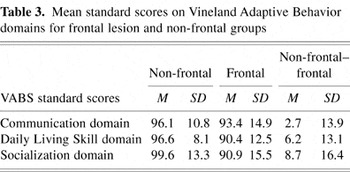
Preliminary analysis disclosed no significant difference in demographic features (e.g., M age at test was 11.9 and 11.8 years) or GCS score between the left and right frontal groups and their Vineland Domain scores were also comparable (e.g., mean total Daily Living standard scores were 88.9 and 91.9 for left and right frontal groups). Three patients (27.27%) in each group were reported by their parents to exhibit intermediate or significant maladaptive behavior as measured by the Vineland critical items. Consequently, we merged the data of the left and right frontal lesion patients into a single frontal lesion group and compared their psychosocial outcome to the findings of individually matched children who sustained TBI without frontal lesions on CT or MRI (Table 3).
Mean standard scores on Vineland Adaptive Behavior domains for frontal lesion and non-frontal groups

Table 3 presents the mean standard scores of the frontal lesion and nonfrontal groups on the Vineland domains with higher scores reflecting better psychosocial outcome. Although the difference in the Communication standard score was not significant [t(21) = 0.92, p < .368, ES = 0.19], the frontal lesion group had significantly lower standard scores on the Daily Living [t(21) = 2.21, p < .039, ES = 0.47], and the Socialization [t(21) = 2.48, p < .022, ES = 0.53] domains than the nonfrontal group.
Distribution of lesions in frontal subregions and relationship of frontal lesion volume to psychosocial outcome
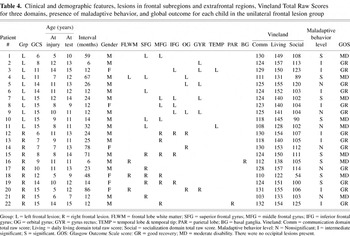
Distribution of frontal subregion lesions. Table 4 shows the frontal subregion(s) and extrafrontal regions involved for each child in the left and right frontal groups. Nine of the children in the combined unilateral frontal lesion group had a lesion in the orbital gyrus and/or gyrus rectus. Other frequent sites were superior frontal gyrus (n = 10), middle frontal gyrus (n = 10), and inferior frontal gyrus (n = 7). Concomitant ipsilateral lesions in extrafrontal areas were present in 2 left and 2 right frontal lesion patients (Table 4). The most common pathologies of the frontal lesions were gliosis (n = 11), shearing injury (n = 6), atrophy (n = 4), and encephalomalacia (n = 4). Of the children in the nonfrontal comparison group, 5 patients had one or more lesions including temporal (n = 4), parietal (n = 4), thalamus (n = 1), and occipital (n = 1) areas. Within the nonfrontal group, atrophy, shearing, calcification, gliosis, combined gliosis-encephalomalacia, and combined gliosis-shearing were the most frequent pathologies.
Clinical and demographic features, lesions in frontal subregions and extrafrontal regions, Vineland Total Raw Scores for three domains, presence of maladaptive behavior, and global outcome for each child in the unilateral frontal lesion group

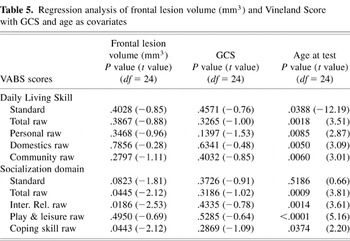
Relationship of frontal lesion volume and frontal subregion site to psychosocial outcome. To determine whether frontal lesion volume was related to psychosocial outcome, exploratory regression analysis was performed in which the GCS score and age at test were first entered into the equation. This analysis was restricted to the Daily Living and Socialization domains because there was no difference between the frontal lesion and nonfrontal groups on the Communication domain. In view of the exploratory nature of the regression analysis, we included the Daily Living and Socialization subdomains and analyzed their raw scores because standard scores are not available (Table 5). Examination of the parameter estimates indicated that the patients who had lower frontal lesion volumes tended to have higher Socialization domain total scores [t(24) = −2.12, p = .04], Interpersonal Relations scores [t(24) = −2.53, p = .02], and Coping Skill scores [t(24) = −2.12, p = .04]. The Socialization domain standard score approached significance and was also inversely related to the frontal lesion volume [t(24) = −1.81, p = .08]. However, frontal lesion volume was not significantly related to the Daily Living domain (Table 5).
Regression analysis of frontal lesion volume (mm3) and Vineland Score with GCS and age as covariates

Due to constraints associated with the small numbers of patients with lesions in specific frontal subregions (Table 4), we compared the psychosocial outcome of 12 children with orbitofrontal, gyrus rectus, and/or inferior frontal gyrus (OGRIF) lesions to the Vineland findings in the 10 children with frontal lesions involving the middle and/or superior frontal gyri and/or white matter lesions (i.e., the “other frontal lesion” group) which did not infiltrate OGRIF. Preliminary analysis revealed no significant differences in demographic features and the GCS scores of the OGRIF group (M = 11.58, SD = 3.53) did not differ significantly from that of the other frontal lesion patients [M = 11.80, SD = 3.55; t(20) = 0.14, p < .89]. Analysis of the Vineland standard scores indicated no significant difference in the Communication domain between the OGRIF (M = 96.0, SD = 14.0) and other frontal lesion (M = 90.3, SD = 16.1) groups [t(20) = 0.89, p < .39]. Similarly, the Daily Living standard scores did not differ for the OGRIF (M = 90.1, SD = 12.6) and other frontal (M = 90.7, SD = 13.0) patients [t(20) = −.10, p < .92]. There was also no difference in Socialization standard scores between the OGRIF (M = 91.3, SD = 13.6) and the other frontal (M = 90.5, SD = 18.3) groups [t(20) = 0.11, p < .92].
Classification of maladaptive behavior
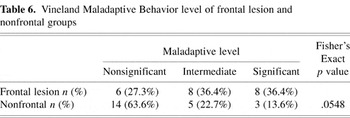
Table 6 shows that 16 children with frontal lesions and 8 patients in the nonfrontal group were classified as exhibiting intermediate-maladaptive, or significant maladaptive behavior according to the VABS. The distributions of proportions of children with findings in these categories were significantly different for the unilateral frontal lesion and the nonfrontal lesion groups. Comparison of frontal lesion volume of the 16 children considered by their parents to exhibit intermediate or significant maladaptive behavior (M volume = 7538.3, SD = 7149.4) to the other 6 patients with frontal lesions (M volume = 1293.5, SD = 2089.2) revealed a significant difference [t(18.1) = 2.43, p < .026].1
I test for unequal variances.
Vineland Maladaptive Behavior level of frontal lesion and nonfrontal groups

Global outcome
All patients in the frontal and nonfrontal groups were found to have either a good recovery or were moderately disabled. Although 9 (40.91%) of the children with frontal lesions were moderately disabled as compared to 4 (18.18%) of the patients without frontal lesions, the difference only approached significance [Fisher's Exact Test, p = .185].
Cognitive function
The mean CVLT–C scale scores for total words recalled on the Monday list were within the average range for the frontal lesion (M = 56.36, SD = 8.08) and nonfrontal (M = 60.86, SD = 10.24) groups [paired t(21) = 1.50, p < .147]. The mean short delay recall z score was 0.20 (SD = 1.13) for the frontal lesion group and 0.46 (SD = 0.80) for the nonfrontal group [paired t(21) = 0.88, p < .39]. The mean Formulated Sentences scale scores were 10.59 (SD = 3.20) for children with a frontal lesion and 9.18 (SD = 3.25)for the nonfrontal group [paired t(21) = −1.64, p < .116]. Processing speed, as measured by the WISC–III composite scale score, was not significantly different in the frontal lesion (M = 103.62, SD = 19.08) and nonfrontal (M = 100.48, SD = 19.52) groups [paired t(20) = −.51,p < .616].
Discussion
In the present study, TBI typically occurred during the primary school years, a period when self-regulatory skills had at least been partially established (Diamond, 2002). Although 12 children had involvement of the orbital gyrus, gyrus rectus, and/or inferior frontal gyrus, it is plausible that white matter disruption and secondary effects of excitotoxicity adversely affected this frontal subregion in other children whose lesions were in adjacent frontal subregions. Consistent with the overall effect of unilateral frontal lesions, regression analysis confirmed that the volume of frontal lesions adversely affected psychosocial outcome as measured by the Socialization Domain of the Vineland scores. Within the frontal lesion group, those who exhibited borderline or significant maladaptive behavior according to the Vineland critical items had larger lesions than children whose behavior was considered by their parents to be relatively normal. Although the sample size did not permit a test of differences in psychosocial outcome between the left and right prefrontal groups, the descriptive statistics did not confirm reports (Blair, 2001) that right frontal lesions are more strongly associated with behavioral disturbance than are left frontal lesions. Despite the apparent lack of differences in psychosocial outcome as measured by the VABS, we acknowledge that the mechanism of impairment might differ. Left frontal lesions could have resulted in altered verbal mediation of behavior whereas right frontal lesions might have impacted emotional processing (Tranel et al., 2002).
Our small sample size of children with lesions in specific frontal subregions limited the parcellation of lesion sites in the analysis of psychosocial outcome. However, our findings did not show differential psychosocial outcome in children with orbitofrontal or inferior frontal lesions relative to other frontal subregions. Our findings regarding laterality and site of frontal lesion are preliminary and mentioned primarily to generate further investigation using more sensitive imaging techniques and outcome measures.
We found relatively specific effects of frontal lesions on the Daily Living and Socialization domains of the VABS, reflecting deficient development of independence and social functioning according to ratings by their parents. As noted in investigations of adults with unilateral right frontal lesions (Tranel et al., 2002), we found a dissociation of impaired psychosocial outcome despite relatively intact cognitive function as reflected by measures of declarative memory, processing speed, and expressive language. Children sustaining frontal lesions also had more than twice the rate of adaptive behavioral difficulty than TBI patients in the nonfrontal group who were individually matched on demographic features and GCS score. A limitation of this matched-pairs approach is that the frontal and nonfrontal groups differed in the proportion of children who had brain lesions due to the relatively low frequency of extrafrontal lesions in pediatric TBI (Levin et al., 1997). Although we had attempted individual matching of patients with frontal versus extrafrontal lesions, the relatively few children with extrafrontal lesions and their younger age at injury precluded this approach. Consequently, it is conceivable that the observed differences in psychosocial outcome were due to the effects of a residual brain lesion regardless of the location. Other limitations of this study include the possibility of a chance finding due to multiple statistical comparisons of the frontal versus nonfrontal groups. In this initial investigation of the effects of unilateral frontal lesions associated with TBI, we did not apply a correction for the number of comparisons. Although the VABS is well validated as a measure of adaptive behavioral in children following TBI (Fletcher et al., 1990, 1996), a structured interview designed specifically to assess behavioral sequelae of frontal injury in children analogous to the technique used with adults by Tranel et al. (2002), could be more sensitive to the effects of frontal lesions than the VABS. Consequently, the results of Study 1 should be interpreted as tentative pending replication.
To mitigate confounding by the higher frequency of brain lesions in the frontal group, in Study 2 we analyzed the effect of focal extrafrontal brain lesions on psychosocial outcome. If the presence of an extrafrontal lesion had no effect on psychosocial functioning, then the findings obtained in Study 1 could be attributed to the presence of frontal lesions rather than a nonspecific effect of lesions, irrespective of location.
STUDY 2
Methods
Research participants
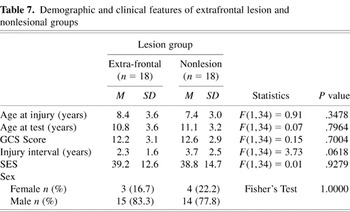
The patients were identified from the same patient cohorts from which we formed the samples in Study 1. All children in Study 2 underwent the same MRI protocol as Study 1. Of the 18 children with extrafrontal lesions, digitized MRI data were unavailable for 1 patient. Consequently, volumetric analysis of the extrafrontal lesions was limited to 17 children. Using a matching process similar to Study 1, we identified two nonfrontal lesion groups consisting of 18 children each, which differed in the presence of an extrafrontal brain lesion identified by MRI. Table 7 shows that these groups did not differ in demographic features or acute severity of TBI as measured by the postresuscitation GCS score. Six children in the nonfrontal lesion group and 4 patients without lesions had also been included in Study 1, whereas the other 26 patients in Study 2 had not participated in Study 1. The mean total lesion volume in the nonfrontal lesion group was 5147.9 cc (SD = 20040) as compared with a mean total lesion volume of 6010 cc (SD = 8714.2) in the frontal lesion group of Study 1, a nonsignificant difference [t(20.7) = −0.17, p < .8700].
Demographic and clinical features of extrafrontal lesion and nonlesional groups

Procedure
Assessment of psychosocial, cognitive, and global outcome used procedures identical to Study 1.
Results
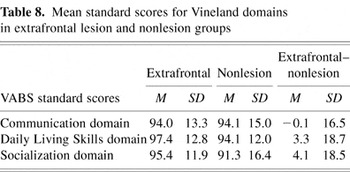
Table 8 shows the mean standard scores on the VABS for the extrafrontal lesion and nonlesion groups. There were no significant differences on the Communication [t(17) = −0.01, p < .989, ES = 0.01] Daily Living [t(17) = 0.75, p < .466, ES = 0.18] and Socialization [t(17) = 0.94, p < .360, ES = 0.22] domains.
Mean standard scores for Vineland domains in extrafrontal lesion and nonlesion groups

The percentages of children with nonfrontal lesions who had normal (7 patients, 38.9%), intermediate (7 patients, 38.9%), and significant maladaptive (4 patients, 22.2%) scores according to the cut-off on the Vineland Maladaptive Behavior Scale did not differ from the corresponding percentages for the nonlesion group (4 patients, 22.2%; 9 patients, 50%; 5 patients, 28.8%), Fisher's Exact Test, p = .68. Global outcome, as measured by the GOS, also did not differ between the children who had extrafrontal lesions and the nonlesion group.
Regression analysis in which the GCS score and age at study were entered as covariates failed to disclose any effect of extrafrontal lesion volume on any of the Vineland Domain Standard Scores. For example, regression of the extrafrontal lesion volume on the Socialization Domain Standard Score was nonsignificant [F(1,13) = 0.00, p < .9819].
Comparison of the cognitive performance of the nonfrontal lesion and nonlesion groups reflected variation in sample size due to missing data for 1 or 2 patients on specific measures. Mean scale score for total words recalled from the Monday list of the CVLT–C did not differ for the nonfrontal lesion and the nonlesion groups [paired t(16) = 0.83, p < .42]. The z score for short delay recall also did not differ for the nonfrontal lesion and nonlesion) groups [paired t(16) = 0.42, p < .68]. There was no difference in the Formulated Sentences scale score of the CELF between the nonfrontal lesion and nonlesion groups [paired t(16) = −0.24, p < .81]. However, processing speed as measured by the WISC–III scale score tended to be slower in the nonfrontal lesion than nonlesion group and approached significance [t(15) = 2.10, p < .06].
Discussion
With relatively few lesions in the nonfrontal group in Study 1, the effects of frontal lesions could not be isolated from the presence of any brain lesion. In view of our finding that the presence of an extrafrontal lesion had no effect on psychosocial or global outcome, it is unlikely that the results of Study 1 can be attributed to the nonspecific effects of a brain lesion rather than to the contribution of a frontal lesion. Direct comparison of the results in Studies 1 and 2 is complicated by differences between the samples in age and gender distribution. The children in Study 2 tended to be injured at an earlier age than the Study 1 patients.
GENERAL DISCUSSION
Our data, including the results of volumetric lesion analysis, extend the small body of work on the effects of frontal lobe lesions in the developing brain, and suggest that unilateral frontal lobe lesions do result in psychosocial deficits following TBI in children. Previous studies of patients sustaining orbitofrontal and ventromedial frontal lesions of diverse etiologies, including case reports or case series of adult onset (Barrash et al., 2000; Bechara et al., 2000; Eslinger & Damasio, 1985) and childhood injuries (Eslinger et al., 1992; Marlowe, 1992; Price et al., 1990) have documented difficulty in self-regulation of social behavior and everyday decision making. Children sustaining orbitofrontal and ventromedial frontal lesions, particularly bilateral lesions prior to age 5 years, have been found to exhibit disruptive behavior, failure to follow rules, deficient empathy, and a lack of moral reasoning which were refractory to repeated instruction, treatment, and punishment (Anderson et al., 1999). In comparison with adults sustaining orbitofrontal and ventromedial frontal lesions, the sequelae of early prefrontal lesions tend to include more blatantly antisocial behavior (Anderson et al., 1999).
Bilateral ventromedial frontal lesions have been frequently noted in cases of socially inappropriate behavior and poor decision making following orbitofrontal injury in children, but right frontal cases and a child with left dorsolateral injury displaying these sequelae have also been described (Eslinger et al., 1992; Marlowe, 1992). Tranel et al. (2002) recently reported that a group of adults with right ventromedial prefrontal lesions (n = 4) had experienced postinjury deterioration of social and occupational functioning, a pattern which was not present in adults with homologous left sided lesions (n = 3). In the present study, analysis of frontal subregion lesions was limited by the small numbers of patients in each group and use of conventional MRI. Within these constraints, we found no effect of lateralization of frontal lesion on VABS measures and no difference in psychosocial outcome between children who sustained orbitofrontal, inferior frontal or gyrus rectus lesions as compared with patients who had lesions in other frontal subregions. Anderson et al. (1999) inferred that medial prefrontal dysfunction, whether resulting from direct injury or by white matter disconnection, is the key feature. To this end, it is plausible that disruption of frontolimbic circuitry and other connections contributed to the psychosocial problems regardless of the frontal subregion that was the site of cortical lesions.
In the present study, groups of children drawn from consecutive hospital admissions for TBI were selected from large cohorts of patients based on their MRI findings rather than referral due to marked behavioral disturbance. Although the group of children with unilateral frontal lesions represents a small percentage of the cohorts studied over 10 years and differed from the total cohort in age at injury, no other significant differences were found in demographic and clinical features. As noted earlier, the findings should be interpreted with caution given their exploratory nature and the multiple statistical comparisons.
The VABS has been well validated as a measure of psychosocial outcome of TBI in children (Fletcher et al., 1990, 1996; Taylor et al., 2002). The interviewers had no information concerning the MRI findings and the neuroradiologists were not given any psychosocial outcome data. Nevertheless, extension of this study could include a structured interview designed to diagnose psychiatric disorder according to DSM–IV (1994) criteria. Although we screened for preinjury neuropsychiatric disorder, the lifetime history provided by a structured interview such as the K-SADS (Kaufman et al., 1997) using DSM–IV criteria would be an enhancement. Preexisting psychopathology is known to increase the risk for TBI, although there is little reason to believe that it generates a bias toward frontal lesions. Convergence of the results for the GOS, which showed a rate of disability twice as high (though only bordering on significance) in children with frontal lesions as compared to the nonfrontal group, provides some confirmation that our findings on the VABS reflect substantive differences in adaptive functioning.
The finding that prefrontal lesions are common in children 3 months or later after TBI, which corroborates our previous study (Levin et al., 1997), is of interest. In the present study, prefrontal lesions were primarily situated in the dorsolateral, inferior, and orbitofrontal subregions. Dorsolateral and inferior frontal cortex has been implicated by functional brain imaging studies to subserve executive control of attention, working memory and inhibition (Bunge et al., 2001; Diamond, 2002). Because frontal lesions are relatively common in children with TBI, it will be possible in larger-scale studies to identify patterns of frontal subregion lesions that are more or less associated with psychosocial sequelae. Future studies should focus on delineating the nature of the psychosocial and social cognitive dysfunction associated with frontal lesions in children. Recent theoretical accounts of frontal lobe function provide the basis for determining which view is more relevant to describing the dysfunction in children with TBI. Is it the case, as the somatic marker theory postulates (Damasio, 1996), that damage to the ventromedial prefrontal cortex disconnects cognitive knowledge and knowledge-relevant affect, so that decision making is random and not guided by affect and reward contingencies? Alternatively, do orbitofrontal lesions prevent the development of finely tuned social inhibitory control, as response reversal views suggest (Blair & Cipolotti, 2000)? Suggestions (Anderson et al., 1999; Eslinger et al., 1992; Marlowe, 1992; Price et al., 1990) that the consequences of frontal lesions in children can become magnified when the patients enter adolescence and adulthood could also be addressed. Ongoing research is aimed at answering these questions.
ACKNOWLEDGMENTS
The authors wish to thank Angela D. Williams, MBA, JD, and Stacey Martin for editorial assistance. This paper is supported by the National Institutes of Health/National Institute of Neurological Disorders and Stroke Grant NS-21889, “Neurobehavioral Outcome of Head Injury in Children.” Presented to Dr. Levin at the Society for Research in Child Development meeting on April 24, 2003 in Tampa, Florida.
References
REFERENCES
American Psychiatric Association.
(1994).
Diagnostic and statistical manual of mental disorders
(4th ed.).
Washington, DC:
Author.
Anderson, S.W.,
Bechara, A.,
Damasio, H.,
Tranel, D., &
Damasio, A.R.
(1999).
Impairment of social and moral behavior related to early damage in
human prefrontal cortex.
Nature Neuroscience,
2,
1032–1037.Google Scholar
Barrash, J.,
Tranel, D., &
Anderson, S.W.
(2000).
Acquired personality disturbances associated with bilateral damage
to the ventromedial prefrontal region.
Developmental Neuropsychology,
18,
355–381.CrossRefGoogle Scholar
Bechara, A.,
Damasio, H., &
Damasio, A.R.
(2000).
Emotion, decision making and the orbitofrontal cortex.
Cerebral Cortex,
10,
295–307.CrossRefGoogle Scholar
Blair, R.J.
(2001).
Neurocognitive models of aggression, the antisocial personality
disorders, and psychopathy.
Journal of Neurology, Neurosurgery, and Psychiatry,
71,
727–731.CrossRefGoogle Scholar
Blair, R.J. &
Cipolotti, L.
(2000).
Impaired social response reversal. A case of ‘acquired
sociopathy’.
Brain,
123,
1122–1141.Google Scholar
Blair, R.J.,
Morris, J.S.,
Frith, C.D.,
Perrett, D.I., &
Dolan, R.J.
(1999).
Dissociable neural responses to facial expressions of sadness and
anger.
Brain,
122,
883–893.CrossRefGoogle Scholar
Bunge, S.A.,
Ochsner, K.N.,
Desmond, J.E.,
Glover, G.H., &
Gabrieli, J.D.
(2001).
Prefrontal regions involved in keeping information in and out of
mind.
Brain,
124,
2074–2086.Google Scholar
Catroppa, C. &
Anderson, V.
(1999).
Attentional skills in the acute phase following pediatric traumatic
brain injury.
Neuropsychology, Development and Cognition. Section C,
Child Neurophychology,
5,
251–264.Google Scholar
Damasio, A.R.
(1996).
The somatic marker hypothesis and the possible functions of the
prefrontal cortex.
Philosophical Transactions of the Royal Society London B:
Biological Sciences,
351,
1413–1420.CrossRefGoogle Scholar
Delis, D.C.,
Kramer, J.H.,
Kaplan, E., &
Ober, B.A.
(1994).
CVLT–C: California Verbal Learning Test–Children's
Version.
San Antonio, TX:
The Psychological Corporation.
Dennis, M.,
Purvis, K.,
Barnes, M.A.,
Wilkinson, M., &
Winner, E.
(2001).
Understanding of literal truth, ironic criticism, and deceptive
praise following childhood head injury.
Brain and Language,
78,
1–16.Google Scholar
Diamond, A.
(2002).
Normal development of prefrontal cortex from birth to young adulthood:
cognitive functions, anatomy, and biochemistry. In
D.T. Stuss &
R. T. Knight (Eds.),
Principles of frontal lobe function (pp.
466–503).
New York:
Oxford University Press.
Eslinger, P.J. &
Damasio, A.R.
(1985).
Severe disturbance of higher cognition after bilateral frontal lobe
ablation: Patient EVR.
Neurology,
35,
1731–1741.CrossRefGoogle Scholar
Eslinger, P.J.,
Grattan, L.M.,
Damasio, H., &
Damasio, A.R.
(1992).
Developmental consequences of childhood frontal lobe damage.
Archives of Neurology,
49,
764–769.CrossRefGoogle Scholar
Ewing-Cobbs, L.,
Levin, H.S.,
Eisenberg, H.M., &
Fletcher, J.M.
(1987).
Language functions following closed-head injury in children and
adolescents.
Journal of Clinical and Experimental Neuropsychology,
9,
575–592.CrossRefGoogle Scholar
Fletcher, J.M.,
Ewing-Cobbs, L.,
Miner, M.E.,
Levin, H.S., &
Eisenberg, H.M.
(1990).
Behavioral changes after closed head injury in children.
Journal of Consulting and Clinical Psychology,
58,
93–98.Google Scholar
Fletcher, J.M.,
Levin, H.S.,
Lachar, D.,
Kusnerik, L.,
Harward, H.,
Mendelsohn, D., &
Lilly, M.A.
(1996).
Behavioral outcomes after pediatric closed head injury:
Relationships with age, severity, and lesion size.
Journal of Child Neurology,
11,
283–290.CrossRefGoogle Scholar
Francis, S.,
Rolls, E.,
Bowetell, R.,
McGlone, F.,
O'Doherty, J.,
Browning, A.,
Claire, S., &
Smith, E.
(1999).
The representation of pleasant touch in the brain and its
relationship with taste and olfactory areas.
Neuroreport,
10,
453–459.Google Scholar
Graham, D.I.,
Ford, I.,
Adams, J.H.,
Doyle, D.,
Lawrence, A.E.,
McLellan, D.R., &
Ng, H.K.
(1989).
Fatal head injury in children.
Journal of Clinical Pathology,
42,
18–22.CrossRefGoogle Scholar
Hollingshead, A.
(1975).
Four Factor Index of Social Status.
New Haven, CT:
Yale University Press.
Jennett, B. &
Bond, M.
(1975).
Assessment of outcome after severe brain damage. A practical scale.
Lancet,
1,
480–487.Google Scholar
Kaufman, J.,
Birmaher, B.,
Brent, D.,
Rao, U.,
Flynn, C.,
Moreci, P.,
Williamson, D., &
Ryan, N.
(1997).
Schedule for Affective Disorders and Schizophrenia for School-Age
Children-Present and Lifetime Version (K-SADS-PL): initial reliability
and validity data.
Journal of the American Academy of Child and Adolescent Psychiatry,
36,
980–988.Google Scholar
Levin, H.S.,
Mendelsohn, D.,
Lilly, M.A.,
Yeakley, J.,
Song, J.,
Scheibel, R.S.,
Harward, H.,
Fletcher, J.M.,
Kufera, J.A.,
Davidson, K.C., &
Bruce, D.
(1997).
Magnetic resonance imaging in relation to functional outcome of
pediatric closed head injury: A test of the Ommaya-Gennarelli
model.
Neurosurgery,
40,
432–440.Google Scholar
Marlowe, W.
(1992).
The impact of right prefrontal lesion on the developing brain.
Brain and Cognition,
20,
205–213.CrossRefGoogle Scholar
Price, B.H.,
Daffner, K.R.,
Stowe, R.M., &
Mesulam, M.M.
(1990).
The comportmental learning disabilities of early frontal lobe
damage.
Brain,
113,
1383–1393.CrossRefGoogle Scholar
Rolls, E.T.,
Hornak, J.,
Wade, D., &
McGrath, J.
(1994).
Emotion-related learning in patients with social and emotional
changes associated with frontal lobe damage.
Journal of Neurology, Neurosurgery, and Psychiatry,
57,
1518–1524.CrossRefGoogle Scholar
Sattler, J.M.
(2002).
Assessment of adaptive behavior. In
Assessment of children
(4th ed., pp.
189–211).
San Diego, CA:
Jerome M. Sattler, Publisher, Inc.
Semel, E.,
Wiig, E.H., &
Secord, W.A.
(1995).
Clinical evaluation of language fundamentals
(3rd ed.).
San Antonio, TX:
The Psychological Corporation.
Sparrow, S.S.,
Balla, D.A., &
Cicchetti, D.
(1984).
Vineland Adaptive Behavior Scales.
Circle Pines, MN:
American Guidance Service.
Taylor, H.G.,
Yeates, K.O.,
Wade, S.L.,
Drotar, D.,
Stancin, T., &
Minich, N.
(2002).
A prospective study of short- and long-term outcomes after
traumatic brain injury in children: Behavior and achievement.
Neuropsychology,
16,
15–27.CrossRefGoogle Scholar
Teasdale, G. &
Jennett, B.
(1974).
Assessment of coma and impaired consciousness. A practical scale.
Lancet,
2,
81–84.Google Scholar
Tranel, D.,
Bechara, A., &
Denburg, N.L.
(2002).
Asymmetric functional roles of right and left ventromedial
prefrontal cortices in social conduct, decision-making, and emotional
processing.
Cortex,
38,
589–612.Google Scholar
Wechsler, D.
(1991).
Wechsler Intelligence Scale for Children, Third Edition manual.
San Antonio, TX:
The Psychological Corporation.
Yeates, K.O.,
Blumenstein, E.,
Patterson, C.M.,
Delis, D.C.
(1995).
Verbal learning and memory following pediatric closed-head injury.
Journal of the International Neuropsychological Society,
1,
78–87.Google Scholar
Demographic and clinical features of frontal lesion and non-frontal groups
Demographic and clinical features of frontal lesion subjects and other patients in the TBI cohorts
Mean standard scores on Vineland Adaptive Behavior domains for frontal lesion and non-frontal groups
Clinical and demographic features, lesions in frontal subregions and extrafrontal regions, Vineland Total Raw Scores for three domains, presence of maladaptive behavior, and global outcome for each child in the unilateral frontal lesion group
Regression analysis of frontal lesion volume (mm3) and Vineland Score with GCS and age as covariates
Vineland Maladaptive Behavior level of frontal lesion and nonfrontal groups
Demographic and clinical features of extrafrontal lesion and nonlesional groups
Mean standard scores for Vineland domains in extrafrontal lesion and nonlesion groups
 You have
Access
- 65
- Cited by