Introduction
Spina bifida myelomeningocele (SBM) is a neural tube defect associated with a modal pattern of strengths and deficits in motor, cognitive, academic, and behavioral domains (Dennis, Landry, Barnes, & Fletcher, Reference Dennis, Landry, Barnes and Fletcher2006). The academic profile of children with SBM has been well-documented; using a low achievement definition of learning disabilities (skill performance below the 25th percentile with an absence of intellectual disability) to identify learning disability, it has been estimated that up to one-third of children with SBM have a disability in reading comprehension (Fletcher et al., Reference Fletcher, Dennis, Northup, Barnes, Hannay, Landry and Francis2004). Moreover, even when children with SBM do not meet stipulated criteria for the diagnosis of a reading comprehension disability per se, their reading comprehension skill is typically significantly lower than their word decoding skill, a pattern less often observed in typically developing (TD) controls (Barnes & Dennis, Reference Barnes and Dennis1992; Barnes, Dennis & Hetherington, Reference Barnes, Dennis and Hetherington2004; Barnes, Faulkner, Wilkinson, & Dennis, Reference Barnes, Faulkner, Wilkinson and Dennis2004).
In comparison to the development of word reading skills, less is known about the processes that underlie success or failure in reading comprehension. Studies of how reading comprehension unfolds in children with SBM have been informed through experiments that examine this population's strengths and weaknesses at accessing meaning from three levels of text (Barnes, Huber, Johnston, & Dennis, Reference Barnes, Huber, Johnston and Dennis2007): the surface-code (i.e., vocabulary, syntax knowledge, and interpreting information from sentences), text-base (i.e., literal interpretation of the text that unfolds via integration of various sources of information from within the text), and situation model (i.e., construction of the mental models that represent an integration of information provided by the text with readers’ goals and world knowledge; Kintsch, Reference Kintsch2005).
In general, children with SBM are able to access surface level representations of written text as well as their TD peers. They have been found to have intact vocabulary knowledge, grammatical skills, and ability to understand figurative language (Barnes & Dennis, Reference Barnes and Dennis1998; Barnes et al., Reference Barnes, Dennis and Hetherington2004; Dennis, Jacennik, & Barnes, Reference Dennis, Jacennik and Barnes1994). Assembling this information into a text-based representation, however, is more difficult for children with SBM (Barnes et al., Reference Barnes, Huber, Johnston and Dennis2007). Specifically, they have been found to have difficulty with a skill that has been highlighted in the literature as particularly important for the construction of text-based representations: bridging inferences (Barnes et al., Reference Barnes, Huber, Johnston and Dennis2007; Clifton & Duffy, Reference Clifton and Duffy2001).
Bridging inferences, which require the reader to integrate two pieces of explicitly stated information from within the text, are also considered essential for developing and maintaining a coherent understanding (Kintsch, Reference Kintsch1994). Barnes et al. (Reference Barnes, Faulkner, Wilkinson and Dennis2004) found that, while children with SBM were accurate at making bridging inferences, they were slower than the control group at making them when required to integrate two pieces of information separated by longer chunks of text.
The aim of the current study is to understand the developmental pathways that result in the difficulties that children with SBM have in making those inferences that are necessary for the formation of an accurate, coherent representation of the text (i.e., bridging inferences). The hypothesized predictors of difficulties in inferential comprehension specifically, and in reading comprehension more generally are as follows:
Working Memory/Inhibitory Control
Working memory and inhibitory control are two executive functioning processes that are considered important for comprehension (Christopher et al., 2012; Miyake et al., Reference Miyake, Friedman, Emerson, Witzki, Howerter and Wager2000; Swanson, Howard, & Saez, Reference Swanson, Howard and Sáez2006). Working memory can be thought of as the “work space” where information is processed, stored, and integrated and therefore limited working memory capacity has consequences for reading comprehension (Cain, Oakhill, & Bryant, Reference Cain, Oakhill and Bryant2004). As new information is read, the mental model is continually updated so that the information that remains activated is relevant to the unfolding situation described by the text (Kintsch, Reference Kintsch1988). The updating of the model involves the reactivation of information from previous cycles and subsequent integration of that information with the material in working memory.
Cognitive theories of reading comprehension also emphasize inhibitory processes such as suppression (Gernsbacher, Reference Gernsbacher1990). Suppression of information that is not relevant for ongoing comprehension is important to free up the cognitive resources required to process the increasing input of information as the reader progresses through the text (Gernsbacher & Faust, Reference Gernsbacher and Faust1991; Gernsbacher, Reference Gernsbacher1990). Failure to suppress irrelevant information overloads cognitive capacity, which then interferes with meaning construction (Palladino, Cornoldi, De Beni, & Passaglia, Reference Palladino, Cornoldi, De Beni and Pazzaglia2001).
Working memory and suppression have been consistently found to be impaired in poor comprehenders, including children with SBM (Barnes et al., Reference Barnes, Dennis and Hetherington2004; De Beni & Palladino, Reference De Beni and Palladino2000; Gernsbacher, Reference Gernsbacher1993; Swanson, Howard, & Sáez, Reference Swanson, Howard and Sáez2007). Some work has demonstrated that the ability to make inferences is associated with working memory ability (e.g., Barnes et al., Reference Barnes, Huber, Johnston and Dennis2007; Cain et al., Reference Cain, Oakhill and Bryant2004; Pike, Barnes, & Barron, Reference Pike, Barnes and Barron2010), however, these relations have only been studied concurrently.
Oral Language
Oral language skills have been linked to reading comprehension ability in numerous studies, with samples of children at various ages (Oakhill & Cain, Reference Oakhill and Cain2007). Early abilities in this area have also been identified as important predictors of later comprehension skill in longitudinal studies (e.g., Catts, Fey, Zhang & Tomblin, Reference Catts, Fey, Zhang and Tomblin1999; Kendeou, White, van den Broek, & Lynch, 2009; Storch & Whitehurst, Reference Storch and Whitehurst2002). Consistent with the ‘Simple View of Reading,’ Hulme and Snowling (Reference Hulme and Snowling2011) argue that oral language problems produce deficits in reading comprehension based on several studies showing that poor comprehenders have early difficulties across a range of oral language skills (e.g., Catts, Adlof, & Ellis-Weismer, Reference Catts, Adlof and Ellis-Weismer2006; Nation, Clarke, Marshall, & Durand, Reference Nation, Clarke, Marshall and Durand2004).
The term “early oral language skills” is broad and can be further broken down into more distinct language skills, such as comprehension and expressive abilities. Comprehension of oral language (e.g., receptive language) involves the understanding of spoken language and is often considered a prerequisite skill for reading comprehension because of its role in accessing meaning from the surface code. Vocabulary knowledge in particular has been identified as a strong predictor of reading comprehension (Tannenbaum, Torgeson, & Wagner, 2006). Expressive language is frequently studied in the comprehension literature through narrative recall tasks because the ability to retell narratives is considered, in part, a function of how well the child understood the story and reflects memory for story content and knowledge of narrative structure (Catts et al., Reference Catts, Fey, Zhang and Tomblin1999; van den Broek, Reference van den Broek1997). A reader's ability to construct a coherent mental model of the text is dependent, in part, on the ability to recall relevant information from the text (van den Broek, White, Kendeou, & Carlson, 2009).
Oral comprehension and narrative retell are partially overlapping, but also somewhat separate abilities; however, most previous longitudinal studies linking them to later outcomes in reading comprehension have combined them into an oral language composite, making their relative contributions unknown (e.g., Catts et al., Reference Catts, Fey, Zhang and Tomblin1999; Kendeou et al., Reference Kendeou, Van den Broek, White and Lynch2009; Storch & Whitehurst, Reference Storch and Whitehurst2002). In addition to examining them separately, testing their impact on later inferencing ability, and in a sample of children with SBM, will add significantly to the current literature.
The Present Study
Although some studies have begun to investigate the cognitive processes that may limit reading comprehension skill in children with SBM (Barnes et al., Reference Barnes, Huber, Johnston and Dennis2007), the developmental origins of these processes in both neurodevelopmental disorders and in typical development remains unclear. An empirical examination of this requires longitudinal studies, which are rare in studies of inferential comprehension, and in the literature on cognitive and academic outcomes in neurodevelopmental disorders such as SBM.
The goal of the current study was to examine the relation between preschool cognitive abilities and school-age ability on an important component skill of comprehension, the ability to make bridging inferences. Specifically, working memory/inhibitory control, oral comprehension, and narrative recall at 36 months of age were tested as mediators of the effect of group (SBM vs. TD) on bridging inference-making at 9 years of age. The relation of these preschool abilities to achievement in reading comprehension was also tested.
Methods
Participants
Participants were recruited from Houston, Texas, and Toronto, Ontario, to participate in a larger longitudinal study on the impact of SBM on learning. Recruited in infancy through treating neurosurgeons and pediatricians (sample with SBM) and well-baby clinic advertisements (TD sample), detailed eligibility criteria are reported elsewhere (Lomax-Bream, Barnes, Copeland, Taylor, & Landry, Reference Lomax-Bream, Barnes, Copeland, Taylor and Landry2007).
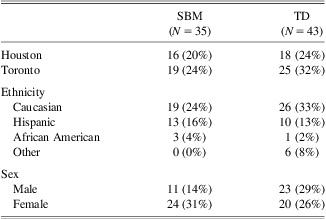
Children who did not complete all tasks were excluded from the analyses. Therefore the final sample reported on in the current study consisted of 78 participants (SBM = 45%). Demographic information is reported in Table 1. The group with SBM had more female participants than the TD group, χ2(1) = 3.82, p = .05, however, sex was not related to any outcome measures and therefore not included as a covariate in subsequent analyses. The TD group had a significantly higher socioeconomic status (SES) than the group with SBM, F(1,76) = 6.13, p = .02, which reflects the greater number of economically disadvantaged Hispanic families in the SBM group in Texas. SES was significantly correlated with many of the outcome measures and was therefore included as a covariate in analyses. Most of the children in the group with SBM had hydrocephalus treated with a diversionary shunt; three had arrested hydrocephalus and no shunt. The majority had lower spinal lesions below L1 (89%).
Demographic information on Spina Bifida and Typically Developing groups
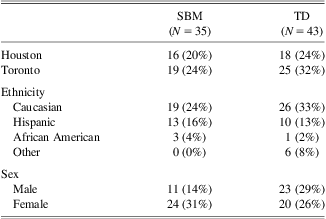
Note. Data is presented in both n and percentage of total sample.
Measures and Procedures
Children and their caregivers participated in several laboratory or home visits over the first 10 years of life. Data for the current study are taken from 36-month and 9.5-year assessments. Consent was obtained from parents and children at 9.5 years-of-age, in accordance with the institutional review boards at the University of Texas Health Science Center at Houston and the Hospital for Sick Children in Toronto.
Tasks Administered at 36 Months
Six boxes task
This is an adapted self-ordered pointing task (Diamond, Prevor, Callender, & Druin, Reference Diamond, Prevor, Callendar and Druin1997; Petrides & Milner, Reference Petrides and Milner1982) that was modified to be suitable for preschool children. The child and examiner sit across from each other at a table with six boxes on it. First, the child watches the examiner hide a reward (a cheerio) under each box. Next, a screen is held up to cover the boxes from the child's view for 5 s. The screen is removed and the child is then asked to find one cheerio, representing one trial. Once the child finds a cheerio, it is removed from the box and given to the child. The screen is again held up to block the child's view of the boxes. After 5 s, the screen is removed and the child is then asked to find another cheerio. To do so, the child has to remember where they previously located the cheerio and not look under the same box again (i.e., they have to inhibit looking under a box in which they previously located a reward). Trials proceed to a maximum of 20. The child's score on this is the total number of searches the child required to locate all of the rewards. This task requires the child to keep track of his or her history of searching multiple boxes for rewards (working memory) and to inhibit return to a previously rewarded location (inhibitory control; Ewing-Cobbs, Prasad, Landry, Kramer, & DeLeon, Reference Ewing-Cobbs, Prasad, Landry, Kramer and DeLeon2004). Because the number of trials required varied from child to child, we used a split half method to estimate reliability, comparing odd numbered trials to the even numbered trials (reliability = .98).
Preschool Language Scale: 3rd Edition - Auditory Comprehension Subtest (PLS-AC; Zimmerman, Steiner, & Pond, 1992)
This task was administered at the 36-month timepoint. This test measures receptive language development through picture-word and picture-phrase matching tasks and requiring the child to follow directions (e.g., “point to the toy that is not red”). There are also items that assess the child's ability to make connections between concepts, to make basic inferences, and that require syntactic knowledge. This subtest reports a test–retest reliability of 0.90.
Story retell task
In this experimental task, children are read a simple story about Winnie the Pooh while the researcher simultaneously acts out events in the story using toy figures. The child is then asked to tell the same story back to the examiner. The child's score on this task is comprised of the number of story elements the child is able to recall, either verbally or nonverbally (e.g., acted out using the toy figures). Because the score for this task is the sum of the individual story components, we used internal consistency reliability and determined the value to be .74.
School-Age Inferencing and Reading Achievement Measures
Bridging Inferences Task (Bridge-IT; Davis, Johnston, Barnes, & Desrochers, Reference Davis, Johnston, Barnes and Desrochers2007; Pike et al., Reference Pike, Barnes and Barron2010)
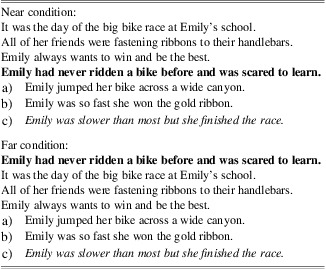
The Bridge-IT measures the ability to integrate information presented within text to make inferences when the text needing integration is in close proximity (i.e., continuous sentences; near condition) or farther apart (i.e., separated by three sentences; far condition). The child is asked to read four sentence stories and then to choose “the best sentence” from three possible answers to complete the story (see Table 2 for an example item). The child is not allowed to refer to the original story when considering their response. Choosing the best of the three possible answers demonstrated that the child made the correct inference. Of the 20 items, 10 were in the near condition and 10 in the far. Children received a raw score comprised of the total number of correct inferences made (out of 20). A previous study that included this task reported a reliability coefficient of 0.73 between parallel versions of the task (Davis et al., Reference Davis, Johnston, Barnes and Desrochers2007).
Example item from the Bridging Inferences Task (Bridge-IT)

Note. Target sentences are in bolded font; correct answers are in italicized font.
Passage Comprehension Subtest, Woodcock-Johnson (WJ-III; Woodcock, McGrew, & Mather, Reference Woodcock, McGrew and Mather2001)
This measure requires the child to read sentences and passages of increasing length and to then generate a missing word to make a passage complete and coherent. Items become progressively more difficult as passages increase in length and vocabulary and syntax become more sophisticated.
Letter-Word Identification Subtest, Woodcock-Johnson (WJ-III; Woodcock et al., Reference Woodcock, McGrew and Mather2001)
This is an untimed measure of word reading ability.
Analytic Approach
The relation between the early preschool abilities and school-age outcomes in making bridging inferences and the relation of these abilities to achievement in reading comprehension were investigated through mediation analyses, specifically using procedures outlined by Preacher and Hayes (Reference Preacher and Hayes2008). This method permits the inclusion of multiple mediators or independent variables in the same model (Hayes, Reference Hayes2011), which allows for the testing of the indirect effect of each individual path while at the same time controlling for all other variables in the model. It also reduces parameter bias due to omitted variables (as would be present in multiple simple mediation models; Preacher & Hayes, Reference Preacher and Hayes2008). Finally, this method allows for the inclusion of covariates, which are partialled out of the outcome variable and all hypothesized mediators (Hayes, Reference Hayes2011).
Bootstrapping procedures as outlined by Preacher and Hayes (Reference Preacher and Hayes2008) and recommended as current best practice in developmental research (Dearing & Hamilton, Reference Dearing and Hamilton2006), were also used. Bootstrapping addresses concerns associated with traditional mediation approaches (e.g., Baron & Kenny, Reference Baron and Kenny1986; Sobel, Reference Sobel1982) when working with small sample sizes and variables with non-normal distributions while at the same time accounting for the increased probability for Type I error (Hayes, Reference Hayes2009; Preacher & Hayes, Reference Preacher and Hayes2008).
In the current study, this procedure was conducted using the SPSS macro provided by Hayes (Reference Hayes2011). The reported results are based on a 5000 resample 90% Bias-Corrected accelerated (BCa) confidence intervals (which account for the often asymmetric point estimate distribution resulting from bootstrapping). The point estimate for an indirect effect was considered significant if zero was not included in the 90% BCa confidence interval (Hayes, Reference Hayes2009).
Results
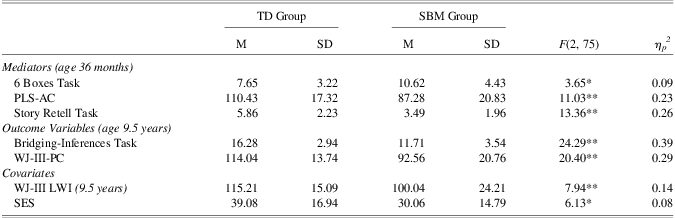
Group comparisons of the hypothesized mediators, covariates, and outcome measures revealed that the TD group significantly outperformed the group with SBM on each measure (Table 3).
Means, standard deviations, and univariate ANOVA group comparison results for mediators and outcome variables
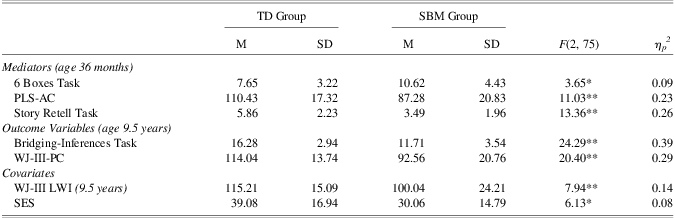
Note. 6 Boxes Task = number of searches required; PLS-AC = Preschool Language Scale – Auditory Comprehension Subtest (standard score); Story Retell Task = total number of elements recalled from story; Bridging-Inferences Task = total number of correct inferences made; WJ-III-PC = Woodcock Johnson Passage Comprehension Subtest (standard score). WJ-III-LWI = Woodcock Johnson Letter-Word ID Subtest (standard score). Group comparisons, with SES as a covariate. * = p < 0.05; ** = p < 0.01.
Comparison of Reading Skill Between Groups
First, analyses were completed to determine whether there was a different pattern of relative strength/weakness within the reading domain for each group. A 2 (group) by 2 (reading measure: decoding and comprehension) repeated measures ANOVA revealed a main effect of group, F(1,98) = 22.7, p < .001, ηp 2 = 0.151, and a main effect of reading measure, F(1,98) = 14.42, p < .001, ηp 2 = 0.107, which was qualified by a significant interaction, F(1,98) = 6.24, p = .014, ηp 2 = 0.056. Tests of simple main effects revealed that for the group with SBM, the mean decoding score (M = 100.04; SD = 24.21) was significantly greater than the comprehension score (M = 92.56; SD = 20.76), p = .003, but that in the TD group there was no difference between decoding (M = 115.21; SD = 15.09) and comprehension (M = 114.04; SD = 13.74).
Multiple Mediation Models
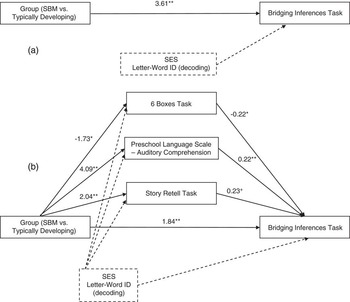
The first model that was tested was a multiple mediator model that consisted of group membership as the predictor (SBM, coded as 1, vs. TD, coded as 2), and 36-month performance on the 6 boxes task (measure of working memory/inhibitory control), the auditory comprehension subtest of the PLS, and number of elements recalled on the story retell task as mediators, performance on the Bridge-IT as the outcome, and SES and word decoding skill entered as covariates.
The unstandardized path coefficients from this model can be seen in Figure 1. The total indirect effect for this set of mediators was significant, with a point estimate of 1.77 and 90% BCa bootstrap confidence interval (CI) of 0.874 to 2.959, suggesting that performance on at least one of the mediating variables was a significant mediator in the relation between group and inferencing ability. An examination of the specific indirect effects was consistent with the model whereby the 6 boxes task, auditory comprehension, and story retell all significantly mediated the effect of group on bridging inferences with point estimates of 0.38, 0.91, and 0.48 and 90% CIs of 0.037 to 1.12, 0.34 to 1.67, and 0.06 to 1.14, respectively. The exclusion of zero from the confidence intervals suggests significant mediation (Hayes, Reference Hayes2011). With all mediators entered in the model, the direct effect from group to inferencing skill remained significant, b = 1.84, t(77) = 2.72, p = .008, which supports a partial mediation model.
Multiple mediation model of bridging inferences skill. (a) unstandardized path estimates for the total effect of group on bridging inferences skill (controlling for SES and decoding skill) and (b) unstandardized path estimates for the indirect effects of group on bridging inferences skill (controlling for SES and decoding skill. +p < .10; *p < .05; **p < .01.

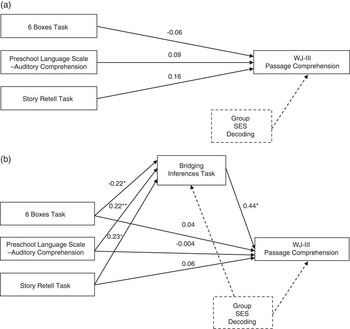
Second, analyses were completed to extend these findings to include reading comprehension achievement. Bridging inferences has been identified in previous studies as a variable that can predict performance in reading comprehension ability above and beyond many other known predictors of the skill (e.g., Pike et al., Reference Pike, Barnes and Barron2010). Although none of the 36-month variables were directly related to passage comprehension after group, SES, and word decoding were accounted for (see Figure 2, Model a), a second mediation model was run to test whether the 36-month variables exerted an indirect effect on passage comprehension via bridging inferences skill. Proceeding to test indirect effects in the absence of a significant total effect is recommended in models with multiple independent variables and small sample sizes (Hayes, Reference Hayes2009; MacKinnon, Krull, & Lockwood, Reference MacKinnon, Krull and Lockwood2000; Shrout & Bolger, Reference Shrout and Bolger2002).
Mediation model of paragraph comprehension with multiple IVs (a) unstandardized path estimates for the total effect of preschool predictors on paragraph comprehension (controlling for group, SES, and decoding skill) and (b) unstandardized path estimates for the indirect effects of preschool predictors on paragraph comprehension (controlling for group, SES, and decoding skill). + = p < 0.10; * = p < 0.05; ** = p < 0.01.

As shown in Figure 2, the second mediation model consisted of three independent variables (36-month performance on the 6 boxes task, auditory comprehension, and story retell), performance on the Bridge-IT as the mediator, and performance on the reading comprehension task as the outcome variable. Group, SES, and word decoding skill were all included as covariates. The unstandardized path coefficients can be found in Figure 2. Results indicated a significant indirect effect between all three independent variables and reading comprehension, via bridging inferences. Specifically, the point estimates of the indirect effects through the Bridge-IT task to reading comprehension for the 6 boxes task, auditory comprehension, and story retell were −0.10 (90% CI = −0.20 to −0.02), 0.10 (90% CI = 0.04 to 0.16), and 0.10 (90% CI = 0.002 to 0.23), respectively. As noted previously, the exclusion of zero from the confidence intervals is indicative of significant indirect effects (Hayes, Reference Hayes2011). In this model, the direct effects from each of the 36-month variables to reading comprehension were all nonsignificant, which is supportive of a complete mediation model.
Discussion
SBM is a disabling birth defect commonly associated with a discrepancy between adequate word decoding skill and poorer reading comprehension (Barnes et al., Reference Barnes, Huber, Johnston and Dennis2007). While accessing meaning from the surface level of text (e.g., words and single sentences) is generally intact, children with SBM have been found to have more difficulty with the higher-order component skills important for the active construction of a coherent text-based representation, such as integrating information within text by making bridging inferences.
As part of a larger study on SBM and learning, the current study allowed for a longitudinal examination of the developmental trajectory of comprehension skill in children with SBM and their TD peers. Specifically, the ability of early cognitive abilities at preschool age to mediate the relation between group (SBM vs. TD) and later performance on bridging inferences ability at school-age was tested and these findings were then linked to a measure of reading comprehension achievement.
In terms of group comparisons, the group with SBM had lower performance on all of the variables included in the model. Although the group with SBM had a significantly lower decoding score than the control group, it was nonetheless age-appropriate (50th %ile). In addition, the reading comprehension score of the group with SBM was significantly lower than their word decoding score. This difference was not present in the control group, which is consistent with the pattern often reported in the literature (Barnes & Dennis, Reference Barnes and Dennis1992; Barnes et al., Reference Barnes, Faulkner, Wilkinson and Dennis2004).
Mediation analyses allow for the inclusion of variables that are hypothesized to explain the relation between two other variables or sets of variables. The longitudinal design of the current study allowed for the testing of preschool abilities that were hypothesized to explain the relationship between SBM status, a condition known at birth, and inferencing skill at age 9.5 years. The multiple mediation analyses were supportive of a model whereby the three early cognitive abilities (working memory/inhibitory control, oral comprehension, and narrative recall, all at 36 months), each explained a significant part of the relation between group and inferencing ability. In addition, even when the effect of the mediators was partialled out, the direct effect of group on inferencing ability remained significant.
Working Memory/Inhibitory Control
Working memory and inhibitory control are related constructs often conceptualized within the broader category of executive functions (Miyake et al., Reference Miyake, Friedman, Emerson, Witzki, Howerter and Wager2000). Each of these abilities has been implicated in reading comprehension for their role in supporting the integration of incoming information during reading (Swanson et al., Reference Swanson, Howard and Sáez2007). Monitoring incoming information to appropriately update the mental model and actively inhibiting irrelevant information from entering working memory are examples of the role of executive functions in comprehension (Kintsch, Reference Kintsch1994; Swanson et al., Reference Swanson, Howard and Sáez2007). Recent studies suggest that executive processing may be particularly important for making bridging inferences, where the reader must reactivate previously read information, and connect relevant material with incoming information while simultaneously suppressing previously activated semantic information that is irrelevant to the current context (Cain et al., Reference Cain, Oakhill and Bryant2004; Gernsbacher, Reference Gernsbacher1990; Pike et al., Reference Pike, Barnes and Barron2010).
Results from the current study extend previous work in this area, which has mostly examined the relation between executive functioning and inferencing and/or reading comprehension concurrently and has used verbal working memory and inhibitory control tasks. Measuring these skills in preschool necessitated an age-appropriate task that is less reliant on language processing. The adapted self-ordered pointing task used required the child to keep track of his or her history of searching multiple boxes for rewards and to inhibit return to a previously rewarded location (Ewing-Cobbs et al., Reference Ewing-Cobbs, Prasad, Landry, Kramer and DeLeon2004; Petrides & Milner, Reference Petrides and Milner1982). Thus, performance on this task requires both working memory and inhibitory control ability in concert and is considered a measure of early executive functioning ability.
At age 36 months, the SBM group required significantly more searches than the control group to locate all of the rewards, meaning that they chose already searched boxes significantly more than the control group, suggesting weaker executive processing ability at this age. Importantly, the deficit in working memory/inhibitory control that children with SBM have compared to their TD peers at preschool age had a significant impact on inferencing ability at school age. This finding is compatible with models of reading comprehension that implicate weak working memory and inhibitory control in poor comprehenders (Barnes et al., Reference Barnes, Huber, Johnston and Dennis2007; De Beni, Palladino, Pazzaglio & Cornoldi, 1998; Gernsbacher & Faust, Reference Gernsbacher and Faust1991).
Oral Language
Early oral language abilities have been linked to later reading comprehension in several longitudinal studies (e.g., Catts et al., Reference Catts, Fey, Zhang and Tomblin1999; Kendeou et al., Reference Kendeou, Van den Broek, White and Lynch2009; Storch & Whitehurst, Reference Storch and Whitehurst2002), but the relative contributions of preschool receptive language and narrative retell abilities to later outcomes in bridging inference skill have not been examined, in particular in a sample of children with SBM who have known difficulty with this skill.
In the current study, the measure of preschool receptive language was a significant mediator between group and bridging inferences. This task purports to measure receptive language comprehension and in doing so, relies heavily on receptive vocabulary knowledge, which consistently emerges in the literature as one of the strongest predictors of reading comprehension (Tannenbaum et al., Reference Tannenbaum, Torgesen and Wagner2006). Vocabulary knowledge and language comprehension skills are often considered important prerequisites for reading comprehension because of their role in accessing meaning from the surface code. In addition to measuring receptive vocabulary skill, the PLS includes items that require the child to follow directions and make basic inferences. These items implicate higher-order cognitive processes, such as the integration and assembly of information, which are known to be weaker in children with SBM (Barnes et al., Reference Barnes, Huber, Johnston and Dennis2007). It follows, then that this would in turn impact later bridging inference skill, which also relies more heavily on these processes. Taken together, the current study suggests that deficits in oral language comprehension are present in children with SBM in preschool and these have a significant impact on the later development of bridging inferences skill.
Children with SBM also performed more poorly at 36 months on their ability to retell a story that was read and acted out to them using toys, and this narrative retell ability was also found to be a unique mediator of the relation between group and inferencing ability. Although narrative retell ability depends on how well the child can encode and retain story content, and their oral comprehension skills, such as vocabulary and syntactic knowledge, this component of oral language emerged as a unique mediator in addition to auditory language comprehension and working memory simultaneously entered into the multiple mediation model. This suggests that there is something unique about the ability to recall and/or express story content that is important for later inferencing skill.
Several variations of early narrative comprehension tasks have emerged as important predictors of reading comprehension in school-age children (e.g., Kendeou et al., Reference Kendeou, Van den Broek, White and Lynch2009; Lynch et al., 2008; Roth, Speece, & Cooper, Reference Roth, Speece and Cooper2002). Work by van den Broek and colleagues indicates that for young children, narrative recall performance is dependent on the causal structure of the story; younger children are able to recall more when there are a higher number of meaningful connections between elements in the narrative (van den Broek, Reference van den Broek1997). Their research suggests that even children as young as preschool age make causal connections (i.e., inferences) between concrete information from presented narratives, and children who make more of these connections have a better understanding of the narrative and thus are better able to recall more of the core elements of the story. With age, children become increasingly able to make more complex inferences (e.g., between underlying goals of characters or related to emotions of characters; Oakhill & Cain, Reference Oakhill and Cain2007; van den Broek, Reference van den Broek1997). The current findings add to the literature of how this skill develops, by identifying narrative recall ability at 36 months as a significant mediator of later, more complex, inferencing skill. Narrative recall and bridging inferences have been highlighted in the literature as important skills contributing to mental model construction, which is a weakness for children with SBM (Barnes et al., Reference Barnes, Huber, Johnston and Dennis2007).
Bridging Inferences and Reading Comprehension
To connect the findings from the first model to more general comprehension skill, a second mediation model was run. Interestingly, this model suggested that, although the 36-month predictors did not exert a direct effect on paragraph comprehension skill at age 9.5 years, they each had a significant indirect effect on comprehension through bridging inferences skill.
The ability to make bridging inferences has been theorized as a component skill of reading comprehension and has been found in previous studies to be a variable that can predict performance in reading comprehension ability above and beyond many other known predictors of the skill (e.g., Cain et al., Reference Cain, Oakhill and Bryant2004; Pike et al., Reference Pike, Barnes and Barron2010). This finding was replicated and extended in the current study by a model which suggests that in the early preschool years, abilities which have been noted to be important for reading comprehension in adult and school-age populations (i.e., working memory/inhibitory control, oral language comprehension, and narrative recall), indirectly affect comprehension some 6 years later through bridging inference skill. This relation was found even when group, SES, and word decoding skill were controlled for in the model. This suggests that inferencing ability is an important part of the developmental pathway that leads to comprehension skill by connecting early cognitive abilities to later reading comprehension.
In addition to providing further evidence that inferencing ability is an important skill for successful reading comprehension (Cain et al., Reference Cain, Oakhill and Bryant2004; Kintsch, Reference Kintsch2005), it also broadens the populations for which this is the case. Children with SBM had poorer performance in working memory/inhibitory control, oral language comprehension, and narrative recall at 36 months—all abilities that analyses from the current study suggest relate to poorer bridging inference skill, which in turn affects reading comprehension.
Study Limitations
While using longitudinal data to assess mediation effects is stronger than cross-sectional effects, it is still possible that some unmeasured variable(s) might have accounted for the relations among the measured variables. For example, other language and cognitive variables known to have associations with later reading comprehension that were not measured include aspects of executive functioning, such as verbal working memory, suppression of verbal information, and updating, as well as more specific discourse skills such as metalinguistic skills and facility with pragmatic language (Cain & Oakhill, 2007). Furthermore, children with SBM are often exposed to different environmental variables, such as modified education plans, which could impact their reading comprehension skill (Dennis et al., Reference Dennis, Landry, Barnes and Fletcher2006). Thus, while these models assume causal relations, they are unable to confirm them. In addition, as is common in longitudinal studies, there were several participants with missing data either within or between assessment points, which resulted in their exclusion from the analyses.
There were also some limitations related to the tasks used in the current study. For example, the Bridge-IT and the story retell tasks are both experimental and lack comprehensive indicators of reliability and validity. Performance on the 6 boxes task provides a score that reflects both working memory and inhibitory control, meaning it was impossible to parse out whether there are separate effects of each. In addition, although the WJ-III Passage Comprehension subtest is commonly used in the literature as a measure of reading comprehension, the nature of the task (i.e., generating a word to fill in the blank), does not likely depend on all of the complex cognitive processes involved when reading text. Finally, it is important to note that the control group performed above age-expectations on the decoding and paragraph comprehension tasks, warranting some caution related to the interpretation of results and group differences.
Conclusion
The current study is unique in its ability to contribute to an understanding of both typical and atypical reading comprehension, blending theories from the developmental, cognitive, and neuropsychological literature. Very few studies have explored the developmental trajectory of reading comprehension longitudinally and even fewer with samples who have particular difficulty with comprehension, such as SBM. From a very early age, children with SBM are disadvantaged in terms of important precursors to reading comprehension, and the current study suggests that these skills may in turn continue to affect inferencing and general comprehension skill through school-age.
Acknowledgments
This research was supported by grants from the National Institute of Child Health and Development, P01 HD35946, Spina Bifida: Cognitive and Neurobiological Variability and R01HD046609, Longitudinal Effects of Spina Bifida on Learning, and by funding from the Canadian Institutes of Health Research and from the CIHR Institute of Human Development, Child and Youth Health. The authors report no financial, professional, or personal conflicts of interest in the conduct of this study.