Korea is probably one of the few countries, if not the only one, that observes a holiday in honor of the national language's alphabet. Hangulnal, which falls on October 9, is the Korean Alphabet Day. Each year, the government hosts events to celebrate one of the most prized possessions of the country, Hangul – the writing system of the national language. Created by King Sejong and his Royal Academy Scholars in the 15th century, Hangul is recognized as one of ‘the world's most scientific writing systems ever created by man’ (Sohn, Reference Sohn2001: 13). To outsiders, such pride may appear somewhat overblown, but Koreans do take great pride in Hangul.
On October 9, the Hangulnal of 2018, Yonhap News, a news agency in Korea, published an article entitled, ‘세종대왕님이 우신다. 한글 파괴에 앞장서는 지자체들 (King Sejong is crying: Local governments are responsible for the destruction of Hangul)’. The article later appeared in Daum, a major search portal used among Koreans (Yonhap News, 2018). Co-authored by 12 journalists, the article criticized local Korean governments for using English in many of the terms and labels they have created. The article lists several English words used by government entities for branding Korean cities, such as Blue-city Geoje, Romantic Chuncheon, Wonderful Samcheuk, Rainbow Youngdong, and Dream-hub Gunsan. The article claims that while the purpose of renaming the cities by prefacing them with catchy English adjectives is to attract and appeal to foreign tourists, most Korean citizens do not understand why those specific English words are used. According to the article, local governments are faced with growing criticism from the public for creating these English labels for their cities.
The fact that there were over 2,000 response postings to the Yonhap News article that criticized the increased use of English by local governments demonstrates the significance of the topic for the Korean people. The responses contain a wealth of information that reveals Korean people's perceptions of English usage for some of the staple lexicon used in daily life. A number of responses pointed out the contradictory nature of the message. While the article condemns local governments for using English words, copious examples of anglicized words are used daily in the country's media, including Yonhap News, which published this particular article which condemns the local governments.
The global spread of English has impacted many spheres in Korea, especially in the proliferation of anglicized neologisms widely used in the media (Kim, Reference Kim2012, Reference Kim2016). The focus of existing studies of Korean English, or Konglish, has mainly been on identifying patterns or studying perceptions of students and teachers (e.g. Ahn Reference Ahn2014, Reference Ahn2015, Reference Ahn2017; Hagens, Reference Hagens2005; McDonald & McRae, Reference McDonald and McRae2010; McPhail, Reference McPhail2018; Rüdiger, Reference Rüdiger2018). The perceptions of the general public regarding the increased use of English among Korean people have not received much attention. To help fill this gap, the current study examines how the general Korean public perceives the prevalent use of English words in their country. The conclusions are based on the analysis of online comments posted to the above-mentioned article.
Data
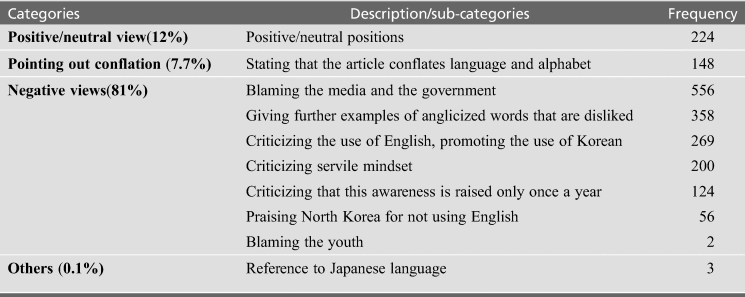
There were a total of 2616 comments to the article at the time of data collection. Among them, about 25% (676) of the comments were excluded from the study because they had no direct bearing on the content of the article (e.g., commercials), were irrelevant comments, or were repeated postings. The following analysis shows the common thematic patterns observed in the remaining 1940 comments, which were analyzed using NVivo. The thematic analysis resulted in three broad categories: 1) positive or neutral comments about the use of English; 2) pointing out confusion caused by the title, and 3) negative comments. The third category, negative comments, is further divided into several sub-categories as listed in Table 1. Some comments included multiple themes. The comments were coded into all relevant categories in cases of overlap.
Thematic categories of comments

Findings
This section discusses major findings of the study based on the thematic categories of comments as summarized in Table 1. As we can see from the table, there were predominantly more negative comments than positive or neutral ones, and only 12% of comments expressed either a positive or neutral view. About eight per cent of the postings criticized the journalists who wrote the article for conflating the Korean language and the Korean alphabet. In what follows, I discuss various views expressed by Korean netizens on the growing usage of English in their country by presenting relevant example postings written in Korean, which I, a native speaker of Korean, have translated into English.
Positive/neutral comments
Comments under the positive or neutral category indicated that using English words is a natural phenomenon since a language is bound to change as a result of outside influence. The following example illustrates this point:
(1) A language must continuously develop. It is bound to be influenced by the outside world for the development to occur. The two expressions ‘Paran-dosi Geoje’ and ‘Blue-city Geoje’ should compete with each other and the one that survives the competition becomes ours. Had we insisted our own language and only sang pansori, BTS would have never been born.
Comment (1) echoes a free-market concept, proposing the Korean label paran dosi and the English counterpart blue city should be given equal opportunities of use and whichever survives should be adopted. Also, by juxtaposing the old Korean music genre ‘pansori’ and the famous K-pop group BTS, the post views adopting English as a prerequisite for prevailing in contemporary society. A similar sentiment was expressed in example (2), in which the writer of the post points out that adopting foreign words is essential for the advancement of society.
(2) Progress is made when our vocabulary grows and becomes rich and diverse by adopting foreign words. The strength of Hangul is that it can write these foreign words to suit our own phonetic system. That's what King Sejong wanted.
Another person (example 3) argues that Koreans are conflating creation and destruction and asks:
(3) Isn't it creation, not destruction? Ah, Korean people.
Some comments (4–5) express a neutral, rather than a positive, stance, indicating that Korean people must recognize that the present demand and exigency are more important than a pride in their language
(4) A language is to be used in the most convenient way in a given generation.
(5) Our love for the Korean alphabet is sufficient enough. Stop this nonsense and just make English the official language.
In addition, 148 comments point out that the title of the article is misleading, as the journalists are conflating the Korean language and the Korean writing system. They maintain that the use of English destroys the Korean language, not its alphabet (example 6–7).
(6) Journalists, your article is about the destruction of the Korean language, not the Korean alphabet. The Korean alphabet is used to write the Korean language and has nothing to do with what you're talking about.
(7) 블루시티[beullusiti ‘blue city’] is not Korean, but it is written in the Korean alphabet. October 9 is the Korean alphabet day, not Korean language day. King Sejong invented the Korean alphabet, not the language.
Those who hold a positive or neutral stance are outnumbered by those who lament the widespread usage of English words by the media and the government as discussed next.
Negative comments
The majority (81%) of comments criticize the use of English words. The most salient theme included blaming the media. More than 500 comments blame TV programs and the media for mindlessly adopting English words, as illustrated in the following example (8).
(8) Media destroys our language the most. Entertainment programs and news use foreign words or language profusely. I feel angry that they use foreign words for things that can be expressed in the Korean language… This issue has been raised many times, but there's no improvement. I think the government should take charge and address this problem.
Some postings blamed the federal and the local government. Many of these posts expressed political ideologies, criticizing the previous or current administration (examples 9–10).
(9) The progressive government is the problem. Moreover, journalists cause confusion by creating new words. We live in a world where you become a fool if you don't know the words they created. The government, preoccupied with North Korea, doesn't even know how to handle the problem. The Ministry of Interior should take charge and purify the language, but the people there are not alert.
(10) The federal and local government and media are ruining the Korean alphabet. Look. Whenever they host events, they mindlessly use foreign words which even I, a master's degree holder, cannot understand! They will probably propose that we abolish the Korean language. Wait and see . . .
Another common pattern among the negative comments is to offer more examples that people are particularly unhappy with. The three most frequently mentioned types of examples all center on place names, i.e. 1) a name for township offices, 2) labels involving the capital city, Seoul, and 3) names of apartments and streets.
Joomin Center is purportedly a new name given for a local governmental office that Koreans previously called dongsamuso, which is similar to a township office in the U.S. In the article comments, 17 posts criticize replacing dongsamuso with the new anglicized name, and some express great frustration that the uniquely Korean term that has been used for generations has now been discontinued and replaced by the English word center. They say they could not understand why a name of a place where Korean people conduct important day-to-day business has been changed to include an English word.
Furthermore, 15 posts criticize the use of I Seoul U, which is currently used as an official phrase to brand the city of Seoul. Created during the tenure of the current mayor Park Won Soon, I Seoul U is used to promote the city globally. But those who mention this example severely criticize the phrase. One person said, ‘I Seoul U breaks not only Korean, but also English!’ Many criticize this term for not being comprehensible. Others criticize the phrase, 하이 서울 (haiseoul ‘Hi Seoul’), which was used for several years as a brand name for Seoul, before I Seoul U was adopted in 2015.
Various anglicized names of apartments are also mentioned. Examples include 웨스턴블루힐 (Weseuteonbeulluhil ‘Western Blue Hill’), 스타씨티 (Seutasiti ‘Star City’), 에듀카운티 (Edyukaunti ‘Edu County’), 파밀리에 (Pamili-e ‘Familie’), 에코타운 (Ecotaun ‘Eco Town’), 아크로리버뷰 (Akroribeobyu ‘Acro River View’), 아이파크 (Aipakeu ‘I-park’), and SK 허브 (Eseukeiheobeu ‘SK Hub’). One person pejoratively comments,
(11) All the apartments now have English names. No matter who you ask, most people these days have a hard time giving apartment names. I wonder if they know the name of their own apartment.
Others ascribe the proliferation of anglicized apartment names to the notion that such names would make the properties seem swanky and prevent their prices from falling. Several posts echo the sentiment expressed in the examples (12–13).
(12) Look at the names of the apartments. Gosh, they think that's how their community comes off as rich.
(13) Those on the women's council changed Korean apartment names to English for fear that the price would drop if they didn't. How empty-headed!
Netizens also mentioned other anglicized apartment names, criticizing them for being pretentious, vain, and often nonsensical. Examples include 로제비앙 (Rojebiang ‘Rose Biang’), 리엔파크 (Ri-en pakeu ‘Li-an Park’), and씨엘포레자이 (Sielporejai ‘CL Poresai’).
Other examples of place names include street names. For instance, 문탠로드 (Muntenrodeu ‘Moontan Road’) is a scenic street in Busan City near Haeundae Beach. The original name was ‘Dalmaji gil,’ which is a compound word, combining two Korean words dalmaji ‘viewing or welcoming the moon’, and gil ‘road.’ Dalmaji encompasses a Korean cultural experience, in which Koreans welcome the view of the full moon. The anglicized street name now contains a unique English neologism which is probably used nowhere other than in Korea, moontan, a derivative of suntan. Another example is 연트럴 파크 (Yeonteureol pakeu ‘Yontral Park’), which refers to an area in Yonnam–Dong in Seoul. The name derives from Central Park in New York.
Other comments
Whereas sociolinguists typically consider young people as instigators of language change (e.g., Birner, Reference Birnern.d.; Bucholtz, Reference Bucholtz2000; Kerswill, Reference Kerswill1996), only two comments contain references to youth as being responsible for the rampant use of English. The majority blame the media and criticize TV programs and journalists for using English even when appropriate Korean words were available, such as 레시피 (resipi ‘recipe’), 셰프 (shepeu ‘chef’), 팩트체크 (paekteuchekeu ‘fact check’), and 니즈 (nijeu ‘needs’), which are widely used in the Korean media outlets. Other examples include 싱크홀 (sinkeuhol ‘sink hole’) and 스웨그 (seuwegeu ‘swag’). The last example (seuwegeu) is loosely used to refer to a carefree, candid, or pompous attitude.
Moreover, 124 comments criticize the media's hypocritical practice. The comments pointed out that journalists are the heaviest users of English words, and yet, each year on Korean Alphabet Day, they feature articles criticizing the increased use of foreign words and try to raise awareness of the importance of preserving the language from the infiltration of foreign words.
200 comments express frustration and a sense of disdain concerning the use of English, criticizing the colonial, subservient mindset that using English makes one more intelligent, educated, and upmarket (examples 14–16).
(14) This is a product of a baseless ‘sadejuui’ that assumes that using English or foreign words makes the user intelligent or sophisticated. This is to cover up one's ignorance.
(15) You can easily see cultural ‘sadaejuui’ everywhere: Suanbo Waikiki, Bugok Hawaii, Ildong Saipan, Swiss Guangwang (Travel), Eeteri (Italy) towel, Pari Bagetu (Paris Baguette), Turejuru (for Tous Les Jours), and E-Land. The fashion industry is full of foreign words. The preconceived notion that using foreign words is more posh still exists and brainwashes people, causing an inferiority complex.
(16) I deplore the current trend in which people try to use English whenever possible, thinking that doing so would make them appear more educated, despite the fact that we have the greatest, the most scientific language in the world.
These comments equate the widespread adoption of English with a servile mentality or linguistic/cultural inferiority complex. They suggest that the blind adoption of English as a superior communication tool is an attempt to disguise one's lack of knowledge and appear more educated. They point out that globalization should not have to involve code-mixing.
A number of postings praised North Korea for preserving the Korean language and said that South Korea has a lot to learn from the North from its ability to keep the language untainted by foreign influence.
Conclusion
This study presents an exploration of anonymous online postings in order to understand how Koreans perceive the widespread usage of English words in their country. Since the comments are unsolicited, they offer netizens’ candid views on the issue. However, it is not possible to determine how representative these views are because no information about the forum participants is available. Also, anonymous online forums are susceptible to being dominated by highly active participants (Graham & Wright, Reference Graham and Wright2014). Despite these limitations, the findings of this study reveal prevailing conceptions among Koreans concerning the growing usage of English. Additionally, widely used English words sampled in the data add to the ongoing sociolinguistic study of Korean English.
The Korean government is making great efforts to make its cities appeal to the global community. Despite the country's expanding global reach, this study indicates that Korean people in general hold negative views of anglicizing their vocabulary. They are particularly unhappy when English supplants existing Korean words. Also, they are resistant to changes made to the names of places that constitute their most immediate environs or contain cultural elements. Although Koreans are proud to influence the global world through their pop culture, they are wary of the effects of globalization influencing their language.
What is interesting is that based on the comments, the topic of preserving the Korean language from foreign influence becomes the focus in the media on every Korean Alphabet Day, as exemplified by this particular article published by Yonhap News. Also, most Korean people seem to believe this is an important topic and that the country has gone too far in its effort to become a ‘global’ nation. And yet, there is the continued and increased use of English in the country, not to mention by journalists who write articles every year denouncing this practice. How could this paradox be explained?
The majority of Koreans holding negative views criticize the servile mindset toward English and English-speaking countries as dominant entities and ascribe Korean people's ‘mindless’ usage of English to a deep-seated insecurity and inferiority that they purportedly harbor concerning their language and country. The comments condemn using English as an attempt to put on a facade of being global members of the world community and appear more educated, modernized, and upmarket. The irony that there is such a widespread usage of Anglicized Korean words by the government, media, as well as the general public (e.g., Kim Reference Kim2012, Reference Kim2016) and at the same time, also widespread resentment of such practice, reveals ambivalence and tension as Koreans’ national pride collides with their desire to exude modernism and a globalized front, at the expense of their prized possessions – their native language and its staple lexicon.
 EUN–YOUNG JULIA KIM is a Professor of English at Andrews University in Southwest Michigan. She teaches first-year college writing, global Englishes, second language acquisition, linguistics, and grammar. Her research interests include academic writing for multilingual students, scholarly publishing for international faculty, impact of English on other languages, critical discourse analysis, and corpus linguistics. keun@andrews.edu