INTRODUCTION
Anthopleura is a common sea anemone genus with 46 widely distributed valid species (Fautin, Reference Fautin2011). Some species are common in the Pacific Ocean, for example A. artemisia (Pickering in Dana, 1846), A. dowi Verrill, 1869, A. elegantissima (Brandt, 1835), A. kurogane Uchida and Muramatsu, 1958, A. mariscali Daly and Fautin, 2004, A. sola Pearse and Francis, 2000, A. xanthogrammica (Brandt, 1835) and A. nigrescens (Verrill, Reference Verrill1928). This last species was described as Teliaopsis nigrescens by Verrill (Reference Verrill1928), and then mentioned as Bunodactis nigrescens by Carlgren, Reference Carlgren1949 and A. nigrescens by Mathew (Reference Mathew1967) and England (Reference England1969). Subsequently, Dunn (Reference Dunn1974) redescribed this sea anemone in detail, using specimens from Hawaii. The distribution of A. nigrescens was extended to the Galápagos Islands and to Singapore by Fautin et al. (Reference Fautin, Hickman, Daly and Molodtsova2007, Reference Fautin, Tan and Tan2009). In this paper we report the presence of A. nigrescens in Mata Limón (Costa Rica), extending its distribution to the Pacific coast of Central America.
MATERIALS AND METHODS
Five specimens of Anthopleura nigrescens were collected during a low tide at 0.2 m depth by one of us (J.A.) from Mata Limón (9°55′01.99″N–84°42′49.50″W) (Costa Rica) on 8 February 2011. There were more individuals in the field but five specimens were enough to identify the species. All were settled on rocks of a man-made breakwater at a sub-tidal level. The material was fixed in 5% seawater formalin and preserved in 70% ethanol; before preservation some photographs were taken. The five specimens are deposited at the Actiniarian Collection of the Departamento de Ciencias Marinas (Facultad de Ciencias Exactas y Naturales, Universidad Nacional de Mar del Plata) with reference C.A. 28. The general morphology, anatomy and other observations related to the taxonomy of the sea anemones were studied at the Instituto de Investigaciones Marinas y Costeras (IIMyC) (CONICET-UNMdP, Mar del Plata, Argentina) by means of a stereo dissecting microscope. Cnidae were analysed from two individuals using a Zeiss Axiolab microscope with a micrometric eyepiece at a magnification of 1000× (oil immersion). Cnidae nomenclature follows England (Reference England1991).
RESULTS
SYSTEMATICS
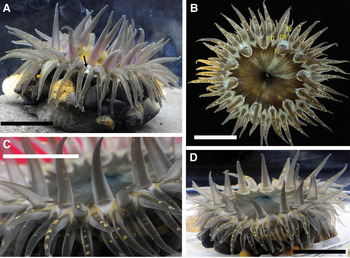
Anthopleura nigrescens (Verrill, Reference Verrill1928): (A) live appearance showing the attached gravel to the column, verrucae and white acrorhagi (arrow); (B) oral disc with the four (I–IV) cycles of tentacles; (C) tentacles with white-yellow spots on their oral face; (D) specimen extending its oral area into a cone. Scale bar: 1 cm.

DESCRIPTION
Oral disc diameter in the studied individuals is 12–21 mm, approximately equal to that of the basal disc. Height is 9–20 mm. Cylindrical column dark. Variable number of rows of adhesive verrucae. Verrucae are about the same size. Attached gravel covering entirely or partly the column. Animals in aquarium retain the gravel grains on their verrucae (Figure 1A). 32–80 tentacles arranged in four cycles (Figure 1B), with transverse white-yellow spots on oral surface (Figure 1C). Each tentacle tapers to a point. White acrorhagi form a ring at the top of the parapet (Figure 1A). Oral disc flat, sometimes the anemone extends its oral area into a cone and the mesenterial insertions are marked as dark lines (Figure 1B, D).
CNIDAE
Spirocysts, basitrichs, microbasic p-mastigophores and holotrichs. The cnidae agree with previous descriptions of this species (Verrill, Reference Verrill1928; Dunn, 1974). We also found microbasic p-mastigophores (23–32 × 6–8 µm (N = 30)) in the column, not mentioned in previous descriptions. This type of cnidocyst was found in all examined specimens.
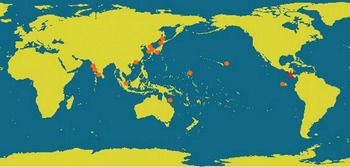
DISTRIBUTION OTHER THAN COSTA RICA (FIGURE 2)
Indian Ocean—India: Mumbai (Parulekar, Reference Parulekar1968), Kochi (England, Reference England1987) and Mahim (Parulekar, Reference Parulekar1968). Western Pacific—Japan: Hokkaido (Uchida, Reference Uchida1938) and Mutsu Bay (Uchida, Reference Uchida1938); Hong Kong (England, Reference England1987, Reference England and Morton1992); Korea: Geojedo Island (Song & Lee, Reference Song and Lee1998). Central Pacific—USA: Hawaii (Verrill, Reference Verrill1928; Dunn, Reference Dunn1974; Cutress, Reference Cutress, Devaney and Eldredge1977; England, Reference England1987); Marshall Islands: Enewetak Atoll (Cutress & Arneson, Reference Cutress, Arneson, Devaney, Reese, Burch and Helfrich1987). Eastern Pacific—Ecuador: Galápagos Islands (Fautin et al., Reference Fautin, Hickman, Daly and Molodtsova2007).
Anthopleura nigrescens (Verrill, Reference Verrill1928): worldwide distribution; previous records (orange circles); the new record for Central America (red star).

DISCUSSION
The examined specimens agree with those described by Dunn (Reference Dunn1974) and Fautin et al. (Reference Fautin, Hickman, Daly and Molodtsova2007). The colour, although often unreliable as a systematic character in sea anemones, is very consistent in the examined specimens (Figure 1) perhaps due to asexual reproduction. The variability in colour of this species was reported by Dunn (Reference Dunn1974). This is the first record of A. nigrescens for the Pacific coast of Central America. In the eastern tropical Pacific, this species has only been found in the Galápagos Islands, where it is common in the intertidal zone (Fautin et al., Reference Fautin, Hickman, Daly and Molodtsova2007; Hickman, Reference Hickman2008). In light of the previous records for other regions of the Pacific Ocean and also the Indian Ocean, we can consider this sea anemone as widely distributed in the Indo-Pacific (Figure 2). The lack of previous records of A. nigrescens, despite several surveys on the Pacific coast of Costa Rica in the last years support the idea of a recent introduction of this species. Although this new record increases the biodiversity of sea anemones from Costa Rica, more studies are necessary in order to obtain a more complete inventory of these poorly known invertebrates.
ACKOWLEDGEMENTS
We are grateful to Dr Marymegan Daly for her constructive comments and improvement of the English version of this manuscript; and to Oscar Pacheco Prieto for the images of A. nigrescens included in this paper.