INTRODUCTION
Coastal ecosystems provide important habitats for different life stages of many fish species (Amara, Reference Amara2003). Coastal areas are of special importance for juveniles of many commercial species that use these places as a feeding ground and refuge (Paterson & Whitfield, Reference Paterson and Whitfield2000). However, the recent impact of the intense human development in coastal areas (Lassari et al., Reference Lassari, Sherman and Kanwit2003), along with increased effort and competition for natural resources (McClanahan & Mangi, Reference McClanahan and Mangi2004), have modified the functioning of coastal ecosystems and have led to a worldwide decrease in fish abundance.
There is a great interest in research to increase the knowledge about vulnerable species and habitats of coastal ecosystems. This knowledge is an important part of the scientific basis for implementing protection regulations against anthropic impacts and for creating the conditions for long-term and continued productivity of natural resources (Lange, Reference Lange2003). Places with great species diversity, as well as areas where the important processes of reproduction and recruitment are concentrated could be the priority for conservation programmes. However, it is important to know the seasonality of abiotic factors and their influence on the fish community (Nero & Sealey, Reference Nero and Sealey2005).
Information on the ecology and fish community structure of Brazilian soft bottom coastal ecosystems is lacking at present. Research on the central coast of Brazil has been focused mainly on the composition and the community structure of coral reefs and estuarine areas (Chagas et al., Reference Chagas, Joyeux and Fonseca2006; Floeter et al., Reference Floeter, Krohling, Gasparini, Ferreira and Zalmon2007). This study shows that the seasonal composition of the fish community in a tropical–subtropical transition area of the west South Atlantic seems to be related to the seasonal pattern of reproduction at the community level, as well as to seasonal migration of individuals that use the area as a feeding ground.
MATERIALS AND METHODS
Study area
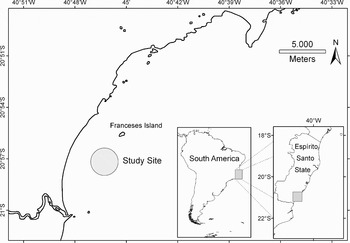
The study area is located in the Benevente Bight (21° 57′S 40° 47′W), in the Central Brazil Shelf ecosystem (Figure 1), and is part of a region that is the subject of a proposal that aims to create a Marine Protection Area. The sampled area was located between 500 and 1000 m from the coast. The average depth in this area is 4 m and the bottom is composed of sand, mud and gravel. The region is located in a transition zone between tropical and subtropical environments and is characterized by northerly inflows of oligotrophic tropical waters from the Brazil Current and southerly inflows from the South Atlantic Central Waters (Schmid et al., Reference Schmid, Schafer, Podesta and Zenk1995).
Study area on the central coast of Brazil.

The predominant winds in the coastal zone come from the north-east, north and east quadrants. However, south and south-east winds are common during winter due to the passage of cold fronts. There is also seasonal variability in wave heights. In summer, when waters are calmer, small waves (Hs = 1.5 m) predominate. The sea then becomes rough throughout the autumn months with increased wave sizes (Hs = 1.8 m), which achieve their maximum in winter (Hs > 2 m) to decrease again in spring (Hs = 1.8 m) (CCAR, 2001).
The place is the fishing ground of bottom trawlers that are based at fishing communities located along the coast (communities of Itaoca, Barra and Pontal do Itapemirim). The region is home to approximately 80 fishermen who work on 38 boats, with sizes varying from 6 to 12 m. The main activity is the prawn Xiphopenaeus kroyeri trawl fishery. Landings for this species are estimated to be about 150 t per year but there is a great deal of uncertainty related to this figure.
Sampling protocol
Data collection was performed on a monthly basis, from October 2003 to September 2004, on board a bottom otter trawl boat similar to the commercial ones used in the region. A total of 10 monthly samplings were carried out, since the prawn fishery is closed every year in March and April as a measure of effort control. The boat used was a commercial artisanal shrimp vessel hired for this study, including its experienced fishermen crew. It was 6 m long powered by an 18 cc engine and equipped with a 10 m long net with an opening of 5 × 3.5 m. The mesh size of the net was 2 cm in the main body and 1 cm in the codend.
One to three hauls performed with a towing speed of 2.5 km/h and lasting between 60 and 90 minutes were sampled in the region of the prawn fishery. The total catch was separated onboard and stored in ice to be transported to the laboratory. A sub-sample of 50 or 25% of the total weight of each haul was collected when the catches were too large.
Laboratory analysis
Fish species were identified following Figueiredo (Reference Figueiredo1977), Figueiredo & Menezes (Reference Figueiredo and Menezes1978, Reference Figueiredo and Menezes1980, Reference Figueiredo and Menezes2000), Fischer (Reference Fischer1978) and Menezes & Figueiredo (Reference Menezes and Figueiredo1980, Reference Menezes and Figueiredo1985). For each individual sampled the following data were recorded: total length (TL) measured to the nearest millimetre; total weight (TW) measured to the nearest tenth of gram; sex and maturity stage. Maturity stages of males and females of the teleost fish were classified according to Martins & Haimovici (Reference Martins and Haimovici2000) in: I, juveniles/immature; II, resting; III, ripening; IV, ripening 2 (advanced); V, running; VI, spent; and VII, recovering. These stages were grouped into adults (II–VII) and juveniles (I) for general comparison purposes. Adults were divided into ‘reproductive group’ (III–VI) and ‘recovering group’ (II and VII). In this study we used the term recruitment to refer to juveniles that become vulnerable to being caught by the bottom trawl fishing.
Data analyses
Numbers and weight data for each species were converted to numbers and weight caught per hour to be used in subsequent analyses. In cases of large catches, when just a fraction was sampled, total numbers and weight were estimated using a multiplying factor estimated as the whole catch weight divided by the total weight of the sample taken. The community structure was analysed using the species grouped into taxonomic/functional unities.
To determine the temporal (monthly) pattern, catch rates (numbers/h) expressed as ln(x + 1) were analysed with the detrended correspondence analysis (DCA; Hill & Gauch, Reference Hill and Gauch1980), a method developed specifically for ecological analysis and indicated for situations when the data to be analysed are restricted to species abundance of different samples. Mann–Whitney U-tests (hereafter U-test) were used to determine whether there were significant differences between CPUEs of different seasons.
The UPGMA (unweighted pair group method with arithmetic mean) clustering method was used to examine the consistency of the classification system obtained with the DCA. The clustering was performed with the Sørensen's relative distance measure. The Sørensen's relative distance measure is a modified version of the Sørensen's distance measure (‘relativized Manhattan’ in Faith et al., Reference Faith, Minchin and Belbin1987), and is based on the standardized summation of each sampling unit. As a result, each unity contributes equally to the distance measure. The advantage of using this coefficient, when compared with the Euclidian distance for example, is that it retains more sensitivity in heterogeneous matrices and gives less weight to outliers (McCune & Mefford, Reference McCune and Mefford1999).
Discriminating species for each assemblage determined by the ordination and clustering analyses were identified with the indicator species analysis (Dufrene & Legendre, Reference Dufrene and Legendre1997). The method combines information on abundance and occurrence and produces indicator values for each species in a group. These values were statistically tested with the Monte Carlo resampling methodology (McCune & Mefford, Reference McCune and Mefford1999).
RESULTS
Species composition
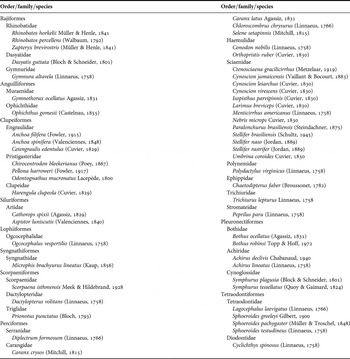
A total of 4625 fish were caught. These fish comprised 57 species, 26 families and 10 orders. The Perciformes presented the largest numbers of families (8), followed by Rajiformes (3), Scorpeaniformes (3) and Pleuronectiformes (3). The Sciaenidae had the largest number of species (13), followed by Carangidae (5) and Tetraodontidae (4) (Table 1). The catches comprised demersal, pelagic and benthonic species. Eighteen species represented 95% of the total numbers, the remaining 39 just 5%. Seventeen species were considered rare since they occurred just in one month.
Species caught in 10 bottom trawl surveys carried out off the central coast of Brazil between October 2003 and September 2004.

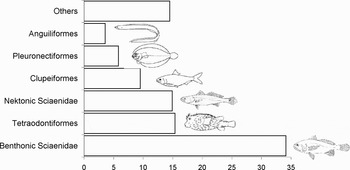
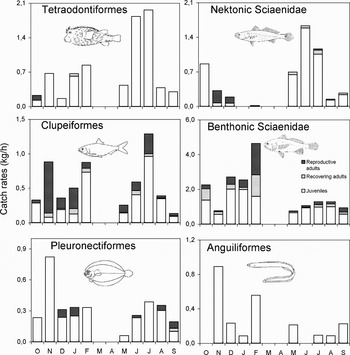
The benthonic Sciaenidae were the most important group caught, representing 33.9% of the sampled weight, followed by Tetraodontiformes species with 15.4%, nektonic Sciaenidae with 14.9% and Clupeiformes with 9.6% (Figure 2).
Relative catch rates (Kg/h) of taxonomic groups in the catches of 10 bottom trawl surveys carried out off the central coast of Brazil from October 2003 to September 2004.

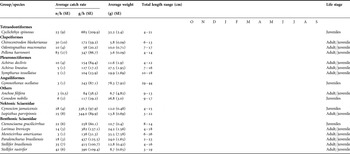
The main species caught, their relative abundances (CPUE) in weight and numbers, size-ranges, mean weights and occurrence in the sampled months are shown in Table 2.
Taxonomy, catch rates (n/h and kg/h), average weight, size-range, sampling month and life stage of the 18 most abundant species. The species presented made up 95% of the catches of 10 bottom trawl surveys carried out off the central coast of Brazil between October 2003 and September 2004. SE = standard error.

Seasonal variation of species composition
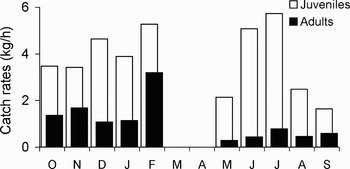
Overall, there was a monthly variation in catches for adults and juveniles and in average fish length. Figure 3 shows the largest catches of adult individuals, with largest sizes, during the spring/summer months (October–February) (U-test, P < 0.01), while small juvenile individuals were abundant in all months (U-test, P = 0.545), but were relatively more important than the adults in the autumn/winter months (May–September).
Catch rates of adults and juveniles of fish species caught in 10 bottom trawl surveys carried out off the central coast of Brazil between October 2003 and September 2004.

Some species that are more typical of the bottom realm had their largest catches in the spring/summer months (benthonic Sciaenidae, Pleuronectiformes and Anguiliformes), while the ones more typical of the nektonic realm (nektonic Sciaenidae and Clupeiformes) along with the Tetraodontiformes species had their largest catches in the autumn/winter months (Figure 4). However, none of these differences between spring/summer and autumn/winter catches were statistically significant (U-test, P > 0.05).
Catch rates (Kg/h) of dominant groups in the catches of 10 bottom trawl surveys carried out off the central coast of Brazil between October 2003 and September 2004.

Only Clupeiformes and benthonic Sciaenidae presented a considerable proportion of adults (reproductive or non-reproductive stages), which represented more than 36 and 42% of these groups respectively. In other groups adults represented always less than 9% of the total catch.
Seasonal variation in community structure
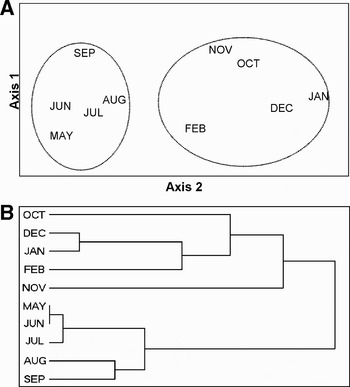
The DCA and cluster analyses discriminated two main groups of months related to the occurrence and abundance of the most important species. One group comprised samples collected from October to February (spring and summer) and another from May to September (autumn and winter) (Figure 5).
(A) Detrended correspondence analysis (DCA) showing the distribution of sampling months in the main axis; (B) dendrogram showing the Sørensen's index of similarity between months. Both analyses were performed using fish catch rates (n/h) of 10 bottom trawl surveys carried out off the central coast of Brazil between October 2003 and September 2004.

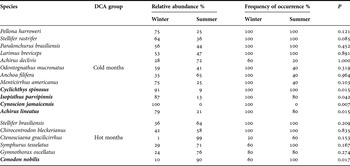
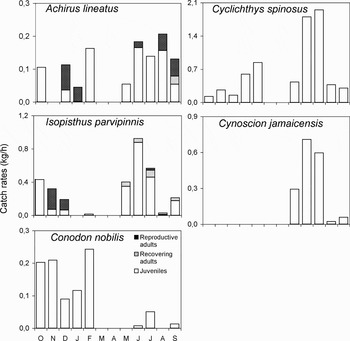
The occurrence and abundance of the indicator species, Cyclichthys spinosus, Isopisthus parvipinnis, Cynoscion jamaicens and Achirus lineatus in the autumn/winter months and Conodon nobilis in the spring/summer months explained the difference between these two periods (P < 0.05; Table 3). Other abundant species were well represented in all months and so did not play an important role in discriminating between the two groups (Table 3).
Groups determined by DCA and cluster analysis of the 18 most abundant species in 10 bottom trawl surveys carried out off the central coast of Brazil from October 2003 to September 2004. Discriminating species are in bold. P, probability that the discriminating species value could be obtained by chance.

Isopisthus parvipinnis, Cyclichthys spinosus and Achirus lineatus occurred in almost every month, but had higher abundance in the autumn/winter months. Cynoscion jamaicensis occurred only in the autumn/winter months and had a large catch of juvenile individuals. Conodon nobilis was the only discriminating species for the spring/summer months. It had a large catch of juvenile individuals in this period (Figure 6).
Catch rates (Kg/h) of discriminating species of spring/summer months and autumn/winter months. Analysis performed using the fish catches of 10 bottom trawl surveys carried out off the central coast of Brazil between October 2003 and September 2004.

DISCUSSION
The studied area is located in a transition region between the tropical and subtropical fish fauna of the south-east Atlantic (Gomes et al., Reference Gomes, Novelli, Faria and Zalmon2001). As a result of the tropical and subtropical features it is possible to find a relatively rich ichthyofauna in the area, with species from all parts of the Brazilian coast. However, the main high taxa found in the studied area are the dominant ones throughout the Brazilian coast and are closed related to the influence of estuaries and fishing ground of Penaeidae species (Santos, Reference Santos2000; Bail & Branco, Reference Bail and Branco2003). Many Sciaenidae and Clupeiformes species are important fishery resources in shallow waters and estuarine environments around the world.
The fish community sampled is characterized by a group of resident species that are observed throughout the year and composed mainly of juveniles and small individuals. However, important differences regarding the frequency of juveniles and adults and in a lesser degree the catch composition were observed. These differences discriminated the samples in two main groups related to the seasons of the year. The spring/summer months were characterized by a higher proportion of the spawning biomass, largely related to the contribution of the benthonic Sciaenidae and the Clupeiformes species. These groups were also abundant in the autumn/winter months but were dominated by juveniles. This pattern characterized by reproduction of some species in the spring/summer months, with the dominance of young individuals in the autumn/winter months seems to be common in coastal waters of the south-east region of Brazil and has been observed previously (Araújo et al., Reference Araújo, Cruz-Filho, Azevedo and Santos1998).
However, shown here is the existence of community structure variation related to seasonal presence of juveniles and reproductive adults, suggesting the existence of environment forcings that lead to similar biological rhythms in species-groups that have totally distinct ecological niches. Despite the observed marked biological seasonality, there is no detailed information on variations of environmental conditions that could be used to identify the main forcings related to the observed community patterns. It can be suggested as a possible cause for the high reproduction activity in the spring/summer months, the reduction in water turbulence, which is related to the lower frequency of storms and high energy waves in the coastal area (CCAR, 2001). These conditions could act as a mechanism that retains the larval and prejuvenile stages in shallow areas, which tend to be more productive and protected from access of predators due to their shallow depths and availability of refuges. In autumn/winter, when the turbidity and turbulence is higher due to higher frequency of storms and waves entering the bight (CCAR, 2001), it is possible that the region continues to play an important role as refuge from predators due to the reduction of visibility. This hypothesis has been suggested previously as an explanation for the variation of fish abundance in other ecosystems (Maes et al., Reference Maes, Taillieu, Vandamme, Cottenie and Ollevier1998; Lassari et al., Reference Lassari, Sherman and Kanwit2003). As the young individuals have already left the planktonic phase, the water turbulence does not seem to influence their permanence in the shallow areas and in this way the environment acts as a nursing ground.
The seasons of the year presented community differences not only related to the process of reproduction, but also in the occurrence of some species. Similar patterns of variation in the abundance of adults and juveniles have been observed in other studies (Nash & Santos, Reference Nash and Santos1998). Some species presented large seasonal abundance variation and seem to explore the shallow waters of the studied area in an opportunistic way. The high abundance of juveniles of many species could be an attracting factor for predatory fish (Maes et al., Reference Maes, Taillieu, Vandamme, Cottenie and Ollevier1998), such as Cynoscion jamaicensis and Isopisthus parvipinnis, common species in estuarine/coastal zones (Froese & Pauly, Reference Froese and Pauly2006). The studied area seems to be an important nursery ground of many species, including the commercial ones. Several authors (Potter et al., Reference Potter, Claridge and Warwick1986; Akin et al., Reference Akin, Winemiller and Gelwick2003) have suggested reproductive biology as a potential factor driving seasonal changes in estuarine assemblages. Akin et al. (Reference Akin, Winemiller and Gelwick2003) and Nero & Sealey (Reference Nero and Sealey2005) suggested that distribution and abundance of fish in a temperate estuary and tropical near-shore coastal habitats, respectively, seem to result from the combined effects of endogenous, seasonal patterns of reproduction and migration operating on large spatial scales, and species-specific response to local environmental variation. This study shows evidence of community-level reproductive patterns for a tropical ecosystem and future studies are necessary to identify the likely ecosystem forcings underlying these patterns.
The permanent local use of the bottom trawl fishery, which acts upon the adult and juvenile stages of many fish species, raises the issue of the sustainability of this activity. This kind of fishing can be even more predatory when developed in places of great diversity as in the studied area. When considering the local ichthyofauna in the management of the shrimp fishery, some areas could be closed to fishing due to their nursery function (Hall et al., Reference Hall, Alverson and Metuzals2000). Also, due to its high species richness and to the process of reproduction, the study area could be a priority in conservation programmes.
ACKNOWLEDGEMENTS
We would like to thank J.L. Gasparini and J.-C. Joyeux for their comments and suggestions. The fishermen Cazimiro, Baton and Josias for the support provided onboard. We also thank F. Carnelli, A. Ferreira, L. Baião, P. Assis, S. Zanardo, M. Perim and S. Pinheiro for their help in the beginning of this research project, J.B. Teixeira for technical support and IBAMA for the research permit. This study was partially funded through grants from CNPq (Brazilian Science Council) to A.S.M. (308867/2006-8) and J.N.A. (151846/2006-5).