In 1845 the Edinburgh Journal noted the sudden rise of a new ‘city’ in England: ‘We allude to Birkenhead, on the Mersey, near Liverpool. By far the greater number of our readers have never even heard of this place by name; yet it is one of the greatest wonders of the age, and indeed one of those by which the character of our age is most strongly expressed.’Footnote 1 A guidebook to the town 20 years later noted that ‘Birkenhead, a few years ago, was almost as barren as the great desert of Sahara . . . That this dreary spot should have become a jealous rival to the largest seaport in the world, is one of the wonders of our time.’Footnote 2 Birkenhead was, of course, not the only new city of the age – and many older towns had grown rapidly in the first half of the century. In the 1790s, John Byng ‘walk'd over the stones of Stockport, which increases hourly’.Footnote 3 Although something of an exaggeration, Stockport almost tripled its population in the last 20 years of the eighteenth century. In the 1810s, John Corry was impressed:
Instead of the obscure and miserable place which formerly appeared on the Cheshire side of the river Mersey, a new town was erected as if by enchantment; streets and houses annually increased on the hills and in the valleys; manufacturies were erected and thousands of busy hands employed in a new and productive staple of national wealth; artisans attracted by the hope of gain flocked hither.Footnote 4
The third substantial Cheshire industrial town of the mid-nineteenth century, Macclesfield attracted less attention. Yet it also experienced rapid population growth from the late eighteenth until the mid-nineteenth century.
Rapidly growing industrial towns such as these faced a range of challenges, irrespective of whether they were old market centres with established structures of urban government or newly planted and controlled by specially appointed commissioners. These challenges included finding ways of feeding, clothing and providing essential household goods to their growing populations through a mix of various types of retail provision. Retailing in eighteenth- and early nineteenth-century Cheshire has attracted considerable attention in the last 30 years or so.Footnote 5 Much of this has been focused around changes in the urban hierarchy, the development of supposedly more ‘modern’ forms of retailing and the role of Chester as an important service and leisure centre. Cheshire was not unusual in experiencing growth in the number and variety of its shops and the importance of shopping as a form of ‘polite’ behaviour is now well established.Footnote 6 But as Stobart comments, ‘it is all too easy to take a Whiggish view of the shop as modern and progressive, developing to inevitably eclipse traditional forms of retailing such as markets, fairs and pedlars’.Footnote 7 Despite the Muis’ dismissal of markets as unimportant in supplying the needs of workers by the late eighteenth century, preferring instead to emphasize the role of backstreet and village shops,Footnote 8 other historians have stressed the continuing complementarity of different retail types into the nineteenth century and beyond.Footnote 9
Some 40 years ago, Alexander in a pioneering study of early nineteenth-century retailing argued that markets occupied a central position in distribution and not just for working-class families. His survey indicated a number of themes that could repay further investigation. For example, were privately owned markets generally less well run than publicly owned ones? How important was the enthusiasm or otherwise of a local authority market committee or were there just too many factors outside their control? Was the mix of goods on offer in a mid-nineteenth-century market hall significantly different from that in a traditional market 50 years earlier?Footnote 10 Questions like these have informed some subsequent research. Grady considered the speculative nature of the investment in market improvements in Leeds in the 1820s and the mixed success of these markets until the council took responsibility for market improvements in the 1840s.Footnote 11 Scola's magisterial study of late eighteenth- and nineteenth-century Manchester offered a comprehensive account of how a major city fed itself. He counselled against taking too simplistic a view both of market evolution and the relationship between markets and shops, and stressed the importance of local context. Nineteenth-century developments in both Manchester and Salford were heavily influenced by the struggle between the local authority and the Mosley family for control of the markets, and by the substantial price paid by Manchester town council for the market rights in the 1840s. He noted the desire of butchers, but not fishmongers, to desert markets for their own shops; the tendency for central markets to be more successful than local ones and the growing convergence of the trading patterns of market traders and shopkeepers in the later nineteenth century as market trading increasingly became a full-time occupation.Footnote 12 Nineteenth-century market halls have also received some attention, particularly from an architectural and social perspective with Schmiechen and Carls providing a comprehensive account of when and where they were built, together with an assessment of their importance for working-class welfare as well as for urban prestige.Footnote 13
It is clear from the literature that the period 1780 to 1860 saw substantial retail growth and change; and that both markets and back street shops were important in catering for growing working-class demand. Historians have tended to emphasize demand factors such as population growth and urbanization, improved transport facilities and rising real incomes when seeking to explain developments in retailing.Footnote 14 But it is also important to consider local context, including the impact of regulation and administrative practices.Footnote 15 This local context was particularly important with regard to markets which might be controlled and regulated by a private individual such as a lord of the manor or by a public authority. Market owners were frequently zealous in protecting their rights and profiting from the market. Providing and regulating the market was of course only one of the many functions of post-1835 municipal corporations and associated bodies. It was hardly as significant as policing, poor relief or public health. But markets mattered and could take up a lot of the time and energy of councillors or improvement commissioners. Urban authorities had considerable scope to determine the appearance of the market, and to indulge in new building. They could regulate it, keeping out undesirables and providing good standards of cleanliness and hygiene. But they could not make people shop there. Moving a market away from its traditional and popular location could damage trade.Footnote 16
Markets were dynamic and adaptable. They traditionally occupied public space but this did not mean that every sort of public activity was welcome in the market place. The interests of traders, of consumers, of those wanting traditional entertainment, of the market owner and of the public authorities, could easily conflict. Properly regulated trading was increasingly more important than public entertainment. To facilitate this, market places were enclosed from the late eighteenth century onwards and the clutter of miscellaneous buildings cleared away. Large covered market halls were built from the 1820s and were controlled environments which, as well as being commercial spaces, could also be places to be seen.Footnote 17 These halls became increasingly important for the sale of clothing and some household goods after about the middle of the nineteenth century.Footnote 18 The transition from open market place to large covered market hall was the most visible sign of the priority some civic authorities gave to provisioning the masses in this period.
This article uses a case-study approach to explore how local context, and particularly urban governance, impacted on retail growth and change from the late eighteenth to mid-nineteenth centuries. The particular mix of retail provision that developed in a rapidly growing town was influenced by what was there already, by social and economic factors such as population growth, occupational structure and real incomes, by geographical location such as proximity to other large centres and by town governance. Urban authorities had a particularly active role in the control of public markets; but might also influence the development of the retail sector as a whole, through, for example, improvements that made the town more appealing to traders and customers. The article focuses on the three principal industrial towns in Cheshire in the period from about 1780 to 1860. It looks first at the nature of the towns and how they were governed, then at the public markets of the towns and finally, and briefly, at shop retailing.
The towns
Although all three towns experienced rapid population growth, albeit at different times, there were significant differences between them. Macclesfield and Stockport were ancient market and manufacturing towns.Footnote 19 Macclesfield was probably the second largest town in Cheshire for most of the eighteenth century and ranked second to Chester in the urban hierarchy until it was overtaken by Stockport in the last decade or so of the century.Footnote 20 Its early importance was derived largely from the manufacture and distribution of silk buttons, and Macclesfield had a significant role as a trading centre from at least the sixteenth century. By the early nineteenth century, Macclesfield had become the centre for silk manufacture in England and the town's prosperity was inextricably linked to that of the silk industry. The town grew quickly and steadily from about 1780 until 1831, roughly doubling in size between 1778 and 1811, and doubling again by 1831 (see Table 1). Stockport grew from a much smaller base, being one of several mid-ranking market towns in Cheshire in the late seventeenth century. The hat making industry provided the first stimulus to growth in the eighteenth century, and meant that Stockport manufacturers developed a range of contacts with London merchants. By the end of the century the cotton industry was well established and became the town's principal manufacture. Stockport grew very rapidly in the last two decades of the eighteenth century, and more steadily but still quickly thereafter, overtaking Chester as the largest urban centre in Cheshire by 1821, though still ranking second in terms of the hierarchy.
Population of Macclesfield, Stockport and Birkenhead

Note: Macclesfield includes Hurdsfield, Stockport includes Heaton Norris and Birkenhead includes Tranmere.
Sources: 1778 figures for Macclesfield and Stockport from Stobart, ‘An eighteenth-century revolution?’, with an adjustment to include Hurdsfield and Heaton Norris; Birkenhead estimated from 1801 census; other Stockport figures from Arrowsmith, Stockport, 264; other Macclesfield and Birkenhead from 1851 and 1861 census.
Birkenhead was very different, except that somewhat like Stockport it grew in the shadow of a much larger place: Liverpool and Manchester respectively. But unlike Stockport, which in 1823 was described by its local newspaper as ‘an irregular, ill-built, badly lighted, dirty place’ where ‘the spirit for public improvement has been slumbering’,Footnote 21 Birkenhead attracted lavish praise. A Cheshire directory commented in 1850 on ‘the park, which may compare in beauty and extent with the finest in the kingdom’ and on Hamilton Square which was ‘a beautiful quadrangle of about seven acres . . . scarcely excelled by any buildings in the kingdom’.Footnote 22 From being a hamlet of a few hundred people, it began in the 1810s to attract affluent Liverpool merchants as a place to live. Then in 1824, William Laird bought land there, established a shipbuilding yard and began to plan a new town.Footnote 23 Birkenhead grew rapidly, its population increasing around threefold in each decade between 1820 and 1850. Its prosperity initially depended on shipbuilding and associated industries and the town suffered severely in the economic contraction of the late 1840s.Footnote 24 But, probably because of the proximity of Liverpool and the attractiveness of the Wirral as a place for the more affluent to live, Birkenhead's economy was more broadly based than that of Macclesfield or Stockport. By 1861, there were some striking differences in the occupational structure of the three towns. Some 40 per cent of the adult population of Macclesfield was employed in textile and associated occupations, while the figure for Stockport approached 45 per cent. There was almost no difference in the percentages for men and women. Birkenhead had far fewer working women: over 60 per cent were in the wives and associated category compared to around 40 per cent in Stockport and Macclesfield. Birkenhead had a larger proportion of its employed population in professional, commercial and craft-related occupations as well as more in domestic service. But it had the smallest proportion in agricultural and similar occupations. It was perhaps the most urban of the three towns, as well as the one least dependent on a single industry.Footnote 25
The three towns were also very different in how they were governed. Macclesfield was an ancient borough governed by 24 capital burgesses from whom the mayor was elected annually. Just over half the capital burgesses were connected with the silk trade. This governing body was chosen from the ordinary burgesses, or freemen, of whom there were 340 in the 1830s. It was said that comparatively few of the principal ratepayers of the town were burgesses and thus many ratepayers had no say in the town's administration or expenditure.Footnote 26 The governance of the town was effectively in the hands of the leading property owners and manufacturers. Between 1775 and 1835 a non-resident burgess was mayor on only four occasions and a silk or cotton manufacturer was mayor 35 times.Footnote 27 The governing body had promoted some town improvement in the early nineteenth century including better lighting and policing. But it had run up significant debts, amounting to £15, 350 in 1833, mainly due to the cost of improving the water supply to the town and building a new town hall.Footnote 28 Local government reform in 1835 swept away the old corporation and replaced it with 36 elected councillors. But the property qualification for holding office meant that the new council was no more representative than the old, and remained very much in the hands of the leading silk manufacturing families. Extreme fiscal caution and inertia were the hallmark of the next decade or so.Footnote 29
Stockport appeared at first sight also to be an ancient incorporated borough, but the reality was very different. In the early 1830s it was said that ‘the Officers of the town are appointed by the lord or lady of the manor, but the burgesses . . . may exercise, independently, their powers and privileges . . . if in truth, they possess any’.Footnote 30 The mayor, who was not a magistrate, was financially dependent on the lady of the manor for the expenses of office. No magistrate resided in the town and the court leet was the only criminal court.Footnote 31 In practice, the Warren family and their associates dominated the town in the eighteenth and early nineteenth centuries. Sir George Warren inherited the lordship of Stockport in 1737 at the age of two and was determined to draw as much profit as possible from his manor. Consequently, he was often at odds with the townspeople and tended to block attempts at improvement in the 1770s and 1780s, when the townspeople petitioned parliament for the right to levy rates to light, clean and widen the streets and for the establishment of a small debts court.Footnote 32 Protégés of the Warrens, like the attorney Holland Watson, the long-serving rector and magistrate Charles Prescott and the magistrate John Lloyd, were the key players in town governance in the first two decades of the nineteenth century. Only one industrialist, Peter Marsland, served as a magistrate in the early industrial revolution. Although some of the cotton masters served as mayor in the early 1800s, industrialists were reluctant to concern themselves with public affairs in the 1810s.Footnote 33 The next decades saw increased involvement by townspeople in the government of the town, due to the Police Act of 1826 which gave the town the right to levy taxes to repair, light and cleanse the streets and to regulate the police and the creation of a new elected corporation in 1835. Even so, the Vernon family (successors to the Warrens) remained influential and the court leet continued to be held.Footnote 34
There were no traditional institutions that had to be swept away in Birkenhead. Within 10 years of the early development of the town by Laird and others, the first Improvement Act had been passed, appointing commissioners and setting out in considerable detail how the town was to be governed.Footnote 35 The commissioners comprised the mayor, two bailiffs and four aldermen of Liverpool and 60 others. Among their powers were those to erect a market, light and clean the streets and maintain a police force. They were able to levy a rate of £8,000, including £4,000 for a market. The first meeting was held on 25 June 1833 with Sir Thomas Brancker, a Liverpool alderman, in the chair. Around half of the original commissioners can be identified as Liverpool merchants, traders or professional men, many of whom resided on the Birkenhead side of the Mersey. Among the Birkenhead residents were the proprietor of the Birkenhead ferry and hotel, several builders, a plumber, a brewer and an ironmonger. Too few of these original commissioners may have had a lasting interest in Birkenhead and early meetings often lacked a quorum.Footnote 36 From 1836 there were to be 24 commissioners of whom 3 would be members of Liverpool town council and 21 elected by Birkenhead ratepayers. Increasingly, the town's government was dominated by leading merchants and industrialists like John Laird and William and John Jackson. William Jackson chaired the commissioners from 1842 to 1846 and his period of office saw the building of a new market hall and the planning of a major public park. The resignation of the Jacksons in 1846 over the supply of gas and water weakened the commission and Birkenhead struggled with large debts for the next decade.Footnote 37 It was possible to be too ambitious.
Markets
These differences in town governance had a major impact on how the town markets were operated and improved. In Macclesfield, the borough authorities, both before and after municipal reform, were responsible for the regulation and possible improvement of the market. It was also a source of income, and the authorities were keen to prevent traders from avoiding paying tolls by trading outside the official market. This became a particular issue with the butchers and resulted in litigation in the 1830s. The mayor and corporation took action against a butcher for selling meat at his own shop in the town on market days, claiming that all meat sold in the town on market days should be sold in the public market. The courts eventually found in the corporation's favour, but the action cost it around £160 and effectively suspended the normal administration of the meat market for two years.Footnote 38 The town's butchers clearly hoped that the reform of local government in 1835 would produce a change of heart but the newly established tolls committee re-affirmed the traditional policy in 1836.Footnote 39 As late as 1840, the town clerk was asked to collect evidence to support action against people selling goods in private and public houses in the town on market days.Footnote 40 This sort of regulation was not just a matter of securing income. There were always those who would claim that a properly regulated market served the public better in terms of quality control and price regulation than did unfettered free trade. Indeed John Corry, the early nineteenth-century historian of Macclesfield, thought that the borough authorities were remiss in not enforcing rigorously the traditional laws against buying outside the market or buying in the market to sell in a provisions shop on the same day so that the ‘extortion of petty shopkeepers would be prevented’.Footnote 41
Improving the market was a lower priority for the authorities even though the market buildings were proving to be inadequate by the early nineteenth century. Rather than taking action itself, the council agreed in 1809 to a proposal from Ralph Deane, one of the capital burgesses, that he should build and keep in repair butchers’ shambles comprising 80 stalls and lease them to the borough for a yearly rent of £200.Footnote 42 By the 1830s, toll and similar receipts from the butchers were falling short of the rent even though the overall tolls of the market were let for £340 compared to £70 in 1758.Footnote 43 When a new town hall was built in 1823, a covered butter market was incorporated.Footnote 44 But these were essentially piecemeal developments: perhaps the £13,000 that the town hall cost deterred the council from any more grandiose plans for the market.
Not much changed with the reform of local government. A tolls, shambles and lands committee was established in 1836 with John Wright, a bookseller, and Thomas Swanwick, a physician, among its members. The committee succeeded in reducing arrears, considered ways of improving the shambles and suggested a nominal rent for twelve months to encourage the letting of shops there.Footnote 45 Some minor improvements were proposed in the late 1830s, such as lighting the shambles with gas and connecting a refuse trough in the fish hall to the main sewer.Footnote 46 Further improvements were made in the 1850s, including enclosing the remaining open parts of the shambles and installing a urinal.Footnote 47 Yet there were also indications that the markets were becoming more of a burden to the town. The butchers sought rent reductions in 1841 and tolls were reduced in 1842.Footnote 48 The committee agreed in 1853 to dispense with the services of one of the men employed in the market and in 1854 agreed to let part of the lower shambles to a coffee roaster. Income from the shambles showed a steady downward trend from £280 in 1850 (though expenditure was £359) to £150 in 1860 (with expenditure of £240). Other toll receipts increased until the mid-1860s and the markets provided a steady income for the town of around £400 a year in the 1850s.
It could be argued that town governance was not that important for Macclesfield's market. The borough authorities were content with a fairly low-profile market that had not required great investment but that had seemed to meet the needs of the town. There was never any great enthusiasm for major redevelopment and meetings of the tolls committee were infrequent and not well attended. But perhaps there were also missed opportunities. A more energetic committee might have investigated the benefits of a purpose-built market hall similar to those in other Cheshire or Lancashire towns. This could have avoided complaints from the town's shopkeepers about stalls being set up in the market place on days other than market days, and about the market opening into the late evening.Footnote 49 It might even have attracted some shoppers into the town. If by the mid-nineteenth century Macclesfield's market was looking a bit old fashioned, the borough authorities were not entirely blameless.
Lack of enthusiasm was certainly not a problem in Stockport in 1851 when the laying of the foundation stone of a new market hall was marked by a civic procession and a speech from the mayor in which he proclaimed that Stockport had now commenced the race of improvement and that he hoped soon for a new town hall.Footnote 50 But it had been a tortuous journey to reach this point. Back in 1785 a petition from Stockport's inhabitants had complained that ‘the Place assigned for the Market weekly held in the said Town is, from the great Increase of Provisions and other Articles brought to Market, become insufficient for that Purpose’.Footnote 51 This was, however, at the time when Sir George Warren, as lord of the manor, was seeking to enforce all his traditional rights and gain maximum income from them. Proposals for town improvement were going nowhere.Footnote 52 The townspeople managed to effect some changes to the market place in the 1820s when it was levelled and repaired. At the same time, some old buildings, including the meal and cheese house at its east end were purchased by public subscription and demolished in order to create more open space.Footnote 53 Despite these changes, the court leet declared 10 years later that the market place was inadequate and needed to be enlarged as speedily as possible and proposed that the lady of the manor be ‘respectfully’ informed of this. Given that the steward who presided over the court leet was a manorial appointment, this court was not really able to represent the interests of the town against the Vernon family.
All these issues came to a head in the 1840s. In 1842, Lord Vernon decided to go ahead with improvements to the market place, including building a market house at its northern end and shambles on the east side. The borough council objected and ordered the town clerk to write to Vernon asking him what right he had to build there. The proposed improvements would have restricted the space available for the open market and maybe the council was asserting its right to represent the interests of the people of Stockport rather than them having to depend on the whim of the lord of the manor. The legal advice received by Vernon was ambiguous, but it seems that he went ahead and built something because in 1844 occupiers of the stalls in the ‘new’ market house asked that it be enclosed before the winter gales came.Footnote 54 Early in 1843, Vernon was being advised to assert his sole rights to the market by suppressing a privately established market in Stockport.Footnote 55 In May of that year, the borough court issued summonses against the toll collectors for taking excessive tolls at fairs and markets. A strongly worded editorial in the local newspaper referred to the ‘undistinguishing severity with which the tolls are collected’ and argued that while fair tolls were justifiable where good market facilities had been provided, they could not be justified where ‘so little pains are taken to accommodate the frequenters of our fairs and markets’.Footnote 56 Two weeks later the editor was more conciliatory (probably under pressure from Vernon's legal advisors), writing of a ‘misunderstanding’ and conceding that Vernon had the interests of the town at heart and was trying to encourage more people to attend the market.Footnote 57 But it was increasingly clear that the only long-term solution was for the town to purchase the market rights and tolls from Vernon – something which many thought should have been done when the town was incorporated.
It took almost another four years before a bill to purchase the tolls began its progress through parliament. The manorial and market rights were finally purchased for £22,500 with the transfer taking effect at the beginning of September 1847.Footnote 58 Having spent this not inconsiderable sum on acquiring the rights, it was perhaps not entirely surprising that although a substantial amount of civic pride was invested in the market hall opened in 1852, the monetary investment at around £4,000 was not all that large. The building was quite modest in scale, making provision for only 37 stalls and 15 basement stores, even if the façade was sufficiently imposing to make a statement about the town's intentions.Footnote 59 The manorial tolls committee, mainly comprising merchants and industrialists not connected with cotton, contemplated building a small fish market and sought tenders for this but the price proved too high and nothing was built.Footnote 60
This may have been a wise move as the market hall was hardly a huge success. Attempting to move traders from their familiar standing places proved unpopular, and a deputation from the greengrocers in November 1852 asked that they might return to their old places. This was refused, but the toll collector was ordered not to move any more stalls for the time being.Footnote 61 Nor did it bring in much income, contributing only £6 or so of the £40 to £50 per fortnight raised from all the manorial tolls. This £6 had fallen to just over £2 by 1860.Footnote 62 A letter to the Cheshire Observer in 1860 described the market hall as ‘inconvenient and ill-adapted to the purposes for which it was designed’. Traders therefore preferred ‘to bear the inclemency of the weather in the open market’.Footnote 63 The manorial tolls committee tried a new approach in 1860. Members visited Manchester, Wolverhampton and other places to see what had been done elsewhere. They then decided to leave the market essentially where it was, but to cover it in a glass and iron construction at a cost of £2,770. This market hall would comprise nine bays and provide for butchers, fishmongers and greengrocers, but also dealers in hardware and similar goods. Drapers and a bookseller were among the first tenants.Footnote 64
Stockport finally had a market hall, popularly known as the glass umbrella, or umbrella on stilts, that would serve the town well for the next century and a half. But Stockport's story illustrates many of the key issues around market development in this period. There was difficult topography: Stockport's traditional market place had long been seen as inadequate to the needs of the town's growing population. Redevelopment was hindered by vested interests, in particular the obstructive attitude of successive lords of the manor, who owned the market rights and tolls. Stockport suffered from the power struggle between the Vernon family and those who claimed to represent the interests of the town. Financial constraints did not help. The borough council paid a high price for the market rights and tolls in 1847 and was then reluctant to spend freely on market facilities. The council perhaps also had to learn that there were limits to what it could do. Covering the existing market place worked much better than trying to move traders into what they regarded as unsuitable new accommodation.
If financial constraints influenced what the borough authorities could achieve in Stockport, there were no such problems in Birkenhead. The 1833 Improvement Act not only provided for a market to be established, but included detailed provisions for its conduct. At their October 1833 meeting, the commissioners appointed a sub-committee to look into building a market. The sub-committee comprised three of the commissioners, Joseph Betteley, a Liverpool ironmonger, Thomas Forsyth, partner of William Laird, and William Walker, a Birkenhead builder. Almost a year later the commissioners approved plans for a market at a cost of £3,150. This was to be funded by borrowing against the expected income from rates tolls and duties.Footnote 65 The market, which included 25 shops and numerous stalls, was opened in July 1835 to considerable celebration in the town. According to the Liverpool Mercury, the ‘substantial, as well as delicate profusion with which the stalls were supplied, spoke well for the gastronomic capacities of the good people of Birkenhead’.Footnote 66 The market was not restricted to specific days of the week but was open all day until 8.00 pm or 9.00 pm on Mondays to Fridays and until 11.00 pm on Saturdays.Footnote 67 Such was the growth of Birkenhead, however, that by 1843 the commissioners were considering, and rejecting, plans to extend the market and then agreeing to the construction of a new market. Tenders in the range of £15,000 were received in September of that year.Footnote 68 This was a very much larger market, similar in design to that of St John's market in Liverpool, and comprised three arcades with space for 42 shops and 80 stalls with wrought iron shutters. There were six entrances and ample storage vaults.Footnote 69 The cost at nearly £32,000, including £8,154 for the purchase of the land, was well in excess of the earlier estimates. The money had again been borrowed, but the land owned by the commissioners for market purposes was valued at over £35,000 and it was hoped that the market, if fully occupied, would produce £2,000 a year income.Footnote 70 As in 1835, the opening of the market was accompanied by celebrations in the town and at the market hall itself.
The overall supervision of these markets was the responsibility of a dedicated market committee reporting to the commissioners. Membership of the committee changed regularly, but it tended to be dominated by Birkenhead-based merchants, builders and an occasional retailer. The committee was responsible for managing the letting of stalls, for setting rents, for approving proposals for improvement to the market and occasionally for settling disputes. The day-to-day running of the market was left to a market inspector, first appointed in July 1835 at a salary of £50 a year.Footnote 71 But the committee was very much involved in the detail of the conduct of the market. For example, in July 1842, a trader was ordered to discontinue making tripe in his vaults; smoking was banned in April 1843; the need for ice houses for fishmongers and others was investigated in August 1844; a provisions dealer was cautioned in August 1845 for selling eggs in his shop contrary to the rules of the market; and another was admonished for being insolent to a customer who had complained about the quality of lard sold to him.Footnote 72 The committee also had to decide what trades were permitted in the market. Until about 1847, it was very reluctant to let shops or stalls to those wanting to retail clothing or household goods. This changed in 1848, probably because of the number of empty stalls in the market and applications from sellers of furniture, boots and shoes, prints and toys were accepted, although a shoe dealer was expected in 1850 to give up his shop when a provisions dealer wanted it.Footnote 73
The late 1840s were difficult years for the town, and this was reflected in the fortunes of the market. There had been problems from the outset in letting all of the shops and stalls. All the butchers’ shops had tenants when the market opened, but only half the stalls were taken. The fish and game shops were also easy to let, in contrast to the vaults (only 12 out of 48 taken) and the farmers’ tables (9 out of 76).Footnote 74 By March 1847, some tenants were well in arrears with their rent, and in September of that year, some rent reductions were agreed. There may also have been longer-term trends at work, with fewer small-scale food producers wanting occasional space in the market. Instead, as Scola suggested with regard to Manchester, full-time market traders and fixed shop retailers were increasingly similar in their trading patterns and interests. Both wanted protection against those trading in the streets outside the market, such as hawkers from Liverpool selling potatoes, oranges and other goods, and from the use of the market place for non-trading purposes.Footnote 75
Despite these difficulties, the market retained its status as a focus for civic pride, particularly when it was decorated for the Christmas celebrations. A letter in the Liverpool Mercury in December 1850 described both the brilliancy of the lighted arches in the avenues of the market and the profusion of cheese, ham, fresh meat, fish, fruit and other goods on sale there.Footnote 76 The story of Birkenhead's market offers the clearest illustration of the importance of town governance. The improvement commissioners had the great advantage of starting from a blank canvas: there were no existing market rights, or traditional locations to worry about. They also had the example of Liverpool's market as a model – or perhaps a challenge. Unlike in Macclesfield, the market committee met regularly and was assiduous in the conduct of business. The commissioners were also willing to think big and borrow big. The result was a market that impressed, as did the docks and the park. It may have been more than Birkenhead needed, but then Birkenhead was one of the ‘wonders of the age’.
Shops
The attitude and policies of those who exercised authority in each town had a direct, though differing, impact on the provision and operation of the markets. But markets were, of course, only one of the places where people purchased the necessities of life. Shops, including back street shops, were important from an early date. They were less likely to be directly affected by how the town was governed, but there could be indirect effects, particularly for those types of goods that could equally well be sold in a shop or in the market. This section looks briefly at shop provision in the three towns and asks whether any significant differences might be linked to urban governance or to other factors like the proximity of larger centres.Footnote 77
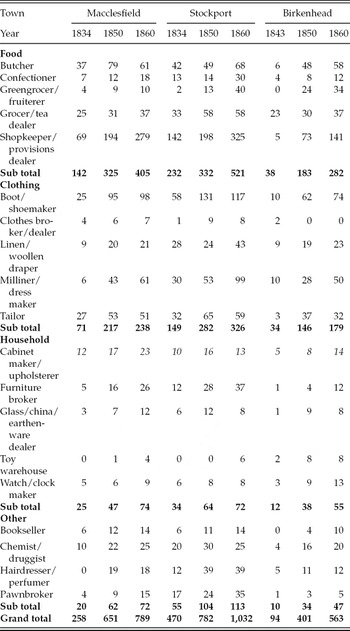
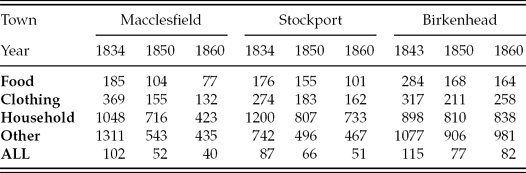
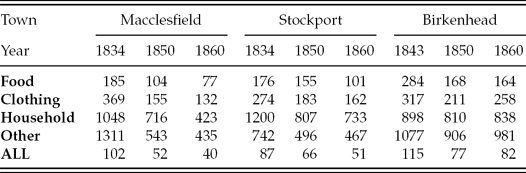
Table 2 shows numbers of traders in selected trades; and Table 3 indicates population per outlet for these trades grouped into four main categories. The figures, especially those in Table 3 need to be treated with considerable caution. Directories were not necessarily consistent or comprehensive in their coverage of less prestigious trades, back street shops and those who primarily traded from shops in covered market halls. There are no Birkenhead directories before 1843, perhaps not surprisingly given the rapid growth of the town in the previous decade; and there is no good Cheshire directory between Pigot in 1834 and Bagshaw in 1850. Population figures have been taken from the census nearest to the date of the directory. But even accepting that the figures are indicative rather than precise, there are some interesting features.
Selected retail and associated businesses in Macclesfield, Stockport and Birkenhead

Sources: Directories used for Tables 2 and 3 and in the subsequent discussion are James Pigot & Co., National Commercial Directory for the Counties of Chester, Cumberland, Durham, Derbyshire etc. (London, 1834); Mortimer and Harwood's Directory of Birkenhead (Birkenhead, 1843); Bagshaw, History, Gazeteer, and Directory; and Francis White and Co., History, Gazeteer and Directory of Cheshire (Sheffield, 1860).
Population per shop
Source: Population is estimated from census figures and shop numbers from directories as cited in source to Table 2.
In all three towns there was a substantial increase in the 1850s in the number of traders who would tend to serve a working-class population, for example provisions dealers, shopkeepers, dressmakers/milliners and furniture brokers. But in Macclesfield and Stockport, though not in Birkenhead, the effect of this was a significant reduction in the population to trader ratio, especially for food outlets. In Birkenhead, however, the ratio remained steady or even increased. Macclesfield and Stockport were mature industrial towns by this time with stable populations while Birkenhead was still growing fast. Perhaps not surprisingly growth in numbers of working-class shops tended to lag behind population growth. Birkenhead's 1860 population per shop figures are more like those for Macclesfield or Stockport in 1834, when both latter towns were still growing fast, than those for 1860. There are two other possible reasons for Birkenhead's higher population per shop figure in 1860: the proximity of Liverpool and the better marketing facilities than in the other towns. In particular, there was more scope in Birkenhead for provisions dealers to have shops or stalls in the market and possibly escape inclusion in a directory. There was not that much difference between Macclesfield and Stockport. Stockport appears to have been better provided with food and clothing shops in 1834. Some of this may be due to directory inconsistencies (for example the number of shoemakers), but the inadequacy of the market may have meant that there were more back street provision shops. But by 1860, Macclesfield looks to have been better provided with shops. The sudden increase in the number of butchers there could well be due to a drifting away from the market after the town gave up its attempts to force butchers only to sell there on market days.Footnote 78 On the other hand, Macclesfield's silk industry coupled with its location away from other main centres may have meant that it had a more stable economy than Stockport by 1860 and was better placed to be a retail centre for its hinterland. One puzzle is the small number of pawnbrokers in Birkenhead. Is this simply persistent omission in the directories, or did Birkenhead's more diverse economic structure coupled with ease of access to Liverpool mean that there was less need for them?
Other evidence tends to support these inferences from the figures. Both Macclesfield and Stockport had a centrally located market place around which the best shops had traditionally been found. This continued to be the case into the mid-nineteenth century. For example, among the high-class shops in Macclesfield Swanwick's was ‘a very aristocratic and first-class tailoring establishment’ where the country gentry went for their clothes.Footnote 79 In Stockport, it was said in 1827 that ‘the Market Place is now nearly surrounded by some very elegant shops’,Footnote 80 while in 1850, Samuel Bagshaw commented on the ‘immense number of handsome shops, stocked with a profusion of goods, in all the different branches of the retail trade’ in the town's central streets.Footnote 81 Stockport seems to have suffered less than might have been expected either from the proximity of ManchesterFootnote 82 or from manufacturers paying their workers in kind.Footnote 83 By contrast, Birkenhead never had a very well-defined central shopping area although Argyle Street was regarded as ‘a place where carriage folk did their shopping’.Footnote 84 Liverpool was also much more accessible to the inhabitants of Birkenhead than Manchester was to those of Stockport. It was not unusual for Birkenhead shopkeepers to advertise prices as ‘lower than in Liverpool’ or that business was done ‘on Liverpool terms’, implying that potential customers could easily be tempted by the greater variety of shops across the Mersey.Footnote 85 Irrespective of the actions of the town's governing bodies, Birkenhead was never going to be a major retail centre.
Conclusion
Retail provision in a mid-nineteenth-century industrial town was many faceted and dynamic. It comprised an ever-changing mix of fixed shops of varying size and prestige, street traders, door-to-door salesmen, open market and covered market. The nature of the mix and how it changed over time was not only dependent on social and economic factors like population growth and occupational structure, important as they were. Geography played a part, particularly in the case of Birkenhead where the proximity of Liverpool meant that the town never developed the number or range of shops that its size and relative prosperity might have justified. It may also have played a lesser part in Stockport where it was claimed in the 1840s that ease of access to Manchester by rail was encouraging some people to shop there.Footnote 86 But also important, though sometimes overlooked, was how the town was governed. In particular, it mattered whether there was clear and strong leadership, as in Birkenhead where a dynamic and pro-active authority provided the town with its large and impressive covered markets. Moving from private to public ownership was the catalyst for market redevelopment in Stockport where the conflict between competing interests had hampered improvement until the late 1840s. But local authority control did not in itself guarantee that much would be done: the manufacturer-led oligarchy that seems to have prevailed in Macclesfield both before and after 1835 was generally content to wait on events and react only when necessary. Going back to the questions raised by Alexander, these case-studies suggest that a shift to public ownership was important for market improvements and that the enthusiasm of the local market committee could significantly affect market evolution, but that the success of the market was also dependent on external factors, including whether or not market traders liked the facilities provided. The case-studies also confirm that by the 1850s non-food goods were becoming increasingly important in purpose-built market halls. The case-studies similarly lend support to Scola's conclusions about the complementarity of markets and shops and the importance of paying careful attention to local context. As suggested in this article, the scale and quality of market provision could have a knock-on effect on the distribution and range of fixed shops – as the case of Birkenhead particularly illustrates. Local context was very important to the development of urban retailing and town governance is to be regarded as a significant part of that context.