Significant outcomes
-
Chronic pain is a global problem affecting about 20% of the population worldwide.
-
Pain and/or insufficient pain management may lead to suicide.
-
Medications used to treat pain may contribute to suicidal behaviour
Limitations
-
Providing clinical trainees with additional knowledge and equipping them with relevant tools to screen and manage chronic pain efficiently may decrease suicide risk.
-
Trainees need to be educated on how to screen for suicidality in individuals with pain and apply suicide prevention interventions.
Introduction
Pain in the modern world
Chronic pain is a long-standing and debilitating condition affecting approximately 20% of the population worldwide (Moulin et al., Reference Moulin, Clark, Speechley and Morley-Forster2002; Boulanger et al., Reference Boulanger, Clark, Squire, Cui and Horbay2007). Chronic pain targets physical functioning and mental wellbeing, leading to unemployment, financial difficulties, social isolation and poorer quality of life (Eriksen et al., Reference Eriksen, Jensen, Sjogren, Ekholm and Rasmussen2003; Phillips, Reference Phillips2009; Choiniere et al., Reference Choiniere, Dion, Peng, Banner, Barton, Boulanger, Clark, Gordon, Guerriere, Guertin, Intrater, Lefort, Lynch, Moulin, Ong-Lam, Racine, Rashiq, Shir, Taenzer and Ware2010; Guerriere et al., Reference Guerriere, Choiniere, Dion, Peng, Stafford-Coyte, Zagorski, Banner, Barton, Boulanger, Clark, Gordon, Guertin, Intrater, Lefort, Lynch, Moulin, Ong-Lam, Racine, Rashiq, Shir, Taenzer and Ware2010). While the economic burden of pain including medical care expenses, loss of productivity and functional impairment is estimated to be around $600 billion a year in the USA, the psychological impact of chronic pain remains difficult to measure (Gaskin & Richard, Reference Gaskin and Richard2012). A systematic population study and literature review in 2016 reports the prevalence of chronic pain between 35–51.3% in 28 million adults in the UK (Fayaz et al., Reference Fayaz, Croft, Langford, Donaldson and Jones2016). Chronic pain usually arises from neuropathic aetiologies such as diabetic neuropathy and post-herpetic neuralgia, chronic inflammation like osteoarthritis or idiosyncratic aetiologies such as fibromyalgia (Elman et al., Reference Elman, Borsook and Volkow2013). Chronic pain is also a common complaint in cancer patients (Aboumrad et al., Reference Aboumrad, Shiner, Riblet, Mills and Watts2018; Kallurkar et al., Reference Kallurkar, Kulkarni, Delfino, Ferraro and Rao2019; Cox-Martin et al., Reference Cox-Martin, Anderson-Mellies, Borges and Bradley2020).
A study of factors contributing to cancer-related suicide in veterans from the USA over the course of 15 years (2002–2017) identified pain as a common suicide risk factor in 47% of the cases (Aboumrad et al., Reference Aboumrad, Shiner, Riblet, Mills and Watts2018). It has been reported that the COVID-19 infection can result in viral-induced myalgia with mild to moderate pain and other pain syndromes including chest pain and headaches which may last for a long time after the acute COVID-19 illness (Clauw et al., Reference Clauw, Hauser, Cohen and Fitzcharles2020; Sher, Reference Sher2021). The pain is intensified with prolonged hospital stay and psychological stress (Song et al., Reference Song, Xiong, Wang, Yang, Zhou and Li2020).
Acute painful sensation is usually a result of tissue damage that is received by nociceptors, sending signals to the dorsal horn of the spinal cord and finally into the brain. The process of pain as damage to the body is called nociception (Costigan et al., Reference Costigan, Scholz and Woolf2009; Von Hehn et al., Reference Von Hehn, Baron and Woolf2012). There is a complex network of brain regions that receive input from nociceptors that includes the prefrontal cortex, the insular cortex, the primary and secondary somatosensory cortices, the thalamus and the anterior cingulate cortex (Morton et al., Reference Morton, Jones and Sandhu2016). In addition, there is a descending modulatory circuit that either potentiates or diminishes pain based on the affective, cognitive or sensory context in which it occurs (Fields & Basbaum, Reference Fields and Basbaum1999).
The biopsychosocial model of pain emphasises its multifactorial aetiologies within the biological, psychological and social factors of individuals suffering from pain (El-Tallawy et al., Reference El-Tallawy, Nalamasu, Pergolizzi and Gharibo2020). This model highlights the nature of pain as a result of multiple factors interfering with the body’s homeostasis and not just as a response to an injury. This model can be used to assess pain in a systematic way and to better understand the underlying factors leading to pain, resulting in better pain management. Multiple lines of evidence indicate that pain is an independent risk factor for suicide, and uncontrolled and poorly managed chronic pain results in poor quality of life, hopelessness, helplessness and in some cases suicide ideation and suicide attempt (Calati et al., Reference Calati, Bakhiyi, Artero, Ilgen and Courtet2015; Petrosky et al., Reference Petrosky, Harpaz, Fowler, Bohm, Helmick, Yuan and Betz2018).
Material and methods
We have conducted a review of the relevant literature. In total 58 peer-reviewed articles were used for the preparation of the Perspectives Article.
Results
Medical management and suicide
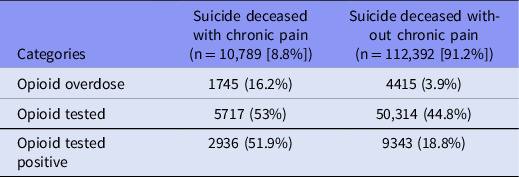
There have been reports of overdose with opioids in patients with chronic pain, which further complicates treating working with this patient population (Salsitz, Reference Salsitz2016; Webster, Reference Webster2017; Petrosky et al., Reference Petrosky, Harpaz, Fowler, Bohm, Helmick, Yuan and Betz2018; Glare et al., Reference Glare, Aubrey and Myles2019). In a study by Petrosky et al. (Reference Petrosky, Harpaz, Fowler, Bohm, Helmick, Yuan and Betz2018), the characteristics of death by suicide in 18 states of the USA from 2003 to 2014 were analysed. Table 1 summarises the number of positive toxicology tests for opioids in people with and without chronic pain, and the number of cases that died by suicide with opioid overdose in both groups.
Characteristics of opioid use and suicide death in 18 states of the USA, 2003–2014 (n = 123,181)

In 2016, the Center for Disease Control (CDC) released guidelines and recommended prescribing practices for (1) chronic pain, (2) cancer patients, (3) palliative care and (4) end of life care patients (Dowell et al., Reference Dowell, Haegerich and Chou2016). The goal of the guideline was to address and manage chronic pain efficiently and to improve the quality of life considering all of the risks and benefits. While this strategy seems to be effective for many patients, prescribing opioids still has its risks and challenges.
Opioid prescriptions have declined rapidly since the CDC guidelines were published in 2016 (Jeffery et al., Reference Jeffery, Hooten, Jena, Ross, Shah and Karaca-Mandic2019; Bohnert et al., Reference Bohnert, Guy and Losby2018; Dayer et al., Reference Dayer, Breckling, Kling, Lakkad, McDade and Painter2019). This highlights how new policy can have a direct impact on patient care. There are two main components to the decrease in opioid prescriptions. One is the safety of the patients, as not only prescribing opioids has declined but also concomitant prescription of opioids and benzodiazepines have also been decreased (Jeffery et al., Reference Jeffery, Hooten, Jena, Ross, Shah and Karaca-Mandic2019; Bohnert et al., Reference Bohnert, Guy and Losby2018; Crabtree et al., Reference Crabtree, Rose, Chong and Smolina2019). On the other hand, many clinicians are reluctant to prescribe opioids due to all the rules and regulations in place after the CDC guidelines in 2016 (Noufi et al., Reference Noufi, Ayoub, Naccache and Richa2016). This has resulted in more defensive practice styles among clinicians in emergency and outpatient departments, pain clinics and inpatient units (Razouki et al., Reference Razouki, Khokhar, Philpot and Ebbert2019). Many patients may benefit from this trend; however, many others may suffer from insufficient pain management and poorer quality of life that may lead to suicide attempts (Elman et al., Reference Elman, Borsook and Volkow2013; Piraccini et al., Reference Piraccini, Byrne and Taddei2020).
Insufficient treatment and suicide
Pain and suicidal behaviour have common psychobiological changes in affected individuals with research pointing to an increase in suicidal behaviour when pain is not properly managed (Elman et al., Reference Elman, Borsook and Volkow2013; Racine, Reference Racine2017). Elman et al. (Reference Elman, Borsook and Volkow2013) have described two interacting and closely linked networks of dopaminergic reward pathways and the extra-hypothalamic norepinephrine or the corticotropin-releasing factor systems, and their role in chronic pain and suicidal behaviour. Elman et al. (Reference Elman, Borsook and Volkow2013) has also highlighted that pain can disrupt the normal function of the structures involved in stress and reward processing, by altering their pathways, leading to disruption in controlling the suicidal urges and handling the impact of painful stimuli.
Insufficient treatment of pain may have different reasons:
-
1. Many clinicians are incompetent and not sufficiently educated and trained about pain, its pathophysiology and its management (Wright, Reference Wright2009; Yanni et al., Reference Yanni, McKinney-Ketchum, Harrington, Huynh, Amin, Matsuyama, Coyne, Johnson, Fagan and Garufi2010). Psychiatry residents devote only 12.5% of their time to non-psychiatric medical education. It is unclear that with the current curriculum in residency training that they would be able to apply and deliver the full benefits of modern medicine to their patients with chronic pain (Wright, Reference Wright2009). Chronic pain is a very difficult and complex phenomenon that makes its management a challenging task for all clinicians alike. Insufficient education combined with other barriers discussed by Yanni et al. (Reference Yanni, McKinney-Ketchum, Harrington, Huynh, Amin, Matsuyama, Coyne, Johnson, Fagan and Garufi2010) has resulted in low levels of confidence in clinicians and residents in management of patients with chronic pain.
-
2. Prescription of opioids has decreased following the CDC guidelines in 2016, and some clinicians are reluctant to prescribe opioids due to social and administrative pressure around opioid use and its prescription (Jeffery et al., Reference Jeffery, Hooten, Jena, Ross, Shah and Karaca-Mandic2019; Bohnert et al., Reference Bohnert, Guy and Losby2018; Dayer et al., Reference Dayer, Breckling, Kling, Lakkad, McDade and Painter2019). This may result in inadequate pain control in a subset of patients who would have benefitted from pain management using opioids, particularly in cancer patients.
-
3. Non-compliance and poor adherence by patients is also a major factor in insufficient treatment that may lead to relapse (Turk & Rudy, Reference Turk and Rudy1991; Berndt et al., Reference Berndt, Maier and Schutz1993). Some of these barriers in seeking the ideal pain management services include but are not limited to physical disability or limited insurance coverage. Other barriers include psychiatric illnesses such as cognitive impairment and poor social support. This could potentially result in self-treatment with substances such as alcohol and opioids, leading to tolerance and dependence on these drugs (Compton & Volkow, Reference Compton and Volkow2006), social isolation, decrease quality of life, hopelessness, helplessness and eventually may lead to suicidal thoughts and behaviours (Calati et al., Reference Calati, Bakhiyi, Artero, Ilgen and Courtet2015; Racine, Reference Racine2017).
Inadequate treatment of pain may lead to suicidal behaviour (Calati et al., Reference Calati, Bakhiyi, Artero, Ilgen and Courtet2015; Aboumrad et al., Reference Aboumrad, Shiner, Riblet, Mills and Watts2018; Petrosky et al., Reference Petrosky, Harpaz, Fowler, Bohm, Helmick, Yuan and Betz2018). Clinicians should address all aspects (biological, psychological and social) around pain to treat it appropriately and to reduce relapse (Gatchel et al., Reference Gatchel, McGeary, McGeary and Lippe2014; Danilov et al., Reference Danilov, Danilov, Barulin, Kurushine and Latysheva2020). Focusing only on the physical pain alone (biological aspect) and treating with only the pharmacologic options available would be insufficient, and it would be inappropriate to expect full recovery without relapse in patients with chronic pain.
Ideal pain management, whether acute or chronic, is to maximise functionality and emotional stability in patients suffering from pain, with the least side effects and least chances of abuse or misuse (Racine, Reference Racine2017). One common recommendation is the use of multimodal analgesia. In this model, multiple pharmacological (Acetaminophen, NSAIDs, etc.) and non-pharmacological therapies (cold or heat application, relaxation exercise, immobilisation, massage, acupuncture, physical therapy, etc.) are used that work on different portions of the pain pathway. This approach decreases tolerability to one medication, decreases side effects and possibly decreases opioid use, opioid dependency and risks (Kehlet, Reference Kehlet1997). Clinicians need to be highly competent and equipped with all the necessary education, resources and skills for this model to be fully effective.
Unfortunately, the COVID-19 pandemic has affected many chronic pain patients’ lives due to closed pain management clinics or their decreased availability at the peak of the pandemic and in some medical facilities, more staff utilisation for COVID-19 units (Piraccini et al., Reference Piraccini, Byrne and Taddei2020). Additionally, many patients were scared to contract COVID-19 and therefore were reluctant to go to any healthcare facility to get appropriate treatment for their symptoms.
To address chronic pain sufficiently and appropriately, a multidisciplinary approach is required with the involvement of physicians and other healthcare professionals from pain clinics, physical rehabilitation centres, psychiatrists and access to programmes that manage addiction. All involved disciplines are required to have close collaboration and established referral systems to manage chronic pain efficiently.
Discussion
Education of trainees and medical professionals
Chronic pain is a global medical problem affecting about 20% of the population worldwide (Moulin et al., Reference Moulin, Clark, Speechley and Morley-Forster2002; Boulanger et al., Reference Boulanger, Clark, Squire, Cui and Horbay2007). Pain and psychiatric illnesses are closely related, and their relationship is bidirectional as they share almost the same or closely linked neural pathways (Elman et al., Reference Elman, Borsook and Volkow2013).
Many studies have shown that pain is an independent risk factor for suicide (Calati et al., Reference Calati, Bakhiyi, Artero, Ilgen and Courtet2015; Petrosky et al., Reference Petrosky, Harpaz, Fowler, Bohm, Helmick, Yuan and Betz2018). Untreated and inadequate management of pain may lead to suicidal behaviour in affected individuals by triggering depression, increasing hopelessness, helplessness and decreasing quality of life.
Psychiatry plays a crucial role in healthcare in that they are inherently trained to assess the patient from a holistic, biopsychosocial perspective. Their training includes validating and assessing the maladaptive symptoms and discomforts of mind and body together and considering biological, psychological and social factors to treat a patient effectively. This holistic approach in treating patients places psychiatrists in a unique position to prevent suicides. A significant portion of training for psychiatrists involves assessing and managing patients at risk for suicide. Despite the expertise in suicide risk assessment, gaps exist with providing adequate mental healthcare to those patients in need from psychiatric treatment. These gaps in access to care directly correlate to the limited number of psychiatrists to provide the care that is needed. This unfortunately results in many patients who may be at risk for suicide not receiving appropriate suicide prevention care (Ku et al., Reference Ku, Li, Lally, Compton and Druss2021).
Psychosomatic medicine is a subspeciality of psychiatry that focuses on the interface between mental health and other fields of medicine. Exposure to this subspeciality in residency has enhanced education for psychiatry residents. It has also afforded other medical specialties an opportunity to learn more about mental illness as it relates directly to their patients. Even after the introduction of psychosomatic medicine and the active presence of consulting psychiatrists in medical settings, the need for identifying patients at risk of suicide remains high (Gitlin et al., Reference Gitlin, Levenson and Lyketsos2004). This highlights the necessity to improve and enhance education of all trainees about pain, its close relationship with suicide and effective suicide screening and management strategies. Trainees may benefit from clinical rotations in outpatient pain clinics, palliative care and oncology services, being involved more in the management of patients suffering from chronic pain. It is very important to educate trainees and clinicians about different aspects of pain such as psychological and social factors, and not to solely focus on the biologic aspect. Trainees should understand the relationship between pain and suicide and should have the ability and the expertise to assess for suicidality in different settings.
There is a misconception among clinicians that suicide risk assessment is not needed in medical units for patients without a psychiatric history. Tseng et al. (Reference Tseng, Cheng and Hu2011) have reported that patients without a psychiatric illness admitted in the general hospital have eight times higher risk of suicide versus the general population. Studies in Taiwan and Hong Kong have reported suicide attempts of almost 1 in every 10,000 general hospital admissions, out of which about 5% resulted in death in both studies (Hung et al., Reference Hung, Liu, Liao, Chang, Yang and Yeh2000; Ho & Tay, Reference Ho and Tay2004). Up to 40% of patients in primary care setting have a baseline psychiatric illness (Qin et al., Reference Qin, Phillips, Wang, Li, Jin, Ai, Wei, Dong and Liu2010; Rivelli & Shirey, Reference Rivelli, Shirey, Summergrad and Kathol2014).
Many clinicians in medical and surgical settings are not trained to effectively manage patients with comorbid psychiatric illness (Lieberman, Reference Lieberman1996).
Clinicians in all disciplines should get into the habit of identifying psychiatric issues and potential cases of suicide and refer them to psychiatrists for further treatment. It is important to teach clinicians and trainees that the illnesses of the mind and body are closely interlinked, and one is not separate from the other. All physicians are ethically and legally responsible when a patient dies by suicide. Litigation against practitioners related to negligence in suicide risk can be filed against both psychiatrists and non-psychiatrists. All efforts should be made by all medical professionals to assess for risk and mitigate suicide risk.
Adequate supervision of medical students during psychiatric clerkships in both inpatient and outpatient settings is required. Teaching effective psychiatric interviewing skills to medical students could improve the rapport between future physicians in all disciplines and psychiatric patients, leading to better therapeutic outcome for patients with pain. Trainees need to be taught about biopsychosocial models of treatment and both psychotherapeutic and psychopharmacologic approaches when treating psychiatric patients (Sher & New, Reference Sher and New2016).
Conclusion
Treatment of pain should always be accompanied by suicide risk assessment, as pain and suicide are closely linked. Teaching trainees about pain and its association with suicide has been identified as a gap in residency education. All clinicians, and not just psychiatrists, are responsible when a patient dies by suicide. Clinicians in all disciplines need hands-on experience in pain and suicide risk assessment and relying solely on lectures and seminars seem to be inadequate.
More studies are needed on how to effectively educate and train medical professionals in pain management and suicide prevention. It is hoped that future studies would reveal more insight into pathophysiology of suicide in patients with pain, that would lead to better screening and suicide risk assessment in this population. Newer and safer treatment modalities need to be introduced for patients with chronic pain to improve quality of life and decrease suicide risk.
Acknowledgements
None.
Author contributions
All authors were involved in conception and design of the study. SP-J conducted literature review and draughting of the article. LS and PK handled the critical revision of the article for important intellectual content. Final approval of the article was done by all authors.
Financial support
This research received no specific grant from any funding agency, commercial or not-for-profit sectors.
Conflict of interest
None.