Faster laboratory identification of pathogens responsible for inpatient pneumonia has been associated with earlier administration of directed antimicrobial therapy and reduction of unnecessary antimicrobial use.Reference Dellit, Owens and McGowan1 Matrix-assisted laser desorption ionization time-of-flight mass spectrometry (MALDI-TOF MS) provides definitive organism identification 1.2–1.5 days faster than conventional identification methods. In the context of bacteremia, when coupled with antimicrobial stewardship (AS) intervention, MALDI-TOF MS has been reported to decrease time to effective antimicrobial therapy, length of stay, and hospital costs.Reference Huang, Newtown and Kunapuli2–Reference Beganovic, Costello and Wieczorkiewicz7 Data demonstrating that MALDI-TOF MS realizes clinical benefits without real-time AS in inpatients with pneumonia are limited. We investigated the impact of implementing MALDI-TOF MS without additional AS support on time to optimal antimicrobial therapy and clinical outcomes in inpatients with pneumonia.
Methods
This study was a single-center, quasi-experimental study in an urban, 732-bed, teaching hospital. The hospital has a long-standing AS program, staffed by a full-time AS pharmacist and supported by infectious diseases physicians when needed. After MALDI-TOF MS was introduced, no new AS resources or programs were added. We included adult inpatients with the following criteria: a diagnosis of pneumonia in their electronic medical record; a chest x-ray with infiltrates; a positive respiratory culture with pathogenic bacteria; and who received antibiotics. Data were collected retrospectively, and patients were analyzed in 2 cohorts: August 2016–February 2017 (before MALDI-TOF MS) and August 2017–February 2018 (after MALDI-TOF MS). We applied the following exclusion criteria: diagnosis of concomitant bacterial or fungal infections; receipt of <48 hours of effective therapy; expiration prior to receiving 48 hours of effective antimicrobial therapy; initiation of palliative care during the admission; transfer to another facility; and/or discharge against medical advice within 48 hours of a positive respiratory culture.
During the period before MALDI-TOF MS implementation, organism identification was performed primarily on the BD Phoenix instrument (Becton Dickinson, Sparks, MD). Starting February 9, 2017, the first-line method of organism identification was switched to the Bruker Biotyper CA system (Bruker Daltonics, Billerica, MA) an FDA-cleared MALDI-TOF MS system. Antimicrobial susceptibility testing was performed using the BD Phoenix Etest (bioMérieux, Durham, NC) or disk diffusion throughout and results were interpreted using the most current Clinical and Laboratory Standards Institute (CLSI) recommendations. 8
The primary outcome was time to optimal antimicrobial therapy, defined as the time interval between specimen collection and initiation of appropriate antimicrobial therapy administration which was, in turn, defined as the narrowest antibiotic for the isolated pathogen that is recommended as definitive therapy for pneumonia. Opportunities for intervention included escalation of therapy, de-escalation of therapy, or discontinuation of inappropriate or duplicative antimicrobial therapy. Secondary outcomes included clinical cure at 7 days, inpatient duration of antibiotic use for respiratory infections, infection-related length of stay (LOS), and overall LOS. Clinical cure was defined as the resolution of baseline signs and symptoms with white blood cell count <10,000 cells/mm3 and absence of oral temperature >38°C for 24 consecutive hours or discharge from the hospital prior to 7 days. Duration of antibiotic therapy was measured in hours and calculated as the time interval between the first dose of antibiotic and antibiotic discontinuation or discharge, whichever was sooner. Infection-related LOS was calculated for all patients as the time interval between the date of the culture collection and antibiotic discontinuation or discharge date, whichever was sooner.
A sample size of 175 subjects per group was required to detect a minimum difference in time to intervention of 12 hours with 80% power at a 5% level of significance. Descriptive statistics were used to summarize continuous and categorical data. The Student t test was used to analyze continuous variables; the χ2 test was used for proportions; and the Mann-Whitney U test was used for non-parametric analyses.
A linear regression model was created using JMP Pro 13 statistical software to examine the relationship between time to optimization of antimicrobials (outcome variable) and MALDI-TOF MS implementation (key predictor variable). The final model included the following covariates: MALDI-TOF MS use, age, immunosuppression, hospital acquired infection, ventilated patient, gram-negative organism isolated, intensive care unit (ICU) admission, infectious diseases consultation for the infection, narrowing of antimicrobials, escalation of antimicrobials, and lack of opportunity to optimize antimicrobials.
Results
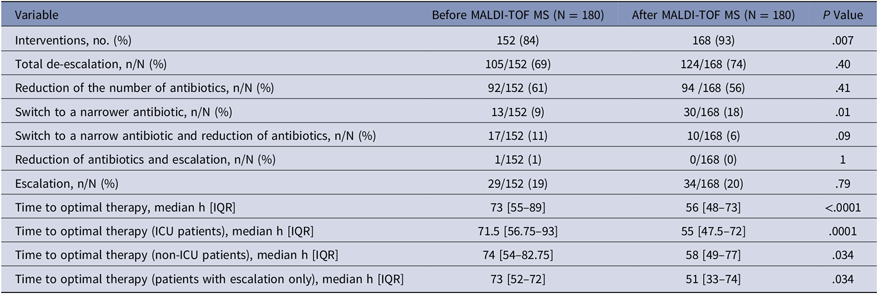
In total, 360 patients were included in the study, 180 subjects in each arm. Baseline characteristics between the 2 groups were similar, although there were significantly more patients with community-acquired pneumonia before MALDI-TOF MS was implemented and significantly more patients with hospital-acquired pneumonia after MALDI-TOF MS was implemented. There were more opportunities for AS intervention after MALDI-TOF MS implementation (93% vs 84%; P = .007), and providers switched to a narrower antibiotic more frequently after MALDI-TOF MS implementation (18% vs 9%; P = .01) (Table 1).
Interventions and Time to Optimal Therapy

Note. MALDI-TOF MS, matrix-assisted laser desorption ionization time-of-flight mass spectrometry; IQR, interquartile range; ICU, intensive care unit.
Univariate analysis showed that after implementation of MALDI-TOF MS, the median times to pathogen identification (63 vs 32 h; P < .001) and optimal antibiotic therapy (73 vs 56 h; P < .001) were shorter among patients in whom there was an opportunity for intervention. There was a reduction in time to optimal therapy in both ICU patients (71.5 vs 55 h; P < .001) and non-ICU patients (74 vs 58 h; P = .034). Also,19% of patients before MALDI TOF MS implementation and 20% of patients after MALDI TOF MS implementation were not on active antimicrobial therapy prior to organism identification and required antibiotic escalation. There was a reduction in time to optimal therapy in patients requiring escalation of antibiotics to achieve active therapy (73 vs 51 h; P = .034). Implementation of MALDI-TOF MS did not significantly impact clinical outcomes (Table 2).
Outcomes

Note. MALDI-TOF MS, matrix-assisted laser desorption ionization time-of-flight mass spectrometry; IQR, interquartile range.
The final linear regression model had an adjusted R2 of 38.4%, suggesting satisfactory model fit. After adjusting for all covariates, on average, optimization of antimicrobials occurred 11.7 hours faster after implementation of MALDI-TOF MS (P = .0002). We detected no association between time to optimization of antimicrobials and age, ICU admission, immunosuppression status, hospital-acquired infection status, ventilator status, gram-negative organism recovery, infectious diseases consultation, de-escalation of antimicrobials, or escalation of antimicrobials.
Discussion
In our study, the implementation of MALDI-TOF MS decreased time to optimal antibiotic therapy in patients with inpatient pneumonia. Other studies have reported similar results when implementation of MALDI-TOF MS was coupled with AS intervention. Wenzler et alReference Wenzler, Goff, Mangino, Reed, Wehr and Bauer 9 examined the impact of implementing MALDI-TOF MS with AS in patients with bacteremia and pneumonia involving Acinetobacter baumannii complex. They reported that implementation was associated with a reduction of median time to effective therapy of 41.1 hours (P < .0001). They also reported a 19% increase in clinical cure (P = .016). Mok et alReference Mok, Eom and Jo 10 evaluated the clinical utility of using MALDI-TOF MS to identify organisms recovered from BAL fluid in ventilated patients with pneumonia. They also reported a significant reduction in the time to the optimization of antibiotic therapy following MALDI-TOF MS implementation (56.5 vs 73.2 h; P < .001).
This study had a number of limitations. This was a retrospective, nonrandomized study, a design that inherently carries a risk of bias. We performed a multivariate analysis in an effort to address this limitation. Second, this study was not adequately powered to demonstrate the effect of implementing MALDI-TOF MS on clinical outcomes. Third, antibiotic treatment of pneumonia was not standardized. Definitions of “optimal therapy” were difficult to define. Finally, the AS program may have acted upon MALDI-TOF MS results without a formal program in place to evaluate them.
In summary, the implementation of MALDI-TOF MS reduced the time to identification and initiation of optimal therapy but did not appear to impact other clinical outcomes in inpatient pneumonia.
Author ORCIDs
Ann Marie Porreca, 0000-0002-1345-8059
Acknowledgments
We thank Raquel Deleon Gonsalves for her contributions to the study design and data extraction.
Financial support
No financial support was provided relevant to this article.
Conflicts of interest
All authors report no conflicts of interest relevant to this article.