INTRODUCTION
Tropical rain forests are one of the most species-rich and functionally important terrestrial ecosystems supporting over half of global biodiversity (Myers et al. Reference MYERS, MITTELMEIER, MITTELMEIER, FONSECA and KENT2000). Although rain-forest modification and conversion has generally a strong negative effect on biodiversity, responses to anthropogenic disturbances vary between taxonomic groups (Lawton et al. Reference LAWTON, BIGNELL, BOLTON, BLOEMERS, EGGLETON, HAMMOND, HODDA, HOLT, LARSEN, MAWDSLEY, STORK, SRIVASTAVA and WATT1998, Schulze et al. Reference SCHULZE, WALTERT, KESSLER, PITOPANG, SHAHABUDDIN, VEDDELER, STEFFAN-DEWENTER, MÜHLENBERG, GRADSTEIN and TSCHARNTKE2004). The loss of biodiversity is not only a conservation issue but also can have important ecological consequences. For example, a decline in species richness can negatively affect ecological services such as pollination and the natural control of pests (Klein et al. Reference KLEIN, STEFFAN-DEWENTER and TSCHARNTKE2002, Reference KLEIN, STEFFAN-DEWENTER and TSCHARNTKE2003). Therefore, studies on the response of functional groups, which provide important ecosystem services, to anthropogenic disturbance are urgent when aiming to maintain a high sustainability of tropical land-use systems.
Dung beetles represent particularly important ecological players involved in many ecosystem processes (Miranda et al. Reference MIRANDA, SANTOS and BIANCHIN1998, Reference MIRANDA, DOS SANTOS and BIANCHIN2001; Mittal Reference MITTAL1993) and providing services highly relevant for humans, such as control of pest flies and parasites of vertebrates (Horgan Reference HORGAN2005). In this study dung beetles (Coleoptera: Scarabaeidae) attracted to dung of large herbivorous mammals were used to analyse effects of land-use change on this ecologically important group (Halffter & Favila Reference HALFFTER and FAVILA1993, Hanski & Cambefort Reference HANSKI and CAMBEFORT1991, McGeoch et al. Reference MCGEOCH, VAN RENSBURG and BOTES2002). Dung beetles are sensitive to habitat perturbation due to changes in vegetation structure and forest canopy cover (Davis et al. Reference DAVIS, HOLLOWAY, HUIJBREGTS, KRIKKEN and SUTTON2001, Halffter & Favila Reference HALFFTER and FAVILA1993), human habitat modification (Gardner et al. Reference GARDNER, HERNÁNDEZ, BARLOW and PERES2008, Harvey et al. Reference HARVEY, GONZALEZ and SOMARRIBA2006, Nichols et al. Reference NICHOLS, LARSEN, SPECTOR, DAVIS, ESCOBAR, FAVILA and VULINEC2007, Shahabuddin et al. Reference SHAHABUDDIN, SCHULZE and TSCHARNTKE2005) and forest fragmentation (Andresen Reference ANDRESEN2003, Klein Reference KLEIN1989, Nichols et al. Reference NICHOLS, LARSEN, SPECTOR, DAVIS, ESCOBAR, FAVILA and VULINEC2007). Although species richness and abundance of dung beetles generally declines with increasing habitat modification, the response of individual species can vary (Nichols et al. Reference NICHOLS, LARSEN, SPECTOR, DAVIS, ESCOBAR, FAVILA and VULINEC2007, Shahabuddin et al. Reference SHAHABUDDIN, SCHULZE and TSCHARNTKE2005). Small-bodied species are suggested to be more resistant to habitat disturbance (Gardner et al. Reference GARDNER, HERNÁNDEZ, BARLOW and PERES2008, Hanski & Cambefort Reference HANSKI and CAMBEFORT1991, Jankielsohn et al. Reference JANKIELSOHN, SCHOLTZ and LOUW2001), and, therefore, may dominate dung beetle communities in open habitats (Nichols et al. Reference NICHOLS, LARSEN, SPECTOR, DAVIS, ESCOBAR, FAVILA and VULINEC2007; for an exception, see Shahabuddin et al. Reference SHAHABUDDIN, SCHULZE and TSCHARNTKE2005).
Besides showing a high fidelity to a particular habitat type, dung preferences exist in some species of dung beetle (Barbero et al. Reference BARBERO, PALESTRINI and ROLANDO1999, Davis & Sutton Reference DAVIS and SUTTON1998, Dormont et al. Reference DORMONT, GUILLAUME and LUMARET2004, Hill Reference HILL1996). However, most dung beetles use a wide variety of excrements without much discrimination (Hanski & Cambefort Reference HANSKI and CAMBEFORT1991). The use of different dung types and the development of different strategies of handling this resource are considered as two possibilities to decrease competition (Hanski & Cambefort 1991). Some species feed and reproduce within the dung (‘dwellers’), others move dung into burrowed tunnels (‘tunnellers’) and another group of species form balls, which are rolled away from the original dung deposition site and burrowed in the vicinity or fixed on structures above the soil surface (‘rollers’) (Hanski & Cambefort 1991).
For coprophagous beetles feeding on dung of large herbivorous mammals, Sulawesi cattle (Bos taurus) and anoa (Bubalus depressicornis) faeces most likely represent two important food sources. Cattles were introduced in recent times (Musser Reference MUSSER and Whitmore1987) and now can be found in most parts of the island's countryside. The anoa is endemic to Sulawesi and categorized as endangered (Whitten et al. Reference WHITTEN, MUSTAFA and HENDERSON2002), but still occurs in most forested parts of the island although in sometimes extremely low densities. This study examined the importance of habitat and dung type for structuring dung beetle ensembles across six different habitat types ranging from natural forest to different land-use systems at the margin of Lore Lindu National Park (LLNP), a biodiversity hotspot of Wallacea in Central Sulawesi.
In particular the following hypotheses were tested: (1) Land-use activities at the margin of LLNP negatively affect species richness, abundance and biomass of dung beetle ensembles. (2) Species ensembles of strongly modified habitats such as agroforestry systems and open cleared areas represent distinct components of the local fauna with a depauperate subset of forest-inhabiting species. (3) Species of different size or different functional groups (dwellers, tunnellers and rollers) respond differentially to habitat modification. (4) Dung beetle ensembles colonizing introduced cattle vs. endemic anoa dung differ, thereby indicating species-specific dung preferences. (5) Both dung and habitat preferences contribute to structuring dung beetle ensembles exploiting dung of large herbivorous mammals along the land-use gradient.
STUDY AREA
The study area is located in Central Sulawesi about 100 km south of Palu at the western margin of Lore Lindu National Park. The margins of the park are characterized by a mosaic of near-primary forest, human-modified forests, forest gardens and plantings of cocoa, coffee, maize and rice, as the most important crops (Gerold et al. Reference GEROLD, FREMERY and GUHARDJA2004). The study sites are located in the proximity of the village of Toro (S 01°30′24″, E 120°02′11″) in Kulawi Valley between 800 and 1100 m asl (Bos Reference BOS2006). In the period December 2001–September 2005, precipitation at Toro village was 1978 mm y−1, mean daily temperature, relative humidity, wind speed, and global radiation were 23.6 °C, 85.0%, 0.95 m s−1 and 17.7 MJ m−2, respectively (Gravenhorst et al., unpublished data).
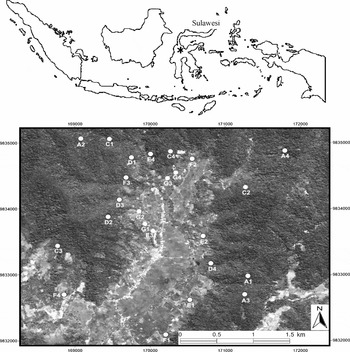
Dung beetle ensembles were studied in six different habitat types: two forest types, three types of cocoa agroforestry system (8–10 y old) situated at the forest margin, and open cleared area. Forest types represented natural forest (habitat type A) with a high density of rattan palms and traditional use (collecting of medicinal plants, extensive hunting) only and selectively logged (habitat type C) forest characterized by small to medium-sized gaps, disturbance of ground vegetation, and increased abundance of lianas following the selective removal of canopy trees and rattan. The canopy height of both forest types is between 35–40 m. The three cocoa agroforestry systems differed with respect to their shade-tree cover which consisted of natural shade trees (= remaining forest cover) with an estimated height of up to 30 m (habitat type D), represented a heterogeneous canopy of planted shade trees (habitat type E) or a monospecific canopy of planted shade trees (habitat type F), both with an estimated canopy height of c. 10 m. Open areas (habitat type G) were dominated by grasses and sometimes used for cultivating maize. Our study site abbreviations correspond to the abbreviations used in related studies conducted simultaneously in the area. Hence, one abbreviation (B) is missing because this habitat type was not included in our study. Four replicates of each habitat type (= total of 24 sites) were sampled. The minimum distance between study sites was about 300 m, the maximum distance between sites was 5 km (Bos Reference BOS2006). Location of the study area and the spatial distribution of study sites are shown in Figure 1.
A map of Indonesia with * indicating the study area (above) and a satellite image showing the 24 study sites in the vicinity of the village Toro, Lore Lindu National Park (below). (Satellite image: QUICKBIRD UTM51S-WGS84. Processed and provided by André Twele, Göttingen University, Germany). Abbreviations of habitat types: A, natural forest; C, selectively logged forest; D, cocoa agroforestry system with natural shade trees; E, cocoa agroforestry system with heterogeneous canopy of planted shade trees, F, cocoa agroforestry system with monospecific canopy of planted shade trees, G, open areas.

METHODS
Dung beetle sampling
Dung beetles were collected at all 24 sites using baited pitfall traps as described in Shahabuddin et al. (Reference SHAHABUDDIN, SCHULZE and TSCHARNTKE2005). Traps were baited with c. 26 g fresh anoa (Bubalus depressicornis) or cattle (Bos taurus) dung. The dung was wrapped in a small square of textile and fixed with a string at the top of the trap, which was covered by a metal roof as protection against sun and rain. At each site ten traps, five baited with anoa and five baited with cattle dung, were set up along two 40-m parallel transect lines, located at a distance of 10 m to each other. Traps baited with anoa and cattle dung were placed alternately about 5 m on both sides of the transect every 10 m. Trapped specimens were removed from the traps after 2 d and preserved in Scheerpelz solution (75% ethanol, 5% acetic acid, 20% water) as recommended by Krell (http://216.73.242.84/scarabnet/). Dung beetles were sampled for 6 mo from March to August 2005. Bait trapping was always conducted in the first week of the respective months.
Fresh cattle dung used for bait trapping was collected from pastures around the study sites, while anoa dung was collected from captive animals kept at Tadulako University, Palu. To avoid a decrease of anoa dung attractiveness through the activity of decomposers such as fungi, the anao dung was stored in a box cooled by ice for 1 d until used as bait in the field.
Identification, body measurements and assignment of beetles to functional groups
The identification of specimens was done in close collaboration with Boris Büche (Berlin, Germany) and using available keys (Balthasar Reference BALTHASAR1963). Additionally, the reference collection of the Bogor Zoological Museum (Indonesia) was used. Unidentified species were sorted to morphospecies.
For all species their body size was quantified as mean body length of representative specimens (n = 10 for abundant species). Body length (anterior margin of clypeus to tip of pygidium) was measured with a vernier calliper accurate to 0.1 mm. Beetles were classified as large (L; body length > 10 mm) or small (S; body length ≤ 10 mm) (following Hanski & Cambefort 1991). Dry mass of dung beetle species was measured following Jankielsohn et al. (Reference JANKIELSOHN, SCHOLTZ and LOUW2001); specimens were dried at 80 °C for 48 h and weighed using a digital balance (Sartorius MC 410 S) accurate to 0.1 mg. The mass of species was obtained by calculating the mean dry mass of 10 specimens per species. If species had a clear sexual dimorphism, body length and dry weight was measured for a maximum of five males and females and the mean of both sexes used for further analyses. When fewer than 10 specimens were collected, all available specimens were used for calculating the mean body length and dry mass, respectively. The total biomass of beetles in individual study sites was calculated by multiplying the total number of collected specimens (or males and females separately in case a pronounced sexual dimorphism existed) of each species with its mean dry mass.
All species were assigned to functional groups according to the way in which they exploit and remove dung: small (≤10 mm) tunnellers, large (>10 mm) tunnellers, rollers and dwellers.
Habitat parameters
Several habitat parameters were measured (Table 1) and tested for their potential to predict spatial changes in the structure of dung beetle ensembles. All habitat parameters were extracted from Ramadhanil (Reference RAMADHANIL2006) and Bos et al. (Reference BOS, HÖHN, SHAHABUDDIN, BUCHORI, STEFFAN-DEWENTER, TSCHARNTKE, Tscharntke, Leuschner, Guhardja and Zeller2007) except for vegetation data of habitat type G and microclimatic data for C and G sites, which were measured by the first author. In habitat A, D, E and F, temperature and relative humidity were measured by digital data loggers (HOBO© Pro Series). The loggers recorded the variables digitally every 15 min from 7h00 to 10h00 on three consecutive mornings at a central and shaded spot at 2 m height. In habitat C and G the data represent means of six measurements (once per month) in the morning (9h00–10h00) at 1 m above ground level using thermo-hygrometer (CoronaR Thermo-hygrometer Model: GL 99). Canopy cover was estimated with a spherical densiometer at four locations per site for a corridor of c. 10 m beside the transect lines. Number of trees (dbh ≥ 10 cm) and tree species richness were measured at fifteen 10 m × 10-m plots (Ramadhanil Reference RAMADHANIL2006). Herb layer coverage and herb diversity was estimated at ten plots of 2 m × 2 m randomly placed in each tree plot (forest and agroforestry systems: Ramadhanil Reference RAMADHANIL2006; open area: Shahabuddin unpubl. data).
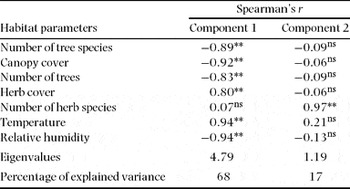
Results of Spearman rank correlations (Spearman's r) between habitat parameters and the first two principal components of a PCA. ns: P ≥ 0.05; * P < 0.05; ** P < 0.01. Additionally, Eigenvalues and percentage of total variance explained by both components are indicated.

Data analysis
Second-order jack-knife extrapolation method was used to estimate species richness (Colwell & Coddington Reference COLWELL and CODDINGTON1994). This species richness predictor appears to be one of the best overall estimators with respect to accuracy (Brose et al. Reference BROSE, MARTINEZ and WILLIAMS2003, Walther & Moore Reference WALTHER and MOORE2005) and particularly produces reliable estimates for small sample sizes (Petersen et al. Reference PETERSEN, MEIER and LARSEN2003). Estimated species richness was computed with the software EstimateS Version 7.00 (http://purl.oclc.org/estimates). As units for estimating total species richness of individual study sites, samples from pitfall traps were pooled for individual sample times (n = 6). The ranking of samples was randomized 100 times (Colwell & Coddington Reference COLWELL and CODDINGTON1994).
Effects of habitat and dung type on species richness, abundance, biomass and ratio large:small species of dung beetles were tested using two-way ANOVAs or Kruskal–Wallis tests depending on if the data distribution achieved normality or not. Additionally, effects of habitat disturbance on dung beetle ensemble variables were tested by ANCOVAs with dung type as covariable. Two-way ANOSIMs (with 1000 random permutations) were calculated with PRIMER version 5 to test for effects of bait and habitat type on species composition (Clarke & Warwick Reference CLARKE and WARWICK2001).
Because most of the measured habitat parameters were correlated, we conducted a principal components analysis (PCA) (Sokal & Rohlf Reference SOKAL and ROHLF1994). Data were rotated using the varimax method to maximize the differences between the principal components extracted. The resulting factor 1 values were used as index for habitat disturbance.
Bray–Curtis similarities based on square-root-transformed abundance data were used to quantify between-site diversity of dung beetle ensembles. Multidimensional scaling based on Bray–Curtis similarities was used to visualize relationships between sites, when raw stress was <0.20 (Clarke Reference CLARKE1993, Clarke & Warwick Reference CLARKE and WARWICK2001). If not mentioned otherwise, data analyses were conducted using the software Statistica 6.0 (Statsoft Inc., Tulsa).
RESULTS
Grouping of habitat types
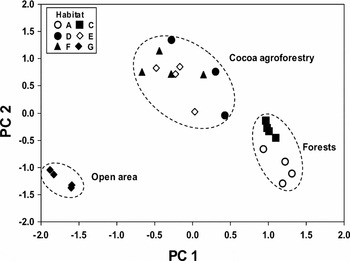
The first two factors of a principal components analysis (PCA) including all measured habitat variables accounted for 68% and 17% of the total variation, respectively (Table 1). Except for herb species richness, all habitat variables were highly correlated with the first component (Table 1). An ordination of sample sites based on the first two components showed a clear grouping into forest sites (A, C), agroforestry systems (D, E, F) and open sites (G). Particularly the classification of the three defined types of agroforestry system was not reflected by the PCA ordination (Figure 2). Due to the high factor loadings of most habitat variables, principal component 1 was used as a habitat-disturbance index in further analyses.
Ordination of habitat types based on the first two components (explaining a total variance of 85%) of a PCA for seven habitat parameters. For habitat abbreviations see Figure 1.

Effects of habitat and dung type on species richness, abundance, body size and biomass
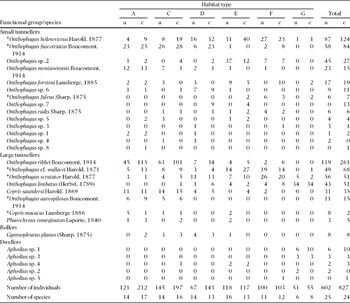
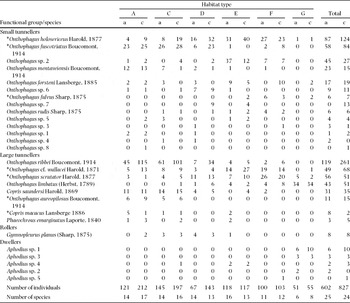
A total of 1429 dung beetles representing 28 species and five genera (Aphodius, Copris, Gymnopleurus, Onthophagus and Phaeochrous) were trapped (Appendix 1). Half of the collected species could be assigned to described species, of which 43% (six species) can be categorized as endemic to Sulawesi (Appendix 1). The majority of species (68%) and specimens (91%) belonged to the genus Onthophagus (19 species, 1299 individuals).
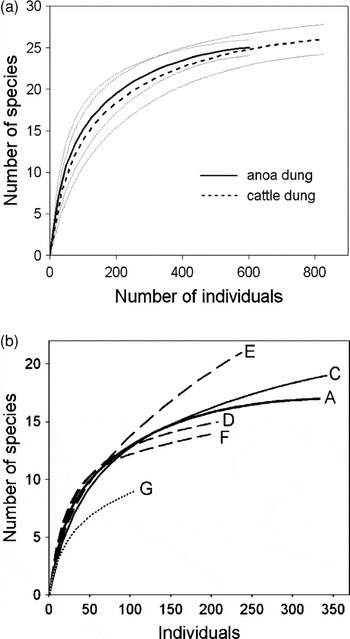
Rarefaction curves for dung beetles attracted by anoa and cattle dung indicated very similar species richness (Figure 3a) and sampled habitats were indistinguishable in terms of species richness (Figure 3b) as indicated by the overlap of 95% confidence intervals of all rarefaction curves (not shown in the figure).
Abundance-based rarefaction curves for dung beetles attracted to two different dung types (dotted lines indicate 95% confidence intervals) (a) and for dung beetles sampled in two different forest types (solid lines), three different agroforestry systems (broken lines) and open area (dotted line) (b). For habitat codes see Figure 1. To maintain clarity, 95% confidence intervals for species accumulation curves are not shown in b.

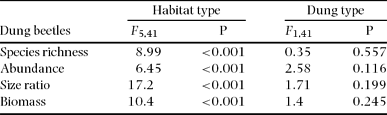
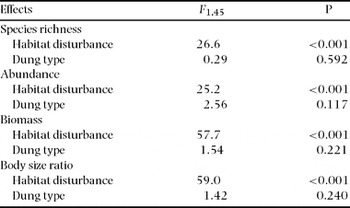
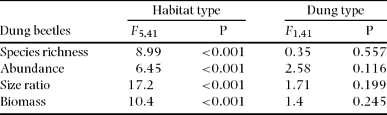
Two-way ANOVAs testing for effects of habitat and dung type on mean dung beetle species richness, abundance, biomass and body size ratio (large:small species) per sampling site only detected a significant influence of habitat, but not dung type (Table 2). Significant effects of habitat disturbance (quantified by habitat disturbance index values) on all four dung beetle ensemble variables were confirmed by ANCOVAs (with dung type as covariable; Table 3).
Effects of habitat and dung type on different parameters of dung beetle communities tested by two-way ANOVAs.
Results of ANCOVAs testing for effects of habitat disturbance on dung beetle ensemble variables – species richness estimated by Jack-knife 2, abundance (log-transformed), biomass (log-transformed) and body size ratio (large:small species) – with dung type as covariable. Because no interaction term was significant, they were removed from the models.

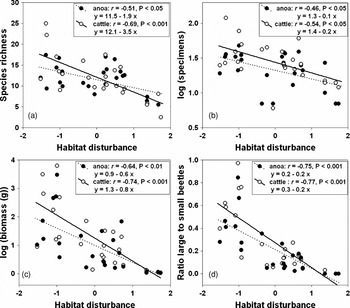
All four dung beetle ensemble variables decreased significantly with increasing habitat disturbance index values (Figure 4a–d).
Species richness (estimated by jack-knife 2) (a), abundance (b), biomass (c), and body size ratio (large to small specimens) (d) of dung beetles attracted to cattle and anoa dung at individual sampling sites in relation to habitat disturbance quantified by factor 1 values of a principal components analysis of measured habitat parameters. Higher habitat disturbance values reflect higher land-use intensity. Each graph contains the linear regression curves and the respective regression functions.

Effects on functional groups
Of all functional groups, only large tunnellers were significantly affected by dung type. The median abundance of large tunnellers captured in cattle dung was eight individuals, relative to five in anoa dung (paired Wilcoxon test; Z = 3.01, n = 24, P = 0.003). Abundance of all other functional groups – small tunnellers, dwellers and rollers – did not differ significantly between dung type (paired Wilcoxon tests; small tunnellers: Z = 1.04, n = 24, P = 0.297; dwellers: Z = 0.89, n = 24, P = 0.371; rollers: Z < 0.01, n = 24, P > 0.99).
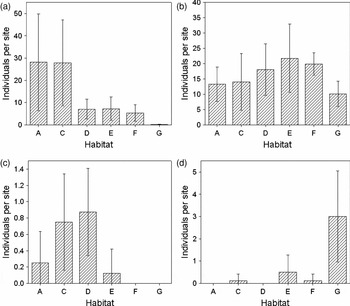
Three of four functional groups responded significantly to habitat modification (Kruskal–Wallis tests; large tunnellers: H 5 = 34.4, P < 0.001; small tunnellers: H 5 = 9.95, P = 0.077; rollers: H 5 = 20.0, P = 0.001; dwellers: H 5 = 21.6, P < 0.001). However, individual groups were affected differentially by habitat modification. The abundance of large tunnellers decreased dramatically from natural and selectively logged forest towards agroforestry systems and open areas. Rollers reached their highest abundance at selectively logged forest sites and in the less intensively managed agroforestry system, and were not recorded in structurally very homogeneous agroforestry systems and open areas. Dwellers were abundant in open areas, but rare or absent in other habitat types. Only small tunnellers did not show any significant differences between habitats (Figure 5).
Abundance of the four functional groups of dung beetles, large tunnellers (a), small tunnellers (b), rollers (c) and dwellers (d), in different habitat types. For habitat codes see Figure 1.

Effects of habitat and dung type on species composition
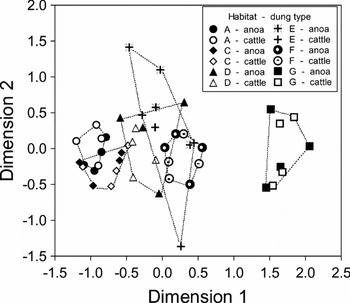
A multidimensional scaling analysis based on Bray–Curtis similarities demonstrates that habitat type was more important than dung type for structuring dung beetle ensembles (Figure 6). This was confirmed by a two-way ANOSIM testing for effects of habitat and dung type on species composition. While species composition was significantly affected by habitat type (global R = 0.65, P = 0.001), dung type failed to achieve a significant effect (global R = –0.08, P = 0.854). Pairwise tests (one-way ANOSIMs) for all combinations of habitat type failed to detect significant differences of dung beetle composition between natural (A) and selectively logged forest (C), and between agroforestry system E and the agroforestry systems D and F. Dung beetle communities at open areas (G) differed significantly from all other habitat types (results of one-way ANOSIMs not shown). Furthermore, as indicated by a Spearman matrix rank correlation, similarity of species composition (quantified by Bray–Curtis similarities) of dung beetles attracted by cattle and anoa dung was similarly affected by forest disturbance and land-use activities (Rho = 0.74, P < 0.001).
Two-dimensional scaling plot based on Bray–Curtis index values quantifying similarity of dung beetle ensembles sampled with traps baited with anoa or cattle dung at 24 sites belonging to six different habitat types. Lines connect samples belonging to the same habitat type. For habitat abbreviations see Figure 1.

Habitat and food preferences of individual species
About 50% of all recorded species could be found in forest and at agroforestry sites, and about 18% of all collected species were observed in all habitat types. Of the 19 species recorded at forest sites, 89.5% (= 17 species) were also found at agroforestry systems. Only one species, Onthophagus aureopilosus, was trapped exclusively (all 26 specimens) at forest sites (Appendix 1). Other species such as O. ribbei, O. fuscostriatus, O. mentaveiensis and Copris saundersi, although predominantly found at forest sites, were also collected at agroforestry systems (Appendix 1). Only two species (Aphodius sp. 1 and A. sp. 3) were exclusively trapped at open sites and one species (Onthophagus limbatus) predominantly occurred in this habitat (72% of all 94 trapped specimens; Appendix 1).
The majority of recorded species were attracted by anoa dung (89.3% of recorded species total) as well as by cattle dung (85.7%) emphasizing a low degree of food specificity. Of the 11 most abundant species, the abundance of 10 species differed significantly between habitat types but only one species, Onthophagus cf. wallacei, was affected by dung type (data not shown).
DISCUSSION
Effect of forest modification and conversion on dung beetle ensembles
Our study showed that dung beetle species richness decreased dramatically only in open areas, but selectively logged forest and the three agroforestry systems appeared to maintain high species richness, similar to that found in natural forest. These findings do not support the conclusions of other studies, emphasizing a negative effect of forest conversion on species richness of tropical dung beetles (Arellano et al. Reference ARELLANO, FAVILA and HUERTA2005, Avendaño-Mendoza et al. Reference AVENDAÑO-MENDOZA, MORÓN-RÍOS, CANO and LEÓN-CORTÉS2005, Davis et al. Reference DAVIS, HOLLOWAY, HUIJBREGTS, KRIKKEN and SUTTON2001, Gardner et al. Reference GARDNER, HERNÁNDEZ, BARLOW and PERES2008, Harvey et al. Reference HARVEY, GONZALEZ and SOMARRIBA2006). However, the value of secondary forests for maintaining dung beetle species richness depends on how strongly forests are modified relative to primary forest (Nichols et al. Reference NICHOLS, LARSEN, SPECTOR, DAVIS, ESCOBAR, FAVILA and VULINEC2007). That highly disturbed forests and agroforestry systems in Sulawesi can be still relatively species-rich compared with old-growth forest has already been reported for dung beetles sampled in another area in Central Sulawesi (Shahabuddin et al. Reference SHAHABUDDIN, SCHULZE and TSCHARNTKE2005). A study on the response of various animal and plant taxa to the transformation from near-primary forest to agroforest, which was conducted in the same region as our study, also reported little effect on overall species richness, but a significant decline of species richness in forest-using species by 60% (Steffan-Dewenter et al. Reference STEFFAN-DEWENTER, KESSLER, BARKMANN, BOS, BUCHORI, ERASMI, FAUST, GEROLD, GLENK, GRADSTEIN, GUHARDJA, HARTEVELD, HERTEL, HOHN, KAPPAS, KOHLER, LEUSCHNER, MAERTENS, MARGGRAF, KLEIAN, MOGEA, PITOPANG, SCHAEFER, SCHWARTZE, SPORN, STEINGREBE, TJITROSOEDIRDJO, TJITROSOEMITO, TWELE, WEBER, WOLTMANN, ZELLER and TSCHARNTKE2007). In our study on dung beetles only a small minority of species appeared to be restricted to forest habitats. However, further studies on Sulawesi dung beetles have to explore to what extent the response of species ensembles and particularly true forest species to forest conversion and land-use depends on the studied geographical scale (Nichols et al. Reference NICHOLS, LARSEN, SPECTOR, DAVIS, ESCOBAR, FAVILA and VULINEC2007) and on the configuration of the landscape matrix (Avendaño-Mendoza et al. Reference AVENDAÑO-MENDOZA, MORÓN-RÍOS, CANO and LEÓN-CORTÉS2005, Nichols et al. Reference NICHOLS, LARSEN, SPECTOR, DAVIS, ESCOBAR, FAVILA and VULINEC2007).
The total biomass of dung beetles decreased threefold from forest towards highly disturbed areas. Therefore, it can be expected that forest conversion may significantly alter ecosystem functioning by reducing abundance and biomass of this ecologically important group. Dung beetles are important ecological players involved in soil fertilization and nutrient cycling (Miranda et al. Reference MIRANDA, SANTOS and BIANCHIN1998, Reference MIRANDA, DOS SANTOS and BIANCHIN2001; Mittal Reference MITTAL1993), seed dispersal (Andresen Reference ANDRESEN2002, Reference ANDRESEN2003; Andresen & Levey Reference ANDRESEN and LEVEY2004) and control of pest flies and parasites of vertebrates (Horgan Reference HORGAN2005). Further studies have to evaluate the ecological consequences of a decreasing dung beetle biomass from natural forest towards agroforestry systems and open areas in Central Sulawesi.
Our study showed that the significant decrease of biomass with increasing land-use intensity was mainly related to the decline of large species. That larger-bodied dung beetle species are more sensitive to habitat disturbance supports findings from other tropical regions (Gardner et al. Reference GARDNER, HERNÁNDEZ, BARLOW and PERES2008, Hanski & Cambefort 1991, Nichols et al. Reference NICHOLS, LARSEN, SPECTOR, DAVIS, ESCOBAR, FAVILA and VULINEC2007). As also demonstrated by this study, large tunnellers (and rollers) are particularly vulnerable to habitat disturbance (Andresen Reference ANDRESEN2002, Avendaño-Mendoza et al. Reference AVENDAÑO-MENDOZA, MORÓN-RÍOS, CANO and LEÓN-CORTÉS2005, Jankielsohn et al. Reference JANKIELSOHN, SCHOLTZ and LOUW2001, Larsen et al. Reference LARSEN, WILLIAMS and KREMEN2005, Scheffler Reference SCHEFFLER2005).
One major problem of the spatial distribution of our study sites is that successively perturbed habitats radiate out from the central open area of the valley (Figure 1). As a consequence, secondary forests and agroforestry systems are more closely linked to natural-forest areas than open-area sites. This decreased connectivity to forest as a potential source area for coprophagous species could potentially contribute to the decline of dung beetle richness, abundance and biomass towards open areas.
Habitat preferences
As already documented by Shahabuddin et al. (Reference SHAHABUDDIN, SCHULZE and TSCHARNTKE2005), the majority of dung beetle species in Central Sulawesi are capable of colonizing dung in a wide variety of habitats. Also in this study few species were restricted to individual habitat types, such as O. aureopilosus, which occurred exclusively at forest sites, or Aphodius sp. 1 and A. sp. 3, which tended to select non-shaded open habitat. However, our results do not necessarily indicate that the majority of species is represented by habitat generalists. Forest species, which are found colonizing dung in human-dominated habitats such as agroforestry systems, might not persist without natural forest nearby, such in this study, where all habitats were in close proximity.
Factors with potential to explain differences between dung beetle ensembles of forest, agroforestry systems and open area, are dung availability, dung quality and distribution, changes of vegetation structure and soil type (Doube Reference DOUBE, Hanski and Cambefort1991, Hanski & Cambefort 1991). These factors are not necessarily independent but may even have additive or synergistic effects on dung beetles ensembles.
Microclimatic conditions have a critical effect on habitat selection by dung beetles (Barbero et al. Reference BARBERO, PALESTRINI and ROLANDO1999). Therefore, changes in microclimate following alterations of vegetation structure at our studied six land-use types may also affect dung beetle populations. It is known that thermoregulation strategies and the limited ability to maintain an optimal body temperature (Verdu et al. Reference VERDU, ARELLANO and NUMA2006) may restrict dung beetles to a certain range of microclimatic conditions (Errouissi et al. Reference ERROUISSI, HALOTI, ROBERT, IDRISSI and LUMARET2004, Menendez & Gutierrez Reference MENENDEZ and GUTIERREZ1996). Sunny land-use systems are characterized by higher soil temperatures than shaded ones, which could be an important source of mortality for dung beetle larvae (Fincher Reference FINCHER1973). Temperature may also affect the quality of dung as food source and microhabitat for dung beetles. When dung is exposed to high temperatures and low moisture as in open areas, it dries out quickly and its nutrient quality becomes low.
Dung preferences
Differences in food resources are a well-known explanation of coexistence in consumer communities (Strong et al. Reference STRONG, LAWTON and SOUTHWOOD1984), but our results indicated little preferences for anoa or cattle dung. Some previous studies from tropical regions (Al-Houty & Al-Musalam Reference AL-HOUTY and AL-MUSALAM1997, Estrada et al. Reference ESTRADA, HALFFTER, COATES-ESTRADA and MERRIT1993), Australia (Holter et al. Reference HOLTER, SCHOLTZ and WARDHAUGH2002), the temperate zone (Finn & Giller Reference FINN and GILLER2002, Gittings & Giller Reference GITTINGS and GILLER1998) and the Mediterranean region (Barbero et al. Reference BARBERO, PALESTRINI and ROLANDO1999, Galante & Cartagena Reference GALANTE and CARTAGENA1999, Martin-Piera & Lobo Reference MARTIN-PIERA and LOBO1996) reported clear feeding preferences for at least a certain proportion of the sampled species. However, most of these studies used dung from vertebrates belonging to different trophic levels (herbivores vs. carnivores) while the present study only used dung from two herbivorous mammal species. Studies on dung beetles attracted to excrements of different large herbivorous mammals have already reported that species ensembles can be very similar (Barbero et al. Reference BARBERO, PALESTRINI and ROLANDO1999, Dormont et al. Reference DORMONT, GUILLAUME and LUMARET2004).
In our study neither species numbers nor total abundance and species composition of dung beetles differed significantly between anoa and cattle dung. This may be also explained by the high similarity of nutritional contents of both anoa and cattle dung (Shahabuddin Reference SHAHABUDDIN2007). That inherent dung parameters such as moisture, nitrogen and organic matter can affect the structure of dung beetle ensembles was already documented by studies from temperate Europe (Errouissi et al. Reference ERROUISSI, HALOTI, ROBERT, IDRISSI and LUMARET2004, Gittings & Giller Reference GITTINGS and GILLER1998).
Conclusions
The long history of Sulawesi's isolation from other landmasses caused a high rate of plant and animal endemism (Whitten et al. Reference WHITTEN, MUSTAFA and HENDERSON2002), which appears to be particularly high in dung beetles. Hanski & Krikken (Reference HANSKI, KRIKKEN, Hanski and Cambefort1991) predicted that more than 75% of Sulawesi's dung beetle species are endemic to the island. However, in our study area only 47% of the recorded species, which could be identified to species, represented species endemic to Sulawesi, a rate similar to the one (43%) found by a study on dung beetles in Northern Borneo (Davis et al. Reference DAVIS, HUIJBREGTS and KRIKKEN2000).
Although species richness of dung beetles at natural forest was higher compared to all other land-use types, our data indicated that agroforestry sites have a high potential to maintain a high proportion of dung beetle species, thereby supporting the findings by Nichols et al. (Reference NICHOLS, LARSEN, SPECTOR, DAVIS, ESCOBAR, FAVILA and VULINEC2007). Nonetheless, understanding patterns of species richness of land-use systems needs to assess the role of landscape matrix effects. Neighbouring forest or isolation from forest may determine insect communities in tropical (as well as temperate) land-use systems (Tscharntke et al. Reference TSCHARNTKE, KLEIN, KRUESS, STEFFAN-DEWENTER and THIES2005). Agroforestry systems can be part of the habitat for many forest species using it for foraging, which enhances population size, but they may also support largely independent populations.
According to our results, small dung beetle species are particularly important in land-use systems and open areas. However, the functional contribution of small-bodied species (even in high abundance) is greatly reduced relative to large species, which bury disproportionately more dung and disperse more plant seeds (Andresen Reference ANDRESEN2003, Larsen et al. Reference LARSEN, WILLIAMS and KREMEN2005). Therefore, the decline of big dung beetles in response to increased land-use intensity may have important ecological consequences, which cannot be compensated by an increasing number of small species from forest towards intensively managed land-use systems and open areas. The result may be a significant loss of ecological services provided by coprophagous beetles in human-dominated tropical habitats.
ACKNOWLEDGEMENTS
The first author gratefully acknowledges a graduate scholarship and grant for publication from the Ministry of Education Indonesia and research funding from the Deutsche Forschungsgemeinschaft (SFB 552). We are grateful to the authorities of Lore Lindu National Park, who kindly provided all necessary permits to conduct our fieldwork. We are thankful to Boris Büche who assisted in the identification of dung beetles, and to Ramadhanil Pitopang and Merijn Bos for providing environmental data. Thanks also go to Wolfram Lorentz, Adam Malik, and the staff of the German-Indonesian Research Project STORMA (Stability of Tropical Rainforest Margins) for their support and help. Additionally, we want to thank all smallholders in the vicinity of Toro, who gave permission to conduct research on their land. The manuscript significantly benefited from comments of three anonymous reviewers.
Number of collected specimens of individual dung beetle species trapped in pitfall traps baited with anoa (a) and cattle (c) dung in the six different habitat types A–G (for abbreviations of habitat types see text). Species are ranked according to their affiliation to functional groups and their total number of collected specimens. Species most likely endemic to Sulawesi according to Balthasar (Reference BALTHASAR1963) are indicated with an asterisk.