1 Introduction
Variation is inherent in language.Footnote 1 For example, the same form may be positioned differently with no change in meaning (e.g. the positioning of loudly in a sentence). In other cases, however, alternative positions available to an item may carry distinct meanings or be preferred in distinct circumstances. For example, frankly has to be a sentence adverb meaning ‘frankly speaking’ when it is sentence-initial but a VP-adverb meaning ‘in a frank way’ when it is VP-final. English adverbs have often been studied with reference to their distribution in a sentence, the placement restrictions that distinct types of adverbs adhere to, and the possible semantic consequences that different positions have for the interpretation of statements (Jackendoff Reference Jackendoff1972; Thomason and Stalnaker Reference Thomason and Stalnaker1973; Jacobson Reference Jacobson1978; Ernst Reference Ernst1984, Reference Ernst2002; Alexiadou Reference Alexiadou1994, Reference Alexiadou1997; Pittner Reference Pittner2000; Shaer Reference Shaer2000). Placement and positional (in)variance have been an important aspect of the study of adverbs. Hunston and Francis (Reference Hunston and Francis2000: 43), who study the major word-classes in terms of complementation patterns, note that adverbs are difficult to examine in this way and are best described in positional terms.
In his seminal work on semantics, Jackendoff (Reference Jackendoff1972) divides English adverbs into six distributional classes and one of them includes items which can only occupy the final position. These are typically non-ly adverbs (with the exception of terribly) such as hard, well, fast, more, less, early, before, slow, home, indoors, lengthwise, downstairs. Jackendoff's treatment of these is very limited and based on Klima (Reference Klima1965), who analyses these adverbs as intransitive prepositions – positionally and semantically parallel to prepositional phrases (e.g. downstairs – down the stairs, (run) home – (run) into the house, afterward – after that, etc.). Additionally, many of them act as prepositions themselves or are morphologically related to prepositions. In this way, at the level of the generative base rules, non-ly adverbs and prepositional phrases can be neatly dealt with by the same projection rules. This approach may hold some theoretical appeal in its being economical, but the question arises as to how it should accommodate adverbs not related to prepositions. Jackendoff (Reference Jackendoff1972: 63) himself concedes: ‘It is not clear to me, however, why adjectives such as hard and fast should be in this category.’
Jackendoff's categorization into six types has since been revisited and revised, but monosyllabic non-ly adverbs have evaded closer analysis based on empirical evidence. This group is often taken to be prototypically represented by fast, well and hard (Alexiadou (Reference Alexiadou1997: 130) calls them well-type adverbs); these three have been stigmatized as distributionally restricted to the final position (postverbal or VP-final) and few attempts at reconsideration have been made despite blatant counterexamples involving preverbal fast and well found in corpora. Consider the following examples, all taken from the British National Corpus:
(1) Some 1800 million years ago atmospheric oxygen was fast approaching the present level of about 21 per cent of the total.
(2) Africa's disenchantment with the two Washington institutions is fast turning to outright hostility.
(3) I well remember the words of an old foreman who said to me . . .
(4) Then he whistled, a sound I well knew from experience was a call to his loon.
The adverb position in (1)–(4) is, in Jackendoff's (Reference Jackendoff1972) terms, the auxiliary position; apparently readily available to all of his adverb classes but one – the non-ly adverbs. Others have followed Jackendoff in this final-only categorization, although normally little attention is paid to these adverbs beyond mere specification of strictly postverbal placement (Huang Reference Huang1975: 72; Travis Reference Travis1988: 291; Alexiadou Reference Alexiadou1997: 11, 130; Göbbel Reference Göbbel, Winkler and Schwabe2007: 4, 5; Trask Reference Trask2007: 7; Eszes Reference Eszes and Kiss2009: 272). Let us review two recent stands on the subject in which attempts are made to account for the final-only categorization.
Ernst (Reference Ernst2002: 274) sees ‘adverbs such as well, hard and quick’ (and presumably fast) as one of the exceptions to what he considers the normal distribution of manner adverbs. In his view they are to be accounted for by marking them intrinsically (lexically) as [+Heavy] and thus confined to occurring postverbally by virtue of the Weight Theory. Note that Ernst's designations [Lite] and [Heavy] are not to be taken as indications of mere physical length or complexity. Heaviness also involves stress (more stress = heavier) as well as lexical and categorial factors (for example, adverbs and adverb phrases without complements are considered [+Lite], but adverb phrases with complements are [+Heavy]). Ernst assumes that short monosyllabic adverbs are marked [+Heavy] in the lexicon – obviously they cannot be seen as heavy by virtue of their length or complexity.
The assignment of these two features influences the range of positions available to adverbials. According to Ernst's Weight Theory, [+Lite] adverbials (e.g. hardly, scarcely, just) take leftward positions and [+Heavy] ones (halfway, partway) tend to keep to the right. If fast is marked [+Heavy] – an assumption which may be questioned – the adverb is effectively banned from occurring preverbally, which is disproved by empirical evidence such as that in (1) and (2).
Haumann (Reference Haumann2007) takes the same stand as to the adverbs being constrained postverbally. However, she questions the need to mark them lexically as [+Heavy] on grounds that this is superfluous. Instead, ‘pure’ manner adverbs (including relevant non-ly adverbs) are to be distinguished from subject-oriented adverbs, even when the two may be represented by homophonous forms such as cleverly. Because hard, well and fast cannot be construed as subject-oriented adverbs, they fail to precede the lexical verb in actives. The author notes the use of hard and well, but not of fast or slow, preceding or following the verb in passives (data from Haumann Reference Haumann2007: 130):
(5) The ground had been well prepared (well).
(6) [Rural] areas have been hard hit (hard) by the recession.
(7) *Birthday presents should be slow opened.
(8) *The ‘Messiah’ had been fast composed.
Whatever proposals are put forward to account for the final position of non-ly adverbs, the question arises as to why their preverbal placement has been largely ignored. With regard to fast specifically, its preverbal occurrences such as in (1) and (2) have received very little attention so far and, oddly, claims to the effect that ‘the preverbal position is uniformly ungrammatical in English’ (Göbbel Reference Göbbel, Winkler and Schwabe2007: 279) are not hard to come by. Rare instances of acknowledgement of such occurrences are limited to observations that fast has ‘a distinctive shade’ when ‘it occasionally goes before [the verb]’ (Bolinger Reference Bolinger1943: 192) and that ‘there are certain examples (belonging to a different style) in which fast can precede finite verbs, e.g. He fast ran out of money’ (Cinque Reference Cinque1999: 212). Unfortunately, it is not clear what style such examples belong to, what other contextual factors may be relevant, or to what extent – expressed quantitatively – fast is found in this position. This study sets out to address these research questions by exploring the typical contexts of preverbal fast and investigating factors which may be responsible for the variation between preverbal and postverbal positions. The nature of these factors may be genre-related (section 3), lexico-grammatical (sections 4 and 5), syntactic (section 6), semantic (section 7) or pragmatic (section 8), or they may jointly determine adverb position. The main focus is the adverb fast, but when appropriate reference will be made to other adverbs, too, in the course of discussion.
2 Sources of data
The data come from three large corpora representing modern British and American English, namely the British National Corpus (BNC), the Corpus of Contemporary American English (COCA) and the Time Magazine Corpus (Time) respectively (Davies Reference Davies2004–, Reference Davies2007–, Reference Davies2008–). The first two were designed to be balanced corpora representative of a range of registers such as spoken, fiction, newspapers, magazines and academic prose. One of the qualitative differences between the BNC and COCA is that the spoken subcorpus of the former includes private spontaneous conversation whereas the latter includes unscripted conversation from TV and radio programmes. Notwithstanding such differences, we take advantage of the combined volume of the three corpora to investigate a language feature that is not very frequent. Still, when appropriate, the three corpora and their subcorpora will be distinguished. For example, in section 3 we will specifically refer to particular registers to point out register-related distributional patterns. For the same reason, the Time corpus is used as it represents the language variety in which preverbal fast seems to be most common.
The COCA (464 million words) is over four and a half times the size of the BNC and Time corpus (approximately 100 million words each). This should be taken into account when comparing the frequencies of occurrence presented below, i.e. direct comparison of figures is possible between the BNC and Time, whereas the COCA's raw counts are relatively high due to the sheer difference in size. For this reason we use normalized frequencies per a common basis of comparison when frequency numbers for the three corpora are juxtaposed.
Every care has been taken to ensure that only relevant occurrences of fast have been used in this study, both in the examples cited and quantitative data reported. For example, constructions resembling compound adjectives (a fast growing market, the fast approaching weekday rush) have been excluded. All occurrences of preverbal and postverbal fast have been checked manually to verify their adverbial status.
3 Distribution across genres
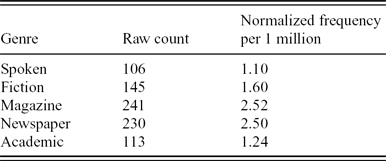
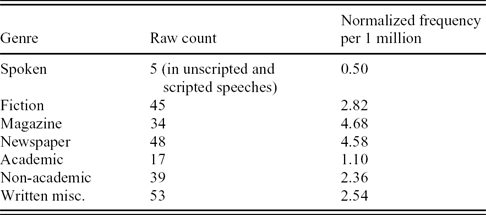
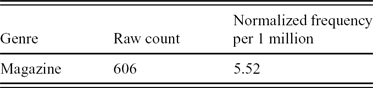
Let us consider the distribution of preverbal fast across the various genres of the three corpora (the Time corpus is considered as representing the ‘magazine’ genre only). Tables 1, 2 and 3 give the respective raw counts and normalized frequencies of occurrence (per 1 million word tokens of text).
Preverbal fast in COCA

Preverbal fast in BNC
Preverbal fast in Time
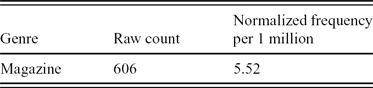
As indicated by the normalized frequencies in the three corpora, the structure is fairly infrequent on the whole (only up to several occurrences per 1 million words, depending on the genre). Across genres the structure is especially typical of newspapers and magazines, i.e. journalistic texts, ranging from 2.5 in the COCA to 5.5 in the Time corpus. In both the BNC and COCA the frequencies in magazines and newspapers are notably higher than those in the other genres, while the Time corpus has the highest frequency. The structure is also observed in other written genres, although less frequently (fiction in the BNC and COCA, the Miscellaneous and Non-academic genres of the BNC) and even more infrequently in spoken language, i.e. the spoken sub-corpus of the COCA (unscripted conversation of TV and radio programmes). The BNC 10-million-word sub-corpus of spoken language has only 5 occurrences of it in its non-conversation spoken texts (speeches) and none in conversation.
The link of preverbal fast with journalism is seen in the abundance of such constructions in the Time corpus. In addition to its highest overall frequency, the corpus has the highest number of verbs which occur with preverbal fast once only, which is notable inasmuch as such once-in-a-corpus items – so-called hapax legomena – have been observed to be possible indicators of linguistic creativity and neology (Baayen & Lieber Reference Baayen and Lieber1991; Plag Reference Plag1999). To be precise, a hapax legomenon may well be a rare or obsolete item, but another possibility is that it may be in some respect new, innovative or original. The number of different verbs which occur in this position only once is higher in the Time corpus than in the COCA (67 and 61 respectively), even though the latter corpus is more than four times bigger. Thus, the structure with preverbal fast is used more freely and with a greater range of lexical diversity in the Time corpus, pointing again to a connection with journalistic language (see also the discussion in section 4).
The air of journalistic style that preverbal fast has can also be seen in the range of co-occurring verb–noun collocations: in conjunction with the verb lose, it is common in contexts of losing significance, appeal, support, opportunities, etc., as in (9). These notions will often be the subject matter of expository or informative registers. By contrast, lose X fast is very often found in the corpora in more mundane contexts of losing weight, money, blood or friends, as in (10).
(9) In Georgia, and in many other states, we are fast losing our historic American identity with so many people speaking Spanish. (COCA, News)
(10) Exhausted and losing blood fast, Bovim somehow managed to swim 70 yards to shore. (COCA, Spoken)
The distribution of preverbal fast noted above is in line with Ernst (2000: 173), who recognizes a similar link between ‘more formal and journalistic styles’ and non-canonical preverbal positioning of phrasal adjuncts, which, he claims, is increasingly acceptable as the phrase becomes relatively lighter compared to the rest of the sentence. Note the unacceptability of preverbal for several days in (11) and its acceptability in (12), increasing along with the length of VP:
(11) *Maureen for several days walked.
(12) The relief officials have for several days tried to move tons of supplies into the devastated valley.
Thus, heaviness is relative, and the positioning of adverbials may be influenced by the heaviness of other sentence constituents. It is possible to link this observation by Ernst to preverbal fast. In (9) above, although the question of genre/style may be relevant in selecting preverbal fast, it is also possible that the initial position is given preference because of the relatively heavy VP; in contrast, in (10), postverbal fast is fine following a light complement of the verb (i.e. blood). In this way, a combination of factors (genre/style, lexical collocates, and weight) may co-determine adverb placement. We will return to the problem of complement weight in section 6. For the time being we note the typical occurrence of preverbal adjuncts/adverbs in more formal styles and, especially, in journalistic language. Beyond considerations of genre, other factors which are likely to carry weight in the choice between preverbal and postverbal fast are discussed in the sections to follow.
4 Lexico-grammatical environment
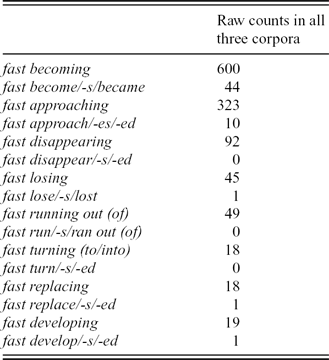
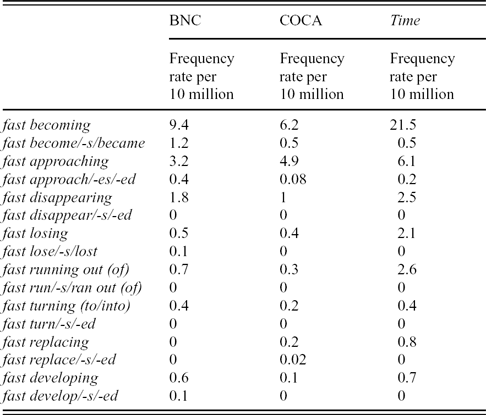
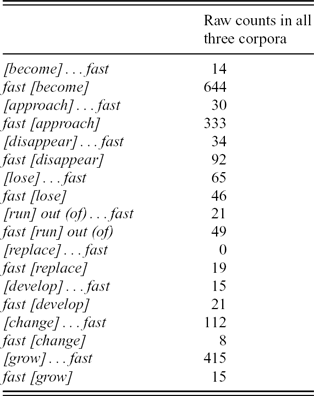
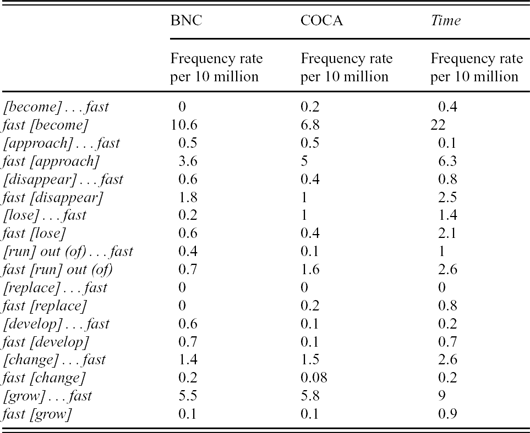
One of the parameters of variation is lexical in nature: quantitatively, preverbal fast is strongly linked to a small number of verbs, the three most typical ones being become, approach and disappear. The raw counts of these three and of other verbs typically used are given in table 4. Table 5 gives the respective frequency rates of occurrence in individual corpora (note the relatively high frequencies of the Time corpus). Also, in this position, verbs are usually used in their -ing forms (see tables 4 and 5), especially in the Present/Past Continuous tenses (examples (1), (2), (9) and (10) above) and never in the perfect tenses. Relatively infrequent are finite verb forms ((13) and (14); see tables 4 and 5) and non-finite participial phrases (15):
Verbs with preverbal fast
Frequency rates of verbs with preverbal fast
(13) The ‘celebratory drink’ fast developed into a full-scale party . . . (BNC)
(14) . . . I fast came to the view I had been too cautious. (BNC)
(15) Fast approaching the age of fifty, Ellis had been in the VC game since the age of twenty-eight. (COCA)
Many other verbs co-occur with fast with decreasing frequencies including a good deal of those recorded in the three corpora only once, e.g.:
(16) . . . on her title page in pink fast deflowering to purple she nevertheless promises ‘a romance’. (Time)
Those once-only occurrences suggest that the pattern is not completely fossilized and limited exclusively to specific verbs; indeed, in the Time corpus alone, there are 67 different verbs appearing once with preverbal fast, and approximately twice this number of all the verbs occurring in the fast [Verb] position. This indicates that the pattern may be freely used with any suitable verb although several specific ones are particularly frequent.
The predominance of -ing forms and progressive aspect may be explained by the fact that in most cases the emphasis is on the continuation of actions. This idea is to some extent conveyed in the word fast itself; however, no such preference for progressive aspect is observed for quickly preceding the same range of verbs: although fast disappear/-s/-ed is not found in any of the three corpora, quickly disappear/-s/-ed has 85 occurrences in the COCA alone. Although semantically the two adverbs are similar, preverbal fast is largely restricted in its use to co-occur with progressive aspect forms (see also section 7 for a discussion of aspectual associations). To conclude, it seems to be the case that, although the pattern with fast is not limited entirely to particular verbs, it is rare outside a very limited range of verbs and pre-wired for present participle forms in particular.
5 Preverbal or postverbal?
At the same time, the postverbal position of fast seems to be far less likely for the top three verbs: become, approach and disappear. Let us first illustrate this alternative location:
(17) He was becoming a warrior fast. (COCA)
(18) . . . and we, you know, really became pretty educated on it fast. (COCA)
The search engine used in this study makes it possible to examine context within nine words to the right of the node word, i.e. the key word. This means that it is possible to find all occurrences of become/approach/disappear followed by fast with up to eight words intervening between them. The results of such a search are surprising: the COCA has only 34 occurrences of [become]. . .fast (the square brackets indicate any inflectional form of the verb; the ellipsis marks indicate omission of words), the Time corpus has 8, and the BNC has none.Footnote 2 In the COCA then, its 318 occurrences of fast [become] are paralleled with only 34 of the alternative [become]. . .fast. We note similar frequency ratios in the BNC (105:0) and Time (220:8).
However, when we look more closely at the 34 sentences in the COCA, it soon becomes clear that the choice between the preverbal and postverbal positions is only available in 10 cases. Although sentences (17) and (18) above might be rephrased with fast [become] (He was fast becoming a warrior), similar rephrasing is impossible in cases such as (19)–(21).
(19) Never before in U.S. history had so few become so rich so fast. (COCA)
(20) . . . a middle class tax cut became a middle class tax increase awfully fast. (COCA)
(21) . . . she became very competent very fast . . . (COCA)
In these sentences fast must follow the verb on account of the specific context it occurs in, e.g. when it is modified by awfully, very, so, too, enough, as. . .as, etc. In these constructions fast cannot be used preverbally, which accounts for 24 out of the 34 occurrences of [become]. . .fast in the COCA. Thus it is only in 10 cases that both positions of fast are possible. Similarly, the Time corpus has 4 such cases. Let us remember that there are no instances at all of [become]. . .fast in the BNC. This leads one to conclude that the connection of preverbal fast with the verb become (see tables 4 and 5) is so strong that it thwarts the likelihood of the string [become]. . .fast occurring. When it does occur, it is very likely to be in constructions with so, too, very, etc., which are not eligible for the preverbal position in any case (*she very fast became competent).
The same can be said of approach and, to a lesser degree, of disappear. The three verbs and their respective counts and frequencies with preverbal and postverbal fast are given in tables 6 and 7.Footnote 3 When it comes to the other verbs from table 4 (lose, run out, replace, develop) – also represented in table 6 – there do not seem to be any obvious patterns of preference, except for replace, which has been found occurring only in fast [replace] but not in [replace]. . .fast.
Verbs with post- and preverbal fast
Frequency rates of verbs with post- and preverbal fast
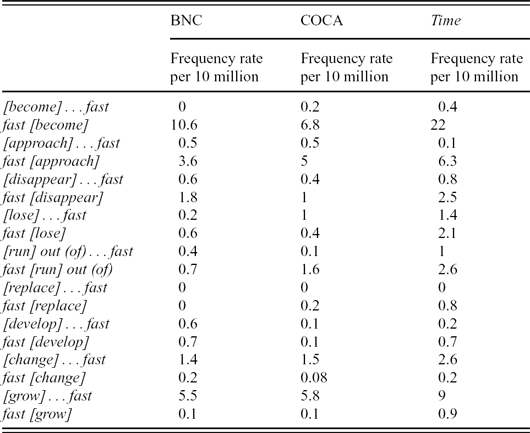
In tables 6 and 7 there are verbs that ‘prefer’ the fast [Verb] position (become, approach, disappear, replace) as well as those which are relatively neutral and are common in both locations (lose, run out, develop). The question that arises is whether there exist verbs which clearly tend to appear in the [Verb]. . .fast position. If this were the case, it might be an indication of a lexically determined variation between the two patterns. The bottom sections of tables 6 and 7 present two such verbs. Postverbal fast is clearly preferred with change and grow, even when only co-occurrences with present participle forms are taken into consideration.
To conclude this section, we have seen again that preverbal fast is closely associated with the verbs become, approach and disappear in the sense that the preposed position is far more common than postposed, especially so in the case of become and approach. Other verbs are fairly neutral with regard to the positioning of the adverb (lose, run out, develop) and still others favour the [Verb]. . . fast location (change and grow).
6 Heavy complements
The linear positioning of sentence constituents has been shown to be influenced by their relative length or weight so that, in languages like English, longer constituents tend to follow shorter ones (see Quirk et al. 1985: 565; Hawkins Reference Hawkins2004). As has been argued, such ordering is cognitively more efficient and maximizes the ease of production and processing (parsing) (see Hawkins Reference Hawkins2004). This has been shown to be the case with regard to subordinate adverbial clauses (Gibson Reference Gibson, Marantz, Miyashita and O'Neil2000; Diessel Reference Diessel2005; Wiechmann & Kerz 2013). With reference to noun phrases (NPs), Firbas (Reference Firbas1966) and Stallings & MacDonald (Reference Stallings and MacDonald1998) add that heavy NPs are shifted to the end of the sentence because they tend to contain more new information than short NPs, which is in keeping with the favoured given–new ordering of information in English, i.e. the increase of informativeness at the end of clauses/sentences.
Such processing-related factors of grammatical weight are also to be considered in adverb placement. According to Ernst (Reference Ernst2002: 227, 230), the preferred order is of increasing weight to the right (Heavy Template). This increases the acceptability of alternative positions of adverbs resulting from Heavy Shift, as in (22)–(24) (data from Ernst Reference Ernst2002: 231):
(22) ?Lou had extremely quickly arrived.
(23) Lou had arrived extremely quickly.
(24) Lou had extremely quickly devised a new way to get the products to market.
As can be seen, the positions of the AdvP extremely quickly are assigned varied degrees of acceptability, depending on the weight of the AdvP relative to that of the VP. The AdvP is relatively heavy compared to the VP in (22) and (23), and therefore preferred postverbally, but relatively light in (24) and thus acceptable preverbally.
The analogous question in our discussion of fast is how its positioning is influenced by the heaviness of co-occurring sentence constituents. We will first consider nominal complements of transitive verbs. As may be expected, preverbal fast is used more often with relatively heavy complements, which allows speakers/writers to accommodate heavy NPs without having the adverb stranded too far away from the verb (25). In contrast, postverbal fast typically co-occurs with light complements of verbs (adjectival in (26)) and the only fairly heavy one found was that in (27).
(25) Entertainment is fast becoming an incentive to learn English and to become immersed in American culture. (COCA)
(26) Often those who go public become rich fast, generating a new class, ‘the working rich’. . . (COCA)
(27) . . . and we, you know, really became pretty educated on it fast. (COCA)
The verb lose, which generally seems to be roughly as frequent with preverbal as it is with postverbal fast (see table 6), shows a similar inclination: [lose]. . .fast co-occurs with light complements (one- or two-word NPs) (28), but fast [lose] is often followed by heavy complements and occasionally with additional adjuncts (29):
(28) . . . a local hairdressing salon which is losing money fast. (BNC)
(29) It was Horton that was fast losing its supply of ‘new entrants’ with the opening of St Charles Psychiatric Unit in Kensington, . . . (BNC)
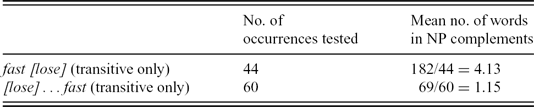
To quantify this observation, table 8 gives measures of heaviness of NPs complementing fast [lose] and [lose]. . . fast. These measures are expressed as mean numbers of words making up NP complements. For example, in sentences (28) and (29) the numbers of words in the NP complements are 1 (money) and 5 (its supply of ‘new entrants’) respectively. The measures of heaviness are calculated by summing the words constituting NP complements and dividing by the number of occurrences. Lose is selected because its occurrence with fast is distributed fairly evenly between the two adverb positions. As can be seen in table 8, preverbal fast facilitates the accommodation of longer phrases: they are, on average, 3.59 times longer than those used with postverbal fast.
Measures of heaviness for NP complements of lose
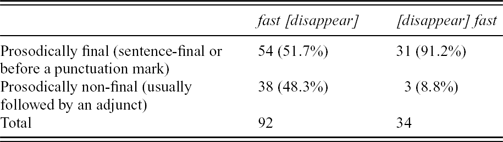
As for intransitive verbs such as disappear, similar constraints seem to hold as far as accompanying adjuncts are concerned. In many cases, fast [disappear] co-occurs with a following adjunct (example (30)). In contrast, [disappear] fast typically ends a sentence (example (31)). In our sample, out of 34 occurrences of [disappear] fast, 26 are sentence-final; in 5 others the string marks the end of a syntactic unit and is set off prosodically from the rest of the sentence and with a comma in writing (32), leaving the adverb in positions where it is foregrounded and can be stressed (see section 8 for a discussion of foregrounding and backgrounding). In turn, the string fast [disappear] supports further development of a sentence more felicitously and, as a result, is less frequently found sentence-finally (see table 9). The difference in proportion in table 9 is statistically significant in the chi-square test (with Yates's correction for continuity; p < 0.002).Footnote 5 The sentence/clause-final appearance of postverbal fast is also typical with other accompanying verbs.
Final and non-final fast [disappear] and [disappear] fast
(30) . . . the knowledge needed to farm well is fast disappearing with the death of the older generation of farmers. . . (COCA)
(31) But this earthly paradise is disappearing fast. (COCA)
(32) But those jobs are disappearing fast, and a high school diploma is becoming crucial for any type of employment. (COCA)
The pattern with disappear is reminiscent of the contrast between preverbal and postverbal fast co-occurring with transitive verbs, of which the former position allows for heavier nominal or adjectival complements. So the preverbal position in both transitive and intransitive uses allows speakers/writers to accommodate longer chunks of language, i.e. heavier nominal or adjectival complements of transitive verbs, or adjuncts following intransitive verbs with additional information.
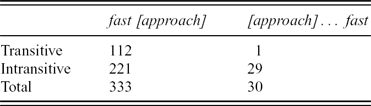
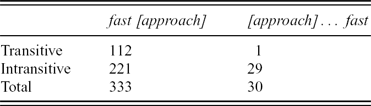
The verb approach, which can be either transitive or intransitive, enters similar syntactic patterns. As noted above, the verb has a strong preference for preverbal fast (see tables 6 and 7). This association is perhaps strengthened still more when approach is used transitively: in the three corpora there is only 1 occurrence of transitive [approach]. . .fast (we're approaching Germany fast) but 112 transitive uses of fast [approach] (e.g. the debt is fast approaching its legal limit). When heavier NPs are involved, the preverbal position brings an obvious advantage in terms of processing/production constraints.
The intransitive use of approach in combination with fast (the deadline is fast approaching/approaching fast) is not as restricted to the preverbal position. The lack of complements means that the clumsiness of locating the verb and the adverb too far apart is no longer a liability. Thus, although the string [approach]. . . fast has only 1 example of transitive use in our corpora, there are 29 examples of intransitive use. The relevant frequencies for transitive and intransitive uses are presented in table 10. The correlation in table 10 is statistically significant in the chi-square test (p < 0.002).
Transitivity of fast [approach] and [approach]. . .fast
The abundance of heavy NPs with preverbal fast is akin to another phenomenon – so-called heavy NP shift – whereby heavy NPs are moved to the right of their canonical positions in order to facilitate processing, e.g.:
(33) Physical Sciences Division was renamed Technical Information, to reflect better the requirements of industrial users and the services that the SSL planned to offer. (BNC)
The outcome of this operation is that, in this particular example, the adverb better and the NP are in their non-canonical surface positions, and that the adverb is adjacent to the verb, just as is the case in preverbal fast. The difference is that heavy NP shift leaves better to the right of the verb and fast is preposed to the left of the verb. However, this positional contrast can often be neutralized: better may be brought to the left of the verb in a manner similar to that of preposing fast, as in (34) and (35):
(34) Physical Sciences Division was renamed Technical Information, to better reflect the requirements of industrial users and the services that the SSL planned to offer.
(35) Synthesizers are fast replacing musicians in theaters, clubs and even opera houses. (COCA)
In this way, heavy NP shift and preverbal positioning of adverbs such as better and fast may co-occur in similar syntactic circumstances and co-produce a similar effect.
We have shown that better and fast can be moved in the same way to the position immediately preceding the verb. Obviously, they also share the canonical VP-final position. Additionally, another similarity is that fast may also appear to the right of the verb ((37) and (38)) – the position in which we have seen better after heavy NP shift has occurred (36):
(36) a desire to understand better the behaviour and movements of wild birds and animals (BNC)
(37) He is said to be recovering fast from multiple gunshot wounds suffered as he tried to escape the strike force of Pakistani security officers. (Time)
(38) The dozen miles between Port Angeles and Sequim were turning fast into a continuous strip of car dealerships, chain drug and hardware stores . . . (COCA)
In (37) and (38) fast immediately follows the verb, as a result not of NP shift, but of PP shift (from multiple gunshot wounds. . . and into a continuous strip. . .); however, the two mechanisms are analogous in their operation. It is noteworthy that fast is observed here in yet another surface structure position – postverbal but pre-complement – in addition to the preverbal and VP-final positions. Evidently, it is not completely restricted to its standard VP-final position, as is widely maintained (see the references cited in section 1). Of the three positions, this pre-complement position is the rarest: in our corpora it is limited to a few PP complements and more commonly found with PP adjuncts (no NP complements have been found). Let us illustrate all three locations of fast with one and the same phrasal verb close on:
(39) I leaned over the captain's glass cabin and saw them: three speed-boats, closing on us fast. (COCA)
(40) . . . an ardent competitor closing fast on a front runner who prefers to go down in style rather than. . . (Time)
(41) China's stock market is Asia's third largest in terms of market capitalization and is ‘fast closing on Hong Kong’ for the rank of second largest, according to . . . (COCA)
The three locations of fast in (39)–(41) may be contrasted as follows. The first is the standard VP-final position; the second is a result of (heavy) complement shift; and the third is the preverbal position that (a) may prove felicitous in accommodating heavy complements and (b) may be associated with a semantic difference compared to postverbal occurrences. Such different semantic readings of pre- and postverbal occurrences are the focus of the next section.
7 Semantics
Manner adverbs have been shown to be a heterogeneous class including distinct subtypes, including ‘pure manner’ adverbs, which are invariably associated with the manner reading, as well as manner/clausal adverbs, which can have a manner or clausal interpretation (Ernst Reference Ernst1984, Reference Ernst2002; Cinque Reference Cinque1999; Schäfer Reference Schäfer, Dölling and Zybatow2001; Eszes Reference Eszes and Kiss2009). The manner/clausal ambiguities of adverbs are well researched and are illustrated below:
(42) Alice has answered the questions cleverly.
(43) Alice cleverly has answered the questions.
(44) Alice has cleverly answered the questions.
Sentence (42) means that the answers were clever (a manner interpretation). Sentence (43) means that the fact (perhaps Alice's decision to give an answer) of giving an answer was clever, although the answers themselves may have been stupid. Sentence (44) is ambiguous between the two interpretations of the first two sentences (Ernst Reference Ernst2002: 42). Many manner adverbs (e.g. rudely, abruptly, roughly) have both readings and this may be due to the fact that they allow extended, often metaphorical, usage (the data from Ernst Reference Ernst2002: 88).
(45) Kim sang quietly.
(46) Kim quietly had gone home to think it over. (quietly = unobtrusively)
On the other hand, pure manner adverbs (e.g. loudly, brightly, tightly) are unable to have a clausal meaning; one of their characteristics is that they are strictly related to the event they describe and often require an event involving purely physical manifestations such as light or sound (as with loudly) (Ernst Reference Ernst2002: 87).
(47) Ken had spoken loudly.
(48) *Ken loudly had spoken.
As can be seen in examples (42)–(48), a pure manner reading is associated with the position following lexical verbs (Haumann Reference Haumann2007: 129), a manner/clausal readingFootnote 6 – with the preverbal position. The clausal readings can be of various semantic types: Ernst's (Reference Ernst2002) example Kim quietly had gone home to think it over is labelled by Schäfer (Reference Schäfer, Dölling and Zybatow2001) as representing a mental attitude reading, She gracelessly had ignored them – an evaluative reading. On the other hand, quickly and slowly are said to yield a temporal or aspectual interpretation (Travis Reference Travis1988: 11; Cinque Reference Cinque1999: 104; Schäfer Reference Schäfer, Dölling and Zybatow2001: 256; Ernst Reference Ernst2002: 85) in the sense that the adverbs locate an event with respect to some reference time. Aspectual readings of slowly and quickly (also other aspect-manner adverbs such as suddenly and abruptly) correlate with preverbal positions (data from Ernst Reference Ernst2002: 85):
(49) Lynn raced down the hallway quickly. (manner)
(50) Lynn quickly raced down the hallway. (aspectual)
The subtle distinction between (49) and (50) is that (50) can be interpreted as suggesting that Lynn began to race down the hallway quickly after some prior event (perhaps a command to fetch something) (Ernst Reference Ernst2002: 85). On such an interpretation quickly has an aspectual (temporal) reading and does not necessarily qualify the action of the verb.
Is it possible that pre- and postverbal occurrences of fast coincide with the same pattern of interpretational differences? Eszes (Reference Eszes and Kiss2009) and Schäfer (Reference Schäfer, Dölling and Zybatow2001) assume that the temporal meaning of quickly is metaphoric and that we may predict that similar interpretational possibilities are unavailable to fast. They illustrate this claim with the unacceptability of two sentences:
(51) *John fast lifted his arm. (Eszes Reference Eszes and Kiss2009: 272)
(52) *She fast ran away. (Schäfer Reference Schäfer, Dölling and Zybatow2001: 259)
Eszes (Reference Eszes and Kiss2009: 272) concludes that ‘the adverb fast, a word which is close in meaning to quickly, lacks the temporal (aspectual) meaning and cannot occur preverbally’. We have seen above that fast does occur preverbally, also with finite verb forms similar to those in (51) and (52), as in (53) and (54):
(53) The legislation fast became a social and philosophical lightning rod . . . (COCA)
(54) The ‘celebratory drink’ fast developed into a full-scale party . . . (BNC)
The unacceptability of (51) and (52) is not because fast does not occur preverbally, but because preverbal fast is disfavoured or unacceptable in these particular sentences. Quickly, unlike fast, is acceptable pre- and postverbally in (51) and (52), showing that fast is more restricted preverbally. Factors that collectively disfavour preverbal fast in the two sentences include those discussed above, i.e. the type of co-occurring verbs (lift and run), aspect (finite verb forms) and the lightness of the respective VPs. Another problem in (52) is the usage of run: fast is followed by the verb used in its basic sense, while in the three corpora preverbal fast only occurs with the verb's usage of ‘run out (of)’, i.e. the preverbal position is only attested in the extended usage of the verb. Consider the acceptability of (55):
(55) . . . but I'm fast running out of time. (COCA)
In this usage, the temporal dimension of events is clearly important, suggesting different semantic readings involved in the placement of fast. The question that will now be considered is whether fast can have temporal/aspectual interpretations similar to those of quickly. Let us review the following extracts:
(56) . . . he screamed, the crew fast came shouting and grabbed canvas and threw it over him and rolled him in it to suffocate the flames (COCA)
(57) Yes, it was a weekend out in the woods, and it employed symbols from other cultures that could, to cynical outsiders, seem hokey and pretentious. The truth is that men came away from that weekend with their lives changed. Men who were lost or stuck or heading nowhere fast came out of the weekend with newfound power, direction, focus, and spirituality. (COCA)
(58) A lack of trust of the education system on the part of the parents was listed as one of these problems. This mistrust, fast brought on during the days of desegregation, has been reinforced by the overrepresentation of African- American students in special education classes. (COCA)
Example (56) above is similar to example (50) with quickly in that fast can indicate a quick succession of two events, i.e. the appearance of the crew very soon after the man had screamed. In other words, fast is likely here to qualify the time elapsed between the scream and the appearance of the crew rather than the speed with which the crew were moving. Similarly, in (57) and (58) fast may be interpreted aspectually. All three examples represent the relatively rare co-occurrences of preverbal fast and finite verbs (see section 4). Let us turn to temporal readings of fast in the environment of progressive aspect. Note the temporal readings of preverbal fast with depart, descend and turn in (59), (61) and (63) and the spatial or speed-related uses in the postverbal position in (60), (62) and (64).
(59) We are fast departing a time when progress can be measured by GDP or any other simple tally of what the economy produces. (COCA)
(60) By 1950 or so most of the horse and mule teams would have departed from the country. The men and women who had known only the old ways were departing fast. (COCA)
(61) With winter fast descending on Russia's Arctic north, government officials say efforts to raise the Kursk . . . (COCA)
(62) We're a hundred feet off the ground and descending fast toward a meadow rimmed by mountains. (COCA)
(63) The evening, which had started out with such promise and optimism, was fast turning into an unmitigated disaster. (COCA)
(64) As soon as you see the windmill with its canvas sails turning fast, people will be so fascinated that . . . (COCA)
As can be seen in examples (59), (61) and (63), the temporal dimension of events is emphasized and extended usages of verbs are used. Fast [turn] is not found in the corpora in the sense of ‘move by turning’ and only the string [turn]. . . fast carries this meaning. Fast [turn] is only found in the sense of ‘turning/transforming into something’ (18 such occurrences in all three corpora). In this usage, the temporal dimension is often important, as in (63). To conclude, preverbal fast can have aspectual/temporal interpretations similar to those of the adverb quickly. These interpretations are linked to the preverbal position, which constitutes another factor in selecting between the initial and the final position.
We now turn to consider in more quantitative terms a semantic pattern involving the adverb fast and the verb approach, in which the choice of either the preverbal or postverbal position has significant semantic implications. Namely, spatial and temporal uses of approach seem to correspond neatly to the two structural positions in that temporal readings are to be expected with the string fast [approach] (65) and spatial readings are more commonly associated with [approach]. . . fast (66).
(65) With a deadline fast approaching, he is madly trying to buff up his term paper on John Updike. (COCA)
(66) Undecided and still bent over towards her he became aware of the patter of running feet, approaching fast. (BNC)
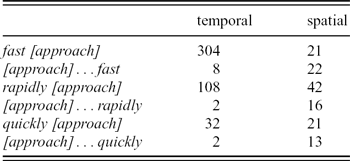
This syntactico-semantic pattern is clearly seen in corpus data: in 334 occurrences of fast [approach] only 21 referred to physical approximation while the rest were either temporal (304 occurrences) or point-on-a-scale uses (e.g. fast approaching its legal limit) (9 occurrences). Conversely, in 30 occurrences of [approach] . . . fast, 22 were spatial and 8 were temporal uses. The same pattern is observed for rapidly [approach] and [approach] . . . rapidly, and quickly [approach] and [approach] . . . quickly. It seems that it is placement that dictates temporal or spatial readings of leftward and rightward adverbs respectively. Table 11 gives the relevant frequencies for fast, rapidly and quickly. For all three adverbs the differences in proportion are statistically significant: for fast in Fisher's exact test (p < 0.0001)Footnote 7 and for rapidly and quickly in the chi-square test (p < 0.0001 for rapidly and p < 0.001 for quickly).
Temporal and spatial readings of approach
It would be difficult to account for this pattern in the same structural terms of scope that have been proposed in the literature to explain subtle semantic differences associated with adverb placement. Let us review one such example. Adger & Tsoulas (Reference Adger, Tsoulas, Austin, Engelberg and Rauh2004: 49) and Thomason & Stalnaker (Reference Thomason and Stalnaker1973: 200) note that preverbal manner adverbials may have a different interpretation from postverbal ones. Both texts cite the same examples to illustrate the difference:
(67) He has been [slowly testing] some bulbs.
(68) He has been [testing some bulbs] slowly.
In (68) the interpretation is that each particular test was slow, whereas this may not necessarily be the case in (67). In (67) slowly has scope over the entire event thus implying that the entire process of testing was slow, although it is possible that a few bulbs were in fact tested quickly. In structural terms, in (68) the adverb modifies the entire VP, including the object some bulbs, whereas in (67) the adverb modifies the verb directly allowing for a distinct interpretation, as indicated by the square brackets. Admittedly, such semantic differences involving manner adverbials are subtle, and Thomason & Stalnaker (Reference Thomason and Stalnaker1973: 200) admit that in many cases there seems to be no difference.
To compare this type of semantic difference with our examples (65) and (66) involving fast, one observes that alternative semantic interpretations are likely to occur for different reasons: in (67) and (68) meaning nuances are attributable to the semantic scope that slowly has over other sentence constituents (i.e. modifying the verb or entire VP), which influences interpretation accordingly. In contrast, in (65) and (66) the difference between the temporal and the spatial uses cannot be simply accounted for in scopal terms. Note that in both sentences (65) and (66) approach is used intransitively with no extra constituents over which the adverb might extend its semantic scope. Nor do there seem to be any different scope readings in sentences in which approach is used transitively:
(69) Lacy is (fast) approaching his 50th birthday (fast) and scooped the bronze medal in the veteran class. (preverbal in BNC)
Differences of scope are irrelevant here; instead, spatial and temporal readings of approach are closely associated with adverb placement, and quantitative analysis suggests that this semantico-syntactic pairing is notable. An interesting observation to make is that the pairings spatial–postverbal and temporal–preverbal are in line with the more general pattern discussed in this section that preverbal adverb positions can have non-manner clausal readings.
8 Pragmatics
As has been noted, the postverbal position has the pragmatic effect of foregrounding a manner adverb, while preverbal adverbs carry backgrounded information (see Ernst Reference Ernst2002: 272–73; Haumann Reference Haumann2007: 100, 131). Consider (70) and (71) from Ernst (Reference Ernst2002: 15):
(70) Carol had roughly handled the pots.
(71) Carol had handled the pots roughly.
The ordering in (71) represents the preferred pattern of marking prominence in an English sentence, in which rightward constituents are taken to carry new/prominent information. This is the case in (71). Ernst (Reference Ernst2002: 15) observes that adverbs are most felicitously used when they are an important part of an assertion. This is coupled with phonological foregrounding of the postverbal position by means of stress, while preverbal adverbs are not normally stressed. Thus (70) is marked in that it does not follow the pragmatic tendency to foreground the adverb. Speakers tend to prefer the unmarked ordering of (71), but the adverb position in (70) may have a discourse-related advantage when backgrounding the adverb is welcome.
Nuances of backgrounded/foregrounded use are often detected more easily in broader textual context. Ernst (Reference Ernst2002: 272) offers a piece of fiction. In the original excerpt (72), a lawyer interviews a secretary whose boss has been murdered and he recommends she put a note on the door of her office.
(72) The man from the Florida Bar shut his briefcase and crisply snapped the brass locks. ‘We recommend “Death in the family.” Most clients won't press the issue.’ (Carl Hiaasen, Strip Tease, 231)
(73) The man from the Florida Bar shut his briefcase and snapped the brass locks crisply. ‘We recommend “Death in the family.” Most clients won't press the issue’
Ernst notes that the narrative function of the first sentence is to indicate that the interview is over – this is communicated in the shutting of the briefcase and the snapping of the locks – crisply is merely there for extra description. The modified phrasing of (73) with the foregrounded adverb is, in Ernst's words, less felicitous, due to the unneeded emphasis on the manner of closing the locks. In other words, for the purpose of the narrative in this particular example, the marked order of (72) is the preferred option.
Similar patterns can also be seen in the placement of fast. Consider the respective backgrounding/foregrounding effects in (74) and (75):
(74) Drowsy, he went into his room and slept. Soon after he was roused. From then till the early hours of the morning when the moon was fast disappearing, he did not sleep again. Sleep had vanished from his eyes and refused to return. (COCA)
(75) Although the Amazon forest cloaks an area as big as the United States east of the Rockies, it was then largely unknown to the public, both in the North and in Brazil itself. It was one of the world's few remaining frontiers, but it was disappearing fast. During the September burning season that year, satellites recorded more than 8,000 places across Amazonia where fires glowed. With the Amazon burning, and with record-setting heat that summer around the world, the notion was finally beginning to emerge that humans were altering the dynamics of the atmosphere and climate. (COCA)
Again, in longer spans of text, the varied prominence of fast in discourse is detected more clearly. In (74) the speed with which the moon was disappearing is rather unimportant and constitutes extra description in the narrative; the preverbal adverb position is therefore used for the backgrounding effect. In (75) the speed with which the Amazon rainforest is disappearing is the main point of the passage – consequently, fast is foregrounded VP-finally and, additionally, sentence-finally, with a possibility of extra stress on it. In cases such as (76), involving repetition with new information added in the adverb, the postverbal location is distinctly more appropriate.
(76) . . . the U.S. is not winning. It is losing, and it is (?fast) losing (fast). (postverbal in COCA)
We have seen in this section that fast, like other adverbs, may occupy the preverbal or postverbal positions, as required by discourse considerations. The preverbal position is marked prosodically and pragmatically in that it is unstressed and backgrounded, while the postverbal position is canonical, stressed and foregrounded.
9 Conclusion
Authors such as Leech (Reference Leech1991), Halliday (Reference Halliday1991) and O'Keeffe et al. (Reference O'Keeffe, McCarthy and Carter2007) recognize the need to distinguish two kinds of grammars: deterministic and probabilistic. The former deals with rigid prescriptive rules that apply invariably in specified context (e.g. the indefinite article is an, not a, in front of words beginning with a vowel). The latter, on the other hand, concerns less rigid aspects of language structure, in which contexts of use may dictate what is likely to occur. When variant forms are available, probabilistic rules will specify which form is more likely in specific circumstances, and these circumstances need not be strictly linguistic in a traditional sense but may be, for example, related to dialectal differences, register, intended audience, emotive use of language, etc. Such likelihood may then be determined and expressed quantitatively, as has been done in this study. Probabilistic grammars require large amounts of text to substantiate their claims and for this reason corpora are best-suited for this kind of linguistics.
The present study is an example of this probabilistic approach to adverb placement. It has been observed that the chances of fast occurring preverbally are heavily dependent on several factors. Its occurrence is sensitive to register in that it is most often found in journalistic texts. The selection of the preverbal position is also lexically (co-) determined in that the vast majority of its occurrences are associated with three collocate verbs (become, disappear and approach). It is also strongly connected with the grammatical context of -ing verb forms, especially in the Present/Past Continuous tenses. When (heavy) verb complementation is involved, preverbal fast offers the advantage of keeping the verb and adverb together, which imposes less of a cognitive processing/production constraint. Similarly, with intransitive verbs, preverbal fast accommodates more extensive sentence structures (e.g. with adjuncts) whereas VP-final fast is overwhelmingly sentence-final or clause-final.
Finally, the genre-related, lexical and syntactic patterns are further compounded by pragmatic and semantic factors. Specifically, the two positions may be associated with different semantic readings, as in the case of the verb approach, which tends to be used with preverbal fast in its temporal meaning but with postverbal fast in its spatial meaning. Aspectual readings similar to those of quickly have also been noted. Also, discourse-related requirements may dictate either postverbal or preverbal position for the pragmatic effects of, respectively, foregrounding or backgrounding the adverb. In conclusion, our analysis shows that, although both positions are plausible in many cases, the factors mentioned above often dictate the selection of one preferred position over the other.
In a wider perspective, one may conclude that for adverbs commonly seen as strictly postverbal or VP-final a more refined analysis is necessary. We have examined the complex network of factors determining the placement of fast and concluded that it is certainly not restricted to VP-final position, but we have also noted similar non-canonical preverbal occurrences of well. Further studies of corpus data should enable us to discover other factors at play in the placement of well and other adverbs.