Introduction: why should we be concerned?
Falls are a major problem in frail older people on account of the associated morbidity, mortality, and cost to health services. The prevalence of falls in community-dwelling older people increases with age and dependency. Twenty-eight to 35% of those aged 65 or older fall each year,Reference Prudham and Evans1, Reference Blake, Morgan, Bendall, Dallosso, Ebrahim, Arie, Fentem and Bassey2 rising towards 50% in those over 85. Individuals living in long-term care institutions have higher rates still (mean 1.7 falls per bed per year),Reference Rubenstein3, Reference Gibson, Harden, Byles and Ward4 a falls rate up to three times the rate seen in community-dwelling older people.Reference Rubenstein, Josephson and Osterweil5 Eleven per cent of all falls result in serious injury, and 4% in fracture.Reference Rubenstein, Josephson and Robbins6 In addition, nursing home residents are estimated to be between fourReference Sugarman, Connell, Hansen, Helgerson, Jessup and Lee7 and elevenReference Butler, Norton, Lee-Joe, Cheng and Campbell8 times more likely to suffer a hip fracture than those living in the community.
Although fractures are often felt to be the major cause of morbidity and mortality following a fall, falls are often associated with significant psychological and physical morbidity. For example, 10–40% of admissions to acute hospitals following a fall are not due to a fracture.Reference Bradley and Pointer9, Reference Peel, Kassulke and McClure10 In addition, the post-falls anxiety syndrome is well recognized in which a lack of confidence and psychological fear of a further fall may in itself result in further fallsReference Delbaere, Close, Brodaty, Sachdev and Lord11 or results in down-regulation of activity levels leading to deconditioning, reduced activities of daily living and further falls and care home admission.Reference Cumming, Salkeld, Thomas and Szonyi12 An increased prevalence of post-traumatic stress disorder has recently been described in older people after a fall.Reference Chung, Kee and Austin13 It is therefore not surprising that it is estimated that around 40% of all care home residents have had falls as a contributing factor for their admission.Reference Dowswell, Towner, Cryer, Jarvis, Edwards and Lowe14
Falls are not only costly from a psychological and physical perspective, but also from a financial perspective. Carroll et al. estimate that falls in long-term care facilities cost US$6200 per resident per year.Reference Carroll, Delafuente, Cox and Narayan15 Fractures associated with falls cost the National Health Service in excess of £1.7 billion each year.Reference Torgerson, Iglesias and Reid16 There has been a recent systematic reviewReference Heinrich, Rapp, Rissmann, Bercker and Konig17 which suggested that between 0.85 and 1.5% of total health care expenditure was spent on fall-related costs in each of the USA, Europe and Australia.
The initial part of this review explores risk factors for and interventions to minimize falls in people in long-term care. Reducing falls and the associated low-impact trauma reduces injury and fracture rate, but equally important is attention to bone health that is addressed in the second part of this review.
Methodology
In order to focus on falls prevention in long-term care, we identified articles for inclusion by conducting a literature search of Medline, combining MESH headings ‘accidental falls’ and ‘residential facilities’. ‘Residential facilities’ are defined as ‘long-term care facilities which provide supervision and assistance in activities of daily living with medical and nursing services when required’. Relevant citations were also followed up and reviewed.
However, in reviewing the literature and the consideration of the application of their conclusions, it is important to be aware of the following possible confounding factors, which are further elaborated elsewhere.Reference Oliver and Masud18, Reference Oliver19 The definition of a fall may vary between studies, although most exclude events that are non-accidental or violent and require that the fall be unintentional. Others also exclude loss of consciousness. The preferred definition of a fall put forward by an expert body of opinion under the auspices of the ‘Prevention of Falls Network Europe (ProFanE) is ‘an unexpected event in which the participant comes to rest on the ground, floor, or lower level’.Reference Lamb, Jorstad-Stein, Hauer and Becker20 Care home facilities in different countries will not all be looking after the same the type of patient in spite of having similar names. In the UK, very few residents of nursing homes will ever be discharged home, but for example in one of the early studies into falls and risk of nursing home admission in the USA, 74 of the 133 patients admitted were discharged home.Reference Tinetti and Williams21 The interventions to reduce falls risk are likely to differ between types of care home, e.g. residential homes for patients with dementia who may be fully ambulant and whose sole medical problem is dementia compared with nursing homes with patients with multiple co-morbidities and very limited mobility.
The heterogeneity of ‘multifactorial’ interventions causes problems both in applying the intervention in practice and in analysing the relative contribution of each component of the intervention. This heterogeneity also makes interpretation of meta-analyses difficult. In addition, the American Geriatrics Society/British Geriatrics Society (AGS/BGS) Clinical Practice Guideline22 is one of only a few reviews which distinguish a ‘multifactorial’ intervention defined as ‘an intervention made up of a subset of interventions that are selected and offered to an individual to address the specific risk factors identified through a multifactorial fall risk assessment’ and a ‘multicomponent’ intervention: ‘a set of interventions addressing more than one intervention domain or category offered to all participants in a program’ (population approach). Lastly, trial design can be a problem with the possibility of recruitment bias reflecting the challenge of recruiting people with cognitive impairment who may not have capacity, problems with possible interactions between intervention and control patients in the same home or providing adequate allowance in statistical power for clustering.
For the above reasons it is important to understand that although an intervention described may not be universally applicable to a defined set of fallers, that intervention(s) may well reduce falls risk in an individual.
Risk factors for falls
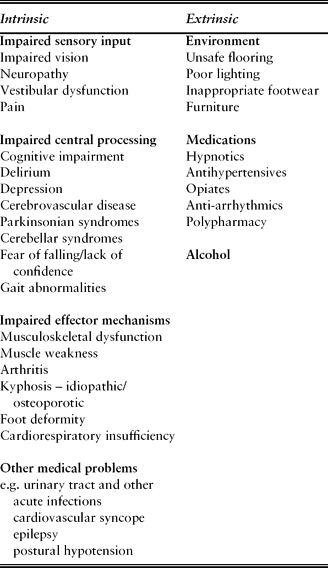
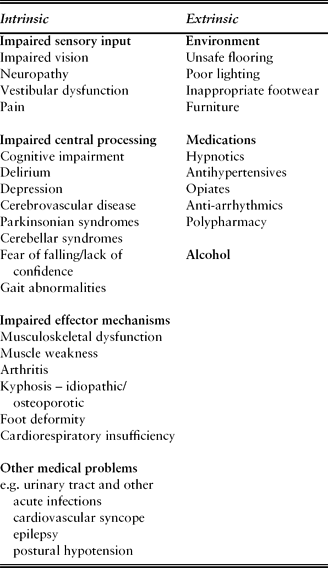
Most falls are multifactorial (Table 1). Over 400 separate risk factors for falls have been identified. These can be divided into those that are intrinsic or extrinsic to the individual at risk. The overall likelihood of falling results from the interplay of the two: an individual with high intrinsic risk may have his/her risk of falling lowered by modifying the environment (e.g. introduction of a second banister rail). Similarly a hazardous environment may prove too challenging for even the most sure-footed individual.
Some risk factors for falls
Identifying those at risk
As previously discussed, the incidence of falls in individuals living in long-term residential care facilities is greater than usual. This group can therefore already be considered ‘higher risk’ and could be considered an ideal group to consider for intervention.
Chen et al.Reference Chen, Sambrook, Simpson, Cameron, Cumming, Seibel, Lord and March23 showed that over a 2.6-year follow-up in institutionalized individuals, the rate of hip fracture was higher in older, lower body weight individuals who had no history of total hip replacement and who were able to walk. Individuals in lower dependency intermediate care hostels were more likely to fracture if they had worse balance, whereas individuals in higher dependency nursing homes were more likely to fracture if they had better balance. This may reflect the differing dependency and nursing support available in the two settings coupled with the propensity of the individual to mobilize. For instance, in the nursing home environment alternative transfer strategies and equipment may be used with individuals with poorer balance. Other independent risk factors identified included cognitive impairment, previous fracture since the age of 50, and longer lower leg length.
Lord et al.Reference Lord, March, Cameron, Cumming, Schwarz, Zochling, Chen, Makaroff, Sitoh, Lau, Brnabic and Sambrook24 have also suggested that even ‘nursing home’ residents as such cannot be thought of as a group with similar risk factors but need to be assessed according to whether they can stand unaided or not. Using this dichotomous classification they found that fall rates were highest in those who could rise from a chair but not stand unaided (81%) and lowest in those who could neither rise from a chair nor stand unaided (48%). Risk factors for falls differed between these two groups and from this they have produced a screening test described below (Delbaere et al.Reference Delbaere, Close, Menz, Cumming, Cameron, Sambrook, March and Lord25).
A screening test, such as the Timed Get-Up-and-Go Test (TUG)Reference Podsiadlo and Richardson26 is often used in the community as an important part of falls risk assessment – taking more than 15 s to rise from a chair, walk 3 m, turn, return to the chair and sit down is associated with impaired postural stability, gait and balance. However this conclusion is not supported by various studies in care homes:
• Nordin et al.Reference Nordin, Lindelöf, Rosendahl, Jensen and Lundin-Olsson27 found that staff judgement of their residents’ fall risk as well as a history of previous falls appeared superior to the TUG test, although a TUG score of <15 s was useful in ruling out a high falls risk.
• Meyer et al.Reference Meyer, Kopke, Haastert and Muhlhauser28 concluded that the application of a fall risk assessment tool in nursing homes in Germany did not result in a better clinical outcome than reliance on nurses’ clinical judgement alone, although it is important to note that both intervention and control clusters were given a structured information programme lasting 60–90 min on the importance of falls and best evidence strategy to prevent fall and fractures.
• Barker et al.Reference Barker, Nitz, Low Choy and Haines29 doubted the usefulness of four different risk assessment tools used in Australian residential care homes as they found that no tool had a higher predictive accuracy than the question, ‘has the resident fallen in past 12 months?’.
• Perell et al.Reference Perell, Nelson, Goldman, Luther, Prieto-Lewis and Rubenstein30 in an analytical review identified the TinettiReference Tinetti, Williams and Mayewski31 performance-orientated mobility assessment and Berg Balance TestReference Berg32 (amongst others) as useful tests in addition to the TUG. They did note, however, that the high risk of patients in an extended care setting meant they were all likely to score highly, whatever risk assessment method was used and postulated that it might be worth investing resources directly into falls prevention measures for all residents rather than screening in such settings.
Given the high prevalence of falls, ongoing attempts to design screening tools are still being met with limited success. Delbaere et al.Reference Delbaere, Close, Menz, Cumming, Cameron, Sambrook, March and Lord25 designed two different screening tools for use in residential care facilities: one for people who could stand unaided and one for people who could not. In those who could stand unaided, inability to stand on a foam mat or having two or more risk factors (from falls history, nursing home residence and incontinence) was associated with higher falls risk. For those who could not stand unaided, a falls history, polypharmacy (≥9 medications) or hostel residence was associated with higher falls risk. However, although these simple screening tools which were easy to apply were found to be useful in identifying the at-risk group, the authors admit that significant proportions of fallers were still not identified. It therefore appears that little has changed since OliverReference Oliver19 reviewed the evidence up to 2006 and concluded ‘that it would be better to focus on assessing each resident for the presence of common reversible risk factors. . .and reassessing them if they fall’.
Interventions to reduce risk of falling in long-term care
Attempts to modify falls risk factors to produce a reduction in fall rates have followed two paths. The first seeks to identify a risk factor and target that for a given individual, e.g. cataract surgery, pacemaker insertion, medication review. Such unifactorial approaches have a reasonable evidence base for community-living fallers.Reference Close33, Reference Gillespie, Robertson, Gillespie, Lamb, Gates, Cumming and Rowe34 The second aims to target a range of factors both intrinsic and extrinsic to an individual. Whereas significant reductions in one risk domain may only have a limited overall effect because of other limiting factors, a multifactorial approach and modest reductions in multiple risk domains might be expected to have a greater summative effect. Intuitively such multifactorial interventions might be thought to lend themselves better to ‘population’ risk reduction in long-term care settings.
Unifactorial interventions
Medication review
There is a high prevalence of polypharmacy in the care home population and it is well recognized that individuals on more medications are more likely to fall.Reference Leipzig, Cumming and Tinetti35 This could result from the larger number of co-morbidities necessitating the larger medication burden or the direct result of the drugs themselves and their interactions. No study has fully addressed this in a pure care home population but Lawlor et al.Reference Lawlor, Patel and Ebrahim36 in a study of over 4000 elderly women both in the community and in care homes confirmed that the prevalence of falling increased with increasing numbers of medications, as well as increasing with simultaneously occurring chronic diseases. However, the relation of polypharmacy with falling was lost when the data were adjusted for the number of chronic diseases found. Only two classes of drugs (hypnotics/anxiolytics, and antidepressants) were independently associated with an increased odds of falling in this study. Each class was associated with an increase of about 50% in the odds of falling, and each had a population attributable risk of around 5%.
Woolcott et al.Reference Woolcott, Richardson, Wiens, Patel, Marin, Khan and Marra37 also explored which medication classes were associated with increased falls risk. They found that in the total population, antihypertensives, antipsychotics, antidepressants, sedatives and hypnotics were all associated with an increased risk of falls. Beta-blockers and diuretics had no significant impact. In subgroup analyses of individuals in long-term care, the positive correlations that were seen in the total population were not maintained. The reason for this discrepancy was not clear but could possibly be related to the increased number of chronic diseases as found in the Lawlor et al.Reference Lawlor, Patel and Ebrahim36 study. The authors recognized the need for further studies with larger sample sizes from long-term care facilities. In the Delbaere et al.Reference Delbaere, Close, Menz, Cumming, Cameron, Sambrook, March and Lord25 study of patients in residential and sheltered care facilities, logistic regression analysis of the data only showed a falls risk when there were ≥9 medications.
While it is well recognized that the pharmacokinetics of drugs alters with increasing age, there is very little published work exploring differences in pharmacokinetics between community-living individuals and those living in long-term care facilities. Given that the requirement for long-term care is recognized as a marker of frailty, it would seem logical to assume that the pharmacokinetics of this population differs and might result in greater sensitivity to medication and increased susceptibility to side-effects. The inferred conclusion would be that this population might benefit most from increased attention to prescribing and frequent medication reviews.
Zermansky et al.Reference Zermansky, Alldred, Petty, Raynor, Freemantle, Eastaugh and Bowie38 demonstrated that a pharmacist-led medication review of 315 patients in care homes resulted in a significant reduction in number of falls (reduced by 38%, P < 0.0001) in the intervention group compared with standard care (330 patients) with a 25% reduction in hospital admissions (P = 0.11). The total number of medications in the two groups was the same; the pharmacist not only stopped drugs (a third were psychotropics/sedatives) but also started drugs (60% of which were calcium and vitamin D preparations). However, permanently stopping drugs is not always easy and the Zermansky study only covered a 6-month period. Although in community-dwelling subjects Campbell et al.Reference Campbell, Robertson, Gardner, Norton and Buchner39 obtained a 66% reduction in the risk of falling at 44 weeks after withdrawal over a 3-month period of psychotropic medication (benzodiazepines and antidepressants), 81% of the patients had re-commenced their psychotropics within a month of the end of the study.
Orthostatic hypotension
Syncope and associated falls are well recognized sequelae of orthostatic hypotension. Older people have multiple risk factors that may predispose them to postural decreases in blood pressure including, for instance, multiple medications, impaired sympathetic response, diabetes, cerebrovascular disease and relative hypovolaemia. Ooi et al.Reference Ooi, Hossain and Lipsitz40 confirmed in their study that orthostatic hypotension is an independent risk factor for recurrent falls among elderly nursing home residents.
Aronow et al.Reference Aronow and Ahn41 demonstrated that even the relatively ‘minor’ stressor of eating a meal may result in significant decreases in postural blood pressure. They also showed that individuals with histories of falls or syncope had significantly larger post-prandial postural decreases in blood pressure when compared with residents who had not fallen. Le Couteur et al.Reference Le Couteur, Fisher, Davis and McLean42 confirmed these findings and identified selective serotonin re-uptake inhibitors (SSRIs), antipsychotic medication and a history of smoking as risk factors for a low post-prandial systolic blood pressure.
Unfortunately there is a lack of prospective outcome data to show that reducing orthostatic hypotension in individuals in long-term care reduces the incidence of falls. The AGS/BGS guideline, however, advocates addressing postural hypotension as part of a comprehensive falls risk assessment.
Vitamin D
Vitamin D (D3 – colecalciferol, 25OD) is predominantly produced in the skin, with only a small (<10%) contribution from dietary sources (mainly oily fish). Production in the skin requires adequate sunlight (UVB) exposure – approximately 20 minutes of daily noonday summer sun is estimated to provide around the equivalent of 1000 iu of vitamin D.43 It is thus not surprising that vitamin D deficiency is commonly found in care home residents, with the last Health Survey for England showing one-third of the over-65-year-old residents having a 25-hydroxyvitamin D level of <25 nmol/l.Reference Hirani and Primatesta44 This level, defined by most authorities as ‘deficiency’, is often associated with histological evidence of the bone changes of osteomalacia,Reference Heaney45 a raised PTH level resulting in bone loss, and is in accordance with Department of Health recommendations.46 Similar rates are found even in countries with a sunny climate, e.g. Australia where in one studyReference Flicker, Mead, MacInnis, Nowson, Scherer, Stein, Thomasx, Hopper and Wark47 45% of nursing home residents suffered vitamin D deficiency. This prospective study also showed a relationship between vitamin D deficiency and falls in older women in residential care, which remained despite adjustment for walking ability and frequency of outdoor exposure. This association was, however, lost in the more disabled nursing home residents.
It is a misconception that vitamin D is solely involved in calcium homeostasis. The role of vitamin D in avoiding a vitamin D deficiency myopathy is increasingly apparent.Reference Prabhala, Garg and Dandona48 Symptoms are variable and often not recognized (possibly not present) in frail older people, but include diffuse skeletal pain and weakness, with a bias towards proximal muscles. The commonest manifestation is weakness of extension, flexion and abduction of the hip and ensuing difficulties in rising from a chair. These clinical findings have been corroborated with electromyograms.Reference Skaria, Katiyar, Srivastava and Dube49 Muscle biopsies of vitamin D-deficient individuals show atrophy of type II muscle fibres. These are the first to be recruited in strong, sudden movements such as those required to prevent falling.Reference Pfeifer, Begerow and Minne50 Vitamin D supplementation can reduce body sway, improve musculoskeletal function and thereby reduce falls risk.Reference Bischoff, Stähelin, Dick, Akos, Knecht, Salis, Nebiker, Theiler, Pfeifer, Begerow, Lew and Conzelmann51, Reference Pfeifer, Begerow, Minne, Abrams, Nachtigall and Hansen52
A recent studyReference Broe, Chen, Weinberg, Bischoff-Ferrari, Holick and Kiel53 showed that only higher doses (800 iu) of vitamin D were effective in falls reduction in care home patients. Recent meta-analyses of studies in community-dwelling and institutionalized older adults suggest that doses of vitamin D between 700 and 1000 iu a day achieving serum 25-hydroxyvitamin D concentrations of >60 nmol/l reduced the risk of falling in older individuals by 14Reference Kalyani, Stein, Valiyil, Manno, Maynard and Crews54 to 19%.Reference Bischoff-Ferrari, Dawson-Hughes, Staehelin, Orav, Stuck, Theiler, Wong, Egli, Kiel and Henschkowski55
This benefit can also be seen in residential care settings. Flicker et al.Reference Flicker, MacInnis and Stein56 showed that supraphysiological doses of between 7000 and 10,000 iu of vitamin D (D2 – ergocalciferol) taken weekly with calcium supplementation resulted in an incident rate ratio for falling of 0.73 compared with controls. This study excluded for ethical reasons individuals who were severely vitamin D deplete (<25 nmol/l), with the majority being in the ‘lower-half’ of the laboratory reference range (25–90 nmol/l). In spite of this evidence of benefit, only between 27.4%Reference Mayes, Walker and Bayly57 and 36.5%Reference Hippisley-Cox, Bayly, Potter, Fenty and Parker58 of individuals living in residential or nursing care have evidence of current treatment with a combined calcium and vitamin D preparation.
As to whether there is a need for calcium supplementation in addition to vitamin D is now controversial, especially in light of the recent meta-analysisReference Bolland, Avenell, Baron, Grey, MacLennan, Gamble and Reid59 suggesting an increased in risk of myocardial infarction with calcium supplementation alone. However, none of the trials had cardiovascular end-points as their primary end-points, data on cardiovascular events were not gathered in a standardized manner and trials with added vitamin D were excluded from the study. In addition, the Women's Health Initiative study using 400 U of cholecalciferol with 1 g of calcium had cardiovascular events as a secondary outcome and showed no excess of cardiovascular events,Reference Hsia, Heiss, Ren, Allison, Dolan, Greenland, Heckbert, Johnson, Manson, Sidney and Trevisan60 so it is possible that vitamin D may have a protective effect. This conclusion is supported by a recent meta-analysis of vitamin D supplementation, which showed a reduction in all-cause mortality (0.93, 95% confidence interval, 0.87–0.99) with the risk being unaffected by the addition of calcium supplementation.Reference Autier and Gandini61 In one meta-analysis a post-hoc sub-group analysis was performed which favoured adjunctive calcium therapy versus none resulting in a 14% lower falls risk.
Thus with regard to vitamin D as an intervention to prevent falls in care homes, both the AGS/BGS guidelines and the Cochrane review recommend vitamin D supplements of at least 800 U/day for care home residents. Attempts to simplify this daily regime by giving bolus doses of vitamin D have generally not been successful when given to a care home populationReference Malcolm Law, Withers, Morris and Anderson62 and a recent study,Reference Sanders, Stuart and Williamson63 admittedly in a community-dwelling population, which gave a mega-dose of 500,000 international units of vitamin D3 orally yearly resulted in an apparent increase in both fracture and falls rates.
Continence
Urinary incontinence is a risk factor for falling. Chiarelli et al.Reference Chiarelli, Mackenzie and Osmotherly64 found that the association was greater with urge incontinence (odds ratio 1.5, 95% CI 1.4–1.7) and mixed incontinence (odds ratio 1.9, 95% CI 1.7–2.2) than with stress incontinence alone (odds ratio 1.1, 95% CI 1.0–1.2). Hasegawa et al.Reference Hasegawa, Kuzuya and Iquchi65 confirmed that incontinence remains an independent risk factor for residents in long-term care. Unfortunately intervention data are limited and this is an area that warrants further work.
Visual acuity
Poor vision does increase the risk of falling.Reference Ivers, Cumming, Mitchell and Attebo66 Harwood et al.Reference Harwood, Foss, Osborn, Gregson, Zaman and Masud67 showed that expediting cataract surgery in community-dwelling older people resulted in a 34% reduction in the rate of falls and in improved vision. This effect was not increased with second eye surgery. Whether this effect would be also found in care home patients has yet to be proved, although it would make logical sense especially in fitter, more mobile residential patients. However, a small study of vision-enhancing interventions, including cataract surgeryReference Elliott, McGwin and Owsley68 improved vision-targeted quality of life measurements, but did not lead to any short-term improvements in physical function in older American nursing home residents. An Australian community studyReference Cumming, Ivers, Clemson, Cullen, Hayes, Tanzer and Mitchell69 concluded ‘in frail older people, comprehensive vision and eye assessment, with appropriate treatment, does not reduce, and may even increase, the risk of falls and fractures’.
It should be noted, however, that even without correction of vision, falls can still be prevented in patients with severe visual impairment. In their study, La Grow et al. show that the intervention of an occupational therapist (OT) reduced falls (both indoors and outdoors) by 60% as a sole intervention, with the authors concluding that it was the individual advice given by a trained OT on safe activity which was the most important component.Reference La Grow, Robertson, Campbell, Clarke and Kerse70
Bedrails
Bedrails are in common use in both hospital and nursing home settings. The rationale for their use is to try and prevent the 1 in 4 falls that occur from bed. In their systematic review, Healey et al.Reference Healey, Oliver, Milne and Connelly71 were unable to find any randomized controlled trials and acknowledged the weak methodological quality of many studies in this field. Furthermore they identified that the evidence base is further confounded as the use of bedrails is already embedded in practice. Considering these limitations they concluded that serious direct injury from bedrails is usually related to outmoded design or incorrect assembly, that bedrails do not appear to increase the risk of falls or injury from falls and there is some suggestion they may reduce risk of falling. Ethical concerns about the use of bedrails persist and whether their use constitutes an inappropriate deprivation of liberty should be assessed on a case-by-case basis.
Nutrition
Malnutrition impairs muscle protein synthesis and may well accelerate the development of sarcopenia with the resultant increase in falls.Reference Vellas, Conceicao, Lafont, Fontan, Garry, Adoue and Albarede72 Only two studies have been published on the effect of nutritional supplements on falls rates, one for older malnourished people receiving care at homeReference Gray-Donald, Payette and Boutier73 and the otherReference Kenkmann, Price, Bolton and Hooper74 a cluster study in residential homes where malnutrition is known to be common. There was a 21% reduction in falls in the community group and there was a statistically non-significant 24% relative reduction in residential falls in intervention homes compared with control homes. The former intervention consisted of protein-dense high-energy supplement, whereas the latter intervention was multi-component, including the ready availability of snacks, greater food choice, extended dining room opening times, etc.
Flooring
An overview of flooring as an intervention concluded that higher quality research was needed to identify the most appropriate materials for use.Reference Drahota, Gal and Windsor75
Structured exercise programmes
Evidence exists to show that structured exercise programmes are useful in reducing falls risk in community-living individuals.Reference Skelton, Dinan, Campbell and Rutherford76–Reference Gillespie, Robertson, Gillespie, Lamb, Gates, Cumming and Rowe78 A Cochrane reviewReference Cameron, Murray and Gillespie79 of studies looking more specifically at long-term care failed to demonstrate a reduction in either the rate or risk of falls in such settings by supervised exercise addressing one component alone. The results from programmes addressing multiple components were inconsistent. However, pooled data from two studies which included an effective exercise programme addressing gait, balance and co-ordination with mechanically induced balance perturbation showed a significant reduction in rate of falls. Pooled data from four studies testing a combination of exercise types showed a significant increase in the rate of falls. It is postulated that such an increase might have occurred on account of removing a staff member from their usual duties to co-ordinate the falls prevention programme. However, Sherrington et al.Reference Sherrington, Whitney, Lord, Herbert, Cumming and Close80 showed that balance training (but not strength training alone) with high dose exercise and the absence of a walking programme was effective (but only 6/44 trials were in nursing homes).
Multifactorial interventions
Multifactorial interventions for community-based individuals aim to assess and then address risk factors present in a given individual. Participants thereby receive different interventions depending upon their individual risk. Gillespie et al.Reference Cameron, Murray, Gillespie, Robertson, Hill, Cumming and Kerse81 show in their Cochrane review that such interventions are effective at reducing the rate, but not necessarily the risk of falls in community-living individuals.
Multifactorial interventions for those in long-term care not only address variables specific to individuals such as exercise programmes, medication review and hip protectors, but also address variables specific to the care institution such as staff education, environmental modification and post-fall ‘critical-incident’ analyses. Jensen et al.Reference Jenson, Lundin-Olsson, Nyberg and Gustafson82 suggest that an 11-week multidisciplinary programme with generic and resident-specific tailored strategies may reduce falls rate and femoral fracture rate. This supports studiesReference Ray, Taylor and Meador83, Reference Becker, Kron and Lindemann84 that show a reduction in rate of, but not risk of falling. However, other studiesReference Dyer, Taylor, Reed, Dyer, Robertson and Harrington85, Reference Kerse, Peri, Robinson, Wilkinson, von Randow, Kiata, Parsons, Latham, Parsons, Willingale, Brown and Arroll86 failed to show a statistically significant benefit. Pooled analysesReference La Grow, Robertson, Campbell, Clarke and Kerse70 in the 2010 Cochrane review failed to show significant reductions in either the risk or rate of falls. However, a post-hoc sub-group analysis found that multifactorial interventions provided by a multidisciplinary team reduced the rate of falls (4 trials, 1651 participants, rate ratio (RR) 0.6, 95% CI 0.51–0.7) and risk of falling (5 trials, 1925 participants, RR 0.9, 95% CI 0.8–0.9). A borderline significant benefit was seen in interventions guided by individual comprehensive geriatric assessment. This conclusion also supports a previous systematic review by Cusimano et al.Reference Cusimano, Kwok and Spadafora87 who concluded that multifaceted programmes that encompass a wide range of intervention strategies have shown some evidence of efficacy. However, more well-designed research that assesses effects on injurious falls, quality of life, cost-effectiveness and sustainability is required.
Jenson et al.Reference Jensen, Nyberg, Gustafson and Lundin-Olsson88 investigated the effect of a multifactorial falls prevention programme and evaluated results by cognition (Mini Mental State Examination (MMSE) < 19 and ≥ 19). They found a significant intervention effect in the higher MMSE group, but not in the lower. It is plausible that variation in cognitive function is responsible, at least in part, for the heterogeneity of multifactorial intervention studies and perhaps more targeted application is needed. This is of particular relevance in the context of the Matthews et al.Reference Matthews and Denning89 estimate that the prevalence of dementia in long-term institutions is of the order of 62%. Further studies are required.
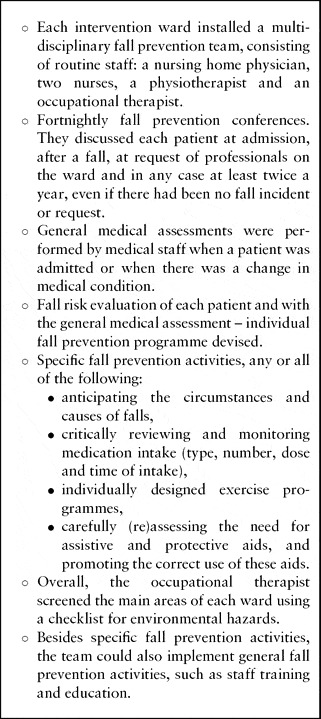
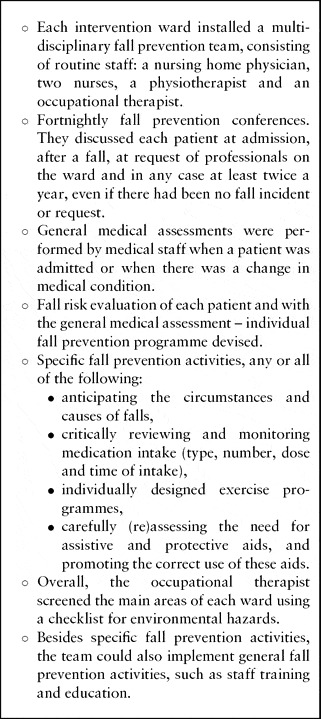
Falls risk for residents with dementia can also be reduced by a multifactorial intervention. Although the presence of cognitive impairment is a major risk factor for falls, Neyens et al.Reference Neyens, Dijcks, Twisk, Schols, van Haastregt, Van Den Heuvel and de Witte90 showed that the intervention group had a significantly lower mean fall incidence rate than the control group (rate ratio = 0.6, 95% CI 0.4–0.9, P = 0.029). Sub-group analyses showed that fall risk declined further as patients participated longer in the intervention programme. However, the intervention (Box 1) was labour intensive and time consuming and unfortunately although this study shows what can be done, it is difficult to see this intervention becoming standard practice.
Summary of intervention programme (Neyens et al.90)
Preventing fractures
The two main factors resulting in fractures are trauma (falls) and bone quality. As well as being reduced by minimizing falls, trauma can be reduced by the use of energy dissipating devices. The commonest of these is the ‘hip protector’. Kannus et al.Reference Kannus, Parkkari, Niemi, Pasanen, Palvanen, Järvinen and Vuori91 showed that such devices can reduce the risk of fracture but that compliance is an issue. However, O'Halloran et al.Reference O'Halloran, Cran, Beringer, Kernohan, O'Neill, Orr, Dunlop and Murray92 did not find the same benefit. Indeed, further studies and pooled dataReference Parker, Gillespie and Gillespie93 failed to show significant benefit in community-dwelling participants although suggested there may be marginal benefit for higher risk individuals in institutional care.
Studies looking specifically at institutionalized populationsReference Sawka, Boulos, Beattie, Thabane, Papaioannou, Gafni, Cranney, Zytaruk, Hanley and Adachi94, Reference Koike, Orito and Toyoda95 supported this hypothesis, suggesting that while the technology may be beneficial, poor compliance and non-adherence in community-living individuals negates any potential benefit. Waldegger et al.Reference Waldegger, Cranney, Man-Son-Hing and Coyle96 found in their meta-analysis that hip protectors compared with controls resulted in a relative risk of fracture of 0.4 for an elderly population living in institutions. An economic analysis found the use of such protectors to be cost-effective and cost-saving. Indeed, Koike et al.Reference Koike, Orito and Toyoda97 supported this hypothesis in their cluster randomized controlled trial, which showed benefit in elderly female ambulant nursing home residents with a history of falls and a body mass index > 19 kg/m2. Warnke et al.Reference Warnke, Meyer, Bender and Muhlhauser98 failed to identify any predictors of hip protector adherence.
Calcium and vitamin D supplementation
The use of calcium and vitamin D supplements in this population for the purpose of fracture prevention is recommended by many guidelines including the AGS/BGS, the National Institute for Health and Clinical Excellence99 and the National Osteoporosis Guideline Group (NOGG).100 A significant reduction in both hip and non-vertebral fractures was seen in the large Chapuy study.Reference Chapuy, Arlot, Duboeuf, Brun, Crouzet, Arnaud, Delmas and Meunier102 This looked at a residential home population who were vitamin D deficient, at risk of falls, had good compliance and achieved 25-hydroxyvitamin D associated with fracture reduction. The recent ‘DIPART’ meta-analysis103 concluded that vitamin D alone was not effective at preventing fractures but calcium and vitamin D supplementation reduced hip and total fracture as well as probably vertebral fracture rates, agreeing with a previous meta-analysis,Reference Bischoff-Ferrari, Willett, Wong, Giovannucci, Dietrich and Dawson-Hughes104 which had not been able to separate out the effect of calcium as all the commonly available supplements in Europe are combined preparations.
Anti-resorptives
There has been a recent general review of osteoporosis and its management by one of the authors.Reference Campbell105 The questions that need to be answered for a care home population, however, are that in view of the fact that many residents will be very elderly with a limited lifespan, will a drug reduce fracture rates and are the drugs available effective in a frail, older population?
A systematic review of studies on the efficacy of the pharmacological management of osteoporosis in care homesReference Parikh, Avorn and Solomon106 has shown that there is a low use of anti-resorptives (9–25%) but confirmed the effectiveness of calcium and vitamin D supplementation.
The effectiveness of the most commonly used drugs, i.e. the bisphosphonates and strontium ranelate, have been demonstrated in numerous large trials. Their efficacy in reducing fracture rates in very elderly people have only been shown mainly in post-hoc analyses with risedronateReference Boonen, McClung, Eastell, El-Hajj Fuleihan, Barton and Delmas107 (81% reduction in new vertebral fractures) and strontium.Reference Seeman, Vellas, Benhamou, Aquino, Semler, Kaufman, Hoszowski, Varela, Fiore, Brixen, Reginster and Boonen108 The only studyReference Greenspan, Schneider, McClung, Miller, Schnitzer, Bonin, Smith, DeLucca, Gormley and Melton109 of a bisphosphonate (alendronate) in a ‘nursing home’ showed an increase in bone mineral density at the hip and vertebra but the study was only performed on ambulant residents and many of these were in fact in sheltered accommodation rather than nursing homes. Administration of the oral bisphosphonates also needs attention in care homes where the medication may not be given by registered nurses. As for example only 1–2% of alendronate is absorbed it needs to be taken on an empty stomach at least half an hour before any food. Failure to comply with this will mean that the drug is not absorbed. It is thus essential that care home staff who may not have been trained in drug management undergo continued education.
Hip fracture patients are often admitted to care homes and zoledronic acid (ZOL) is the only drug which has been used in the secondary prevention of further fractures in patients with a fractured neck of femur. The Horizon 2 studyReference Lyles, Colón-Emeric, Magaziner, Adachi, Pieper, Mautalen, Hyldstrup, Recknor, Nordsletten, Moore, Lavecchia, Zhang, Mesenbrink, Hodgson, Abrams, Orloff, Horowitz, Eriksen and Boonen110 used a yearly infusion of zolendronic acid in patients post fractured neck of femur and significantly reduced all clinical fractures (33%) over the three trial periods. A reduction in mortality was also noted for reasons which are not fully clear, but could not be explained fully by the non-statistically significant reduction in hip fracture rate (30%). The disadvantages for this drug in care home patients is that it is an infusion which at present entails day case hospital admission. However, a recent reportReference Black, Reid and Lyles111 showed a magnitude of fracture risk reduction in a group of patients who received a single zoledronate infusion similar to those observed with three annual ZOL infusions at 36 months (34%). Thus with the limited average lifespan of patients in care homes of less than 2 years,Reference Bebbington, Darton and Netten112 a single infusion might well be sufficient for adequate fracture prevention.
The bisphosphonates, however, are contraindicated in patients in renal failure with an eGFR < 30–35, a condition commonly found in care home patients. A drug with no restrictions when used in renal failure is Denosumab, an anti-resorptive which has been recently licensed in the UK. It is a monoclonal antibody to RANK ligand, a cytokine which stimulates osteoclast production, function and survival. Its particular relevance to a care home population is that its efficacy in prevention of vertebral and non-vertebral fractures including hip fractures was demonstrated in an older population with a mean age of 72 years (range 60–90 years)Reference Cummings, San Martin, McClung, Siris, Eastell, Reid, Delmas, Zoog, Austin, Wang, Kutilek, Adami, Zanchetta, Libanati, Siddhanti and Christiansen113 and that no dose adjustment is necessary for patients in renal failure, unlike the bisphosphonates which are not recommended for patients with eGFR of < 30–35 ml/min. Ease of administration is also a advantage (by 6-monthly subcutaneous injections).
Certainly the power of the presence of osteoporosis as an individual risk factor diminishes with age in view of the increasing prevalence of osteoporosis with ageing. However, this does not mean that osteoporosis should not be treated and certainly it would seem to be reasonable certainly to treat residents with a past history of fracture, who are ambulant and not likely to die within one year with alendronate which is the cheapest drug available. Prospective lack of adherence, which is often the most common reason for not prescribing alendronate in the community, may not be such an issue in the care home situation. However, the high incidence of side-effects with generic alendronate (mainly gastrointestinal) may reduce adherenceReference Ringe and Moller114 in any setting. Vigilance is required by the patient's physician, who may need to consider the other available anti-resorptives.
As part of a medication review, however, the appropriateness of the continuation of an anti-resorptive will need considering. The ‘FLEX’ trialReference Black, Schwartz, Ensrud, Cauley, Levis, Quandt, Satterfield, Wallace, Bauer, Palermo, Wehren, Lombardi, Santora and Cummings115 suggested that the fracture rate in patients who had a 5-year course of alendronate followed by 5 years placebo, had only a small decrease in BMD compared with patients continuing on alendronate for 10 years with just a small increase in clinical vertebral fractures. Thus for patients with a limited life expectancy it would certainly be reasonable to discontinue their alendronate.
Lastly, consideration may need to be given to the risk–benefit balance of drugs known to be associated with an increased fracture risk. Both proton pump inhibitors and histamine-2 receptor antagonistsReference Corley, Kubo, Zhao and Quesenberry116 as well as the thiazolidinedionesReference Habib, Havstad, Wells, Divine, Pladevall and Williams117 are associated with an increased fracture risk in older women at risk of fracture.
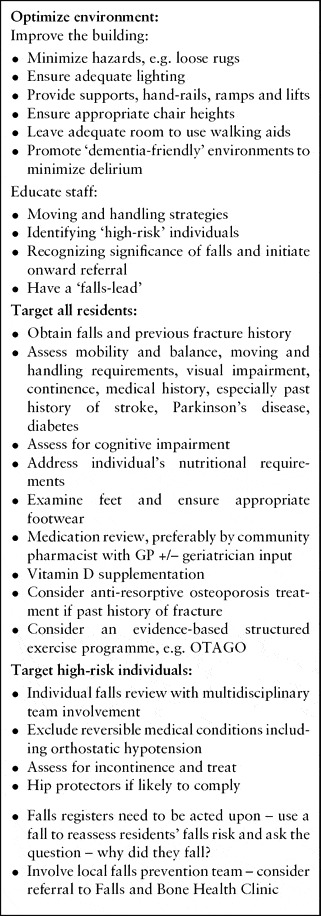
A strategy to minimize falls risk in long-term care environments is outlined in Box 2.
A strategy to minimize falls risk in long-term care environments

Conclusion
Falls remain a significant burden on individuals and healthcare systems. The prevalence is greatest in frail older people, particularly those in long-term care. Very few interventions show benefits across all these groups. Medication review, expediting cataract surgery, targeted bed-rail use and multiple-component structured exercise programmes do appear to be efficacious, although there is some concern that not adequately resourcing the latter may increase falls risk. There may also be a role for the targeted use of hip protectors in preventing fracture. The Cochrane review and the AGS/BGS guidelines both recommend vitamin D supplementation and a multifactorial intervention with a multi-disciplinary team for care home residents. The UK Care Quality Commission's (CQC) assessment tool for falls prevention in care homes is available on the CQC website.118
Conflicts of interest
Stephen Wallis – none. Gordon Campbell – has received educational grants and honoraria for lectures from Amgen, Chilcott Warner, Napp, Novartis, P&G, Prostrakan, Roche and Servier. Member of advisory committees for P&G and Novartis.