

1. Introduction
A report in the Financial Times in May 2020 commented upon how, whilst the ‘lockdown-induced’ fall in output was no greater in the USA than in many European countries, the rate of unemployment there was much higher (Davis, Reference Davis2020). Europe’s ‘superior’ outcome was attributed to the use of Short Time Working (STW) provisions. The implication was that there were lessons to be learnt.Footnote 1 This article, completed in August 2021, looks at the contribution of STW in the covid crisis, but it also looks at the labour market initiatives that might be required to complement policymaking, both in Europe and the USA, in the medium and longer term. It pays special attention to four countries—namely Germany, the UK, Sweden and the USA. Although in the USA the principal means by which employers reduced their use of labour was resort to layoffs, in so far as these were ‘temporary’, they could be regarded as a sort of functional equivalent to STW. What is more, the USA does present some cases of STW under the name of ‘work-sharing’, and these too, are described briefly.
Between February and April 2020, the unemployment rate in the USA rose from 3.5 to 14.7 per cent—by 11.2 percentage points. The unemployment rate in Germany rose from 3.4 to 4.3 per cent—an increase of only 0.9 percentage points. Commentators in the international press made extensive reference to Kurzarbeit (a term that was seldom translated) to explain the latter country’s experience.Footnote 2 Even in Germany, the existing STW scheme was extended in its generosity, whilst the same happened in 18 of the other 29 countries where trade unions were members of the European Trade Union Confederation (ETUC), and in the 10 others SWT provisions were introduced for the first time (ETUC, 2020). Europe was not alone.Footnote 3
This article reviews what is known about STW drawing from its use in the covid-induced downturn and from earlier experience—especially the great recession of 2008 onward. It does not report any evaluations of what happened during the 2020–2021 period, since it is far too soon to be able to do this, but it does report on findings from research covering earlier periods. It uses these, together with assessments of what has occurred in the most recent period, to draw some conclusions and to make suggestions about whether there might be a role for a more permanent system of STW in the UK—to be introduced now that its temporary ‘furlough’ scheme has run its course.
The rest of this article is organised as follows. First, the rationale for STW is set out. Next (Section 3) comes a brief review of the schemes in the four countries and of findings from evaluations of previous uses of STW. In Section 4, a brief description is given of who was most impacted by STW and temporary layoffs. This points to how particular economic sectors, and thus categories of workers, were most affected. Section 5 discusses how the covid-induced downturn might well differ from the sort of downturns for which STW was envisaged. This leads to the question of its suitability in such circumstances. Section 6 asks whether complementary measures might be needed. It is particularly concerned with whether proposals to combine STW with retraining of the employees in order to make them better equipped to deal with perceived structural changes. The last section draws conclusions.
2. Explaining short time working
Traditionally, STW schemes have been justified as:
-
1. Helping employers retain their workers in order that they are readily available when the economy recovers, thereby saving costs associated with rehiring and training new workers;
-
2. Acting as a countercyclical support programme, and helping to maintain purchasing power by offering a higher level of income than that available through an unemployment benefits system, and providing a targeted way of delivering that income support;Footnote 4
-
3. Giving workers a warning that their jobs might be less secure than presumed, together with an opportunity to consider searching for employment elsewhere; and
-
4. Not providing a subsidy that benefits the firm concerned and, thereby, unduly advantaging it compared to other producers.Footnote 5
Up to now, the USA has relied, instead, on ‘temporary layoffs’. If demand falls away, even if it is presumed that this will not last, employees have been dismissed and have been able to claim unemployment insurance. However, those laid off have had the expectation of being ‘recalled’ (reinstated). Back in the 1970s, research suggested that well over half of job losers were temporarily laid off, and more than half of these for a ‘fixed’ rather than an ‘indefinite’ duration. Those whose layoff was of a fixed duration were also unlikely to engage in job search (Feldstein, Reference Feldstein1975).Footnote 6 Of the increase in unemployment in the USA between February and April, as much as 96 per cent of it was attributed to temporary layoffs.Footnote 7 By contrast, almost all the decline in labour usage in Germany was absorbed through Kurzarbeit. Footnote 8
3. A brief review of the schemes and the literature
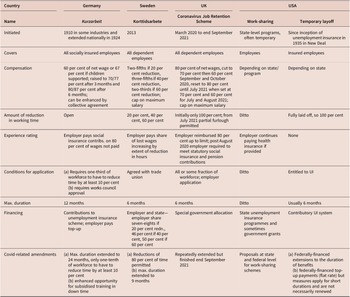
Accounts of how national STW systems function are manifold. In the context of the covid-induced downturn, they have multiplied, with commentators explaining their history, how they work, how they have been expanded, and showing how many people they affect.Footnote 9 Table 1 shows the systems that are the subject of this article, together with the temporary layoff system of the USA.
Short-time working and related measures in four countries

Many of these descriptions speak of them having a positive effect, and frequently they contained proposals for their prolongation and/or widening (e.g. ETUC, 2020). Analyses of the impact of such systems are more limited. Whilst some predate the ‘great recession’ of 2008–2009, many more were conducted in relation to the contributions STW made at that time.Footnote 10 Reviews of the literature are given in, inter alia, Balleer et al. (Reference Balleer, Gehrke, Lechthaler and Merkl2014), Boeri and Brücker (Reference Boeri and Brücker2011), Cahuc et al. (Reference Cahuc, Kramarz and Nevoux2018) and Hijzen and Martin (Reference Hijzen and Martin2012). Most find that STW schemes can have a positive impact on employment during downturns, even if their longer-term impact is more or less neutral—partly because they might have impeded recovery. Perhaps unsurprisingly, STW schemes benefited regular workers rather than those with non-standard employment contracts. There is evidence that STW had a deadweight effect, although for active labour market measures this is not unusual, but there are few suggestions that this deadweight was large. Nonetheless, STW schemes seem to be relatively cost effective in terms of their impact (Cahuc et al., Reference Cahuc, Kramarz and Nevoux2018).
The institutional context in which STW schemes operate is important, and this explains why some countries performed better than others. Germany is frequently mentioned in this respect. Here, but also elsewhere, its effectiveness is enhanced by its interaction with employment protection legislation and by the degree of centralization of collective bargaining (Boeri and Brücker, Reference Boeri and Brücker2011). The extent to which schemes contain a degree of ‘experience rating’ is also important. By this is meant the extent to which the employer bears a share of costs, and that these are not picked up entirely by the state.
One study concludes that the impacts of ‘regular’ and ‘extended’ STW can differ (Balleer et al., Reference Balleer, Gehrke, Lechthaler and Merkl2014). Following the use of such schemes over a business cycle, it concluded that, when regular STW was used, it had a positive impact. However, when provisions were ‘expanded’ to deal with abnormal circumstances, that impact was much more limited. Yet, this was not a consequence of the workings of the STW schemes themselves, rather the way they served as a form of automatic stabiliser holding up income levels and so purchasing power in the economy as a whole.
Last, one study from Germany suggested that the motivation and engagement at work of employees who were on Kurzarbeit was lower than that of their colleagues who were working normal hours (Business-Wissen, 2009).Footnote 11
4. Who is most affected by STW
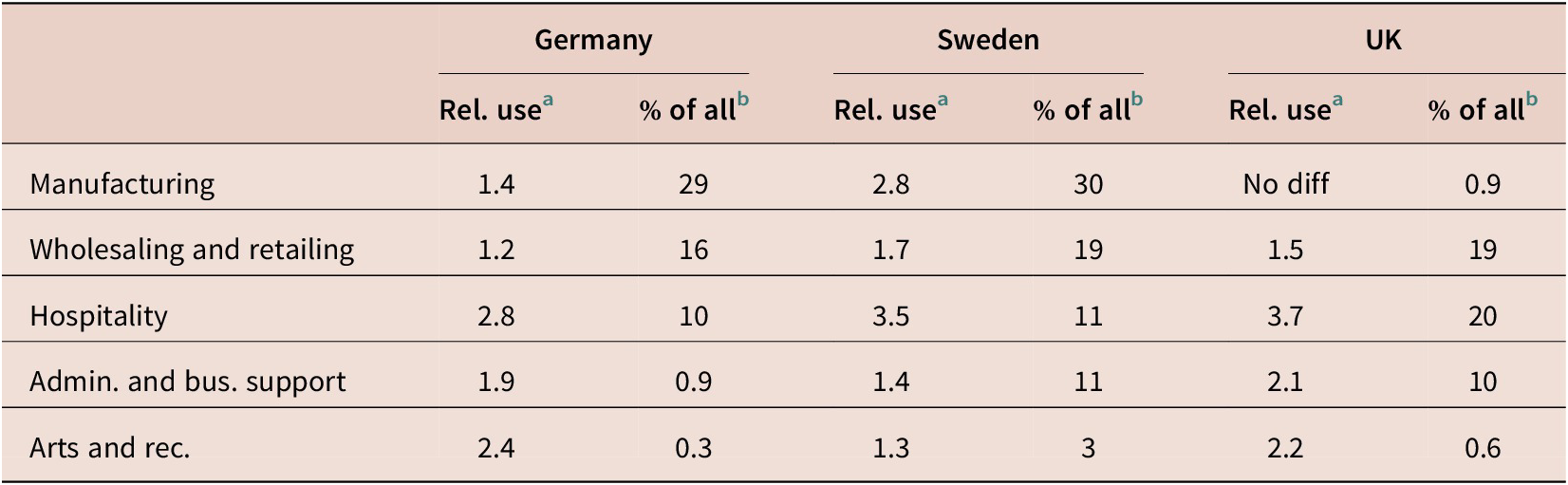
The use of STW during the covid-induced downturn was heavily concentrated in particular sectors of the economy, and the same has applied to temporary layoffs in the USA. The same sectors were affected—retailing and repairs, hotels and restaurants, administrative and business support services and arts and recreational services. In Germany and Sweden, manufacturing employees were also more likely to have experienced STW, but this was not the case in the UK. The preponderance of its use in the retailing and hospitality sectors meant it was lower-paid employees who were more likely to be working short time or to be temporarily laid off. In the UK, this aspect of the furlough scheme was realised when it became clear that the costs of the scheme were lower than had been anticipated (Strauss, Reference Strauss2020a). Detailed analysis of furloughed workers in the UK also showed how young people, and to a lesser extent older people, were more likely to have been furloughed (Gustafsson, Reference Gustafsson2020). With respect to the USA, the less that workers were paid, the more likely they were to have experienced job loss (Bartik et al., Reference Bartik, Bertrand, Lin, Rothstein and Unrath2020; Escobari et al., Reference Escobari, Seyal and Daboin2020).
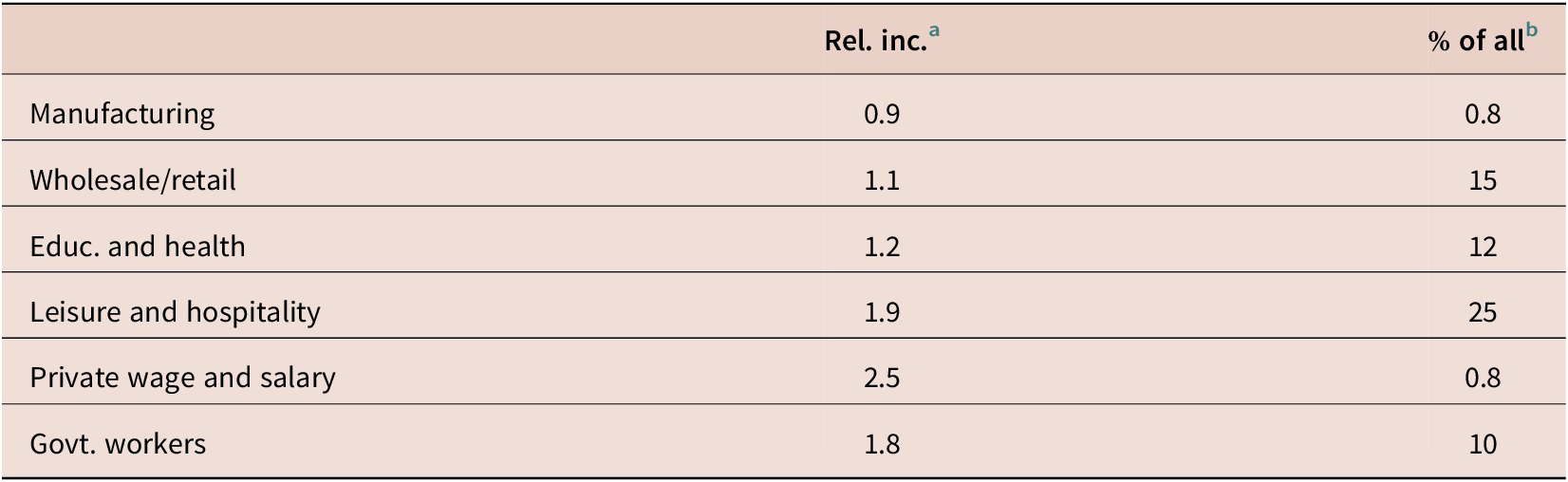
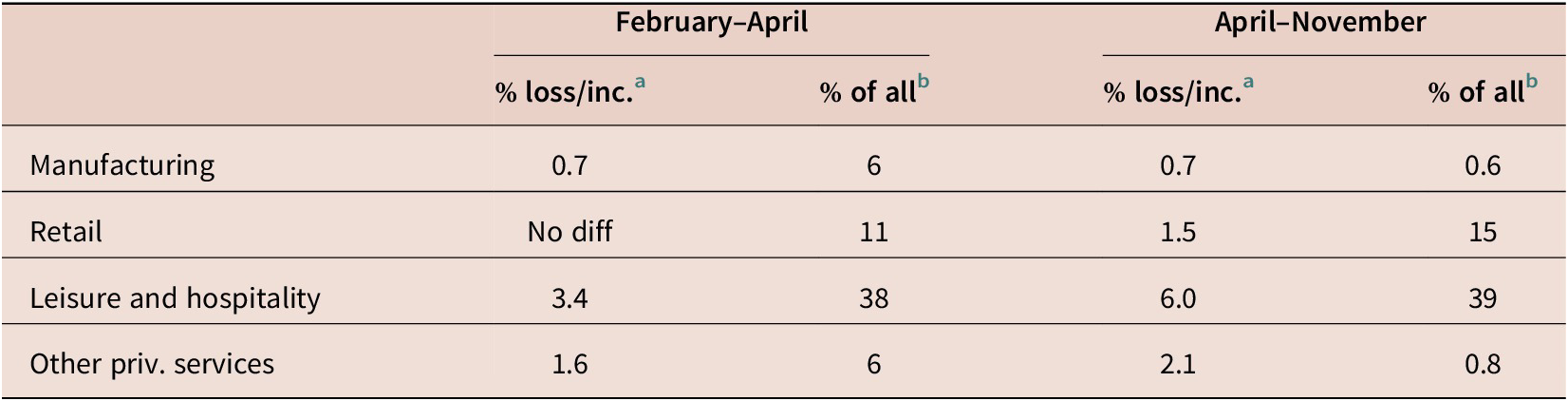
An examination of national statistics, given in tables 2–4, shows what happened in more detail. What is interesting is not merely the similarities in experience between the three countries where STW was used but also between them and the USA. This supports the proposition that STW and temporary layoff are functional equivalents. This becomes even more clear when employment in America is tracked over time. The sectors that saw the most dramatic drops in employment, and the largest increases in people made unemployed, were also the sectors that grew fastest after the spring. Jobs came back. What is not known is whether those who were laid off (temporarily or otherwise) returned to their old jobs or to other jobs—either in the same sector or elsewhere. Some 77 per cent of newly laid off Americans presumed they would be going back to their former workplace (Long and Guskin, Reference Long and Guskin2020), but actual rates of return to those jobs were lower than anticipated, and they differed substantially by industry (Cajner et al., Reference Cajner, Crane, Decker, Grigsby, Hamins-Puertolas, Hurst, Kurz and Yildirmaz2020).Footnote 12 It is also worth noting that those in the UK who had lost their jobs during the pandemic seem to have been searching for new jobs in the industry from which they had come, or in an industry closely related to it (Resolution Foundation, 2020). These people might have been behaving much like their American counterparts and did not take the view, as some commentators have suggested, that the sort of jobs they had been in were disappearing.
Disproportionate users of SWT in three countries

Note: The data refers to the cumulated total use in during the covid period.
a Likelihood of use relative to number of employees in 2019 (e.g. hospitality workers in Germany were 2.8 time more likely to be in STW than the overall proportion of the workforce were).
b Proportion of all employees on STW (e.g. 29 per cent of all employees on STW in Germany came from the manufacturing sector).
Source: Bundesanstalt für Arbeit, Tillväxtverket, ONS and own calculations.
Unemployment in USA, February to April 2020

a Increase in unemployment in the sector relative to overall increase in unemployment (e.g. the unemployment rates for manufacturing workers increased by only 90 per cent of the amount that unemployment rose for all workers).
b Share of the total increase in unemployment recorded by the sector (e.g. the increase in unemployment amongst manufacturing workers made up 8 per cent of the total increase in unemployment).
Source: BLS and own calculations.
Falls and rises in jobs in USA, 2020

a Number of job losses/increases relative to all job losses/increases (e.g. in the period February–April, jobs in manufacturing fell only 70 per cent as fast as all jobs fell).
b Percent of all jobs lost or gained (e.g. in the period February–April, manufacturing jobs accounted for 6 per cent of all jobs lost).
Source: BLS and own calculations.
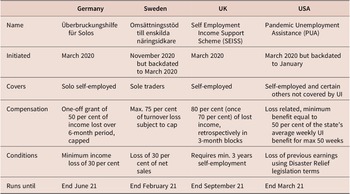
Unprotected either by STW schemes or conventional unemployment insurance schemes were those who were self-employed and those who were working in the gig economy (insofar as they were self-employed).Footnote 13 Because of the pandemic, in all the countries studied special measures were introduced to assist at least some of those who were unable to work. These are summarised in table 5.
Schemes for self-employed workers

Each of these schemes seems to have its deficiencies. The maximum payment to a recipient of the grant in Germany was €7,500 (the average claimed was only about €4,200) and it was paid only once (Bundestag, 2020).Footnote 14 Thereafter, people had to apply for means-tested social assistance. The amount available under the American PAU was usually the minimum—even if this is partly explained by the individual states, which are responsible for the scheme, trying to distribute money quickly (GAO, 2020). In the UK, many were excluded from the Self-Employment Income Support Scheme (SEISS) because they had not been self-employed for long enough. Others were excluded because their self-employed income was not their major source of income—they also had an employee job or had pension income. Yet others were excluded because their annual profits exceeded £50,000. Last, those self-employed who paid themselves out of dividends were also excluded (Strauss, Reference Strauss2020b). The SEISS has been criticised for being poorly targeted (Resolution Foundation, 2020). On the one hand, the average (monthly) SEISS benefit was higher than the average furlough benefit, and one in six of SEISS beneficiaries had experienced no fall in earnings over the period March to September 2020. On the other, three in five of self-employed people who had seen their earnings drop to zero had received no support whatsoever (Resolution Foundation, 2020). Along the same lines, a study from Germany found that self-employed people were much more likely to experience a reduction in the time they were working than were dependent employees, that they were much more likely to experience a fall in their incomes and that the size of the income fall, if it occurred, was much greater (Kritikos et al., Reference Kritikos, Graeber and Seebauer2020). Another study from Germany found that, since the onset of covid, the number of ‘mini-jobs’—employee jobs that have earnings lower than the threshold for social insurance—dropped very much faster than the number of regular employee jobs. The former fell by 12 per cent but the latter by only 0.2 per cent (Grabka et al., Reference Grabka, Braband and Göbler2020). Last, in the case of the PAU, criticisms have been made of slowness of delivery, with some states having great difficulty in coping with the demands put upon them (GAO, 2020).
5. The nature of the covid-induced recession
Almost by definition, STW is a short-term solution. Similarly, many of the layoffs in the USA were categorised as temporary. Both STW and temporary layoffs appear well suited to dealing with disruptions that impact briefly either on an individual organisation or on a country as a whole. However, as descriptions of Kurzarbeit explain, STW can be broken down into three components—as well as the cyclical variety there are also the seasonal and structural varieties. Cyclical STW would seem to be appropriate for a situation where recovery is V-shaped—a sudden downturn followed by a rapid, compensating recovery. Seasonal STW can be ignored for the purposes of this article, but the structural STW is important. It is described as a scheme that ‘helps companies in restructuring to prepare redundant workers for a new job’ (Schmid, Reference Schmid2014).
In the case of the covid-induced downturn, it soon became clear that a simple, V-shaped recovery was unlikely. Instead, observers discussed a U-shaped recovery, whereby the downturn would be drawn out, a W-shaped recovery, where there would be some improvement, but this would be offset by a further downturn as a consequence of a second wave of covid, an L-shaped recovery, where output would stay at a low level for a very prolonged period and, lastly, a K-shaped recovery, where some firms/sectors would improve rapidly and others would continue in a downturn and would not recover at all (Atwater, Reference Atwater2020).Footnote 15 Many commentators pointed out how the covid crisis had accelerated a process of change that was already underway. Some even suggested that the crisis was being used by companies to push through changes already planned, but to do so at a faster pace and, even, to disguise the reasons for change by reference to covid.Footnote 16
As prospects for a V-shaped recovery started to wane, the importance of the measures needed to accommodate substantial job change started to be discussed.Footnote 17 Already by May 2020, more than a third of short-time workers in Germany feared they might well find themselves unemployed (ZEW, 2020). More importantly, there were indications of individual economies stuttering before the pandemic. Some had avoided moving into recession under technical definitions of the term, but they were only narrowly avoiding doing so. Germany fitted that description.Footnote 18 Lufthansa, as a major company, had already started shedding parts of its operations (Germanwings). The German motor car industry was suffering from a worldwide excess capacity of production and was making, or planning, reductions including the closure of whole factories (on the latter, see Miller and Campbell, Reference Miller and Campbell2019).
This led to some coming to see STW as no more than a measure that was delaying necessary changes. It helped prop companies and sectors up that no longer had a genuine role as producers—so-called ‘zombie companies’ supporting ‘zombie jobs’.Footnote 19 In the context of this discussion, one study went so far as to suggest that 6 per cent of European employment was currently in zombie jobs and that these were particularly prevalent in what have been termed the ‘late bloomer’ sectors of transportation and storage, accommodation and food services, arts, entertainment and recreation, retail and wholesale, and construction (Allianz, 2020). An even more pessimistic view came from the USA, where it was argued that as many as 32–42 per cent of covid-induced layoffs would be permanent. The sectors mentioned largely mirror those reported above for Europe, but also included the energy sector (Barrero et al., Reference Barrero, Bloom and Davis2020). Yet another study, this time from the UK, pointed out that 61 per cent of the jobs furloughed came from the sectors where employees face the highest risk of automation (Fabian Society, 2020).
6. STW and reskilling the economy
Proponents of STW frequently emphasise the desirability of combining STW with some form of education or training (Schmid and Schröder, Reference Schmid and Schröder2020). Supportive calls have come from bodies such as the OECD (2020) and, in the UK, especially from trade unions (ETUI, 2020; Staton, Reference Staton2020).
The furlough scheme in the UK did permit employees who were not working to undertake training if this did not involve them in the production of goods or services. Indeed, there was encouragement both from government and from a variety of employers’ organisations for them to do so (Moss, Reference Moss2020). Two types of training were mentioned. The first was training with the current employer—often low-level courses in things like health and safety. The second was training for alternative employment—usually via online courses. That the covid-induced downturn impacted heavily on young people also led the UK and devolved governments to initiate several special measures to assist people in this age group. These included subsidies for employers who took on apprentices (England alone), and who offered Traineeships (England alone). The latter offer work experience with some training for up to year. The Kickstart Scheme (excluding Northern Ireland) provides subsidised work placements for young people on Universal Credit who were thought to be at risk of long-term unemployment. Whilst these initiatives are for young people, it is recognised that many older workers also need help and a variety of opportunities are open to them, ranging from the Restart Scheme (England and Wales) for the long-term unemployed through Skills Bootcamps to the Lifetime Skills Guarantee that offers the prospect of major funding to individuals who wish to take up education and training later in life. However, none of these schemes was linked in any way to STW itself.
In Germany, the Kurzarbeit scheme has always allowed training for people whose hours have been reduced, but its use is subject to demanding eligibility rules. It is forbidden to those employees who have completed publicly financed training within the last 4 years (Mosely, Reference Mosely2020). In autumn 2020, the labour minister was complaining that the take up for training by those on SWT was ‘too little’ (Presse Augsburg, 2020). Figures for June 2020 suggested that fewer than 5 per cent of all Kurzarbeiter were taking any training (IAB, 2020). Rules were changed at the end of 2020, when the requirement that the employees concerned had to be ‘affected by structural change’ or to be training for shortage occupations was removed.
The combination of STW and further training had been discussed in Sweden well before covid hit the economy. It had been the subject of a special inquiry established by the office of the prime minister and the ministry of finance (SOU, 2019). The inquiry concluded that it was not a desirable approach if that training were to be encouraged by the offer of public support. The danger of a deadweight effect was seen as too high. The position was restated in a report produced in late 2020 that tried to set out the way forward for the Swedish labour market in a post-covid period (Calmfors, Reference Calmfors and Eklund2020). Retraining is, however, available for those who lose their jobs, financed as part of the country’s conventional active labour market policy. Greater use of this measure was to be encouraged.
Last, in the USA, the temporarily laid off are entitled to enter training and education whilst continuing to draw unemployment benefit. Indeed, there is an array of federal, and in some cases state, programmes that cover all or most of the costs.
Assessing how many of the short time working or temporarily laid off employees have actually undertaken training is difficult. Even with respect to Germany, regularly published information is not available. However, if the experience of the previous recession is anything to go by, it is unlikely that many have done so. The OECD has estimated that, in most EU countries, no more than 10 per cent of employees on STW participated in training at the height of the 2008–2009 recession (Hijzen and Venn, Reference Hijzen and Venn2011).
7. Conclusions
During the pandemic, there were calls from both organisations representing labour and those representing business for the extension of STW schemes in Europe. The European Commission made provision, under a new SURE initiative, to finance—albeit in the form of repayable loans—the costs of such measures in member countries. In the USA, the Biden 2021 $1.9tn recovery package included further extension of supplements and payment periods for workers who were laid off. However, in June 2021, on the assumption that the end of the crisis was in sight, the UK government reiterated its intention that the furlough scheme would finish completely by end September.
Three issues stand out as worthy of discussion. First, it can be asked whether STW and temporary layoffs are functional equivalents. Second, the question of whether, and if so how, training/retraining should be made a part of STW schemes should be addressed. Third, and with respect to the UK in particular, it is appropriate to consider whether government should establish of a more permanent system of STW rather than relying, as it has in the past, on ‘temporary’ measures.
With respect to functional equivalence, it is recognised that both STW and temporary layoffs serve as a means of supporting income, and as such, they act as an automatic stabiliser. They are not, however, sufficient in themselves. There are categories of worker that they do not reach—of which the self-employed and gig workers make up an important share. Because of this, both STW and temporary layoffs need complements. Yet special measures for workers such as these have been less well-developed, and they have not performed as well in doing their basic job as STW and unemployment insurance-based schemes. Social assistance schemes might well have had to intervene. These are often more limited or less generous, and sometimes they are not available at all.
The differences between European STW schemes and American temporary layoff arrangements are smaller than, at first sight, they appear. In cases of short-lived, cyclical downturns, the differences scarcely exist at all. What matters is to whom they are open to and how much income they support. However, one difference does stand out—namely health coverage. Employees on STW in each of the European countries maintain their health coverage. American employees were in a different situation. Some of them would have had no health insurance at all. Those insured under ‘Obama care’ should have been protected, but their position depended upon employers fulfilling their obligations. Those with insurance coverage directly via their jobs were covered by special provisions under the 2020 CARES Act—but not in all cases. There could be periods of non-coverage—between their point of layoff and the point when their unemployment insurance payment commenced. These periods could be substantial when a huge number of claims were being processed. Moreover, exactly what entitlements they had depended upon the way in which each state had signed up to the CARES Act provisions.Footnote 20 One study indicated that, by June 2020, nearly eight million workers and seven million dependents—over 8 per cent of all with such coverage—had lost employer-sponsored health insurance because of the covid pandemic (Fronstin and Woodbury, Reference Fronstin and Woodbury2020).
With respect to the role of complementary (re)training for people on STW, the issue needs to be looked at from the perspectives of the employers and of the employees concerned. Taking employers first, it would seem wrong to impose the costs on them in the extreme circumstances that occasioned use of STW in the first place. Rather, it should be for government to provide subsidies if a good case can be made for them. It could be that planned training had been interrupted when an employee was placed on STW, or it could be that the employee was in a post in which it had been difficult to create sufficient time for training. If, in such circumstances, it could also be shown that the employer’s financial position had worsened, there is a case for a subsidy. However, as the Swedish inquiry showed, there is a real danger of deadweight—employers would, in fact, have been able to fund the training themselves. Also, there is also little point in paying for training in a company that is likely to go into liquidation.
Turning to employees on STW, it would be wrong to insist they undertook training. Indeed, many of the training schemes in the UK that were described earlier were available only to those who were unemployed not those who were furloughed. It is important that training is available for those individuals on STW, should they want to undertake it. They might wish to do so to take advantage of opportunities to obtain better jobs, or to acquire skills that would be useful in a labour market whose industrial and occupational structure will inevitably change. However, the relationship between training and the matching of supply and demand is a notoriously difficult one, and that difficulty increases the further ahead the ‘planner’ is looking (Cappelli, Reference Cappelli2015; Felstead et al., 2017). This does not mean that nothing should, or could, be done. Training is an essential ingredient of active labour market policy. Rather, it means that decisions on whether to engage in training should not be taken for, or by, people simply because they are on STW. Training should merely be an option that is available to them.
With respect to the role of a more permanent STW scheme in the UK, it is to be remembered that the furlough scheme was drawn up very quickly. This led to the scheme being open to overpayment and abuse. In June 2021, it was reported that £1bn of the £64bn paid out against the furlough had been recouped—£703m because the companies in question had performed better than they had expected, £319m because the companies had overclaimed. Included in the total were repayments from companies that claimed furlough support but had also paid handsome bonuses to their directors, even if this practice was not forbidden. (Thomas, Reference Thomas2021). The payback of rather over 1.5 per cent does not indicate fraud per se—at the time of writing, estimates of the latter were not yet available although the tax authorities were assuming that between five and 10 per cent of payments had been ‘wrongly awarded’. Nevertheless, the figures can be compared with some from Germany, where a well-established STW program was operating. There, losses due to fraud of €6.3m in the period from spring to autumn 2020 have been reported (Spiegel, 24-9-20). Since total costs of Kurzarbeit were running at between €20-30bn per year, this indicates a fraud rate of only 0.04–0.06 per cent.Footnote 21
In fact, a more permanent form of STW exists already in the UK—under the title ‘temporarily stopped’. Subject to it being in their contract of employment, employers are permitted to stand down employees when there are interruptions to their activities (ACAS, n.d.). However, unless specified in that contract or any supplementary (collective) agreement, the employer is not required to pay for time not worked. Employees are merely eligible for a ‘minimum guaranteed payment’ for a maximum of five days in any 3-month period. Because of this, they are also eligible to apply for means-tested social assistance (Universal Credit).Footnote 22 On the other hand, if they are stood down, they are also they are entitled to claim for redundancy. The extent of usage of the temporarily stopped provision is not known—in part because public funds are not directly involved. A more permanent STW program would cost the government money—although perhaps not as much as the furlough scheme has cost—but such money might be better managed than money was under the latter scheme.
The justification for STW as a means of enabling employers to maintain the skills of their workforces is widely accepted in Germany. Great stress is placed on high degrees of internal flexibility based upon competencies for which the employer has paid. The UK, by contrast, has prided itself on the external flexibility of its labour markets. This rather undermines the arguments in favour of a more permanent STW scheme. Moreover, by summer 2021, most forecasters, whether national or covering wider areas, were revising their growth projections up and their unemployment projections down. There are sectors of the economy that have endured prolonged lockdown, and these are ones for which furlough/STW might have been especially valuable. Prominent here are hospitality and leisure. However, these are also sectors with high labour churn, and not only in the UK but also Germany, the USA and Sweden, there have been repeated stories of employers trying to recruit to meet upturns and failing to be able to do so. This suggests that the furlough/STW measures have been only partially successful.
How those who remain with or find themselves without work are to be compensated, and conditions under which this compensation is to be made, remains an open question; the case for a permanent STW in the UK has not been decisively made.