The Trojan cycle has been retold and re-envisioned many times from antiquity to modern times. The themes covered by these myths, especially the Homeric poems, have captivated the minds and hearts of poets, historians, authors, and others. Homer's Iliad extoled the grandeur as well as exposed the ugliness and folly of war. These humanistic virtues resonated with various cultures around the world. In this article we examine the reception of the Trojan cycle, especially the Iliad, on the noted manga artist Tezuka Osamu (1928–89). Recent reception theories focus on the creation of a new composition or artefact as part of the reception process; we shall thus discuss the Phoenix: Early Works manga as an example of such reception.
The Homeric epos is regarded as the magnum opus of ancient Greece, a canonical work. However, the themes of the Iliad, and of the Trojan cycle in general, are universal and appeal to many non-Greeks, ancient as well as modern. Homer wrote about manhood and war, about love and peace, and these themes obviously resonate in almost all cultures.Footnote 1 In this article, we shall examine what happens when the Trojan cycle, replete with its plethora of symbols and themes, is imported into a different culture, the Japanese pop culture, by the author Tezuka Osamu.Footnote 2 We aim to show how Tezuka, dubbed in Japan the ‘God of Manga’, has incorporated the Trojan cycle into one of the first chapters of Phoenix, his own imaginative and ambitious cyclic epic in manga form.Footnote 3 For our investigation, it is less important whether Tezuka read Homer himself or was only familiar with the myth via movies or other forms. Tezuka exhibits more than sufficient proficiency in the myth as he carefully and astutely alters it to suit his own purposes. The changes he makes in the story do not stem from an inaccurate or ignorant grasp of the details; rather, he reshapes the myth to create his own version of it in order to reflect on his personal ideologies and beliefs.
We adopt the method used by Nisbet in his paper on the reception of Greek mythology in Shirow Masamune's Appleseed manga,Footnote 4 and focus on the translated manga itself rather than on how the Japanese manga was accepted by the original Japanese readers (or the later Western readers in its translation).Footnote 5 In addition, as Nisbet, we are also interested in exploring how Tezuka ‘teaches’ the Greek myth to his audience, using his own retelling of it in manga form. Our article therefore studies Tezuka the author himself and his work as an example of reception as a free-form creative dynamic.Footnote 6 Tezuka's manga does not directly engage in a literary debate with the ancient texts, but plays more freely with the myth itself as a whole and alters it according to the author's specific aims. The more recent discussions in classical reception theories emphasize the importance of cultural context as well as the new text which is received by the dialogue between the past and the present.Footnote 7 We argue that the cultural context and personal experiences of the author are significant in influencing his new creation. We shall therefore examine how Tezuka's own cultural milieu influenced his rendition of an ancient Greek myth and illustrate how Tezuka interpreted the ancient myths, occasionally counter to the presumed intentions of the ancient authors, and used them to emphasize what he considered to be universal truths about war and humanity.
Manga and Tezuka Osamu
The distinct quality of manga as a visual medium enables the author to use this medium to convey his or her ideas to various audiences. Manga is a highly popular medium in Japan, and its popularity grew considerably after the Second World War; today it occupies an important place in the country's culture. Manga is read by all age groups in Japan, with works going far beyond the usual subject matter of Western comics; in addition to various stories for children and adults, there are manuals and textbooks on different subjects in manga format, as well as serious works about history, politics, and philosophy.Footnote 8 The respective magazines in which the authors publish their work (hence their respective audiences) greatly affect the content of manga.Footnote 9 For example, a magazine aimed at young boys will feature more action-packed comics than a magazine aimed at young girls.
Lately, we have witnessed the beginnings of a critical analysis of the role that classical reception plays in Japanese pop culture, namely manga and anime.Footnote 10 Though this field of study is relatively new, and much remains as yet unexplored in the field of literary relations between East and West, questions of reception are already under discussion.Footnote 11 One critical question which arises (and is also relevant to other non-Western countries) is whether the Japanese authors simply use Western-related associations as eccentric anecdotes, or whether they are engaged in an effort to create some kind of cultural linkage.Footnote 12 As the analysis presented in this article will show, Tezuka's interpretation of the myth is a case of the latter, which can be traced to long-running themes in the artist's work.
Tezuka himself admits that he was greatly influenced by the American epic movies of the late 50s, including Helen of Troy (a source of reception in their own right);Footnote 13 and his other works involving Greek myth (we shall note them later) suggest that he was aware of the myths via other forms (which he does not disclose). Tezuka does not follow the movies or the myths verbatim, but rather creates an original retelling of the Trojan War using his knowledge of the myth. His manga also uses the Greek myth to create a correlation between the mythological war and Japanese history.
The fundamental human story of men and women caught up in a fatal war is the aspect of the myth which appealed to Tezuka. To expose the absurdity of the war, he combines his own experience of growing up in the Second World War with the prevalent sentiments of the Iliad, which laments the Trojan War as much as it glorifies it.
Tezuka Osamu, his work and classical connections
Before moving to the analysis of the manga, let us briefly introduce Tezuka and his work. Tezuka greatly contributed to the popularity of manga in post-war Japan. He was responsible for an enormous output of published works, estimated at about 150,000 pages of comics, consisting of pioneering works in many genres including science fiction, romance, history, religion, satires of everyday life, and more.Footnote 14 This wide variety reflects his strong interest in different forms of the art: literature, theatre, music, and especially film.Footnote 15 The range of his work was influenced by events of the twentieth century which he witnessed first-hand, as well as by his medical studies.
Born to a well-to-do family in a cosmopolitan region, Tezuka spent his youth in the twilight years of Japan's democratic renaissance, and entered adulthood as his country became a military dictatorship. He witnessed Japan's defeat at the end of the Second World War and, realizing that the Japanese government had lied to its own people, and how easy it is for governments to lead their people into false wars, he developed what Schodt has defined as ‘revulsion of war’, alongside ‘a lifelong interest in the complexity of human nature, a deep belief in the need to communicate with other cultures’.Footnote 16 We should note that Tezuka's own war experience in his youth, as witness to Japan's defeat and to the suffering of his friends, made him more aware of the influence of war on children; he wished in his works to give children hope, something to hold on to, and the fantasy setting allowed him to do so freely.Footnote 17 As Godart notes, Tezuka himself wrote in his autobiography that ‘experiences in his early life and adolescence led him to find life as the leading theme of his work’.Footnote 18 Among these experiences were bullying he suffered at school (which would resonate later in the character of Paris in the manga discussed here).Footnote 19 Other life-changing experiences included the B-29 raids on Osaka. Tezuka specifically recalled the firebombing of Osaka in June 1945, which, as he describes, was the greatest shock of his life.
Tezuka's unique visual style merges the cartoony design of Walt Disney and the Fleischer brothers with the sophisticated cinematic compositions of German expressionism, film noir, and the removal of the fourth wall from theatre stage; his plots also vary in nature, from slapstick gags to tragedies.Footnote 20 As Phillipps observes:
Tezuka gathered his themes and characters from all sources: Asian and European history, the world's fairy tales and myths…in the treasure trove of Tezuka's manga, one can find all possible genres with the idiosyncratic narrative patterns and the characters associated with them.Footnote 21
Tezuka's interest in the Trojan cycle can therefore be explained as both ideological and intellectual; he was attracted to the ‘complexity of human nature’ as demonstrated in the epic (while rejecting, as the analysis in this article will show, its glorification of war), and he found the aesthetical elements of the epic equally appealing.
Our claim that he was well versed in Greek mythology stems from the way in which he introduced elements from classic mythology into his other works as well, often deliberately anachronistically. Thus we argue that Tezuka's works exhibits a free-style and dynamic reception and not a direct response to the myth. In correlation with Nisbet's note regarding the teaching of the Greek myth, we see that Tezuka picks and chooses the Greek myths in which he is interested and alters them according to his aims in each of his manga. A memorable gag appeared in the first-ever animated production involving Tezuka, the 1960 animated film Sayuki (released in English-speaking territories as Alakazam the Great), which adapted the sixteenth-century Chinese literary classic Journey to the West. It featured a fight between the Chinese mythical monkey Son Goku and the Greek mythical hero Hercules (just such a comical approach to fighting which mixes different races and cultures will be repeated in the Phoenix: Early Works regarding the Trojan War, as we shall later show). A more serious, adult-oriented work is Apollo's Song (originally Aporo no Uta, published in 1970). This manga explores love, sex, violence, and death, using the mythical story of the Olympic god as a metaphor for the different stages of the protagonist's life. Theisen analyses Tezuka's use of elements from the Greek classics, specifically from Aeschylus’ Oresteia, in Apollo's Song. He argues that, while the work clearly demonstrates that Tezuka had a degree of familiarity with the Greek classics, this degree is hard to measure since thematic interpretations of the work may well have been rooted in the culture of Tezuka's native Japan or in the broader Asian culture.Footnote 22 Yet, even if we cannot measure the degree of familiarity, what most interests us is the new work that Tezuka created which was influenced by the classics, and how he chose to relate to those classics.Footnote 23
Phoenix manga: settings and aims
Phoenix, originally titled Hi no Tori, is considered Tezuka's life's work, and in many ways is the most representative of his style, storytelling, and themes. The manga was serialized in different magazines (including girls’ and boys’ magazines, as well as those aimed at young adults) over a span of almost thirty years and the work on it continued simultaneously with Tezuka's engagement in other projects (the series continued, at intervals, from 1954 until Tezuka's death in 1989). It is composed of individual stories interlinked through the appearance of different characters. The canonical stories in the series take place in historical Japan, or feature Japanese protagonists in the distant future, each centring on an attempt to capture the legendary firebird whose blood can provide eternal life. Through these stories runs the theme that people's ambition to gain immortality, literally or through an act that will be remembered after their death, leads to tragic results.Footnote 24
The story examined in this article, while set out as part of the series, is not considered canonical within its overall plot, owing to the deviation from Japanese history. It is one of three stories (collected in a single volume, in English titled Phoenix: Early Works) taking place in ancient Egypt, Greece, and Rome. As the name suggests, the Early Works were indeed among the first in the Phoenix saga, as they were serialized between 1954 and 1957 and aimed at a younger readership than the rest of the series.Footnote 25 As noted, Tezuka was a prolific author who created manga for young as well as older audiences, depending on the themes of the stories and the magazines in which he published. He also greatly contributed to the development of manga for young girls (shōjo manga) and it is therefore not surprising that several of his stories were published in girls’ magazines.Footnote 26Princess Knight (Ribon no Kishi), one of Tezuka's famous shōjo manga from the 1950s, told the story of a medieval princess in a fictional European kingdom who must impersonate a male prince to inherit her father's throne. In the back of the Phoenix: Early Works manga, Tezuka writes that, while finishing Princess Knight, he got more interested in American epic films, and then in Greek epic. He created this volume of the Phoenix for the audience of Princess Knight, hence his focus on female characters in this manga, as well as a story which he acknowledged to be ‘sweeter and more romantic’ in comparison to the later chapters of the series.Footnote 27
As noted above, the three stories included in Phoenix: Early Works were published in a girls’ magazine titled Shōjo Club (Shōjo kurabu), which was the only time when chapters from the series appeared in a magazine aimed specifically at this readership. This necessitates a particular relation to content.Footnote 28 While we cannot determine whether the young Japanese girls reading the various manga appearing in girls’ magazines were more interested in the romantic relationship between the characters or in the overall tale, romance and strong heroines were a recurring motif of the stories aimed at this demographic and which appeared in shōjo magazines.
Tezuka created stories which deviated somewhat from the usual norms of shōjo manga (for example in some elements of style), and he also created interesting and quite powerful female heroines. Thus, even if his audience was less familiar with the historical/mythological setting of the story, they could still relate to its various aspects on an emotional level. He accordingly made the necessary alterations to the classical Greek narrative in order to domesticate it for his specific audience of Japanese young girls.
One of Tezuka's aims in compiling the Phoenix saga was to criticize Japan's behaviour in times of war, especially the flaws of the emperor system and the brutality which ensues from the combination of religion and state power.Footnote 29 Yet the different non-Japanese geography of the Early Works volume does not alter the main tropes of the manga, which are notable in this volume as well, such as humanity, the folly of war, and cruelty to others. Since it evolves around foreign countries, the readers probably felt less emotionally invested in the more unfamiliar setting of the narrative and could centre on the characters’ relationships. Consequently, the stories of Early Works, although they also depict war and loss, could be perceived as more light-hearted (by the inclusion of humoristic scenes) than the Japanese narrative of the entire Phoenix series. In a reference to the Japanese history narrated in the Phoenix, Phillipps argues that in the manga we find ‘that those whom history lauds as brilliant figures become, in Tezuka's retelling, moody, complaining egoists’.Footnote 30 While this statement is true regarding the Japanese part of the manga, it is also relevant to the Early Works volume and the portrayal of its mythical heroes, as we shall show: grand classical/mythological figures are reduced to caricatures as a result of their lust for power.
Analysing Phoenix: Early Works’ Trojan War
In Tezuka's rendition of the Trojan War, we find leading female heroines (the main protagonist Daia, Helen, and her mother) and strong childlike characters (Paris). While there are several strong male characters in the story, the equal emphasis on the female characters and their deeds could be, at least partially, connected to the manga's readership. At the end of the volume, Tezuka admits that he wanted to create a ‘romantic epic’ for his young readers.Footnote 31 This might also explain why he chose to omit the adultery of Helen and Paris, and preferred to depict Helen as an innocent maiden and Paris as a young boy. Although Tezuka was influenced by the grand epic movies, he deliberately chose to change the characters in order to tell his own narrative of the story.
In the Early Works volume we discuss here, the two lovers/siblings (depending on the story), the chaste girl Daia and her lover, are destined to fall in love over and over again, throughout different periods of time.Footnote 32 They keep finding each other in various reincarnations, from ancient Egypt, through ancient Greece, to imperial Rome. Thus, it does not really matter if the young readers of Tezuka's tale were familiar with Greek mythology. What matters is their understanding of and their sympathizing with the basic human emotions at play in the story, which are common to all humans regardless of their origins. Now let us examine several themes from the manga in order to show how Tezuka adapted the Greek myth.
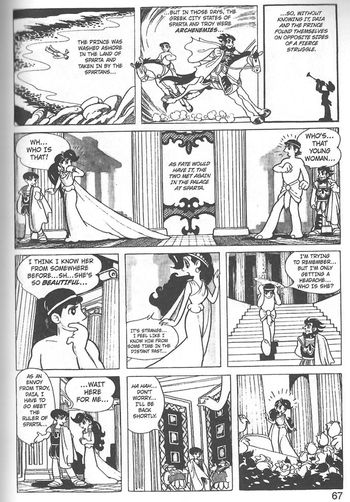
In the chapter that adapts the story of the Trojan War, Tezuka simplifies matters for his less knowledgeable readers, commenting that ‘in those days, the Greek city states of Sparta and Troy were archenemies’ (see figure 1).Footnote 33 The fact that Tezuka does not differentiate Sparta and Troy, and names them both ‘Greek city states’, could be attributed to a deliberate intention to focus on his main theme without overloading the unfamiliar reader with too many historical details.Footnote 34 Thus, seemingly unintentionally, Tezuka transforms the tale of the (foreign) Trojan War into a quasi-civil-war narrative, thereby amplifying its tragedy. In his fictional literary world, Sparta and Troy were both Greek cities, yet their mutual hatred overcame their bonds of kinship. While Sparta and Troy are presented as old enemies they are nonetheless described as analogous, sharing similar culture and traits. We could also wonder whether Tezuka deliberately obscured the nationalities of the Greek and Trojans because they are also obscured in the original Iliad, culminating in the meeting of Diomedes and Glaucus in Book 6. Even the movies which were produced on the background of the Trojan War do not clearly differentiate between the two cities. Tezuka's general attitude towards nationality should be considered here as well: his negative views on extreme nationalism, which he considered to be connected with militarism and war,Footnote 35 may have led him to consider both Sparta and Troy as reflective of war-driven national cultures, commenting on the futility of war and violence fuelled by nationalism on both sides that (to him) were seen as very similar.
Sparta and Troy as archenemies. From Tezuka (n. 13), 67 (photo courtesy of Viz Media)

The young readers of Tezuka's tale may not have been familiar with the history of ancient Greece, but they could relate to civil wars. Japanese history is replete with such conflicts, which formed an important historical backdrop for some later (canonical) chapters of Phoenix. Here Tezuka makes the foreign and complicated Western history more digestible and understandable for his readers, while also bringing the tragic aspect of this history closer to home. Narrative-wise, he chooses to present the events through the eyes of his own characters Daia and Krav, who witness the events that led to the war and are even caught up in the action themselves. Thus, they can offer their own insight into and interpretation of the circumstances. In a way, these new characters who witnessed the events could also be understood as extensions of Tezuka himself, the narrator, who witnessed these events of a foreign culture from afar, yet was also involved with them personally via his work. By mixing the main heroes of the narrative (Daia and Krav) with the great epic heroes of the Iliad, such as Helen, Hector, Ulysses (his Roman name is usedFootnote 36), and Paris, Tezuka can portray the epic characters not as larger-than-life heroes but as real people. Paris is an innocent pacifist, Hector an upright warrior. Only Ulysses remains a schemer, true to his epic characterization. The Japanese readers are naturally more concerned about the well-being of Daia and Krav than that of Helen or Hector. This choice can be seen as another example – narrative this time, rather than linguistic – of both foreignization and domestication of the original mythological story. Tezuka extensively employs a similar narrative structure (telling a famous historical or mythological story from the perspective of a new character created by him) in other works as well, including later stories of Phoenix set in Japan.
Tezuka is not concerned about remaining true to the ancient narrative, nor does he try to set forth the accurate sequence of events. As we noted earlier, he is interested in human behaviour. Furthermore, this mixture of Greek myth and original story also allows him to present the events that led to the Trojan War as a string of mistakes, misjudgements, and overall misconduct on both sides. Tezuka is therefore also not interested in one of the great motivations for the war in the Iliad: the kleos and tîmê of the characters, mainly Achilles. He even makes Achilles almost a marginal character in his work, and prefers to focus on the gentler Hector and ParisFootnote 37 and their relations with the other characters, especially the female ones, in keeping with the more romantic tone of the manga. Achilles had almost no involvement with any female character in the Iliad (except his insistence on his prize, Briseis), and thus he makes a less attractive character for a girls’ manga; he represents the role of a ruthless warrior.Footnote 38 As noted above, Tezuka is familiar with the Trojan cycle and therefore he incorporates in his work episodes which do not appear in the Iliad but are nonetheless necessary in order to present his readers with a complete story. This shows Tezuka's literacy of the entire cycle.
Let us first offer a brief summary of the plot in Tezuka's narrative. At the beginning, we meet all the main characters and learn about the relations among them, especially the odium between Sparta and Troy. Then the story unfolds. Our protagonists, Daia and Krav (their true origin and nationality are unknown), are swept away by a turbulent sea in different directions. Daia is rescued by the Trojan prince Hector, who takes her with him to Sparta, while Krav is washed up on the Spartan shore and is later picked up by Ulysses after proving his bravery. The couple lose their memories and at first even forget their names. Only the mystical Phoenix bird is aware of their past and their identities; the narrator comments that the two are ‘on opposite sides of a fierce struggle’.Footnote 39 Thus our fate-bound couple meet again at the Palace of Sparta.
In the Spartan palace, we encounter Helen's braggart mother (a ludicrous character, depicted as fat and grotesque), who prides herself on her daughter's beauty. When she sees Daia disembarking from the Trojan ship she is at once infuriated by her good looks. She wishes to kill her because she is prettier than her own Helen, but Helen intervenes and the queen orders Daia to be locked up in the Acropolis, while Helen secretly promises to save her. While Daia is imprisoned, matters become challenging for Krav as well. He duels with Hector and the latter loses. Hector is ashamed and determines to leave Sparta. Hector cannot find Daia (incarcerated in the Acropolis), and he concludes that she has been kidnapped by the Spartan king, with whom he quarrelled earlier; in retaliation, he decides to abduct Helen. Eventually the great battle ensues, causing many fatalities. Helen herself is heartrendingly stabbed to death by her own father. In the end, it is the ploy of Ulysses’ wooden horse that hands victory to the Spartans. Daia is hurt by the horse (in a deliberate act by Ulysses) and in the end Krav carries her away from the burning city and ends his life by leaping off a cliff clutching her dead body. The two are discovered by Ulysses, who ordains a fitting burial for them.Footnote 40
Now that we have introduced the main plot of the Greek chapter of the manga, let us examine Tezuka's interpretation and presentation of the myth. Tezuka portrays the main characters very distinctively, and this portrayal is every bit as visual as it is narrative. As noted by the comics scholar Scott McCloud, one notable common stylistic element in Japanese comics in general, and Tezuka's work in particular, is the ‘masking effect’, which presents cartoony, low-on-detail and expressive (or ‘iconic’, to use McCloud's term) characters against detailed, realistic backgrounds.Footnote 41 This combination assigns different roles to the backgrounds and the characters in the story; the backgrounds set the time and place of the epic, whereas the characters, who more easily express emotions and concepts owing to their simple design, provide Tezuka's interpretation of that same epic. Of course, as noted above, Tezuka's style complicates this divide: his backgrounds are inspired by existing cinematic (especially Hollywood) interpretations of the epic and the period, while his character design is highly influenced by American cartoonists and animators. Nonetheless, this divide draws the readers’ attention to the characters and to Tezuka's interpretation of the mythological stories.
For example, the royal house of Sparta, the king and queen, are portrayed as fat and vulgar (in complete contrast to their daughter, Helen). The Spartan king mocks the Trojans at the dinner party as pigs for having a delicate palate (perhaps Tezuka refers here to the crass Spartan society, known for its strictness and ‘Spartan’ ways). This insult is, of course, ironic, since the one who truly behaves in a rowdy manner is in fact the Spartan king himself. At the Trojan palace the (also unnamed) Trojan king is caricatured as an old, squat, warmongering monarch. This depiction is far removed from the classic character of the warm and paternal Priam of the Iliad. Tezuka's Trojan king forces his subjects to make fun of the innocent (abducted) Helen. When Paris admits that he prefers to live in peace and fears dying, his father beats him in response, calling him a coward. Thus, the rulers of both cities exhibit acts of stupidity and crassness. Since Phoenix is a visual medium, their deeds are enhanced by their cartoonish appearance. They are deliberately depicted as laughable characters, not noble or handsome. The two sides are very similar in their rude behaviour, and are not even aware of it. They are quick to send their soldiers to a pointless war just to settle petty grievances.
While less blatant in comparison with other anachronisms that Tezuka has introduced into the Homeric epos (discussed below), this depiction of the two kings is greatly influenced by the contemporary political reality experienced by Tezuka in his own country: as noted, during his childhood and adolescent years Japan became a military dictatorship and waged war against its neighbours; following his country's defeat in the Second World War, he became wary of leaders and their ideologies. Selfish politicians who lead their people to tragedy are a common theme in his work, especially in the rendition of Japanese history in the Phoenix (as we have noted, Tezuka strongly criticizes the all-powerful emperors). In his portrayal of the ancient kings as corrupt, tyrannical, and ultimately stupid, Tezuka definitely alludes to Japanese history and its culmination in twentieth-century politics, and thus his Trojan War reflects Japanese history (Tezuka thus offers reception as well as interpretation of the myth).
While the Iliad is the tale of heroes and kings, in his version Tezuka looks beyond the aristocracy and endows the common people (the simple soldiers or palace maids) with a truer grasp and understating of reality. Thus, he again pokes fun at those who aim to master all power and knowledge yet are basically blinded by ambition. In light of his own life experience, Tezuka makes the literary choice to grant a greater degree of common sense to the commoners. These characters are not highlighted in the Greek myths; they are usually used as the background against which the true heroes shine, and they have no say at all regarding the events, being simply pawns. Tezuka gives these nameless characters a voice and the power of reasoning. By doing so, he connects the events of the Greek myth with the pacifistic convictions he had held since his youth about the folly of war.
Two examples from the manga serve to illustrate his technique. In the first, after learning of Helen's abduction, the Spartan king summons a war council. The eavesdropping maids guess that the reason for the council might be that the queen stepped on her cat. No-one really believes that a war is coming. The simple people look at the events more humorously; they do not think matters should escalate so needlessly. This remark paints the entire casus belli and the following war as absurd. The initial cause of the hostilities does not appear significant enough to create such violence, yet it is obvious that the war ignites primarily because of a lack of trust and basic feelings of prejudice and animosity between the parties, and not because of the breach in hospitality. It is the sullied pride of the royal house that leads to war. In fact, the dignitaries are portrayed as rushing to the council as if they are competing in the Olympics. They literally rush to war, although there is no real reason for it, and it could have been avoided.
In the second example, another tilt at the war by the commoners occurs at the expense of the Greek fleet. The braggart Spartan king commands the naval force and asks his crew what they feel about ‘our fleet of over eight hundred (he wishes)’.Footnote 42 The ironic remark in parentheses denotes the crew's reaction to the commander's brazen words. This is a far cry from the catalogue of a thousand ships so glamourized by Homer. In fact, the crew express their concern about the assembly of these ‘old ships’ and ask for due reward for their fighting. The common soldiers appear more level-headed and see the situation clearly, while the admirals are caught up in their own war fantasies. The irony is revealed when the reward offered to the crew for Helen's rescue is a set of stationery or some soap (see figure 2). A bar of soap is ironically made equal to what one's life is worth (as the leaders cannot see that, in the end, it is the simple soldiers who suffer the most on the battlefield). The irritated king claims that ‘indulgence is the enemy of the Spartan nation’.Footnote 43
The reward for rescuing Helen. From Tezuka (n. 13), 108–9 (photo courtesy of Viz Media)

The higher moral values he professes are, in the end, just empty words, like the empty rewards he has promised. This highlights another aspect of Tezuka's wartime experience, beyond his resentment of corrupt leaders who send their people to war: his sympathies lie with the suffering of the people during the war. Even before forming his anti-war ideology in the post-war period, Tezuka was horrified by the events he witnessed daily during the bombings of Japan, the scattering of dead civilian bodies in the streets.Footnote 44 The civilians, according to Tezuka, are the real victims of militant tyrants.
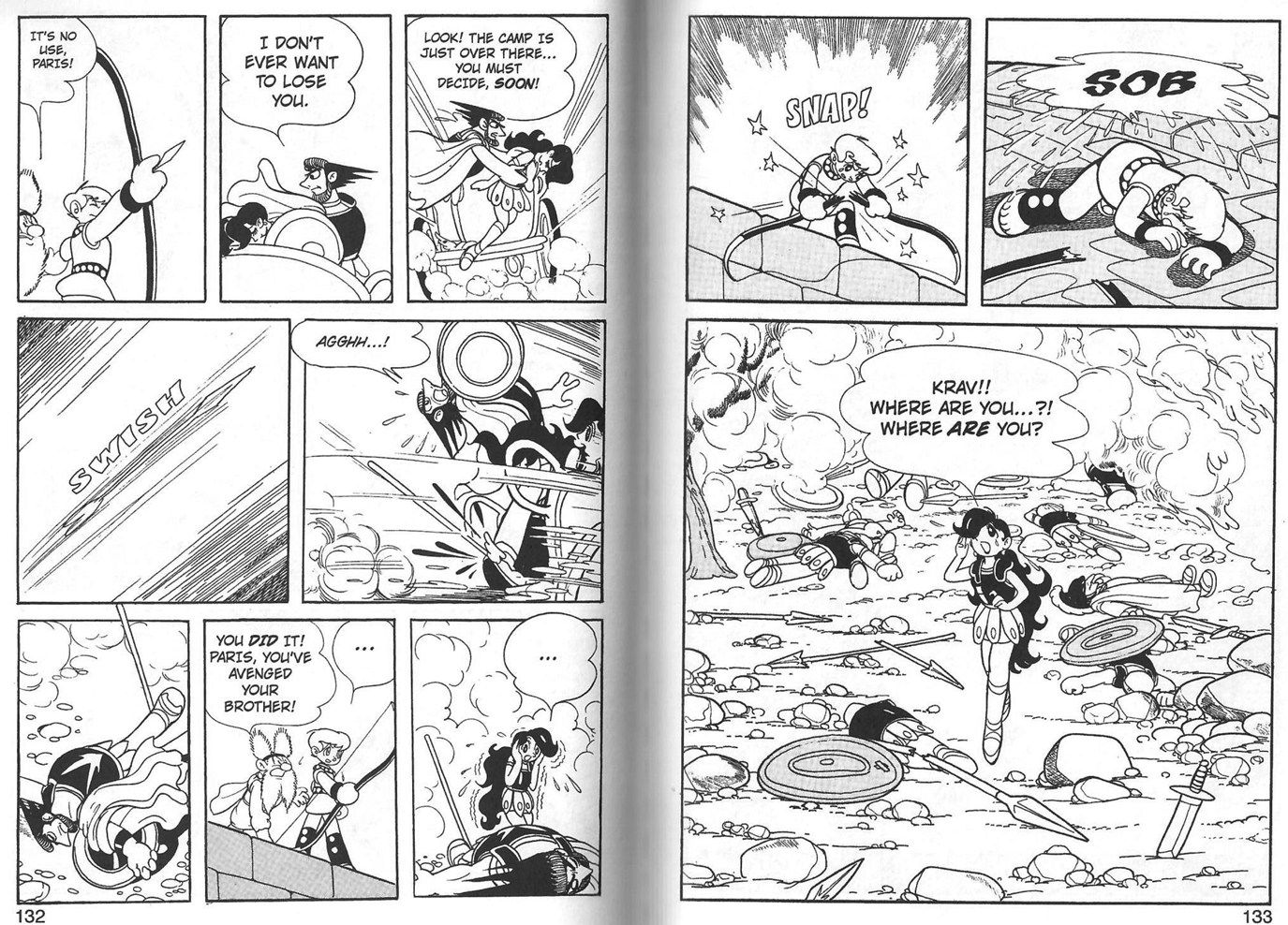
Another deviation from the Greek myth appears in the depiction of key characters from the myth, as we shall now demonstrate. Paris is shown as a very young boy, almost a child (close to the age of the intended readers). The way he is drawn highlights his inner childlike innocence. He believes that if he could just capture the phoenix bird the war would be over. He is not haunted by old rivalries like his father or brother Hector and is scolded by his father for his pacifism. Yet even in his naïveté, this child eventually comes face to face with the harsh truth: he must avenge his fallen brother, so Paris kills Achilles (see figure 3). Tezuka emphasizes this emotional breakdown of his character. Realizing what he has done, he breaks his bow and falls to the ground weeping. There is no room for childish innocence on the battlefield. Instead of ending the war, he has become an active participant in it; even his father approves of him now. Yet when he sees Daia, horrified at seeing Achilles’ body (even though he kidnapped her earlier), Paris understands the futility of revenge, and the symbolic breaking of his bow is meaningless in the city soon to be burned. This of course relates to Tezuka's aforementioned concern for children during wartime: Paris is the ultimate example of the victims who might become aggressors, yet his breaking of the bow illustrates the hope that Tezuka placed in children for stopping the cycle of violence.
The death of Achilles and the battle aftermath. From Tezuka (n. 13), 132–3 (photo courtesy of Viz Media)

Hector, unlike Paris, is a mature, handsome man. He is kind and noble (unlike his laughable father). Note that he is the one who abducts Helen; she does not go willingly with the Spartans. His great battle with Achilles, one of the key moments of the Iliad, is presented here as unjust. Krav is Hector's real adversary in the manga, since they both care for Daia. Achilles, watching their duel, seizes this opportunity to stab Hector while he is preoccupied with Krav. Thus Hector regains his honour (after losing in an earlier duel to Krav), even though he loses the fight, while Achilles is portrayed as an opportunist, not the great hero of the epic. Achilles is depicted as resenting the Spartan king for engaging in what he calls a ‘ridiculous enterprise’.Footnote 45 Tezuka may be alluding here to Achilles’ famous feud with Agamemnon in the myth. After slaying Hector, Achilles hurriedly steals Daia, thus abandoning any vestige of morality or dignity (here Tezuka perhaps intimates Achilles’ feud over Briseis in the original myth). In an interesting resemblance to Greek tragedy, it is primarily pride (and prejudice) which determines the characters’ actions: Helen's mother is jealous of Daia's beauty; the Spartan king insults his Trojan guests and extols the Spartan virtues; Hector, who lost to Krav, seeks an opportunity to regain his honour and take revenge on the Spartans for their insults. Yet in the background is the constant reminder that the two cities are ancient enemies; they cannot forgo their past rivalries. The only characters who try to form a true friendship are Helen and Paris. So, ironically, the act of treachery which sparked the mythological Trojan War is transformed in this retelling into a pure friendship between two young people who try to stop the war.
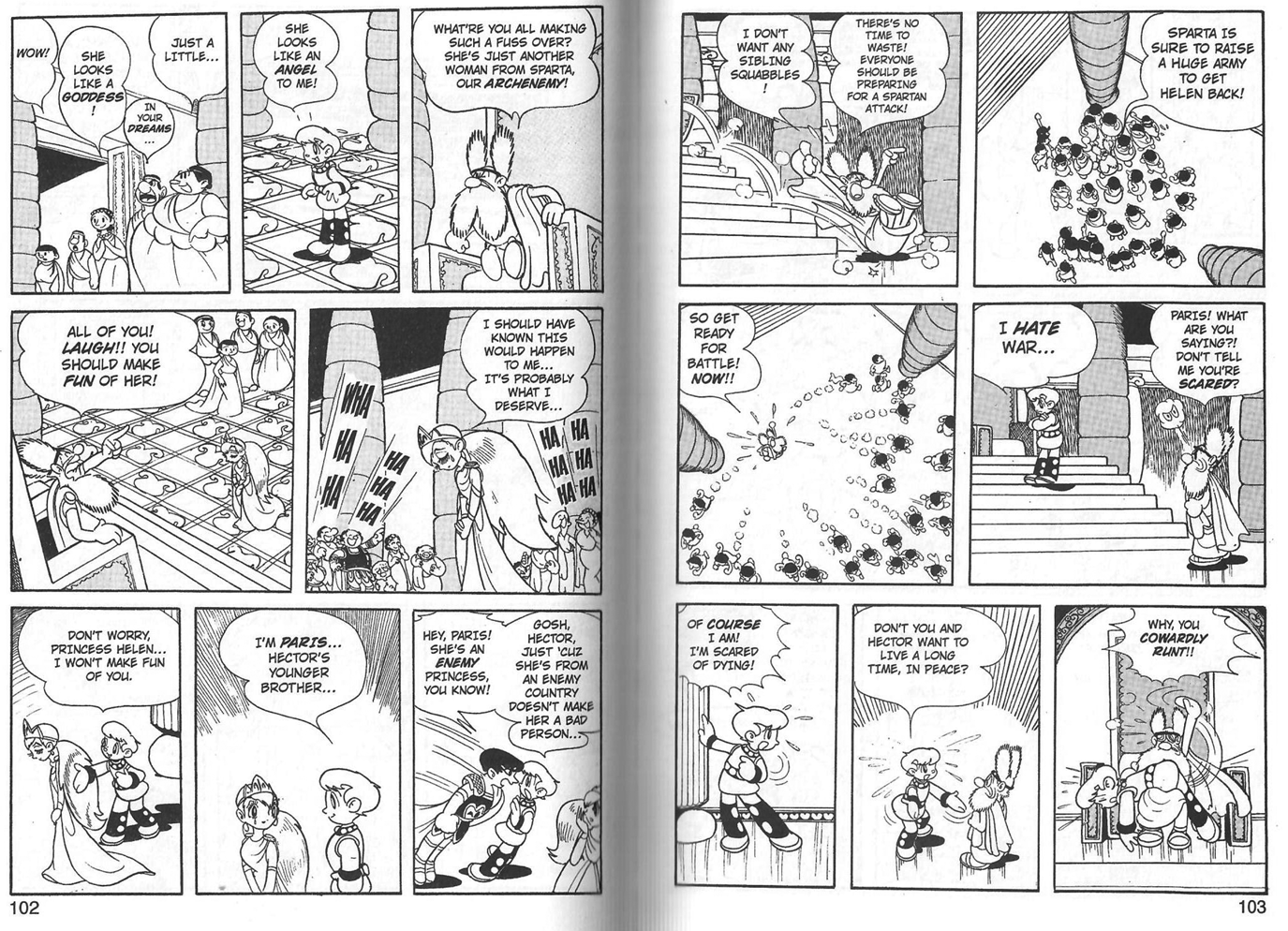
Tezuka also dares to alter one of the greatest symbols of the mythological tale: Helen. As we have noted, he makes his own couple key players in the narrative. Accordingly, he boldly presents what might have been regarded as an unthinkable travesty for any (Western) ancient reader or author: he presents a more beautiful woman than Helen. For anyone familiar with the myth, this is a bold statement. Helen was the prettiest woman in the world, and now a character of unknown nationality surpasses her beauty. Furthermore, on arriving at the Trojan palace she is mistreated by the king (see figure 4). While all the guests remark on her exceptional beauty, the king mutters: ‘What're you all making such a fuss about? She's just another woman from Sparta, our archenemy!’Footnote 46 The only detail that matters to the king is Helen's identification as a Spartan; he cannot see beyond the ancient rivalry. He even orders all present to poke fun at her.Footnote 47 Helen suffers this lèse-majesté with dignity, as if she deserves it, although in the manga she is completely innocent, having been kidnapped by Hector as revenge for the disappearance of Daia. Shockingly, Helen is not the main reason for the Trojan War; the introduced Daia is. As above noted, Tezuka deliberately neglects emphasizing the role of Helen and her abduction as the cause of the war. We can only guess at his reasoning; perhaps he did not wish to broach adultery in a story published in a magazine aimed at young girls. The main theme of the story that he narrates is the endless, reincarnated love of the titular characters, Daia and Krav; there is no (literary) room for other couples. While even the Greeks argue about Helen's true role in the war, Tezuka chooses to make her presence almost insignificant in the course of the events. Again, this is hardly due to lack of familiarity with the myth, as Tezuka proves to be quite familiar with it, but a conscious decision to make Helen a marginal character and Daia the main female figure of the manga.
Helen and Paris at Troy. From Tezuka (n. 13), 102–3 (photo courtesy of Viz Media)

The rivalry between the cities and the impending war reappear throughout the narrative. From the first revelation of the enmity between the cities we witness Ulysses’ warlike character. As a newly initiated citizen, the most important thing that Krav is required by Ulysses to do is to give his body and soul to his new land, Sparta. In a land that Krav does not even know, he is thrown into an ancient conflict whose causes he does not understand. Even the readers do not know why Sparta and Troy are enemies, as if it is of no concern even to the characters themselves. This ancient hostility has become so deep-rooted in both countries that no-one attempts to question or change it; they simply repeat continuously the slogan that they are sworn enemies; no-one even bothers to ask why.
A vivid expression of this situation erupts at the dinner party in Sparta. Here Tezuka deliberately mixes nationalities. The Spartan king's invitation to play mah-jong is intended for laughs from the readers as it is so bluntly out of context in this Greek setting; however, there might be a more hidden purpose. Perhaps Tezuka wanted to show that Trojans, Spartans, and Asians are all the same: simply humans. This line of thought will persist throughout. Furthermore, a simple insult turns into unruly fisticuffs, as if Tezuka means to show us how petty and silly are the reasons behind wars. In the end, the Trojan soldier who started it all by saying that the food tasted bad has to be dragged away from the dinner table since he cannot part from his food. Thus the cause of the brawl seems even sillier and more insignificant. The dinner party scenes demonstrate how, in addition to his opinions on tyranny and war, Tezuka held a somewhat grim view of nationalism and its destructive potential; the comedy of the absurd highlights the violence to which nationalism can lead (extreme nationalism was strongly linked to the emperor system which Tezuka harshly criticized in his works), while the mix of the classical Greek setting and mah-jong reveals just how insignificant and artificial national boundaries can be. Tezuka constantly crosses the line between describing the folly of war and human hatred, and depicting war's horrors.
The Trojans themselves are also delusional. In a reverse of the myth presented in the Aeneid (which also exhibits Tezuka's knowledge of the various myths surrounding the Trojan War), the Trojan king summons Laocoön before the battle commences. Asked to decipher the appearance of the phoenix in Troy, Laocoön interprets the sighting of the bird as proof that Troy ‘cannot be destroyed’.Footnote 48 We have seen how Tezuka manipulated the ancient myth before, and here too he alters it entirely. The same Laocoön who was the only one who could see through the Greeks’ scheme is depicted here as quite wrong and as giving the Trojans false hopes. We have seen how the intervention of Tezuka's fictional characters influences the narrative (with Daia's kidnap and Krav's duel with Hector), and now the phoenix itself is inserted into the narrative as an active participant. The manga revolves around the bird's mysterious character and the humans’ desire to seize it. Here it is presented as falsely assuring the Trojans a victory. In consequence, the king is encouraged to send his soldiers to war. But, on the other hand, Paris is determined to capture it in order to stop the war. Thus the phoenix is perceived differently according to the wishes and desires of the different characters (the king and Paris); it embodies their true wishes. Yet, in the end, while the phoenix regenerates through fire, burned Troy shall not rise again.
Then the battle begins, and again it gives Tezuka the opportunity to present the war as both irrational and horrifying. He challenges Homer's original text both ideologically and narratively. The Homeric epos glorifies war in the name of honour, but Tezuka mocks this kind of war, as well as any other kind – or, for that matter, anything military. This approach corresponds with his personal history and his own experience of being recruited to work in a munitions factory during the war. This is especially notable in his portrayal of mass combat as a grotesque slapstick affair. There are plentiful representations of Homeric scenes in classical and modern art. In many art works, be they vases or oil paintings, the various scenes are portrayed with due gravitas, as befits the magnitude of the epos. Many modern painters, from the seventeenth century (such as Peter Paul Rubens) to the nineteenth (John Flaxman, among many others) have also painted the Homeric scenes with abundant baroque or neoclassical pathos. No-one ventured to paint the great battle as complete chaos, involving a samurai and a penguin – that is, until Tezuka offered his own graphic interpretation of the myth. Homer's epos presented universal themes, of war but more importantly of humanity itself. Such themes were not alien to a Japanese artist growing up during the Second World War. Humanity, good and bad, is the main focus of Tezuka's works, a concept which bridges the gap between him and the ancient Greek poet.
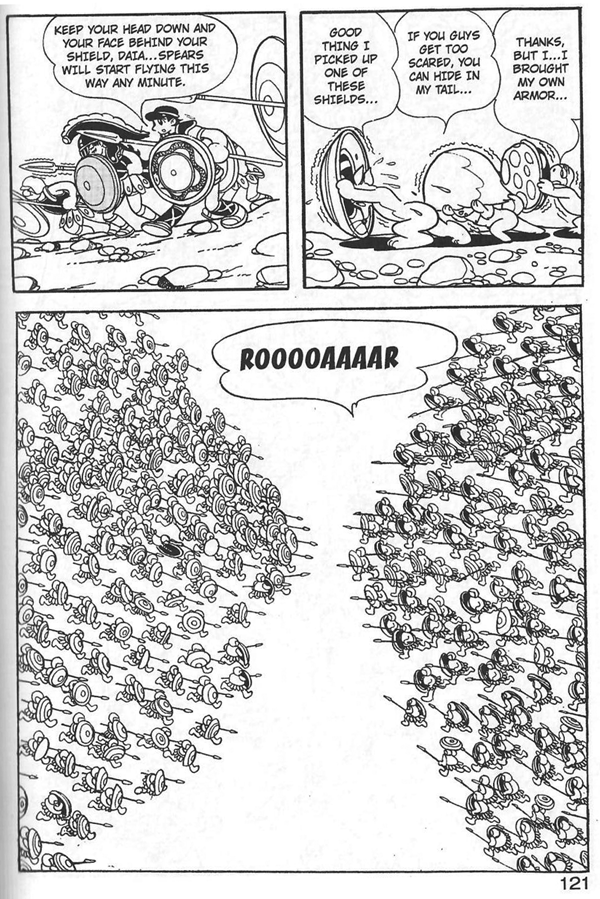
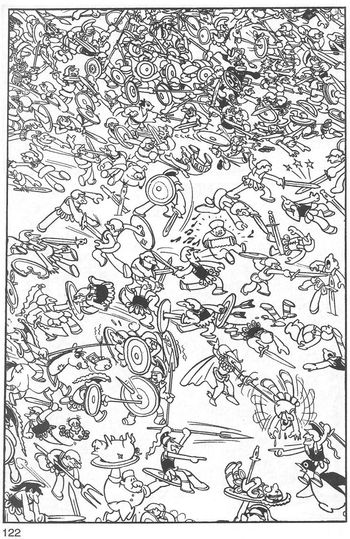
In the first picture, indistinguishable soldiers are seen charging each other (see figure 5). In the one-page panel dedicated to the fight (the only such panel in the volume; one-page panels depict new chapters in this volume, but they are not used for individual scenes within chapters, except in the illustration of this battle), we see absolute mayhem, as if the battle is painted to the point of absurdity (see figure 6). We have warring soldiers, but among them we see a martial arts master, a samurai, a chef, an accordion player, a Spanish warrior, an African warrior, and a European gentleman who has dropped his gun. Even exotic animals are involved in the fighting, contrary to their nature (hence the penguin being used as a horse). Why would Tezuka take this climactic event and play it for laughs? Is it just to keep things light (since he is essentially writing in a magazine for young girls)? Or is there a deeper philosophy behind his artistic decisions?
The battle. From Tezuka (n. 13), 121 (photo courtesy of Viz Media)

Chaos on the battlefield. From Tezuka (n. 13), 122 (photo courtesy of Viz Media)
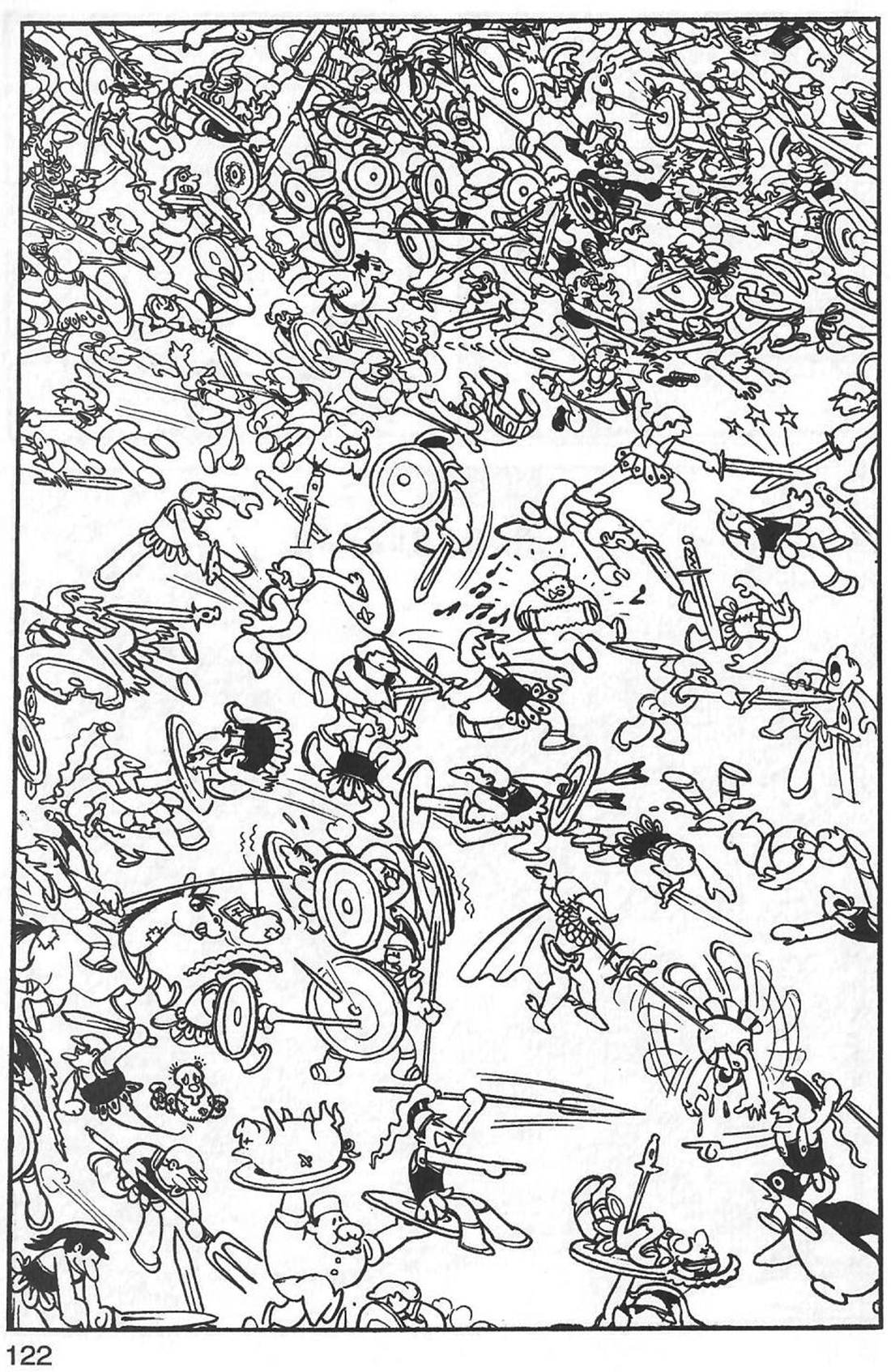
Tezuka, as noted, was an educated man; he knew exactly what the Trojan War was, and he knew how impressive it was considered to be. Nevertheless, he makes it look puerile. Tezuka may again be trying to show here how absurd the concepts of tyranny, war, and nationalism are. Furthermore, the absurdity of war is not limited to one nation or people, but is universal. Thus we have the foreign warriors who join in the commotion. The image of the chef carrying two plates, one holding a dead pig, the other a screaming soldier, is especially powerful. The soldiers are nothing but fodder, insignificant tools in the war game; they themselves are unaware of their condition, being so caught up in it. Even the spirit of a dead soldier continues to attack with its sword. There is complete anarchy, yet soldiers are depicted dying, some with a smile on their faces, other gasping. Shields are shattered. A closer look at this battle scene reveals the carnage. We cannot discern who the Trojans are and who the Greeks; they are all the same.
After Achilles’ death by Paris’ arrow, we see Daia standing in the middle of the battleground, searching for Krav. Now Tezuka offers a more realistic depiction of the bloody field, with dead soldiers strewn on the ground everywhere; nothing is comical in this scene. There is only a lonely girl searching for the one she loves amid complete devastation. Visually, above the large panel showing Daia are two smaller panels: one shows Paris breaking his bow, the other Paris weeping on the floor. This creates a visual link between the acts of war (the bow) and the misery it brings to the soldiers themselves (Paris) and to the survivors (Daia). Tezuka delivers this powerful message through his application of the strong effect of the visuals and with few words; the only words that appear on this page are Daia's desperate calls for Krav.
At the end of the chapter, Tezuka depicts a battle between the kings of Sparta and Troy, yet another deviation from the myth. Even young Paris is drawn into the battle. When he sees that his father has been slain by the Spartan king, he hastens to avenge him. The young boy who hated the war is now caught up in the cruel cycle of death and revenge. Yet the duel tragically ends when the Spartan king accidently stabs Helen as she tries to stop the fight. Her dying wish from her father is to end the war, but it is too late and the city burns; the last picture of Troy depicts empty shrines consumed by flames.
Conclusion
To conclude, in Tezuka's Trojan War he merges various elements from the original myth and alters many others, according to the artist's vision. Tezuka wished to show the sheer folly of war, the damage it does to innocent people, and the ruin it leaves behind. People are dead, ancient cities are destroyed. The Phoenix manga centres on recurrent reincarnation and rejuvenation through history and into the future. The tragedy is that, just as Daia and Krav continue to live and rediscover their pure love for each other, so other humans continue to hurt themselves with endless fighting and pointless bloodshed. In the final chapter in this volume our couple at last find peace in the Roman Empire; they defeat the corrupt emperor and Krav gains the power to rule. His message to Daia and to the people is, ‘We must learn to face one another and discuss our differences. That's the only way!’Footnote 49 This is the message that Tezuka wished to convey in this volume of ancient wars (and in the later volumes of Japanese history); this is the message that, in his interpretation, the Greeks and the Trojans could not understand.
As this paper shows, it is not Tezuka's straightforward adaptation of the Trojan cycle but rather his many deviations from it that demonstrate his deep understanding of the original text. He does not ignore the themes of Homer's work, but mercilessly reflects them against the contemporary reality of his own country, reaching harsh conclusions as to the consequences for all humanity of the perpetuation of Homer's heroification of war.