Most nutritionists agree that milk is one of the most basic necessities of a healthy diet. Unfortunately, milk is also one of the eight foods, along with wheat, eggs, peanuts, fish, crustaceans, tree nuts, and soy beans, that are thought to account for more than 90% of all IgE-mediated food allergies in the U.S.A., as well as on a worldwide basis, according to the Institute of Food Technologists’ Expert Panel on Food Safety and Nutrition (Taylor & Hefle, Reference Taylor and Hefle2001). In 2007 the World Health Organization formally acknowledged that allergy had become the biggest environmental epidemic disease facing children of the developed world (World Health Organization, 2007). In 2010 the World Allergy Organization estimated that 1·9 to 4·9% of children suffered from cow's milk allergy (Fiocchi et al. Reference Fiocchi, Brazek, Schunemann, Bahna, von Berg, Beyer, Bozzola, Bradsher, Compalati, Ebisawa, Guzman, Li, Heine, Keith, Lack, Landi, Martelli, Rance, Sampson, Stein, Terracciano and Vieths2010). At this point, however, it is important to clear up a widespread misconception and point out that an allergy to cow's milk is entirely different from lactose intolerance. Lactose intolerance can be confused with a type of cow's milk allergy as their symptoms overlap, so much so that the two terms are often mistakenly used interchangeably. Lactose is the sugar contained in cow's milk. An enzyme called lactase is produced in the gut to digest the lactose in milk. Lactose intolerance arises when, for whatever reason, the body loses or reduces its ability to produce lactase, thus becoming unable to digest the lactose in milk (Walsh et al. Reference Walsh, Meyer, Shah, Quekett and Fox2016). Lactose intolerance has nothing to do with the immune system. With this understood, we must emphasize that this article is not concerned with lactose intolerance.
Cow's milk protein allergy (CMPA) is one of the most common food allergies affecting young infants (Katz et al. Reference Katz, Goldberg, Zadik-Mnuhin, Leshno and Heyman2008). It may be defined as a reproducible adverse reaction of an immunological nature to one or more cow's milk proteins. Although the majority of children outgrow CMPA, it can affect older children and even adults (Luyt et al. Reference Luyt, Bali, Makwana, Green, Bravin, Nasser and Clark2014). CMPA can be divided into two types: IgE-mediated immediate-onset and non-IgE-mediated delayed-onset (Luyt et al. Reference Luyt, Bali, Makwana, Green, Bravin, Nasser and Clark2014).
IgE-mediated or immediate CMPA occurs when the body's immune defense system mistakenly identifies some of the proteins in cow's milk as threats, pathogens or invaders. This results in the release of certain chemicals such as histamine from immune cells. Symptoms can typically present within minutes, and can range from redness of the skin and puffiness to more serious manifestations such as vomiting, abdominal pain, diarrhea, swelling of the mouth or throat, wheezing, coughing, fall of blood pressure and even collapse. These extreme allergic reactions are known as anaphylaxis. IgE-mediated CMPA is more likely to persist, especially when the individual has multiple food allergies and/or concomitant asthma and allergic rhinitis (Luyt et al. Reference Luyt, Bali, Makwana, Green, Bravin, Nasser and Clark2014).
Non-IgE-mediated or delayed CMPA is often confused with lactose intolerance. It is associated with cow's milk proteins that are passed on to the child through a mother's breast milk or through the introduction of cow's milk-based formula into the infant's diet. Symptoms may be delayed by hours or days and can include both cutaneous manifestations and gastrointestinal symptoms that affect the entire GI tract (Luyt et al. Reference Luyt, Bali, Makwana, Green, Bravin, Nasser and Clark2014).
True milk allergy, then, is a subversion of the body's natural immune protection system in which, instead of accepting them as harmless foods, the immune system reacts to the proteins and peptides in milk as if they were harmful agents. The composition of milk proteins and peptides varies from mammal to mammal according to the differing nutritional needs of the specific neonates (El Agamy, Reference El Agamy2007). The major allergenic proteins of milk are α-casein, β-casein, κ-casein, and β-lactoglobulin. Casein fractions, particularly β-casein and β-lactoglobulin (β-LG), are the most common proteins involved in IgE-mediated cow's milk allergy. β-LG is not unique to cow whey protein but is a common protein found in goat, sheep, buffalo, mare and donkey milk. Caseins including α-, β- and κ-caseins of different species vary in their amino acid composition and peptide mapping. Due to these compositional differences in milk proteomes, the most suitable milk for a mammal would be milk from the same species: i.e., human milk is the most beneficial nutrient for human infants, and cow's milk is the best nutrient for the growth of a calf. However, there are many reasons why some human mothers do not breastfeed their babies, and when they don't, cow's milk is commonly chosen as the primary substitute for human milk, followed by goat's milk. However, the different compositions of the different mammalian milks mean that among the hundreds of proteins and peptides contained therein (Dallas et al. Reference Dallas, Murray and Gan2015) there may be allergens or proteins that can cause severe allergic reactions (Virtanen et al. Reference Virtanen, Nevalainen, Kronberg-Kippila, Ahonen, Tapanainen, Uusitalo, Takkinen, Niinisto, Overaskainen, Kenward, Veijola, Ilonen, Simell and Knip2012).
While human milk at present remains the best source of nutrition for the development and immune enhancement of human infants, it would still be desirable to find the least reactive substitute for human milk, not just for infants, but also for adults, for whom milk is one of the major sources of calcium.
In an attempt to evaluate the allergenicity and antigenicity of different milks, we measured levels of IgE, IgG and IgA antibodies against human and animal milks and plant-based milk substitutes in the blood of 500 individuals, with the goal of finding the least reactive alternative to human milk for infants and adults.
Materials & methods
Five hundred sera from a cross-spectrum population aged 18–65 were obtained from Innovative Research (Novi, MI, USA). The healthy subjects were tested according to FDA guidelines for the detection of hepatitis B surface antigen, antibodies to HIV, HIV-1 RNA, Hepatitis-C RNA, and syphilis. All samples yielded non-reactive or negative results for each test performed.
Cows’ milk (raw Jersey grass-fed, raw Holstein A1, raw Holstein A2) was obtained from a farm in Lancaster, PA. Whole Foods organic milk in glass bottle, regular milk, sheep milk, goat milk, soy-based milk substitute, almond-based milk substitute, and coconut-based milk substitute were purchased from different supermarkets. Raw camel milk was purchased from Desert Farms Inc., Santa Monica, CA, USA. Human milk was obtained from the senior author's daughter, a healthy female in her early thirties.
Measurement of IgE, IgG, and IgA antibodies by ELISA
A 10 ml aliquot of each milk was put into a dialysis bag (cutoff 6000 dalton), and dialyzed against 0·1 m phosphate buffer saline (PBS) pH 7·4 for 48 h in order to remove small molecules from the antigenic materials. All milks and milk substitutes, at a protein concentration of 1·0 mg/ml, were diluted 1 : 50 in 0·1 m carbonate buffer, pH 9·5, and 100 µl each of the milk proteins were added to different microtiter plates. On each plate 4 different wells were coated only with BSA or HSA and used as controls. Plates were incubated for 4 h at 25 °C followed by overnight incubation at 4 °C. Then the plates were washed three times with 200 µl Tris-buffered Saline (TBS) 0·05% Tween 20, pH 7·4. The non-specific binding of immunoglobulin was prevented by adding 200 µl of 2% BSA in TBS, and incubated overnight at 4 °C. Plates were washed as described above and then serum samples diluted 1 : 2 for IgE measurement, 1 : 50 for determination of IgA antibody and 1 : 100 for determination of IgG antibody in 1% BSA in TBS containing 0·5 Tween 20 were added to duplicate wells and incubated for 4 h for IgE, and 1 h for IgG and IgA at room temperature.
Plates were washed 3 times and after addition of secondary antibody and substrate, color development was measured.
ELISA index for each antibody was calculated based on the following formula:
 $$ \eqalign{&{\rm Antibody}\,\,{\rm ELISA}\,\,{\rm Index} \cr&= \displaystyle{{{\rm OD\; }\,{\rm of}\,\,{\rm Sample} - {\rm OD\; }\,\,{\rm of}\,\,{\rm Negative\; }\,{\rm Control}\; } \over {{\rm OD}\,{\rm of\; }\,{\rm Calibrator} - {\rm OD\; }\,{\rm of\; }\,\,{\rm Negative\; }\,{\rm Control}\; }}}$$
Inhibition studies for human IgE and IgG antibodies against cow's milk with different mammalian and plant milks are described in the online Supplementary File.
Statistical analysis
Statistical analyses were performed on 500 human sera to study the relationships of cow milk IgE, IgG and IgA antibodies to goat, sheep and human milks, and almond, soy and coconut milk substitutes. The determination of the presence of statistically significant correlative relationships was conducted with Pearson's coefficients. A scatter matrix was developed to identify linear trends. A Bonferroni adjustment was conducted for multiple comparisons. Chi-square analysis was performed to determine the risk of immunological reactivity to other milk proteins with individuals that were reactive to cow's milk. Stata software package version 14.1 was used to perform the analysis.
Results
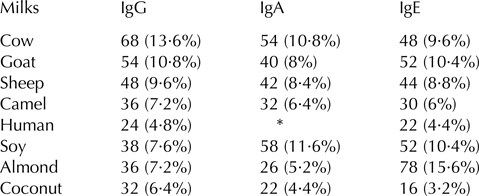
The study comprised 500 blood samples from a cross-spectrum population of the USA. IgG, IgA and IgE antibodies were measured against mammalian- and plant-based milks/milk substitutes in order to detect the degree of immune reactivity against antigens of these products. Table 1 shows the percentage of individuals producing milk-specific IgG, IgA and IgE antibodies against different milks/milk substitutes at 3SD above the mean or ELISA index of >1·4 for IgE, >1·7 for IgG and >1·6 for IgA.
Number of specimens with elevated antibodies against different milks at 3SD above the mean of 500 samples

From an allergenic point of view, of the mammalian milks human milk was the least allergenic with only 4·4% allergic reaction as measured in elevation of IgE antibodies, while IgE against camel milk was elevated in 6% of the tested individuals, much lower than cow (9·6%), goat (10·4%) and sheep (8·8%). From an antigenic point of view, measurement of IgG positivity showed human milk to be the lowest among the mammalian milks again with less than 5% of tested individuals, camel milk again the second least antigenic with 7·2%, with sheep and goat following at 9·6% and 10·8% respectively. Cow's milk was the most antigenic with 13·6% elevation. These results confirmed once more that next to human milk for both allergenicity as well as antigenicity, camel milk is the least reactive mammalian milk for consumption, followed by sheep, goat, and, finally, cow's milk in decreasing order of acceptability.
When human serum was added to the wells coated with human milk antigen, the antibodies reacted so strongly with the human IgA that no accurate measurement was possible. This is indicated by the symbol * in Table 1 and online Supplementary Table S6.
Regarding the plant-based milk substitutes, we found that almond was the most allergenic with a significant elevation of IgE antibody in 15·6% followed by soy (10·4%), and coconut in only 3·2%. However, from an antigenic point of view soy was the most reactive with 11·6% elevation for IgA and 7·6% for IgG, followed by almond with 5·2% for IgA and 7·2% for IgG, and coconut 4·4% for IgA and 6·4% for IgG (Table 1).
Immune reactions to different cow's milks
We selected 24 out of 500 specimens, some with very high, some with medium, and some with very low levels of IgG, IgA and IgE antibodies against non-organic pasteurized cow's milk, and then tested them for their antibodies against 5 different types of cow's milk, regular, organic, grass-fed and others, as shown in online Supplementary Tables S1–S3. Among the 24 tested blood samples, we found that an individual with high levels of IgE, IgA or IgG antibodies against one type of milk also showed very similar trends in antibody levels against the other 4 types of cow's milk. An analysis of variance between these groups resulted in a correlation of 0·9727, meaning there is no significant difference in immune reactivity among the 5 different types of cow's milk.
Immune reaction to goat, sheep, camel, human and plant milks.
We selected an additional 24 different sera that exhibited very high levels of IgE, IgG and IgA antibodies against cow's milk and tested them for possible antibody elevations against goat, sheep, camel, and human milks, and soy, almond, and coconut milk substitutes. At the cutoff > 1·4 ELISA index, 19/24 or 79% of these cow milk IgE-positive samples were highly reactive with goat's milk, 71% with sheep's milk, 58% with camel's milk, 33% were IgE-positive with human milk, 67% showed IgE elevation against almond, 63% against soy, and only 29% showed IgE elevation against coconut milk substitute (online Supplementary Table S4). In relation to IgG, at a cutoff of >1·7, we found that all 24 samples or 100% were reactive against goat's and sheep's milk, 71% were reactive with camel's milk, 58% showed IgG reactivity with human milk, 71% showed significant reactivity against soy, 50% were reactive with almond, and 63% showed a significant antibody elevation against coconut (see online Supplementary Table S5). For elevations in IgA antibody at the cutoff of >1·6, goat milk was elevated in 67%, camel milk in 63%, sheep, soy and almond in 58%, and IgA positivity against coconut milk substitute was detected in only 29% (see online Supplementary Table S6).
Risk analysis for those with immunological reactivity to cow milk protein identified a 3–9-fold increased risk of having IgA, IgE, and IgG immunological reactivity to goat, sheep or camel milk. There was no statistically significant risk for immunological reactivity with almond, soy or coconut milk substitutes or for human milk with individuals that react to cow's milk proteins (see online Supplementary Tables S7–S9). Goat milk (risk ratio 6–9) and sheep milk (risk ratio 7–9) were the most reactive followed by camel milk (risk ratio 3) in individuals that reacted to cow milk protein. Human milk protein was the only source of milk from animals that did not possess any risk for individuals that reacted to cow milk proteins.
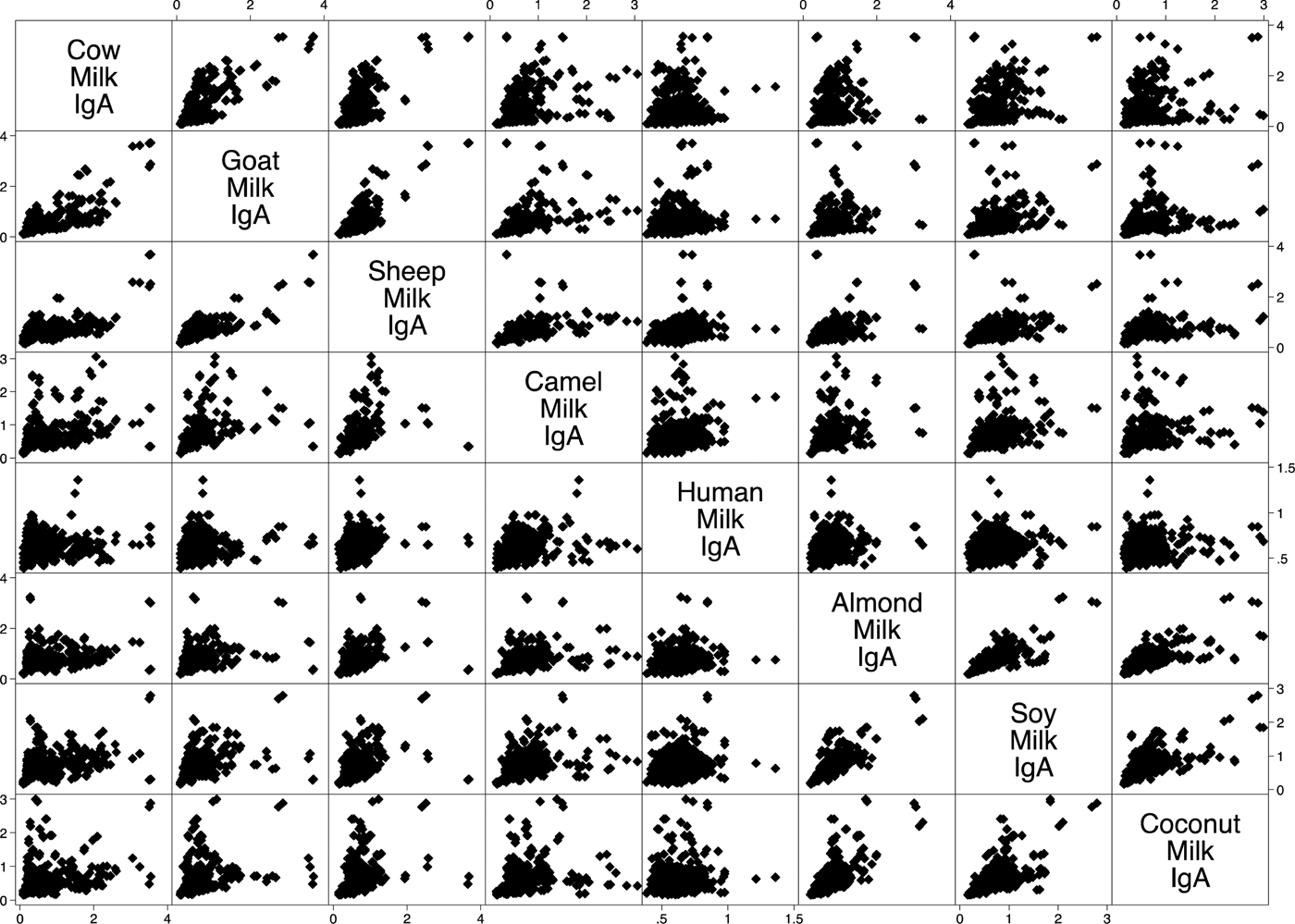
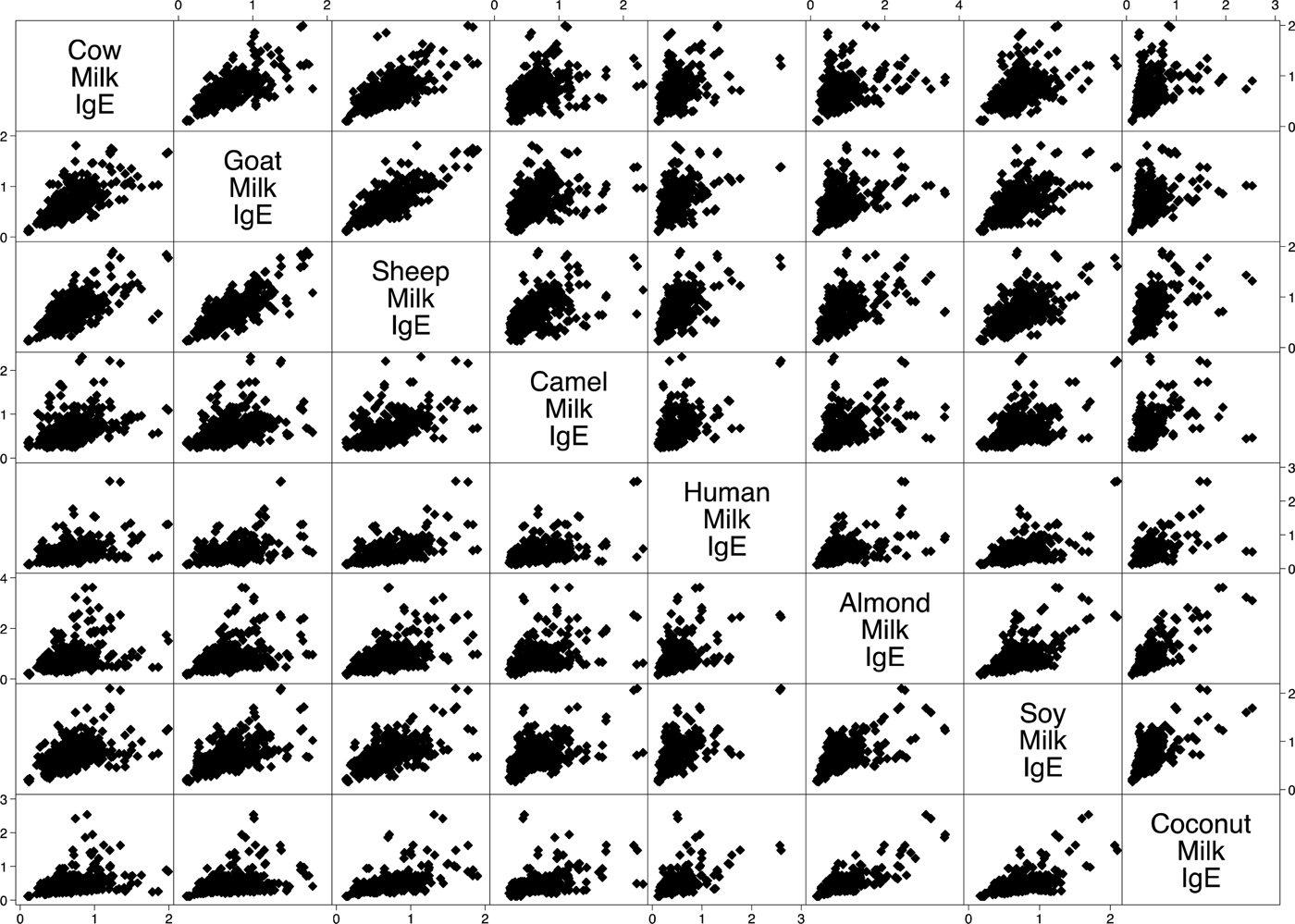
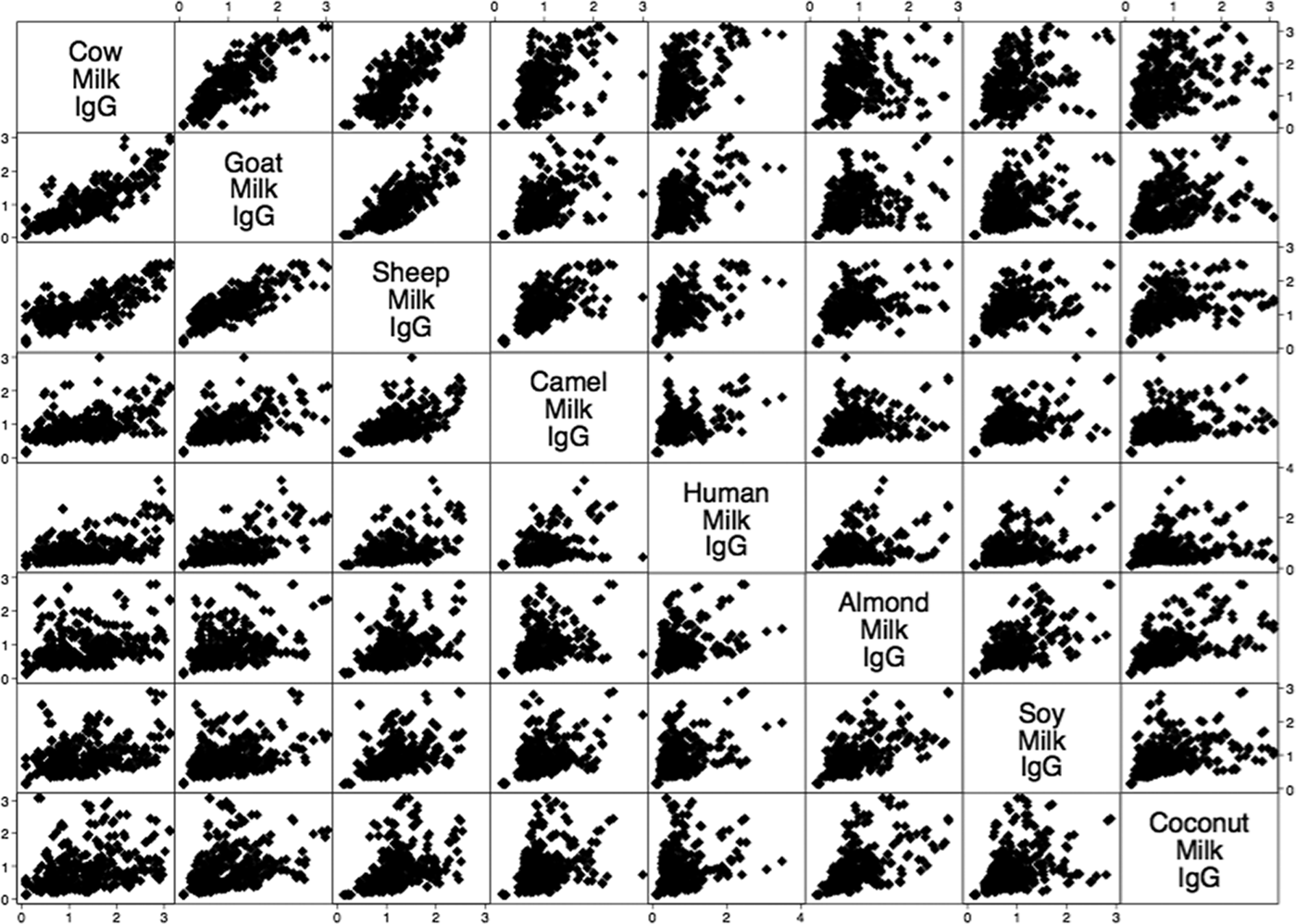
Correlative analysis for IgA, IgE, and IgG demonstrated significant correlations between reactivity to cow's milk and reactivity to sheep and goat milk (r-values 0·7–0·8). There were small to moderate correlations between human milk and soy, almond, and coconut milk substitute proteins with individuals that reacted to cow's milk (see online Supplementary Tables S10–S12). Significantly stronger linear relationships were noted for goat, sheep, and camel proteins compared to plant milk substitute proteins for individuals that reacted to cow's milk proteins × for IgA, IgE, and IgG (see Figs. 1–3).
Linear relationships between IgA antibody reaction to cow's milk and IgA antibody reaction to mammalian and plant milks.

Linear relationships between IgE antibody reaction to cow's milk and IgA antibody reaction to mammalian and plant milks.

Linear relationships between IgG antibody reaction to cow's milk and IgG antibody reaction to mammalian and plant milks.

Demonstration of antibody specificity
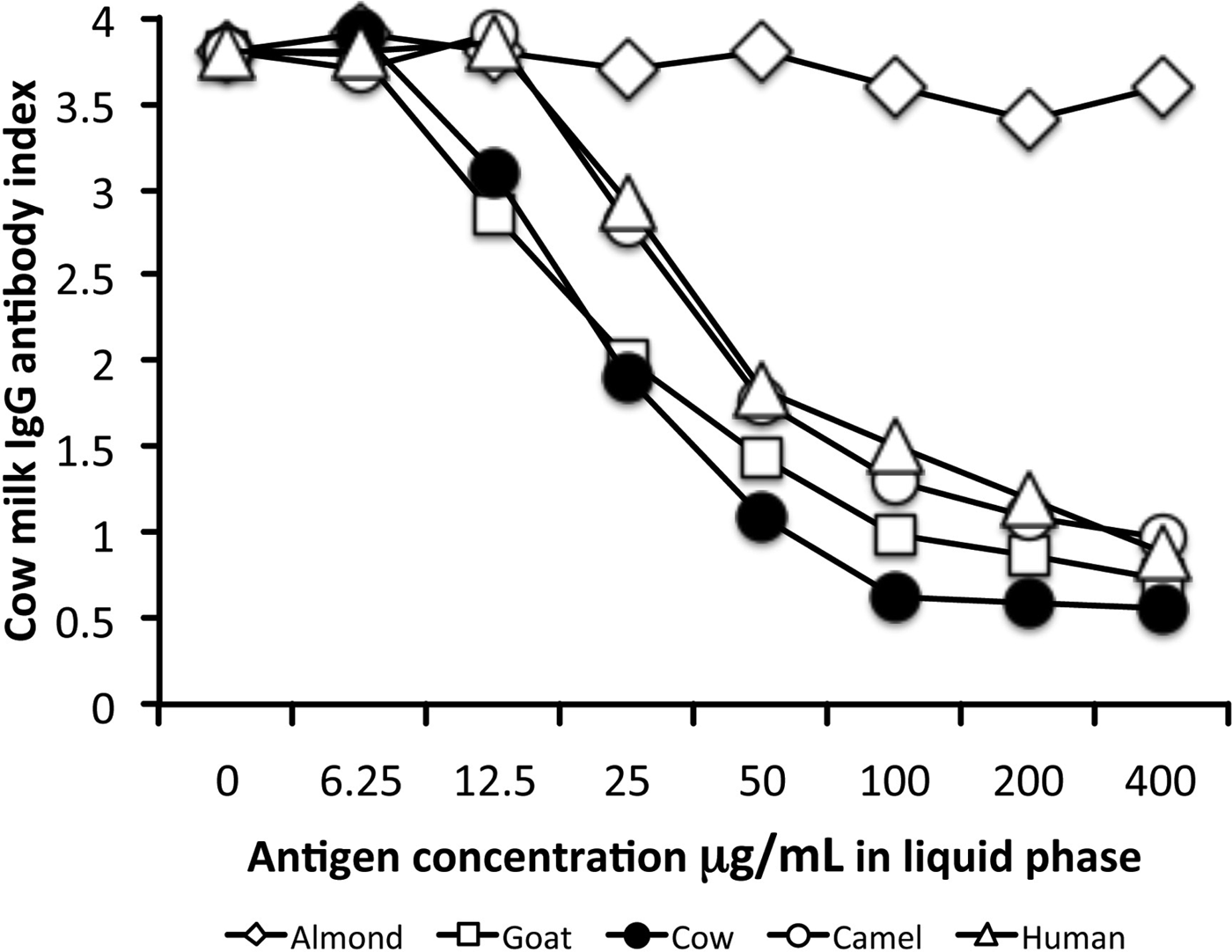
The specificity of the ELISA assay for human serum binding to cow and other milks was confirmed by having specific milks such as cow milk and others in competition assay. Results depicted in Fig. 4 show that in proportion to the concentration of cow milk protein in liquid phase, a significant inhibition in the binding of affinity-purified human IgE anti-cow's milk antibody to the cow milk-coated plates was observed. For example, the presence of 40 µg of cow milk in liquid phase caused 79·4% inhibition, 5 µg caused 66% inhibition, 1·2 µg caused 19% inhibition, and 0·6 µg caused no inhibition in the binding of this antigen-antibody reaction. This inhibition of anti-cow milk antibody binding to cow milk on a solid phase at the highest concentration of goat's milk (40 µg) was 76%, camel milk was 70% human milk was 66%, and with coconut milk substitute was very minimal (Fig. 4). The pattern of inhibition of IgG human anti-cow milk binding to cow milk by cow, goat, camel and human milk was very similar to the inhibition of IgE. Furthermore, when almond-based milk substitute was used in this inhibition study, non-significant inhibition was observed as shown in Fig. 5.
Inhibition in the binding of affinity-purified human IgE anti-cow's milk antibody to cow milk-coated plates in the absence or presence of goat, cow, camel, human, and coconut milks.

Inhibition in the binding of affinity-purified human IgG anti-cow's milk antibody to cow milk-coated plates in the absence or presence of goat, cow, camel, human, and almond milks.

Discussion
True cow's milk allergy or CMPA generally affects infants or young children, most of whom are able to outgrow it. It does, however, affect a small percentage of older children and even adults (Luyt et al. Reference Luyt, Bali, Makwana, Green, Bravin, Nasser and Clark2014). As non-IgE-mediated CMPA has been associated with the introduction and use of cow's milk-based formula, there has been some discussion as to whether the delay or stopping of this practice is beneficial regarding allergenicity. Unfortunately, the evidence is rather mixed at this point. Previous studies had recommended exclusive breastfeeding and delayed cow's milk introduction for many years as a protective measure (American Academy of Pediatrics, 2000; Greer et al. Reference Greer, Sicherer and Burks2008). Some later studies seem to indicate the contrary. A 13 000-infant Israeli cohort found that infants who were introduced to cow's milk between 105–194 d of life were 20 times more likely to develop CMPA than those who were introduced to it in the first 14 d of life (Katz et al. Reference Katz, Rajuan, Goldberg, Eisenberg, Heyman, Cohen and Leshno2010). Recently, Onizawa et al. (Reference Onizawa, Noguchi, Okada, Sumazaki and Hayashi2016) concluded that the early introduction of cow's milk formula is associated with lower incidence of IgE-mediated cow's milk allergy. There is a very real need to find an acceptable alternative for cow's milk, which is in itself only a substitute for human milk.
During the past 25 years the authors have performed testing for IgE, IgG and IgA antibodies against cow's milk proteins on thousands of blood samples. To our knowledge no studies have been conducted to measure the IgE, IgA and IgG isotype antibodies in representatives of the general population against different mammalian milks and plant-based milk substitutes. In this present study, we sought to find the best possible alternative for human milk, to determine if there is a difference in reactivity among the different kinds of cow's milk and other mammalian milks, and if plant-based milk substitutes would be acceptable for individuals allergic to any kind of animal milk. We first measured antibodies against 5 different mammalian and 3 different plant-based milks. We found that human milk, followed by camel milk, then sheep, goat, and cow milk, in that order, were from the least to the most allergenic and antigenic (Table 1). In an attempt to investigate further we measured these isotype antibodies against 5 different types of cow's milk from non-organic to organic and A1 to A2. Data presented in online Supplementary Tables S1–S3 clearly show that if a specific serum was immune reactive to one kind of cow milk it was also reactive against the other 4 cow milks. Over all, this similarity in immune reactivity to all tested cow milks should not be surprising since cow's milk contains more than 20 major allergenic proteins among hundreds of its composite milk proteins and peptides.
The amino acid sequences and protein compositions of these milks are more than 99% homologous whether or not the cow's milk is organic, non-organic, grass-fed, A1 or A2 milk. Depending on the genetic makeup of the cow, the β-casein comes in several forms. One of these forms is called A1 β-casein, which has been suggested to cause or aggravate T1D, heart disease, schizophrenia and autism. The other main form of β-casein, A2, has not been implicated in these diseases (Truswell, Reference Truswell2005). The only difference between A1 and A2 β-casein is 1 amino acid out of 224. In A1 β-casein the amino acid at position 67 is histidine, while in A2 β-casein the amino acid at position 67 is proline (De Noni, Reference De Noni2008; Givens et al. Reference Givens, Aikman, Gibson and Brown2013). This change of a single amino acid out of 224 will not affect the antigenicity and allergenicity of β-casein in either A1 or A2 variant form. Our results confirm this because we did not find a significant difference in IgE, IgG and IgA antibody production against A1 or A2. This is because milk from different cow's breeds still contains all major proteins. Therefore, if an individual cannot tolerate cow's milk, that person will react to all types of cow's milk.
Can goat, sheep and camel milks be consumed by an individual allergic to cow's milk without adverse effects?
The amino acid sequences of cow, goat and sheep caseins and α-lactalbumin are almost identical (more than 95% homologous). This is why it has been shown that if an individual is allergic to cow's milk, the probability of being allergic to goat's milk is about 92% (El Hatmi et al. Reference El Hatmi, Jrad, Salhi and Khorchani2015). β-lactoglobulin is absent in both camel and human milk. The complete absence of the β-lactoglobulin whey protein from human and camel milk is shown by gel electrophoresis in a study by El Hatmi et al. (Reference El Hatmi, Jrad, Salhi and Khorchani2015). In addition to the absence of allergenic β-lactoglobulin, camel milk has a different casein and smaller immunoglobulins, which altogether makes camel milk much less allergenic in comparison to cow, sheep or goat milk (El Hatmi et al. Reference El Hatmi, Girardet, Gaillard, Yahyaoui and Attia2007, Reference El Hatmi, Jrad, Khorchani, Dary and Girardet2014; El Fakharany et al. Reference El Fakharany, Abedelbaky, Haroum, Sanchez, Redwan and Redwan2012).
Both human and camel milk are used as therapeutic modalities for the prevention of allergies and autoimmunities (Agrawal et al. Reference Agrawal, Swami, Beniwal, Kochar and Kotbari2002; Boehm & Stahl, Reference Boehm and Stahl2007; El Agamy, Reference El Agamy2007; Al Hashem, Reference Al Hashem2009; El Hatmi et al. Reference El Hatmi, Jrad, Salhi and Khorchani2015). Similar to human milk, camel milk contains high amounts of α-lactalbumin and lactoferrin. Camel caseins have been shown to contain antioxidative peptides. Because of the heavy chain structure of camelid IgGs, their smaller size allows for better tissue penetration, giving them great advantages over other animals’ milk (Wernery, Reference Wernery2001; El Hatmi et al. Reference El Hatmi, Girardet, Gaillard, Yahyaoui and Attia2007, Reference El Hatmi, Jrad, Khorchani, Dary and Girardet2014; Ereifej et al. Reference Ereifej, Alu'datt, AlKhalidi, Alli and Rababah2011; El Fakharany et al. Reference El Fakharany, Abedelbaky, Haroum, Sanchez, Redwan and Redwan2012). Our results are in agreement with these findings. In 12 out of 24 samples with high IgE against cow's milk, the level for IgE antibody against camel and human milk was much lower than the antibody levels against cow, goat and sheep milk, however, in the other 12 samples, IgE antibodies were detected in significant amounts, with the camel milk scoring higher than the human milk. This means that an individual with an allergic reaction to cow's milk will be allergic to goat and sheep milk but may have an approximately 50% chance of not reacting to camel and human milk.
Admittedly, our results shows that camel milk is not a 100% acceptable alternative for cow, sheep or goat milk because some individuals not only produced moderate levels of IgE antibody against cow, goat and sheep but an even stronger IgE response against human and camel milk. Nevertheless, based on our results, we may conclude that for individuals allergic to cow's milk, the least allergenic alternative may be human milk, then camel milk, followed by sheep and goat in descending order. These findings are supported by risk and correlative analyses. However, for some individuals, camel milk could be as allergenic as cow's milk or even worse. Likewise, from the levels of IgG and IgA antibody production against cow, goat, sheep, camel and human milk presented in online Supplementary Tables S5 and S6, we concluded that human milk foremost followed by camel milk are the least antigenic in about half of the 24 specimens, while in the other 12 individuals human and camel milk could be just as antigenic as cow, goat or sheep milk.
What about plant-based milk substitutes?
People who are allergic to milk from one kind of animal will be reactive to almost any kind of animal milk, except perhaps human and camel milk. For this reason many reactive individuals have chosen to replace animal milk with plant or vegan milk substitutes produced from soy, almond or coconut. However, based on our results, conclusions similar to those for mammalian milks could be drawn from the data for plant milk substitutes such as soy, almond and coconut. Our data clearly shows that although coconut milk substitute is the least allergenic and antigenic, in some individuals the reaction to coconut milk substitute could still be as strong as that to almond or soy milk substitute, or sheep, goat or cow's milk.
Interestingly, we found that several individuals who were allergic to mammalian milks were also allergic to soy, almond and coconut milk substitutes simultaneously. This immune reaction to coconut, almond and soy milk substitute is not due to any antigenic similarity with mammalian milk but simply due to the allergenicity of these plant-derived liquids in certain individuals. This conclusion is based on the lack of capacity of coconut or almond milk substitute to inhibit IgE or IgG anti-cow milk antibody binding to cow milk protein-coated plates (Fig. 4).
One cannot assume that plant milk substitutes are automatically a better alternative to mammalian milks. Although the results for plant-based milk substitutes appear generally favorable, there are apparently still a small percentage of individuals that may strongly react against them. Therefore, the most advisable means of determining an acceptable milk alternative for an individual with cow's milk allergy would be to accurately test that subject for IgG, IgA and IgE antibodies against different mammalian milks and plant-based milk substitutes. The resulting test scores should be used as a guide for the removal of particular milks from the individual's diet.
In conclusion, our results indicate that human milk is still the best milk for infants. If a substitute is necessary, camel milk would seem to be the least reactive. If an individual is reactive to all mammalian milks, coconut-based milk substitute might be considered. In all cases, the best way to determine what milks to avoid would be through accurate IgE, IgG and IgA antibody testing in blood in cases of true cow's milk allergy.
Conflicts of interest
Aristo Vojdani is the CEO and Technical Director of Immunosciences Lab., Inc.
Supplementary material
The supplementary material for this article can be found at https://doi.org/10.1017/S0022029918000523
The authors wish to acknowledge Joel Bautista for his help in the preparation of this article.