Specific language impairment (SLI) is a very common childhood disorder with a prevalence rate of approximately 7% in early childhood (Siu, Reference Siu2015; Tomblin et al., Reference Tomblin, Records, Buckwalter, Zhang, Smith and O’Brien1997). According to the fifth edition of the Diagnostic and Statistical Manual of Mental Disorders (DSM-V; American Psychiatric Association, 2013), it is classified as a neurodevelopmental disease that is characterized by impairments in expressive or/and receptive language regarding different modalities.Footnote 1 These impairments concern the use and/or comprehension of speech, written language, or symbols (American Speech-Language-Hearing Association, 2016) and in further consequence the linguistic dimensions phonology, morphology, semantic, syntax, and pragmatics (e.g., Kamhi & Clark, Reference Kamhi, Clark, Dulac, Lassonde and Sarnat2013).
Besides these characteristic symptoms, SLI is increasingly associated with lower performance in different cognitive domains such as sustained selective attention, attentional shifting, working memory, inhibitory control, cognitive flexibility, problem solving, and planning (e.g., Aljahlan & Spaulding, Reference Aljahlan and Spaulding2019; Hughes, Turkstra, & Wulfeck, Reference Hughes, Turkstra and Wulfeck2009; Kapa, Plante, & Doubleday, Reference Kapa, Plante and Doubleday2017; Pauls & Archibald, Reference Pauls and Archibald2016; Roello, Ferretti, Colonnello, & Levi, Reference Roello, Ferretti, Colonnello and Levi2015; Spaulding, Reference Spaulding2010; Willinger et al., Reference Willinger, Schmoeger, Deckert, Eisenwort, Loader, Hofmair and Auff2017). In this context, it was shown that these deficits are at least partly independent of language impairment severity or linguistic demand of used tasks (e.g., Pauls & Archibald, Reference Pauls and Archibald2016). In this way, SLI is increasingly connected to general processing limitations and difficulties in the acquisition of automatic skills (e.g., Kamhi & Clark, Reference Kamhi, Clark, Dulac, Lassonde and Sarnat2013; Nicolson & Fawcett, Reference Nicolson and Fawcett2007).
Language problems in SLI should traditionally not be better explained by, inter alia, apparent sensory or neurological deficits (e.g., Kamhi & Clark, Reference Kamhi, Clark, Dulac, Lassonde and Sarnat2013). However, recent studies increasingly indicate alterations in brain morphology and functionality in children with SLI. In this context, changes were shown, for example, in language-specific regions such as Broca’s area or Wernicke’s area, in regions associated with visual perception as well as in white matter tracts connecting these brain regions (e.g., Girbau-Massana, Garcia-Marti, Marti-Bonmati, & Schwartz, Reference Girbau-Massana, Garcia-Marti, Marti-Bonmati and Schwartz2014; Kamhi & Clark, Reference Kamhi, Clark, Dulac, Lassonde and Sarnat2013; Morgan, Bonthrone, & Liégeois, Reference Morgan, Bonthrone and Liégeois2016; Van der Lely & Pinker, Reference Van der Lely and Pinker2014).
SLI appears early in childhood and often persists into adolescence and even adulthood (for summaries, see Gillam & Kamhi, Reference Gillam, Kamhi, Damico, Mueller and Ball2010; Kamhi & Clark, Reference Kamhi, Clark, Dulac, Lassonde and Sarnat2013), whereas SLI subtypes and associated symptoms are seemingly not stable over time. In this context, a cross-sectional study on SLI subtypes showed that in kindergarten children with SLI, 35% were classified as the expressive type, 28% as the receptive type, and 35% as an expressive/receptive type (Tomblin, Records, & Zhang, Reference Tomblin, Records and Zhang1996). Nevertheless, longitudinal studies showed that children frequently change from one SLI subtype to another and can do so in a short time (e.g., Conti-Ramsden & Botting, Reference Conti-Ramsden and Botting1999). With respect to SLI subtypes, however, others argue that pure expressive subtypes of SLI do not exist and that expressive problems are associated with impairments in language knowledge and problems in language input processing (Leonard, Reference Leonard2009).
In the course of typical language development, until the age of (approximately) 3, children mainly achieve bottom-up processes of language processing such as phonological word form detection, morphosyntactic categorization, lexical–sematic categorization, lexical access and retrieval, phrase structure and reconstruction as well as aspects of prosodic processing (for a review, see Skeide & Friederici, Reference Skeide and Friederici2016). Shortly before as well as at the beginning of preschool age (approximately 3–4 years of age), children increasingly develop top-down processes such as the analysis of semantic and syntactic relations (Skeide & Friederici, Reference Skeide and Friederici2016). In this context, it was shown that between ages 5 and 8 typically developing children but also children with SLI each show relatively stable language development trajectories (Norbury et al., Reference Norbury, Vamvakas, Gooch, Baird, Charman, Simonoff and Pickles2017), whereas a greater variability regarding language performance in preschoolers was seen compared to school-aged children (Schmitt et al., Reference Schmitt, Logan, Tambyraja, Farquharson and Justice2017). In preschool age, besides language processing, further cognitive abilities that heavily rely on prefrontal brain regions develop increasingly, such as working memory, and cognitive flexibility in terms of shifting ability, inhibition, attentional control, and planning (e.g., Best & Miller, Reference Best and Miller2010; Garon, Bryson, & Smith, Reference Garon, Bryson and Smith2008; Jurado & Rosselli, Reference Jurado and Rosselli2007), all of which were shown to be less well developed in SLI (e.g., Aljahlan & Spaulding, Reference Aljahlan and Spaulding2019; Kapa et al., Reference Kapa, Plante and Doubleday2017; Pauls & Archibald, Reference Pauls and Archibald2016).
Given the multiple problems in SLI as well as its prolonged course, the necessity for an early detection of language impairments is clearly given and has already been strongly recommended by associations like the American Speech-Language-Hearing Association or the American Academy of Pediatrics (Hagan, Shaw, & Duncan, Reference Hagan, Shaw and Duncan2008; Siu, Reference Siu2015). Despite these recommendations, at least in the United States, 30%–55% of the children receive no screening of language impairments by their health service provider (American Speech-Language-Hearing Association, n.d.; Siu, Reference Siu2015). Furthermore, nonverbal intelligence tests that are necessary for the diagnosis of SLI are often not administered by professionals because nonverbal intelligence performance often does not influence the access to services and such an assessment seemingly falls outside their scope of practice (see, e.g., Kamhi & Clark, Reference Kamhi, Clark, Dulac, Lassonde and Sarnat2013). The current situation regarding screening for language impairments is even more critical if everyday consequences of (undetected) SLI are considered as ongoing SLI is associated with, inter alia, poorer psychosocial outcome (Snowling, Bishop, Stothard, Chipchase, & Kaplan, Reference Snowling, Bishop, Stothard, Chipchase and Kaplan2006), a higher disposition for social–emotional and behavioral difficulties (Levickis et al., Reference Levickis, Sciberras, McKean, Conway, Pezic, Mensah and Reilly2018; Willinger et al., Reference Willinger, Brunner, Diendorfer-Radner, Sams, Sirsch and Eisenwort2003), lower independent functioning (Conti-Ramsden & Durkin, Reference Conti-Ramsden and Durkin2008), as well as with higher costs for families and states by higher health service utilization (Le et al., Reference Le, Gold, Mensah, Eadie, Bavin, Bretherton and Reilly2017).
Although research on tasks for the early and fast detection of language impairments shows promising developments (e.g., Eisenberg & Guo, Reference Eisenberg and Guo2013; Guo & Eisenberg, Reference Guo and Eisenberg2014; Lugo-Neris, Peña, Bedore, & Gillam, Reference Lugo-Neris, Peña, Bedore and Gillam2015; Sim et al., Reference Sim, Haig, O’Dowd, Thompson, Law, McConnachie and Wilson2015), it has to be noted that most of these screening procedures show disadvantageous properties or missing information with respect to, for example, duration or modality of administration and/or scoring. In this context, a recent review indicated that all openly available language assessments in English show limitations with respect to the evidence of their psychometric quality (Denman et al., Reference Denman, Speyer, Munro, Pearce, Chen and Cordier2017). Furthermore, with respect to the daily use of language assessments, it was shown that, unfortunately, psychometric properties of language tests do not influence how frequently they are used (Betz, Eickhoff, & Sullivan, Reference Betz, Eickhoff and Sullivan2013). With respect to the German-speaking area, it was shown that no adequate screening protocols for SLI are currently available (Kasper et al., Reference Kasper, Kreis, Scheibler, Möller, Skipka, Lange and Von Dem Knesebeck2011). Given the multiple and concomitant problems of SLI, the negative consequences of ongoing (undetected) SLI as well as the current situation regarding assessment tools, the necessity for the evaluation of short, effective, and feasible tools for the screening of SLI in preschoolers becomes apparent.
The “Token Test” was originally designed to measure receptive language impairments in patients with aphasia (De Renzi & Vignolo, Reference De Renzi and Vignolo1962) but was also shown to be effective in the detection of language problems in children and even preschool children (e.g., Cole & Fewell, Reference Cole and Fewell1983, Geyer, Niebergall, Remschmidt, & Merschmann Reference Geyer, Niebergall, Remschmidt and Merschmann1978). In this task, the examinees are shown plastic objects (tokens) lying on a table The tokens differ in size, form, and color. Across the different parts of the Token Test, the examinees are given increasingly difficult commands like, for example, “Touch the red circle” (in Part I, the most easiest part), or “Before touching the green circle, pick up the white rectangle” (in Part V, the most difficult part) and have to execute these demands (see, e.g., De Renzi & Vignolo, Reference De Renzi and Vignolo1962; Strauss, Sherman, & Spreen, Reference Strauss, Sherman and Spreen2006). The Token Test measures language comprehension in the form of understanding nonredundant commands (e.g., Strauss et al., Reference Strauss, Sherman and Spreen2006) and was shown to be strongly associated with the performance in language reception but also production tasks (see, e.g., Cole & Fewell, Reference Cole and Fewell1983; Gutbrod, Mager, Meier, & Cohen, Reference Gutbrod, Mager, Meier and Cohen1985).
As Token Test performance further relies on cognitive abilities like short-term memory/working memory and inhibition (see, e.g., Lezak, Howieson, Bigler, & Tranel, Reference Lezak, Howieson, Bigler and Tranel2012; Strauss et al., Reference Strauss, Sherman and Spreen2006), and is considered to indicate problems in more complex verbal comprehension or even general cognitive processing (e.g., DiSimoni & Mucha, Reference DiSimoni and Mucha1982; Geyer et al., Reference Geyer, Niebergall, Remschmidt and Merschmann1978; Kamhi & Clark, Reference Kamhi, Clark, Dulac, Lassonde and Sarnat2013; Willinger et al., Reference Willinger, Schmoeger, Deckert, Eisenwort, Loader, Hofmair and Auff2017), the Token Test seems to be very suited for screening SLI in preschool children, especially given the previously mentioned language and cognitive development in this age span.
Willinger et al. (Reference Willinger, Schmoeger, Deckert, Eisenwort, Loader, Hofmair and Auff2017) investigated the predictive role of a short German version of the Token Test (Orgass, Reference Orgass1982) as a screening of preschool SLI and showed insufficient detection rates in the screening of SLI (based on the recommendations by Plante and Vance, Reference Plante and Vance1994, regarding the classification rates of preschool language tests). Due to the advantageous properties of the Token Test, such as its sound discriminant validity and reasonable reliability, gamelike character, clear instructions, independence from gender and ethnicity, portability, and its cost-effectiveness (Peña-Casanova et al., Reference Peña-Casanova, Quiñones-Úbeda, Gramunt-Fombuena, Aguilar, Casas, Molinuevo and Martínez-Parra2009; Ripich, Carpenter, & Ziol, Reference Ripich, Carpenter and Ziol1997; Strauss et al., Reference Strauss, Sherman and Spreen2006; Taylor, Reference Taylor1998; Willinger et al., Reference Willinger, Schmoeger, Deckert, Eisenwort, Loader, Hofmair and Auff2017), they nevertheless recommend investigating the predicitve role of variations or single parts of the Token Test. In this context, a study involving adult aphasic patients, Orgass, Poeck, Hartje, and Kerschensteiner (Reference Orgass, Poeck, Hartje and Kerschensteiner1973) indicated that Part V of the Token Test potentially holds the same diagnostic value as the whole Token Test, whereas this result was opposed by Kelter, Cohen, Engel, List, and Strohner (Reference Kelter, Cohen, Engel, List and Strohner1976, Reference Kelter, Cohen, Engel, List and Strohner1977). Nevertheless, Part V could be predicitive of SLI as its increased requirements to process syntax, relational concepts, and subtle changes in symbol formulation as well as its greater syntactic and semantic variability (Orgass, Reference Orgass1982; Lezak et al., Reference Lezak, Howieson, Bigler and Tranel2012; Strauss et al., Reference Strauss, Sherman and Spreen2006) in terms of complex speech comprehension is potentially sensitive with regard to the unstable development of syntactic and semantic processing in preschool age (e.g., Schmitt et al., Reference Schmitt, Logan, Tambyraja, Farquharson and Justice2017; Skeide & Friederici, Reference Skeide and Friederici2016). According to the authors of the current study, it can be argued that Part V shows increased requirements not only regarding linguistic aspects but also regarding cognitive abilities like short-term memory/working memory, and inhibition (abilities depicted for the whole Token Test; see Lezak et al., Reference Lezak, Howieson, Bigler and Tranel2012; Strauss et al., Reference Strauss, Sherman and Spreen2006) as well as regarding cognitive flexibility in terms of set shifting, attentional control, attentional shifting, and aspects of planning (abilities not previously linked to Part V in test descriptions). Part V with its increasingly longer and difficult commands would, in the notion of the authors, put greater requirements on the child to hold the target objects in mind and to manipulate them (short-term/working memory), to maintain and shift the attentional focus between objects (attentional shifting and attentional control), to withhold touching objects that should be excluded from actions (inhibition), to change between including or excluding objects from actions (cognitive flexibility), and to analyze all information of a command in order to respond adequately (planning). Similar to linguistic aspects, these cognitive requirements could be potentially sensitive with regard to executive function impairments in SLI (as previously mentioned).
AIMS
Given the early occurring linguistic impairments, the weaker performance regarding different cognitive abilities, and the number of concomitant problems, the necessity for the evaluation of short, effective, and feasible tools for the screening of SLI in young age becomes apparent. Willinger et al. (Reference Willinger, Schmoeger, Deckert, Eisenwort, Loader, Hofmair and Auff2017) previously investigated the diagnostic value of the Token Test in preschool children and showed insufficient detection rates in the screening of SLI. Nevertheless, considering the advantageous properties of the Token Test as well as the previously mentioned theoretical implications, and further following the recommendation of Willinger et al. (Reference Willinger, Schmoeger, Deckert, Eisenwort, Loader, Hofmair and Auff2017), the aim of the current study was to analyze the diagnostic value of the five parts of the 50-item German version of the Token Test (Orgass, Reference Orgass1982). This was done to investigate whether Part V has a higher predictive value than the whole Token Test and therefore to see whether Part V can be considered as an adequate screening of SLI in preschool age. The data for the analyses in the present study were provided by Willinger et al. (Reference Willinger, Schmoeger, Deckert, Eisenwort, Loader, Hofmair and Auff2017). Whereas until 2011, adequate screening protocols for SLI in German language were scarce (Kasper et al., Reference Kasper, Kreis, Scheibler, Möller, Skipka, Lange and Von Dem Knesebeck2011), in the recent years promising language screening instruments were increasingly published (see, e.g., the ESGRAF 4-8 [Evozierte Sprachdiagnose grammatischer Fähigkeiten], Motsch & Rietz, Reference Motsch and Rietz2019; PDSS [Patholinguistische Diagnostik bei Sprachentwicklungsstörungen], Kauschke & Siegmüller, Reference Kauschke and Siegmüller2009). Nevertheless, investigating the diagnostic value of the Token Test as a short screening for SLI has further beneficial effects as it can be conducted in different languages. Therefore, the results of the current study have implications not only for the German-speaking area. The result of Part V being an adequate, short screening of SLI would further have another positive diagnostic implication as preschoolers with SLI were shown to have less clear preference for spoken answers upon being questioned and by trend use more supporting und substituting gestures (Lavelli & Majorano, Reference Lavelli and Majorano2016). In order to further compare the results of the present study with those of Willinger et al. (Reference Willinger, Schmoeger, Deckert, Eisenwort, Loader, Hofmair and Auff2017), the association between intellectual capacities and Part V of the Token Test was investigated. The hypotheses of the current study, given in the Method section, build on the results of Willinger et al. (Reference Willinger, Schmoeger, Deckert, Eisenwort, Loader, Hofmair and Auff2017) and are therefore mainly formulated accordingly. Hypotheses 1–3 addressed the question whether preschoolers with SLI and typically developing controls differ regarding performance on the different parts of the Token Test and can be adequately be classified by Part V, in view of diagnostic implications. Regarding Hypotheses 2 and 3, additional, explorative analyses were conducted with respect to explicit age groups. These reanalyses were inspired by the reviews of the manuscript.Footnote 2 Hypothesis 4 and 5 tended to offer intellectual profiles of preschoolers with SLI and typically developing children, in view of therapeutic implications.
Materials and method
Subjects
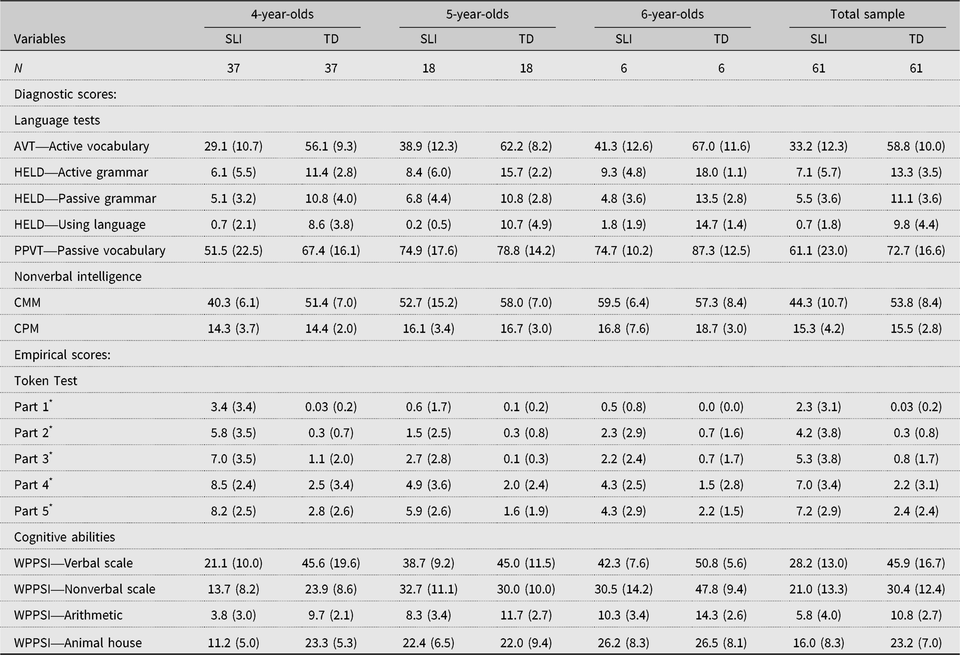
Forty-five boys (74%) and 16 girls (26%; expected gender ratio; see, e.g., Tomblin et al., Reference Tomblin, Records, Buckwalter, Zhang, Smith and O’Brien1997) aged between 4 and 6 years (M = 4.9 years, SD = 8 months) were recruited at the Medical University of Vienna. SLI was diagnosed by a psychologist according to DSM-V (2013) whereby diagnosis implied at least average scores in two nonverbal intelligence tests (Coloured Progressive Matrices—Raven, Raven, & Court, Reference Raven, Raven and Court1998; Columbia Mental Maturity Scale—Burgemeister, Blum, & Lorge, Reference Burgemeister, Blum and Lorge1954) as well as at least one below average score out of five in standardized linguistic tests (Active Vocabulary Test for 3- to 6-year-old children—Kiese & Kozielski, Reference Kiese and Kozielski1996; Heidelberg Evaluation of Language Development—Grimm & Schoeler, Reference Grimm and Schoeler1990; Peabody Picture Vocabulary Test—Dunn, Reference Dunn1965). Furthermore, a control sample of typically developing, age-matched 45 boys and 16 girls was recruited. The control sample was examined using the same tasks as with the children with SLI whereby these children were required to have at least average scores in all tasks. Scores for all tasks can be seen in Table 1.
Test scores for preschoolers with SLI and typically developing children, with scores given for the total sample patient and control group that was used for calculations in the current study as well as explorative for the different age groups (values are presented as means with standard deviations [SD])

Note: SLI, preschoolers with specific language disorder. TD, typically developing children. AVT, Active Vocabulary Test for 3- to 6-year-old children.HELD, Heidelberg Evaluation of Language Development. PPVT, Peabody Picture Vocabulary Test. CMM, Columbia Mental Maturity Scale. CPM, Coloured Progressive Matrices. WPPSI, Wechsler Preschool and Primary Scale of Intelligence.
* Error scores, higher scores mean worse performance
All preschoolers (SLI and controls) were monolingual native German speakers and all tasks in this study were performed in German. Before participating in this study, the examiners ensured that all children understood the target words used in the Token Test (colors and forms). In this pretest, no child had to be excluded from further participation. The caregivers of each child were informed and had to give their written consent prior to participation. The study protocol obtained approval by the ethics committee of the Medical University of Vienna and conforms to the provisions of the Declaration of Helsinki.
Materials
Token test
Performing a German 50-item version of the Token Test (Orgass, Reference Orgass1982), children are shown plastic objects lying on a table whereas these objects differ regarding three dimensions: size (small/large), form (rectangles/circles), and color (green/white/yellow/red/blue). Within a fixed order, children have to understand commands and perform accordingly like for example in Part I: “Touch the yellow circle.” The Token Test is divided into five parts, and each part becomes increasingly more difficult (e.g., Part II: “Touch the small yellow rectangle”; Part III: “Touch the yellow circle and the white rectangle”; Part IV: “Touch the small yellow circle and the big green circle”). In accordance with the handbook, in each part, the objects are arranged differently on the table. Part V of the Token Test was shown to be the most difficult one (Orgass, Reference Orgass1982; e.g., Part V: “Before touching the green circle, pick up the white rectangle”). Incorrect responses are scored and summed for each part separately, yielding error scores for each part. Administration time of the whole Token Test is approximately 10 min and scoring time is approximately 5 min.
Intelligence scores
Intellectual capacities were examined using the German version of the Wechsler Preschool and Primary Scale of Intelligence (WPPSI; Eggert, Reference Eggert1975), yielding a verbal and a nonverbal scale. Furthermore, the WPPSI subtests arithmetic (measuring numeracy, problem solving, and verbal working memory) and animal house (measuring visual memory, visual attention, and fine motor coordination) were performed.
Hypotheses and statistics
Hypothesis 1. Preschoolers with SLI and typically developing controls will differ significantly regarding their performance on each of the five parts of the Token Test. T tests will be performed to analyze this hypothesis.
Hypothesis 2. Preschoolers with SLI and typically developing controls will be significantly classified by all five parts of the Token Test, yielding classification rates of 80% or greater (see Plante & Vance, Reference Plante and Vance1994). A direct discriminant analysis will be performed.
Hypothesis 3. Preschoolers with SLI and typically developing controls will be significantly classified by Part V of the Token Test, yielding classification rates of 80% or greater (see Plante & Vance, Reference Plante and Vance1994). A direct discriminant analysis will be performed.
Hypothesis 4. Preschoolers with SLI who were correctly classified and those who were incorrectly classified by Part V of the Token Test will differ significantly regarding all four scores of the WPPSI. Mann–Whitney U tests will be performed (criteria for T test were not fulfilled).
Hypothesis 5. Typically developing controls who were correctly classified and those who were incorrectly classified by Part V of the Token Test will differ significantly regarding all four scores of the WPPSI. Mann–Whitney U tests will be performed (criteria for T test were not fulfilled).
Additional, explorative calculations regarding Hypotheses 2 and 3
Separate direct discriminant analyses for the classification of preschoolers with SLI and typically developing controls will be performed separately for age groups 4, 5, and 6, using all five parts of the Token Test (additional calculations regarding Hypothesis 2) as well as Part V of the Token Test (additional calculations regarding Hypothesis 3) as classifying variables. These additional analyses are explorative, especially regarding age group 6 with its small sample size (see Figure 1). Statistical analyses were performed using IBM SPSS 25 whereas all results fulfilling p < .05 were seen as significant.
Token Test error scores shown for children with specific language impairment (SLI) and typically developing, age- and gender-matched controls (TD) in the separate age groups (a) 4 years (n = 72), (b) 5 years (n = 36), and (c) 6 years (n = 12). Results indicate great differences in age group 4 and decreasing differences in age groups 5 and 6. Higher scores mean worse performance.

Results
In the following, the results with respect to each hypothesis will be presented.
Hypothesis 1
Preschoolers with SLI and typically developing controls showed significant differences regarding all five parts of the Token Test, Part I: T (120) = 5.6, p ≤ .0001; Part II: T (120) = 8.0, p ≤ .0001; Part III: T (120) = 9.2, p ≤ .0001; Part IV: T (120) = 8.5, p ≤ .0001; Part V: T (120) = 11.0, p ≤ .0001. In each part, preschoolers with SLI showed significantly more mistakes than the controls (see Table 1).
Hypothesis 2
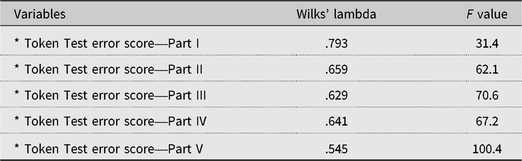
The analysis revealed a significant discriminant function, Canonical Correlation = .7, Wilks’ lambda = .5, χ2 (5, N = 122) = 75.9, p ≤ .0001. In addition, 87% of the typically developing controls and 71% of the preschoolers with SLI were classified correctly by all five parts of the Token Test, showing a total correct classification of 79% (see Table 2).
Direct discriminant analyses between preschoolers with SLI and typically developing children with respect to the five parts of the Token Test (error scores)

Note: All results are statistically significant (p ≤ .0001).
Additional calculations Hypothesis 2
Regarding age group 4, analysis revealed a significant discriminant function, Canonical Correlation = .80, Wilks’ lambda = .36, χ2 (5, N = 74) = 70.14, p ≤ .0001. In addition, 97.3% of the typically developing controls and 81.1% of the preschoolers with SLI were classified correctly by all five parts of the Token Test, Part I: Wilks’ lambda = .67, F (1, 72) = 35.44, p ≤ .0001; Part II: Wilks’ lambda = .45, F (1, 72) = 89.31, p ≤ .0001; Part III: Wilks’ lambda = .47, F (1, 72) = 81.2, p ≤ .0001; Part IV: Wilks’ lambda = .49, F (1, 72) = 75.80, p ≤ .0001; Part V: Wilks’ lambda = .46, F (1, 72) = 84.30, p ≤ .0001, showing a total correct classification of 89.2%.
Regarding age group 5, analysis revealed a significant discriminant function, Canonical Correlation = .73, Wilks’ lambda = .46, χ2 (5, N = 36) = 24.46, p ≤ .0001. In addition, 94.4% of the typically developing controls and 77.8% of the preschoolers with SLI were classified correctly by all five parts of the Token Test, Part I: Wilks’ lambda = .95, F (1, 34) = 1.92, p = .175; Part II: Wilks’ lambda = .91, F (1, 34) = 3.51, p = .069; Part III: Wilks’ lambda = .69, F (1, 34) = 15.41, p ≤ .0001; Part IV: Wilks’ lambda = .81, F (1, 34) = 7.80, p = .009; Part V: Wilks’ lambda = .51, F (1, 34) = 32.17, p ≤ .0001, showing a total correct classification of 86.1%.
Regarding age group 6, analysis revealed a nonsignificant discriminant function, Canonical Correlation = .79, Wilks’ lambda = .37, χ2 (5, N = 12) = 7.35, p = .196. In addition, 83.3% of the typically developing controls and 83.3% of the preschoolers with SLI were classified correctly by all five parts of the Token Test, showing a total correct classification of 83.3%.
Hypothesis 3
The analysis revealed a significant discriminant function, Canonical Correlation = .7, Wilks’ lambda = .5, χ2 (5, N = 122) = 72.6, p ≤ .0001, by Part V of the Token Test. In addition, 79% of the typically developing controls and 75% of the preschoolers with SLI were classified correctly by Part V of the Token Test, showing a total correct classification of 77% (see Table 2).
Additional calculations Hypothesis 3
Regarding age group 4, analysis revealed a significant discriminant function, Canonical Correlation = .73, Wilks’ lambda = .46, χ2 (1, N = 74) = 55.40, p ≤ .0001. In addition, 83.8% of the typically developing controls and 86.5% of the preschoolers with SLI were classified correctly by Part V of the Token Test showing a total correct classification of 85.1%.
Regarding age group 5, analysis revealed a significant discriminant function, Canonical Correlation = .67, Wilks’ lambda = .51, χ2 (1, N = 36) = 22.31, p ≤ .0001. In addition, 77.8% of the typically developing controls and 83.3% of the preschoolers with SLI were classified correctly by Part V of the Token Test showing a total correct classification of 80.6%.
Regarding age group 6, analysis revealed a nonsignificant discriminant function, Canonical Correlation = .45, Wilks’ lambda = .79, χ2 (1, N = 12) = 2.20, p = .138. In addition, 66.7% of the typically developing controls and 33.3% of the preschoolers with SLI were classified correctly by Part V of the Token Test, showing a total correct classification of 50%.
Hypothesis 4
Analysis regarding the univariate differences between correctly and incorrectly classified preschoolers with SLI yielded significant differences regarding all four scores of the WPPSI. Preschoolers with SLI who were correctly classified by Part V of the Token Test showed significantly lower scores on the WPPSI verbal scale, Z = –4.3, p ≤ .0001, WPPSI nonverbal scale, Z = –3, p = .003, WPPSI subtests arithmetic, Z = –4.3, p ≤ .0001, and animal house, Z = –3.5, p ≤ .0001, than those who were classified incorrectly. Details are shown in Table 3.
Group differences between correctly and incorrectly classified preschoolers with SLI as well as between correctly and incorrectly classified typically developing children with respect to the four WPPSI scores (classifications are based on the scores of Token Test Part V, and values are presented as mean with standard deviation [SD])

Note: WPPSI, Wechsler Preschool and Primary Scale of Intelligence. SLI, preschoolers with specific language impairment. TD, typically developing children. Significant results are bold faced.
Hypothesis 5
Analysis regarding the univariate differences between correctly and incorrectly classified typically developing controls showed significant differences regarding two scores of the WPPSI. Controls who were correctly classified by Part V of the Token Test showed significantly higher scores on the WPPSI verbal scale, Z = –2.8, p = .005, and WPPSI subtest arithmetic, Z = –3.3, p = .001, than those who were classified incorrectly. No significant differences were shown for the WPPSI nonverbal scale, Z = –.1, p = .951, and the WPPSI subtest animal house, Z = –8, p = .436. Details are shown in Table 3.
Discussion
SLI emerges early in child development and is characterized by impairments in expressive and/or receptive language (e.g., American Psychiatric Association, 2013; Tomblin et al., Reference Tomblin, Records, Buckwalter, Zhang, Smith and O’Brien1997). Considering the unfavorable aspects associated with SLI such as its early onset, its prolonged course, its multiple associated impairments, its unfavorable prognosis, the negative everyday life consequences of ongoing (undetected) SLI, the current situation regarding the screening of SLI, as well as the properties of existing assessment tools, the necessity for the evaluation of short, effective, and feasible tools for the screening of SLI in early childhood becomes apparent. Recently, Willinger et al. (Reference Willinger, Schmoeger, Deckert, Eisenwort, Loader, Hofmair and Auff2017) evaluated the Token Test, a task that was previously shown to detect language problems in preschool children (e.g., Cole & Fewell, Reference Cole and Fewell1983) and basically shows good psychometric properties (e.g., Strauss et al., Reference Strauss, Sherman and Spreen2006) as well as characteristics that go well with SLI symptoms, even if they change over time (see, e.g., Cole & Fewell, Reference Cole and Fewell1983; Conti-Ramsden & Botting, Reference Conti-Ramsden and Botting1999; Lavelli & Majorano, Reference Lavelli and Majorano2016; Leonard, Reference Leonard2009). Although Willinger et al. (Reference Willinger, Schmoeger, Deckert, Eisenwort, Loader, Hofmair and Auff2017) showed that the total score of a short German version of the Token Test did not yield sufficient detection rates in the screening of SLI in preschool age (age range 4–6 years), they nevertheless recommend to investigate the predicitive value of variations or single parts of the Token Test, given the advantageuos properties of the task. Following this recommendation as well as theoretical implications, the aim of the study was to investigate whether Part V has a higher predictive value than the whole Token Test and therefore to see whether Part V can be considered as an adequate screening of SLI in preschool age.
The results of the current study showed that preschoolers with SLI exhibit worse results on all five parts of the Token Test, including the easiest (Part I) and well as the most difficult (Part V). When examining these results in detail with regard to explicit age groups (see Table 1 and Figure 1), it can be seen that 4-year-old preschoolers show the worst overall results, including on the easiest part (Part I). Furthermore, it can be seen that after the age of 4, there is seemingly no difference between children with SLI and controls on Part I whereas on Parts II–V children with SLI still show worse results.
These results are presumably explained by excessive demands on language-specific top-down processes such as analysis of semantic and syntactic relations in SLI (for an overview regarding typical language development see, e.g., Skeide & Friederici, Reference Skeide and Friederici2016). This is depicted by worse results in children with SLI across the whole age range regarding Parts II–V. The overall difference (whole sample) between groups regarding Part I is seemingly mainly driven by great difficulties of children with SLI at age 4 (see Figure 1). By trend, the greatest differences between groups can be seen in Part V, which would be explained by previously reported greater requirements with regard to semantic and syntactic processing in this part (see, e.g., Orgass, Reference Orgass1982; Strauss et al., Reference Strauss, Sherman and Spreen2006). As can be seen in the explorative Figure 1, at age 4 great differences between children with SLI and typically developing children can be seen, whereas the difference between groups on each part shows similar curves at ages 5 and 6. This explorative result has to be treated with caution due to the small sample size in age group 6. Nevertheless, such a development would be in line with studies that indicate that between ages 5 and 8 typically developing children and children with SLI show relatively stable language development trajectories (Norbury et al., Reference Norbury, Vamvakas, Gooch, Baird, Charman, Simonoff and Pickles2017) whereas a greater variability regarding language performance can be found in preschoolers (Schmitt et al., Reference Schmitt, Logan, Tambyraja, Farquharson and Justice2017).
The results showing an increasing difference between preschoolers with SLI and typically developing children on Token Test performance across the progressively difficult parts could possibly be further explained by aspects on executive functions development and pathology in SLI. Whereas typical development of executive functions in young age is associated with development of the prefrontal cortex (for a review, see Garon et al., Reference Garon, Bryson and Smith2008), children with SLI were previously shown to exhibit limitations in cognitive abilities that heavily rely on prefrontal brain regions. They show, for example, weaker performance in cognitive aspects such as the ability to shift and maintain your focus (attentional shifting and sustained selective attention); the ability to avoid distraction or refraining from a dominating, incorrect response (inhibition/inhibitory control); the ability to keep information in memory as well as use it for mental operations (short-term/working memory); the ability to stick to rules and adjust to changing rules or task demands (use of rules and cognitive flexibility); or the ability to analyze given information in a way that leads to adequate responses (planning ability; see, for example, Aljahlan & Spaulding, Reference Aljahlan and Spaulding2019; Kapa et al., Reference Kapa, Plante and Doubleday2017; Roello et al., Reference Roello, Ferretti, Colonnello and Levi2015). In the notion of the authors, impairments in one or more of these abilities could lead to worse results on the Token Test, as the task requires, with increasing difficulty across parts, to hold the target objects in mind and to manipulate them, to maintain and shift the attentional focus between objects, to withhold touching objects that should be excluded from actions, to change between including or excluding objects from actions, and to analyze all information of a command in order to respond adequately.
In SLI, the lower performance on the Token Test can be possibly explained by problems in both language processing and cognitive abilities, which were shown above to be associated with Token Test performance, especially regarding Part V. This notion would be supported by literature indicating a bidirectional influence of cognitive abilities and language development such as executive functions influencing vocabulary learning or processing syntax as well as language skills mediating executive functions (for summaries see, e.g., Aljahlan & Spaulding, Reference Aljahlan and Spaulding2019; Kapa et al., Reference Kapa, Plante and Doubleday2017). Further support stems from studies on pathological brain alterations in SLI regarding regions associated with language processing as well as regions associated with higher order cognitive abilities such as executive functions (see, e.g., Agostini et al., Reference Agostini, Mancini, Chabrol, Villeneuve, Milh, George and Girard2010; Crinion et al., Reference Crinion, Turner, Grogan, Hanakawa, Noppeney, Devlin and Usui2006; Girbau-Massana et al., Reference Girbau-Massana, Garcia-Marti, Marti-Bonmati and Schwartz2014; Kamhi & Clark, Reference Kamhi, Clark, Dulac, Lassonde and Sarnat2013; Krishnan, Watkins, & Bishop, Reference Krishnan, Watkins and Bishop2016; Van der Lely & Pinker, Reference Van der Lely and Pinker2014).
Attentional shifting in terms of shifting attentional resources between targets influences language development and was shown to be impaired in SLI (Aljahlan & Spaulding, Reference Aljahlan and Spaulding2019). Abnormal electrophysiological brain activity during auditory language perception (Pijnacker et al., Reference Pijnacker, Davids, van Weerdenburg, Verhoeven, Knoors and van Alphen2017), developmental lags and variations in temporal language processing abilities (Choudhury & Benasich, Reference Choudhury and Benasich2011), and alterations in regions associated with visual perception (Girbau-Massana et al., Reference Girbau-Massana, Garcia-Marti, Marti-Bonmati and Schwartz2014) suggest problems in the integration of auditory and visual information. This would lead to problems in attentional shifting across sensory modalities (see, e.g., Aljahlan & Spaulding, Reference Aljahlan and Spaulding2019), which is important in the Token Test as verbally given commands have to be combined with visual information regarding the objects. In this context, it was shown that the integration of auditory and visual attentional shifting predicts children’s ability to understand verbal directions (Magimairaj & Montgomery, Reference Magimairaj and Montgomery2013).
With respect to the diagnostic value of the Token Test as a screening tool for SLI, the present study showed that the whole Token Test correctly classified 79% of the preschoolers with SLI and typically developing children whereas Part V of the Token Test correctly classified 77% of the whole sample (age range 4–6 years). Therefore, when taking children at preschool age/early childhood as well as at the end of preschool age/beginning of middle childhood into account (for age groups please see, e.g., Berk, Reference Berk2014; Feldman, Reference Feldman2017; Steinberg, Vandell, & Bornstein, Reference Steinberg, Vandell and Bornstein2010), the whole Token Test as well as Part V alone shows inacceptable detection rates (lower than 80%), following the guidelines of Plante and Vance (Reference Plante and Vance1994), Messick (Reference Messick1989), and the “The Standards for Educational and Psychological Testing” (American Educational Research Association, American Psychological Association, & National Council on Measurement in Education, 1999).
Nevertheless, when considering the additional, explorative analyses of the current study, in age groups 4 and 5, the whole Token Test as well as Part V alone yields acceptable identification rates whereas in age group 4 the whole Token Test nearly reaches good levels (for guidelines on detection rates of language screenings, see Plante & Vance, Reference Plante and Vance1994). In this way, in age group 4, groups were correctly classified with a rate of 89.2% by the whole Token Test and 85.1% by Part V, whereas in age group 5, groups were correctly classified with a rate of 86.1% by the whole Token Test and 80.6% by Part V. Viewing these results, it can be seen that the whole Token Test yields higher detection rates than Part V alone whereby Part V also yields acceptable classification rates with respect to age groups 4 and 5. In contrast, age group 6 was not significantly classified by any Token Test measure. It has to be noted that due to varying sample sizes, these results are of rather explorative nature and, therefore, following explanatory approaches, have to be treated with caution.
In SLI, abnormalities in the superior temporal lobe as well as regarding the inferior longitudinal fasciculus were shown (e.g., Girbau-Massana et al., Reference Girbau-Massana, Garcia-Marti, Marti-Bonmati and Schwartz2014; Van der Lely & Pinker, Reference Van der Lely and Pinker2014). These areas are typically associated with language processing in typically developing children, whereas at the age of 6, compared to adults, there is still strong interhemispheric connectivity, mainly within these superior temporal regions (Friederici, Brauer, & Lohmann, Reference Friederici, Brauer and Lohmann2011). Nevertheless, it can be hypothesized that fast changes in white matter tracts such as the corpus callosum, the inferior longitudinal fasciculus, and the superior longitudinal fasciculus starting around age 6 (Uda et al., Reference Uda, Matsui, Tanaka, Uematsu, Miura, Kawana and Noguchi2015) would also apply to children with SLI. Given such changes, at approximately age 6, children with SLI could have reached a language level at which the linguistic demands of the Token Test are not sufficient for correct classification.
In contrast, it can be hypothesized that shown increases in typically developing children at the end of preschool age in executive functions such as attentional control, working memory, inhibition, shifting, and planning (Best & Miller, Reference Best and Miller2010; Garon et al., Reference Garon, Bryson and Smith2008; Jurado & Rosselli, Reference Jurado and Rosselli2007) also apply to children with SLI to a certain degree. In this way, it can be further hypothesized that at approximately age 6, children with SLI reach a level of executive functioning at which the cognitive demands of the Token Test are not sufficient for correct classification.
Taking these two explanatory approaches together, it is also conceivable that such increases in language processing and/or cognitive processing lead to compensatory mechanisms, increasing the Token Test performance at age 6 (see Figure 1). Such a hypothesis would also be in line with the previously mentioned bidirectional influence of language processing and executive functioning (see, e.g., Kapa et al., Reference Kapa, Plante and Doubleday2017).
The Token Test seemingly does not cover all important language and cognitive aspects to identify a heterogeneous patient group such as SLI across several age groups. Likewise problems were previously discussed by Theodorou, Kambanaros, and Grohmann (Reference Theodorou, Kambanaros and Grohmann2013), as they state that the effectiveness of language tests depends, inter alia, on the multi-facetedness of assessment tools, measuring different aspects of language such as phonology, semantics, morphology, syntax, and sentence repetition. Therefore, the necessity for developing and validating new screening tools for the detection of SLI is still clearly given. In this context, Theodorou, Kambanaros, and Grohmann (Reference Theodorou, Kambanaros and Grohmann2017) showed good results using a sentence repetition task to identify SLI in Cypriot Greek-speaking children.
Summarizing the results on the predictive value of the Token Test, the results of the current study indicate that for the use of the Token Test as well as Part V alone, possible age effects have to be taken into account. The whole Token Test or Part V alone could potentially serve as acceptable tools for the screening of SLI in age groups 4 and 5, whereas regarding age 6, the diagnostic value of the Token Test needs to be further investigated in future studies. Given the current results as well as the advantageous properties of the Token Test, future studies should definitely investigate the diagnostic value of the Token Test as well as its separate parts in the same and even older age groups including greater sample sizes. These studies should further include executive function tasks so as to add empirical data to the previously mentioned hypotheses.
Previous studies suggest that SLI is often associated with weaker cognitive performance (Dyck & Piek, Reference Dyck and Piek2010; Henry, Messer, & Nash, Reference Henry, Messer and Nash2012; Willinger & Eisenwort, Reference Willinger and Eisenwort1999; Willinger et al., Reference Willinger, Schmoeger, Deckert, Eisenwort, Loader, Hofmair and Auff2017; Willinger, Voelkl-Kernstock, Neubauer, & Einenwort, Reference Willinger, Voelkl-Kernstock, Neubauer, Einenwort, Kallus, Posthumus and Jimenez2001). Another aim of the study was to provide intellectual profiles of children who were previously correctly classified by Part V of the Token Test in comparison with incorrectly classified children. It was shown that correctly classified preschoolers with SLI exhibited significantly worse results with respect to nonverbal and verbal intelligence, numeracy, problem solving, verbal working memory, fine motor coordination, visual attention, and visual memory than incorrectly classified preschoolers with SLI. Furthermore, it was shown that correctly classified typically developing children showed better performances in verbal intelligence and the WPPSI subtest arithmetic than incorrectly classified typically developing children. On the one hand, these results support the notion of the Token Test being an assessment tool for more general cognitive abilities (see, e.g., DiSimoni & Mucha, Reference DiSimoni and Mucha1982; Peña-Casanova et al., Reference Peña-Casanova, Quiñones-Úbeda, Gramunt-Fombuena, Aguilar, Casas, Molinuevo and Martínez-Parra2009; Willinger et al., Reference Willinger, Schmoeger, Deckert, Eisenwort, Loader, Hofmair and Auff2017) as well as the notion of SLI being dependent on general processing limitations (see, e.g., Kamhi & Clark, Reference Kamhi, Clark, Dulac, Lassonde and Sarnat2013; Nicolson & Fawcett, Reference Nicolson and Fawcett2007). On the other hand, these results as well as the result that preschoolers with SLI showed worse performance regarding each part of the Token Test (even the easiest parts), indicate the urgency of an early detection of SLI as well as early therapy for children with SLI. In this context, recent research shows promising therapeutic approaches like, for example, grammar training (Smith-Lock, Leitano, Lambert, & Nickels, Reference Smith‐Lock, Leitao, Lambert and Nickels2013; Smith-Lock, Leitãno, Lambert, et al., Reference Smith-Lock, Leitão, Lambert, Prior, Dunn, Cronje and Nickels2013), specific read-aloud techniques (Justice, Logan, & Kaderavek, Reference Justice, Logan and Kaderavek2017), or metacognitive and metalinguistic training (Schiff, Nuri Ben-Shushan, & Ben-Artzi, Reference Schiff, Nuri Ben-Shushan and Ben-Artzi2017). Furthermore, it was shown that higher education of parents as well as more adequate judgment of executive functions in children by teachers increases the chance that children with SLI receive therapy (Wittke & Spaulding, Reference Wittke and Spaulding2018).
Conclusion
Preschoolers with SLI showed significantly worse performance in all five parts of the Token Test than age- and gender-matched typically developing controls including the easiest (Part I) and well as the most difficult (Part V). This result can likely be explained by greater demands on children with SLI regarding language-specific top-down processes typically developing in this age span such as analysis of semantic and syntactic relations. This result could further be explained by greater demands on children with SLI regarding cognitive abilities associated with the Token Test such as short-term memory/working memory, inhibition, attentional control, attentional shifting, set shifting, and planning. Another explanation could probably be SLI-specific problems in the integration of auditory and visual information, which is important in the Token Test as verbally given commands have to be combined with visual information regarding the objects. These explanations would be supported by shown language and executive functioning deficits in SLI and/or corresponding brain pathology. Additional analyses involving explicit age groups showed that across all age groups, apparent differences regarding Parts II–V of the Token Test could be seen. Furthermore, great differences between patient and control group was shown at age 4, whereas afterward this difference seemingly decreases and rather similar curves across all Token Test parts can be seen in age groups 5 and 6. These results are supported by studies that show relatively stable language development trajectories between ages 5 and 8 as well as a greater variability regarding language performance in preschool age. The whole Token Test correctly identified 79% of the preschoolers with SLI and typically developing children, whereas Part V of the Token Test correctly classified 77% when taking the whole sample (age range 4–6) into account. Therefore, at least in a sample comprising children in early as well as middle childhood, the Token Test cannot be seen as an effective tool for the detection of SLI. Nevertheless, additional analyses showed that in age groups 4 and 5, Part V of the Token Test yielded acceptable classification rates (85.1% and 80.6%) whereas age group 6 was not significantly discriminated by any Token Test variable. The Token Test seemingly does not cover all important language and cognitive aspects to identify a heterogeneous patient group such as SLI across several age groups. With respect to the results regarding age group 6, it can by hypothesized that age-specific increases in language processing and executive functioning as well as neurodevelopmental aspects that were to date shown in typically developing children also apply to children with SLI. In this way, increases in language processing and/or cognitive processing could lead to compensatory mechanisms, increasing the Token Test performance at age 6. Given the results on Token Test performance as well as the intellectual profiles provided by the present study, the necessity of an early detection of SLI as well as an early therapy for children with SLI is clearly given.
Conflicts of interest and source of funding
The authors report no conflict of interest. This study did not receive any funding.