INTRODUCTION
Markets are necessary intermediaries between rural and urban consumer demand on the one side, and agricultural production on the other. While most of today's African smallholders combine subsistence farming with marketing a smaller surplus production, an expansion of well-functioning regional, national and international markets may provide them with incentives to increase their market-oriented surplus production, leading to increased incomes (Barrett Reference Barrett2008; World Bank 2007). The argument that well-functioning market institutions can provide incentives for productivity increase and technological change in smallholder communities is reasonably uncontested (see Barrett Reference Barrett2008; Hayami & Ruttan Reference Hayami and Ruttan1971). What is more problematic is to identify the specific characteristics of good market institutions, understand how they develop, and define what role they play in overall processes of agricultural development. At present, market systems in Africa are relatively underdeveloped, both institutionally and technologically. This poor state of markets hinders an accurate reflection of both the relative price between factor endowments and the production relationship between supply and demand. Poorly developed markets thus distort smallholders' incentives for surplus, market-oriented agricultural production (see Jayne et al. Reference Jayne, Govereh, Mwanaumo and Nyoro2002; Shiferaw et al. Reference Shiferaw, Obare and Muricho2008; World Bank 2007).
The point of departure for this article is an interest in understanding pathways within the larger process of agricultural development, with commercialisation and market orientation as an essential part of that process. The article seeks to further our understanding of conditions and incentives for smallholders' market participation, and to give examples of how well-functioning market institutions can develop at the local level. It consists of a case study on smallholders' marketing of agricultural products in Meru, Tanzania. The study is rooted in an understanding of historical processes of change, but focuses on contemporary agricultural production and market opportunities. It poses three specific research questions: through which channels are agricultural products marketed in Meru? What are the relative advantages for smallholders of different marketing channels? What is the significance of petty trading in agricultural products for smallholders' household economies?
In both the Tanzanian and the general sub-Saharan Africa context, Meru is an area of relatively successful agricultural development, significant market integration and improving overall standards of living (Hillbom Reference Hillbom2012; Larsson Reference Larsson2001). Although the Meru experience is not unique, it is not a representative case for sub-Saharan Africa, and consequently one must be careful when drawing generalised conclusions from the study. However, investigations into potential leading localities and regions can be valuable when identifying and drawing lessons from embryonic processes of change. To capture and learn about the dynamics in local systems of production, including institutional development and change, there is a general need for in-depth region-specific studies (Hopkins Reference Hopkins2009; Nunn Reference Nunn2009; Schirmer et al. Reference Schirmer2010).
AREA BACKGROUND
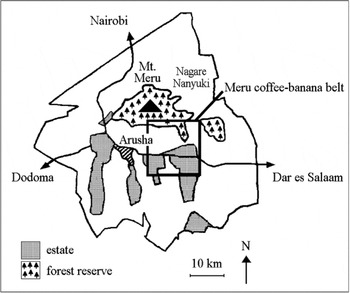
Meru is located 5 km east of Arusha town within Arumeru District in north-eastern Tanzania, and covers roughly 50 sq. km on the south-eastern slopes of Mount Meru. Soils are of volcanic origin and soil fertility is considered medium to high. It has a tropical climate moderated by altitude, and a bi-modal rainfall pattern with an average precipitation of more than 1,200 mm per annum, but with significant local variations. Climatic conditions paired with gravity irrigation systems provide a fair access to water for agricultural purposes. Favourable agricultural conditions have been a precondition for the development of intense farming methods. Due to its agricultural system based on coffee–banana intercropping, the core area is termed the Meru coffee–banana belt (see Figure 1). The area was never subjected to the Tanzanian villagisation programme in the 1970s, and villages function as administrative divisions where dwellings are spread out and each household primarily cultivates the plots surrounding the homestead.
The Arumeru District with Meru area

During the late nineteenth and early twentieth centuries, land was alienated as the German colonial administration established a forest reserve above 1,600 metres on Mount Meru, and awarded land to European and Afrikaner settlers in the lowlands. Expansion to the west had already been blocked in the mid-nineteenth century by the arrival of the Arusha people (Larsson Reference Larsson2001: 31–2; Spear Reference Spear, Maddox, Giblin and Kimambo1996: 16). From the decades following land alienation and continuing until the present, population increase on the mountain has been radical. Between 1902 and 1948, the population increased from approximately 5,500 to 19,000, and during the next two decades it almost doubled. It reached 62,500 inhabitants in 1988 and population growth continued throughout the twentieth century (Larsson Reference Larsson2001: 106, Table 4.1). The average population density grew from 37 persons per square kilometre in the 1930s to 114 in the 1960s, and 170–250 in the 1970s (Spear Reference Spear1994: 6; Reference Spear1997: 128–9). Population density has remained extremely high and while the national average in Tanzania is forty-six persons per square kilometre, the density in Meru core area is on average above 1,000. In some villages on the Dar es Salaam-Nairobi road, density can even reach 2,000 persons per square kilometre (Larsson Reference Larsson2001: 35, 39).
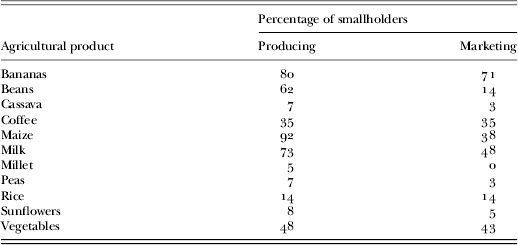
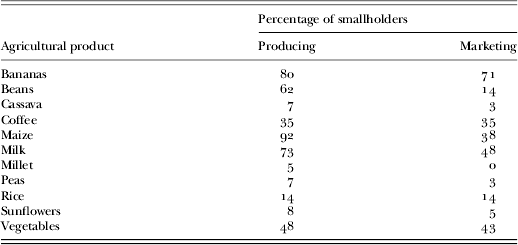
Demographic conditions have driven a farm intensification process that has been on-going since the mid twentieth century. This has included both technological and institutional change in local agricultural systems of production. The previous open grazing range has been turned into fields for crop farming, while free-ranging Zebu cattle have been replaced by stall-fed exotic breeds. This has resulted in both more efficient land use and increased milk production (Hillbom Reference Hillbom2011). Traditional staple crops such as bananas, beans, maize and millet are central primarily for subsistence farming, but also for surplus production, and coffee has been grown as a promoted cash crop since the 1920s. During the last half century, cropping patterns have changed and become more diversified with the introduction of a range of new types of vegetables, e.g. tomatoes, carrots, cabbage, Irish potatoes, onions, green beans and sweet peppers (see Table 1). Some smallholders have engaged in contract farming, producing more specialised vegetables such as baby corn, sweet peas and lettuce, as well as flowers and seeds. Although the original driving force in the farm intensification process was changes in land/labour ratios, the production of staple crops, vegetables and dairy products has been further encouraged during the last two to three decades by significant market expansion (Hillbom Reference Hillbom2011, Reference Hillbom2012).
Agricultural goods produced and marketed by Meru smallholders
Source: Questionnaire 2008–2011.
In the present text, market expansion is discussed primarily from the point of view of institutional development and change, but it should be stressed that technological change is also a significant contributing factor. The development of infrastructure, primarily transport and mobile telecommunications, helps smallholders to reach and receive relevant price information from potential markets. In this respect, Meru is well situated as the heavily trafficked Dar es Salaam–Nairobi road cuts through the area and from there, dirt roads venture both up the mountain slopes and to the plains in the south. The relatively well functioning infrastructure facilitates farmers' access to local, regional, national and international markets, and reduced transaction costs.
The economic success and continuous expansion of nearby Arusha town has led to a growing number of urban consumers in general, and of consumers with improved levels of income specifically. Arusha has a population of more than 270,000 (NBS 2005); size and economic dynamics stemming from tourism, mining and a large service sector make it one of the biggest and most important towns in Tanzania. Urbanisation in the Arumeru District includes an increase in population numbers in urban and semi-urban settlements in Meru itself, such as Tengeru, Usa River and Magia Chai. Combining the urban population of Arusha and the rest of the district, urban dwellers constitute roughly 35% of the total population. Previous studies from the Sahel region indicate that when urban dwellers make up 30% and above of an area's population, urban demand becomes significant enough to motivate smallholders to move away from subsistence farming and produce specifically for the market (Cour Reference Cour2001). This conclusion resonates well with the Meru experience. Meanwhile, population increase and land scarcity in Meru have resulted in a growing number of land poor and even landless rural inhabitants who can no longer produce enough food for the household. These have to complement farming with off-farm incomes, and provide a growing rural demand for agricultural products. This rural demand is further boosted by increasing cash incomes for net producing smallholders, allowing them to diversify their consumption patterns.
THE ROLE OF MARKETS
Successful market exchange depends on good institutions and functioning market infrastructure. Institutions are here defined in the tradition of North (Reference North1990) as ‘rules of the game’. They can be either formal (i.e. legislation, government regulations) or informal (i.e. rules of conduct, codes for interaction). Together they set up the framework for human interaction and exchange. Appropriate institutions can ensure optimal information transmission, set up a framework for mediating transactions, transfer property rights, enforce contracts and regulate competition (see Coase Reference Coase1988; World Bank 2007). One key explanation for market failure in rural sub-Saharan Africa is that the institutional structure has been unsuccessful in meeting these requirements, resulting in high marketing and transaction costs (see Barrett Reference Barrett2008; Shiferaw et al. Reference Shiferaw, Obare and Muricho2008: 26). Agricultural marketing systems have often suffered from problems such as imperfect information, contract enforcement problems, poor financial arrangements, high risks associated with failing harvests, and seasonal fluctuation (Jayne et al. Reference Jayne, Govereh, Mwanaumo and Nyoro2002: 1968). It has often been argued that this market failure cements low productivity in the agricultural sector (see Shiferaw et al. Reference Shiferaw, Obare and Muricho2008; World Bank 2007).
To come to terms with failing market systems, good institutions need to be created that reduce transaction costs for smallholders who wish to participate in market transactions (Kydd & Dorward Reference Kydd and Dorward2001). This concern has become well known as the call for market reform has been heard for several decades. Market liberalisation and reform were central to the Structural Adjustment Programmes in the 1980–90 s, and pathways and outcomes have since varied. Some politicians and academics claim that these reforms have contributed to the present agricultural crisis, and urge that the state resume activities directing farm inputs and commodities. Others claim that market liberalisation has been beneficial for smallholders, and that present market failure can be explained by prevailing poor market institutions and insufficient infrastructure, and even by insufficient liberalisation (see Barrett Reference Barrett2008; Jayne & Jones Reference Jayne and Jones1997; Jayne et al. Reference Jayne, Govereh, Mwanaumo and Nyoro2002; Poulton et al. Reference Poulton, Dorward and Kydd1998, Reference Poulton, Kydd and Dorward2006). Practical remedies for market failure, however, require further investigation of specific issues such as poor roads, lack of storage, poor information on prices, restricted numbers of traders, difficulties in securing payments, taxes and governments restrictions. Concrete solutions can only be found after case-specific causes of market failure have been identified.
Good market institutions can be created and developed through government involvement and trade promoting policies (see Bardhan Reference Bardhan1989; Barrett Reference Barrett2008; North Reference North1987; Poulton et al. Reference Poulton, Kydd and Dorward2006). Increasingly in contemporary Africa, private actors such as export firms, supermarket chains, wholesalers and long-distance traders also play an important role in market expansion (see Delgado et al. Reference Delgado, Rosegrant, Steinfield, Ehui and Courbois1999; World Bank 2007). However, although an aiding government environment and large-scale private business help to promote surplus production and market exchange, this does not have to be a precondition for the development of good market institutions. Without dismissing or undervaluing the potential of state or private led top-down intervention, this article focuses mainly on processes of change where new market opportunities are created from below as a result of local and regional technological and institutional change. In Meru, well-functioning market institutions for agricultural products have primarily been created by producers, consumers and petty traders as a bottom-up process while government and larger private companies have played a limited role.
An increase in surplus of existing agricultural production is one way to enhance smallholders' market integration, but this may not be enough. Incomes derived from agricultural development may increase even more if smallholders also make the transition from growing low-value staple crops to producing high-value agricultural products (World Bank 2007). A change-over in production may be a way to tap into an increasing demand stemming from the growth in urban population and wealth on the continent. If markets function well, urbanisation can be a positive force. Several studies show that increasing urbanisation is affecting local farming systems in present sub-Saharan Africa. In particular, mixed farming systems (farming combining crop, and cattle raising), like those found in Meru, appear to have most to gain, because the demand for high-value products, such as vegetables, meat and dairy, is greatest in urban areas where general income levels are higher (see Hillbom Reference Hillbom2011; Jayne et al. Reference Jayne, Zulu and Nijhoff2006; Tiffen Reference Tiffen2006).
METHODS AND DATA
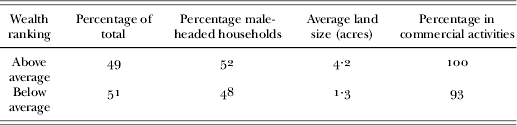
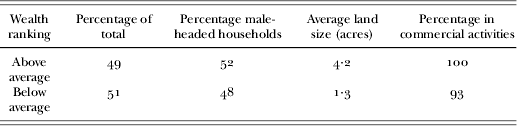
Qualitative methods have been used in data collection and analysis. The study is part of a larger project on Meru smallholders' production and marketing strategies running from 2008 to 2011. Questionnaires were distributed in ten villages throughout Meru, with 240 households sampled to represent variations in wealth, age, gender, climatic preconditions, agricultural production and distance to main roads and markets (see Table 2). These included inquiries into smallholders' production and marketing of agricultural products as well as their involvement in trading as a strategy to diversify their incomes.
Characteristics of selected smallholder households
Source: Questionnaire 2008–2011.
In 2009, market expansion in the area was investigated through in-depth semi-structured interviews with seventy traders. Of these, twenty-eight were smallholders who traded as a complementary income to farming. Thirty-two were professional traders active in Meru, and ten were professional traders with their base in Arusha. Further in-depth studies were made of two cooperative dairies, four coffee cooperatives, three village shops and one micro-finance institution, all situated in Meru. Government officials in Arusha were also interviewed regarding government strategies to facilitate market expansion in Meru and Arusha. In 2011 information on smallholders' access to credit was collected in another in-depth study, in the course of which six commercial banks, five micro-finance institutions, three co-operatives and fifteen groups and individuals receiving various forms of loans were interviewed.
Marketing the Agricultural Surplus
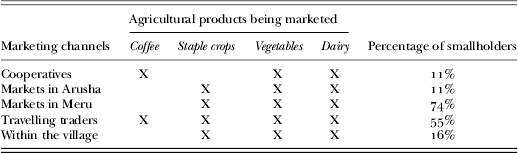
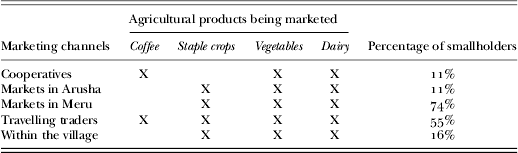
Meru smallholders engage in several market institutions simultaneously (see Table 3). Their transactions may be in the form of one shot deals or repeated interactions, and although they may not always decide for the economically optimal outcome, they are generally well informed about their alternatives. The characterisation of African smallholders as potentially flexible and initiated market participants is supported by other studies (see Hillbom Reference Hillbom2011; Mdoe & Wiggins Reference Mdoe and Wiggins1996; World Bank 2007). Since the 1980s, transaction costs related to the quality of both physical infrastructure and institutional arrangements have been falling, for reasons including improvements in information about market conditions, as well as physical infrastructure such as roads and marketplaces in Meru. With expanding interaction between producers and traders, it has also become easier and less risky to set up transactions. Meanwhile, although the state may not have actively aided market expansion apart from improving some physical infrastructure, it has not hindered it by charging excessive taxes or prohibiting the movement of commodities.
Marketing channels for Meru smallholders
Source: Questionnaire 2008–2011.
Market channels within the village
In the questionnaire sample (2008–2011), 16% of smallholders adhered to the strategy of selling within the village when marketing their agricultural products, primarily bananas, vegetables and milk, products that are already integrated in existing farming patterns (see Table 3). Selling to the village shops requires smallholders to set up long-term contracts where they are expected to deliver products every day or week, while being paid weekly or monthly. They may also run a credit in the shop, buying farm inputs such as animal feed and other necessities. Purchases are later deducted from the payment for their products. On the one hand, profit levels for selling within the village are usually 10–15% lower for the producer than when receiving optimal payment in the local marketplace (smallholders, Meru, September 2009 int.). On the other, risks and transaction costs are also lower. The system offers security to the producer as it relies entirely on traditional, endogenously developed market institutions and prices are arranged beforehand. In addition, as most smallholders find it difficult to save money that can later be spent on farm inputs, it is valuable to secure access to these products from the shop and to have a contract where they can be paid in instalments. Further, taking goods to the nearby shop means that the smallholder has no expenses for transport to market or marketing fees. Finally, labour resources can be concentrated on working in the fields, increasing agricultural production instead of investing time and effort on travel to the market (ibid.).
There is no shortage of local customers in the village: smallholders who have either specialised in other products or do not produce enough for their household needs. Village smallholders may have difficulties finding the time to go to the local marketplace and therefore prefer buying in the village. Neighbours who find that they have common interests in complementing their own agricultural production with the surplus production of other households may well set up their own trading arrangements. Prices and transaction costs resonate with selling to the village shop, and contracts between neighbours are enforced by social pressure and continuous opportunities for both parties to exit and use alternative marketing channels (smallholders, Meru, September 2009 int.).
As well as securing a supply of products from smallholders in the villages, shopkeepers also travel to the local markets, buying up local agricultural products or food cash crops produced in other parts of Tanzania. As costs for transport to the village have to be added, retail prices in the village shop are often 5–10% higher than in the marketplace. However, when shopkeepers successfully buy wholesale in the market, they can offer agricultural products in the village at the same retail prices as in the marketplace, and still make a reasonable profit. Shopkeepers with access to storage facilities can buy larger quantities of staple crops such as maize and beans, thereby negotiating better prices and improving their profits even more (village shop keepers and smallholders, Meru, September 2009 int.).
Marketing through cooperatives
Government-initiated cooperatives were top-down projects, the preconditions for which depended on national policy. The movement for building smallholder peasant cooperatives in Tanzania originated in the Kilimanjaro area in the 1930s, and received a further boost during the post-independence socialist policies of the 1960–70 s. Cooperatives were given a prominent role in the rural development process, represented a government strategy for controlling and taxing agricultural production, and primarily promoted cash crops – coffee in the case of Meru. They would pool together the efforts of small-scale producers and act as a mediator between them and large-scale buyers, offer subsidised farm inputs that smallholders could get on credit, provide education, etc. (Hydén Reference Hydén1974). In Meru today, most coffee cooperatives have disappeared or are in decay since the economic crisis of the 1980s and deregulation in the 1990s (coffee cooperative representatives, Meru, September 2009 & February 2011 int.). Although cooperatives were formerly used by most smallholders in Meru, only 11% of farmers in the questionnaire sample presently sell their products through cooperatives of some sort (see Table 3).
There are still a few surviving coffee cooperatives, and 33% of farmers producing coffee use them for marketing their products. The decline of coffee cooperatives over the last three decades has gone hand-in-hand with the decrease in incomes from coffee. In the 1990s, it was thought that deregulation and the presence of private traders would improve market opportunities for smallholders as well as increase producer prices, but this turned out not to be the case. Annual average prices for coffee paid to growers in Tanzania fell from US$1.19 per pound in current terms in 1997 to US$0.24 per pound in 2002. Since then there has been an upsurge in prices, and in 2008 producers received US$0.88 per pound (ICO 2011). The downfall of the cooperatives, however, began before deregulation and falling prices as corruption and inefficiency undermined their activities. Since the heyday of the cooperatives in the 1970s, some coffee cooperatives in Meru have lost 85% of their previously active smallholders (coffee cooperative representatives, Meru, September 2009, February 2011 int.).
Today, 67% of coffee growers report selling to private traders who represent large national and international companies. A few state that this is a conscious choice due to higher prices, but most would prefer to have access to a well-functioning coffee cooperative (smallholders, Meru, September 2009 int.). The cooperatives offered their members access to factories for washing, pulping and drying the coffee, and this improved the quality of the final product. With the disappearance of the cooperatives and their factories, smallholders rely on their individual resources, but poorer quality results in lower producer prices (coffee cooperative representatives and smallholders, Meru, September 2009 int.).
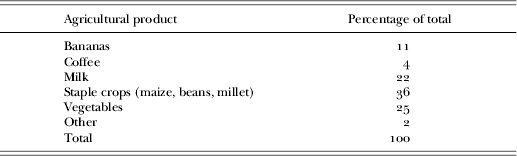
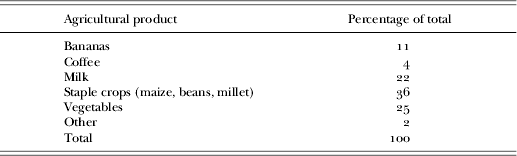
Due to falling coffee prices, increasing prices for farm inputs and expanding markets for horticulture and dairy products, smallholders in Meru started uprooting their coffee as early as the mid 1990s. Despite the last decade of systematic increase in producer prices, this trend has continued (coffee cooperative representatives, Meru, September 2009, February 2011 int.). Thirty-five per cent of smallholders in the questionnaire sample still grow coffee (see Table 1), but only 4% claim it to be their main source of income (see Table 4).
Main sources of agricultural incomes among smallholders
Source: Questionnaire 2008–2011.
Generally, both coffee cooperatives and private traders pay in two instalments over the year, but smallholders find it difficult to budget coffee incomes to buy the necessary farm-inputs at the appropriate time. Instead, many smallholders prefer to sell milk, which provides a small but daily income for the family (Hillbom Reference Hillbom2011). Vegetables are also favoured, as they give three to four harvests a year, and different types of vegetables have different seasons, so that that there is a more constant flow of income (smallholders, Meru, February 2011 int.). During the last decade, smallholders have initiated a new type of cooperative to organise their production and marketing of dairy and horticulture. This trend of local initiatives to create rural producer organisations is not unique to Meru. It has been recognised in numerous micro-studies by scholars, and has also captured the interest of donors and governments (Bernard & Spielman Reference Bernard and Spielman2009).
The newly formed vegetable cooperatives usually operate under contract farming schemes, where deals are made between cooperatives and larger national or international private companies seeking high-quality production of specialised crops, such as green peas and baby corn, to be exported or sold in national supermarkets. Significant investment in farm inputs is needed to farm these exotic crops, and meet the quality standards of the companies, but with higher production costs come potentially higher profit margins. Such contract farming has expanded rather than revolutionised existing vegetable farming, and provides a good match between top-down interests and grass-root initiated smallholder organisations (vegetable cooperative representatives, Meru, February 2011 int.).
Meanwhile, locally initiated milk cooperatives have developed their own refinement processes in Meru. They set up continuous as well as temporary delivery contracts with smallholders in surrounding villages to ensure a constant supply of milk. Based on local supply, they produce pasteurised and packaged milk, yoghurt, butter and cheese that are sold directly to consumers in the village or through street vendors in urban areas, to rural and urban shops as well as to supermarkets in Arusha (Hillbom Reference Hillbom2011). Their major constraint is to find the money needed to invest in dairy plants and counter the seasonal demand for certain products such as cheese, which is vulnerable to fluctuations in the tourist sector. The volumes of these small, local dairies are increasing and they can collect 7,000–12,000 litres of milk per month depending on seasonal variations in production (milk cooperative and micro-finance representatives, Meru, September 2009, February 2011 int.).
The new cooperatives have taken up several of the services offered by the old government-initiated cooperatives: smallholders access buyers in lucrative markets with whom it would be difficult to negotiate as individuals; payments are made in instalments so that smallholders have their incomes spread out over the year; farm inputs and veterinary services are offered on credit, using the future production of the individual smallholder as collateral; the cooperatives attract other sources of credit such as micro-finance organisations; and farm demonstrations and other types of education are offered.
Private traders
In the wake of market liberalisation in the 1990s, the number of private traders travelling to the farms has increased, and the range of agricultural products has diversified beyond promoted cash crops (coffee) and traditional crops (bananas, beans, cassava, coffee, maize, millet), to include horticulture (tomatoes, cucumbers, carrots, Irish potatoes, green beans, sweet peppers, etc.) and dairy. The characteristics of these traders vary. Traders in bananas, beans, cassava, maize and vegetables may be either agents of larger companies, or self-employed in small-scale business schemes. The larger enterprises are likely to be registered and be part of the formal sector of the economy, while the self-employed as a rule operate in the informal sector. Capital to set up the business can be secured in various ways: registered trading companies may get it from commercial banks, while informal businesses may receive micro-finance loans (wholesale traders, Meru, September 2009 int.).
Smallholders selling to private traders save the time, effort and costs (transport, markets fees, etc.) of taking their products to the marketplace, and do not have to risk being unable to off-load their products or having to sell at bargain prices. On the other hand, prices offered by travelling traders are lower than those the smallholders could get if they themselves went to the market. The questionnaire sample shows that 55% of smallholders sell to traders who come to their farm, and that this marketing channel embraces all sorts of products (see Table 3).
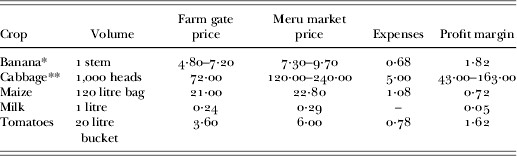
Table 5 contains selected illustrative examples of prices and profits for various products. It is important to emphasise that this information can only be read as an illustration of existing market conditions. Prices fluctuate significantly over seasons, primarily due to availability of a crop depending on harvest conditions and for some products due to changes in demand during tourist seasons. On top of seasonal inconsistency, there are also no set prices in the marketplace. Instead profits are determined by negotiations between sellers and buyers, reflecting the temporary match between supply and demand.
Selected illustrative transactions (all prices in US$)
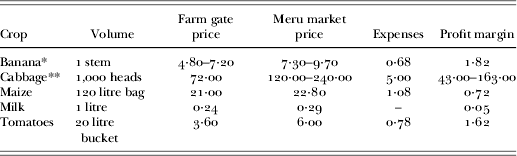
* The price for banana stems fluctuates depending on size and quality.
** Cabbage is bought at a set price in the plot before harvest and the selling price fluctuates depending on size and quality of each head.
Sources: Interviews with banana/cabbage/maize/milk/tomato growers, Meru, September 2009.
Transactions between smallholders and private traders include both long-term contracts and temporary opportunities. Most commonly, traders travel around the countryside looking for suppliers, and negotiations are carried out at the farm. Farm gate prices are 10–15% lower than those obtained at the market, but the advantage for the smallholders is saving time and expenses involved in going to market. Smallholders make informed decisions about these trade-offs, as they are well aware of the prices paid in the marketplace, the cost of transport, and the amount of time spent going to market. Contracts between traders and smallholders are set up without any interference from the state, or any real possibilities to call on official authorities in the case of a breach. Despite the lack of external enforcement and written agreements, both parties will stick to their obligations as they are involved in playing an open-ended game in a competitive context. With the high numbers of both traders and smallholders, they are replaceable and need to maintain a professional relationship built on trust in order to do business continuously.
Marketplaces in Meru
An increasing number of smallholders hold plots that are too small to feed the household or provide a sufficient income, with some even becoming landless. Consequently, a growing number of smallholders have to turn to off-farm incomes, and have become permanent net consumers of agricultural products. Further, with the expanding opportunities for cash incomes derived from the sale of agricultural products, smallholders who are net producers can afford to change and diversify their consumption patterns. Net consumers and net producers together make up an expanding local demand for agricultural products. Marketplaces in Meru are also frequented by large and small-scale traders, residing in and outside Meru, who buy products that are then shifted to other regional, national and international markets. As many as 74% of smallholders in the questionnaire sample brought their agricultural products to marketplaces in Meru where they would sell to consumers as well as traders (see Table 3). Below follow two examples of how Meru is increasingly becoming a ‘bread basket’ for nearby as well as distant consumers.
Example 1: Bananas are traded not only on the local and regional markets, but also to other parts of Tanzania such as Dar es Salaam and Lake Victoria, as well as neighbouring countries like Kenya and Rwanda. International traders set up regular trading routes and travel to Meru once or twice a week to buy banana stems. In Meru they may either set up long-term contracts with larger producers or scan the market for temporary transactions. While demand is constant, supply fluctuates depending on season and with that, prices also fluctuate over the year (banana traders, Meru, September 2009 int.). Bananas have gone from being considered a subsistence crop to being one of the main income earners in Meru. They share advantages with milk in the sense that they provide a regular income with limited seasonal fluctuations, and in the questionnaire, 11% of smallholders state bananas to be their main source of income (see Table 4).
Example 2: Tomatoes are traded extensively from Meru to national and international markets. With the spread of mobile phones it is relatively easy for smallholders to find out the going price for tomatoes, e.g. in Dar es Salaam. They thus also know if the deals offered by traders in the local marketplaces are fair or not. In the questionnaire sample, all smallholders claimed to be fairly or very well informed about market prices of the products they were selling. Should there be significant price differences between marketplaces, a larger number of smallholders may get together and transport their tomatoes themselves from Meru to other national and international marketplaces to secure the profits (tomato growers, Meru, September 2009 int.).
While market institutions are generally developed jointly by producers, consumers and traders, the government contributes by setting up and maintaining basic physical market infrastructure, such as roads and marketplaces with permanent stalls, cooking facilities, etc. In Meru, there are marketplaces designated for specific products such as the Kikatiti livestock market and the Nguruma banana market. There are also mixed marketplaces with all sorts of agricultural products as well as a great variety of consumption goods, e.g. in Tengeru and Usa River. Government officials uphold physical infrastructure, organising stalls, charging markets fees of US$0.18 per day, and so on (government officials, Arusha, September 2009 int.). These officials are, however, few and far between, and several vendors complained that they are corrupt and that it is difficult to get any help if you have been cheated in a transaction, unless you pay a bribe. The intense everyday trading is not supervised by government officials or regulated by formal institutions. Instead, the conduct of buyers and sellers is regulated by informal institutions and local codes of conduct (traders, Meru, September 2009 int.).
Urban markets
In nearby Arusha town, bananas, vegetables and milk are sold fresh in marketplaces to traders and consumers, or may be taken to supermarkets, hotels, restaurants and processing plants such as dairies. The opportunity costs for smallholders to invest labour and financial resources in transporting their products to town are high, but profits will increase as the producer cuts out the middle men. Some larger-scale producers may therefore pool together with neighbours to organise transport (traders, September 2009 int.). Expenses consist of transport, market fees and meals, and the fact that smallholders are less well informed about urban market procedures brings additional transaction costs. In the questionnaire sample, 11% of smallholders marketed their products themselves in Arusha (see Table 3).
A few of the more progressive smallholders set up long-term contracts with traders owning permanent high-end vegetable stalls in Arusha's main Kolombero market. They produce uncommon and expensive types of vegetables such as lettuce, broccoli, leak, green beans and baby corn. With such products a stall keeper can make a daily profit after deducting all expenses of US$6. As seeds, fertilisers and other farm inputs for these types of vegetables are more expensive than for more common crops, urban traders assist producers with inputs or alternatively set up credit arrangements so that the smallholders can afford to secure the necessary inputs themselves. Producing and trading in these up-market vegetables is a growing business, as an increasing number of consumers in Arusha want them. There is a significant interest from both smallholders and traders for this type of contract farming, although such arrangements are demanding in terms of financial capital and farming skills, and thus provide an opportunity that is open only to a smaller group (smallholders and traders, Meru and Arusha, September 2009 int.).
Expanding urban markets take various forms, and new marketplaces take over as the African urban setting becomes increasingly modern. Urban supermarkets for high-value agricultural products for domestic consumption are, for example, the fastest-growing mediators of agricultural products in most developing countries today (Delgado et al. Reference Delgado, Rosegrant, Steinfield, Ehui and Courbois1999; World Bank 2007: 12). Supermarkets usually start by targeting upper-income households, then the middle class and finally urban lower-income earners. They are primarily interested in processed foods such as cheese, secondly in semi-processed goods such as treated milk and lastly in fresh food (World Bank 2007: 126). Generally, customers for both high-end market stalls and supermarkets come from a relatively small number of socio-economic groups in town who can afford to spend more on food and have more diversified consumption habits than most Tanzanians. These groups include businessmen in the tourist industry, foreigners who work temporarily in Arusha, and Tanzanians enjoying higher than average levels of incomes, including many members of the Indian community.
Petty Trading as a Source of Household Income
As well as marketing their own produce, 47% of smallholder households in the questionnaire sample expanded their trading activities by buying and selling agricultural goods produced by their neighbours and smallholders in other villages. At one end of the scale, there are smallholders who are close to being landless, and depend on incomes from trading to make ends meet in the household. At the other end, there are ‘entrepreneurial’ smallholders who are net producers, but who see an opportunity to put some extra labour into trading, thereby improving their incomes and standards of living.
The milk market
Petty trading in milk is dominated by men, and there are more so called milk boys than milk girls. As a rule they are sons and daughters of local smallholders who still live with their parents, and milk trading diversifies household incomes. The individual usually combines milk trading with either on-farm milk production and other agricultural activities, or with off-farm activities. Milk is a product that until the introduction of exotic breeds in the 1960s and the expansion of the milk market in the 1980s was primarily for subsistence consumption, but has developed into a reliable daily income for many households. Milk boys/girls buy fresh milk from smallholders and transport it to village shops or to Arusha, where it is sold to private consumers, hotels, restaurants and, to some small extent, dairies (Hillbom Reference Hillbom2011). In general, it is preferable for smallholders to sell their milk to these petty traders, rather than having to travel to Arusha themselves with only a few litres per day. Advantages of scale give the milk boys/girls an upper hand.
There seems to be a never-ending demand for milk, especially from urban consumers, the tourist sector and processing plants. The constant high demand secures relatively constant high prices all year around, with only some decrease during the most productive season, which is the rainy season (see Table 5). The amount of milk that a milk boy/girl trades each day varies significantly, depending on their contacts with producers and consumers. As an illustration, someone trading 40 litres of milk per day would gain a daily income of US$2. The milk is transported in plastic jerry cans loaded on wheel-barrows and bicycles, which means that once they have secured the cans and a means of transport, milk boy/girls can conduct trade without any extra expenses (milk boys/girls, Meru, February 2011 int.). Milk boys/girls are often accused by producers of not paying their suppliers on time, while consumers and processing plants accuse them of watering down the milk. Despite this discontent, the system seems to be working overall, and there is no evidence that poor market institutions have hampered the expansion of the milk market. In the future, milk boys/girls are likely to get more competition from local processing plants, and this could push for a strengthening of market institutions (local dairies, Meru, September 2009 int.; milk boys/girls, Meru, February 2011 int.).
Food cash crops
Petty trading in food cash crops is monopolised by women: in the questionnaire sample, 100% of this type of trading was done by women. Visits to markets in Meru and Arusha confirm that few men adopt individual strategies which combine petty trading of food cash crops with farming. They may still be part of a household strategy where the husband stays at home farming, while his wife goes to the market to sell the household produce as well as engage in petty trading. This division of labour within the household makes the husband concentrate on the local community, while the wife has more connections to the world outside the village. It also strengthens the economic position of women within households, as they are in control of a large part, or even all, of the household's cash income. Some husbands even confess to having no insight into the incomes brought in by their wives, and relying completely on their budgeting for the family's economic strategies (traders and smallholders, Arusha and Meru, September 2009 int.).
The explanation for female dominance in trading with food crops lies in the local historical division of labour and incomes. Traditionally, women were responsible for feeding the family, especially the children. As farming food crops was primarily for subsistence purposes, this was the responsibility of the wife, while the husband controlled the cash crop, such as coffee. The negligible surplus production, particularly of bananas and milk, could be sold by the wife and generated some minor income from trading. Women of today have maintained their position as the petty traders in the family. What has changed drastically is the context. Farm intensification, with the introduction of new high-value food crops such as vegetables, and increasing urban demand, including demand for traditional staple crops such as maize and bananas, has significantly expanded both supply and demand for the trading sector controlled by women (smallholders, Meru, September 2009 int.).
Daily incomes from women's petty trading fluctuate significantly depending on season, supply, demand and other short-term circumstances. Seasonal fluctuations in crop prices result from harvests as well as daily insecurity. On every market day it is a challenge to get the maximum price as the deals that are struck depend on factors such as finding a good spot in the marketplace, networking, competition from other traders, and so on. If you are left with products at the end of the market day you may have to sell them cheaply or, in some cases of perishable crops, dispose of them. Storable products can, of course, be taken home again and brought to the market another day, but this involves transport costs, new market fees and time-consuming labour. Petty trading can be a risky business, but very profitable if you manage to secure a continuous supply of products in high demand and counter seasonal changes in prices (petty traders, Meru, September 2009 int.).
For those who want to get involved in petty trading as a small-scale business, credit is available in the form of micro-finance loans. Organisations such as SACCOS and PRIDE give special business loans that are easily accessible, but have high interest rates running on a weekly or even daily basis. The conditions often encourage traders to off-load their goods as soon as possible rather than to set up long-term strategies. For example, in Tengeru there is a SACCOS office located within the marketplace offering traders loans for one day's trading at an interest rate of 5%. Such loans are very popular as the profits of one day's successful trading can be a source of significant income for smallholder households. With potentially high daily profits, however, come high risks. If you are not successful it may be difficult to pay back the daily interest rate of the loan and you may end up making a loss (micro-finance representatives and traders, Meru, September 2009, February 2011 int.).
Table 5 offers some illustrative examples of prices and potential profits, but as incomes depend on harvests, seasonality and fluctuating demand, it is difficult to calculate average incomes from petty trading. The overall importance of these incomes may instead be illustrated in a different way. Forty-seven percent of households in the questionnaire stated that they could not cover all of their expenses if they did not have the incomes from petty trading in milk and food crops, and 7% claimed that petty trading was the main source of income for the family. Apart from being a significant income, it also has the advantage of providing, if not a daily, then at least a weekly income. Even at times when there is nothing to harvest and sell from the farm, it is always possible to buy some products from your neighbours, take them to the market and generate some income (smallholders and petty traders, Meru, September 2009 int.).

The study was set up to investigate the channels through which agricultural products are marketed in Meru; the relative advantages of different marketing channels for smallholders; and the significance of petty trading in agricultural products for smallholders' household economies. Following these lines of questioning, the study has identified the following main findings.
1) Opportunities to choose due to access to numerous marketing channels for agricultural products play an important role in smallholders' ability to opt for profitable market alternatives.
2) Due to easy market access, smallholders can diversify household incomes with petty trading, which is particularly important for net consumers.
3) Lower transaction costs due to improved physical infrastructure, market expansion and smallholders' increased experience from market interaction have facilitated commercialisation.
4) Accumulated experience and access to updated market information allow smallholders to make knowledgeable decisions on how to optimise the use of their factors of production (land, labour, capital).
5) Despite some initiatives from government and large-scale private companies, existing market institutions are primarily the results of an endogenous processes of repetitive interaction between producers, consumers and traders involved in local, regional, national and international marketing networks.
6) Continuous open-ended games and repeated interaction between actors with limited access to financial capital mean that social networks, reputation and trust are the most important assets for producers and traders in local markets.
7) Dynamic rural–urban exchange is pushing for a new balance between rural supply and urban as well as rural demand. While such exchange between medium-sized towns and the surrounding countryside is not yet typical, either for Tanzania or sub-Saharan Africa generally, it can be significant for other so-called ‘islands of intensification’ as well as for future overall agricultural development.
In conclusion, this article has argued that there is good potential for well-functioning market institutions to develop through endogenous processes of change. While government and large-scale private initiatives are in no way dismissed, it emphasises the strength of local processes and the fruitful interplay between the two. Well-established local incentives and opportunities for commercialisation provide an imperative precondition for further agricultural development in Meru specifically, and in sub-Saharan Africa generally.