INTRODUCTION
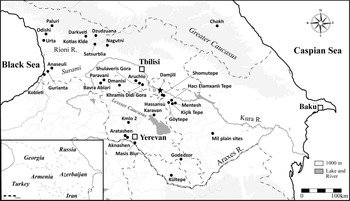
Research into the Neolithization of the Southern Caucasus has entered a new stage in the 2000s, with a remarkable increase in international archaeological investigations employing cutting-edge field techniques and related laboratory studies (e.g., Lyonnet et al. Reference Lyonnet, Guliyev, Helwing, Aliyev, Hansen, Mirtskhulava, Astruc, Bastert-Lamprichs, Bebermeier, Becker, Benecke, Bouquet, Bruley-Chabot, Courcier, D’anna, Decaix, Fassbinder, Fontugne, Geitel, Goren, Hamon, Koch, Dosseur, Lincot, Link, Neef, Neumann, Ollivier, Raymond, Ricci, Samzun, Schorr, Schlütz, Shillito, Ullrich and Wahl2012; Chataigner et al. Reference Chataigner, Badalyan and Arimura2015; Helwing et al. Reference Helwing, Aliev, Lyonnet, Guliyev, Hansen and Mirtskhulava2017; Nishiaki and Guliyev Reference Nishiaki and Guliyev2020). The results have shown us a number of previously unknown aspects of the earliest food-production societies of the region, especially regarding the timing of their emergence and subsequent development. The impact on this cultural process of interactions with the Neolithic communities of the Fertile Crescent of Southwest Asia has long been emphasized, driven mainly by the discovery of imported ceramics with Northern Mesopotamian features (Narimanov Reference Narimanov1987; Badalyan et al. Reference Badalyan, Lombard, Avetisyan, Chataigner, Chabot, Vila, Hovsepyan, Willcox, Pessin and Lyonnet2007, Reference Badalyan, Harutyunyan, Chataigner, Le Fort, Chabot, Brochier, Balasescu, Radu and Hovsepyan2010; Nishiaki et al. Reference Nishiaki, Guliyev, Kadowaki, Alakbarov, Miki, Salimbayov, Akashi and Arai2015a). However, the relationship between the indigenous Mesolithic foraging societies and the supposedly in-coming Neolithic food-producing societies is an important issue that remains under-investigated, mainly because of the near-total absence of Mesolithic sites firmly dated to the seventh millennium BC, a period immediately preceding the Neolithic of the sixth millennium BC. Apart from sites investigated earlier with less-rigorous stratigraphic approaches (see Meshveliani Reference Meshveliani2013), the precisely dated Mesolithic sites such as Lernagog (Arimura et al. Reference Arimura, Martirosyan-Olshansky, Petrosyan, Gasparyan, Nishiaki, Maeda and Arimura2022), Kmlo (Arimura et al. Reference Arimura, Badalyan, Gasparyan and Chataigner2010), and Bavra Ablari caves (Varoutiskos et al. Reference Varoutsikos, Mgeladze, Chahoud, Gabunia, Agapishvili, Martin, Chataigner, Batmaz, Michalewicz, Robinson and Bedianashvili2018) have been restricted to the early seventh millennium BC, or even earlier (Figure 1). Thus, the gap in our understanding of the Mesolithic–Neolithic transition in the Southern Caucasus persists (Chataigner et al. Reference Chataigner, Badalyan and Arimura2015: 9; Varoutiskos Reference Varoutsikos2015: 109).
Map of the South Caucasus showing the location of Damjili Cave and related Mesolithic and Neolithic sites.

Part of this gap has recently been filled by the archaeological records of Damjili Cave, West Azerbaijan. Our first two seasons’ excavations in 2016 and 2017 revealed a stratigraphic sequence of the late seventh to the sixth millennium BC along with rich cultural and subsistence assemblages of the Mesolithic-to-Neolithic transition period (Nishiaki et al. Reference Nishiaki, Zeynalov, Mansrov, Akashi, Arai, Shimogama and Guliyev2019). Later, the excavations in 2018 and 2019 produced additional evidence to support our previous interpretation and allowed us to refine the stratigraphy with additional radiocarbon dates. This paper presents a radiocarbon chronology for the Mesolithic-Neolithic sequence at this cave based on these four seasons’ excavations and discusses its implications in light of the current interpretive framework for the Neolithization of the Southern Caucasus.
SITE AND STUDY MATERIALS
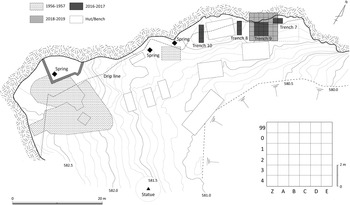
The Damjili Cave is situated in the eastern foothills of the Avey Mountains, the Middle Kura Valley, and West Azerbaijan (Figure 1). Located at a cluster of natural springs at the bottom of a high limestone cliff facing the Ganja Gazakh plain, approximately 650 m above sea level, this cave is believed to have served as a locale for repeated visits by prehistoric people. However, the original excavations in 1956 and 1957 (Figure 2) exposed disturbed deposits only, yielding Paleolithic to Bronze Age artifacts in mixed contexts (Huseynov Reference Hüseynov2010: 212). Nevertheless, we concluded that it was worthwhile resuming excavations on the basis of an examination of the lithic materials and the 1956–1957 excavation archives at the National Academy of Sciences in Baku. Consequently, we set up 10 trenches in 2016 at this cave, which consists of two rockshelters, separated by heavy collapsed rocks: Trenches 1 to 6 in the east and Trenches 7 to 10 in the west. The results revealed the existence of in-situ archaeological deposits in the eastern part of the west rockshelter in an area where Trenches 7 and 9 were located (Figure 2).
Plan and the excavation areas of Damjili Cave. The main excavation area of 2018–2019 is enlarged at the lower right.

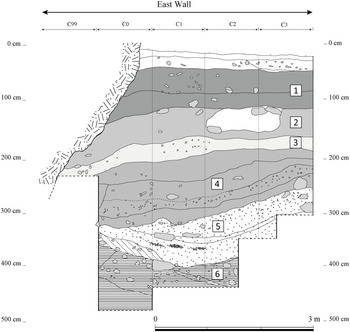
The excavations conducted in the following seasons were thus concentrated in this area, opening a trench of 6 × 5 m in plan, excavated down to approximately 5 m at the deepest point. The results confirmed the validity of the six lithological units defined in 2016 and 2017: Unit 1 to the Medieval period and later, Unit 2 to the Bronze Age, Unit 3 to the Chalcolithic, Unit 4 to the Neolithic, Unit 5 to the Mesolithic, and Unit 6 to the Paleolithic (Nishiaki et al. Reference Nishiaki, Zeynalov, Mansrov, Akashi, Arai, Shimogama and Guliyev2019).
The materials used for this study’s analysis were obtained from Units 4 and 5 (Figure 3). Unit 4 is distinguished by dark brown to grayish-brown sediments descending toward the cave wall. Its top part shows a lamination of sands, which suggests water erosion, indicating a time gap from overlying Unit 3. Four layers were identified for Unit 4 (Units 4-1 to 4-4) according to a different combination of darker or brighter colors and matrix, notably in different amounts of ashes. The sediments, which are generally sticky, often contain charcoal remains. On the other hand, the Unit 5 sediments differ in both inclination and lithological aspects. The layers of this unit, divisible to at least two sub-units, exhibit reverse inclination near the cave wall, and their top shows evidence of cutting by the lowest layer of Unit 4 (Unit 4-4; Figure 3). In other words, there may be a stratigraphic gap between Units 4 and 5. This interpretation is supported by the sedimentological observations. The Unit 5 sediments generally display reddish yellow colors and limited distributions of blackish gray ash patches. Our stratigraphic examination defined two sub-units, Units 5-1 and 5-2 (Figure 3), the latter of which is a new unit unrecognized in the 2016–2017 seasons (Nishiaki et al. Reference Nishiaki, Zeynalov, Mansrov, Akashi, Arai, Shimogama and Guliyev2019).
Stratigraphy of northeast wall of Squares C99 to C3.

ANALYSIS
Radiocarbon Chronology
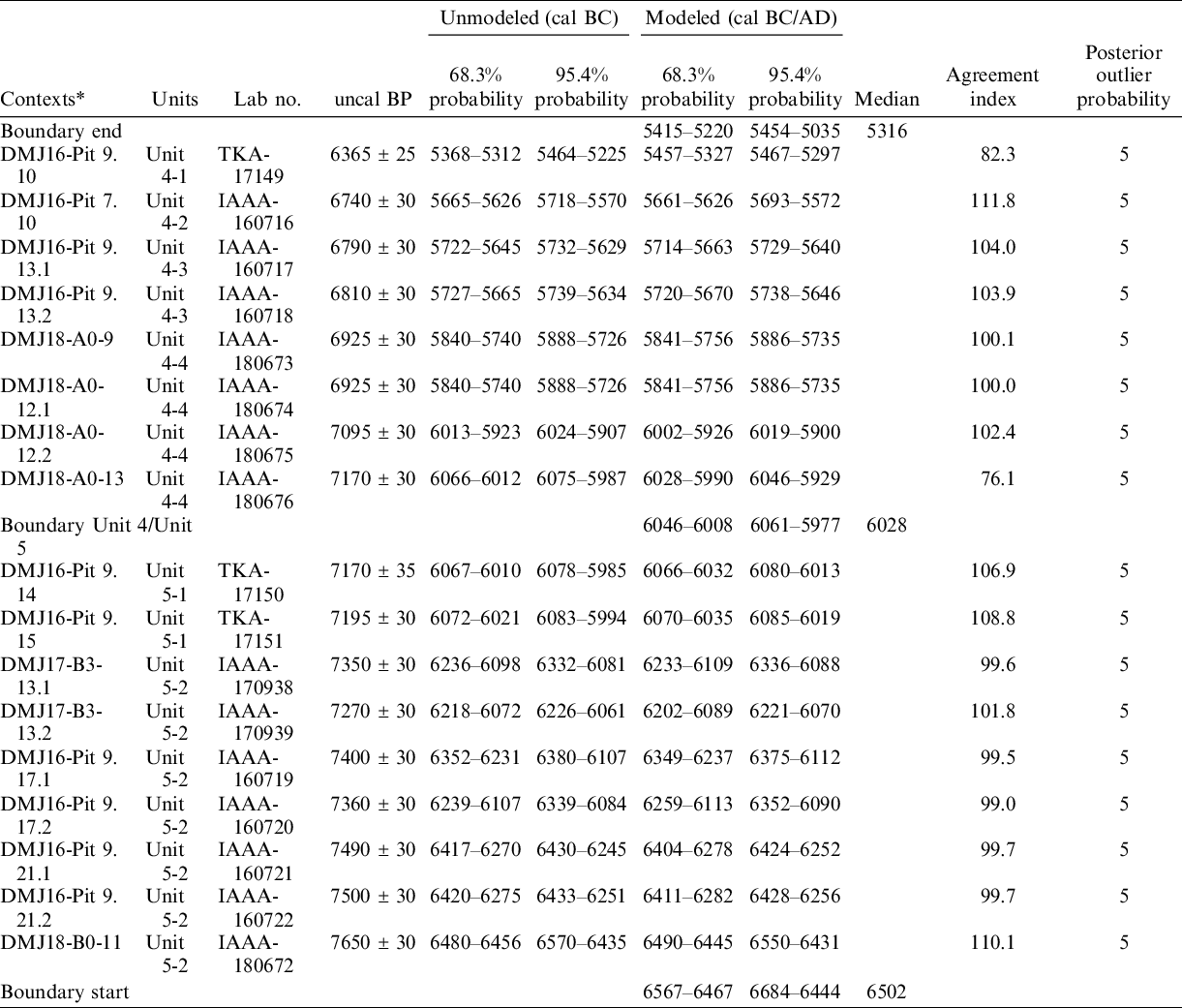
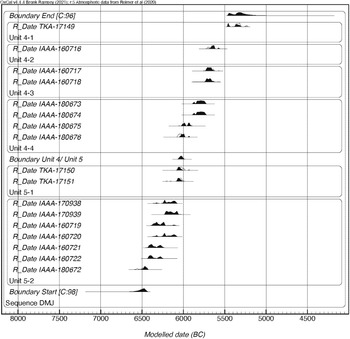
A total of 19 radiocarbon dates were obtained for Units 4 and 5 of the Damjili Cave. However, one date based on animal bone collected from a dark blackish brown layer of Unit 5-1 (Pit 7-14) has been omitted as an outlier for further consideration; the bone probably intruded from an upper level through modern vegetal root holes (Nishiaki et al. Reference Nishiaki, Zeynalov, Mansrov, Akashi, Arai, Shimogama and Guliyev2019: 9). The remaining 18 dates were tabulated according to the stratigraphy refined after the 2018–2019 excavations (Table 1). They confirm the existence of a cultural sequence covering the late seventh to early sixth millennium BC. The dates of Unit 4 (Neolithic) and 5 (Mesolithic) were subjected to a Bayesian statistical analysis (Figure 4). The results demonstrate a remarkable continuity of occupation between ca. 6500 cal BC and 5300 cal BC. This is the first dataset to be recovered at a single site identified in the Southern Caucasus. The Chalcolithic phase is estimated to have started at approximately 4500 cal BC. There was obviously an unoccupied period of several centuries after the abandonment of the Neolithic occupations in this excavation area (Table 1). The occupation gap after the mid-sixth millennium BC has also been noted in other recently excavated Neolithic settlements, such as Göytepe (Nishiaki and Guliyev Reference Nishiaki and Guliyev2020), Mentesh (Lyonnet et al. Reference Lyonnet, Guliyev, Bouquet, Bruley-Chabot, Samzun, Pecqueur, Jovenet, Baudouin, Fontugne, Raymond, Degorre, Astruc, Guilbeau, Le Dosseur, Benecke, Hamon, Poulmarch and Courcier2016), and Kiçik Tepe (Palumbi et al. Reference Palumbi, Guliyev, Astruc, Baudouin, Berthon, d’Anna, Decaix, Gratuze, Hamon and Poulmarc’h2021) in West Azerbaijan. Although this phenomenon has not been fully explained, it is important to consider complex factors such as paleo-climatic and geomorphological changes (Chataigner et al. Reference Chataigner, Badalyan and Arimura2015: Varoutiskos Reference Varoutsikos2015). Our new data from Damjili Cave are unique in showing that this phenomenon also occurred in a non-mound-type settlement.
Radiocarbon dates for the Neolithic (Unit 4) and Mesolithic (Unit 5) stratigraphic units of Damjili Cave and the results of a Bayesian stratigraphic analysis.

* The dates for DMJ18 have not been published previously.
Bayesian analysis of radiocarbon dates for Units 4 and 5 of Damjili Cave.

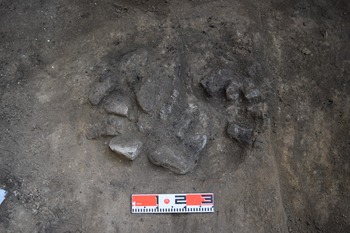
The more relevant question for us is the chronological relationship between Units 4 (Neolithic) and 5 (Mesolithic). As mentioned, the stratigraphy suggests a chronological gap between these units. The duration of their separation can be approximated using radiocarbon dates from these two units. In this regard, we need a caution in interpreting the date of IAAA-180676 from Unit 4-4, whose agreement index is the lowest (Table 1). This indicates the final seventh millennium BC, comparable to the dates of the latest Mesolithic levels. The sample was a charcoal fragment taken from a stone-encircled hearth/oven without evidence of stratigraphic disturbance (Figure 5). Any date indicating Neolithic occupation prior to 6000 cal BC should be treated with caution given that the firmly accepted date of the oldest Neolithic occupation at Hacı Elamxanlı Tepe has been 6000 cal BC or later (Nishiaki et al. Reference Nishiaki, Guliyev and Kadowaki2015b). Indeed, recent research at Kiçik Tepe has refuted the final seventh millennium BC dates for the Neolithic levels as old wood effects (Palumbi et al. Reference Palumbi, Guliyev, Astruc, Baudouin, Berthon, d’Anna, Decaix, Gratuze, Hamon and Poulmarc’h2021). In the case of IAAA-180676, the possibility of intrusion from the Mesolithic level underneath as well as an old wood effect can never be excluded. In the meantime, we performed a Bayesian analysis incorporating this date as Unit 4 to estimate the boundary between Unit 4 (Neolithic) and 5 (Mesolithic). The result indicates the date of the very end of the seventh millennium BC, with the median of 6028 cal BC (Table 1). If IAAA-180676 is excluded due to its lower agreement index, it becomes precisely 6000 cal BC (1-sigma: 6038–5971; 2-sigma: 6054–5930), a boundary supporting the current model whereby the earliest Neolithic settlements emerged in West Azerbaijan during this period (Nishiaki et al. Reference Nishiaki, Guliyev, Kadowaki, Alakbarov, Miki, Salimbayov, Akashi and Arai2015a).
A cobble-filled pit hearth/oven from Unit 4-4.

Mesolithic-to-Neolithic Transitions in the Southern Caucasus
We assigned Unit 4 to the Neolithic and Unit 5 to the Mesolithic. This assignment is based mainly on subsistence evidence. Evidence of cereal cultivation cannot be easily discovered due to the cave environment. Therefore, faunal remains are important (Nishiaki et al. Reference Nishiaki, Zeynalov, Mansrov, Akashi, Arai, Shimogama and Guliyev2019; Arai Reference Arai, Nishiaki, Guliyev and Kadowaki2021). Our analysis showed that the body size of sheep from Unit 5 was indistinguishable from that of the pre-Neolithic sheep assemblages of Southeast Anatolia, while the body size decreased sharply in Unit 4 to a level similar to that of the sheep remains from the Neolithic sites of Hacı Elamxanlı Tepe and Göytepe, in the Middle Kura Valley (Arai Reference Arai, Nishiaki, Guliyev and Kadowaki2021). A size change in goats has not been documented because of the limited number of samples taken from the Mesolithic layers. However, their sudden increase in the Neolithic unit is obvious, suggesting a considerable change in subsistence. These abrupt changes in faunal assemblages are unlikely to have occurred without an external origin of food production technology in Unit 4. This view is in accordance with our previous interpretation of the sources of the Hacı Elamxanlı Tepe goats based on an ancient DNA analysis (Kadowaki et al. Reference Kadowaki, Ohnishi, Arai, Guliyev and Nishiaki2017).
The resemblances of Unit 4 and Neolithic settlements in the plain are also noted in cultural remains. In terms of residential patterns, this cave was likely a short-term camp, even in the Neolithic period, used for limited activities designed to exploit mountain resources related to herding and/or hunting. In this sense, the cave used in the Neolithic could have resembled the Mesolithic ones. Nevertheless, an important difference was observed in the hearth/oven structures. The Neolithic levels, including the lowest one (Unit 4-4), yielded cobble-filled pits with fire traces (Figure 5) identical to the examples found at Hacı Elamxanlı Tepe, one of the oldest Neolithic mound sites in this region (Nishiaki et al. Reference Nishiaki, Guliyev and Kadowaki2021). This feature type, closely resembling the cobble-filled pits popular in the Neolithic of Upper Mesopotamia (Nishiaki Reference Nishiaki, Borrell, Alarashi and Healeyforthcoming), has not been recovered from the Mesolithic Unit 5 to date.
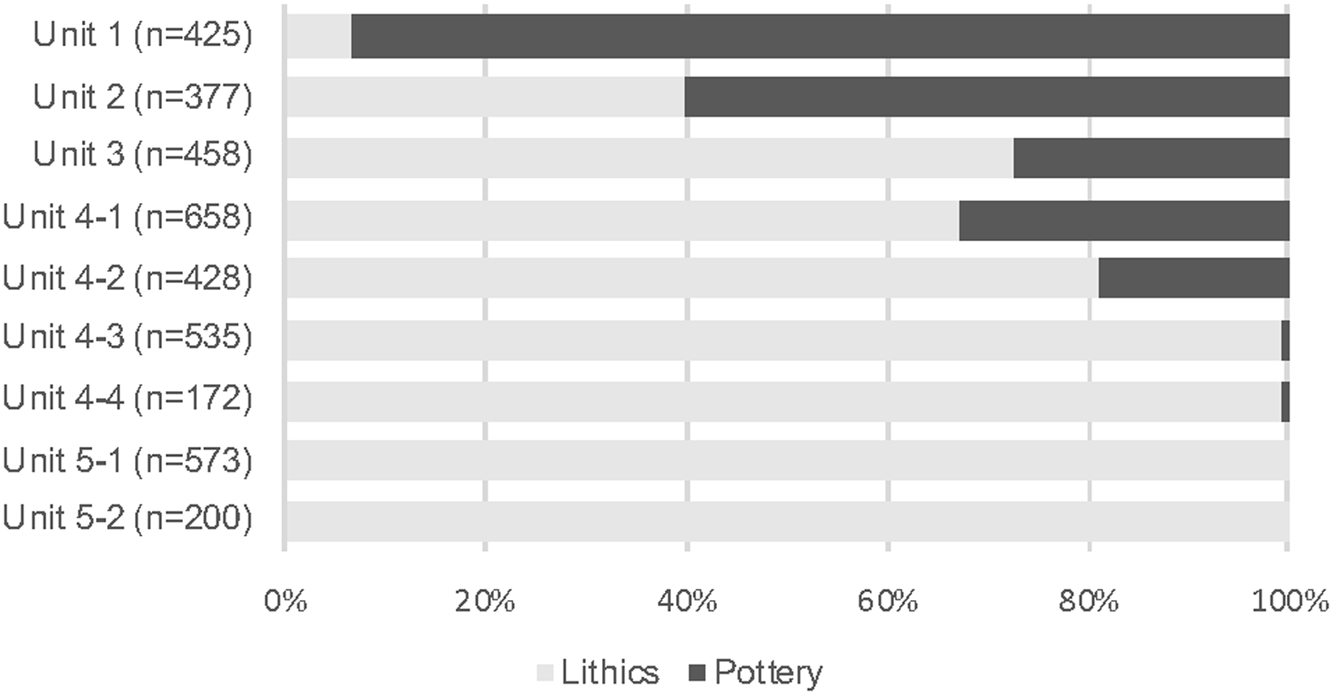
In terms of tool technology, the artifact assemblages of Units 4 and 5 from Damjili Cave provide us with the first opportunity to monitor cultural changes in the Mesolithic–Neolithic transition at a single site. The preliminary finding is one of cultural continuity in at least two respects. First, the use of pottery was extremely limited at the beginning of the Neolithic (Units 4-4 and 4-3), but it suddenly increased in its later stage (Units 4-2 and 4-1; Figure 6). The radiocarbon analysis points to a period of increase during the middle of the sixth millennium BC (Table 1). This pattern is precisely what we have identified in Neolithic cultural development at Hacı Elamxanlı Tepe and Göytepe (see Nishiaki et al. Reference Nishiaki, Guliyev and Kadowaki2015b). The persistence of the near absence of pottery use in the early Neolithic would be best interpreted as a continuation of the Mesolithic way of life.
Ratio of pottery sherds to flaked stone artifacts by stratigraphic unit.

Another important finding comes from lithic analysis. A study of the 2016–2017 materials revealed a patterned change from the Damjili Mesolithic to the developed Neolithic Göytepe, with an intermediate stage represented at Hacı Elamxanlı Tepe (Nishiaki and Guliyev Reference Nishiaki, Guliyev, Astruc, Briois, McCartney and Kassianidou2019). Hunting tools and heavy scrapers decreased in the Neolithic assemblages of Göytepe relative to the Mesolithic of Damjili Cave (Nishiaki et al. Reference Nishiaki, Zeynalov, Mansrov, Akashi, Arai, Shimogama and Guliyev2019). The data from Hacı Elamxanlı Tepe, situated chronologically in-between, bridge these lithic assemblages of the Mesolithic and the developed Neolithic. The newly recovered lithic assemblages covering both the Mesolithic and Neolithic periods from the 2018–2019 seasons are currently being studied. However, the preliminary results have confirmed these previous statements. The discovery of Unit 5-2 in the 2019 season assemblage will enable an examination of the diachronic changes based on a longer perspective than what has been possible to date.
DISCUSSION
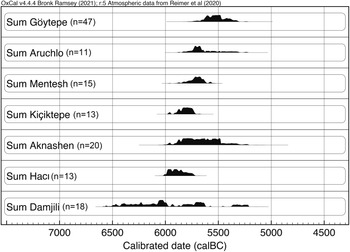
We evaluated the Mesolithic-Neolithic shift at Damjili Cave from a chronological perspective by compiling radiocarbon datasets from well-dated settlements, namely those reported with more than 10 radiocarbon dates in the Middle Kura Valley and its surroundings (Figure 7). All sites other than Damjili Cave are Neolithic mound settlements. The summed probability of their radiocarbon dates, which exclude those considered as outliers by the excavators, shows a similar chronological pattern: The occupations of the Neolithic mounds in the region started at around 6000 cal BC and ended at approximately 5300 cal BC. The data from the Damjili Cave are unique. They cover not only this time period but also earlier Mesolithic dating back to the mid-seventh millennium BC. The absence of any visible chronological gap between these two periods (Units 4 and 5) is striking. In other words, the Mesolithic–Neolithic transition occurred rapidly, at approximately 6000 cal BC in the Damjili Cave region. Although a short gap was noted in the lithological analyses (Figure 3), it could not be identified radiometrically. The gap was probably a few generations, or even shorter (Figure 4).
Summed probability distribution of radiocarbon dates for major Mesolithic and Neolithic sites in the region. Data taken from Nishiaki and Guliyev (Reference Nishiaki and Guliyev2020), Lyonnet et al. (Reference Lyonnet, Guliyev, Helwing, Aliyev, Hansen, Mirtskhulava, Astruc, Bastert-Lamprichs, Bebermeier, Becker, Benecke, Bouquet, Bruley-Chabot, Courcier, D’anna, Decaix, Fassbinder, Fontugne, Geitel, Goren, Hamon, Koch, Dosseur, Lincot, Link, Neef, Neumann, Ollivier, Raymond, Ricci, Samzun, Schorr, Schlütz, Shillito, Ullrich and Wahl2012, Reference Lyonnet, Guliyev, Bouquet, Bruley-Chabot, Samzun, Pecqueur, Jovenet, Baudouin, Fontugne, Raymond, Degorre, Astruc, Guilbeau, Le Dosseur, Benecke, Hamon, Poulmarch and Courcier2016), Palumbi et al. (Reference Palumbi, Guliyev, Astruc, Baudouin, Berthon, d’Anna, Decaix, Gratuze, Hamon and Poulmarc’h2021), Badalyan et al. (Reference Badalyan, Harutyunyan, Chataigner, Le Fort, Chabot, Brochier, Balasescu, Radu and Hovsepyan2010), Nishiaki et al. (Reference Nishiaki, Zeynalov, Mansrov, Akashi, Arai, Shimogama and Guliyev2019), and this study.

One may interpret the abrupt change as evidence of a replacement of the Mesolithic communities by the incoming Neolithic communities from Southwest Asia. However, we consider that the Mesolithic-Neolithic transitions of the Southern Caucasus occurred with contributions from indigenous communities. If we are correct, an appropriate interpretation is required to explain this apparently paradoxical phenomenon.
We assume that the long-lasting cultural interaction during the “pre-Neolithic” period contributed to the rapid transition as a possible driving force (Nishiaki et al. Reference Nishiaki, Guliyev and Kadowaki2015b; Nishiaki Reference Nishiaki2021). This interaction is evidenced most prominently in lithic industries. The lithic analysis of Damjili Units 5-4 is apparently linked with those of the East Wing of the Fertile Crescent of Southwest Asia, including the Caspian Sea region close to Central Asia (Kozlowski Reference Kozlowski1999). Technologically, lithic production in these two regions in the seventh to sixth millennium BC is characterized by pressure debitage, in contrast to the direct percussion technology popular in the West Wing represented by the Levant. Typologically, the tradition of manufacturing hunting tools was also shared by the South Caucasus and the East Wing. They were dominated by composite tools made with backed bladelets, but they shifted to geometrics in the late seventh millennium BC. This echoed change is unlikely to have occurred without close cultural contact (Nishiaki et al. Reference Nishiaki, Zeynalov, Mansrov, Akashi, Arai, Shimogama and Guliyev2019).
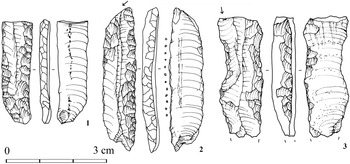
Further, we focus on a particular tool type, known as the “Çayönü tool.” This tool type, first identified at the site of Çayönü, Southeast Anatolia (Redman Reference Redman1982), has been referred to in the Southern Caucasus context using various terms, such as “hook-shaped tools” and “Kmlo tools” (Arimura et al. Reference Arimura, Badalyan, Gasparyan and Chataigner2010). However, given that its defining characteristic is a series of distinct steep pressure retouching along one or both lateral edges of obsidian, often on smoky abrasion surfaces, it is unlikely to have been invented independently in many regions. These tools are considered to rather represent the same tool type and its variants. Indeed, one of the reportedly unique features of the South Caucasus examples, a burination faceting at ends (Arimura Reference Arimura, Astruc, Briois, McCartney and Kassianidou2019), is not uncommon also in Upper Mesopotamia (Nishiaki 1991: 51; Reference Nishiaki and Prince Takahito Mikasa1995: 171), likely reflecting the diversity of this tool manufacturing. The common occurrences of Çayönü tools at the Mesolithic sites of Armenia and Georgia suggest a cultural interaction in the pre-Neolithic period. Although the 2016–2017 excavations did not yield any of this tool type from the Mesolithic contexts, they revealed an interesting tool type that could have inherited the Çayönü tool tradition, the “Damjili tool,” which is similar to Çayönü tools but with less-steep retouching and manufacturing on a variety of raw materials including flint (Nishiaki et al. Reference Nishiaki, Zeynalov, Mansrov, Akashi, Arai, Shimogama and Guliyev2019) (Figure 8: 1, 2). The discovery of a comparable tool, made on obsidian, from the late seventh millennium BC context of the 2018–2019 excavations (Figure 8: 3) reinforces our view to this tool group reflecting the earlier Mesolithic tradition.
Damjili tools from Damjili Cave. 1–2: Flint (Unit 4-2; after Nishiaki et al. Reference Nishiaki, Zeynalov, Mansrov, Akashi, Arai, Shimogama and Guliyev2019); 3: Obsidian (Unit 5-2).

CONCLUSIONS
The excavations at Damjili Cave in West Azerbaijan from 2016 to 2019 revealed a cultural sequence that is key to our understanding of the Mesolithic-to-Neolithic transitions in the Southern Caucasus. The archaeological finds from Damjili Unit 5 filled a gap in our knowledge of the societies immediately before the introduction of the full-fledged Neolithic economy. A comparison of this new dataset with those of the Neolithic period demonstrates a rapid Mesolithic–Neolithic transition. The situation is different in the nearby Fertile Crescent, where farming societies were established through prolonged processes over a few millennia. It has been debated whether the farming societies emerged as a local development of the earlier indigenous societies (e.g., Munchaev Reference Munchaev, Masson and Merpert1982; Kushnareva Reference Kushnareva1997; Akhundov Reference Akhundov and Sagona2004; Sagona Reference Sagona2018: 88–93). Some authors refer to the sixth millennium BC farming societies as the “Late Neolithic,” implying the existence of an as-yet-unknown earlier “Early Neolithic” cultural entity, as in the Anatolia of Southwest Asia (Hayrapetyan et al. Reference Hayrapetyan, Martirosyan-Olshansky, Areshian, Avetisyan, Gasparyan and Arimura2014; Chataigner et al. Reference Chataigner, Badalyan and Arimura2015). The sequence identified at Damjili Cave questions applicability of this terminology, at least in the Middle Kura Valley.
The Mesolithic sequence at Damjili covers a half-millennium period, which likely involves diachronic changes in tool production and subsistence. Identifying these changes would lead to a better understanding of what enabled the abrupt shift from the Mesolithic to the Neolithic. We acknowledge that it occurred due to cultural contacts with the Neolithic societies of the Fertile Crescent during the Mesolithic period. However, the near absence of pottery at the beginning of the Neolithic and the continuity in lithic typology, among others, suggest that Mesolithic societies were involved in the Neolithization of this part of the Southern Caucasus. The Unit 5 archaeological remains of Damjili Cave deserve more intensive study as a unique source of elements that can assist in interpreting the cultural changes in this period.
ACKNOWLEDGMENTS
We would like to thank Dr. Maissa Ragimova, the Institute of Archaeology and Ethnography of the National Academy of Sciences of Azerbaijan, Republic of Azerbaijan, for permitting us to conduct our fieldwork. We would also like to thank Dr. Sadat Aliyeva and her staff of the Avey State Historical-Cultural Reserve of the Ministry of Culture and Tourism, who provided us with every necessary support during the field seasons. This study was carried out with the help of grants from the Ministry of Education, Culture, Sports, Science, and Technology (16H06408, 21H00455, and 24251014).