Infections due to multidrug-resistant gram-negative rod (MDR-GNR) bacteria are a significant threat to public health. Numerous studies have demonstrated that MDR-GNR infections lead to increased patient morbidity, mortality, and healthcare costs.Reference Giske, Monnet, Cars and Carmeli 1 – Reference Peralta, Sánchez and Garrido 10 Most of these studies examined morbidity and outcomes of infections in tertiary care settings. Prior studies have focused primarily on the impact of bloodstream infections (BSIs)Reference Schwaber and Carmeli 2 – Reference Kang, Kim and Park 5 or infections caused by specific resistance mechanisms (eg, extended spectrum beta-lactamase [ESBL]).Reference Schwaber and Carmeli 2 , Reference Rottier, Ammerlaan and Bonten 4 , Reference Peña, Gudiol and Calatayud 6 – Reference Raymond, Pelletier, Crabtree, Evans, Pruett and Sawyer 8 Some studies used overly inclusive definitions of MDR (eg, resistance to only a single class of antimicrobial).Reference de Kraker, Wolkewitz and Davey 3 , Reference Kang, Kim and Park 5
Less is known about the impact of MDR-GNR infections in community hospital settings; however, multiple studies have shown an increase in the rate of MDR-GNR infections at community hospitals. For example, ESBL Escherichia coli has doubled in community hospitals in the southeastern United States from 2009 through 2014.Reference Thaden, Fowler, Sexton and Anderson 11 Additionally, carbapenem-resistant Enterobacteriaceae detection increased 5-fold in community hospitals in the southeastern United States from 2008 to 2012.Reference Thaden, Lewis and Hazen 12 We therefore pursued the following analyses to better understand the epidemiology and outcomes attributed to MDR-GNR infections in community hospitals.
METHODS
Study Design
Two case-control analyses were performed to understand the impact of MDR-GNR infections on healthcare utilization and outcomes: (1) patients with BSI or urinary tract infection (UTI) due to MDR-GNR pathogens were compared with patients with BSI or UTI due to gram-negative pathogens that were not multidrug-resistant (nonMDR-GNR) and (2) patients with MDR-GNR infections were compared with control patients representative of the nonpsychiatric, non-obstetric hospitalized population (control). Study participants were admitted to 6 community hospitals participating in the Duke Infection Control Outreach Network from January 1, 2010, through December 31, 2012. These 6 community hospitals were selected to participate in the study on the basis of their similar patient volumes and utilization of an electronic medical record system. The Duke Infection Control Outreach Network is a network of 43 community hospitals in 5 states throughout the southeastern United States that has been described previously.Reference Anderson, Miller and Chen 13 Trained infection preventionists at each hospital collect surveillance data using National Healthcare Safety Network definitions. Select clinical and microbiologic data for all patients with healthcare-associated and MDR infections are entered into a deidentified database. This study was approved by the Duke University Institutional Review Board and the institutional review boards for each participating community hospital.
MDR-GNR and nonMDR-GNR patients were first identified using the existing Duke Infection Control Outreach Network surveillance database. Electronic medical records were then reviewed to confirm that each subject met our study criteria for BSI or UTI and to determine MDR status. Patients who transitioned to hospice care before completing antibiotic therapy were excluded from the study because it was impossible to determine whether outcomes were related to infection or another underlying comorbidity.
NonMDR-GNR patients were matched to MDR-GNR patients by hospital, patient age (±5 years), number of days between admission date and infection date, and infection site (BSI vs UTI). For MDR-GNR patients with hospital-acquired infections, matched nonMDR-GNR patients were required to have a hospital length of stay (LOS) at least as long as the case patient’s LOS prior to developing an infection to ensure that nonMDR-GNR patients had as much “risk time” as cases. For example, if an MDR-GNR patient developed an infection on hospital day 4, a nonMDR-GNR control patient must have had a total duration of hospitalization at least 4 days. All MDR-GNR patients who had a suitable match were included in the study.
Controls were non-obstetric and nonpsychiatric patients admitted to the study hospitals during the study period. Controls were matched to MDR-GNR patients by hospital, patient age (±5 years), and LOS prior to developing infection. A list of potential eligible matches was generated for each MDR-GNR case on the basis of the matching factors. For each case patient, 1 eligible matched patient was randomly selected for inclusion in the study.
The primary study outcome was 30-day all-cause mortality, defined as the proportion of patients who died of any cause within 30 days of infection (MDR-GNRs and nonMDR-GNRs) or hospital admission (controls). Secondary end points included cost of hospitalization, LOS, and 30-day readmission. Cost of hospitalization was defined as the direct hospital costs per patient for the index hospitalization and hospital readmission(s) occurring within 30 days. LOS following onset of infection was compared between MDR-GNR and nonMDR-GNR patients, whereas total LOS was compared between MDR-GNR and controls.
A single reviewer abstracted data from electronic medical records using a standardized case report form. An independent study monitor performed data validation for 6 key variables from a random sample of 45 medical charts from all study sites: MDR-GNR, site of infection, admission date, discharge date, death within 30 days, and readmission within 30 days.
Definitions
MDR was defined as nonsusceptibility to any antimicrobial in 3 or more of the following classes of antimicrobials: aminoglycosides, carbapenems, third- or fourth-generation cephalosporins, fluoroquinolones, and piperacillin-tazobactam. This definition was modified from the international recommendation proposed by Magiorakos et alReference Magiorakos, Srinivasan and Carey 14 and is consistent with the definition of MDR utilized by the National Healthcare Safety Network.Reference Sievert, Ricks and Edwards 15 All infections due to ESBL- or carbapenemase-producing GNRs were defined as MDR. Effective antibiotics were defined as antibiotics with in vitro activity against a pathogen based on the pathogen’s susceptibility results.
BSI was defined as at least 1 blood culture growing a GNR in the setting of 1 of the following: fever (temperature>38°C), rigors, altered mental status, systolic blood pressure less than 90 mm Hg or mean arterial pressure less than 70 mm Hg, heart rate greater than 90 beats/min, or respiratory rate greater than 20 breaths/min.
UTI was defined as a positive urine culture of at least 1×10⁵ colony-forming units/mL and with no more than 2 species of GNRs, a urinalysis with at least 10 white blood cells/high-power field, and at least 1 of the following: fever (temperature>38°C), dysuria, frequency, urgency, or hematuria.
Community-onset infections were defined as infections that were detected within 2 calendar days of hospital admission. Hospital-acquired infections were defined as infections that occurred after the second day of hospitalization.
Statistical Analysis
Multivariable regression models were created to estimate the effect of MDR status on each outcome measure. Logistic regression models were used for the readmission and mortality outcomes. Linear regression models were used for LOS and hospital cost outcomes.
Intensive care unit admission within 12 months of admission, hospitalization within 12 months of admission, Charlson comorbidity score,Reference Carlson, Szatrowski, Peterson and Gold 16 functional status as measured by location prior to hospitalization (nursing home vs other), and location of onset of infection (community-onset vs hospital-acquired) were considered potential confounders. LOS prior to developing an infection was also considered a potential confounder for the cost analysis. Appropriate empirical antibiotic treatment and infection site (BSI vs UTI) were considered potential effect measure modifiers. Bivariable analyses were performed to assess crude relationships between potential confounders, outcomes, and MDR status. Continuous variables were compared using the Wilcoxon rank-sum test or t test. Dichotomous variables were compared using the Fisher exact or χ2 test. Effect measure modification was assessed by comparing nested models with and without interaction terms for appropriate empirical antibiotic therapy and infection site. A likelihood ratio test with P<.2 was considered significant. Potential confounders with P<.2 in bivariable comparisons or potential confounders with a P>.2 but with suspected clinical importance were included in initial multivariable models. A change-in-estimate approach was used to remove potential confounders from the model. Covariates were retained in the final model if removing them from the model resulted in greater than 10% change in effect measure estimate.
All statistical analyses were performed using SAS software, version 9.3.
RESULTS
MDR-GNR Infections vs NonMDR-GNR Infections
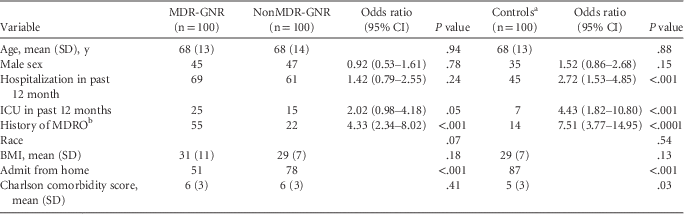
One hundred patients with MDR-GNR infections and 100 patients with nonMDR-GNR infections were included in the study (Table 1). Age, sex, and Charlson comorbidity scores were similar between both groups. A higher proportion of patients with MDR-GNR infections were admitted from a nursing home than from home. Patients in both groups were equally likely to have been admitted to a hospital in the 12 months prior to their current admission, but patients in the MDR-GNR infection group were more likely to have spent time in the intensive care unit within the past 12 months.
Demographic Characteristics of Case and Control Patients

NOTE. Data are no. of patients unless otherwise indicated. BMI, body mass index (calculated as weight in kilograms divided by height in meters squared); ICU, intensive care unit; MDR-GNR, multidrug-resistant gram-negative rod infection; MDRO, multidrug-resistant organism; nonMDR-GNR, non-multidrug-resistant gram-negative rod infection.
a Randomly selected from all nonpsychiatric, non-obstetric hospital admissions.
b MDR-GNR: carbapenem-resistant Enterobacteriaceae 5, extended spectrum beta-lactamase-producing bacteria 27, methicillin-resistant Staphylococcus aureus 33, vancomycin-resistant Enterococcus 18, Pseudomonas species 10, Acinetobacter species 8. NonMDR-GNR: extended spectrum beta-lactamase–producing bacteria 1, methicillin-resistant Staphylococcus aureus 19, vancomycin-resistant Enterococcus 4, Pseudomonas species 3, Acinetobacter species 2. Controls: methicillin-resistant Staphylococcus aureus 13, vancomycin-resistant Enterococcus 1.
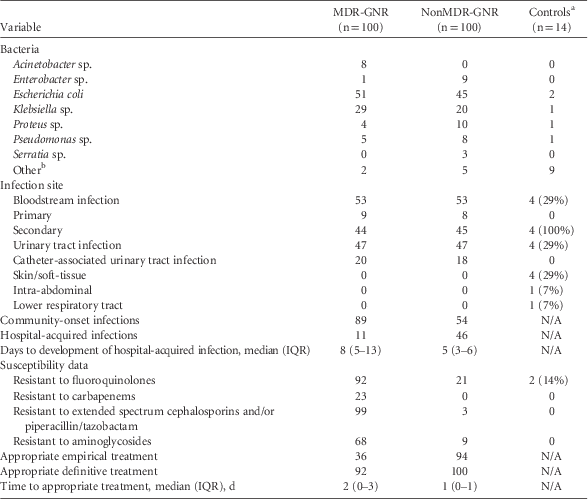
Fifty-three patients in each group had BSIs and 47 patients in each group had UTIs (Table 2). Nine MDR-GNR BSIs (17%) and 8 nonMDR-GNR BSIs (15%) were primary BSIs, whereas the remainder were secondary to other sites of infection. Twenty MDR-GNR UTIs (43%) were catheter-associated compared with 18 nonMDR-GNR UTIs (38%). Forty-six patients with nonMDR-GNR infections had hospital-acquired infections compared with 11 patients with MDR-GNR infections.
Infection and Antibiotic Data for Cases and Controls

NOTE. IQR, interquartile range; MDR-GNR, multidrug-resistant gram-negative rod infection; nonMDR-GNR, non-multidrug-resistant gram-negative rod infection.
a Randomly selected from all nonpsychiatric, non-obstetric hospital admissions.
b MDR-GNR: Stenotrophomonas sp. 2. NonMDR-GNR: Citrobacter sp. 2, Morganella sp. 1, Providencia sp. 2. Controls: gram-positive bacteria 9.
Thirty-six MDR-GNR patients received effective empirical antibiotics compared with 94 patients with nonMDR-GNR infections. Empirical antibiotic choices varied widely. Thirty patients with MDR-GNR infections and 24 patients with nonMDR-GNR infections received initial empirical treatment with antibiotics from 2 different classes. Piperacillin-tazobactam plus a fluoroquinolone was the most common combination. Fifteen patients with MDR-GNR infections and 9 patients with nonMDR-GNR infections received definitive treatment with antibiotics from 2 different classes. The median time to appropriate antibiotic treatment was 2 days in the MDR-GNR group (interquartile range, 0–3 days) and 1 day (0–1 day) in the nonMDR-GNR group. Ultimately 92% of patients with MDR-GNR infections received effective final antimicrobial therapy compared with 100% of nonMDR-GNR infections.
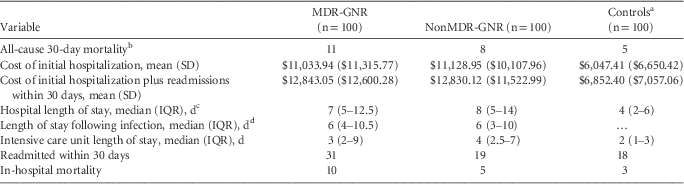
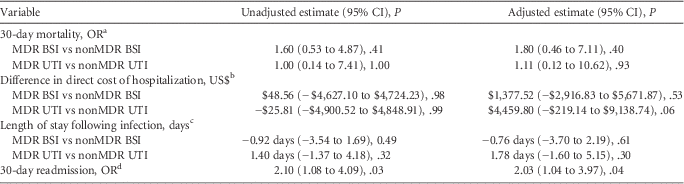
Eleven patients with MDR-GNR infections died within 30 days of infection onset, compared with 8 patients with nonMDR-GNR infections (Table 3). Infection site was a significant effect measure modifier for all outcomes except 30-day readmission. Appropriate empirical antibiotic treatment was not a significant effect measure modifier for any analysis. No mortality difference was seen between the MDR-GNR patients and the nonMDR-GNR patients for either infection site before or after adjusting for confounding by effective empirical antibiotics, functional status, and whether the infection was present upon admission or acquired in the hospital (Table 4). There was also no difference in LOS following infection between patients with MDR-GNR infections and patients with nonMDR-GNR infections. The LOS results were similar when 15 patients who died during the hospitalization were removed from the analysis. Patients with MDR-GNR BSIs and patients with MDR-GNR UTIs trended toward having more expensive hospitalizations than their nonMDR-GNR counterparts, although statistical significance was not reached (MDR-GNR BSI vs nonMDR-GNR BSI: $1,377.52 [95% CI, −$2,916.83 to $5,671.87], P=.53; MDR-GNR UTI vs nonMDR-GNR UTI: $4,459.80 [−$219.14 to $9,138.74], P=.06). Patients with MDR-GNR infections were twice as likely as patients with nonMDR-GNR infections to require 30-day readmission (odds ratio, 2.03 [95% CI, 1.04–3.97], P=.04).
Outcomes of Case and Control Patients

NOTE. IQR, interquartile range; MDR-GNR, multidrug-resistant gram-negative rod infection; nonMDR-GNR: non-multidrug-resistant gram-negative rod infection.
a Randomly selected from all nonpsychiatric, non-obstetric hospital admissions.
b The proportion of patients who died of any cause within 30 days of infection (MDR-GNR and nonMDR-GNR) or hospital admission (controls).
c Number of days between admission and discharge.
d Number of days between infection and discharge.
Unadjusted and Adjusted Estimates for Outcomes of 100 Multidrug-Resistant Gram-Negative Infections Compared With 100 Non-Multidrug-Resistant Gram-Negative Infections

NOTE. BSI, bloodstream infection; OR, odds ratio; MDR, multidrug-resistant; nonMDR, non-multidrug-resistant; UTI, urinary tract infection.
a The proportion of patients who died of any cause within 30 days of infection. Controlled for infection site, effective empirical antibiotics, functional status, and whether the infection was present upon admission or acquired in the hospital.
b Controlled for infection site and length of stay prior to developing an infection.
c Controlled for infection site, effective empirical antibiotics, functional status, and whether the infection was present upon admission or acquired in the hospital.
d Controlled for hospitalizations in the prior 12 months.
MDR-GNR Infections vs Controls
One hundred patients with MDR-GNR infections and 100 matched controls were included in the study (Table 1). The age distribution and Charlson comorbidity scores were similar between both groups. A higher proportion of patients with MDR-GNR infections were male, had been hospitalized in the past 12 months, and were admitted from nursing homes rather than from home.
Fourteen controls had a culture-positive infection during their hospitalization: 4 patients had secondary BSIs, 4 patients had UTIs (none of which were catheter-associated), 4 patients had skin and soft-tissue infections, 1 patient had an intra-abdominal infection, and 1 patient had a lower respiratory infection (Table 2). Forty-six controls received antibiotics during the hospitalization for suspected or confirmed infection.
Five control patients died within 30 days of hospital admission (Table 3). No mortality difference was seen between the MDR-GNR patients and the control patients (Table 5) before or after adjusting for confounding by functional status. There was also no difference in 30-day readmission for patients with MDR-GNR infections and control. The adjusted direct cost for a patient with MDR-GNR infection was $5,320.03 more than for a control patient (95% CI, $2,366.02-$8,274.05, P≤.001). Patients with MDR-GNR infections had adjusted hospital LOS 3.40 days longer than control patients (95% CI, 1.41–5.40 days, P<.001). The LOS results were similar when 13 patients who died during the hospitalization were removed from the analysis.
Unadjusted and Adjusted Estimates for Outcomes of 100 Multidrug-Resistant Gram-Negative Infections Compared With 100 Randomly Selected Hospitalized Patients

NOTE. OR, odds ratio.
a The proportion of patients who died of any cause within 30 days of infection (MDR-GNR) or hospital admission (controls). Controlled for functional status.
b Controlled for hospital and functional status.
c Controlled for functional status.
d Controlled for hospitalizations in the prior 12 months.
DISCUSSION
Our study is the largest description of epidemiology, treatment, and outcomes related to MDR-GNR infections in community hospitals. Prior studies, primarily conducted in academic medical centers, have yielded conflicting data about outcomes of MDR-GNR owing to varying study methodology and definitions. Many investigators have focused on specific mechanisms of resistance (eg, ESBL or carbapenemase production) whereas others have defined antimicrobial resistance as resistance to 1 antibiotic class.Reference Schwaber and Carmeli 2 – Reference Raymond, Pelletier, Crabtree, Evans, Pruett and Sawyer 8 The National Healthcare Safety Network definition for MDR used in this study identifies a clinically relevant group of isolates and includes isolates that may be resistant by various mechanisms. To our knowledge, few other studies have compared outcomes between MDR-GNR and nonMDR-GNR infections using the National Healthcare Safety Network or a similar definition of antimicrobial resistance.Reference Gudiol, Tubau and Calatayud 9 , Reference Lye, Earnest and Ling 17
Other investigators have found that both resistant gram-negative infectionsReference Giske, Monnet, Cars and Carmeli 1 – Reference de Kraker, Wolkewitz and Davey 3 , Reference Peña, Gudiol and Calatayud 6 , Reference Gudiol, Tubau and Calatayud 9 and ineffective initial antimicrobial therapyReference Schwaber and Carmeli 2 , Reference Rottier, Ammerlaan and Bonten 4 , Reference Peralta, Sánchez and Garrido 10 , Reference Shorr, Micek, Welch, Doherty, Reichley and Kollef 18 , Reference Micek, Welch and Khan 19 are risk factors for mortality. It is unclear whether the increased mortality associated with MDR-GNR infections is primarily mediated by inappropriate antimicrobial therapy or other factors.Reference Rottier, Ammerlaan and Bonten 4 In our study, only approximately one-third of patients with MDR-GNR infections received effective initial empirical therapy compared with more than 90% of patients with nonMDR-GNR infections. The median time to effective therapy was 1 day longer in the MDR-GNR group, but nearly all patients in both groups ultimately received appropriate definitive antibiotic therapy. We found no difference in mortality between infection groups before or after adjustment for appropriate empirical antibiotic therapy. Like other investigators, we found that MDR is not associated with increased mortality as long as effective antibiotics are ultimately used for definitive therapy.Reference Raymond, Pelletier, Crabtree, Evans, Pruett and Sawyer 8 , Reference Lye, Earnest and Ling 17
Patients with MDR-GNR infections trended toward having higher direct costs compared with patients with nonMDR-GNR infections, but the difference was not statistically significant. However, our study may not have been powered to detect meaningful cost differences that may exist between these 2 groups. Patients with MDR-GNR UTIs had roughly $4,500 more direct costs than patients with nonMDR-GNR UTIs. This cost differential may reflect the difference between oral and intravenous final antibiotic plans. MDR-GNR UTIs are typically resistant to most oral antibiotic options; 89% of patients with MDR-GNR UTI had a final antibiotic plan that utilized intravenous antibiotics, compared with only 34% of patients with nonMDR-GNR UTIs. Less of a difference was seen between patients with MDR-GNR BSIs and patients with nonMDR-GNR BSIs (100% and 75%, respectively). Additionally, direct costs for patients with MDR-GNR infections were approximately $5,000 more than for controls, a finding that did reach statistical significance.
Utilizing 2 separate case-control studies to evaluate the impact of MDR-GNR infections is important for understanding the risk factors and outcomes of these infections.Reference Kaye, Harris, Samore and Carmeli 20 Comparing patients with MDR-GNR infections with those with nonMDR-GNR infections allows for evaluation of the impact of MDR on outcomes. Comparing patients with MDR-GNR infections with controls allows for examination of risk factors and outcomes in MDR-GNR infections compared with the general hospitalized population. We did not limit our control patients to uninfected patients because uninfected patients do not represent a general hospitalized patient. A study published in 2015 found that among 8,358 admissions to a medical emergency department, 1,173 patients (14%) presented with an incident admission of sepsis of any severity due to infection.Reference Henriksen, Laursen, Jensen, Hallas, Pedersen and Lassen 21 Additionally, it is estimated that 1 in 25 hospitalized patients will contract a hospital-acquired infection.Reference Magill, Edwards and Bamberg 22 Fourteen percent of the controls in this study were diagnosed with a culture-positive infection, suggesting that our control population is likely comparable with the general population in terms of infection prevalence.
Only patients who completed antibiotic therapy or who died while undergoing antibiotic therapy were included in the MDR-GNR vs nonMDR-GNR study; patients who transitioned to hospice before completing antibiotic therapy were excluded. We were unable to determine whether patients transitioning to hospice without antibiotic therapy died from their underlying comorbidities or died from their infections. Excluding hospice patients who died as a result of their infections rather than their underlying comorbidities may have biased mortality toward the null. However, we wanted to examine mortality in patients who were actively treated for an infection and believe that excluding the above group of patients best captured the study population of interest.
Our study has additional limitations. Selection bias may have occurred during selection of MDR-GNR and nonMDR-GNR cases; however, strict inclusion and exclusion criteria were established before case selection. The 6 study hospitals used different electronic medical record systems with varying thoroughness of documentation; however, we feel confident that all of the necessary information for this study was collected accurately. It is possible that the study was not powered to see significant differences in mortality or hospitalization costs; the observed mortality rate was lower than the expected mortality rate used for power calculations.
In summary, our study is one of the first analyses of outcomes of MDR-GNR infections in community hospitals. Although we found no difference in mortality between patients with MDR-GNR infections and those with nonMDR-GNR infections, MDR-GNR infections were associated with higher costs and an increased risk of hospital readmission. Our findings are important because we expect the number of MDR-GNR infections in community hospitals to continue to increase.
ACKNOWLEDGMENTS
Financial support. Cubist Pharmaceuticals; and National Institutes of Health/ National Institute of Allergy and Infectious Diseases (grant K23AI095357 to D.J.A.).
Potential conflicts of interest. All authors report no conflicts of interest relevant to this article.