Introduction
It is acknowledged that (CA) mostly a life-threatening illness. Therefore, being diagnosed with CA and living with a life-threatening illness can create a crisis that may profoundly devastate multiple aspects of an individual's life including physical, psychosocial, behavioural, and spiritual (Forouzi et al., Reference Forouzi, Tirgari, Safarizadeh and Jahani2017). Due to its fatality, patients living with CA struggle with a sense that their lives are threatened in meaning and purpose (Canada et al., Reference Canada, Murphy, Fitchett and Stein2016; Weathers et al., Reference Weathers, McCarthy and Coffey2016). In other words, patients experience existential suffering, specific to individuals and depending on the personal meaning of the disease (Wang et al., Reference Wang, Chow and Chan2017), leading to the loss of self-esteem and faith (Mohebbifar et al., Reference Mohebbifar, Pakpour, Nahvijou and Sadeghi2015).
Consequently, CA has a substantial negative impact on a person's spiritual well-being (SpWB) and quality of life (QoL). SpWB is a fundamental approach for improving QoL in patients through creating meaningfulness and purpose (Mohebbifar et al., Reference Mohebbifar, Pakpour, Nahvijou and Sadeghi2015), by way of improving physical and mental health outcomes as well as the maintenance of social roles and relationships during the CA experience (Salsman et al., Reference Salsman, Pustejovsky, Jim, Munoz, Merluzzi, George, Park, Danhauer, Sherman, Snyder and Fitchett2015). This is because spirituality is the dynamic and intrinsic dimension of human life that relates to the way persons experience, express, and/or seek meaning, purpose, and transcendence, and the way they connect to the moment, to self, to others, to nature, to the significant and/or the sacred (Puchalski et al., Reference Puchalski, Blatt, Kogan and Butler2014). However, its definition depends on the individual's worldview. Recently, in a number of studies, it has been reported that there is a relationship between the SpWB and QoL of patients with CA, without distinction in the religious/spiritual identity (Forouzi et al., Reference Forouzi, Tirgari, Safarizadeh and Jahani2017; Canada et al., Reference Canada, Murphy, Fitchett and Stein2016; Bai et al., Reference Bai, Lazenby, Jeon, Dixon and Mccorkle2015; Bai & Lazenby Reference Bai and Lazenby2015; Puchalski et al., Reference Puchalski, Blatt, Kogan and Butler2014). One's religious/spiritual identity can significantly relate to QoL, and coping among individuals with life-threatening illness (Walker et al., Reference Walker S, Chen, Paik, Mirly, Thomas and Hung2017) and cultural differences may influence the results. Indeed, cultural background and heterogeneity play a critical role in the manner in which people make meaning of suffering and illness, and spiritual beliefs may empower CA patients to endure the therapeutic process. However, spiritual belief systems may vary among individuals, and are often embedded in their cultural or religious background and according to society (Timmins & Caldeira Reference Timmins and Caldeira2017).
The Republic of Turkey is a secular country; there are many ethnic groups with a variety of rituals and practices as well as many different beliefs. However, the majority of individuals in this society are Muslim. In Turkey, the word spirituality and faith are often used interchangeably with religion for the majority of the population, and religion is considered as the set of values, beliefs, and practices that people adopt to meet spiritual needs. Although spirituality is a complex concept that has different meanings for different people, it has historically been referred to as religious beliefs and practices (Bai & Lazenby Reference Bai and Lazenby2015). However, in recent years, an increasing secularisation and privatisation in the world regarding religious understanding and faith specifically may have also influenced peoples’ SpWB.
QoL and SpWB provide a more in-depth understanding of the patient as a unique human being with beliefs and values. Furthermore, SpWB is the essential element of person-centered care (Puchalski, Reference Puchalski2012) and is often highlighted as a factor in the essence of holistic nursing practice and the improvement of QoL (WHO, 1998). However, this topic is still often neglected as a necessary part of holistic care in nursing. In addition, recognition of the relationship between SpWB and QoL in CA patients is considered a vital element in providing spiritual and cultural care. However, the spirituality concept and spiritual care are relatively new concepts for Turkish healthcare professionals, including nurses. Therefore, SpWB and its association with QoL have not yet been well identified among the CA population in Turkey. In this study, there was consistency between the time data were collected and contemporary knowledge. Due to the increase in CA cases across the world and given the extensive effects of CA on QoL, identifying the factors that help improve QoL, such as spiritual health, is necessary. The present study was therefore conducted to evaluate the relationship between SpWB and QoL in CA survivors.
Materials and Methods
Study design and setting
This is a cross-sectional and descriptive study, and the data collection was performed from January 1, 2011 to June 30, 2011 in the Oncology Center at Cumhuriyet University in Central Anatolia, Turkey.
Participants
This study included 150 participants who will receive curative treatment (chemotherapy after surgery) for their CA. The study sample consisted of patients diagnosed with breast, thyroid, or gastrointestinal tract (stomach, liver, pancreas, colon, mesothelioma, kolanjiocellular) CA. The inclusion criteria were CA patients (1) who had not yet undergone their first chemotherapy session after surgery; (2) aged 20 or older at the time they were diagnosed; (3) diagnosed either 2-, 5-, or 12-months prior to sampling; (4) diagnosed with CA at stage II; (5) conscientious and aware about self-identity, space, time, and expressing well-being; and (6) able to consent to participate in the study. Each patient was in an armchair, in an individualized space with curtains. All the nurses and physicians were informed about the presence of the researcher, the research goals, inclusion criteria, and collaborated in selecting and planning the interviews, e.g. helping the researcher schedule the interview.
Instruments
Two instruments were used to collect data in this study:
Questionnaire
A questionnaire form was developed for this study by the researchers. The questionnaire form included two sections. The first section included demographic characteristics (e.g. age, education level, current marital status, employment status, household, place of residence, and income level) and disease-related characteristics (e.g. CA diagnosis, knowledge of CA). The second section included spirituality-related features, i.e. Do you a have a driving force to live?; Have you experienced a negative life event?; What adverse event did you experience?; Coping behaviors for adverse life events; and What is your force to live?
Functional Assessment of Chronic Illness Therapy-Spiritual Well-Being (SpWB) (FACIT-Sp-12 VERSION 4).
Peterman et al. (Reference Peterman, Fitchett, Brady, Hernandez and Cella2002) SpWB scale was developed to complement the widely used Functional Assessment of Cancer Therapy General (FACT-G) scale previously developed by Cella et al. (Reference Cella, Tulsky, Gray, Sarafian, Linn, Bonomi, Silberman, Yellen, Winicour and Brannon1993). In combination, the Functional Assessment of Chronic Illness Therapy Spiritual Wellbeing (FACIT-Sp-version 4) scale assesses physical, social/family, emotional, functional, and SpWB in chronically ill patients, including an overall measure of QoL. The scale consists of a core general questionnaire which includes seven sub-scales for measuring QoL and additional spirituality, four of general well being and three of SpWB.
The FACT-G (version 4) comprises 27 items and four subscales: physical well-being (PWB = 7 items, score range 0–28), social/family well-being (SWB = 7-items, score range 0–28), emotional well-being (EWB = 6 items, score range 0–24), and functional well-being (FWB = 7 items, score range 0–28). All questions in the FACT-G use a 5-point rating scale (0 = Not at all; 4 = Very much) and evaluate quality of life during the previous week. The FACT-G scores range from 0 to 108 points with higher scores reflecting better overall QoL. The FACT-G Cronbach's alphas for the total score and the four subscales were: 0.92 (Cella et al., Reference Cella, Tulsky, Gray, Sarafian, Linn, Bonomi, Silberman, Yellen, Winicour and Brannon1993). In this study, FACT- G Cronbach's alpha was found to be 0.84.
The additional the FACIT-Sp for measuring spirituality contains 12 items and three subdomains: peace, meaning, and faith which are broadly consistent with conceptual models of SpWB. The FACIT-Sp is self-administered and uses a 5-point Likert-type scale (0 = not at all to 4 = very much) and the score range is 0–48 (Bredle et al., Reference Bredle, Salsman, Debb, Arnold and Cella2011). The FACIT-Sp Cronbach's alpha total scale calculated was 0.87, 0.86/0.81 for Meaning/Peace, and 0.86 for Faith. A higher score reflects a better SpWB (Cella et al., Reference Cella, Tulsky, Gray, Sarafian, Linn, Bonomi, Silberman, Yellen, Winicour and Brannon1993).
This is a valid and reliable instrument and briefly, a large measure of SpWB with content that is not confined to any religious or spiritual tradition. The Turkish version used in this study was provided by the teams of the FACIT website (http://www.facit.org). This study indicated relatively acceptable internal consistency for the faith (α = 0.57), peace (α = 0.79), and meaning (α = 0.76) dimensions. Cronbach's alpha for the global score was also good (α = 0.87).
Data collection
Before starting to implement the study forms, participants were informed about the purpose of the study and then completed the voluntarily signed consent. Then, the questionnaire and FACIT-Sp-version 4 scale were carried out individually by face-to-face interview method in order to respect the privacy of the participants by the second researcher in the chemotherapy unit after surgery. The forms from illiterate patients (n = 38) were read and marked by the researchers.
Ethical considerations
Permission was obtained from the Noninvasive Research Ethics Board at the relevant university (number: 2010-03/04), and written permission was obtained from the institution where the study was conducted. All participants gave written and verbal informed consent. Throughout the study, attention was paid to participants' rights to autonomy, dignity, informed consent, voluntariness, and confidentiality.
Analysis
Statistical analysis of the collected data was performed using the software Statistical Package for the Social Sciences (SPSS), version 22.0. Using the previous studies, the standard deviation of the main mass was estimated as 0.6 and the effect size (effect size, difference) was estimated to be 0.2. If 150 samples are taken at 5% significance level, the test power is 1-β = 0.983103 (98%). A Kolmogorov-Smirnov test (K-S test) was conducted to ensure that the data were normally distributed. Answers to open-ended questions were categorized via consensus between two researchers. The quantitative data collected from the questionnaire was summarized with descriptive statistics (i.e., means, medians, and standard deviations for continuous data, and frequency counts) and were reported as appropriate. The qualitative responses on the questionnaire were then coded and later analyzed using descriptive statistics, proportions. Pearson correlations analysis was conducted to assess the degree of potential relationship of participants’ between the FACT-G and FACIT-Sp scores. An independent sample t-test, Kruskal-Wallis, Mann-Whitney U, Tukey test analysis were used to assess some patient characteristics with FACT-G and FACIT-Sp scores mean. Statistical significance of the tests was reported at p < 0.05.
Results
Sample characteristics
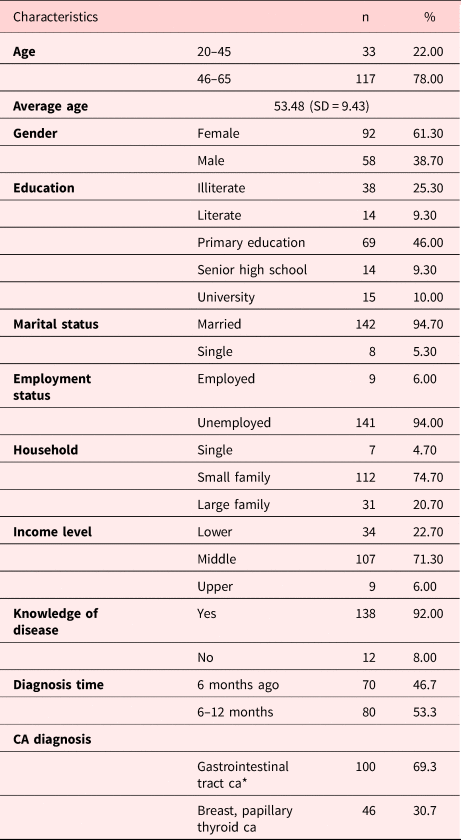
The basic characteristics of the patients in the study sample are shown in Table 1. A total of 150 patients were enrolled in this study. The mean age was 53.5 (SD = 9.4) years (range 20–65), 61.3% were female, 38.7% were male, and 94.7% were married. The majority had basic education (46%) and 94% were not working due to the health condition. The majority of participants (74.7%) had a small family. All patients identified themselves as Muslim. The majority of participants knew about the illness. Gastrointestinal tract CA comprised 69.3%.
Characteristics of CA survivors

* Colon ca, stomach ca, mesothelioma, pancreatic ca, cholangiocellular ca, liver ca (primary or metastatic)
Total and subdomain scores of the FACIT-Sp-version 4 in CA survivors
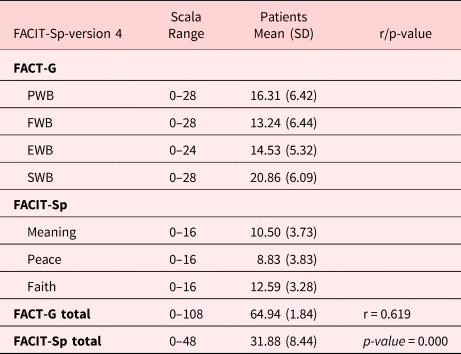
The results showed that our sample of Turkish CA survivors had an overall FACT-G score of 64.94 (SD = 1.84) and an overall FACIT-Sp score of 31.88 (SD = 8.44). The Pearson correlation coefficient indicated a significant, positive correlation between the FACT-G and FACIT-Sp total score (r = 0.619, p = 0.001) (Table 2).
Total and subdomain scores of the FACIT-Sp-version 4 of CA survivors

FACT-G = Functional Assessment of Cancer Therapy General
FACIT–Sp = Functional Assessment of Chronic Illness Therapy–Spiritual Well-Being Scale.
Pearson correlations among FACIT-Sp-version 4 scores
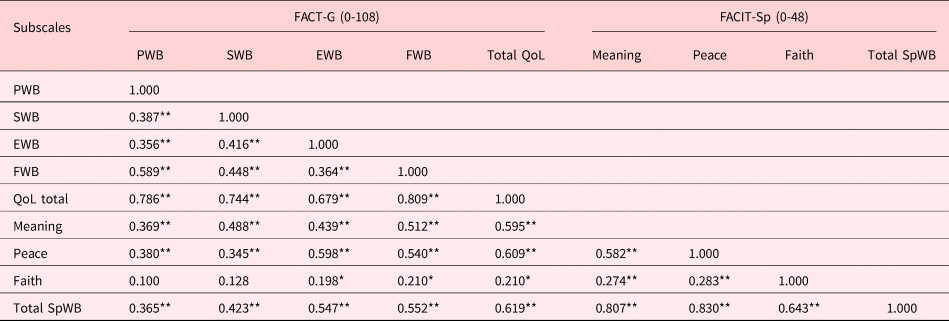
The Pearson correlation coefficient indicated a significant, positive correlation between each of the sub-dimension and total scores of FACT-G and FACIT-Sp (Table 3).
Pearson correlation among FACT-G and FACIT-Sp scores of CA survivors

PWB: physical well-being; SWB: social/family well-being; EWB: emotional well-being; FWB: functional well-being: SpWB: Spiritual well-being; QoL: Quality of Life
Adverse events, coping behaviors, and force will to live among CA patients
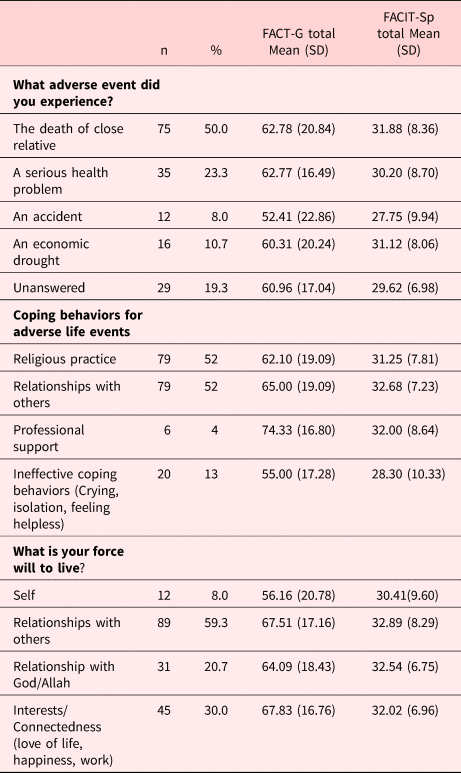
As shown in Table 4, 50% of patients stated that the death of someone near to them was an adverse (negative) life event (experience) and was associated with higher FACT-G and FACIT-Sp total scores. In this study, patients equally used their relationships with others and religious practices as coping behaviors with regard to negative life events (52%). The patients stated that 59.3% of them drew strength from their relationship with others. While 20.7% stated that God/a higher power/Allah was what helped them.
Adverse events, coping behaviors, and force will to live among CA survivors.

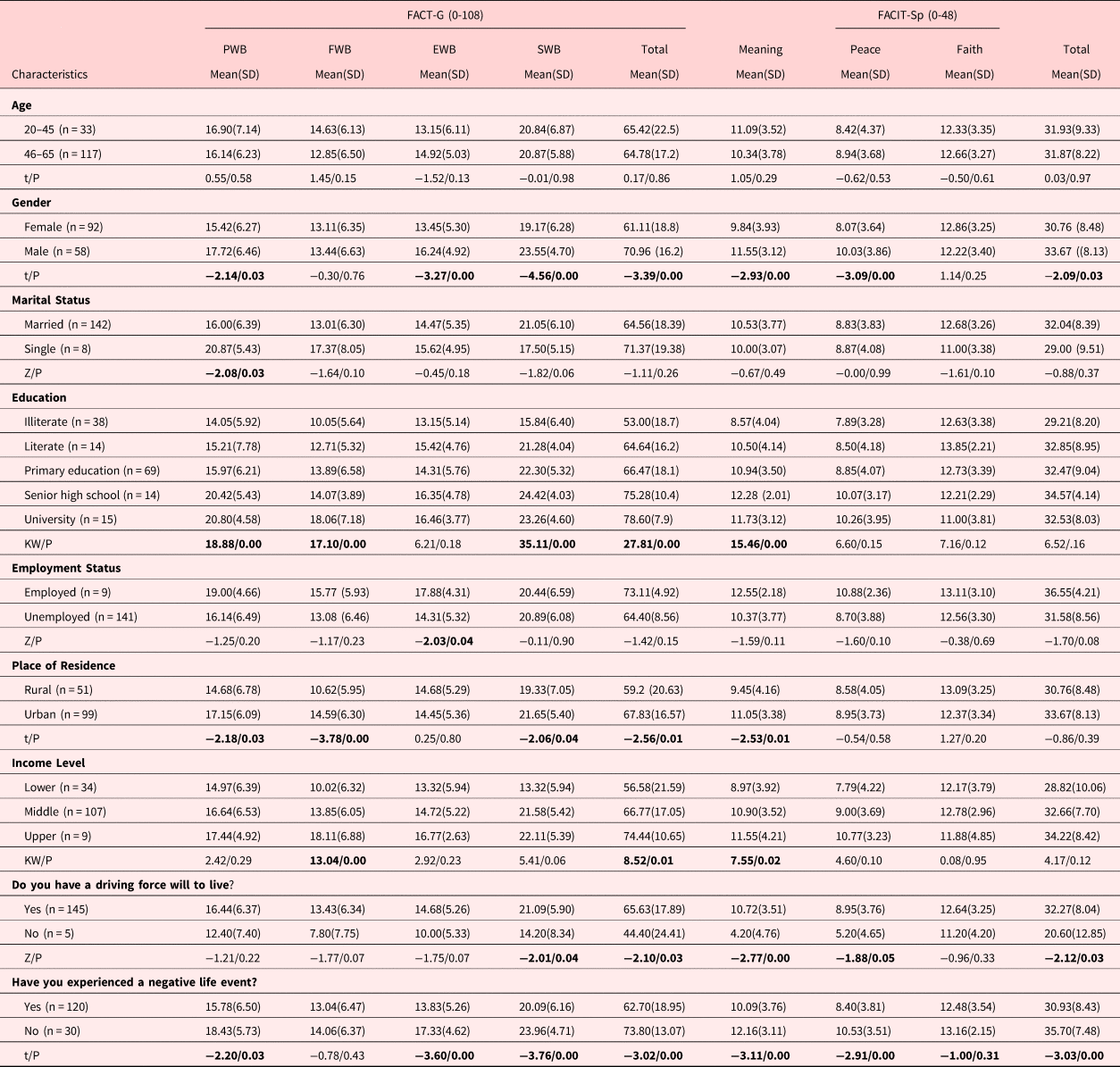
There was no statistically significant difference between the age of patients and all dimensions of the FACT-G and FACIT-Sp (p > 0.05). Male patients had higher scores than female patients except for the FWB and Faith in all areas of the FACT-G and FACIT-Sp scores; these differences were statistically significant (p < 0.05). A statistically significant difference was found among PWB, FWB, SWB, Meaning, and FACT-G total scores when the education levels of patients were compared (p < 0.05). Being single had a higher PWB score than being married and this difference was statistically significant. There was a statistically significant difference in the EWB score between the patients who were employed and those that were not. A statistically significant difference was found for PWB, FWB, SWB, Meaning, and FACT-G total scores when patients living in urban areas were compared to those living in rural areas. There was a statistically significant difference in the FWB, Meaning, and FACT-G total scores among patient income levels (p < 0.05). When variables were compared using the Tukey test, higher levels on the FACIT-Sp and FACT-G total scores were found for higher education level, urban location, and upper income. Those who experienced a negative event in their lives had lower FACT-G and FACIT-Sp total scores than those who did not, and the FACT-G and FACIT-Sp scores were higher in those with life-driving power (Table 5).
Comparison of total and subscale scores on the FACT-G and FACIT-Sp according to patient characteristics

Discussion
To the best of our knowledge, the present study is the first to evaluate the relationship between QoL and SpWB in Turkish adult patients with CA. The results revealed that there is a strong, positive correlation between the overall scores of FACIT-Sp and FACT-G (r = 0.619). This result is similar to the results of other studies in this field (Xing et al., Reference Xing, Guo, Bai, Qian and Chen2018; Martoni et al., Reference Martoni, Varani, Peghetti, Roganti, Volpicella, Pannuti and Pannuti2017; Bai & Lazenby, Reference Bai and Lazenby2015; Bai et al., Reference Bai, Lazenby, Jeon, Dixon and Mccorkle2015; Rabow & Knish, Reference Rabow and Knish2015; Agli et al., Reference Agli, Bailly and Ferrand2014; Jafari et al., Reference Jafari, Farajzadegan, Zamani, Bahrami, Emami and Loghmani2013). In other studies, it was determined that SpWB had a 7.1% contribution to total QoL (Lazenby et al., Reference Lazenby, Khatib, Al-Khair and Neamat2013), while for 78% (Peteet & Balboni, Reference Peteet and Balboni2013) and 84% (Vallurupalli et al., Reference Vallurupalli, Lauderdale, Balboni, Phelps, Block, Ng, Kachnic, Vanderweele and Balboni2012) of patients, it was important for coping with their CA.
In the present study, participants’ QoL scores were low, except SWB. However, they high Meaning and Faith scores, while the Peace score decreased by 50%. Additionally, in this study, it was found that there was a stronger relationship between Peace, Meaning, overall QoL, and all sub-dimensions of QoL, and also, total SpWB with Meaning/Peace and Faith. As is known, the Meaning dimension of spirituality suggests reflecting on a cognitive aspect of SpWB and physical health, and Peace as reflecting an affective dimension of spirituality which has a stronger relationship with mental health. In line with this knowledge, it can be argued that in this study, participants are emotionally challenged to cope with CA. The need for Meaning is a universal trait that is essential to life itself. In three studies by Breitbart et al. (Reference Breitbart, Rosenfeld, Gibson, Pessin, Poppito, Nelson, Tomarken, Timm, Berg, Jacobson, Sorger, Abbey and Olden2010, Reference Breitbart, Poppito, Rosenfeld, Vickers, Li, Abbey, Olden, Pessin, Lichtenthal, Sjoberg and Cassileth2012, Reference Breitbart, Rosenfeld, Pessin, Applebaum, Kulikowski and Lichtenthal2015), it was found that SpWB and QoL in CA patients receiving Meaning-centered group psychotherapy was significantly improved. In another study using life review interventions (Wang et al., Reference Wang, Chow and Chan2017), a positive effect on the Meaning dimension of SpWB and total QoL was determined. A meta-analytical study (Salsman et al., Reference Salsman, Pustejovsky, Jim, Munoz, Merluzzi, George, Park, Danhauer, Sherman, Snyder and Fitchett2015), suggests that religion and spirituality are patient-centered factors and often resources for managing the emotional sequelae of the CA experience. Furthermore, the high SBW score in this study may be interpreted as indicating that patients are not feeling alone, as the importance of patient visits in Turkish society may have increased the sense of meaning in life.
In light of the above, it can be said that Peace and Meaning contribute uniquely to QoL. Conversely, in some studies, it was found that for patients with advanced CA, Meaning/Peace scores were low (Pearce et al., Reference Pearce, Coan, Herndon, Koenig and Abernethy2012), with an inverse association between overall SpWB and the emotional (Lazenby et al., Reference Lazenby, Khatib, Al-Khair and Neamat2013) and physical (Lazenby & Khatib, Reference Lazenby and Khatib2012) dimensions of QoL.
The Faith dimension of spirituality is connected with most religious beliefs. Therefore, the word faith is also often used interchangeably with religion, referring to the whole of a tradition's belief system. For Muslims, the “faith” component of spirituality is closely associated with their religious beliefs, although it differs as a function of ethnic identity, age, and gender. This study also revealed that Faith had a weak correlation with sub-dimensions of QoL and Meaning/Peace. The faith factor was not consistently associated with QoL among patients with CA (Bai & Lazenby, Reference Bai and Lazenby2015). In another study (Lazenby et al., Reference Lazenby, Khatib, Al-Khair and Neamat2013), it was found that faith did not significantly contribute to the unique prediction of QoL in Jordanian Muslim CA patients. However, two studies in contrast (Bovero et al., Reference Bovero, Leombruni, Miniotti, Rocca and Torta2016; Canada et al., Reference Canada, Murphy, Fitchett and Stein2016) found that Faith was more associated with QoL than Meaning/Peace. These results may have originated from cultural factors, as faith is influenced by cultural factors and cultural factors also affect faith.
In the present study, it was determined that peace positively contributed to the subscales of the FACT-G (physical, emotional, and functional well-being). Conversely, in another study (Lazenby et al., Reference Lazenby, Khatib, Al-Khair and Neamat2013), peace was found to be inversely related to PWB in Muslim CA patients. It can be said that peace can provide a perspective that allows individuals to reinterpret their perceptions of the environment and the meaning and purpose of life when coping with CA.
In the present study, participants’ overall FACIT-Sp and FACT-G scores were higher in patients who had no negative life events and had a driving force. Furthermore, it was found that religious practices and relationships with others were used as coping behaviors by patients who have experienced negative life events, and relationships with others were used as driving forces. In a person's life, others, nature, and important or transcendent connections are essential. The strength of the connection dimensions of spirituality is important in coping with CA and may help people look beyond their current state of health and ultimately, achieve purpose in life. According to Narayanasamy (Reference Narayanasamy2002), connections with others appear to be a key source of support in the chronic illness coping process.
The present study shows that a higher overall FACT-G score was increased by a higher level of education; younger age; those living in urban areas; and upper-income level. Both the FACIT-Sp and FACT-G scores, except faith, were higher in males than females. One study (Rabow & Knish, Reference Rabow and Knish2015) found that among patients with CA, SpWB was not associated with patient age, gender, race, or CA stage. In some studies, those with low levels of education (Prince-Paul, Reference Prince-Paul2008) and women (Munoz et al., Reference Munoz, Salsman, Stein and Cella2015), were found to have significantly higher FACIT-Sp scores. In contrast, another study (Peterman et al., Reference Peterman, Fitchett, Brady, Hernandez and Cella2002) found a negative relationship between the level of education, Faith and Meaning/Peace scores, being higher in females than males. In a further study (Samuelson et al., Reference Samuelson, Fromme and Thomas2012), it was determined that Meaning/Peace were not significant in females, unchanged in males, but showed significant increases in the Faith dimension and overall FACIT-Sp scores. In this study, Faith scores were higher for those of middle income, those living in urban areas, in literacy education, females, and in those of advanced age. These differences may be due to cultural characteristics and lifestyle.
The current study found that Meaning contributes to an increase of SWB and FWB dimensions of the QoL, but not EWB. As is known, maintaining satisfying relationships, despite illness, is a critical concern for CA survivors. SWB and FWB, which reflect patients’ capacity to remain actively engaged in social roles and to feel meaningfully connected with others, is a critical aspect of QoL, the meaning and purpose of life and finally, adjustment to CA.
In conclusion, in light of the findings of this study and studies in other countries, it can be said that SpWB is universally necessary to improve the QoL of patients with CA.
Due to the sharp increase in CA incidence in the world, we believe that QoL improvement should be a priority for these patients. Therefore, we recommend that patients with CA should experience SpWB, and that perhaps suitable guidelines should be prepared.
Limitations
This study has some limitations. First, it is cross-sectional and also, we have only evaluated the relationship between SpWB and QoL, not considering other relationships such as those dealing with anxiety/depression. Second, non-random sampling and the small overall sample size limits the generalizability of our findings. The limited sample volume is due to the fact that the city where the study was conducted is a small town in the Central Anatolia region of Turkey and people with diseases such as CA go to bigger cities like Ankara or Kayseri near Sivas. Therefore, the number of samples remained small between the dates specified (six months). Despite these limitations, our study makes a contribution to increasing the SpWB and QoL of CA survivors and to future research.
Conclusion
This study demonstrates that SpWB positively contributes to the QoL of CA survivors. Spirituality is not necessarily limited to any specific types of beliefs or practices. For some, faith in self, others, and/or God constitutes in large part the meaning, purpose, and fulfilment they find in life. Thus, it can be said that SpWB is a stress-buffering mechanism available for improving QoL, especially when faced with life-threatening illnesses such as CA. We believe that SpWB and QoL measurements can be useful in health-related research. For this, the FACIT-G and FACIT-Sp (Version 4) is one measurement tool worthy of consideration. Future studies are needed to elucidate the factors associated with SpWB and spiritual care of patients with the goal of improving patient QoL in Turkey.