INTRODUCTION
The Myidae is a heterodont family consisting of fewer than 40 species in seven living genera (Huber, Reference Huber2010). The genus Mya burrows deeply in sandy or muddy sediment, while Sphenia attaches to hard substrates by byssal threads (Huber, Reference Huber2010). In addition, some myid genera are known to live symbiotically with other marine invertebrates: Cryptomya lives in the burrows of upogebid and callinassid shrimps (MacGinitie, Reference MacGinitie1934; Itani & Kato, Reference Itani and Kato2002; Nara et al., Reference Nara, Akiyama and Itani2008) and echiuran worms (Lawly, Reference Lawly1978), whereas Paramya lives in burrows of echiuran worms (Jenner & McCary, Reference Jenner and McCary1969; Henry, Reference Henry1976). These commensal bivalves embed themselves in the wall of the host burrows, protruding their very short siphons into the burrow lumen. Evolutionary pathways to symbiotic lifestyle have been studied in other several bivalve groups (Tsubaki et al., Reference Tsubaki, Kameda and Kato2010; Goto et al., Reference Goto, Kawakita, Ishikawa, Hamamura and Kato2012; Li et al., Reference Li, Ó Foighil and Middelfart2012). However, those remain little understood in the family Myidae.
This paper examines the genus Paramya, a poorly known genus of Myidae. The genus includes three uncommon species (Huber, Reference Huber2010): Paramya subovata (Conrad, 1845), Paramya recluzi (A. Adams, 1864) and Paramya africana Cosel, Reference Cosel1995. Paramya subovata lives in the burrows of the echiuran worm Thalassema hartmani (Thalassematidae) in North American coastal waters (Jenner & McCary, Reference Jenner and McCary1969; Henry, Reference Henry1976; Fox, Reference Fox1979), P. recluzi is distributed in eastern Asia (Habe, Reference Habe1977; Zhang et al., Reference Zhang, Xu, Liu and Liu2012), and P. africana occurs in Africa (Cosel, Reference Cosel1995). The biology of P. recluzi and P. africana remains unknown.
In this paper, we revealed that P. recluzi lives in the burrows of the thalassematid echiuran worms Ikedosoma gogoshimense and Arhinchite hayaoi in the Seto Inland Sea, Japan. This species is similar to the genus Basterotia (Galeommatoidea: Basterotiidae) in having a peg-like cardinal tooth on each valve and short siphons surrounded by unique tentacles. We performed a molecular phylogenetic analysis to determine the phylogenetic position of this species. Based on the results of the molecular analysis, in combination with morphological and ecological observations, we propose that P. recluzi should be transferred to the genus Basterotia. We also discussed the taxonomic position of P. subovata and P. africana.
MATERIALS AND METHODS
Sampling and observation
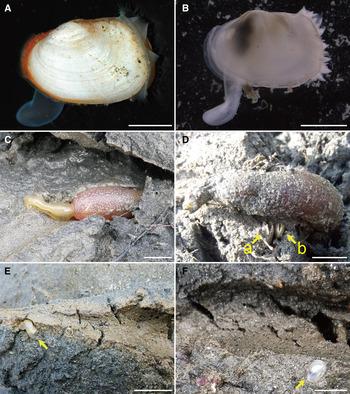
We collected P. recluzi by digging up the burrows of the thalassematid echiurans I. gogoshimense and A. hayaoi on muddy sand flats on Hakatajima Island and Matsuyama, Ehime Prefecture, the Seto Inland Sea, Japan, in July 2011 and July 2012 (Figure 1). The samples were stored in 100% ethanol. We also surveyed the burrows of sympatric invertebrates to check whether occurrences of P. recluzi were restricted to the echiuran burrows. We observed the shell and anatomical characteristics of specimens of P. recluzi under a microscope (Figures 1–3).
Paramya recluzi and its host echiurans. (A) A mature individual of P. recluzi. (B) A young individual of P. recluzi. (C) Arhynchite hayaoi, a host echiuran of P. recluzi. (D) Paramya recluzi (a) and Basterotia gouldi (b), with their host echiuran Ikedosoma gogoshimense. (E, F) Paramya recluzi living in the burrows of A. hayaoi. Scale bars: 3 mm (A); 3 mm (B); 2 cm (C, D, E); 1 cm (F).

Host echiurans
Both of the two host echiurans I. gogoshimense and A. hayaoi are thought to be endemic to Japanese waters (Goto et al., Reference Goto, Hamamura and Kato2011; Tanaka & Nishikawa, Reference Tanaka and Nishikawa2013; Tanaka et al., Reference Tanaka, Kon and Nishikawa2014). These two species are ecologically very similar in building L-shaped burrows in muddy or sandy sediments (Goto et al., Reference Goto, Hamamura and Kato2011; Tanaka & Nishikawa, Reference Tanaka and Nishikawa2013; Tanaka et al., Reference Tanaka, Kon and Nishikawa2014), but phylogenetically distant within the Thalassematidae (Goto et al., Reference Goto, Okamoto, Ishikawa, Hamamura and Kato2013; Goto, Reference Goto2016). Ikedosoma gogoshimense and A. hayaoi often co-occur sympatrically on intertidal flats in the Seto Inland Sea (Goto et al., Reference Goto, Hamamura and Kato2011). The former is more abundant than the latter in most populations (Goto et al., personal observations). The burrows of these echiurans are inhabited by various commensal animals, including the bivalve Basterotia gouldi, the snail Macromphalus tornatilis and the crab Pinnixa sp. (Goto et al., Reference Goto, Hamamura and Kato2011).
DNA extraction, amplification and sequencing
Total DNA of P. recluzi was extracted from the tissue using DNeasy Blood and Tissue Kit (Qiagen) following the manufacturer's instructions.
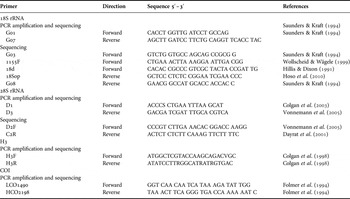
We sequenced the fragments of the nuclear 18S and 28S ribosomal RNA (rRNA), H3 and COI genes. Polymerase chain reactions (PCRs) were used to amplify ~1700 bp of 18S rRNA, ~1000 bp of 28S rRNA, ~360 bp of H3 and ~700 bp of COI. Amplifications were performed in 20 µl mixtures consisting of 0.4 µl of forward and reverse primers (primer sequences are provided in Table 1), 1.6 µl of dNTP, 2.0 µl of ExTaq buffer, 0.1 µl of ExTaq polymerase (TaKaRa, Otsu, Japan), and 15.1 µl of distilled water. Thermal cycling was performed with an initial denaturation for 3 min at 94°C, followed by 30 cycles of 30 s at 94°C, 30 s at a gene-specific annealing temperature, and 2 min at 72°C, with a final 3 min extension at 72°C. The sequencing reaction was performed using the PCR primers and internal primers (Table 1) and the BigDye Terminator Cycle Sequencing Ready Reaction Kit (Applied Biosystems, Foster City, CA) and electrophoresed on an ABI 3130 sequencer (Applied Biosystems). The obtained sequences have been deposited in the DDBJ/EMBL/GenBank databases with accession numbers LC152763–LC152766 (Table 2).
Information on primers used in this study.

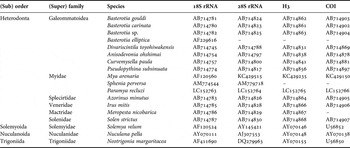
GenBank accession numbers of the specimens used in this study.

Molecular phylogenetic analysis
To determine the phylogenetic position of P. recluzi, we performed the molecular phylogenetic analysis using the four genes (18S + 28S + H3 + COI). In addition to the sequences of P. recluzi, which were obtained in this study, we also collected the sequence data from GenBank for the analyses (Table 2). The collected sequence data were mainly described by Goto et al. (Reference Goto, Kawakita, Ishikawa, Hamamura and Kato2012).
Sequences of the 18S and 28S genes were aligned using the Muscle function (Edgar, Reference Edgar2004) with default settings in the software Seaview (Galtier et al., Reference Galtier, Gouy and Gautiel1996; Gouy et al., Reference Gouy, Guindon and Gascuel2010), while those of the H3 and COI genes were aligned without gaps. Phylogenetic trees were obtained by the maximum likelihood (ML) and Bayesian methods. For the ML analysis, model selection and tree search were conducted using the TreeFinder program (Jobb et al., Reference Jobb, Haeseler and Strimmer2004; Jobb, Reference Jobb2007). The robustness of the ML tree was validated by bootstrap analysis with 1000 replications using the same program. Bayesian analyses were performed using MrBayes 3.1.2 (Ronquist & Huelsenbeck, Reference Ronquist and Huelsenbeck2003) with substitution models chosen using Kakusan 4 (Tanabe, Reference Tanabe2011). In the combined data set, substitution parameters were estimated separately for each gene. Two independent runs of Metropolis-coupled Markov chain Monte Carlo were performed simultaneously, sampling trees every 100 generations and calculating the average standard deviation of split frequencies every 1000 generations. Using the ‘stoprule’ option, analyses were continued until the average standard deviation of split frequencies dropped below 0.01, at which point the two chains were considered to have achieved convergence. Because the average standard deviation of split frequencies was calculated based on the last 75% of the samples, we discarded the initial 25% of the sampled trees as burn-in. We confirmed that analyses reached stationarity well before the burn-in period by plotting the ln-likelihood of the sampled trees against generation time.
RESULTS
Host associations
All Paramya recluzi specimens were collected from the burrows of the echiuran worms I. gogoshimense and A. hayaoi (Figure 1). Paramya recluzi was not found in the burrows of other sympatric burrowing invertebrates, such as sipunculans (Sipunculus nudus, Siphonosoma cumanense), holothurians (Protankyra bidentata), spatangoids (Echinocardia cordatum) or lingulid brachiopods (Lingula anatina). The symbiotic bivalves were embedded into the host burrow wall, and their posterior ends protruded into the burrow lumen (Figure 1E, F). Paramya recluzi sometimes co-occurred with the bivalve B. gouldi in the same burrow of I. gogoshimense or A. hayaoi (Figure 1D); however, B. gouldi was found more frequently in echiuran burrows than was P. recluzi, although the difference was not quantitatively assessed.
Shell morphology and anatomy
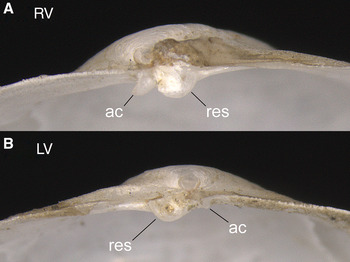
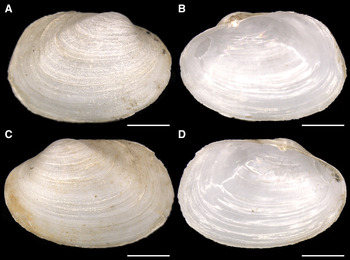
Shell (Figures 1–3): Small, thin, subquadrate, laterally inflated, length/height ratio 1.4–1.6 (Figures 1 & 2). Beak prosogyrate, suited 35–41% from the anterior end; anterior end rounded; posterior end broad, subtruncate; ventral margin broadly rounded; dorsal and ventral margins nearly parallel; low ridge present from the umbo to the postero-ventral margin (Figures 1 & 2). Sculpture consisting of comarginal growth lines and irregular sparse pustules (Figure 2). Single protruding cardinal tooth present in each valve (Figure 3); cardinal tooth of right valve short, located anterior to the resilium, and projecting antero-ventrally (Figure 3A); cardinal tooth of left valve ventrally projecting and much shorter than that of right valve (Figure 3B). Resilifers in each valve equally sized and ventrally projecting (Figure 3). External ligament moderate in size. Shell colour white.
Soft tissues: Outer and inner demibranch present, with the outer larger than the inner. Posterior part of mantle having very short inhalant and exhalant siphons, surrounded by numerous short tentacles (Figure 1A, B); antero-ventral side of the mantle having one aperture through which the foot is extended. Foot long and slender with short heel.
Shells of Paramya recluzi. (A, B) Right valves and (C, D) left valves. Scale bars: 3 mm.
Hinge structure of Paramya recluzi. ac: anterior cardinal tooth; res: resilifer.

Molecular phylogenetic analyses
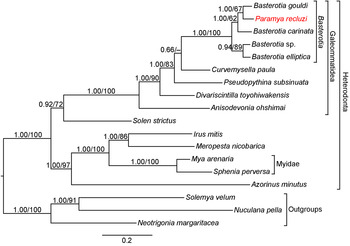
We sequenced the 18S, 28S, COI and H3 genes of P. recluzi (Table 2). Analysis of the phylogenetic position of P. recluzi using the basic local alignment search tool (BLAST) (Altschul et al., Reference Altschul, Gish, Miller, Myers and Lipman1990) showed that this species is closely related to Basterotia (Basterotiidae) species, not to myid species. To confirm the phylogenetic position of P. recluzi, we constructed a phylogenetic tree that included P. recluzi, eight galeommatoidean species (including four Basterotia species), two myid species, four other heterodont species and three non-heterodont outgroup species (Table 2; Figure 4). The sequence data were obtained from GenBank, except for those of P. recluzi. Our analyses confirmed that P. recluzi does not belong to the Myidae clade, but to the Basterotia clade (Figure 4). Basterotia consisted of two clades (Figure 4): Basterotia carinata, P. recluzi and B. gouldi [Bayesian posterior probability (BPP) = 1.00, maximum likelihood bootstrap percentage (MBP) = 62] and Basterotia sp. and B. elliptica (BPP = 0.94, MBP = 84); P. recluzi was the sister of B. gouldi (BPP = 1.00, MBP = 67) (Figure 4).
Phylogenetic position of Paramya recluzi within heterodont bivalves. The Bayesian tree was reconstructed based on combined sequence data (18S + 28S + H3 + COI). Numbers above branches indicate Bayesian posterior probabilities followed by supporting maximum likelihood bootstrap values.

DISCUSSION
Transfer of P. recluzi to the genus Basterotia
Paramya recluzi has been considered as a myid bivalve (e.g. Huber, Reference Huber2010; Zhang et al., Reference Zhang, Xu, Liu and Liu2012). However, our molecular phylogenetic analysis suggests that P. recluzi belongs to the genus Basterotia (Galeommatoidea: Basterotiidae) (Figure 4). Thus, we propose that the species should be transferred to the family Basterotiidae.
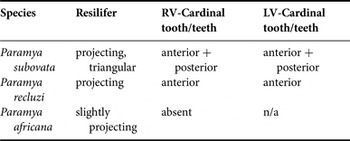
Paramya recluzi was originally described as a species of Eucharis (Adams, Reference Adams1864), which is now considered as Basterotia. However, the species was transferred from the genus Basterotia to the genus Paramya by Habe (Reference Habe1977). The reason for the transfer was not mentioned, but we assume that it was because of the presence of ventrally projecting resilifers in both valves in P. recluzi (Figure 3); such resilifers are considered as a common feature of Paramya (Cosel, Reference Cosel1995) (Table 3). Excluding this, the general morphological characteristics of P. recluzi, including anteriorly protruding cardinal tooth on the hinge (Figure 3) and short siphons surrounded by a numerous short tentacles (Figure 1), are identical to those of Basterotia.
Comparison of resilifers and hinge cardinal tooth/teeth among the three Paramya species. The information is based on Deshayes (Reference Deshayes1860), Fox (Reference Fox1979), Cosel (Reference Cosel1995) and this study.

RV, right valve; LV, left valve.
Most species of Basterotia have narrow or small resilifers, but some species have wide ones (Coan, Reference Coan1999a; Goto et al., Reference Goto, Hamamura and Kato2011). Similar to P. recluzi, B. gouldi also has ventrally projecting resilifers on each valve (Goto et al., Reference Goto, Hamamura and Kato2011). This species is the sister of P. recluzi in our molecular phylogenetic tree (Figure 4). Such resilifers are absent in the other Basterotia species used in the analyses (Goto et al., Reference Goto, Hamamura and Kato2011; Goto, personal observations). Thus, the ventrally projecting resilifers may have evolved in the common ancestor of B. gouldi and P. recluzi.
Paramaya subovata (the type species of Paramya) is similar to P. recluzi in having ventrally projecting, equal resilifers in symmetric position of each valve. However, shape of resilifers is different between the two species: P. subovata has large, triangular resilifers between anterior and posterior cardinal teeth (Fox, Reference Fox1979; Goto, personal observations on USNM specimens), whereas P. recluzi has relatively small, rounded resilifers posterior to a single cardinal tooth (Figure 3) (Table 3).
The family Basterotiidae also include several Basterotia-like genera (e.g. Anisodonta, Saxicavella, Atopomya and Basterotina) (Table 4). However, we considered that the genus Basterotia is most appropriate for this species on the basis of the hinge structure. The present species has a single prominent cardinal tooth on each valve (Figure 3). The type of Basterotia (B. corbuloides) has also a single prominent tooth similar to that in the present species (Hörnes, Reference Hörnes1859) (Table 4). On the other hand, the type of Anisodonta (A. complanatum) has both anterior and posterior cardinals (Deshayes, Reference Deshayes1860) (Table 4). The types of Saxicavella (S. jeffreysi) and Atopomya (A. dorobrata) have no cardinal on the hinge (Scott, Reference Scott1994; Oliver, Reference Oliver2013) (Table 4). The hinge of the type of Basterotina (B. rectangularis) has a cardinal tooth but it is much lower than that of the present species (Coan, Reference Coan1999a) (Table 4).
Comparison of resilifers and hinge cardinal tooth/teeth among basterotiid genera. The classification is based on Gofas (Reference Gofas2015).

RV, right valve; LV, left valve.
We found P. recluzi living commensally in the burrows of echiuran worms, embedded in the burrow wall with their siphons opening into the burrow lumen (Figure 1). Such a symbiotic habit also occurs in Basterotia species (Oliver et al., Reference Oliver, Holmes, Kileen, Light and Wood2004; Anker et al., Reference Anker, Murina, Lira, Vera Caripe, Palmer and Jeng2005; Goto et al., Reference Goto, Hamamura and Kato2011; Goto & Kato, Reference Goto and Kato2012). Thus, the transfer of P. recluzi to Basterotia is also supported by its ecological characteristics.
The taxonomy of the other Paramya species
By the transfer of P. recluzi to the genus Basterotia, only two species (P. subovata and P. africana) remain in the genus Paramya.
Paramya subovata is the type species of this genus. This species has a large resilifer and thus belongs to Myidae. However, this species is distinguished from all other myids in having the equal resilifers in symmetric position (Coan, Reference Coan1999b). This species lives in thalassematid echiuran burrows in the east coast of North America (Jenner & McCary, Reference Jenner and McCary1969; Henry, Reference Henry1976; Fox, Reference Fox1979); the bivalve is embedded in the burrow wall with its short siphons protruding into the host burrow lumen. Small juveniles are brooded on the ventral mantle margin (Fox, Reference Fox1979). These ecological characteristics are very similar to those of basterotiids (Scott, Reference Scott1994; Coan Reference Coan1999a; Goto et al., Reference Goto, Hamamura and Kato2011).
The shell appearance and general anatomical characteristics of P. subovata described in Fox (Reference Fox1979) are similar to those of basterotiid bivalves, for example, inhalant and exhalant siphons surrounded by short tentacles. The external shell surface with pustules of this species is similar to that of basterotiids (Campbell, Reference Campbell1993). Thus, as suggested in Campbell (Reference Campbell1993) and Coan (Reference Coan1999b), we assume that this species also belongs to the family Basterotiidae. Paramya subovata has triangular resilifers between anterior and posterior cardinals (Abbott, Reference Abbott1974; Fox, Reference Fox1979; Goto, personal observations on USNM specimens) (Table 3). Such a hinge structure is similar to that of the type of Anisodonta (Table 4). Thus, this species may be closely related with this genus.
Paramya africana was described from occurrences of only right valves (Cosel, Reference Cosel1995). This species has a slightly protruding resilifer on the hinge (Table 3). Judging from the figure in Cosel (Reference Cosel1995), its shell shape and hinge structure are nearly the same as those of S. jeffreysi (Basterotiidae). Thus, we suggest that P. africana is S. jeffreysi or a closely related species. Similar to Basterotia, S. jeffreysi is known as a commensal living in the burrows of echiuran worms (Nickell et al., Reference Nickell, Atkinson, Hughes, Ansell and Smith1995).
In conclusion, we propose that all the three Paramya species belong to the family Basterotiidae. However, to confirm this assumption, a further molecular phylogenetic analysis, including P. subovata, P. africana, Saxicavella and other basterotiid genera, is necessary.
Paramya recluzi and Basterotia gouldi
Paramya recluzi and B. gouldi are sympatric in the Seto Inland Sea, and both live commensally with the same echiuran host species (Ikedosoma gogoshimense and Arhynchite hayaoi) (Goto et al., Reference Goto, Hamamura and Kato2011; this study). The two bivalve species were sometimes found in the same echiuran burrow (Figure 1D). Coexistence of closely related Basterotia species in the same echiuran burrow has also been reported in the Ryukyu Archipelago, southern Japan (Goto & Kato, Reference Goto and Kato2012). These observations suggest that competitive exclusion may not occur between closely related species of Basterotia. The distribution of both P. recluzi and B. gouldi is limited to temperate eastern Asia (Goto et al., Reference Goto, Hamamura and Kato2011; Zhang et al., Reference Zhang, Xu, Liu and Liu2012; this study). Results of the molecular phylogeny show that these two species form a sister-group relationship within the Basterotia clade (Figure 4), suggesting that speciation of these two species may have occurred in temperate eastern Asia, although this should be confirmed by analyses including more taxa. In spite of the close relationship, the shell shape of P. recluzi is quite different from that of B. gouldi: the shell of P. recluzi is subquadrate (Figures 1 & 2), whereas that of B. gouldi is ovate (Goto et al., Reference Goto, Hamamura and Kato2011). In addition, shells of B. gouldi are thicker than those of P. recluzi. Such morphological differences between closely related species sometimes occur in Galeommatoidea as a result of specialization to different host environments (Goto et al., Reference Goto, Ishikawa, Hamamura, Sato and Kato2014). Paramya recluzi and B. gouldi use the same host echiurans in a similar way (Figure 1D). However, P. recluzi tends to inhabit more sandy sediments than does B. gouldi (Goto, Ishikawa, & Hamamura, personal observations). Thus, differently shaped shells of P. recluzi and B. gouldi may reflect specialized adaptations to different sediment habitats.
ACKNOWLEDGEMENTS
We wish to express our sincere gratitude to E.E. Strong (Smithsonian National Museum of Natural History) for her assistance with the examination of the specimens of P. subovata; S. Kojima (University of Tokyo), Y. Kano (University of Tokyo) and D. Ó Foighil (University of Michigan) for hosting RG as a research fellow for this study and permission to use the facilities in the laboratory. We also thank E.V. Coan (Santa Barbara Museum of Natural History) and one anonymous referee for careful reading of our manuscript and for giving useful comments.
FINANCIAL SUPPORT
This study was partially supported by grants to RG from the Research Institute of Marine Invertebrates (Tokyo) and the Japan Society for the Promotion of Science (JSPS) Research Fellowship for Young Scientists and the JSPS Postdoctoral Fellowship for Research Abroad.