Introduction
Obsessive-compulsive disorder (OCD) is a neuropsychiatric disorder involving distressing intrusive thoughts and related compulsive behaviours. OCD has been reported to be associated with neurobiological abnormalities that are distinct from those associated with other anxiety disorders (Radua et al. Reference Radua, van den Heuvel, Surguladze and Mataix-Cols2010). Considerable evidence has indicated neurocognitive impairment in patients with OCD (Kuelz et al. Reference Kuelz, Hohagen and Voderholzer2004; Chamberlain et al. Reference Chamberlain, Blackwell, Fineberg, Robbins and Sahakian2005; Muller & Roberts, Reference Muller and Roberts2005; Cavedini et al. Reference Cavedini, Gorini and Bellodi2006; Olley et al. Reference Olley, Malhi and Sachdev2007; Menzies et al. Reference Menzies, Chamberlain, Laird, Thelen, Sahakian and Bullmore2008; Goncalves et al. Reference Goncalves, Marques, Lori, Sampaio and Branco2010; Melloni et al. Reference Melloni, Urbistondo, Sedeño, Gelormini, Kichic and Ibanez2012). The cognitive domain with the most consistently reported deficits is visual memory, especially for complex visual stimuli (Savage et al. Reference Savage, Baer, Keuthen, Brown, Rauch and Jenike1999; Muller & Roberts, Reference Muller and Roberts2005; Olley et al. Reference Olley, Malhi and Sachdev2007), although it has also been suggested that such memory deficits arise from impairments in executive function, such as organizational strategy, rather than from memory difficulties per se (Savage et al. Reference Savage, Baer, Keuthen, Brown, Rauch and Jenike1999). Other cognitive functions frequently investigated with regard to this disorder include executive function, verbal fluency and verbal memory. Individuals with OCD have been observed to experience difficulties in inhibiting ongoing cognitive and motor responses (Aycicegi et al. Reference Aycicegi, Dinn, Harris and Erkmen2003; Penades et al. Reference Penades, Catalan, Rubia, Andres, Salamero and Gasto2007; Abramovitch et al. Reference Abramovitch, Dar, Schweiger and Hermesh2011; Rajender et al. Reference Rajender, Bhatia, Kanwal, Malhotra, Singh and Chaudhary2011; Tukel et al. Reference Tukel, Gurvit, Ertekin, Oflaz, Ertekin, Baran, Kalem, Kandemir, Ozdemiroglu and Atalay2012), shifting attention from one aspect of stimuli to others (Abbruzzese et al. Reference Abbruzzese, Bellodi, Ferri and Scarone1995, Reference Abbruzzese, Ferri and Scarone1997; Aycicegi et al. Reference Aycicegi, Dinn, Harris and Erkmen2003; Fenger et al. Reference Fenger, Gade, Adams, Hansen, Bolwig and Knudsen2005), engaging in executive planning (Cavedini et al. Reference Cavedini, Cisima, Riboldi, D'Annucci and Bellodi2001, Reference Cavedini, Zorzi, Piccinni, Cavallini and Bellodi2010; Nielen & Den Boer, Reference Nielen and Den Boer2003; Chamberlain et al. Reference Chamberlain, Fineberg, Blackwell, Clark, Robbins and Sahakian2007; Wobrock et al. Reference Wobrock, Gruber, McIntosh, Kraft, Klinghardt, Scherk, Reith, Schneider-Axmann, Lawrie, Falkai and Moorhead2010; Rajender et al. Reference Rajender, Bhatia, Kanwal, Malhotra, Singh and Chaudhary2011; Tukel et al. Reference Tukel, Gurvit, Ertekin, Oflaz, Ertekin, Baran, Kalem, Kandemir, Ozdemiroglu and Atalay2012) and decision making (Cavallaro et al. Reference Cavallaro, Cavedini, Mistretta, Bassi, Angelone, Ubbiali and Bellodi2003, Cavedini et al. Reference Cavedini, Zorzi, Piccinni, Cavallini and Bellodi2010; Starcke et al. Reference Starcke, Tuschen-Caffier, Markowitsch and Brand2010), generating words within a limited time (Schmidtke et al. Reference Schmidtke, Schorb, Winkelmann and Hohagen1998; Murphy et al. Reference Murphy, Nutzinger, Paul and Leplow2004; Rampacher et al. Reference Rampacher, Lennertz, Vogeley, Schulze-Rauschenbach, Kathmann, Falkai and Wagner2010; Borges et al. Reference Borges, Braga, Iego, D'Alcante, Sidrim, Machado, Pinto, Cordioli, do Rosario, Petribu, Mendlowicz, Mari, Miguel and Fontenelle2011; Tukel et al. Reference Tukel, Gurvit, Ertekin, Oflaz, Ertekin, Baran, Kalem, Kandemir, Ozdemiroglu and Atalay2012) and recalling verbal information (Savage et al. Reference Savage, Deckersbach, Wilhelm, Rauch, Baer, Reid and Jenike2000; Ceschi et al. Reference Ceschi, Van der Linden, Dunker, Perroud and Bredart2003; Deckersbach et al. Reference Deckersbach, Savage, Reilly-Harrington, Clark, Sachs and Rauch2004; Segalas et al. Reference Segalas, Alonso, Real, Garcia, Minambres, Labad, Pertusa, Bueno, Jimenez-Murcia and Menchon2010; Rajender et al. Reference Rajender, Bhatia, Kanwal, Malhotra, Singh and Chaudhary2011). However, findings of cognitive dysfunction in OCD have not been consistent across studies (Kuelz et al. Reference Kuelz, Hohagen and Voderholzer2004; Chamberlain et al. Reference Chamberlain, Blackwell, Fineberg, Robbins and Sahakian2005). Discrepant findings may be attributable to confounding factors including sex (Savage et al. Reference Savage, Deckersbach, Wilhelm, Rauch, Baer, Reid and Jenike2000; Deckersbach et al. Reference Deckersbach, Savage, Reilly-Harrington, Clark, Sachs and Rauch2004), duration of illness (Nakao et al. Reference Nakao, Nakagawa, Yoshiura, Nakatani, Nabeyama, Sanematsu, Togao, Yoshioka, Tomita, Kuroki and Kanba2009), medication status (Nakao et al. Reference Nakao, Nakagawa, Yoshiura, Nakatani, Nabeyama, Sanematsu, Togao, Yoshioka, Tomita, Kuroki and Kanba2009; Segalas et al. Reference Segalas, Alonso, Real, Garcia, Minambres, Labad, Pertusa, Bueno, Jimenez-Murcia and Menchon2010), co-morbidity (Aycicegi et al. Reference Aycicegi, Dinn, Harris and Erkmen2003), age at onset of illness (Henin et al. Reference Henin, Savage, Rauch, Deckersbach, Wilhelm, Baer, Otto and Jenike2001; Roth et al. Reference Roth, Milovan, Baribeau and O'Connor2005; Hwang et al. Reference Hwang, Kwon, Shin, Lee, Kim and Kim2007), insight (Tumkaya et al. Reference Tumkaya, Karadag, Oguzhanoglu, Tekkanat, Varma, Ozdel and Atesci2009), family history (Boone et al. Reference Boone, Ananth, Philpott and Kaur1991) and symptom-based subtype (Ceschi et al. Reference Ceschi, Van der Linden, Dunker, Perroud and Bredart2003; Cha et al. Reference Cha, Koo, Kim, Kim, Oh, Suh and Lee2008; Nedeljkovic et al. Reference Nedeljkovic, Kyrios, Moulding, Doron, Wainwright, Pantelis, Purcell and Maruff2009). However, data on the impact of these confounding factors on cognitive functioning have been conflicting.
Although several reviews systematically reviewed the neuropsychological impairments (Kuelz et al. Reference Kuelz, Hohagen and Voderholzer2004; Chamberlain et al. Reference Chamberlain, Blackwell, Fineberg, Robbins and Sahakian2005; Olley et al. Reference Olley, Malhi and Sachdev2007; Menzies et al. Reference Menzies, Chamberlain, Laird, Thelen, Sahakian and Bullmore2008; Melloni et al. Reference Melloni, Urbistondo, Sedeño, Gelormini, Kichic and Ibanez2012) and/or confounding variables (Kuelz et al. Reference Kuelz, Hohagen and Voderholzer2004) in OCD, they adopted a qualitative approach to the data and did not provide a systematic overview of the magnitude of the effects. Thus, to assess comprehensively the existence and magnitude of the cognitive impairments experienced by patients with OCD, this study used a meta-analytic approach to synthesize the available data. Additionally, we examined the effects of demographic and clinical variables on cognitive impairment in OCD patients to test our hypothesis that cognitive dysfunction in patients with OCD may be associated with these variables.
Method
Search strategies and study selection
Potential articles were identified through a Pubmed literature search conducted by two researchers (N.Y.S. and T.Y.L.) for articles published between 1980 and October 2012. The following keywords were used for searching: (‘obsessive–compulsive disorder’ OR ‘obsessive–compulsive’) AND (‘cognitive’ OR ‘cognition’ OR ‘neuropsychological’ OR ‘neuropsychology’ OR ‘neurocognitive’ OR ‘neurocognition’ OR ‘executive’). The reference lists of review articles were also checked. The following inclusion criteria were used to select studies for full-paper review: (1) published in English in a peer-reviewed journal; (2) restricted to adult patients (aged 18 years or older) diagnosed with OCD according to Diagnostic and Statistical Manual of Mental Disorders, third edition (DSM-III), fourth edition (DSM-IV), Ninth Revision of the International Classification of Diseases (ICD-9), or Tenth Revision (ICD-10); (3) used reliable neuropsychological tests to measure cognitive functioning and reported data for each individual test, not providing only composite scores; and (4) reported statistics for both patient and healthy control groups that were convertible to effect sizes. When several relevant articles from the same centre were identified, the study with the largest sample was selected.
Data extraction
The variables extracted for the meta-analysis were year of publication, mean and standard deviation for age, sex (ratio of males), mean and standard deviation of years of education, and cognitive performance (mean and standard deviation or t, F and p statistics). Additionally, we coded clinical variables including symptom severity, as evaluated by the Yale–Brown Obsessive-Compulsive Scale (YBOCS), percentage of patients receiving psychotropic medication, percentage of patients with co-morbid psychiatric disorders, and mean age at onset and duration of illness. The variables recorded were cross-checked by the two authors (N.Y.S. and T.Y.L.)
Statistical analyses
Analysis was conducted using Comprehensive Meta-Analysis version 2 (Biostat, Inc., USA) and Stata version 12 (StataCorp LP, USA) software. Effect sizes for outcome variables and cognitive domains were estimated by calculating Hedges' g, which is the difference between patient and control groups divided by the pooled standard deviation and weighted for sample size to control for small-sample bias (Hedges & Holkin, Reference Hedges and Holkin1985). Negative values for effect sizes indicate poor performance by patients with OCD compared with healthy controls. The heterogeneity of effects across studies was tested with Cochran's Q statistic and the I 2 index. For homogeneous data (p > 0.1 for Q statistic), a fixed-effect model was calculated, and in the presence of heterogeneity, a random-effect model was adopted for the effect size of each variable. In cases with significant heterogeneity across studies, potential sources of heterogeneity were investigated with a Galbraith plot. This scatter plot graphically displays studies that contribute heterogeneity by plotting each study's z score (the mean difference divided by the standard error of the difference) against the reciprocal of the standard error of the mean difference. Studies with high heterogeneity fell outside 2 standard deviations above and below the 95% confidence interval (CI) limit. We evaluated changes in Q statistics after removing outlier studies. Subgroup analysis and meta-regression were conducted to evaluate the effects of study characteristics on cognitive functioning. Subgroup analysis was performed to investigate the influence of categorical factors (test forms or methods of testing used). Between-group heterogeneity (Q bet) was computed to test the significance of differences in the magnitudes of effect sizes between subgroups. Meta-regression analysis was used to examine the effects of continuous moderators on the effect sizes across all variables related to cognitive tasks (publication year, age, sex, years of education, symptom severity, percentage of medicated patients, and percentage of patients with co-morbid psychiatric disorders). We were not able to include the effects of age at onset and duration of illness in the analysis because too few studies reported relevant data. To control for type I errors due to multiple comparisons, we applied the adjusted p value for the meta-regression by dividing α by the number of moderators. Publication bias was examined by visually inspecting funnel plots and using the regression intercept developed by Egger et al. (Reference Egger, Smith, Schneider and Minder1997). The trim-and-fill method (Duval & Tweedie, Reference Duval and Tweedie2000) was applied to adjust for publication bias when indicated.
We analysed data from at least five studies for each neuropsychological variable. Cognitive tasks that are very similar in their set-up [e.g. the Auditory Verbal Learning Test and the California Verbal Learning Test; the Tower of London (ToL) and the Tower of Hanoi (ToH) tasks; the Object Alternation Test and the Delayed Alternation Test] were combined for analysis. To examine the cognitive domain specificity, we grouped individual test variables into six domains (visuospatial memory, verbal memory, verbal fluency, executive function, processing speed, and attention).
Results
Study characteristics
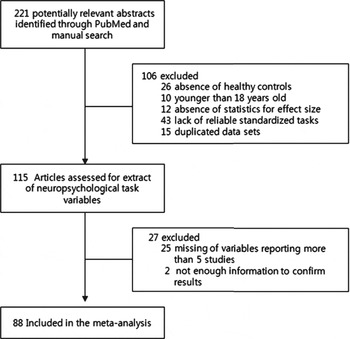
More than 2300 articles were identified through a two-step search strategy. After reviewing titles and abstracts, we selected 221 relevant articles for full-text analysis. Of these, 133 were excluded based on the inclusion criteria: 26 did not include a healthy control group, 10 included patients younger than 18 years of age, 12 did not use statistics appropriate for conversion into effect sizes, 43 did not use reliable standardized neuropsychological tests, and 15 used samples that overlapped with those used by studies that had been already included. Additionally, 25 studies were not included in the analysis because fewer than five studies reported results for each cognitive variable they addressed. Moreover, two studies were excluded because the statistics reported in tables did not match statements in the text. Therefore, 88 studies (Fig. 1) including a total of 3070 patients with OCD (mean age 33.5 years, s.d. = 4.7, 49.0% male) and 3024 control subjects (mean age 32.6 years, s.d. = 4.7, 49.5% male) met the inclusion criteria (online Supplementary Table S1). The mean years of education in 63 studies was 13.5 (s.d. = 2.0) in patients and 14.2 (s.d. = 2.1) in controls. Of the patients, 56% with OCD included in 76 studies were drug-naive or drug-free, and 58% in 65 studies excluded patients with co-morbid psychiatric disorders. Symptom severity, as evaluated by the YBOCS, was 24.2 (s.d. = 3.1) in 62 studies. The average duration of illness was 11.9 years in 42 studies, and the mean age at onset of OCD was 19 years in 28 studies.
Search strategy used for selection of studies included in the meta-analysis.

Cognitive functioning
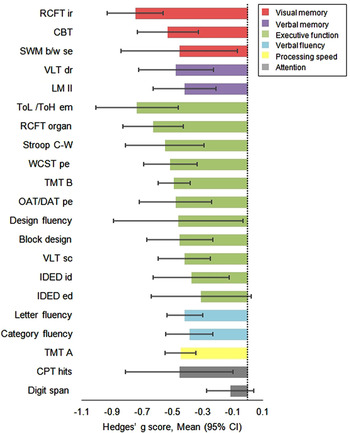
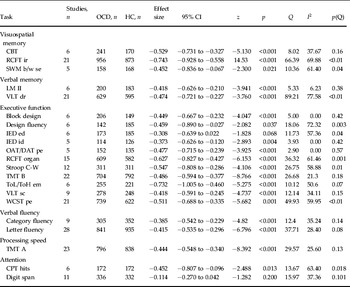
The main results of the meta-analysis are presented in Table 1 and Fig. 2. Patients with OCD showed significantly poorer performances in all task variables except digit span and the extra-dimension trial of the Intra/Extra-Dimensional Set (IED ed) compared with that of healthy controls. The largest effect sizes were found for immediate recall in the Rey–Osterrieth Complex Figure test (RCFT ir) (g = −0.74), which measures visuospatial memory, and for number of moves in excess on the ToL/ToH (ToL/ToH em) (g = −0.73); this was followed by organizational strategies in the RCFT (RCFT organ) (g = −0.63). The effect sizes for the Stroop test, Wisconsin Card Sorting Test (WCST) and Corsi block-tapping tests (CBT) reflected a medium degree of impairment, whereas those for tests measuring other variables reflected a small to medium degree of impairment (g < 0.5). We found no significant differences between groups in the digit span test (p > 0.2) and IED ed (p > 0.06).
Effect sizes of individual cognitive tasks in obsessive-compulsive disorder compared with controls. Negative values of Hedges' g mean worse performance in the patients compared with the controls. Values are means, with 95% confidence intervals (CIs) represented by vertical bars. RCFT, Rey–Osterrieth Complex Figure Test; ir, immediate recall; CBT, Corsi block-tapping test; SWM, spatial working memory; b/w se, between search errors; VLT, Verbal Learning Test; dr, delayed recall; LM, logical memory; ToL, Tower of London; ToH, Tower of Hanoi; em, number of moves in excess; organ, organizational strategies; Stroop C-W, Stroop Color–Word inference condition; WCST, Wisconsin Card Sorting Test; TMT B, Trail Making Test part B; OAT, Object Alternation Test; DAT, Delayed Alternation Test; pe, perseverative errors; VLT, Verbal Learning Test; sc, semantic clustering; IED, Intra/Extra Dimension; id, intra-dimensional trial score; ed, extra-dimensional trial score; TMT A, Trail Making Test part A; CPT, Continuous Performance Test.

Cognitive function in patients with OCD compared with controls subjects in individual cognitive test variables

OCD, Obsessive compulsive disorder; HC, healthy controls; CI, confidence interval; CBT, Corsi block-tapping test; RCFT, Rey–Osterrieth Complex Figure Test; ir, immediate recall; SWM b/w se, Spatial Working Memory between search errors; LM, logical memory; VLT, Verbal Learning Test; dr, delayed recall; IED, Intra/Extra Dimension; ed, extra-dimensional trial score; id, intra-dimensional trial score; OAT, Object Alternation Test; DAT, Delayed Alternation Test; pe, perseverative errors; organ, organizational strategies; Stroop C-W, Stroop Color–Word inference condition; TMT B, Trail Making Test part B; ToL, Tower of London; ToH, Tower of Hanoi; em, number of moves in excess; sc, semantic clustering; WCST, Wisconsin Card Sorting Test; TMT A, Trail Making Test part A; CPT, Continuous Performance Test.
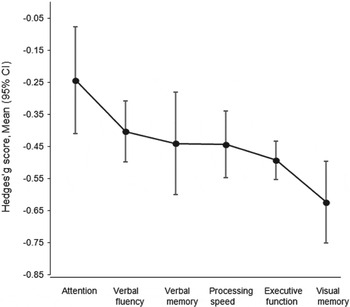
Fig. 3 presents the results by cognitive domain. Patients with OCD showed significant impairment in the domains of visuospatial memory (g = −0.624, 95% CI −0.752 to −0.495, z = −9.508, p < 0.001), executive function (g = −0.493, 95% CI −0.553 to −0.432, z = −15.937, p < 0.001), verbal memory (g = −0.441, 95% CI −0.600 to −0.282, z = −5.436, p < 0.001), processing speed (g = −0.444, 95% CI −0.548 to −0.340, z = −8.392, p < 0.001) and verbal fluency (g = −0.404, 95% CI −0.499 to −0.309, z = −8.336, p < 0.001), whereas no significant differences in the domain of attention (g = −0.244, 95% CI −0.566 to −0.078, z = −1.483, p = 0.14) were observed. The grand mean effect size for all cognitive domains was g = −0.478 (p < 0.001).
Cognitive profile of neuropsychological domains in obsessive-compulsive disorder compared with controls. Negative values of Hedges' g mean worse performance in the patients compared with the controls. Values are means, with 95% confidence intervals (CIs) represented by vertical bars.

Heterogeneity and publication bias
The Q tests showed significant heterogeneity for 11 of 21 cognitive variables. A Galbraith plot showed that several studies made significant contributions to the heterogeneity for the five variables. The study conducted by Rajender et al. (Reference Rajender, Bhatia, Kanwal, Malhotra, Singh and Chaudhary2011) reported the highest effect size between patients and controls in the Verbal Learning Test (VLT dr), and after removal of this study, significant heterogeneity disappeared (Q = 18.95, I 2 < 0.01, p = 0.46; g = −0.344, 95% CI −0.450 to −0.218, z = −5.655, p < 0.001). The study conducted by Starcke et al. (Reference Starcke, Tuschen-Caffier, Markowitsch and Brand2010) was a significant source of heterogeneity on the letter fluency. After exclusion of those data from the present study, the results of the Q test were non-significant (Q = 30.70, I 2 = 8.80, p = 0.33; g = −0.449, 95% CI −0.550 to −0.348, z = −8.724, p < 0.001). The study conducted by Cohen et al. (Reference Cohen, Lachenmeyer and Springer2003) reported the largest effect size for the Stroop test, and the Q test showed no significant heterogeneity after the data from that study were excluded (Q = 17.05, I 2 = 35.47, p = 0.11; g = −0.429, 95% CI −0.594 to −0.264, z = −5.097, p < 0.001). The study conducted by Trivedi et al. (Reference Trivedi, Dhyani, Goel, Sharma, Singh, Sinha and Tandon2008) showed the largest effect size for the Continuous Performance Test (CPT); heterogeneity was no longer significant after the exclusion of the data from that study (Q = 3.28, I 2 < 0.01, p = 0.51; g = −0.298, 95% CI −0.530 to −0.067, z = −2.526, p = 0.012). In terms of the IED ed, the effect reported by Nielen & Den Boer (Reference Nielen and Den Boer2003) fell outside the margin in the Galbraith plot. When this study was removed, the heterogeneity of the IED ed was not significant (Q = 1.30, I 2 < 0.01, p = 0.86), and the effect size became significant (g = −0.439, 95% CI −0.660 to −0.218, z = −3.891, p < 0.001). Visual inspection of funnel plots and Egger's test revealed significant publication bias for only the VLT dr (p = 0.04). After adjusting for publication bias using the trim-and-fill method, the estimate of the effect size remained significant for this variable (g = −0.514, 95% CI −0.748 to −0.281).
Effects of moderators
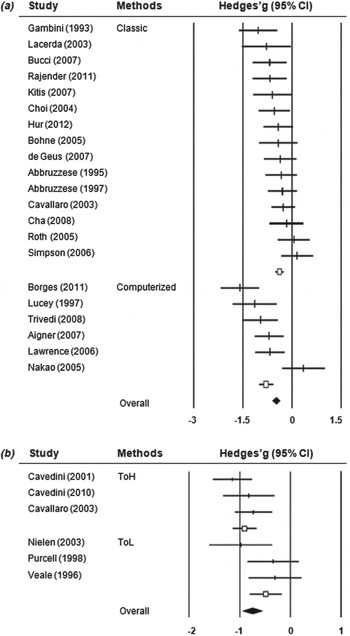
Subgroup analysis revealed that the use of different forms of test was a significant contributor to heterogeneity for the WCST and the ToL/ToH. For the WCST, two forms were used: the classical manual (n = 15) and the computerized (n = 6, containing either 48 or 64 items) forms. Studies using the classical manual approach were identified homogenous (Q = 18.66, I 2 = 24.91, p = 0.18), but those relying on the computerized version remained heterogeneous (Q = 20.93, I 2 = 76.12, p = 0.001). The magnitudes of the effect sizes of the two methods differed significantly (Q bet = 10.34, p = 0.001, g = −0.380, 95% CI −0.508 to −0.253 for the manual version; g = −0.794, 95% CI −1.012 to −0.577 for the computerized version) (Fig. 4 a). When data from the ToL (n = 3) were separated from data from the ToH (n = 3), each of the two groups of studies was homogeneous (Q = 3.17, I 2 = 36.88, p = 0.21 for the ToL; Q = 2.54, I 2 = 21.34, p = 0.28 for the ToH), and the two groups differed significantly from each other in their effect sizes (Q bet = 4.41, p = 0.04; g = −0.904, 95% CI −1.137 to −0.671 for the ToH; g = −0.486, 95% CI −0.799 to −0.174 for the ToL) (Fig. 4 b).
Effect size of each study for the Wisconsin Card Sorting Test (a) and the Tower of Hanoi (ToH) and the Tower of London (ToL) tasks (b). The square indicates the overall estimate for each method and the diamond indicates the combined effect size for the two kinds of methods. CI, Confidence interval.

The meta-regression analysis indicated that two tests (the IED ed and CPT) were significantly associated with demographic variables. Younger patients showed more pronounced impairment than did their age-matched controls on the IED ed (z = 3.122, p = 0.002). Additionally, deficits on the CPT were more pronounced with inclusion of fewer male patients (z = 3.278, p = 0.001). In terms of clinical variables, symptom severity, as measured by YBOCS total scores, was significantly related to performance on the category fluency test (z = −2.928, p = 0.003), with patients with severe symptoms showing more impairment on this test than those with less severe symptoms. The percentages of medicated patients and patients with co-morbid disorders were not significantly associated with performance on any of the tasks.
Discussion
The purpose of this meta-analysis was to provide a comprehensive overview of the magnitude of cognitive deficits in OCD. To our knowledge, this is the first meta-analysis examining the results of various neuropsychological tests addressing different cognitive domains with respect to OCD. Consistent with earlier reviews, we found impairments on the tasks measuring visuospatial memory, verbal memory, executive function, verbal fluency and processing speed among patients with OCD, with effect sizes ranging from −0.7 to −0.3 compared with healthy control subjects. No deficits were found in auditory attention, as measured by the digit span test. According to the conventional interpretation of effect size (Cohen, Reference Cohen1988), visuospatial memory, visual organizational skill and planning ability showed medium-to-large effects, whereas set-shifting ability, design fluency, cognitive inhibition, verbal memory, verbal fluency and processing speed showed medium or small-to-medium effect size. When the tasks were grouped according to cognitive domain, visuospatial memory showed medium-to-large effects, whereas executive function, verbal fluency, processing speed and verbal memory showed small-to-medium effects. We found no significant impairment in the domain of attention among patients with OCD. Patients with OCD appear to have broad, albeit not severe, cognitive dysfunction but preserved attentional ability.
The results of the current meta-analysis suggest that impairment in visuospatial memory is more pronounced than are deficits in executive function such as set shifting and inhibition in patients with OCD. The small number of studies using certain tests and the small sample sizes included in some studies require that additional research be conducted before definite conclusions are reached. However, this meta-analysis underscores the significance of findings reflecting OCD patients' difficulty in accurately recalling information about visual stimuli. This impairment was more profound when the configurations of complex figures were recalled than when sequences of spatial locations were retrieved. It has been assumed that memory deficits in patients with OCD may be secondary to defective organizational strategies (Savage et al. Reference Savage, Baer, Keuthen, Brown, Rauch and Jenike1999; Melloni et al. Reference Melloni, Urbistondo, Sedeño, Gelormini, Kichic and Ibanez2012). Several studies found that organizational skill, which is required for efficient information processing, was impaired in patients with OCD and completely or partially mediated problems with non-verbal (Savage et al. Reference Savage, Baer, Keuthen, Brown, Rauch and Jenike1999, Reference Savage, Deckersbach, Wilhelm, Rauch, Baer, Reid and Jenike2000; Shin et al. Reference Shin, Park, Kim, Lee, Ha and Kwon2004) and verbal memory (Savage et al. Reference Savage, Deckersbach, Wilhelm, Rauch, Baer, Reid and Jenike2000). The current meta-analysis provides evidence about the relatively strong magnitude of effects related to visual organizational skill. Impaired performance seemed to be more pronounced in tasks involving the organization of complex visual configurations than in those involving the assembly of simple diagonal patterns. Additionally, this disability in organizational skill seems to be more evident in tasks that require processing of visuospatial than of verbal information, given the smaller effect size of semantic clustering on the verbal learning test. However, it should be noted that the deficit in visual memory was slightly larger in magnitude than was the deficit in visual organizational skill. This may imply that poor performance with regard to visuospatial memory is not explained by a single problem involving organizational skill.
Regarding executive function, the magnitude of the deficit differed among tasks, but in no case was it very large. A relatively large effect size was found for planning ability. However, as we included studies measuring excessive numbers of moves, many studies that used different outcome variables (n = 17) were excluded from the analysis. Thus, our interpretation of these results should be considered with caution. It is somewhat surprising that executive function, in particular set shifting and inhibition, which have been considered core deficits in OCD (Chamberlain et al. Reference Chamberlain, Blackwell, Fineberg, Robbins and Sahakian2005), had relatively small effect sizes. A considerable body of research using neuroimaging techniques with individuals with OCD has investigated executive function in OCD patients by employing neuropsychological tests known to be sensitive to abnormalities in certain brain regions, including the orbitofrontal cortex, anterior cingulate cortex and basal ganglia (Melloni et al. Reference Melloni, Urbistondo, Sedeño, Gelormini, Kichic and Ibanez2012). However, the neuropsychological findings are inconsistent, and our meta-analysis revealed that impairment in tasks involving set shifting and inhibition (i.e. alternation tests and the IED, Stroop, TMT, WCST) was moderate (medium or small to medium).
The subgroup analysis revealed that the use of different forms of tests explained a significant proportion of the heterogeneity in the effect estimates for the WCST and the ToL/ToH. The computerized version of the WCST appears to be more sensitive than the classic method for identifying deficits in patients with OCD. Similarly, the ToH seems to be more sensitive for detecting planning problems in these patients. Although additional studies are needed to draw conclusions, these results imply that the selection of the method of testing and the form of the test may be important considerations in efforts to detect neurocognitive dysfunction in OCD.
Our examination of confounding moderator variables revealed that age and sex significantly contributed to the variability in only two tests (the IED ed and CPT) and that educational level had no effect. These results suggest that cognitive deficits are not typically moderated by demographic variables in OCD. In terms of clinical variables, severe symptoms were associated with deficits in category fluency, whereas the prevalence of medicated patients or patients with co-morbid psychiatric disorders did not influence any outcome variables. However, these results should be interpreted with caution, as many studies included in this main meta-analysis did not report the relevant clinical information. Moreover, some important potential clinical moderators that have been proposed to influence cognitive functioning in OCD could not be analysed due to the small number of studies that reported the relevant information. Level of depressive symptoms, symptom subtypes, age at onset and duration of illness have been considered as possible moderators affecting cognitive functioning in OCD (Kuelz et al. Reference Kuelz, Hohagen and Voderholzer2004). These important moderators are needed to be investigated further and to be controlled before a definite conclusion can be made.
The limitations of this meta-analysis should be addressed. First, studies using non-standardized cognitive tests were excluded because the psychometric properties of such tests have not been established. Second, the classification of individual tasks into cognitive domains was not based on reliable criteria, although it was based on existent psychometric evidence.
In conclusion, this meta-analysis indicated that patients with OCD experience significant impairments in visuospatial memory, executive function, verbal memory, verbal fluency and processing speed, whereas the attentional ability of these individuals is relatively preserved. Although the magnitude of the deficits is, in general, not large, visuospatial memory, visual organizational skill and planning ability appear to be the most impaired areas in patients with OCD. Different test forms and methods of testing probably influence the performance of patients with OCD, indicating the need to carefully select the form of each test and methods of testing used. Further exploration of the effects of various clinical variables on cognitive functioning in patients with OCD and additional investigation of whether the cognitive dysfunction associated with this disorder differs from or overlap with that in other anxiety disorders are needed.
Supplementary material
For supplementary material accompanying this paper visit http://dx.doi.org/10.1017/S0033291713001803.
Acknowledgements
This research was supported by the Mid-carrier Research Program through National Research Foundation grants funded by the Ministry of Education, Science and Technology, Republic of Korea (20110015639).
Declaration of Interest
None.