Introduction
Seed persistence under field conditions is a key determinant of soil seed bank dynamics and knowledge of it is crucial to assess plant population dynamics and adaptation under both natural and agricultural ecosystems (Saatkamp et al., Reference Saatkamp, Poschlod, Venable and Gallagher2014). Hence, effective management of plant populations, including restoration ecology, conservation of endangered species and weed eradication, require knowledge of seed persistence (Bakker et al., Reference Bakker, Poschlod, Strykstra, Bekker and Thompson1996; Panetta and Lawes, Reference Panetta and Lawes2005; Bossuyt and Honnay, Reference Bossuyt and Honnay2008).
How long viable seeds persist in the field varies among species and populations, and depends on physical and physiological seed characteristics (inherent longevity) and how these are affected by biotic and abiotic factors (Long et al., Reference Long, Gorecki, Renton, Scott, Colville, Goggin, Commander, Westcott, Cherry and Finch-Savage2015). Whilst several studies found ecological correlates of abiotic factors with seed persistence in the field (Bekker et al., Reference Bekker, Knevel, Tallowin, Troost and Bakker1998a; Abedi et al., Reference Abedi, Bartelheimer and Poschlod2014) few studies have included soil water and temperature conditions (Bekker et al., Reference Bekker, Oomes and Bakker1998b; Long et al., Reference Long, Steadman, Panetta and Adkins2009; Pakeman et al., Reference Pakeman, Small and Torvell2012). In addition, although seed persistence in the field has been shown to be predicted by laboratory-controlled ageing (Bekker et al., Reference Bekker, Bakker, Ozinga and Thompson2003; Long et al., Reference Long, Panetta, Steadman, Probert, Bekker, Brooks and Adkins2008), most laboratory experiments were conducted under conditions not common under natural environments (Walters et al., Reference Walters, Wheeler and Grotenhuis2005). Hence, although it is well known that the longevity of seeds is mainly determined by seed moisture content and storage temperature, with lifespan increasing with decreasing temperature and moisture content (Ellis and Roberts, Reference Ellis and Roberts1980), the contribution of these factors on inherent longevity under near-natural conditions are not satisfactorily explored.
While temperature and moisture content are the two most important conditions affecting seed lifespan, other abiotic factors also contribute to seed longevity in the field. For example, soils with high moisture levels are accompanied by low oxygen pressure and vice versa. Oxygen might be expected to have both positive and negative effects on seed longevity. It tends to promote ageing at moisture contents below those at which respiration is possible and oxidative damage can accumulate, but it delays ageing at higher moisture contents when respiration can occur and damage can be repaired (Ibrahim et al., Reference Ibrahim, Roberts and Murdoch1983; Roberts and Ellis, Reference Roberts and Ellis1989; Vertucci and Leopold, Reference Vertucci and Leopold1984; Walters et al., Reference Walters, Farrant, Pammenter, Berjak, Black and Pritchard2002). Hence, as under natural conditions seeds in the soil are metabolically active, increased water content of the soil could therefore be beneficial for seed survival but, on the other hand, effects of long periods of waterlogging could be negative when anoxic conditions occur (Bekker et al., Reference Bekker, Oomes and Bakker1998b). The exact mechanisms that lead to the loss of seed viability have not been completely elucidated. However, there is general consensus that oxidative and peroxidative processes play the primary roles in initiating damage (Bewley et al., Reference Bewley, Bradford, Hilhorst and Nonogaki2013). Particularly, reactive oxygen species (ROS) accumulation, lipid peroxidation and membrane damage are generally considered as the major contributors to seed deterioration (Hendry, Reference Hendry1993; Bailly, Reference Bailly2004; Kranner et al., Reference Kranner, Minibayeva, Beckett and Seal2010). Damage due to free radicals and ROS is prevalent in dry seeds while at higher seed moisture contents, additional mechanisms of damage become possibly mediated by enzyme activity (Walters et al., Reference Walters, Farrant, Pammenter, Berjak, Black and Pritchard2002). Finally, seed deterioration is associated with a decreased activity of the detoxification system composed by a number of anti-oxidant enzymes which, in turn, changes in their activity and may be considered good oxidative stress indicators (Bailly et al., Reference Bailly, El-Maarouf-Bouteau and Corbineau2008).
The influence of temperature, moisture content and oxygen on seed longevity has been mostly examined to estimate viability of seed lots held in dry storage for long-term ex situ conservation of plant germplasm (Ellis and Roberts, Reference Ellis and Roberts1980; Walters et al., Reference Walters, Wheeler and Grotenhuis2005; Groot et al., Reference Groot, de Groot, Kodde and van Treuren2015); hence equilibrium relative humidity and temperature conditions, mostly used in a standard comparative longevity protocol (Newton et al., Reference Newton, Hay and Probert2009), are respectively lower (60% RH) and higher (45°C) than those usually present in natural environments. Indeed, very few studies have been undertaken on viability of seeds under conditions simulating a near-natural environment with a special focus on understanding seed persistence in the soil (Long et al., Reference Long, Steadman, Panetta and Adkins2009). Here, we aged seeds of Ranunculus baudotii Godr. (Ranunculaceae) under three different relative humidities and under both aerobic and anoxic conditions, simulating the natural environment in the laboratory and assessed their viability, oxidative stress (hydrogen peroxide content) and changes in anti-oxidant defence system activity. As a model species we selected R. baudotii because it is a hydrophyte with an abundant soil seed bank (Rhazi et al., Reference Rhazi, Grillas, Tan Ham and El Khyari2001), germinating without requirement for a particular dormancy-breaking treatment (Carta et al., Reference Carta, Bedini, Foggi and Probert2012). In addition, as this species is widely distributed in temporary ponds of Southern Europe, we expect that the conclusions of our study could also be valuable, not only for other aquatic plants but also for terrestrial species growing in seasonally wet habitats.
Materials and methods
Seed material
Achenes of Ranunculus baudotii (hereafter referred to as seeds) were collected from approximately 100 plants of a population growing in the natural pond of Stagnone, Capraia Island, Italy (43.04° N, 9.80° E) on 8 June 2016. Seeds were stored in the laboratory [approximately 50% relative humidity (RH) at 25 ± 1°C] for 6 weeks before starting the experiments.
Seed ageing treatments
A 2 × 3 factorial design was used to test the interactive effects of RH and oxygen on seed viability. Vials containing 60 seeds (for seed germination) and about 0.4 g (for membrane permeability, H2O2 contents, anti-oxidant enzymes) were pre-equilibrated above a non-saturated solution of LiCl held in a sealed box (Hay et al., Reference Hay, Adams, Manger and Probert2008) placed at 20 ± 1°C, creating an RH of 47 ± 1% (395 g l–1 LiCl) for 3 days. At the end of this treatment, seed moisture content was 10.97 ± 0.35%. The ageing test started when these vials were transferred at 35 ± 1°C into sealed boxes with three relative humidities: 70 ± 1% RH (250 g l–1 LiCl), 90 ± 1% RH (100 g l–1 LiCl) and 97 ± 1% RH (30 g l–1 LiCl) and two distinct gaseous environments (anaerobic conditions and aerobic conditions). Anaerobic conditions were achieved by adding ATCO oxygen absorber sachets (Laboratoires Standa, Caen, France). On days 0, 2, 7, 9, 16, 30 and 50 of controlled ageing, vials were retrieved for moisture content, seed germination, membrane permeability, lipid peroxidation and anti-oxidant enzyme determination. A hysteresis effect when seeds were transferred to ageing cannot be ruled out (Hay and Timple, Reference Hay and Timple2016), but if present it is of little concern to make comparisons across treatments because measurements of moisture content confirmed that the seeds were equilibrated at the desired RH.
These combinations were chosen for mimicking six distinct conditions the seeds may experience after dispersal in summer when the water table in the pond drops: the soil can have different moisture levels (dry, moist or wet) and the seeds can accumulate at the soil surface or be buried (limiting gas exchange). In addition, these moisture levels were chosen because they coincide with hydration levels II, III and IV, respectively, at which distinct deterioration and protection mechanisms are expected to be possible in seeds (Walters et al., Reference Walters, Farrant, Pammenter, Berjak, Black and Pritchard2002; Bewley et al., Reference Bewley, Bradford, Hilhorst and Nonogaki2013).
Seed viability
Viability was assessed by a germination test in Petri dishes containing 1% distilled water–agar, incubated at a constant temperature of 10°C with a 12 h photoperiod (40–50 μmol m–2 s–1). This condition was selected because it is optimal for germination of this species (Carta et al., Reference Carta, Bedini, Foggi and Probert2012). The experiment lasted for 50 days, during which time germinated seeds were counted and removed every 5 days. Germination was defined as radicle emergence from the testa by at least 1 mm. At the end of the experiment, cut tests determined the number of ungerminated but viable seeds with intact, white embryo and endosperm.
Determination of water content
Calculations of seed fresh weight, dry weight and moisture content (MC) were based on weights determined before and after oven drying of seed samples at 100°C, until constant weight (Bass, Reference Bass, Rubenstein, Phillips, Green and Gengenbach1979). Water content percentage was estimated on a fresh weight basis.
Electrolytic conductivity method for membrane damage estimation
Membrane damage was estimated as in Spanò et al. (Reference Spanò, Bruno and Bottega2013) with minor modifications. Seeds (20 for each of the three repetitions) were incubated in deionized water and allowed stirring for 22 h at 4°C. The conductivity of the aqueous solution was measured with a Jeenway 4310 conductivity meter at 25°C. Conductivity was also detected at 25°C after boiling the test-tube in a water bath for 2 h. The extent of damage was calculated as percentage of membrane damage using the formula:
 $$\left( {C_1 -C_w} \right)/\left( {C_2 -C_w} \right){\rm} \times {\rm} 100,$$
where C 1 is electroconductance value of samples at the first measurement, C 2 is electroconductance value after boiling, and C w is electroconductance value of deionized water.
Extraction and determination of hydrogen peroxide and anti-oxidant enzymes
Seeds were milled (15 s, 30 oscillations s–1) in a steel-ball mill, cooled with dry ice. The powders were stored at –80°C until their use for biochemical determinations. H2O2 content was determined according to Jana and Choudhuri (Reference Jana and Choudhuri1982). The powder was extracted with phosphate buffer (50 mM, pH 6.5) and the homogenate was centrifuged at 6000 g for 25 min. To determine the H2O2 content, 3 ml of extracted solution was mixed with 1 ml of 0.1% titanium chloride in 20% (v/v) H2SO4, after which the mixture was centrifuged at 6000 g for 15 min and the supernatant absorbance at 410 nm was read. The amount of H2O2 in the extracts was calculated from a standard curve and expressed as μmol g–1 fresh weight.
To assess activity of the anti-oxidant enzymes, the extraction was made as in Spanò et al. (Reference Spanò, Bruno and Bottega2013), at 4°C. The homogenate was then centrifuged at 15,000 g for 20 min. Ascorbate peroxidase (APX; EC 1.11.1.11) activity was measured according to Nakano and Asada (Reference Nakano and Asada1981). Enzyme activity was assayed from the decrease in absorbance at 290 nm (extinction coefficient 2.8 mM–1 cm–1) as ascorbate was oxidized. Correction was made for the low, non-enzymatic oxidation of ascorbate by hydrogen peroxide (blank). Glutathione peroxidase (GPX, EC 1.11.1.9) activity was determined according to Navari-Izzo et al. (Reference Navari-Izzo, Meneguzzo, Loggini, Vazzana and Sgherri1997) following the oxidation of NADPH at 340 nm (extinction coefficient 6.2 mM–1 cm–1). Catalase (CAT; EC 1.11.1.6) activity was determined as described by Aebi (Reference Aebi1984). Specific activity was calculated from the 39.4 mM–1 cm–1 extinction coefficient. A blank containing only the enzymatic solution was made. All enzymatic activities were determined at 25°C and expressed as U mg–1 protein. Protein measurement was performed according to Bradford (Reference Bradford1976), using bovine serum albumin (BSA) as standard.
Statistical analysis
Seed viability was modelled by fitting the viability equation (Ellis and Roberts Reference Ellis and Roberts1980):
 $$v = K_i - {\rm} \left( {\,p/\sigma} \right),$$
where v is the viability (in normal equivalent deviates, NED) of the seed lot after p days, K i is the initial viability (NED) of the seed lot, and σ is the time (days) for viability to fall by 1NED (i.e. the standard deviation of the normal distribution of seed deaths over time). In fitting the Ellis and Roberts (Reference Ellis and Roberts1980) viability equations, K i is usually constrained to a single estimate for all ageing experiments on a particular seed lot. Hence a generalized linear model (GLM) with binomial error and probit link function was fitted to the survival data (numbers of seeds germinating, number of seeds sown) in R (R Development Core Team, 2016) with ageing time as explanatory variable, and ageing conditions as fixed factors. The effect of dropping intercept was also considered, using an F-test to assess significance. The effects of ageing treatments on membrane damage, H2O2 content and anti-oxidant enzymes content were assessed by means of linear models, while their correspondences with mean final germination (viability) was modelled using binomial GLMs.
Results
Seed viability
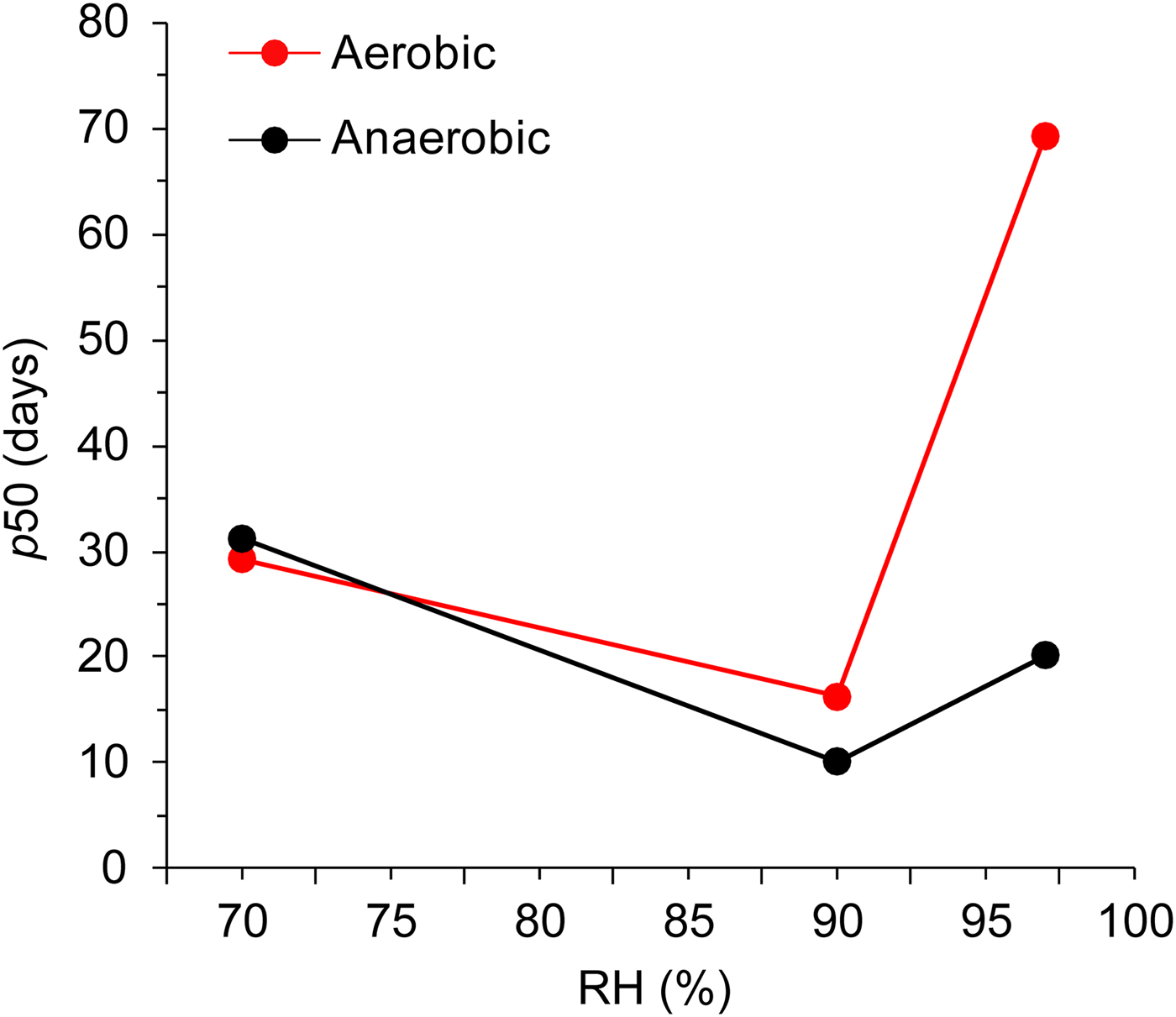
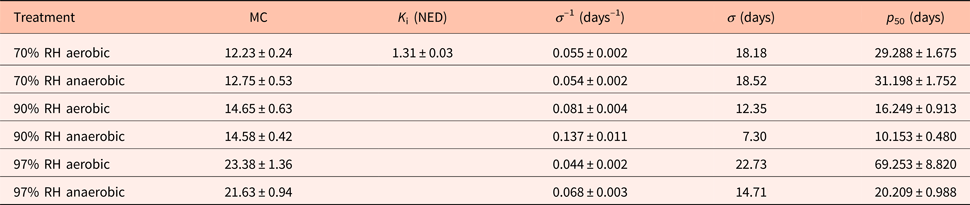
When fitting the probit GLM the main effect of oxygen on viability was significantly positive (P = 0.01). However, the interaction of 70% RH (~12.5% MC; Table 1) with oxygen was not significant (P > 0.05), i.e. at 70% RH the differences in viability were not significantly different regardless of whether the seeds were aged in aerobic or anaerobic conditions. On the contrary, whilst the main effect of relative humidity was not significant, all slope terms were highly significant (P < 0.001) and indeed seed viability declined as the period of experimental ageing increased, for all treatments (Fig. 1; Figure S1) with a significant variation in the estimate for deterioration rate σ (7.3–22.7 days) and thus in the time taken for viability to fall to 50% (p 50; 10.1–69.2 days) between ageing treatments (Table 1). Dropping the intercept (K i) term from the model resulted in a significant increase in residual deviance (P < 0.001) and hence the final model fitted is that showing a single estimate of K i for all ageing experiments (Table 1).
Relationships between p 50, time (days) for viability to fall to 50% and experimental relative humidity (RH) for seeds of Ranunculus baudotii under either aerobic (red line) or anaerobic (black line) conditions.

Survival curve parameters for each ageing treatment determined using a generalized linear model with binomial error and probit link function

Ageing conditions (relative humidity and oxygen) were included as factors. Estimates of K i could be constrained to a single value for the different ageing treatments. K i (±SE), initial viability [normal equivalent deviates (NED)] of the seed lot; σ, time (days) for viability to fall by 1 NED; p 50 (±SE), time (days) for viability to fall to 50%. MC, mean (±SE) moisture content during experimental treatments.
Seed samples aged under aerobic conditions showed a slower rate of viability loss and survived longer compared with seeds aged at the corresponding relative humidity under anaerobic conditions, except the loss of viability at 70% RH when deterioration rate was a little faster (σ = 18.18 days) in the presence of oxygen compared with the sample aged under anaerobic conditions (σ = 18.52 days; Table 1). Nevertheless, as discussed above, the interactive effect of 70% RH with oxygen was not significant. Despite the overall beneficial effect of oxygen, the longevity at 90% RH (~15% MC; Table 1) showed a marked reduction (σ = 12.35 days) compared with 97% (σ = 22.73 days). On the contrary, under anaerobic conditions at 97% RH (~23% MC; Table 1), seed viability declined much more and faster than at 70% RH (Fig. 1).
Membrane permeability
Overall, no significant (P > 0.05) changes of membrane damage during the time of treatments were detected, nor was there a significant association of damage with H2O2; however, membrane damage generally significantly increased under aerobic conditions (P < 0.001) and with increasing moisture content (P < 0.05). At 70% RH the damage was negligible under both aerobic and anaerobic conditions.
Membrane damage was not generally significantly (P > 0.05) associated with H2O2 concentration, nor with seed viability. This was apparently caused by the opposite association of damage with viability at 97 and 90% RH: significantly (P < 0.001) negative under aerobic conditions and positive (P > 0.05) under anaerobic conditions.
Hydrogen peroxide
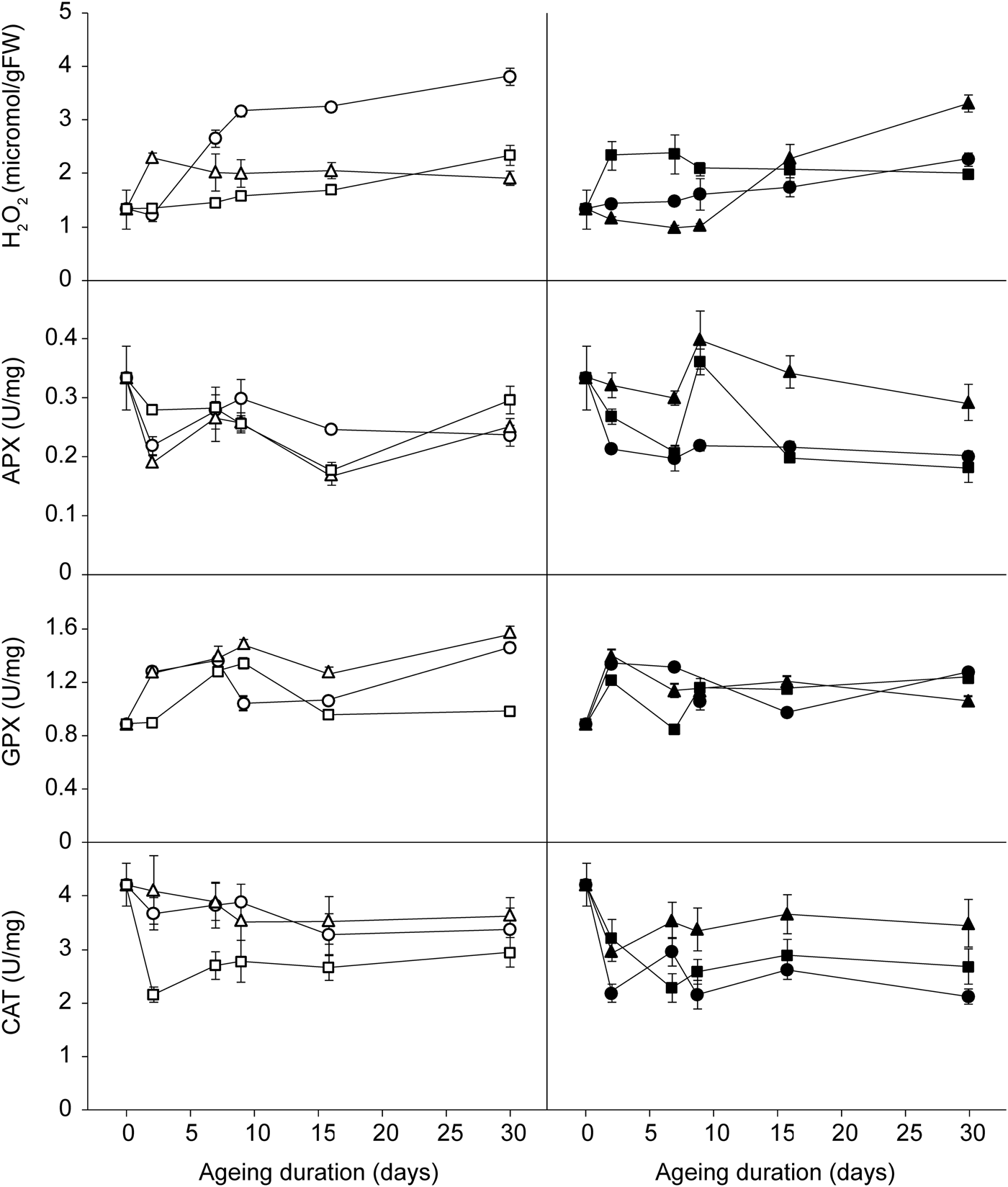
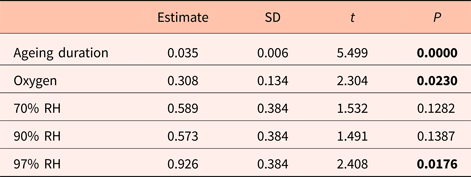
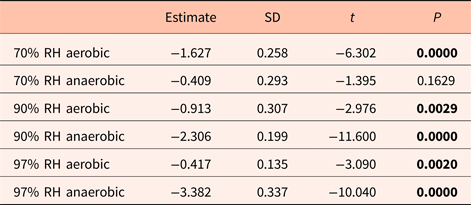
Overall, there were significant positive effects of oxygen and duration of ageing on H2O2 content (Table 2). However, we could not find a general significant effect of RH on H2O2 content. Nevertheless, the highest H2O2 concentrations were detected at 97% RH, especially under aerobic conditions (Fig. 2). In addition, hydrogen peroxide concentrations recorded at 70 and 90% RH were slightly lower under aerobic than under anaerobic conditions. An overall negative association (P < 0.001) of H2O2 content with viability was found and this effect on seed viability was similar in all ageing treatment (Table 3) except for 70% RH under anaerobic conditions where viability was unaffected by H2O2. The estimate coefficients are, however, larger at 90 and 97% RH anaerobic and 70% RH aerobic conditions, suggesting that the negative effect of H2O2 on seed viability is particularly strong under such conditions.
Anti-oxidant enzyme activities (±SE) and H2O2 content (as indicated) for treatments under aerobic conditions (open symbols) and for those under anaerobic conditions (filled symbols) at 35°C and 70% (squares), 90% (triangles) and 97% RH (circles).

Simple linear regression results for the effect of ageing duration and ageing conditions on hydrogen peroxide concentration (fitted separately)

Ageing duration was included as continuous variable, oxygen and relative humidity were included as factors. Significant results are in bold.
Generalized linear model (GLM, binomial error, logit link) results for the effect of hydrogen peroxide concentration on seed viability (fitted separately for each treatment)

H2O2 concentration was included as continuous variables. Significant results are in bold.
Anti-oxidant enzymes
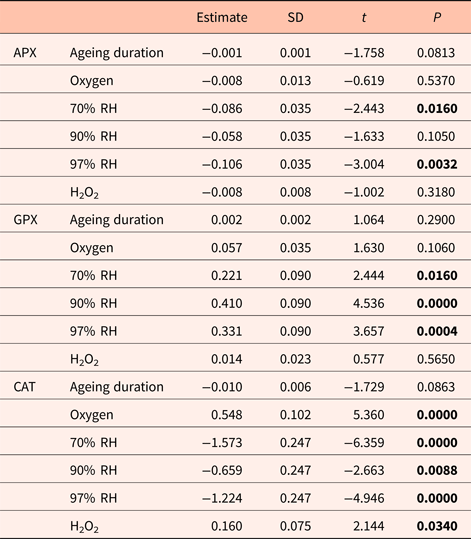
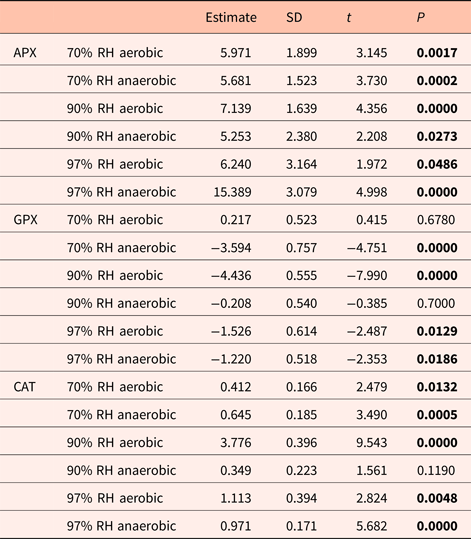
While H2O2 content and oxygen were not generally associated with APX, the decrease of the activity of this enzyme depended on RH, with an overall significant reduction at 70 and 97% RH (Table 4, Fig. 2). Under anaerobic conditions, the decrease of APX activity was particularly strong at 97% while under aerobic conditions a significant reduction was detected only at 90% RH. No general relation between seed viability and APX activity was found; however, by considering the aerobic treatments alone, a significant (P < 0.001) positive association was found. Nevertheless, considering all treatments separately, significant positive relations of APX with viability were recorded for all conditions, especially for 97% RH anaerobic (Table 5).
Simple linear regression results for the effect of ageing duration, ageing conditions and hydrogen peroxide concentration on anti-oxidant enzyme activity (fitted separately)

Ageing duration and H2O2 concentration were included as continuous variables, oxygen and relative humidity were included as factors. Significant results are in bold.
Generalized linear model (GLM, binomial error, logit link) results for the effect of anti-oxidant enzymes activity on seed viability (fitted separately for each treatment)

Enzyme concentrations were included as continuous variables. Significant results are in bold.
Hydrogen peroxide and oxygen were not significantly associated with GPX activity while RH levels significantly explain the variation in GPX activity detected. Indeed, GPX is generally favoured by higher RH; in addition, under aerobic conditions a significant increase was detectable mostly at 90% RH while under anaerobic conditions no significant variation was found. Overall, there was a significant (P < 0.001) negative association between GPX activity and viability but this effect largely varied among ageing treatments (Table 5). Indeed, besides a strong negative effect at 90% RH aerobic, a non-significant effect was present at 90% RH anaerobic whereas the contrary was evident for 70% RH. Finally, moderate negative effects were evident for both aerobic and anaerobic conditions at 97% RH.
Both hydrogen peroxide and oxygen were positively associated with CAT activity that decreased, depending on RH in particular, at 97 and 70% RH (Table 4). Under anaerobic conditions, the decrease in activity was higher at 97 and 70% RH, while under aerobic conditions the activity of CAT was significantly reduced at 70% RH only. We found no overall significant association between CAT activity and viability over the duration of ageing, but when results were analysed separately among treatments, positive significant effects were shown for all treatments except at 90% RH in absence of oxygen (Table 5).
Discussion
The rate of ageing is known to be determined by the species, the seed moisture content and the temperature and duration of the ageing process (Ellis and Roberts, Reference Ellis and Roberts1980; Bekker et al., Reference Bekker, Bakker, Ozinga and Thompson2003; Probert et al., Reference Probert, Daws and Hay2009) but also by the gaseous environment (Ibrahim and Roberts, Reference Ibrahim, Roberts and Murdoch1983; Roberts and Ellis, Reference Roberts and Ellis1989). In our experimental design we focused on the relative influence of water and oxygen availability and used a single temperature condition because this is the temperature the seeds may experience after dispersal in a Mediterranean climate. As seed viability loss clearly depended on ageing conditions simulating the natural environment in summer (Table 1), our ageing treatments in the laboratory afforded insights into the effects of soil moisture and oxygen on the persistence of seeds in the field before germination might take place in autumn (Carta et al., Reference Carta, Bedini, Foggi and Probert2012). The physiological causes of ageing have been largely studied but they are undoubtedly complex and the variation of patterns observed at different moisture contents pointed out controversial roles of the oxidative processes in seed ageing (Bailly et al., Reference Bailly, El-Maarouf-Bouteau and Corbineau2008). Similarly, whilst anti-oxidant enzyme activities were generally positively associated with seed viability (Table 5), the single enzyme activity and its supposed beneficial effects varied among treatments, suggesting possible reorientation of the enzymatic anti-oxidant defence system, depending on ageing condition.
Membrane damage is one of the main alterations occurring during storage (Fotouo-M et al., Reference Fotouo-M, du Toit and Robbertse2015) and the electrical conductivity (EC) test, indicative of membrane injury, is often used as an effective method to assess seed viability (Fessel et al., Reference Fessel, Vieira, Pessoa da Cruz, de Paula and Panobianco2006). Indeed, in our study, EC increase under aerobic conditions and with increasing hydrogen peroxide concentrations at high RH is consistent with oxidative damage to membranes. Unlike the negative correlation often detected between viability and membrane damage (Shereena and Salim, Reference Shereena and Salim2006; Singh and Richa, Reference Singh2016), the lack of association between EC and viability recorded in our seeds, suggests that membrane damage is not the main cause of loss of germination ability, at least under anaerobic conditions. On the other hand, the strong negative association between hydrogen peroxide and viability (Table 3) seems to indicate that membranes are not the main target of oxidative damage and other damaging events could occur to stored oils (R. baudotii seeds have about 15% oil content; Guil-Guerrero et al., Reference Guil-Guerrero, García Maroto and Giménez Giménez2001) or to the non-lipid cellular fraction (Kibinza et al., Reference Kibinza, Vinel, Cȏme, Bailly and Corbineau2006; Morscher et al., Reference Morscher, Kranner, Arc, Bailly and Roach2015).
Hydrogen peroxide is a key ROS that being rather stable, is able to cross cell membranes and can act as a signalling molecule, able to activate an anti-oxidant protective response. The increase in H2O2 content detected under anaerobic conditions (Fig. 2) confirms the possibility of accumulation of this ROS also in the absence of oxygen or in hypoxic conditions (Paradiso et al., Reference Paradiso, Caretto, Leone, Nisi and De Gara2016). It is noteworthy that the highest contents of hydrogen peroxide were recorded in aerobic conditions with high RH where, however, viability remained high. This could be due to the significant positive effect of anti-oxidant enzymes at 97% RH, highlighting the importance of an adequate metabolic recovery possible only at the highest moisture contents (Bewley et al., Reference Bewley, Bradford, Hilhorst and Nonogaki2013). The anoxic conditions seem to play a protective role in viability only at 70% RH, confirming previous data (Ellis and Hong, Reference Ellis and Hong2007) on Phleum pratense and Sesamum indicum, showing a better longevity in hermetic storage at low RH values. In contrast, oxygenic conditions were necessary for a longer-lasting germination ability at both 90 and 97% RH (Table 1; Fig. 1). Moreover, previous findings reported that seed viability under anaerobic conditions at very high moisture contents cannot be maintained for more than a few days (Ibrahim et al., Reference Ibrahim, Roberts and Murdoch1983; Roberts and Ellis, Reference Roberts and Ellis1989). However, in our study survival was lowest at 90% RH, while at 97% RH anaerobic seed survival was slightly higher, suggesting that protective mechanisms may be effective even in absence of oxygen. Indeed, we found a strong positive association of the anti-oxidant system (particularly APX) with seed viability at 97% RH anaerobic (Table 5). The positive action of anti-oxidant enzymes in seeds with moisture content higher than the lower limit for respiration is consistent with an increased ROS production due to electron transport chain (ETC) disorganization under low oxygen conditions (Bewley et al., Reference Bewley, Bradford, Hilhorst and Nonogaki2013). Accordingly, in our study the difference between aerobic and anaerobic ageing was mostly marked at very high moisture content (97% RH). Instead, at 90% RH, simulating moist, non-waterlogged soils, survival was lowest under both aerobic and anaerobic conditions. It should be noted that this level of humidity approximately coincides with the minimum limit for respiration (Bewley et al., Reference Bewley, Bradford, Hilhorst and Nonogaki2013), that is to say that at 90% RH even under aerobic conditions respiratory activity may be inefficient but sufficient water is available, allowing most damaging reactions (e.g. chemical, ROS, enzymatic and some metabolic) to occur. Indeed, the ability of seeds to maintain a good viability also depends on its capacity to sustain a good anti-oxidant machinery (Kumar et al., Reference Kumar, Prasad, Banerjee and Thammineni2015).
Ascorbate peroxidase and catalase are two H2O2-detoxifying enzymes, playing an important role in the control of this reactive molecule (Anjum et al., Reference Anjum, Sharma, Gill, Hasanuzzaman, Khan, Kachhap, Mohamed, Thangavel, Devi, Vasudhevan, Sofo, Khan, Misra, Lukatkin, Singh, Pereira and Tuteja2016). GPX, besides scavenging H2O2, can detoxify lipid hydroperoxides and other reactive molecules under several stress conditions (Bela et al., Reference Bela, Horváth, Gallé, Szabdos, Tari and Csiszár2015). There was a general decrease in APX activity with the time of treatment (albeit not significant; Table 4) with a trend that was opposite to that of the content of hydrogen peroxide. The activity of CAT was lower under anaerobic conditions (Table 4), and so the high concentrations of hydrogen peroxide in the absence of oxygen could also be derived from the low activity of these H2O2-scavenging enzymes. Nevertheless, we found a strong positive association of APX with seed viability and significant positive effects of CAT for all treatments, except 90% RH anaerobic (Table 5). We also found an overall increase of GPX with time of ageing under aerobic condition (Fig. 2) but the effect of this enzyme on viability was not clear; its increase may simply be an indication of stress (Hossain et al., Reference Hossain, Bhattachrjee, Armin, Qian, Xin, Li, Burritt, Fujita and Tran2015) and might be linked with detoxification of lipid peroxidation products that may be formed due to the activity of active oxygen species (Eshdat et al., Reference Eshdat, Holland, Faltin and Ben-Hayyim1997). Several studies have demonstrated that seed ageing is associated with a loss of anti-oxidant enzyme activity (Bailly, Reference Bailly2004) and this tendency was also found in our study. On the other side, we also found good correlations of seed viability with enzyme activity. Nevertheless, if only dead seeds lose a given component of anti-oxidant activity, it is not easy to distinguish cause and effect (Bewley et al., Reference Bewley, Bradford, Hilhorst and Nonogaki2013). Hence we regard with caution the resulted associations of enzyme activities with seed viability.
Studies investigating the influence of the water regime on the species composition of the soil seed bank under natural conditions present contrasting results with seeds of species from wet habitats that may better tolerate anoxic conditions (Bekker et al., Reference Bekker, Knevel, Tallowin, Troost and Bakker1998a; Murdoch and Ellis, Reference Murdoch, Ellis and Fenner2000). Wetland species accumulate dense seed banks in waterlogged soils and presumably such species have metabolic adaptations that permit them to survive also in the absence of oxygen (Bekker et al., Reference Bekker, Oomes and Bakker1998b). Transferring our results to field conditions, the capacity for R. baudotii seeds to survive better at 97% RH anaerobic compared with 90% RH anaerobic appears to be consistent with this. Indeed, numerous records of seed survival in the soil (Bonis et al., Reference Bonis, Lepart and Gillas1995; Rhazi et al., Reference Rhazi, Grillas, Tan Ham and El Khyari2001; A. Carta, unpublished data) provide evidence that R. baudotii seeds may remain viable for years under conditions where they are fully hydrated for considerable periods. Such observations are compatible with our laboratory experiments also considering that for a large part of the year the soil temperature is significantly lower than the one used in our experiment. Only during summer may the temperature and humidity levels be close to those used in our experiments (Casas and Ninot, Reference Casas and Ninot2007).
In the field, seeds in strongly seasonal climates can experience daily and seasonal fluctuations in temperature and moisture, particularly in the upper centimetres of the soil (Benvenuti et al., Reference Benvenuti, Macchia and Miele2001; Saatkamp et al., Reference Saatkamp, Affre, Dutoit and Poschlod2011). It is not necessary for seeds to be fully hydrated continuously in order to maintain viability for extended periods: intermittent hydration is adequate, assuming that the dry periods are not too long (Long et al., Reference Long, Kranner, Panetta, Birtic, Adkins and Steadman2011). Similarly, future studies should explore the role of intermittent aeration in reinstalling the anti-oxidant capacity after the seeds experienced a short period of anoxic conditions. Altogether, these results suggest a negative role for moist soils in determining the persistence of seeds in the field. The ability to activate the anti-oxidant system even under these unfavourable conditions might, however, help seeds to recover once they are in wet soils, when most protective processes can fully operate. These data underscore the plasticity of the mechanisms involved in seed loss viability and may in part explain the controversy about the role of the oxidative processes in seed ageing.
Supplementary material
To view supplementary material for this article, please visit https://doi.org/10.1017/S0960258517000307
Figure S1. Survival curves fitted using a generalized linear model with binomial error and probit link function for treatments under aerobic conditions (open symbols) and for those under anaerobic conditions (filled symbols) at 35°C and 70% (squares), 90% (triangles) and 97% RH (circles).
Acknowledgements
We wish to thank Robin J. Probert (UK) for his help in defining the experimental setting of the research. We are also grateful to Hugh W. Pritchard and an anonymous reviewer for their valuable comments.
Conflicts of interest
None.