On 8 January 1438 Pope Eugenius IV opened the Council of Ferrara after numerous attempts to dissolve or transfer the Council of Basel. Less than a month later, on 14 February, the Council of Basel, still in defiance of the pope, elected Cardinal Louis Allemand, an old enemy of Eugenius, as its president. News of this could not have reached Eugenius by the next day, when he took the step of anathematising any further decision by the Council of Basel, but in the end this would lead the Council of Basel to proclaim the deposition of Eugenius IV on 25 June 1439 and the election of the former duke of Savoy, Amadeus VIII, as Pope Felix V on 5 November of that year, opening a schism that would take more than a decade to sort itself out.Footnote 1
By the early spring of 1439 it was probably quite clear to Guillaume Du Fay, at that point a representative of the Cathedral of Cambrai to the Council of Basel and magister cappellae of Amadeus's son, Louis II of Savoy, how things would play themselves out, all the more so in that he had personal knowledge of all the major players in these events. From 1426 to 1428 he was a singer and probably the magister cappellae of Cardinal Allemand when the later was papal governor of Bologna,Footnote 2 from 1428 to 1437 he had been a singer and for a time the magister cappellae to Pope Martin V and Pope Eugenius IV, in 1434, while on leave from the papal chapel, he had been made magister cappellae of the Savoy court chapel by Duke Amadeus VIII, and since 1437, he had the same position in the Savoy chapel under Amadeus's son, Louis II. His fellow representative from Cambrai, Robert Auclou, had equally close ties to Allemand and to the houses of Savoy and Burgundy going back to at least 1418.Footnote 3
At the same time Du Fay's most lucrative benefices were in the north. He had resigned all his early benefices, which were relatively minor and not lucrative: the chaplaincy of the Salve at the altar of St Géry in St Géry in Cambrai, the parish church of St Peter in Tournai, the chaplaincy at the altar of St Fiacre in the Cathedral of Laon, and the chaplaincy at the altar of St John the Baptist at the church in Nouvion les Vineux.Footnote 4 In early 1439 he had, as far as we know, seven nominal benefices, three of which were under some sort of litigation. The secure benefices were a canonicate at the Cathedral of Lausanne that he had obtained from Pope Eugenius IV in August 1431,Footnote 5 the parish church of Versoix granted to him by Amadeus VIII probably in the spring of 1434,Footnote 6 a canonicate in Cambrai granted to him by Eugenius IV on 3 September 1436,Footnote 7 and a canonicate at St Donatian in Bruges, promised him by Eugenius IV in the pope's coronation rotulus for the chapel, dated 26 April 1431, but which the canons had successfully delayed in granting until 28 April 1438.Footnote 8 The contested benefices were a semi-prebend at the cathedral of Tournai, a prebend at Notre-Dame de Condé,Footnote 9 and a canonicate in Geneva, where the cathedral chapter had effectively stonewalled both Amadeus VIII and Eugenius IV.Footnote 10 The admission to the chapter in Bruges also gives us the first symptom that Du Fay had probably come to the attention of the music-loving Duke of Burgundy because, as Reinhard Strohm notes, Du Fay's acceptance by the chapter comes shortly after John of Burgundy, the illegitimate step-brother of Philip the Good, was elected provost of St Donatian on 7 January 1438, and Strohm surmises that the provost pressured the chapter to action on Du Fay.Footnote 11
From events throughout his life there can be no doubt that Du Fay had a particular attachment to the house of Savoy, but at this point it could not have escaped him that the dukes of Savoy did not have political control over the churches in their domain comparable to what the Duke of Burgundy had in his. For more than three years the Duke of Savoy had failed to force the Cathedral of Geneva to accept Du Fay to the canonicate to which the duke had nominated the composer.Footnote 12 In contrast, it had taken John of Burgundy less than four months to get the notoriously fractious chapter of St Donatian to admit Du Fay as a canon. Had Du Fay become a canon of Geneva it is possible that his entire career would have been different, but by the spring of 1439 he made the decision to leave Savoy and return to the north, where most of his secure benefices lay. The last mention of Du Fay in the accounts of the tesoreria generale of Savoy for 1439 is dated 23 April, when he received cloth for his robes.Footnote 13 The next document mentioning him is a payment at Cambrai on 9 December of that year.Footnote 14 The chapter acts of the cathedral of Cambrai for the years 1439–42 (old signature H), which would have recorded when Du Fay presented himself to the chapter to make his prima residentia, are lost; Craig Wright and David Fallows surmise that he might have been in Cambrai already by the summer of 1439.Footnote 15 But the payment of 9 December actually allows us to posit that Du Fay had arrived at Cambrai only shortly before that date. Du Fay was given two virlands for his presence at the general chapter the day after the Feast of the Conception of the Virgin. The previous general chapter had taken place on 3 October, the day after All Souls: at this chapter thirty-three canons were present, none named, but the entry for 9 December lists thirty-four canons including Du Fay. A later chapter, listing thirty-six canons on the day after the Annunciation, also gives the names of the two newcomers, Mikiel van Beringhen and Grégoire Nicolai.Footnote 16 Now, it would have been inconceivable for any canon to be present at Cambrai and not in attendance at the general chapter, so we must conclude that Du Fay arrived in the city sometime between 3 October and 9 December 1439.
And yet there is evidence that Du Fay had reached the north early in the summer. In the acrimonious dispute between the chapter of St Donatian and Du Fay, which lasted from 1440 to his resignation of the canonicate in 1447, there are references, entered into the acts on 22 and 30 June 1440, to letters from Du Fay and from Philip the Good, stating that Du Fay was a chaplain of the duke and had been in his service from the Octave of the Apostles (7 July 1439) to the Purification just past (2 February 1440).Footnote 17 Thus it is almost certain that Du Fay was in the north by the summer of 1439, but not in Cambrai but rather in Bruges and Lille, where the court of Burgundy was at the time. This was the beginning of a relationship between Du Fay and the Dukes of Burgundy that was to last until the end of the composer's life. It has left traces in the designations of Du Fay as ‘cantor illustrissimi ducis Burgundiae’, found in Savoyard documents of the 1450s and elsewhere,Footnote 18 and in the gift Du Fay made to Charles the Bold of most of his musical library.Footnote 19 This relationship, at least as an official connection of patronage, had been doubted by Wright and Fallows because Du Fay's name never appears either in the lists of the Burgundian chapel or in the accounts of the chambre de comptes.Footnote 20 But in this context we need to remember two details. The first is that during the years Du Fay spent in Savoy between 1452 and 1458, when a number of ducal documents, a papal letter, and even one of Du Fay's two surviving autographs refer to the composer as the magister cappellae of the Duke of Savoy,Footnote 21 his name does not appear ever in the very detailed accounts of the Savoy chapel, which survive complete from 1449 on.Footnote 22 Fallows surmises that the appointment was honorary,Footnote 23 but rather it would appear that at that point Du Fay was no longer an employee of the duke but rather another of his courtiers.Footnote 24 The second is that Jehan Molinet, the Burgundian poet and chronicler, whose official ties to the court have never been in doubt, never once appears in the accounts of the chambre de comptes: the Burgundian financial records pass him entirely in silence.
Du Fay, then, went first to the Duke of Burgundy to offer his services, which as we now know were readily accepted. But those services were not those of a singer, a cantor, but those of a composer. Rob Wegman has made a careful and mostly persuasive argument that the notion of a composer had not yet crystallised in the fifteenth century,Footnote 25 but Du Fay clearly thought of himself as a composer in a sense that was not to be common until the early sixteenth century. He promoted and preserved his music, and this is probably one of the reasons why so much of it has survived, far more than the music of most of his contemporaries, despite the almost total loss of the late sources for his work – the Cambrai manuscripts copied by Symon Mellet from c.1440 to the end of his life.Footnote 26 Du Fay's music collection at his death is seven times larger than those of any of his contemporaries for whom we have testamentary accounts, and there is also a little noticed matter of terminology. In the fifteenth century there was no term for what we call ‘composer’, even though the verb componere was beginning to be used for ‘writing music’, significantly, I think, in connection with Du Fay himself.Footnote 27 But around 1450 the term musicus begins to be used to refer not to those who dealt with musica speculativa, but rather with those who wrote music. This is certainly the meaning of the term in the entry on the chapter acts of the Cathedral of Cambrai on 20 October 1451 when it refers to Paul le Josne and Petrus de Domarto, two prospects for the post of magister puerorum, as each being reputed a bonus musicus.Footnote 28 And even more telling, it is the very first thing Du Fay says of himself in his own epitaph: ‘Hic inferius iacet venerabilis vir Guillermus Du Fay, musicus, bacallarius in decretis, olim huius ecclesiae chorialis, deinde canonicus et Sanctae Waletrudis Montensis’.Footnote 29
In any event, Philip had a task he wanted from Du Fay the musicus, the composition of a gigantic cycle of six Mass Propers for the weekly Masses of the Order of the Golden Fleece that he had founded at the Sainte Chapelle in Dijon about a decade earlier, five of which survive and have been identified as Du Fay's work.Footnote 30 This, in turn, appears to have served as an impetus and a prelude to a task that apparently occupied Du Fay for the entire decade in the 1440s, the revision of the liturgy at the Cathedral of Cambrai, which included not only the recopying of the entire antiphoner in a series of large parchment manuscripts, but also the production of polyphony for the Mass, both the Ordinary and the Proper, which led to the copying of four large volumes, two of music for the Ordinary and two of music for the Proper, by Symon Mellet in 1449.Footnote 31 No doubt the music for the Ordinary contained a number of new compositions, but much of it could easily be compiled by using works already composed in Cambrai and elsewhere, and among the imported works there were most likely English Masses that could be obtained in Bruges or Antwerp. Among these it is almost certain were the last four movements of the English Caput Mass, since the one work of Du Fay with a tenor cantus firmus that we have from the middle or late 1440s, the motet Fulgens iubar ecclesiae, shows not only the new texture of the Caput Mass but more importantly the use of the high contratenor as a formal marker, something in which the composer of Caput was an innovator and that Du Fay then took up extensively in his mass on Se la face ay pale. The presence of the last four movements of Caput in the Cambrai repertory of the 1440s would also explain the composer's interest in having the Kyrie copied at Cambrai when it became available to him, probably through the visit of Ockeghem in 1463.Footnote 32
If the polyphony for the Ordinary could largely be compiled from an already existing repertory, the same cannot be said of the music for the Propers; virtually all of it had to have been composed at Cambrai by Du Fay and perhaps by some of his colleagues. Fragments of this repertory found their way to Johannes Wiser in the 1450s. A number of the Ordinary movements in Trent 93, including most likely those of the English group that begins with movements from the Caput Mass, probably came through Cambrai, and Cambrai is certainly the ultimate point of origin of the Kyrie of Du Fay's Mass for St Anthony of Padua and St Francis, as well as some of the introits, which come from Du Fay's cycles for the Order of the Golden Fleece.Footnote 33 Trent 90 has those pieces already present in Trent 93 plus the complete Ordinary for St Anthony of Padua and St Francis, and in Trent 88 we find the complete Propers for St Anthony of Padua and for St Francis, as well as five of the cycles for the Order of the Golden Fleece and parts of some of the Proper cycles written for the Cathedral of Cambrai.Footnote 34
The fragments that survive of the Propers at Cambrai suggest that the Proper cycles for the cathedral most likely consisted of Masses for: the major festivals of the temporale – Christmas, Epiphany, Easter, Ascension, Pentecost, Corpus Christi and Trinity; the major feasts of the Virgin – Conception, Purification, Annunciation, perhaps Visitation, Ascension and Nativity; some of the major saints – Stephen, John the Evangelist, John the Baptist, Peter, Mary Magdalene (a major saint at Cambrai), Lawrence and Michael; the feasts of the Cross, and a commune sanctorum for apostles, martyrs, confessors and virgins.Footnote 35 Several of the cycles that Du Fay wrote for the Order of the Golden Fleece could be used for these purposes: the Mass for St Andrew has most of the common of apostles, the Mass of the Angels has all the Propers for St Michael, the Mass of the Holy Ghost has all the Propers for Pentecost, the Mass of the Cross has all the Propers for the feasts of the Cross except for the communion,Footnote 36 the lost Lady Mass probably had virtually all the Propers necessary for all the feasts of the Virgin, and the Mass for the Trinity has all the Propers for Trinity Sunday. In addition, the two cycles he wrote for St Anthony of Padua and St Francis have also many of the Propers needed for the common of confessors. The other surviving cycles which show evidence of his authorship add to a common of martyrs.Footnote 37 Now, sixteen cycles of Propers, some by Du Fay and some anonymous, copied in Trent 88 take up ninety folios (from 113v to 204v), and each of the volumes with Propers that Mellet copied contained fourteen sexternions, that is 168 folios, which could easily accommodate the twenty-two to twenty-five cycles described above (since the cycles for the Virgin probably had a good deal of redundancy) as well as a number of sequences.Footnote 38 In addition, polyphony was apparently used at Cambrai for some of the missae communes that were said every week.
The evidence for this last statement comes from an extraordinary document, a true hapax liturgicum, a votive missal copied at the cathedral, Cambrai, Mediathèque Municipale, MS 158. When I call it a true hapax liturgicum I mean that over the last twenty-five years I have examined more than one thousand missals from the thirteenth to the fifteenth century and found not another organised as this one. It is a small manuscript, with only forty-one numbered folios and no musical notation, and all the Masses in the manuscript include not only the text of the sung Propers but also all the prayers and lessons for each Mass. Fols. 1–4 have the missae communes or votive Masses for the Holy Ghost and the Holy Cross; fols. 4–10 have the Lady Mass with all of its seasonal variations; fols. 10–21 have the prefaces, the canon, the Lord's prayer, and the prayers that precede the pax domini, with a full painting of the crucifixion on fol. 13v and the Te igitur on fol. 14r; fols. 21–26 have the missa communis for the Trinity and the Requiem; fols. 26–32 have the collects, secrets, and postcommunions for the common of saints; fols. 32–33 have the petition prayers for peace, for serenity, for the sick, etc.; and finally, fols. 33–41 have three non-votive Masses – the Mass of the five wounds of Christ instituted by Pope John XII, the Mass of the Holy Sacrament, and the Mass of St Barbara.
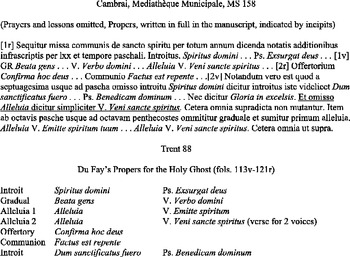
The unique aspects of the missal concern the rubrics for the celebration of the three missae communes for the Holy Ghost, the Cross, and the Trinity, since the Lady Mass Propers for each season are copied in extenso and the Requiem is essentially unchanging. The Propers and rubrics for the Mass of the Holy Ghost are given in Example 1 together with Du Fay's Propers for the Holy Ghost in Trent 88.
Propers for the Holy Ghost.

The crucial passage that makes this missal what I have called a hapax liturgicum is the part of the rubric underlined in Example 1. It instructs the clergy, during Septuagesima and Lent to omit the alleluia respond and sing only the verse Veni sancte spiritus. Singing simply the verse without the alleluia respond would produce what amounts to a single-verse tract. Between Easter and the Octave of Pentecost the first alleluia with its respond is resumed, and a second alleluia is added.
Now, in the plainsong tradition the underlined portion of this rubric is absolutely needless. The procedures for the singing of missae communes throughout the year had, by the fifteenth century, a well-established tradition of seven centuries, rooted in the changes needed for the saints of February and March, whose feasts fell on both sides of Septuagesima and those of April and May, whose feasts fell on both sides of Easter depending on the year. In the first instance the Masses had a gradual and an alleluia, with a rubric to suppress the alleluia after Septuagesima and sing the tract de feria or, in some cases, sing a tract assigned to saints whose feasts fell during that season. In Cambrai, at the time these tracts were Qui seminant or Desiderium in the case of martyrs, Beatus vir in the case of confessors, and Diffusa est gratia in the case of virgins. In the second instance, the Masses had no gradual and one alleluia and a rubric to sing a second alleluia de feria or de resurrectione.Footnote 39 In other words, a rubric designed to create an ad hoc tract from an alleluia is absolutely unnecessary if one is dealing with the plainsong repertory.
On the other hand, it becomes absolutely necessary if we are dealing with a repertory where there are no tracts, and this is the repertory of polyphonic Propers, particularly as it existed when Du Fay began composing the polyphonic Propers for the Order of the Golden Fleece. Du Fay's solution, two alleluias, one of which has a verse for two voices, which can be used as an ad hoc tract, is a masterstroke of liturgical and compositional economy. The reduced texture of the verse when sung as a tract is symbolic of the soloistic nature of the tract and, in fact, virtually all polyphonic tracts of the fifteenth century consist of extended duos, with extra voices joining only in the last phrase of the last verse, the traditional ‘choral’ ending of a tract. Given the date of the Du Fay Masses, it is most likely Du Fay who initiated this two-voice texture and its association with the polyphonic tract.
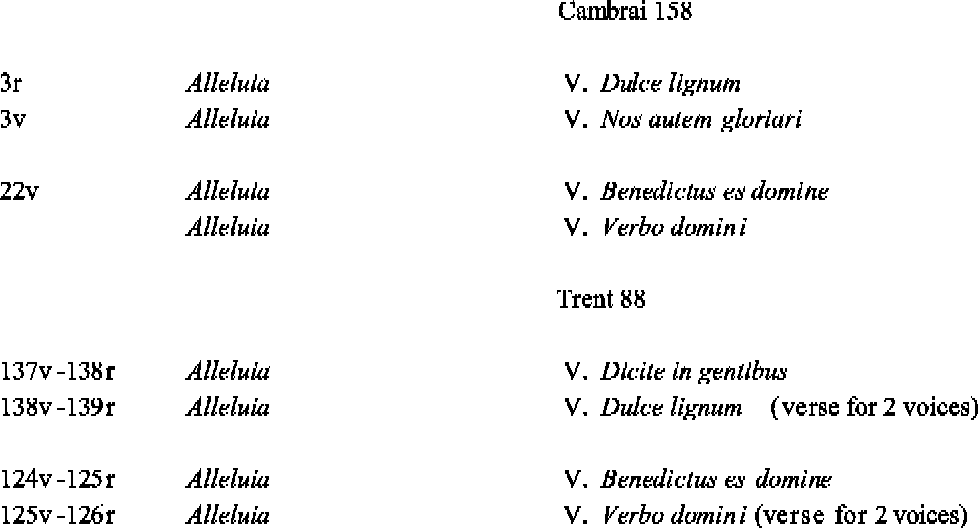
Of all the polyphonic Propers that survive from the fifteenth and early sixteenth century, including those of the Choralis Constantinus of Isaac, only five cycles have two alleluias, the five surviving missae communes for the Order of the Golden Fleece by Du Fay, and in all these cycles one of the two alleluias has a verse for two voices. But there is more. Three of the five missae communes in Cambrai 158 have two alleluiasFootnote 40 – the Mass for the Holy Ghost, the Mass for the Cross and the Mass for the Trinity. The alleluias for the Holy Ghost are given in Example 1 and are the same as those in the Du Fay cycle in Trent 88. The alleluias for the Cross and the Trinity are given in Example 2.
Alleluias for the Cross and the Trinity.

The alleluias in Cambrai 158 and Trent 88 are all identical except for one of the alleluias for the Cross. The difference in the communions, noted above, is because the communion for the Cross was different in Dijon and Cambrai.Footnote 41 But the difference in the alleluias is not produced by a liturgical difference between Dijon and Cambrai. The missa communis for the Cross in the plainsong tradition in Dijon had only one alleluia, the second one being de resurrectione and taken from the temporale. In the case of the Masses in Trent 88, the second alleluia was clearly an ad hoc addition by Du Fay, and since the Alleluia V. Dulce lignum was far and away the most common alleluia for the Cross, the addition by Du Fay is surely the Alleluia V. Dicite in gentibus. It was unknown at Cambrai, and although used in Dijon in the eleventh century, it had apparently fallen into disuse there.Footnote 42 Its most common use was as the alleluia for Friday in albis, which made it a logical choice for the Eastertide alleluia for a missa communis. In northern France it is found in the liturgy of two churches in the region, the cathedral of Laon and St Pierre de Lille,Footnote 43 and in Lille it was also the principal alleluia for the feast of the Finding of the Cross.Footnote 44 The Burgundian court spent most of the second half of 1439 at St Omer, but no missals or graduals from St Omer appear to have survived. Lille, however, was the major administrative centre of the court, it was nearby, and it is possible that its liturgy and that of St Omer were very close. Thus Du Fay's choice of Alleluia V. Dicite in gentibus for the second alleluia in his Mass would make eminent sense.
But to return to Cambrai 158, the rubrics in the missal, as noted earlier, make sense only if they are referring to a repertory where there are no available tracts, and in the 1440s at Cambrai that repertory could not be the plainsong repertory but a repertory of specifically polyphonic Propers. To be sure, eventually Du Fay did write some polyphonic tracts; one of the cycles for the common of martyrs that survives in Trent 88 and is surely by Du Fay has a setting of the tract Desiderium,Footnote 45 an entry in the accounts of the fabric for 1473–74 mentions the copying of another setting of the same tract, most likely also by Du Fay,Footnote 46 and his Requiem surely included the tract, but the rubrics of Cambrai 158 reflect instead the ad hoc solution produced by Du Fay in the Masses for the Order of the Golden Fleece before he had begun the Propers for the cathedral. The missal reflects the circumstances of the new polyphonic repertory at Cambrai, in the mid-1440s, before the completion of what can be called Du Fay's Choralis Cameracencis by 1449.
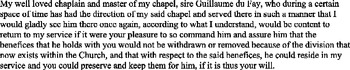
A little more than a year after Du Fay returned to Cambrai, however, Louis of Savoy wrote to his cousin Philip the Good asking the Duke of Burgundy to assist Louis, who was seeking to have Du Fay return to Savoy.Footnote 47 The letter was discovered and published by Augusta Lange,Footnote 48 and a translation of most of it was published by Wright.Footnote 49 The crucial parts of the letter for our purposes are given in Example 3.
Aosta, Archives Regionales, Archive Challant, Carton 247, Lettres.

No record of any answer by Philip survives, and Wright and Fallows surmise no answer was forthcoming. At the same time I am afraid that both have, understandably, misunderstood the import of the letter. Wright assumed that perhaps Philip did not answer for fear of censure by Eugenius IV.Footnote 50 Fallows views the letter as a symptom of Louis's well-known lack of tact and diplomatic savoir faire.Footnote 51 But it is nothing of the kind: far more importantly, Louis is probably being accurate when he states that, as he understands, Du Fay would like to return if it would be possible to do so without losing his benefices. Du Fay probably had told Louis so before leaving Savoy, and, as I hope to show, might have intimated it after returning to Cambrai, because there is now evidence that Du Fay and Louis remained in contact with each other throughout the schism.
Philip probably answered Louis even if doing so would have, as Wright surmises, elicited a censure from the pope.Footnote 52 At this time Eugenius needed Philip more than Philip needed Eugenius, and on occasion the duke went considerably beyond answering a letter from his cousin. In July 1443 he received Louis at Chalon-sur-Saône and for forty days the two princes entertained each other with jousts and banquets.Footnote 53 Sometimes the pope was sufficiently annoyed that Philip would seek an absolution, which Eugenius simply had to grant.Footnote 54 In fact, in 1440 Eugenius had granted the duke and his familia an exception from the excommunication attendant in any dealing with the schismatics.Footnote 55 This in itself was very convenient for Du Fay, because as a member of the familia of the Duke of Burgundy he could maintain discreet communications with the court of Savoy and remain in the good graces of Louis and even of Felix V. He realised, of course, that he could not leave the protective umbrella of the Duke of Burgundy without putting all of his northern benefices in jeopardy, and as for Philip's ability to hold his benefices for him, as Louis had suggested in the letter to his cousin, by 1441 the conflict between Du Fay and the chapter of St Donatian probably had given Du Fay a very clear idea of the limits of Philip's power to protect him. So it is likely that not only was Philip unwilling to give such assurances to his cousin, but Du Fay, while probably assuring Louis of Savoy of his devotion and of how much he missed his court, both of which were probably true as the events of the 1450s show, was equally unwilling at this time to leave the north.
But just as the Alleluia V. Dicite in gentibus for the Mass of the Holy Cross discussed above gives us an inkling of where Du Fay was during the summer of 1439, one of the Proper cycles that survives in Trent 88 suggests a number of things about Du Fay's life in the 1440s. The cycle is labelled Missa Sancti Mauritii et sociorum eius in Trent 88,Footnote 56 and though a work of Du Fay, as Feininger surmised, and in terms of style a product of the 1440s, it does not agree with the liturgy for St Maurice as it was celebrated at Cambrai. The Mass in Trent 88 and at Cambrai are given in Example 4.Footnote 57
Propers for St Maurice in Trent 88 and Cambrai.

St Maurice and his companions, martyred in 287 at Saint-Maurice-en-Valois in Switzerland according to the entirely implausible legend, were venerated throughout Europe and particularly in Savoy. Their feast fell on 22 September. On 8 October 1434 Duke Amadeus VIII of Savoy, at that time Du Fay's patron, had founded the Order of St Maurice, to be housed in the castle of Ripaille near Thonon, and on 11 November, with a solemn ceremony, he retired from the rule of the duchy (although keeping the title), making his eldest son, Louis, prince of Piedmont, and his second son, Philip, count of Geneva.Footnote 58 After becoming Pope Felix V, he remained the head of the Order, and the Order itself was an important part of the symbolic religious life at Savoy.
The double introit of Du Fay's cycle should alert us immediately that this is not an ordinary cycle. In most of Europe in Du Fay's time, as well as in the post-Tridentine liturgy, the introit Venite benedicti was sung only once during the year, on Wednesday of Easter week. This apparently puzzled Feininger and led him to indicate that the introit was to be used when singing this Mass during Eastertide, thus implying that we are dealing here with a missa communis like those for the Order of the Golden Fleece.Footnote 59 But the mass does not have the two alleluias that are the mark of Du Fay's other missae communes, and there is something else that escaped Feininger. In a good deal of southern France, Venite benedicti was, in fact, the introit for St Maurice, and in the tenth and eleventh centuries it was provided with tropes specific to the saint.Footnote 60 In all likelihood what we have in Trent 88 is a Mass for St Maurice with an alternate introit for his octave, which is the form that Du Fay's Propers for St Francis of Assisi take in Trent 88 as well.Footnote 61 To be sure, all the pieces in the Propers for St Maurice could be used for other feasts at Cambrai, but the Mass in Trent 88 follows the south French liturgy for St Maurice, which was almost certainly that which was used in Savoy. Nonetheless the style of the pieces is such that they cannot have been written either before 1439, when Du Fay left Savoy or after 1452, when he returned. They are a product of his Cambrai years in the 1440s, and thus indicate that Du Fay remained in contact with the court of Savoy during the schism.
There are a number of hints that this was the case. The first is the passage of Louis's letter to Philip that in fact implies that Louis has been in touch with Du Fay, even if it might be just the case of Du Fay writing to Louis to assure him of his devotion while fully intending to remain at Cambrai until the political and religious situation resolved itself. The second concerns the resignation of his benefices in Savoy between 1441 and 1443. Since his benefices had been obtained before the schism, Du Fay covered his back with a petition to Eugenius IV for a licentia permutandi for two of his benefices on 14 September 1441.Footnote 62 The papal bull, dated 18 October 1441, has not survived, but from a reference to it in the Libri annatarum it ended allowing Du Fay to exchange three rather than two of his benefices, which indicates that we are missing a document modifying the first licence.Footnote 63 The payment for the licence was done by Pierre Philippron, a papal scriptor and a formidable curialist who came from Cambrai and later was for a time a canon of the cathedral, which means that Du Fay had the best possible representation at the court of Rome.Footnote 64 The payment was registered on 26 February 1442.Footnote 65 The three benefices turn out to be the disputed canonicate in Geneva, which Du Fay never really managed to collate,Footnote 66 the parish church at Versoix,Footnote 67 and the canonicate in Lausanne.Footnote 68 But all three benefices were now in the obedience of Felix V, and it is through his court that the resignations took place. None of the supplications to Felix survive; the documents mentioning the resignations are papal letters of the type one finds in the Lateran Registers, and they are all in response to the petitioners for Du Fay's benefices, Jehan Ligier, in Geneva, Étienne Seclier in Versoix, and Guillaume Hughes in Lausanne. Du Fay clearly approached the matter obliquely, and the letters refer to resignations rather than permutations. Still it is worth noting that while the letters of both popes refer to clerics in the rival obedience by such terms of endearment as filius perditionis, Du Fay is still referred as dilectus filius in these letters.
The third hint is the cycle for St Maurice, which follows not the liturgy of the cathedral of Cambrai but a south French liturgy that extended from Aquitaine to Savoy and is surely the liturgy used by the Order of St Maurice.Footnote 69 Du Fay surely received a request to compose the cycle, a Proper cycle to be used by a Savoyard Order, most likely in the form of a letter that apparently included the full texts of the Propers, not just a list or a set of incipits. This would not be much different from a letter sent to Du Fay in May 1467 by Antonio Squarcialupi, which included a request that he set to music a poem by Lorenzo de' Medici and provided the text of the poem.Footnote 70 That this was the case is suggested by a curious anomaly in one of the movements of the Proper, which indicates that in that instance Du Fay was forced to ‘improvise’. The piece in question is the offertory Mirabilis deus. The text Du Fay received surely read as follows:
Mirabilis deus in sanctis suis: Deus Israel, ipse dabit virtutem, et fortitudinem plebi suae: benedictus deus, alleluia.
This is the text of the offertory as it is found in the southern French chant books and indeed throughout most of Europe, and this is the form in which it was incorporated into the modern Vatican editions. The music appears in Example 5.
The offertory Mirabilis deus.
The musical text follows Cambrai 61, which is thoroughly diastematic. Notes in parentheses are not in Cambrai 60, other variants from Cambrai 60 indicated above the staff.

Example 5 is based on the musical text of Cambrai, Mediathèque Municipale, MSS 61 and 60, both from the twelfth century. No later notated chant books from Cambrai survive between these and the Cambrai Gradual, Mediathèque Municipale, MS 12, copied in 1547, which presents Mirabilis deus in a severely curtailed version that clearly bears no relation to the version of the chant used by Du Fay.Footnote 71
Mirabilis deus is an offertory used almost exclusively for the feasts of martyrs. The alleluia is set to a melodic formula that is always attached to offertories in the eighth mode when these are sung between Easter and the octave of Pentecost. Most offertories of the sanctorale were usually copied without the alleluia in most of the graduals, but Mirabilis deus is an exception, and the tradition of copying it with the alleluia apparently goes back to the Old Roman liturgy.Footnote 72 This is most likely because the earliest traditional appearance of the offertory in the liturgical year is for the feast of Sts Gordianus and Epimachus, whose feast is on 10 May, which falls always within Eastertide and thus calls for an alleluia at the end of the introit, the offertory and the communion.
Having received the texts, Du Fay did what he had done at this point for decades when writing any chant-based music: he went to the chant books available to him and found the chants that would serve as cantus firmi for his settings. Having done this, he would have immediately come up against a problem, as at Cambrai the offertory Mirabilis deus did not have an alleluia, and I suspect that nowhere in the liturgical books available to him was a collection of separate alleluia endings such as those found in the modern Vatican editions.Footnote 73 In the late Middle Ages, the practice was to copy the full version of the chants only once in their earliest liturgical position, and to copy only the incipit for all later occurrences, or else to copy incipits only throughout the year for most of the feasts of the sanctorale and the full pieces as part of the commune sanctorum. Only very occasionally was a choral chant copied in full more than once. The absence of an alleluia for Mirabilis deus is not limited to Cambrai: neither the graduals from Lille or Arras have the alleluia, even though their copy of this offertory falls in feasts within Eastertide,Footnote 74 even though other offertories copied in full for saints whose feasts fall in Eastertide in the same graduals do have a final alleluia.
Du Fay's offertory as transmitted in Trent 88 does not have an alleluia, but it has a uniquely anomalous ending that makes it clear that some text was suppressed at the end of the setting, and that text can only be the alleluia. The offertory is given in the Appendix, with a double texting at the end, the text as it appears in Trent 88 and a reconstruction of the putative original with the alleluia at the end. The edition used for the Appendix is a performance edition,Footnote 75 so I have provided text for all the voices, while Trent 88 has text only in the cantus.Footnote 76 In bars 120–39 I have repeated the word Deus to articulate the important cadence in bar 125. The text of the cantus, as it appears in Trent 88, is written over the staff in the last page of the example. The setting of the word Deus is given a large melisma in the chant. Bars 120–5 of the cantus paraphrase the chant up to the first porrectus in the penultimate line of Example 5. The rest of the melisma is paraphrased in the cantus in bars 128–39, beginning with the ascent from F to C of the chant, in three voices and ending with a very strong cadence, complete with a composed out ritenuto in bars 136–9. The cadence is on the final and is allowed to ring for an entire long, but if you look at the chant, the paraphrase has stopped four notes from the end of the melisma on Deus. Then, on bar 140 the bass enters and the last four notes of the chant are presented in long values, giving all the due weight to the signed B flat of the chant, and an ornamented final. I know of no other instance in Du Fay's canon where he treats the end of a plainsong the way he treats the end of this offertory. A rhythmic and textural change such as that in bar 140 is always accompanied in his music by a textual articulation. This, to me, indicates that he had to find a way to accommodate the final alleluia of the text he received but that he had no access to the offertory ending with the alleluia and its melisma in any source available to him.
Let us summarise some of the reasons behind the addition of the word alleluia at the end of the offertory in the edition of Trent 88. (1) The cycle points to a liturgy from outside Cambrai, since the constellation of Propers it transmits is not found in any of the liturgical books of the cathedral or the other local churches. (2) The rubric for St Maurice at the beginning of the cycle, precisely in the introit Venite benedicti, points to a liturgical tradition from the south of France, which included Savoy. It was not used in the north of France, where St Maurice's introit was usually Intret in conspectu, nor in Germany and Switzerland, where his introit was usually Multae tribulationes.Footnote 77 (3) The offertory for St Maurice, Mirabilis deus, has an alleluia in the south French liturgical tradition and no alleluia in the north French tradition. (4) Du Fay's setting, even though it does not have an alleluia in its only source, and does not paraphrase the chant beyond the melisma of Deus, has very unusual articulation, including a change of texture, for the last ten bars, an articulation that in Du Fay's other works is always accompanied by a change in the text. This suggests that the composer, at the very least, wanted to make it clear to those who would sing the offertory with the alleluia of the southern tradition where that word should be placed.
To conclude, as Reinhard Strohm has suggested in his study of the transmission of the Caput Mass,Footnote 78 it would appear that a good deal of music in Trent 88 came from Cambrai. All the individual pieces of the Mass for St Maurice could be used in other contexts in the liturgy of the cathedral, and in the case of the offertory this required eliminating the alleluia. But as with the Mass for the Holy Cross among the Golden Fleece Masses, a number of the cycles survived in Cambrai, if they indeed came to Trent 88 from Cambrai, in the form that they were written either for Dijon in the case of the missae communes or for Savoy in the case of the St Maurice Mass. Surely Du Fay kept copies of most of his music, particularly the music he wrote at Cambrai, both in the 1440s and after he returned in 1458. He left six volumes of music to the Duke of Burgundy, but the will and the execution do not tell us the size of those volumes. I have reconstructed the size of the two volumes he left to the chapel of St Stephen, and they are relatively modest in terms of their size,Footnote 79 but what he left to Charles the Bold was probably his opera omnia as it survived in his possession at the end of his life. The most famous private collection of music from the fifteenth century, and one completed around the time of Du Fay's death, was the collection of seven volumes owned by Johannes Wiser, music master at the cathedral in Trent. Five of them were copied by Wiser and his students over a period of about twenty-five years; they contain over two thousand works. Du Fay was associated with Symon Mellet, the prodigiously prolific music scribe at Cambrai from 1441 to 1474, and it is most likely that Mellet also served as Du Fay's personal scribe, so that there might have been at Cambrai both ‘official’ and ‘private’ versions of many of these works, which would explain how the ‘Dijon’ version of the Golden Fleece Masses or a mixture of ‘Cambrai’ and ‘Savoy’ versions of the St Maurice Mass were available for transmission to southern Germany by whatever route these repertories arrived in Munich and in Trent in the 1450s and 1460s. The southern journey of these works, however, remains still a mystery.
Appendix
Guillaume Du Fay, Officium de Sancto Mauricio, Offertorium: Mirabilis Deus


 y Romae composuit’.