INTRODUCTION
Rice (O. sativa L.) plays a crucial role in meeting the food requirements of Earth's ever increasing population. More or less, three-fourths of the world's rice is grown under inundated conditions. Rice cultivation needs a huge amount of water, more than all other arable crops; about 75 and 80% of the total existing water resources of the world and Asia, respectively, are devoted to rice production (Bouman et al., Reference Bouman, Humphreys, Tuong and Barker2007). Nonetheless, global freshwater resources are rapidly declining. Water supply for farmland from these resources, including rainfall, groundwater and surface water, is reduced, owing to heavy extraction and climatic change. Because of the continuing decrease in surface and underground water resources, water shortage has become a major threat in rice production (Farooq et al., Reference Farooq, Kobayashi, Wahid, Ito and Basra2009). Water is the main crop growth-limiting factor in many parts of the world; even in areas where water for irrigation is not limiting, concerns about its future availability are rising (Rijsberman, Reference Rijsberman2006). Farmers in many rice-growing areas of the world face a restricted supply of irrigation water in the future as there are dire predictions: about 17 million ha of irrigated rice may experience ‘physical water scarcity’ and 22 million ha may endure ‘economic water scarcity’ by 2025 in Asia (David, Reference David2007).
The traditional way of growing rice involves puddling (intensive tillage in wet conditions) and inundation of the fields. This way of rice farming is practiced in major rice-growing areas of the world. However, considering the current scenario of acute labour and water shortages, direct planting of rice seeds under aerobic conditions (without puddling) seems an alternative to the traditional system (Bhushan et al., Reference Bhushan, Ladha, Gupta, Singh, Tirol-Padre, Saharawat and Pathak2007; Farooq et al., Reference Farooq, Kobayashi, Wahid, Ito and Basra2009). This system is named as dry-seeded rice (DSR), the use of this production system may help decrease water demand by eliminating the puddling step. Compared with traditional transplanted rice, about 35–57% water savings have been reported by growing rice in non-puddled and non-flooded soils (Bhushan et al., Reference Bhushan, Ladha, Gupta, Singh, Tirol-Padre, Saharawat and Pathak2007; Peng et al., Reference Peng, Bouman, Visperas, Castaneda, Nie and Park2006). Likewise, a comparison between DSR and transplanted rice under flooded conditions revealed about 32–88% higher water productivity of the former (Bouman et al., Reference Bouman, Peng, Castaneda and Visperas2005). Transplanted rice with alternate wetting and drying (TRAWD) is the other water-saving method developed in response to reduced water supply in irrigated farming. Under this system, rice is flooded for two weeks after transplanting and the fields are later re-flooded intermittently.
Higher weed abundance, lower yield, and higher panicle sterility constitute great challenges for TRAWD and DSR growing methods in comparison with conventional rice production (de Vries et al., Reference de Vries, Rodenburg, Bado, Sow, Leffelaar and Giller2010; Farooq et al., Reference Farooq, Siddique, Rehman, Aziz, Lee and Wahid2011a; Peng et al., Reference Peng, Bouman, Visperas, Castaneda, Nie and Park2006). Although some studies have reported the weed flora in DSR and TRAWD, the comparative weed intensity of conventional and water-saving rice systems is rarely reported. Factors responsible for the decline in rice yield using either TRAWD or DSR than the conventional system needs to be explored.
Basmati rice has attracted attention because of its longer grains, fragrance and excellent cooking quality. Importantly, this type of rice is grown over a large area, especially in the Indo-Gangetic Plains of South Asia. Head rice from these cultivars is fetching the highest price in the world market. Like other rice types, basmati rice is also grown in inundated field with huge water inputs, ~2000 mm ha−1 in certain cases (Bouman et al., Reference Bouman, Peng, Castaneda and Visperas2005; Ehsanullah et al., Reference Ehsanullah, Jabran and Tahir2007; Farooq et al., Reference Farooq, Siddique, Rehman, Aziz, Lee and Wahid2011a; Jabran et al., Reference Jabran, Ullah, Hussain, Farooq, Zaman, Yaseen and Chauhan2014). Although research on water-saving rice production methods is under way, actual water inputs, real water savings, water productivity, economic returns and yield outputs of traditional and water-saving rice systems (e.g., TRAWD and DSR) are rarely compared, especially for the fine rice cultivars. We conducted a two-year study to compare water input, water saving, water productivity, yield advantages/disadvantage and economic returns of low-water-input rice systems (DSR and TRAWD) with those of traditional rice sowing systems. Further, weed flora (in terms of kind and intensity) was also evaluated under both systems.
MATERIALS AND METHODS
Description of experimental site and soil
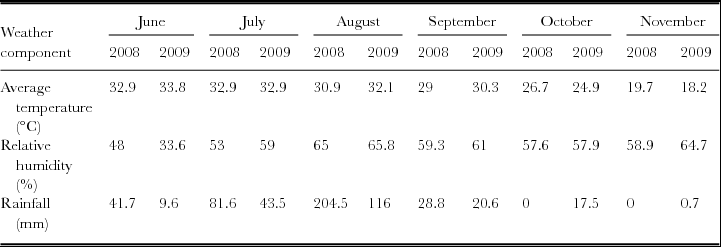
This field study was carried out at the Agronomic Research Farm, University of Agriculture, Faisalabad, Pakistan (73.07° east longitude, 31.44° north latitude; altitude of 135 m above sea level) in 2008 and 2009. The climate of the region is semi-arid subtropical. In each year, before rice cultivation, physico-chemical analysis of the experimental soil was carried out. In the first and second years of the experiment, the soil had a pH of 7.8 and 7.9, electrical conductivity of 0.61 and 0.69 dS m−1, exchangeable sodium of 0.30 and 0.33 mmolc 100 g−1, organic matter of 9.5 and 9.0 g kg−1, total nitrogen of 0.60 and 0.50 g kg−1, available phosphorus of 8.0 and 7.18 mg kg−1 and available potassium of 118.0 and 90.0 mg kg−1, respectively. The weather data during the study period are given in Table 1.
Weather data during the experiment, 2008 and 2009.

Experiment details
Transplanted rice with continuous flooding (TRCF) was compared with the low-water-input rice productions systems ─ TRAWD and DSR. The basmati rice cultivars popular among farmers (Super Basmati, Basmati 2000, and Shaheen Basmati) were used in the experiment. TRCF and TRAWD were established as suggested by Yao et al. (Reference Yao, Huang, Cui, Nie, Xiang, Liu, Wu, Chen and Peng2012). However, the PVC tubes (as used by Yao et al. (Reference Yao, Huang, Cui, Nie, Xiang, Liu, Wu, Chen and Peng2012) did not work under our conditions; soil moisture was thus monitored by gravimetric method to guide decisions on timing of irrigation (Awan et al., Reference Awan, Bastiaans, van Oort, Ahmad, Ashraf and Meinke2014; Jabran et al., Reference Jabran, Ullah, Hussain, Farooq, Zaman, Yaseen and Chauhan2014). Soil conditions typical of TRCF, TRAWD and DSR were created. Irrigation applications (50, 75, 100, 125 and 150 mm) were practiced in dummy plots (equal to real plots in size) well before the setup of real experiments in order to decide water input level for each irrigation. A water depth of 100 mm was found sufficient to fully cover the fields under TRCF and TRAWD and 75 mm was enough for the DSR fields. The differences in water needs were due to the varying soil conditions. TRCF was established in puddled inundated plots and irrigated in accordance with traditional methods (Yao et al., Reference Yao, Huang, Cui, Nie, Xiang, Liu, Wu, Chen and Peng2012). Under this system, the respective experimental plots were given the 100 mm water treatment as soon as the layer of standing water disappeared. TRAWD was also established in puddled plots and flooded the first two weeks after transplanting. Later, this treatment was irrigated with 100 mm of water when soil moisture dropped to 80% of field capacity. DSR was established under aerobic (non-inundated) conditions and the plots were exposed to 75 mm of irrigation water when soil moisture reached 50% of field capacity (Awan et al., Reference Awan, Bastiaans, van Oort, Ahmad, Ashraf and Meinke2014). Seepage among the main plots was avoided by making doubly strong bunds and inserting plastic sheets.
In each year, the experiment was laid out in a randomized complete block design with split plot arrangement and replicated thrice. Sub-plot size was 2.2 m × 8.0 m. Production systems and rice cultivars were the main plots and subplots, respectively. The seeds of rice cultivars Super Basmati and Basmati 2000 were obtained from the Rice Research Institute, Kala Shah Kaku, Pakistan; the Shaheen Basmati seeds were collected from the Soil Salinity Research Institute, Pindi Bhattiyan, Pakistan. For implementation of treatments and management practices, the rice growth stages were identified according to rice growth staging system of Counce et al. (Reference Counce, Keisling and Mitchell2000).
Crop husbandry
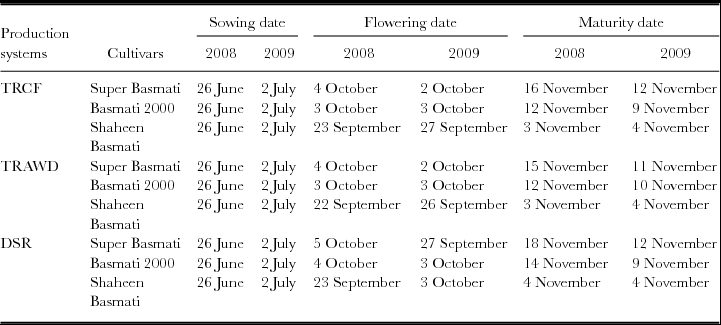
For DSR, the seedbed was prepared by tilling the field three times with a tractor-mounted cultivator, each cultivation followed by a planking operation. The three rice cultivars were sown (S0 growth stage) under aerobic conditions (direct seeding) on June 26, 2008 and on July 2, 2009, while seeds of the same cultivars were sown on the same date (for raising seedlings). The seed rate for DSR was kept at 75 kg ha−1 while that for TRCF and TRAWD were 0.50 kg seeds per 25 m2 broadcast in a well-prepared flooded field. Thirty-day old seedlings (V3–V4 growth stage) of all three cultivars were transplanted in the puddled soil (TRCF and TRAWD). The rice rows were spaced 22 cm apart in all production systems. The crop was fertilized with 150 kg nitrogen (N) ha−1, 75 kg P2O5 ha−1, and 60 kg K2 O ha−1 in the form of urea, di-ammonium phosphate, and potassium sulfate, respectively. Half of the N and all of the phosphorus and potassium were applied at sowing (S0 growth stage for DSR, and V3 growth stage for TRCF and TRAWD), while the remaining N was given in two splits, at tillering (V6 growth stage) and at panicle formation (VF V13 R2 growth stage). All other agronomic practices were done to keep the crop free from insects and diseases. The respective sowing and harvesting dates for the different treatments in the experiment are given in Table 2.
Sowing and harvesting dates under different production systems.

TRCF = transplanted rice with continuous flooding; TRAWD = transplanted rice with alternate wetting and drying; DSR = dry-seeded rice.
Weed cover estimates
The data on weed presence in the experimental area were obtained two weeks after crop sowing (V3 growth stage for DSR and V6 growth stage for TRCF and TRAWD). Through visual assessment, the percentage of the ground covered by weeds in each experimental unit was estimated following Brown et al. (Reference Brown, Bettink, Paczkowska, Cullity, Region and French2011). The weeds were then removed from the experimental area through hand weeding to avoid weed-crop competition.
Agronomic and yield-related traits
The agronomic and yield-related traits were recorded when the plants reached R9 growth stage. Productive tillers were counted from an area of 1.1 m2 at three random places, averaged and converted into number m−2. The height of 20 primary tillers, selected randomly from each plot, was measured from the base to the end point of the panicle with the help of a meter rod and then averaged. The number of grains per panicle were counted from 20 randomly selected panicles of the primary tillers and averaged. Three batches of samples from the seed lot of each experimental unit were taken and weighed using an electrical balance and averaged to determine 1000-grain weight. A 6.6 m2 area was harvested from each experimental plot and threshed manually to measure grain yield. The recorded grain weight was adjusted to 12% moisture content and converted into grain yield in kg ha−1. Harvest index (expressed in percentage) was calculated as the ratio of grain yield to biological yield.
Water input and water productivity
Total water applied either through irrigation or precipitation in all rice production systems was collectively termed water input. Water productivity was calculated according to a formula (Viets, Reference Viets1962): it is the ratio of paddy yield to the amount of water applied. Here, paddy yield was expressed in g m−2 and the water used (irrigation + rainfall) was expressed in mm. Water productivity was expressed in terms of kg m−3. The measured quantity of irrigation water was applied to each treatment using a cut-throat flume using the following formula: QT = AD, where Q = discharge rate from flume (m3 s−1), T = time for which water is to be applied (s), A = area to be irrigated (m2), and D = depth of irrigation water (m).
Economic analysis
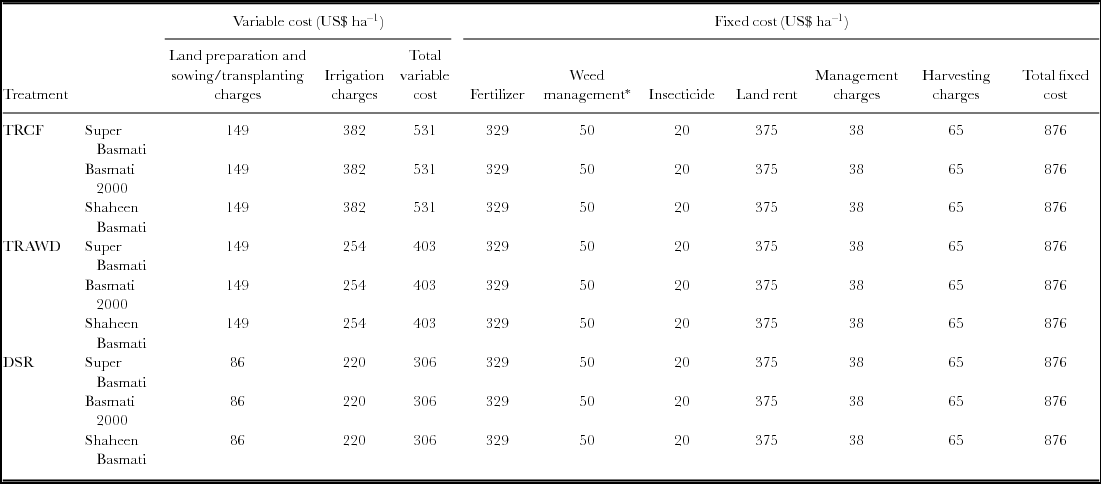
The cost of production for rice was assessed by calculating the variable and fixed costs for the two years of study. The most economical treatment was found by calculating net field benefits, net returns and benefit-cost ratio in accordance with Byerlee (Reference Byerlee1988). Net field benefits were calculated as the difference between gross income and variable cost, whereas net returns were the difference between gross income and total cost (including, fixed and variable costs). Details of variable and fixed costs have been described in Table 3.
Details of variable and fixed costs of different rice cultivars.

*Weed management consisted of one early post-emergence herbicide (bis-pyribac sodium) + post-emergence one hand-weeding.
Statistical analyses
The data were analyzed using Fisher's analysis of variance (ANOVA) technique. The least significant difference (LSD) test at the 0.05 probability level was used to compare differences among treatment means. The ANOVA results (combined over the years) indicated significant differences across the years. Hence, the data were analyzed separately for both years of study. The interaction among the investigated factors was significant; hence, only the results for the interactions are presented. Weeds did not differ significantly in kind and intensity over the years so the weed cover data for individual and total weeds were averaged over the years.
RESULTS
Weed prevalence
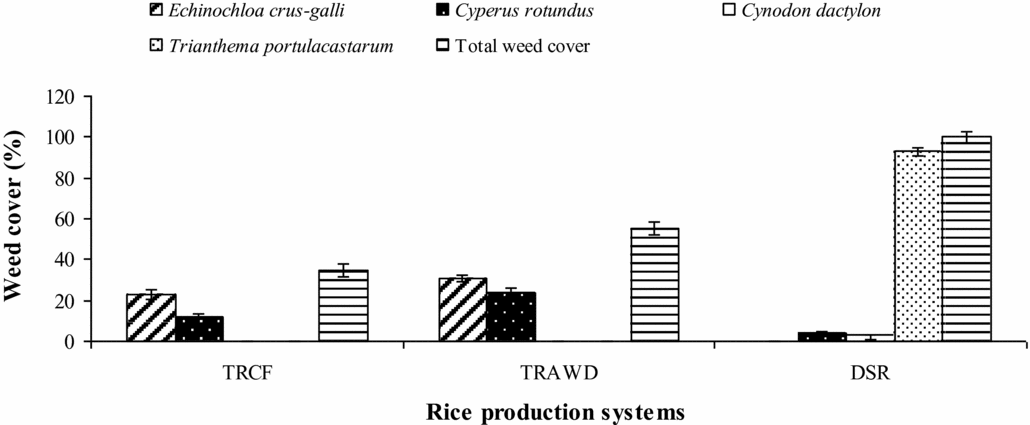
Variable weed flora was recorded for TRCF, TRAWD and DSR production systems (Figure 1). However, amongst cultivars, there was no variation in the kind and intensity of weed prevalence. The production system × cultivar and treatment × year interactions had a non-significant effect on weed flora. Both TRCF and TRAWD contained similar weeds, including Echinochloa crus-galli (L.) Beauv. and Cyperus rotundus L. DSR had Trianthema portulacastrum L., C. rotundus and Cynodon dactylon L. Weed intensity and ground cover were much higher (~100%) in DSR than in TRCF and TRAWD (~35–55%). The visually estimated weed ground cover in TRCF was 23% and 12% for E. crus-galli and C. rotundus, respectively, with a total of 35% ground cover (Figure 1). For TRAWD, the recorded weed cover was 31% (E. crus-galli) and 24% (C. rotundus), making a total weed cover of 55%. Similarly, weed ground cover in DSR was 4%, 3% and 93% for C. rotundus, C. dactylon and T. portulacastrum, respectively, with a total of 100% ground cover with weed foliage (Figure 1).
Comparative weed prevalence and weed cover in transplanted rice with continuous flooding (TRCF), transplanted rice with alternate wetting and drying (TRAWD) and dry-seeded rice (DSR). The lines fitted on each bar of the chart present the standard error for the respective treatment. The figure presents the average of two years' data.

Water input, water savings, water productivity and panicle sterility
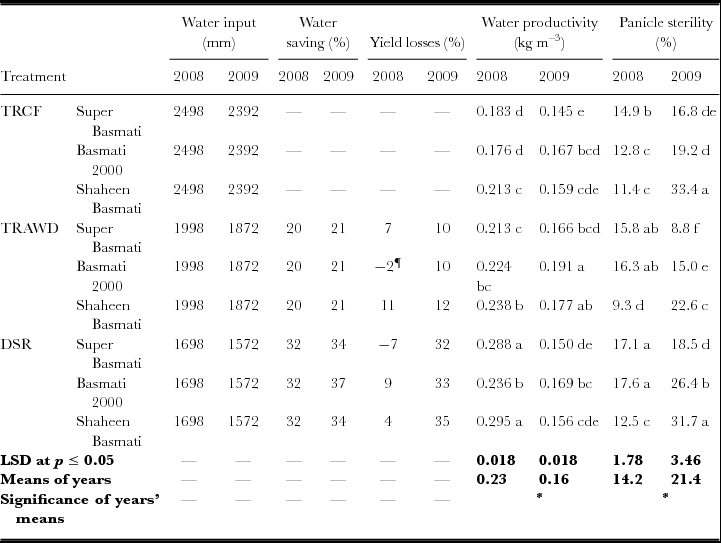
TRCF had the highest water input, 2498 and 2392 mm ha−1, during 2008 and 2009, followed by TRAWD with water inputs of 1998 and 1872 mm ha−1, while the DSR system had the lowest 1698 and 1572 mm ha−1), respectively. TRAWD and DSR had 20 and 21, and 32 and 34% water savings, respectively, in 2008 and 2009 than TRCF (Table 4). There were significant differences for year × treatment interactions for water productivity and panicle sterility (Table 4). Higher water productivity was recorded (0.23 kg m−3) during the first year of experiment than the second year (0.16 kg m−3). Contrarily, lower panicle sterility (14.2%) was recorded in the first year of experiment than the second year (Table 4). Shaheen Basmati and Super Basmati grown under the DSR system had the highest water productivity (0.295 and 0.288 kg m−3, respectively) while the Super Basmati and Basmati 2000 (0.183 and 0.176 kg m−3, respectively) had the lowest water productivity in 2008 (Table 4). In 2009, Basmati 2000 and Shaheen Basmati sown under the TRAWD system had the highest water productivity (0.191 and 0.177 kg m−3, respectively), while the lowest water productivity values were recorded when Super Basmati was cultivated under TRCF and DSR and Shaheen Basmati was grown under TRCF (Table 4). As to panicle sterility, higher values were found (17.6 and 17.1%, respectively) in Super Basmati and Basmati 2000 sown under DSR and TRAWD in 2008; the lowest (9.3%) was recorded in Shaheen Basmati in TRAWD (Table 4). In the following year, significantly higher panicle sterility (33.4 and 31.7%, respectively) was recorded in Shaheen Basmati sown under TRCF and DSR. The lowest panicle sterility (19.2 and 15.1%, respectively) was seen in Super Basmati sown under TRCF and Basmati 2000 under TRAWD (Table 4).
Effect of production systems on water saving and productivity, and panicle sterility of different rice cultivars.

TRCF = transplanted rice with continuous flooding; TRAWD = transplanted rice with alternate wetting and drying; DSR = dry-seeded rice; ¶The numbers with minus (−) sign present the yield gains over TRCF; numbers not sharing a letter in common differ significantly at p = 0.05; *indicates that the difference among the two years’ means was statistically significant.
Agronomic and yield-related traits of rice
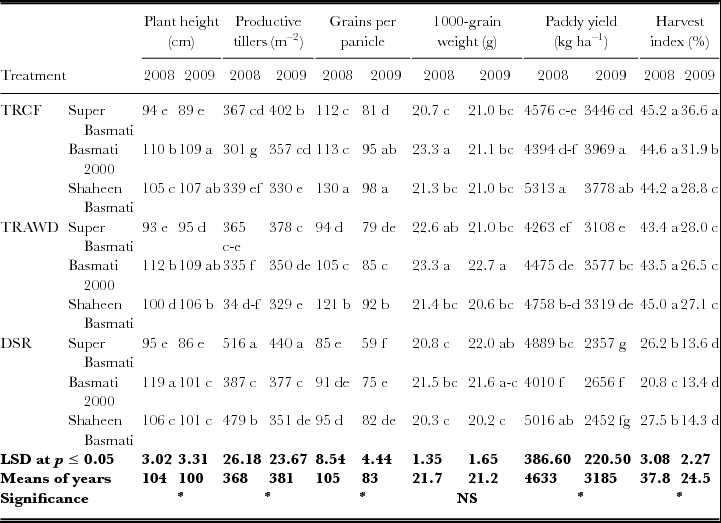
There were significant differences for year × treatment interactions for the parameters including plant height, productive tillers, grains per panicle, paddy yield and harvest index (Table 5). Higher paddy yield (4633 kg ha−1) was recorded in 2008 than in 2009 (3185 kg ha−1; Table 5). In 2008, highest yield was recorded for Shaheen Basmati sown under TRCF (5313 kg ha−1), followed by Shaheen Basmati under DSR (5016 kg ha−1; Table 5). The lowest paddy yield was recorded for Basmati 2000 grown under DSR (4010 kg ha−1), followed by Super Basmati sown under TRAWD (4263 kg ha−1; Table 5). In 2009, Basmati 2000 cultivated under TRCF produced the highest paddy yield (3969 kg ha−1), followed by Shaheen Basmati under TRCF (3778 kg ha−1). Under DSR, Super Basmati gave minimum paddy yield (2656 kg ha−1), followed by Shaheen Basmati (2452 kg ha−1; Table 5). A higher harvest index (37.8%) was noted in 2008 while a lower in 2009 (24.5%; Table 5). In 2008, the same harvest index values (43.4–45.2%) were noted in all three cultivars under both TRCF and TRAWD, while Basmati 2000 (DSR) had the lowest harvest index (20.8%; Table 5). In 2009, highest harvest index (36.6%) was attained by Super Basmati sown under TRCF while the least value (13.3–14.3%) was observed in the three rice cultivars cultivated under DSR (Table 5).
Influence of production system on yield and related traits of different rice cultivars.

TRCF = transplanted rice with continuous flooding; TRAWD = transplanted rice with alternate wetting and drying; DSR = dry-seeded rice. Digits not sharing a letter in common differ significantly at p = 0.05; *indicates that the difference among the two years’ means was statistically significant. NS = non-significant.
Higher plant height (104 cm) was recorded in 2008 than in 2009 (100 cm; Table 5). In 2008, Basmati 2000 sown as DSR attained the highest plant height (119 cm) while Super Basmati sown under either of the production system had lower plant height (Table 5). In 2009, Basmati 2000 sown under TRCF had the higher plant height (109 cm) while Super Basmati in TRCF and DSR attained the lowest plant height. Lower number of productive tillers (368 m−2) was recorded in the first year of study than the second (Table 5). In 2008, Super Basmati sown under DSR had the highest productive tillers (516 m−2) while Basmati 2000 under TRCF had the lowest number of productive tillers (301 m−2). In 2009, the highest number of productive tillers (440 m−2) was recorded for Super Basmati sown under DSR while the lowest productive tillers were noted for Shaheen Basmati under TRCF and TRAWD.
Higher number of grains per panicle (105) was noted in 2008 than in 2009 (Table 5). In 2008, Shaheen Basmati (TRCF) produced the highest number of grains per panicle (130), while Super Basmati (85 grains panicle−1) and Basmati 2000 (91 grains panicle−1) grown under DSR had the lowest (Table 5). In 2009, Shaheen Basmati (TRCF) had a significantly higher number (98) of grains per panicle, followed by Basmati 2000 (TRCF) with 95. Super Basmati (DSR) had the lowest number (59) of grains per panicle in 2009 (Table 5).
The year × treatment effect was non-significant for 1000-grain weight (Table 5). In 2008, highest 1000-grain weight (23.3 g) was recorded for Basmati 2000 under both TRCF and TRAWD, followed by Super Basmati under TRAWD (22.6 g). The lowest 1000-grain weight was recorded for Super Basmati and Shaheen Basmati under TRCF and for all cultivars under DSR (Table 5). In 2009, Basmati 2000 under TRAWD (22.7 g) had the highest 1000-grain weight, followed by Super Basmati and Basmati 2000 under DSR (22.0 and 21.6 g, respectively) (Table 5).
Net economic returns and benefit-cost ratio
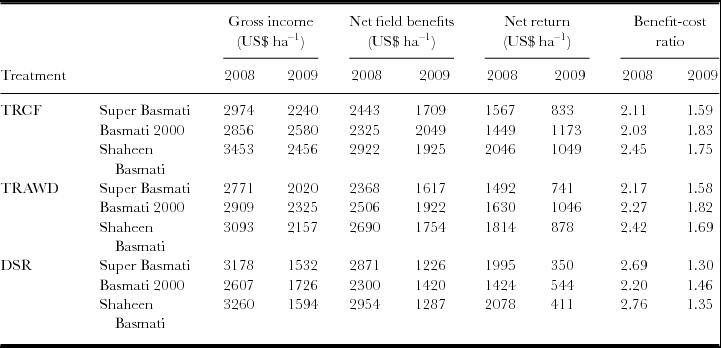
In 2008, cultivation of Shaheen Basmati under both TRCF and DSR gave highest gross income (US$3453 and 3260 ha−1, respectively; Table 6). During 2009, Basmati 2000 and Shaheen Basmati (TRCF) attained the highest gross income (US$2580 and 2456 ha−1, respectively). Highest net field benefits and net returns (US$2954 and 2078 ha−1, respectively) were recorded for Shaheen Basmati cultivated as DSR during 2008 (Table 6). In 2009, these figures were recorded for Basmati 2000 in TRCF (US$2049 and 1173 ha−1, respectively). In 2008, Shaheen Basmati and Super Basmati grown as DSR had the highest benefit-cost ratio (2.76 and 2.69, respectively), whereas Basmati 2000 grown as TRCF had the lowest (2.03) (Table 6). In 2009, Basmati 2000 grown under TRCF had the highest benefit-cost ratio (1.83).
Effects of production system on net field benefits, net returns and benefit-cost ratio of different rice cultivars.

TRCF = transplanted rice with continuous flooding; TRAWD = transplanted rice with alternate wetting and drying; DSR = dry-seeded rice. The variable cost was recorded to be US$518.10, 397.20 and 325.60 in both years of study for TRCF, TRAWD and DSR, respectively. Total cost was US$977.10, 856.30 and 748.60 in both years for TRCF, TRAWD and DSR, respectively.
DISCUSSION
Rice plays an important role in ensuring food security in the world. But rice production is currently constrained by limited water supply. Keeping in view the high water requirements of the conventional method, rice production using alternative methods is advocated under water-limited environments. However, methods like transplanted rice with alternate wetting and drying (TRAWD) and dry-seeded rice (DSR) have been reported as water-saving rice production methods in various parts of world. However, the significance of such methods for reducing water input in fine-grain rice has been rarely reported. In this study, we have reported the comparative weed emergence, water input, water productivity, yield and economic returns for three most important fine-grain rice cultivars grown under TRCF, TRAWD and DSR for the first time.
The weed flora found in water-saving rice systems was more intensive and more variable than in conventionally grown rice. Importantly, weeds, including T. portulacastrum and C. dactylon, are generally not present in TRCF; these can thus be considered new emerging weeds in rice when grown as DSR. The higher weed intensity in DSR than in other rice production systems can be a challenge to the productivity of rice grown under this production system (Jabran et al., Reference Jabran, Hussain, Farooq, Babar, Dogan and Lee2012a). Results from these experiments and other observations indicate that T. portulacastrum may be a great threat to the productivity of rice under DSR culture (Jabran et al., Reference Jabran, Farooq, Hussain, Ehsanullah, Khan, Shahid and Lee2012b). Severe weed intensity under DSR would not only lead to reduced productivity but also to high weed management cost (Jabran et al., Reference Jabran, Hussain, Farooq, Babar, Dogan and Lee2012a). The weed problem, however, can be reduced if a proper weed management plan is implemented (Akbar et al., Reference Akbar, Ehsanullah Jabran and Ali2011; Singh et al., Reference Singh, Ladha, Gupta, Bhushan and Rao2008).
The higher water input under the TRCF system was due to the water requirement for raising seedlings, puddling and maintaining a layer of water in the field for a major part of the crop cycle (Bouman et al., Reference Bouman, Humphreys, Tuong and Barker2007). However, under TRAWD system, a layer of water in the field is maintained only for two weeks and, after that, the field is irrigated when soil moisture drops to a certain level. There were 20.0 and 21.1% water savings observed during 2008 and 2009, respectively. Other studies show that the greater water savings from TRAWD and DSR (compared with conventional system) may be attributed to reduced percolation, seepage and evaporation under these systems (Bhushan et al., Reference Bhushan, Ladha, Gupta, Singh, Tirol-Padre, Saharawat and Pathak2007; Bouman et al., Reference Bouman, Peng, Castaneda and Visperas2005; Peng et al., Reference Peng, Bouman, Visperas, Castaneda, Nie and Park2006). Although water saving under TRAWD and DSR was accompanied by certain yield losses (compared with TRCF), the results indicate the importance of these rice production systems in rice-growing areas that face water scarcity.
Researchers from various parts of the world have reported water-saving in non-basmati rice types. For example, in Philippines, shifting from conventional system to alternate wetting and drying system of rice production was found to have a 38% saving in irrigation water input without causing a decline in farmers’ profit (Rejesus et al., Reference Rejesus, Palis, Rodriguez, Lampayan and Bouman2011). Similarly, the water-saving systems were found to reduce irrigation water and improve water productivity of Chinese rice varieties (Moya et al., Reference Moya, Hong, Dawe and Chongde2004; Yang et al., Reference Yang, Liu, Wang, Du and Zhang2007). Similarly, in Japan, the water-saving rice cultivation methods were found effective for reducing water input and improving water productivity of rice crop (Kamoshita et al., Reference Kamoshita, Ishikawa, Abe and Imoto2007).
Cultivars under water-saving rice production systems had higher water productivity than TRCF during both years. However, water productivity was higher for DSR in 2008 and for TRAWD in 2009. The higher water productivity of TRAWD or DSR in the respective years was attributed to yield outputs from these treatments. Higher water productivity with low water input signifies the importance of these rice production systems under water-limited environments. This implies that TRAWD and DSR may be used in rice-growing areas where water supply gets critically low.
There were significant differences between the results of the two years: yield outcomes were higher in the first year of the study than in the second year. The reasons may be the relatively higher rainfall and lower temperature, especially in July and August in the first year. Two occurrences of rainfall in October 2009 might have disturbed the grain formation process, which resulted in overall lower yield in 2009 than 2008 (Stuerz et al., Reference Stuerz, Sow, Muller, Manneh and Asch2014). The allelopathic phenomenon may be the other reason for the low yield in the second year (Farooq et al., Reference Farooq, Jabran, Cheema, Wahid and Siddique2011b). Basmati rice as well as wheat cultivars are reported to have some allelopathic effects (Bertholdsson, Reference Bertholdsson2010; Farooq et al., Reference Farooq, Jabran, Rehman and Hussain2008). The rice crop was grown on the same field, followed by a wheat crop in both seasons. Hence, in addition to variable rainfall and temperature, the accumulation of allelochemicals might have contributed to overall rice yield reduction during the second season of the experiment. Overall crop growth period was shorter in the second year than in the first year, which might have affected yield negatively in year 2. Further, the overall yields and harvest indices were low especially in the second year of experiment. The yields were lower than the ones usually obtained from non-aromatic long grain rice. Genetics and agronomic requirements are responsible for the difference in yields and harvest indices of fine grain basmati rice and non-aromatic long grain rice types. Non-aromatic long grain rice is higher yielding, more responsive to fertilizer than basmati rice and planted earlier than the basmati rice. Hence, the yields were in general lower in this study.
Generally, the number of productive tillers was highest in DSR than in other production systems. However, this increased number of productive tillers resulted in decreased number of grains per panicle and 1000-grain weight in DSR. The lower number of grains per panicle and less 1000-grain weight in DSR might be due to the higher number of tillers and subsequent intraspecific competition in this system (Tuong and Bouman, Reference Tuong, Bouman, Kijne, Barker and Molden2003).
The adoption of rice production systems that require lower water inputs (e.g., TRAWD and DSR) is inevitable in a scenario of water scarcity. Such production systems provide promising opportunities of growing rice with improved water productivity in areas like South Asia, where water is getting scarce. The results of this study would be helpful in assessing the suitability of TRAWD and DSR along with TRCF in various water-limited environments.
CONCLUSIONS
The result of our studies highlights the importance of water saving rice systems for growing fine grain basmati rice under water short environments. A higher water productivity was recorded for TRAWD and DSR than TRCF. However, higher weed prevalence and spikelet sterility were noted in TRAWD and DSR than TRCF. The yield outcomes and economic returns from TRAWD and DSR are either comparable with or lower than those from TRCF. Although yields of TRAWD and DSR are lower than that of TRCF in certain cases, these rice production systems carry significance for growing rice under water-limited environments, owing to the improved water productivity resulting from these systems.