Introduction
Life requires a considerable variety of chemical ingredients, and these ingredients are composed mostly of four elements: hydrogen, carbon, nitrogen and oxygen. The backbone species for prebiotic chemistry include the reactive species HCHO, HCN, ethylene, cyanoacetylene and acetylene (Miller & Cleaves Reference Miller and Cleaves2006), and it is an open question how or even where these species were first formed, whether in the interstellar medium (Hoyle & Wickramasinghe Reference Hoyle and Wickramasinghe2000), on the backs of meteorites, in the atmosphere or deep within the oceans of the archaic earth (Orgel Reference Orgel1998). Energetic processes, such as photolysis and cosmic-ray ionization affect atmospheric and geological chemistry on Earth, and may have an important role to play in the formation of prebiotically relevant radical species. The atmosphere of Jupiter and Jupiter-like planets provide a natural laboratory in which to study the effects energetic processes have on hydrocarbon and organic chemistry. The atmospheres of giant gas planets are hydrogen dominated and have significant elemental concentrations of carbon and oxygen (Lodders Reference Lodders2004), and many of the same energetic processes take place in their atmospheres as on Earth, such as photodissociation (Moses et al. Reference Moses, Fouchet, Bézard, Gladstone, Lellouch and Feuchtgruber2005), cosmic-ray ionization (Whitten et al. Reference Whitten, Borucki, O'Brien and Tripathi2008) and lightning (Gurnett et al. Reference Gurnett, Shaw, Anderson and Kurth1979).
There has been significant work on cosmic-ray transport and ionization in the atmosphere of Titan. The effect cosmic rays have on ionizing and dissociating carbon and nitrogen species (Capone et al. Reference Capone, Dubach, Whitten, Prasad and Santhanam1980, Reference Capone, Dubach, Prasad and Whitten1983; Molina-Cuberos et al. Reference Molina-Cuberos, López-Moreno, Rodrigo and Lara1999a), enhancing the formation of aerosols (Sittler et al. Reference Sittler, Hartle, Bertucci, Coates, Cravens, Dandouras and Shemansky2010), and the role of cosmic rays in instigating lightning (Borucki et al. Reference Borucki, Levin, Whitten, Keesee, Capone, Summers, Toon and Dubach1987) have been explored. Cosmic-ray transport in Titan has also been investigated (for example, Molina-Cuberos et al. Reference Molina-Cuberos, López-Moreno, Rodrigo, Lara and O'Brien1999b). In terms of electron production, the transport model for Titan bears qualitatively similar results to the cosmic-ray transport models on Earth (e.g., Velinov et al. Reference Velinov, Mishev and Mateev2009). If results are cast in terms of column density, both seem to be well-fit by a Poisson distribution and peak at roughly the same atmospheric depth (∼100 g cm−2). Initial studies on cosmic-ray ionization in Jupiter (Whitten et al. Reference Whitten, Borucki, O'Brien and Tripathi2008) and exoplanets (Rimmer & Helling Reference Rimmer and Helling2013) support this result.
The effects of cosmic-ray ionization on the chemistry of extrasolar planet atmospheres have not yet been investigated, although Moses et al. (Reference Moses2011) speculate that cosmic-ray ionization may be connected to the hazes in the upper atmosphere of HD 189733b observed by Pont et al. (Reference Pont, Knutson, Gilliland, Moutou and Charbonneau2008) and Sing et al. (Reference Sing2011). An investigation into hydrocarbon chemistry in the atmospheres of extrasolar giant gas planets is interesting from an astrobiological perspective because such a study will provide insight into the significance of different initial conditions and physical parameters on this prebiotic chemistry. We present a proof-of-concept on the potential effect of cosmic rays in the atmosphere between 10 μbar and 1 nbar. In order to accomplish this we take the results of cosmic-ray ionization on a Drift–Phoenix model atmosphere of a Jupiter-like planet from Rimmer & Helling (Reference Rimmer and Helling2013), and apply them to an astrochemical network adapted to the atmospheric environment of a Jupiter-like planet. A brief description of Drift–Phoenix and the cosmic-ray transport is provided in ‘The model atmosphere and cosmic-ray transport’ section. We then discuss the chemical network and its results in ‘Gas-phase chemical kinetics model’ section.
The model atmosphere and cosmic ray transport
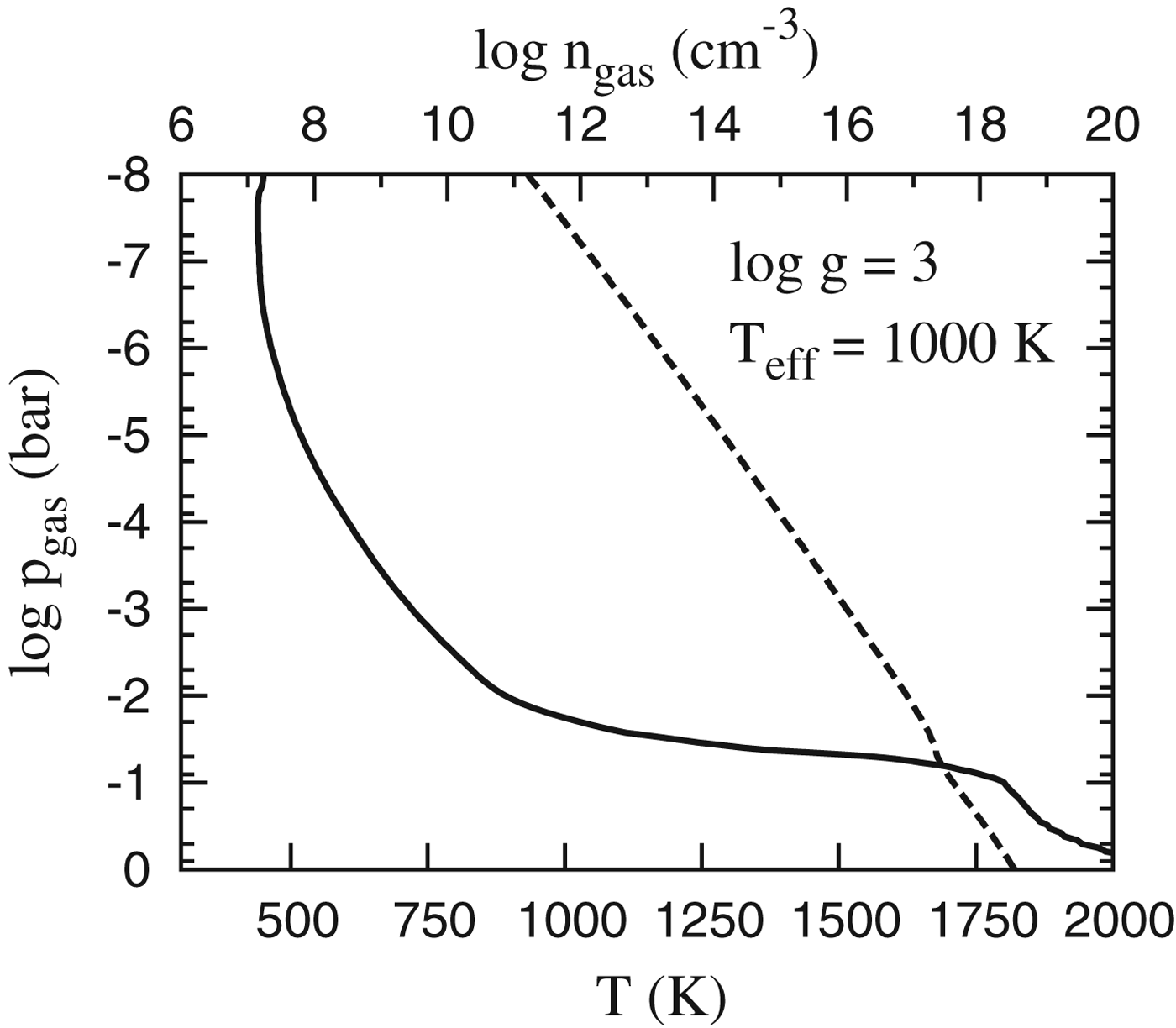
The chemical calculations in the following section are built upon a model atmosphere of Drift–Phoenix (from Dehn Reference Dehn2007; Helling et al. Reference Helling2008; Witte et al. Reference Witte, Helling and Hauschildt2009), and cosmic-ray transport calculations from Rimmer & Helling (Reference Rimmer and Helling2013). Drift–Phoenix is a model that self-consistently combines the calculation of hydrostatic equilibrium and comprehensive radiative transfer for a substellar object or warm exoplanet with a dust formation model that incorporates seed nucleation, growth, gravitational settling and evaporation of dust grains. This self-consistent approach has the advantage of capturing the effect of the dust on the gas-phase, e.g., the elemental depletion and the backwarming effect of the dust on the gas-phase temperature. Drift–Phoenix has been utilized in explorations of non-thermodynamic charging of the atmosphere by, e.g., dust–dust collisions and Alfvén ionization (Helling et al. Reference Helling, Jardine and Mokler2011; Stark et al. Reference Stark, Helling, Diver and Rimmer2013). This model takes as input elemental abundances, effective temperature (T eff, K) and surface gravity (log g, with g in units of cm s−2). The example atmosphere we consider here is that of a model free-floating exoplanet, with log g=3, T eff=1000 K and solar metallicity. The pressure–temperature structure of the model is plotted in Fig. 1.
The temperature, T [K] (solid,bottom) and density, log n gas [cm−3] (dashed, top) plotted as a function of pressure, log p gas [bar], for our model Drift–Phoenix atmosphere, when log g=3, T eff=1000 K, and at solar metallicity.

We apply a Monte Carlo model to determine cosmic-ray transport for cosmic rays of energy E<109 eV. In this model, detailed in Rimmer et al. (Reference Rimmer, Herbst, Morata and Roueff2012), we take 10 000 cosmic rays and propagate them through a model exosphere (Rimmer & Helling Reference Rimmer and Helling2013, their Section 2) and Drift–Phoenix atmosphere. The cosmic rays travel a distance such that σΔN=1 (σ [cm2] denotes the collisional cross-section between the cosmic ray and a gas-phase atmospheric species, and ΔN [cm−2] is the column density of the distance travelled). A fraction of the cosmic rays will have experienced a collision and will lose some of their energy, W(E) [eV]. Alfvén wave generation by cosmic rays is also accounted for (Skilling & Strong Reference Skilling and Strong1976).
An analytical form for the column-dependent ionization rate, Q, as a function of column density, N col [cm−2] from Rimmer & Helling (Reference Rimmer and Helling2013) is:
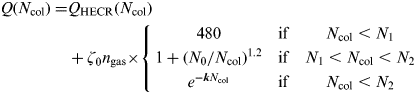 $$\eqalign{Q(N_{{\rm col}} ) = & Q_{{\rm HECR}} (N_{{\rm col}} ) \cr & + \zeta _0 n_{{\rm gas}} \hskip-2pt\times\hskip-2pt \left\{ {\matrix{ {480} & {{\rm if}} & {N_{{\rm col}} \lt N_1} \cr {1 + (N_0 /N_{{\rm col}} )^{1.2}} & {{\rm if}} & {N_1 \lt N_{{\rm col}} \lt N_2} \cr {e^{ - {\bi k}N_{{\rm col}}}} & {{\rm if}} & {N_{{\rm col}} \lt N_2} \cr}} \right.} $$
where ζ0=10−17 s−1 is the standard ionization rate in the dense interstellar medium, and the column densities N 0=7.85×1021 cm−2, N 1=4.6×1019 cm−2, N 2=5.0×1023 cm−2 and k=1.7×10⁻²⁶ cm2 are fitting parameters. The value for the high-energy cosmic-ray ionization rate, Q HECR(N col) is given in Rimmer & Helling (Reference Rimmer and Helling2013, their Fig. 5).
For cosmic rays with E>109 eV, the cosmic-ray transport is treated by the analytical form of Velinov & Mateev (Reference Velinov and Mateev2008); Velinov et al. (Reference Velinov, Mishev and Mateev2009), appropriately modified for our model atmosphere. Rimmer & Helling (Reference Rimmer and Helling2013) provide a detailed description of the modifications to the calculations of Velinov & Mateev (Reference Velinov and Mateev2008) and Rimmer et al. (Reference Rimmer, Herbst, Morata and Roueff2012).
Gas-phase chemical kinetics model
Now that the rate of electron production by galactic cosmic rays is determined, we study the effect that this rate will have on the atmospheric gas by applying a gas-phase network. Our chemical model allows us to explore first findings with respect to the local hydrocarbon chemistry. The electrons in the atmosphere will be freed by cosmic rays and by the secondary photons produced from their interaction with the gas. Secondary photons are generated via the Prasad–Tarafdar mechanism (Prasad & Tarafdar Reference Prasad and Tarafdar1983). We utilize the detailed emission spectrum from Gredel et al. (Reference Gredel, Lepp, Dalgarno and Herbst1989). Photoionization and photodissociation rates for secondary photons are included in the model. The rate of collisional de-excitation varies throughout the atmosphere. At the upper limit for our model, T gas=800 K, the H2 number density is ∼1014 cm−3 for our model giant gas planet atmosphere. The cross-section for collisional de-excitation is of the order of σ coll∼10−23−10−22 cm2 (Shull & Hollenbach Reference Shull and Hollenbach1978), corresponding to a timescale for collisional de-excitation of t coll≈(n gasσ collv coll)−1∼100 s, where v coll is the average collisional velocity of the gas at 800 K. This is much longer than the timescale for spontaneous emission (Prasad & Tarafdar Reference Prasad and Tarafdar1983), and so we ignore the effect of collisional de-excitation on our emission spectrum. Millar et al. (Reference Millar, Farquhar and Willacy1997); McElroy et al. (Reference McElroy, Walsh, Markwick, Cordiner, Smith and Millar2013) claim that the photoionization and photodissociation rates for secondary photons are valid over a temperature range of 10 K<T eff<41 000 K.
Free electrons will also be destroyed by recombination processes, e.g., with ions. We compare these two competing processes in detail: if the cosmic-ray ionization rate is much greater than the recombination rate, then we can expect a significant electron enhancement from cosmic rays. If, however, the recombination is much more rapid than the ionization, then the number of free electrons will remain low. We examine these two rates by concentrating on the number of free electrons produced by cosmic rays and cosmic-ray photons. We utilize a self-consistent gas-phase time-dependent chemical model that includes various cosmic ray, secondary electron and secondary photo-ionization chemical processes, and recombination reactions (described below). This model is calculated iteratively at different depths with the value of Q [cm−3 s−1] calculated using Rimmer & Helling (Reference Rimmer and Helling2013, their equation 23). As result of this procedure, we determine the number of free electrons and chemical abundances as a function of the local atmospheric pressure for our model giant gas planet atmosphere.
The kinetic gas-phase chemistry model
Various chemical kinetics networks have been developed to model the non-equilibrium atmospheric chemistry of giant gas planets (Moses et al. Reference Moses, Bézard, Lellouch, Gladstone, Feuchtgruber and Allen2000; Zahnle et al. Reference Zahnle, Marley, Freedman, Lodders and Fortney2009; Venot et al. Reference Venot, Hébrard, Agùndez, Dobrijevic, Selsis, Hersant, Iro and Bounaceur2012). Bilger et al. (Reference Bilger, Rimmer and Helling2013) introduce a new approach to non-equilibrium chemistry that explores individual and immediate destruction reactions for various species absent from the gas-phase in the upper atmosphere. These models involve robust chemical networks and calculate radiative transfer and vertical mixing, but they do not account for ion–neutral chemistry. We thus have adapted an interstellar chemical model with a detailed cosmic-ray chemistry in order to calculate the impact of cosmic rays on the degree of ionization by chemical kinetic processes. Molecular hydrogen dominates throughout our model atmospheres, and interstellar kinetics models contain a detailed treatment of the cosmic-ray ionization of H and H2, among other species, as well as recombination rates for all ions included in the networks.
The density profile and equilibrium chemical abundances for the atmosphere, from the exobase and through the cloud layer, are taken from the Drift–Phoenix model atmosphere results. The chemical kinetics are modelled using the Nahoon gas-phase time-dependent astrochemical model (Wakelam et al. Reference Wakelam, Selsis, Herbst and Caselli2005, Reference Wakelam2012). The newest version of this code can model objects with temperatures of T≲800 K (Harada et al. Reference Harada, Herbst and Wakelam2010). We use the high-temperature OSU 2010 Network from http://physics.ohio-state.edu/∼eric/research_files/osu_09_2010_ht.
This network comprises 461 species and well over 4000 reactions, including cosmic-ray ionization, photo-ionization, photo-dissociation, ion–neutral and neutral–neutral reactions. The additional reactions from the high-temperature network of Harada et al. (Reference Harada, Herbst and Wakelam2010) include processes with activation energies of magnitude ∼2000 K, reverse reactions and collisional dissociation.
We effectively apply a model at our model atmosphere for the chemical composition at different atmospheric heights. For irradiated atmospheres and atmospheres of rotating bodies, vertical mixing can be significant, especially in the upper atmosphere. For non-rotating planets far from their host star, however, vertical mixing timescales are of the order of 103−107 years (Woitke & Helling Reference Woitke and Helling2004, esp. their Fig. 2), and are orders of magnitude longer than the chemical timescales over the entire range of atmospheric pressures. We therefore expect that the atmospheric chemistry can effectively be treated as a series of zero-dimensional chemical networks. For irradiated atmospheres, vertical mixing timescales can be much shorter (Showman et al. Reference Showman, Fortney, Lian, Marley, Freedman, Knutson and Charbonneau2009; Moses et al. Reference Moses2011). For initial abundances at each height, we use the thermodynamic equilibrium abundances calculated in the manner described by Bilger et al. (Reference Bilger, Rimmer and Helling2013), where available. If the thermochemistry is not calculated for a given species in the OSU high Temperature network, we set the initial abundances equal to zero. The model is calculated until it reaches steady-state. We have not yet explored the effect of varying the initial abundances.
Because our model is applied to a hypothetical free-floating giant gas planet, vertical mixing and UV photoionization need not be accounted to approximate the non-equilibrium chemistry, because these processes are expected to be negligible in such an environment. This is appropriate for a first proof-of-concept, but it does mean that our methods cannot be directly applied to irradiated planets, where vertical mixing timescales are short and UV photoionization and photodissociation has a major effect on chemistry in the upper atmosphere. We plan to apply an expanded version of our ion–neutral network to a Hot Jupiter in a future paper.
Our model does not account for termolecular neutral–neutral or ion–neutral reactions. At some atmospheric density, termolecular reactions will become important. In order to estimate when this is, we follow the example of Aikawa et al. (Reference Aikawa, Umebayashi, Nakano and Miyama1999) and calculate the ‘typical’ rate for a bimolecular reaction (k 2∼10−11 cm6 s−1) divided by a ‘typical’ rate for a termolecular reaction, k 3∼10−30 cm6 s−1):
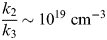 $$\displaystyle{{k_2} \over {k_3}} \sim 10^{19} \;{\rm cm}^{ - 3} $$
Our critical density below which three-body neutral–neutral reactions are not significant would be n c∼1017 cm−3. Alternatively, Woods & Willacy (Reference Woods and Willacy2007) estimate that n c∼1014 cm−3. If we use the lower value, then the critical pressure, above which termolecular reactions dominate, is p c≈10−5 bar. If we use the higher value of ∼1017 cm−3, then the cutoff moves to higher pressure, of about p c≈0.1 bar. We use the stronger limit of n c∼1014 cm−3.
Nahoon treats the kinetic chemistry as a series of rate equations. A given rate equation for a species A formed by B+C→A+X, and destroyed by A+D→Y+Z, is of the form:
 $$f_1 = \displaystyle{{{\rm d}n(A)} \over {{\rm d}t}} = k_{BC} n(B)n(C) - k_{AD} n(A)n(D) + \cdots $$
where k BC, kAD are the rates of formation and destruction of A, respectively. We can represent the rate equation for the i-th species as f i, i ranging from 1 to the total number of species, N. This system of equations has the Jacobian:
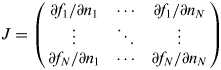 $$J = \left( {\matrix{ {\partial f_1 /\partial n_1} & \cdots & {\partial f_1 /\partial n_N} \cr \vdots & \ddots & \vdots \cr {\partial f_N /\partial n_1} & \cdots & {\partial f_N /\partial n_N} \cr}} \right)$$
where N is the total number of gas-phase species.
We run this model for the whole temperature–density profile for the model atmosphere considered here. We allow the network to evolve to steady state, and the time the system takes to reach steady state depends on the atmospheric depth. The timesteps decrease in proportion to the increasing total density. The relaxation timescale for the model can be determined from the inverse of the Jacobian of the system taken when all the species in the system have reached a steady state:  $n_i = \mathop {n _i}\limits^ { \circ} $ for a given species, i, and
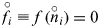 $\mathop f\limits^ { \circ} {\hskip-3 _i} \equiv f\,(\mathop n\limits^ { \circ} {\hskip-1 _i} ) = 0$. Specifically, one can determine the relaxation timescale, τ chem, to achieve steady state to be equal to the inverse of the eigenvalue, λ i, with the smallest absolute real component, or Woitke et al. (Reference Woitke, Kamp and Thi2009, their Eq. 117):
 $$\tau _{{\rm chem}} = {\rm max}|{\rm Re}\{ \lambda _i \} ^{ - 1} |$$
For the eigen-vectors of the Jacobian, j:
 $$J{\bi j} = \lambda _i {\bi j}$$
All λi must have the same proportionality relationship as the components of J, so:
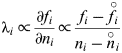 $${\rm \lambda} _i \propto \displaystyle{{\partial f_i} \over {\partial n_i}} \propto \displaystyle{{\,f_i - \mathop f\limits^ { \circ} {\hskip-3 _i}} \over {n_i - \mathop n\limits^{ \circ} {\hskip-1 _i}}} $$
Since the deviation from steady state,  $n_i - \mathop n\limits^ { \circ} { _i} $, is proportional to the total density of the system, n gas=Σ ini, and the deviation
 $f_i - \mathop f\limits^ { \circ} {\hskip-3 _i} = f_i $ is proportional to n gas2 for two-body reactions, it follows that:
 $$\tau _{{\rm chem}} \propto \displaystyle{1 \over {n_{{\rm gas}}}} $$
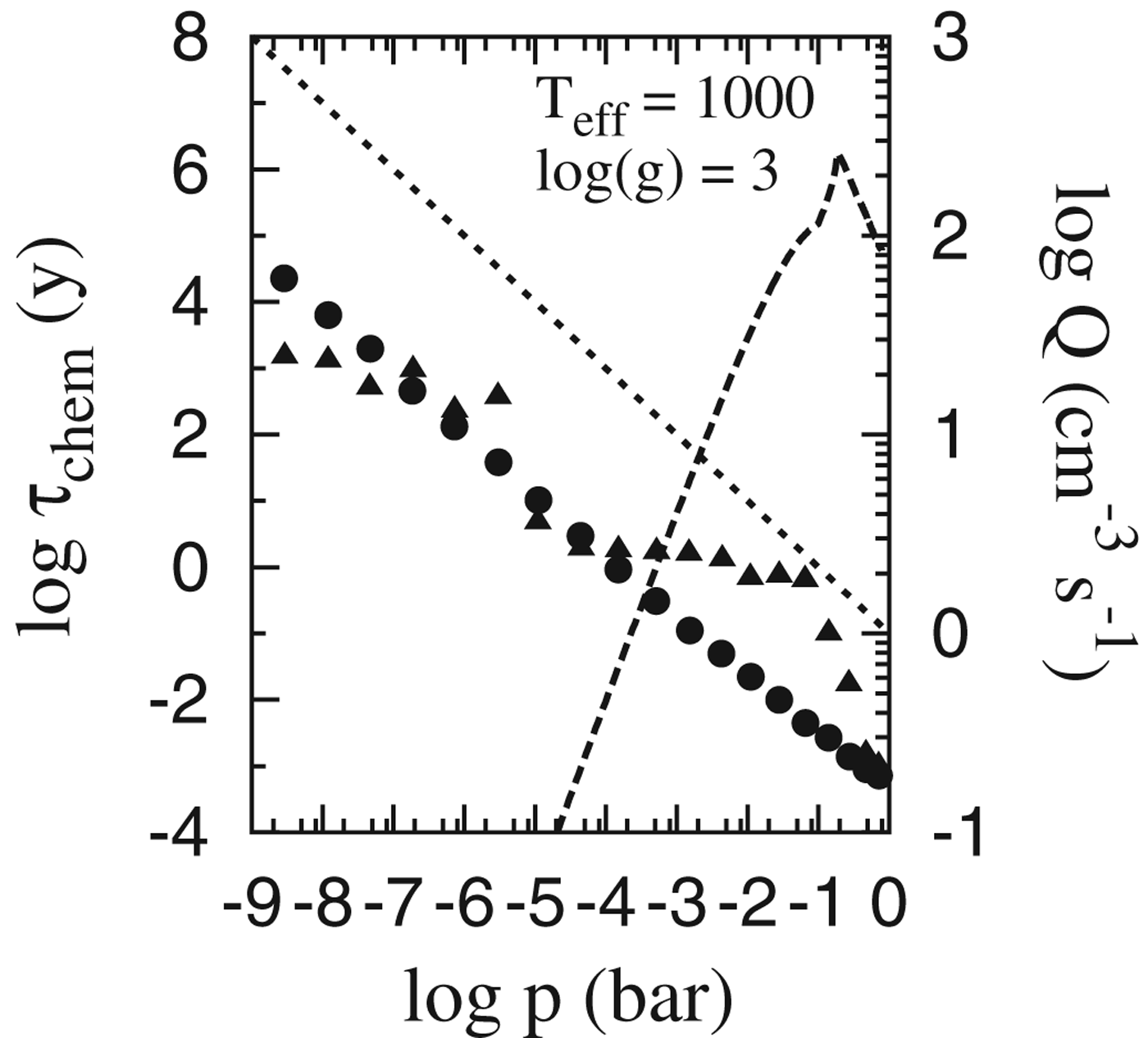
We run Nahoon until steady state,  $\mathop t\limits^ { \circ} = {\rm \tau} _{{\rm chem}} $, with timesteps proportional to τchem and therefore to 1/n gas. Equation (8) does not account for the temperature dependence. Also, first-order reactions, particularly the cosmic-ray ionization reactions, will have relaxation times that scale differently with n gas and this is why the time to equilibrium is different with cosmic-ray ionization than without cosmic-ray ionization. Ionization rate coefficients for certain species are quite small, and this can increase the time to steady-state. A complete determination of τchem therefore would require solving equation (5). In practice, however, we find that adjusting the runtime of Nahoon by the proportionality 1/n gas achieves steady state at each point in the atmosphere. Figure 2 contains a plot of τchem as a function of the atmospheric gas pressure both with and without cosmic-ray ionization. The figure shows that significantly different amounts of time are required in order to reach steady state for different depths. Near the exobase, the timescale can be of the order of 103 years, whereas in the cloud layer τchem is of the order of hours. When cosmic-ray ionization is included, τchem is less than 1/n gas by two orders of magnitude in the very upper atmosphere, and is greater than 1/n gas by more than an order of magnitude within the cloud layer. At the cloud base, however, the value of τchem with cosmic rays converges to the value of τchem without cosmic rays.
The chemical relaxation timescale towards steady state, τ chem, as a function of the local gas pressure, for the giant gas planet model atmosphere (T eff=1500, log g=3, solar metallicity). Each data point represents the time for the Nahoon model to achieve steady state, with cosmic rays (triangles, left axis) and without cosmic rays (circles, left axis). The dotted line (left axis) represents the total runtime for the Nahoon model. The divergence from 1/n gas in runtimes is probably due to the higher number of free electrons produced by cosmic rays. The cosmic ray electron production rate, Q [cm−3s−1], is also shown (dashed line, right axis).
Cosmic-ray ionization is included in the OSU network as rates with coefficients, α X, scaling the primary ionization rate for the reaction X such that ζX=α Xζp. The Nahoon model is iterated towards steady state at different depths, where the local gas density and temperature (n(z), T(z)) and the cosmic-ray flux density change with depth. External UV fields are not considered in this study, in order to clearly identify the cosmic-ray contribution to ionization. The impact of photons generated by the secondary electrons, so-called cosmic-ray photons, is included, however.
The results of our network provide some interesting predictions for free-floating giant gas planets. Some of these results may be applicable also to irradiated exoplanets, although the enhanced mixing and photochemistry may drastically change some of these predictions. First, our results predict where the free charges, both positive and negative, are likely to reside, chemically. Our model predictions for the most abundant cations and anions are presented in subsection ‘Atmospheric cations and anions’. Because the focus of this paper is on prebiotic chemistry, and because of the strong effect cosmic rays have upon them, complex hydrocarbons are the neutral species of most interest. Our results for complex hydrocarbons are presented in subsection ‘Cosmic rays and carbon chemistry in the upper atmosphere’. In this section, we also discuss a neutral–neutral reaction that produces free electrons, and will speculate on its effect on the degree of ionization within a brown dwarf atmosphere. Subsection ‘Ammonia’ concludes our discussion on chemistry.
Atmospheric cations and anions
According to our chemical network, cosmic rays primarily ionize H2, H2O, C and He, the most abundant neutral species in the upper atmosphere of an oxygen-rich, hydrogen-dominated planet. The ions H2+, H2O+, C+ and He+ do not retain the bulk of the excess positive charge for long, but react away or exchange their excess charge.
We find that for our model exoplanet atmosphere, when p gas<10−6 bar, up to 90% of positive charge is carried by NH4+, and the rest of the positive charge is carried by various large carbon-bearing cations. When p gas>10−6 bar, the most abundant cation becomes NaH2O+, carrying more than 95% of the charge for p gas>5×10⁻⁴ bar. There are two reasons for the transition between these two species: cosmic-ray ionization and enhanced charge exchange at high densities. Figure 3 shows which species carry most of the positive charge.
The percentage of positive (black) and negative (red) charge contained by a given species as a function of pressure, p [bar] for our model giant gas planet atmosphere (T eff=1000 K, log g=3). The negative charge is mostly in the form of electrons and CN−. The positive charge is carried primarily by NH4+ in the upper atmosphere and NaH2O+ in the cloud layer. The rest of the positive charge is mostly in the form of large carbon-containing ions, e.g., C7H2+, C7H3+ and C8H4+. A blue horizontal line indicates the pressure above which termolecular reactions may dominate.
In the upper atmosphere, NH4+ is formed primarily by the reactions:
 $${\rm C}_3 {\rm H}_2 {\rm N}^ + + {\rm NH}_3 \to {\rm NH}_4^ + + {\rm HC}_3 {\rm N}$$
 $${\rm C}_5 {\rm H}_2 {\rm N}^ + + {\rm NH}_3 \to {\rm NH}_4^ + + {\rm HC}_5 {\rm N}$$
 $${\rm C}_7 {\rm H}_2 {\rm N}^ + + {\rm NH}_3 \to {\rm NH}_4^ + + {\rm HC}_7 {\rm N},\;{\rm and}$$
 $${\rm H}_3 {\rm O}^ + + {\rm NH}_3 \to {\rm NH}_4^ + + {\rm H}_2 {\rm O}$$
Reactions (9)–(11) are also the dominant formation pathways for the cyanopolyynes in the upper atmosphere. The large cations C2n+1H2N+ as well as H3O+ are connected, via H3+, to cosmic-ray driven chemistry. Since the cosmic rays do not penetrate through the cloud layer, the C2n+1H2N+ ions become depleted, and NH4+ is no longer efficiently formed.
At p gas>10−6 bar, as the gas density increases, collisions become more frequent and charge exchange reactions dominate. Atomic sodium collects a large amount of the charge through these charge exchange reactions. Then:
 $${\rm Na}^ + + {\rm H}_2 \to {\rm NaH}_2^ + $$
 $${\rm NaH}_2^ + + {\rm H}_2 {\rm O} \to {\rm NaH}_2 {\rm O}^ + + {\rm H}_2 $$
 $${\rm Na}^ + + {\rm H}_2 {\rm O} \to {\rm NaH}_2 {\rm O}^ + $$
which proceed rapidly because of the high abundances of H2 and water. NH4+ and NaH2O+ are both destroyed mostly by dissociative recombination.
Cosmic rays and carbon chemistry in the upper atmosphere
It has been suggested that cosmic rays enhance aerosol production in the terrestrial atmosphere (e.g., Shumilov et al. Reference Shumilov, Kasatkina, Henriksen and Vashenyuk1996) and that they potentially initiate chemical reactions that allow the formation of mesospheric haze layers such as those observed on the exoplanet HD 189733b by Pont et al. (Reference Pont, Knutson, Gilliland, Moutou and Charbonneau2008) and Sing et al. (Reference Sing2011) and those observed on Titan (Rages & Pollack Reference Rages and Pollack1983; Porco et al. Reference Porco2005; Liang et al. Reference Liang, Yung and Shemansky2007; Lavvas et al. Reference Lavvas, Yelle and Vuitton2009). We are interested in the effects that cosmic rays can have on the carbon chemistry in extraterrestrial, oxygen-rich atmospheres, such as those of giant gas planets. Especially relevant are the chemical abundances of the largest carbon species in the gas-phase model, which is likely connected to Polycyclic Aromatic Hydrocarbon (PAH) production in planetary atmospheres (Wilson & Atreya Reference Wilson and Atreya2003). Although our network does not incorporate a complete PAH chemistry, it does contain chemical pathways that reach into long carbon chains, the longest chain being C10H.
The most meaningful information from our chemical model is the enhanced or reduced abundance of various species due to ion–neutral chemistry, compared with their abundances according to purely neutral–neutral chemistry. Although this shows us the effect cosmic-ray driven chemistry can have on the abundances of carbon bearing species, it does not tell us whether these enhancements are observable. An enhancement of ten orders of magnitude on a species with a volume fraction, from 10−40 to 10−30, is significant, but unobservable. In order to answer this question, we apply the thermochemical equilibrium results for a log g = 3, 1000 K atmosphere using the calculations from Bilger et al. (Reference Bilger, Rimmer and Helling2013), to the degree that the various species have been enhanced or reduced. We take the chemical equilibrium number density of a species, X, n eq(X) [cm−3] and solve for the non-equilibrium abundance, n neq(X) [cm−3] by:
 $$n_{{\rm neq}} (X) = {\rm \xi} n_{{\rm eq}} (X)$$
where ξ is the amount that the abundance is enhanced or reduced by cosmic rays. We plot the predicted volume fractions of CO, CO2, H2O, CH4, C2H2, C2H4 and NH3, as a function of pressure, in Fig. 4. Although C2H and C10H are also enhanced by orders of magnitude, the results are not shown in this figure. For C2H, this is because the resulting volume fraction is lower than 10−20 throughout the model atmosphere. For C10H, this is because the equilibrium concentration is unknown. The results for cosmic-ray enhancement are not reliable when p gas>10−5 bar because termolecular reactions may begin to take over. When this happens, so long as vertical mixing timescales are not too small, the added reactions will bring the system to thermochemical equilibrium; equilibrium abundances are also presented in the figure.
Volume fraction of various species as a function of the gas pressure, p [bar] for the model atmosphere of a free-floating giant gas planet (T eff=1000 K, log g=3), obtained by combining our results to those of Bilger et al. (Reference Bilger, Rimmer and Helling2013). The results of Bilger et al. (Reference Bilger, Rimmer and Helling2013, dotted), the results assuming chemical quenching of C2H2 and C2H4 at height at ∼10−3 (dashed), and the results with cosmic ray ionization (solid) are all presented in this plot. A thick black horizontal line indicates the pressure above which termolecular reactions may dominate.
C2H2 and C2H4
For the predicted cosmic-ray enhancement of C2H2 and C2H4, we assume chemical quenching at 10−3 bar, although it may well be quenched at much higher pressures of ∼0.01 bar (Moses et al. Reference Moses2011). With this assumption, we find that both C2H2 and C2H4 are brought to volume fractions of ∼10−12 when p gas≈10−8 bar. This is compared to the quenched abundance in the absence of cosmic rays, of ∼10−17 for C2H2 and ∼10−19 for C2H4.
Carbon monoxide and methane are largely unaffected by cosmic-ray ionization, although methane is depleted by about one order of magnitude at 10−8 bar. Both methane and carbon monoxide decrease rapidly with decreasing pressure when p gas≲10−6 bar and, according to Bilger et al. (Reference Bilger, Rimmer and Helling2013), at these pressures and temperatures a significant amount of the carbon is atomic. The cosmic-ray chemistry does impact methane, but only in the very upper atmosphere, where it is not very abundant. Cosmic rays deplete the methane by approximately one order of magnitude, from a volume fraction of 10−16–10−17.
Acetylene and ethylene, as well as C2H, are enhanced by various complex reaction pathways. One such pathway to acetylene, dominant at 10−8 bar, when there is a high fraction neutral carbon, is:
 $${\rm H}_2 + {\rm CR} \to {\rm H}_2^ + + {\rm CR} + e^ - $$
 $${\rm H}_2^ + + {\rm H}_2 \to {\rm H}_3^ + + {\rm H}$$
 $${\rm H}_3^ + + {\rm C} \to {\rm CH}^ + + {\rm H}_2 $$
 $${\rm CH}^ + + 3{\rm H}_2 \to {\rm CH}_5^ + + 2{\rm H}$$
 $${\rm CH}_5^ + + {\rm C} \to {\rm C}_2 {\rm H}_3^ + + {\rm H}_2 $$
 $${\rm C}_2 {\rm H}_3^ + + e^ - \to {\rm C}_2 {\rm H}_2 + {\rm H}$$
There are dozens of pathways from H3+ to the complex hydrocarbons listed above, and it would be beyond the scope of this paper to list which multiple pathways dominate at different atmospheric heights. Nevertheless, the above reaction pathway gives some insight into the manner in which ion–neutral chemistry can enhance complex hydrocarbons at the cost of other carbon-bearing species, such as methane. Acetylene and ethylene may have an interesting connection to hazes observed in some exoplanets; they are specifically mentioned by Zahnle et al. (Reference Zahnle, Marley, Freedman, Lodders and Fortney2009) as possibly contributing to the hazes observed in HD 189733b and other exoplanets (Pont et al. Reference Pont, Knutson, Gilliland, Moutou and Charbonneau2008; Bean et al. Reference Bean, Miller-Ricci Kempton and Homeier2010; Demory et al. Reference Demory2011; Sing et al. Reference Sing2011).
Although our model is not directly applicable to irradiated exoplanets, we can speculate what would happen on such planets, by examining the results of comprehensive photochemical models. Moses et al. (Reference Moses2011), for example, indicate that UV photochemistry is efficient at destroying the C2H2 in HD189733b when p gas≲10 μbar (see their Fig. 3). They do find far higher abundances for C2H2 overall, such that its volume fraction at 10−8 with photodissociation and mixing but without cosmic rays may be ∼10−20. If so, the cosmic-ray enhanced volume fraction may approach 10−11 at p gas=10−8 bar. Confirming these speculative results will require a comprehensive photochemistry self-consistently combined with the cosmic-ray chemistry.
Long polyacetylene radicals are believed to contribute to PAH and other soot formation both in the interstellar medium (Frenklach & Feigelson Reference Frenklach and Feigelson1989) and in atmospheres of e.g., Titan (Wilson & Atreya Reference Wilson and Atreya2003). In an atmospheric environment, polyacetylene radicals tend to react with polyacetylenes to produce longer chains (Wilson & Atreya Reference Wilson and Atreya2003, their R1, R2). Further chains can build upon radical sites on these polyacetylenes and may lead to cyclization of the structure, possibly initiating soot nucleation (Krestinin Reference Krestinin2000). Although our network does not incorporate near this level of complexity, our model does include the constituent parts of this process: C2H2 and CnH. These species currently seem to be the most likely candidate constituents for PAH growth.
C10H and C6H6
According to our calculations, one of the most common ions to experience dissociative recombination in the upper atmosphere is C10H2+. The favoured dissociative recombination of this large carbon-chain cation in our network is:
 $${\rm C}_{10} {\rm H}_2^ + + e^ - \to {\rm C}_{10} {\rm H} + {\rm H}$$
The cosmic-ray ionization results in an exceptionally high steady-state fractional abundance of C10H in the very upper atmosphere of exoplanet (p gas∼10−6), corresponding to a density of n(C10H)≈1000 cm−3, or a fractional abundance of n(C10H)/n gas∼10−10. It is unlikely that a long polyacetylene radical would be so abundant in exoplanetary atmospheres because of the numerous destruction pathways that should exist in a high-temperature high-density environment for a species so far from thermochemical equilibrium. Planetary atmospheres are expected to favour aromatic over aliphatic species, and partly for this reason, the high abundance predicted by our model nevertheless suggests possibly enhanced abundances of larger hydrocarbons built up from reactions between and C10H and C2H2.
Our model also includes the simple mono-cyclic aromatic hydrocarbon benzene. We find that cosmic rays enhance the abundance of benzene in the upper atmosphere, when p gas≲10−6 bar, by several orders of magnitude. Since benzene normally has a very small volume fraction (<10−50) at these low pressures, we assume a quenching scale height of p gas=10−3 bar, and find that the volume fraction of benzene still remains well below 10−20 in the absence of cosmic rays, but does achieve a volume fraction of ∼10−16 when cosmic rays are present. Although this is a significant enhancement, benzene would be very difficult to observe at this volume fraction.
Chemi-ionization
The OSU chemical network used in the Nahoon code also provides us with an opportunity to explore purely chemical avenues for enhancing ionization. The single reaction involving two neutral species that impacts the ionization is the chemi-ionization reaction:
 $${\rm O} + {\rm CH} \to {\rm HCO}^ + + e^ - $$
This reaction has a rate coefficient of k=2×10⁻¹¹(T/300 K)0.44 cm3 s−1, accurate to within 50% at T<1750 K (MacGregor & Berry Reference MacGregor and Berry1973). We can use the energetics from MacGregor & Berry (Reference MacGregor and Berry1973) to construct the reverse reaction, following the method of Visscher & Moses (Reference Visscher and Moses2011). The reverse reaction is slightly endothermic, with an activation energy of ∼0.4 eV, or ΔE≈4600 K. These reaction taken together will consistently produce a steady-state degree of ionization, f e=n(e−)/n gas∼10−11 in our model. This degree of ionization is a non-equilibrium steady-state value, resulting from the enhanced abundance of CH and O predicted by our kinetics model. The impact of this reaction has not been fully explored and is outside the scope of this paper. In the absence of any significant ionizing source, if either chemical quenching or photodissociation enhance the abundances of O and CH significantly, the degree of ionization would then be enhanced, and ion–neutral chemistry may become important even in these regions.
Ammonia
In the case of ammonia, we do not invoke quenching at all. The species NH has a reasonable thermochemical volume fraction in the upper atmosphere (Bilger et al. Reference Bilger, Rimmer and Helling2013). Ammonia has a straight-forward connection to the cosmic-ray ionization rate via the reactions:
 $${\rm H}_3^ + + {\rm NH} \to {\rm NH}_2^ + + {\rm H}_2 $$
 $${\rm NH}_2^ + + {\rm H}_2 \to {\rm NH}_3^ + + {\rm H}$$
 $${\rm NH}_3^ + + {\rm H}_2 \to {\rm NH}_4^ + + {\rm H}$$
 $${\rm NH}_4^ + + e^ - \to {\rm NH}_3 + {\rm H}$$
As such, its volume fraction follows the cosmic-ray flux somewhat closely, at least in the upper atmosphere; for higher pressures nitrogen becomes locked into N2. Our model predicts an abundance of NH3 in the upper atmospheres almost five orders of magnitude enhanced, bringing the volume fraction from ∼10−12 to ∼10−7. Our model therefore predicts observable quantities of ammonia in the upper atmospheres of free-floating giant gas planets, in regions where the cosmic rays are not effectively shielded by the magnetic field. As such, for low-mass substellar objects, this may conceivably be a source of variability.
Conclusions
The application of Rimmer & Helling (Reference Rimmer and Helling2013) to a model atmosphere calculated using Drift–Phoenix with log g=3 and T eff=1000 K provides us with an ionization rate. We include the ionization rate, as well as the temperature profile, atmospheric number density and elemental abundances as input parameters to a time-dependent chemical network. This allows us to calculate the number density of ions as well as the abundances of a variety of atomic and molecular species.
The ion–neutral chemistry is responsible for much of the prebiotic chemistry. This preliminary approach to exoplanet ion–neutral chemistry suggests that it is significant for producing hydrocarbon chains, and may help to drive PAH production in oxygen-rich atmospheres, possibly giving the upper atmospheres of these planets a chemistry similar to that expected from those objects with an enhanced C/O ratio. Finally, chemi-ionization processes may also significantly enhance the electron fraction in the cloud layer, if the abundances of atomic oxygen and CH are both above their equilibrium values. The formation of saturated carbon chains is closely connected to the formation of amino acids and other important pre-biotic species. Our results suggest that ion–neutral chemistry has a role to play in hydrogen-dominated environments at altitudes of ∼1 μbar, and seems, at least without fast mixing and UV photochemistry present in atmospheres of irradiated planets, to generally enhance the abundances of some complex hydrocarbons, some of which may be relevant to prebiotic chemistry.
This work on a free-floating exoplanet may also be applicable to the directly imaged exoplanets orbiting HR 8799, but in order to explore this mechanism for the haze in the upper atmosphere of the exoplanet HD 189733 b we need to model the atmospheric chemistry for an irradiated exoplanet. It will then be important to account for the effect of the magnetic field of the host star as well as the planet upon cosmic-ray transport. The effect of stellar winds and their interaction with the magnetic field of the giant gas planet may also become important (see, e.g., Vidotto et al. Reference Vidotto, Fares, Jardine, Donati, Opher, Moutou, Catala and Gombosi2012). It will also be necessary for ion–neutral chemical models to provide absolute abundances instead of ratios. Although the result of this work has indicated significant trends, and suggests that ion–neutral chemistry may be important part of the atmospheric chemistry of free-floating giant gas planets, much work still needs to be done to develop a useful ion–neutral gas-phase network appropriate for the atmospheres of giant gas planets, both free-floating and the hot Jupiters.
Acknowledgements
We highlight financial support of the European Community under the FP7 by an ERC starting grant. We thank Peter Woitke for his help with determining timescales to chemical equilibrium. We also thank the anonymous referees for comments that have significantly improved the quality of this paper. This research has made use of NASA's Astrophysics Data System. We thank Ian Taylor for his technical support.