Dementia is a global public health priority with 46.8 million individuals affected globally in 2015 and 131.5 million people projected to have the disease by 2050 (Prince et al., Reference Prince, Wimo, Guerchet, Ali, Wu and Prina2015). Early detection of dementia may facilitate early treatment, potentially improving clinical outcomes, and reducing overall burden (Borson et al., Reference Borson2013). Cognitive screening targeting older adults at risk of age-related cognitive impairment and dementia could facilitate early detection and slow disease progression (Ashford et al., Reference Ashford2007; Galvin, Reference Galvin2011).
Outcomes of cognitive screening may include making lifestyle changes such as participation in regular physical, social and cognitive activity, as well as maintaining a healthy diet, limiting alcohol intake, and avoiding smoking, all of which are promising strategies in the prevention of dementia (Fratiglioni et al., Reference Fratiglioni, Paillard-Borg and Winblad2004; Middleton and Yaffe, Reference Middleton and Yaffe2009), and advance planning arrangements for future decisional incapacity (e.g. appointment of power of attorney). Cognitive screening may also increase the use of support services for the management of caregiver burden which are typically underutilized (Brodaty et al., Reference Brodaty, Thomson, Thompson and Fine2005), such as caregiver support groups, psychoeducation and counselling services, and dementia day care centers for the patients. Similarly, early detection of cognitive impairment in older adults may reduce the risk of medication non-adherence (Okuno et al., Reference Okuno, Yanagi and Tomura2001; Campbell et al., Reference Campbell, Boustani, Skopelja, Gao, Unverzagt and Murray2012). Finally, cognitive screening can potentially lead to treatment for co-morbid geriatric depression as research has shown that depression is a common mood disorder among older adults with dementia (e.g. Zubenko et al., Reference Zubenko2003; Wilson et al., Reference Wilson2014). Persons with dementia may present with neuropsychiatric symptoms, and these symptoms have been associated with increased dementia severity (Peters et al., Reference Peters2015). To date, the impact of screening for cognitive impairment on subsequent service utilization, advance planning, lifestyle changes, and medical adherence has not been investigated.
The present study aims to examine outcomes of cognitive screening with regards to the acceptance of comprehensive diagnostic evaluations, service utilization, advance planning, lifestyle changes, and medication adherence. Our previous study reported approximately one-third of informants (i.e. caregivers of patients who completed informant-based screening to provide information about the patient) did not support the patient to undergo subsequent diagnostic evaluation (Shaik et al., Reference Shaik2016). In the present study, we explore the determinants of this decision. We hypothesize that follow up with diagnostic evaluation, service use, advance planning, and lifestyle changes will be more likely in patients with cognitive impairment. These patients are hypothesized to be more likely to have depressive symptoms and other neuropsychiatric symptoms (Zubenko et al., Reference Zubenko2003; Wilson et al., Reference Wilson2014; Peters et al., Reference Peters2015), which could influence their motivation for service use and making lifestyle changes. Based on past research (Hawkins et al., Reference Hawkins, Kilian, Firek, Kashner, Firek and Silvet2012), patients with cognitive impairment are predicted to be more likely to have poorer medication adherence than those with no cognitive impairment.
Methods
Participants
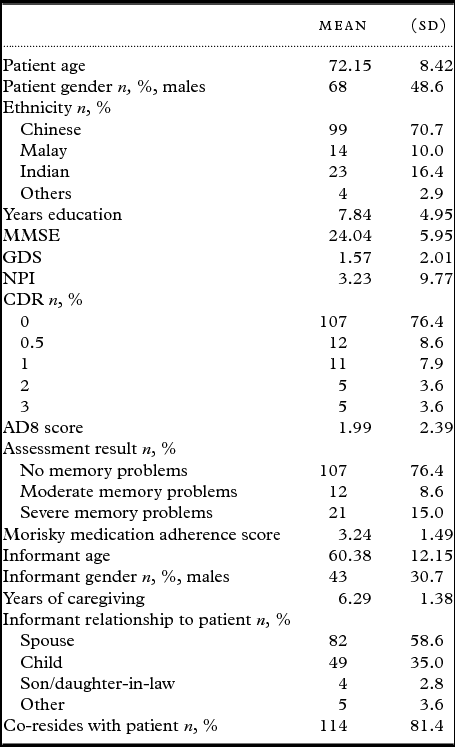
In our previous study (reported elsewhere; Shaik et al., Reference Shaik2016), AD8 assessment in a primary care setting was followed by a neuropsychological assessment and informant measures of function, depression, and other neuropsychiatric symptoms that may influence motivation for service use and lifestyle changes. Patients were rated using the Clinical Dementia Rating scale and diagnosed by multidisciplinary consensus conference as having no dementia (CDR = 0), questionable dementia (CDR = 0.5), or definite dementia (CDR ≥ 1). Participants with questionable or definite dementia were informed they had a moderate or severe risk of memory problems, respectively. Informants from the previous study were contacted by telephone. Of the 309 eligible patients described in the previous study, 140 of the informants consented to this follow-up study. Informants were caregivers who had accompanied patients to a medical appointment in the previous study or been nominated by the patient for a telephone interview. Of those not included, 106 could not be contacted, 59 declined the interview, three were unable to communicate by telephone and one was deceased. The demographic and clinical characteristics of the patients and informants in the sample are in Table 1.
Demographic and clinical characteristics of the patients and informants

Note: n=140; MMSE: Mini-Mental State Examination; GDS: Geriatric Depression Scale; NPI: NeuroPsychiatric Inventory; CDR: Clinical Dementia Rating scale; AD8: Eight-item Informant Interview to Differentiate Aging and Dementia.
Materials and procedure
The patients had previously undergone assessment (4), including cognition using the Eight-item Informant Interview to Differentiate Aging and Dementia (AD8; Galvin et al., Reference Galvin2005), Mini-Mental State Examination (MMSE; Folstein et al., Reference Folstein, Folstein and McHugh1975), and Montreal Cognitive Assessment (MoCA; Nasreddine et al., Reference Nasreddine2005), as well as a formal neuropsychological test battery, and neuropsychiatric symptoms using the Neuropsychiatric Inventory (NPI; Cummings et al., Reference Cummings, Mega, Gray, Rosenberg-Thompson, Carusi and Gornbein1994), including depression using the Geriatric Depression Scale (GDS; Yesavage et al., Reference Yesavage1982). The present study used a purpose-designed telephone survey collecting the informant's rating of the occurrence of any subsequent diagnostic evaluation or treatment and occurrence of any advance planning. Advance planning included discussion with family or healthcare providers about potential future decisional incapacity, preparations for patient's future financial affairs, arrangements for lasting power of attorney; any lifestyle changes such as diet, physical, social or cognitive activity, health checks, limiting alcohol and avoiding smoking; medication adherence by participants; and the use of community support services by patients and their caregivers. Patient's general medication adherence was measured using the Morisky Medication-Taking Adherence Scale (MMAS; Morisky et al., Reference Morisky, Green and Levine1986), a 4-item self-report scale with scores ranging from 0 to 4 with higher scores indicating higher medication adherence. Following institutional ethics approval, informants were contacted four to fifteen months (M=9.06, SD=2.41) following the cognitive screening study. Informed consent was obtained and the survey, including MMAS, was administered by telephone.
Analysis
An independent samples t-test assessed the demographic and cognitive screening differences between patients in this follow-up study and patients who were not. Descriptive statistics (frequencies) were calculated for service use and non-use, advance planning, lifestyle changes, and post-screening diagnostic evaluation participation. A logistic regression for 134 patients assessed predictors (patient screening result, NPI, GDS, patient age, and time since screening) of acceptance or refusal of further diagnostic evaluation. MMAS data was not normally distributed, so group differences (no-risk, moderate-risk, and high-risk of memory problems) were evaluated with Kruskall–Wallis H and Mann–Whitney U tests. Correlations were conducted using Kendall's tau (τ) due to non-normally distributed data.
Results
Demographic and cognitive screening differences
There was no significant difference in patient age, years of education, MMSE, CDR, and NPI scores for patients in this follow-up study and patients who were not. There was a significant difference in level of GDS for patients in this follow-up study (M=1.57, SD=2.01) and patients who were not, M=2.26, SD=2.61; t (300)=2.54, p<0.05. Given that the interval between the screening event and the present survey ranged from four to fifteen months, correlations were conducted of the interval and the outcome measures of number of services used, advanced planning activities, number of lifestyle changes, uptake of diagnostic evaluation, and medication adherence score. None of these correlations were significant (all ps > 0.05).
Service use and reasons for service non-use
A total of 33 patients had a screening result of moderate to severe risk of memory problems. The informants of these patients were asked if they had made use of support services since the screening. A total of 27.3% (n=9) made use of services for the patient, 3% (n=1) made use of services for the caregiver, while 69.7% (n=23) did not make use of any support services. Of those who made use of services, five respondents did so following screening while the other five already made used of services prior to screening. Informants were asked to indicate the types of services used and could indicate more than one type. The types of services used included dementia patient day care once a week (n=2), caregiver educational workshop attended once previously (n=1), and a live-in domestic worker (n=9). Service use was significantly more frequent for patients assessed as being at severe (n=21), rather than moderate (n=12), risk of memory problems, χ 2 (1)=4.31, p=0.038.
Advance planning
All 140 informants were asked if they had (i) talked to their family or healthcare provider about a time when the patient will not be able to make decisions, (ii) made preparations to handle the patient's financial affairs, and (iii) made arrangements for lasting power of attorney. Of the 140 informants, 117 (83.6%) indicated that the patients and informants did not engage in any advance planning activity. A total of 23 (16.4%) respondents indicated taking part in advance planning activity. Of these 23 participants, 10 had engaged in advance planning prior to screening. They were asked to indicate the types of advance planning activity and could indicate more than one type. Of the 23 who engaged in advance planning, 69.57% (n=16) talked to family about a time when the patient will not be able to make decisions, 8.70% (n=2) talked to a healthcare provider, 39.13% (n=9) made financial preparations, 13.04% (n=3) made arrangements for lasting power of attorney, while 4.35% (n=1) patients made a will. There was no significant association between AD8 screening score (range 0–8) and advance planning activity χ 2 (4)=2.79, p=0.593.
Diet and lifestyle changes
Of the 140 participants, 35 (25%) reported making dietary or other lifestyle changes. Of these 35 respondents, 9 had made these changes prior to screening. They were asked to indicate the types of diet and lifestyle changes and could indicate more than one type. Of 35 respondents, 18 (51.43%) made changes to the patient's diet, 12 (34.29%) patients started taking supplements or vitamins, 8 (22.86%) patients started engaging in physical activity, 3 patients (8.57%) started engaging in social activity, 3 (8.57%) patients reduced alcohol intake, and 1 (2.86%) reduced smoking. Other lifestyle changes included patients engaging in spirituality (n=1; 2.86%) and travelling more (n=1; 2.86%). None reported increasing activities specifically to promote mental engagement. There was no significant association between AD8 screening score and diet and lifestyle changes, χ 2 (6)=3.90, p=0.690.
Uptake and predictors of diagnostic evaluation at a specialist memory clinic
To assess the effect of screening result on the likelihood of further diagnostic evaluation occurring, a binary logistic regression analysis of 134 participants (a further 6 were excluded from this analysis due to missing data) assessed the impact of patient screening result, neuropsychiatric symptoms (NPI), depression (GDS), patient age and time since screening, on the likelihood that participants accepted or refused further diagnostic evaluation. The model showed these predictors made a statistically significant contribution to distinguishing between respondents who accepted or refused further diagnostic evaluation, χ 2 (df=5, n=139)=49.48, p<0.001. The model explained between 30.9% and 58.0% of the variability in accepting or refusing diagnostic evaluation, and correctly classified 91.8% of cases. As shown in Table 2, statistically significant predictors were the patient's screening result (i.e. what the patient and informant were told about the patient's likelihood of cognitive impairment: no risk, moderate risk, or severe risk) and GDS score. Of the 33 patients with moderate or severe risk of memory problems, 20 (60.6%) followed up the cognitive screening with further diagnostic evaluation.
Regression predicting follow up with screening outcomes

Medication adherence
A Kruskal–Wallis test with the independent variable of patient risk group (no risk, moderate risk, and severe risk) indicated statistically significant differences in general medication adherence scores, H=42.82, df=2, p<0.001, ηp 2=0.37. Results of χ 2 tests showed that each MMAS category was significantly associated with patient screening result. The MMAS categories and their associations with patients’ screening results are (i) forgetting to take medication, χ 2 (1, n=116)=40.67, p<0.001; (ii) having problems remembering to take medication, χ 2 (1, n=116)=43.12, p<0.001; (iii) not taking medication when feeling better, χ 2 (1, n=116)=22.24, p<0.001; and (iv) not taking medication when feeling worse, χ 2 (1, n=116)=19.43, p<0.001. Post-hoc Mann–Whitney U tests indicated that the levels of medication adherence of those with no risk of cognitive impairment were significantly higher than those with moderate risk, U=314.00, p=0.011, and those with severe risk, U=205.50, p<0.01. The latter two groups did not differ, U=66.00, p=0.07. There was a strong negative correlation between AD8 score and level of general medication adherence, τ=–0.551, p<0.001, n=116, indicating that greater cognitive problems are associated with poorer medication adherence.
Discussion
The primary aims of this study were to assess outcomes following screening for cognitive impairment in a primary care setting. Specifically, we sought to ascertain the numbers of people who accepted or refused further diagnostic evaluation following screening, and the factors that predicted acceptance or refusal of further diagnostic evaluation. We also sought to assess levels of advance planning, diet and lifestyle changes, service utilization, and medication adherence among participants who completed screening for cognitive impairment. To the best of our knowledge, this is the first comprehensive study to follow up patients who have participated in a cognitive screening program.
In our sample of 33 patients with a result of moderate or severe risk of memory problems, 69.7% of caregivers did not make use of patient or caregiver support services, often due to perceived lack of need but also due to caregiver, patient, and service characteristics. This is consistent with an earlier Singaporean study (Lim et al., Reference Lim, Goh, Chionh and Yap2012), which also reported modest service utilization among family caregivers of people with dementia.
Of the 140 participants recruited following screening, 33 patients had an assessment result of moderate or severe risk of memory problems. Of these, the majority (60.6%) followed up with further diagnostic evaluation. This rate is somewhat higher than the 52% documented in a USA study by Boustani et al. (Reference Boustani2006). One possibility is that cultural differences between Singapore and the USA could account for the difference in rates of agreement to complete further diagnostic testing, where participants in Singapore could be more compliant due to a greater emphasis placed on healthcare professionals’ authority.
A model which included patient clinical variables as predictors of acceptance or refusal of further diagnostic evaluation was statistically significant, with the effect being driven by the patient's screening result and level of depression, where a screening result indicating higher risk of memory problems and lower GDS-rated depression each increase the likelihood of accepting diagnostic evaluation. Patients participating in the follow-up study also had significantly lesser depression symptoms than patients who did not participate. Depression has been associated with poorer motivation to participate in activities, which could explain the current results. Depression and dementia have a bi-directional relationship as studies have found depression to be a risk factor for dementia (Diniz et al., Reference Diniz, Butters, Albert, Dew and Reynolds2013), a prodrome of dementia (Reding et al., Reference Reding, Haycox and Blass1985), a mood disorder precipitated by a diagnosis of dementia (Zubenko et al., Reference Zubenko2003), or a neuropsychiatric symptom of dementia (APA, 2013). Rates of financial and legal advance planning for patients following screening were low. Similarly, rates of diet and other lifestyle changes made by care recipients following screening were low. This may largely be due to those who were screened as being unimpaired, consequently seeing no need for advance planning or lifestyle changes. The act of engaging in screening, in itself, does not seem sufficient to raise awareness of cognitive impairment and the importance of modifiable risk factors that can be addressed when one is cognitively well. However, even for those who were categorized as likely having some cognitive decline the rates of action are low. The addition of a psychoeducational component to the screening process might increase awareness of the benefits of advance planning and lifestyle changes, and this possibility points to a useful direction for future research. We suggest that psychoeducation regarding cognitive impairment and dementia, as well as the process of screening for dementia that emphasizes the importance of follow up with further diagnostic assessment, be provided to patients and caregivers. With the aim of increasing uptake of diagnostic evaluation, cognitive screening programs can be paired with depression screening to allow for identification and treatment of geriatric depression.
Limitations of the current study include the small sample size, where only 140 patients’ informants were interviewed and resulting number of patients with risk of moderate or severe memory impairment was therefore small. Additionally, medication adherence was measured via informant-recollection, which may lack accuracy given that there was no opportunity to objectively verify this information.
Conclusions
In conclusion, our data suggests that informing patients and informants of a likelihood of memory problems following cognitive screening, along with the absence of depressive symptoms, increases the likelihood of acceptance of further diagnostic evaluation. Psychoeducation regarding treatment options for dementia and dementia care services may encourage patients and their caregivers to follow up cognitive screening with a diagnostic evaluation.
Despite reporting cognitive difficulties on the AD8, the majority of informants did not engage in advance planning, lifestyle modifications, or use of community services. This highlights a need for active intervention in primary care settings to increase caregivers’ and patients’ awareness through means such as health education and brain health intervention programs. Our data also shows medication adherence difficulties are more common in those with higher risk of memory problems, which underlies the importance of identifying and providing timely assessment and intervention to such individuals.
Conflicts of interest
None.
Author contributions
JJY Lee: study conceptualization and design, data collection, analysis and interpretation, drafting and revising the manuscript. C L Thompson: study conceptualization and design, supervision during data acquisition, data analysis and interpretation, and revising the manuscript. MA Shaik: providing input into the manuscript. E Wan: providing input into the manuscript. CLH Chen: study conceptualization and providing input into the manuscript. Y Dong: study conceptualization and design and revising the manuscript.