INTRODUCTION
Sickle cell disease (SCD), an autosomal recessive blood disorder, is characterized by the production of abnormal hemoglobin. Individuals with SCD have inherited at least one gene for S-type hemoglobin (HbS) and another abnormal hemoglobin (Steinberg, Reference Steinberg1984). HbSS and HbSβ0 thalassemia are two subtypes that are associated with more severe neurological problems (Charache, Lubin, & Reid, Reference Charache, Lubin and Reid2002), indicating high-risk SCD. The neurological consequences of high-risk SCD result from complications associated with the symptoms of the disease: hemolytic anemia, cerebral hypoxia, small vessel sludging, and stenosis of the major cerebral arteries (Prengler, Pavlakis, Prohovnik, & Adams, Reference Prengler, Pavlakis, Prohovnik and Adams2002). The neurological consequences of SCD put children at elevated risk of suffering a stroke, with 11% of SCD patients experiencing clinical stroke syndrome by 20 years of age and 22% of children having subclinical evidence of cerebral infarction on brain magnetic resonance imaging (MRI) (Ohene-Frempong et al., Reference Ohene-Frempong, Weiner, Sleeper, Miller, Embury and Moohr1998; Wang et al., Reference Wang, Gallagher, Pegelow, Wright, Vichinsky and Abboud2000). Although the progression of central nervous system abnormalities in sickle cell disease has not been fully delineated, it is possible that measures of cerebral blood flow velocity (CBFV) obtained by Transcranial Doppler (TCD) predict neurological complications before other imaging techniques (e.g., magnetic resonance imaging or magnetic resonance angiography) (Abboud et al., Reference Abboud, Cure, Granger, Gallagher, Hsu and Wang2004; Wang et al., Reference Wang, Gallagher, Pegelow, Wright, Vichinsky and Abboud2000). Given that the development of neurological complications is usually coupled with cognitive dysfunction, TCD measurements may not only act as an early indicator of neurological problems, but also of neurocognitive impairment.
TCD reliably predicts risk of stroke in children with SCD through measurement of CBFV in the major cerebral arteries, particularly in the middle cerebral artery (MCA) (Adams et al., Reference Adams, McKie, Carl, Nichols, Perry and Brock1997). Adams et al.’s (Reference Adams, McKie, Nichols, Carl, Zhang and McKie1992) seminal study established a criterion to classify normal or abnormal velocities in children with SCD, with velocities above 170 cm/s in the MCA identifying children who were at increased risk of stroke (i.e., normal < 170 cm/s; conditional between 170 and 200 cm/s; abnormal > 200 cm/s). Abnormal levels of cerebral blood flow velocity have been observed in children with SCD, with 11% of children ages 2–8 years having elevated levels in the Stroke Prevention Trial in Sickle Cell (STOP) study (Adams et al., Reference Adams, McKie, Hsu, Files, Vichinsky and Pegelow1998b). Children without SCD generally have CBFV in the range of 90 cm/s in the MCA. By comparison, CBFV velocities in the MCA of 110–130 cm/s are often found in children with SCD and are not considered to increase the risk of stroke (Adams et al., Reference Adams, McKie, Nichols, Carl, Zhang and McKie1992; Adams, Ohene-Frempong, & Wang, Reference Adams, Ohene-Frempong and Wang2001). High cerebral blood flow velocities seen in this population may be due to a combination of factors, including lowered viscosity of anemia blood, local stenosis and cerebral vasodilation of cortical blood vessels caused by the increased demand for adequate oxygen delivery (Venketasubramanian, Prohovnik, Hurlet, Mohr, & Piomelli, Reference Venketasubramanian, Prohovnik, Hurlet, Mohr and Piomelli1994). TCD measurements may act as an early indicator of neurological disease, so high blood velocity may also be an important predictor of cognitive functioning. The former assertion is bolstered by evidence pointing to the reversal of cognitive impairment for patients whose velocities decreased after receiving transfusion therapy (Pickett et al., Reference Pickett, Theberge, Brown, Schweitzer and Nissenson1999; Stivelman, Reference Stivelman2000), thus underscoring the sensitivity of neurocognitive measures to the early effects of brain dysfunction.
Yearly TCD examinations are recommended as part of clinical care for SCD children between the ages of 2 to 8 years, with more frequent examinations for those with elevated velocities. A repeat TCD screening is important for accurate detection of long-term increases in velocities, because intracranial velocities can vary an estimated ±15 cm/s between repeat exams over 6 months (Adams, Reference Adams2005; Brambilla, Miller, & Adams, Reference Brambilla, Miller and Adams2007). Brambilla and colleagues provided 95% confidence intervals for a single TCD exam, which suggested the confidence limits were CBFV ± 29 cm/s. Over an 18-month period, children with SCD displayed a 23% risk of converting from conditional to abnormal TCD velocities (Hankins et al., Reference Hankins, Fortner, McCarville, Smeltzer, Wang and Li2008). The latter velocity levels correspond to those associated with medium versus high risk for overt stroke as defined by Adams et al. (Reference Adams, McKie, Carl, Nichols, Perry and Brock1997). Longitudinal studies of variations in TCD velocities indicate that children with abnormally high velocities and of younger age are more likely to show elevated velocities on repeat TCD exams (Adams et al., Reference Adams, Brambilla, Granger, Gallagher, Vichinsky and Abboud2004; Brambilla et al., Reference Brambilla, Miller and Adams2007; Hankins et al., Reference Hankins, Fortner, McCarville, Smeltzer, Wang and Li2008). Due to TCD’s major role in standard care for stroke prevention, this technique may also be useful in monitoring neurocognitive risk in the SCD pediatric population (Adams et al., Reference Adams, McKie, Carl, Nichols, Perry and Brock1997, Reference Adams, Brambilla, Granger, Gallagher, Vichinsky and Abboud2004).
Cognitive dysfunction in high-risk SCD children is well documented, although the literature suffers from a lack of consensus in defining the most typical neurocognitive symptoms of a sickle cell patient. Generally, the literature has shown deficits across a wide variety of cognitive domains, including: intelligence, attention and executive function, memory, language, visuomotor, and academic achievement (Berkelhammer et al., Reference Berkelhammer, Williamson, Sanford, Dirksen, Sharp and Margulies2007). Measures of verbal intelligence such as verbal IQ (VIQ) appear to be more sensitive to SCD-related impairment than other IQ or achievement-based measures (Bernaudin et al., Reference Bernaudin, Verlhac, Freard, Roudot-Thoravel, Benkerrou and Thuret2000; Schatz, Finke, Kellett, & Kramer, Reference Schatz, Finke, Kellett and Kramer2002; Steen et al., Reference Steen, Fineberg-Buchner, Hankins, Weiss, Prifitera and Mulhern2005; Wang et al., Reference Wang, Gallagher, Pegelow, Wright, Vichinsky and Abboud2000). The decrement in VIQ observed in children with SCD has been attributed to both the neurological effects and the persistent nature of the disease (i.e., pain episodes, school absenteeism) (Wang et al., Reference Wang, Enos, Gallagher, Thompson, Guarini and Vichinsky2001).
Global measures of verbal ability, however, may be less sensitive to disease effects than more selective assessments of this cognitive domain (Schatz et al., Reference Schatz, Finke, Kellett and Kramer2002). Language ability is often categorized by at least three types of linguistic features: semantics, syntax, and phonology. Semantics is the study of meaning in language, syntax is the set of rules that govern the structure of language, and phonology refers to the ability to produce and discriminate different speech sounds (Toppelberg & Shapiro, Reference Toppelberg and Shapiro2000). Tests of semantics, syntax, and phonology may be more informative as to the nature of the child’s language impairment than a composite measure such as VIQ. Recently, our group showed the presence of specific language deficits in pediatric SCD that appeared to be related to the neurological effects of the disease (Schatz, Puffer, Sanchez, Stancil, & Roberts, Reference Schatz, Puffer, Sanchez, Stancil and Roberts2009). We examined language skills in young school-aged children by comparing SCD groups classified by genotype (high-risk and low-risk) and a group without SCD. The low-risk SCD group displayed language skills that were similar to the demographically matched non-SCD group. However, the high-risk SCD group showed broad deficits in language processing, and these deficits were more strongly associated with neurologic risk group based on genotype than with disease-related complications (e.g., number of hospitalizations over past year and pain episodes).
Previous research has also pointed to language difficulties in children with SCD, as evidenced by decreased scores on tests of VIQ (Noll et al., Reference Noll, Stith, Gartstein, Ris, Grueneich and Vannatta2001), and, more specifically, oral vocabulary (Schatz, Finke, & Roberts, Reference Schatz, Finke and Roberts2004) and verbal comprehension (Steen et al., Reference Steen, Miles, Helton, Strawn, Wang and Xiong2003, Reference Steen, Fineberg-Buchner, Hankins, Weiss, Prifitera and Mulhern2005). In studies of the effects of medical treatment on cognition, language ability has been shown to improve with treatment (Puffer, Schatz, & Roberts, Reference Puffer, Schatz and Roberts2007; Kral et al., Reference Kral, Brown, Connelly, Cure, Besenski and Jackson2006), which suggests that language ability may be one of the more sensitive measures of underlying disease pathology. Additionally, studies have found relationships between neurological risk and language ability, with results showing associations of decreased verbal ability with lower white matter density (Baldeweg et al., Reference Baldeweg, Hogan, Saunders, Telfer, Gadian and Vargha-Khadem2006) and increased imaging abnormalities (Schatz et al., Reference Schatz, Craft, Koby, Siegel, Resar and Lee1999; Steen et al., Reference Steen, Miles, Helton, Strawn, Wang and Xiong2003; Wang et al., Reference Wang, Enos, Gallagher, Thompson, Guarini and Vichinsky2001).
If language functioning is affected by cerebrovascular disruptions, it is possible that TCD can detect language difficulties in children with SCD. Hogan et al. (2006) found that increased TCD velocities were correlated with decreased VIQ in adolescents with SCD and suggested that this association may have reflected greater impairments in some verbal skills than in others. Kral et al. (Reference Kral, Brown, Nietert, Abboud, Jackson and Hynd2003) found that children with abnormal TCD had better verbal ability than those with conditional TCD. The unexpected findings may be accounted for by the fact that individuals who had abnormal TCD values were receiving transfusion therapy, which may have partially reversed the neurocognitive dysfunction attributed to anemia (Pickett et al., Reference Pickett, Theberge, Brown, Schweitzer and Nissenson1999; Puffer et al., Reference Puffer, Schatz and Roberts2007; Stivelman, Reference Stivelman2000). In a third study, Strouse et al. (Reference Strouse, Cox, Melhem, Lu, Kraut and Razumovsky2006) found no relationship between standardized TCD maximum velocities and VIQ measures in a sample of elementary school-age children with SCD.
The current study addressed limitations of previous research in this area by: (1) examining cognitive functioning that included specific areas of language functioning, (2) using a representative sample of children, and (3) focusing on young children within a relatively narrow age range. Previous research has examined global measures of verbal ability, which may have obscured more subtle effects of increased velocity on specific aspects of verbal or language functioning. Additionally, this study attempted to utilize a highly representative sample from our catchment area. Previous studies examining TCD velocities and language functioning have typically over-sampled children with high TCD velocities. As a result, these samples are not likely to reflect variability in TCD velocities and cognitive function seen by clinicians in routine care of this population. Finally, it is unclear how age and disease progression may impact the relationship between blood flow velocity and cognitive dysfunction. Increases in blood flow velocity and incidents of stroke typically occur before 12 years of age (Adams et al., Reference Adams, Brambilla, Granger, Gallagher, Vichinsky and Abboud2004, Reference Adams, McKie, Hsu, Files, Vichinsky and Pegelow1998b). Investigations of the effect of blood flow velocities at younger ages might elucidate early relationships between cerebral pathology and cognitive functioning. Previous research has shown relationships between various cognitive measures and elevated TCD velocities; however, it is unclear as to how early these cognitive decrements become apparent. Early detection of cognitive difficulties prior to the onset of overt stroke or stroke-prevention measures would yield more information about the natural course of disease progression and associated changes in blood flow velocity and cognitive functioning.
The present study was designed to investigate the effects of increased cerebral blood flow velocity on language functioning in young school-aged children with high-risk SCD. Elevated TCD velocities have been observed primarily in the MCA (Adams, Reference Adams2005). Because the MCA is a major source of oxygen to traditional language areas of the brain, the aim of the study was to examine the relation of CBFV in this region to the specific language domains of semantic ability, phonological processing, and syntactical ability. We hypothesized that elevated CBFV would be more robustly related to children’s performance in each of these domains than to other cognitive abilities.
METHODS
Research Participants
Children were recruited through routine hematological health maintenance visits at one of five regional SCD clinics. These clinics are the only source of pediatric hematological care in the region, serving an estimated 80% of the children with SCD. Participants were children who received voluntary developmental screenings through the Prevention and Early Intervention Program for Sickle Cell Disease. All participants were African American children 5 to 8 years of age with a diagnosis of high-risk sickle cell disease (HbSS or HbSβ° thalassemia) and their parent/guardian. Patients were excluded from the study if they were receiving blood transfusion therapy or hydroxyurea treatment due to the observed reversal of elevated TCD velocities and cognitive symptoms with these treatments (Kral et al., Reference Kral, Brown, Connelly, Cure, Besenski and Jackson2006; Puffer et al., Reference Puffer, Schatz and Roberts2007; Zimmerman, Schultz, Burgett, Mortier, & Ware, Reference Zimmerman, Schultz, Burgett, Mortier and Ware2007). Patients were also excluded if they had a history of overt stroke, recent illness, seizure disorder, or a major developmental disability. Participants who may have had a history of silent stroke were not excluded, as MRI data was not available for most participants. Among the 49 consecutive children attending clinic visits, one family refused participation, one family was not able to complete the testing due to scheduling conflicts, two children did not receive TCD examinations, two children were tested but were on transfusion therapy, and one child completed the testing but his/her data was excluded from this study due to a history of overt stroke. Three additional participants were excluded due to the interval between cognitive testing and TCD examination exceeding one year.
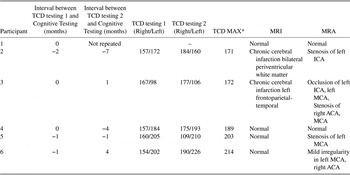
The remaining 39 children with high-risk SCD (HbSS, n = 36; HbSβ° thalassemia, n = 3) received both cognitive and TCD assessments. Schatz and colleagues (Reference Schatz, Puffer, Sanchez, Stancil and Roberts2009) previously reported on the language skills of a subset of this sample, but did not relate these outcomes to TCD velocities. The TCD measurement completed closest in time to the neurocognitive testing was obtained through retrospective chart review. Of the 39 children in the sample, 23 (59%) were females and 10 (26%) were born preterm (defined as being born earlier than 36 weeks, M = 31.8 weeks, range = 25–36). One of the preterm children was born very preterm (28–31 weeks) and 3 others were born extremely preterm (23–27 weeks) (classification system based on Tucker & McGuire, Reference Tucker and McGuire2004). Ten children (26%) had been hospitalized in the past year. Based on parent or guardian report of household income, 12 families (31%) made less than $10,000, 12 families (31%) made between $10,000 and $19,999, 3 families (8%) made between $20,000 and $29,999, 6 families (15%) made between $30,000 and $39,999, and 6 families (15%) made more than $40,000. See Table 1 for other clinical information and cognitive testing results. Six (15%) of the 39 participants had elevated TCD values according to criteria set by Adams et al. (Reference Adams, Brambilla, Granger, Gallagher, Vichinsky and Abboud2004), 4 with conditional and 2 with abnormal velocities. All 6 participants who exhibited elevated TCD velocities received subsequent magnetic resonance imaging and magnetic resonance angiography (MRI/MRA) examinations: two of the six exhibited MRI abnormalities and four of the six exhibited MRA abnormalities (see Table 2).
Descriptive data for the study sample

Note
* Interval = date of TCD testing – date of cognitive testing. TCD Max = Transcranial Doppler Maximum velocity; Hct = hematocrit; TOLD = Test of Language Development Primary, 3rd edition; VMI = visual motor integration; WJ-III = Woodcock–Johnson Tests of Cognitive Abilities, 3rd Edition; SS = Standard Score.
Timing of cognitive testing and neuroimaging results for subsample with elevated TCD velocities

Note
All children tested at Time 1 and repeat testing exhibited elevated TCD velocities. TCD = Transcranial Doppler; TCD Exam 1 = TCD exam closest in time to cognitive testing; TCD Testing 2 = TCD exam within 6 months of TCD Exam 1; MRI = Magnetic Resonance Image; MRA = Magnetic Resonance Angiography; ICA = Internal Carotid Artery; MCA = Middle Cerebral Artery; ACA = Anterior Cerebral Artery. TCD MAX = Maximum TCD velocity in either side. *For these subjects with repeat TCDs, TCD testing 1 and testing 2 were first averaged and then the highest TCD velocity from either side was used as the TCD MAX.
Procedure
Informed consent regarding the use of each child’s data for research purposes was obtained from parents as approved by Palmetto Health Richland and USC Institutional Review Boards. Participants were offered written feedback and a subscription to a children’s magazine as incentives to participate. Children were assessed one-on-one by a graduate-level psychometrician who used standardized procedures as described in the test manual. Children were tested after their visit with the hematologist. Assessments were given in the same fixed order across participants. Examiners were unaware at the time of testing of disease-related measures (e.g., TCD values). Medical records were reviewed after cognitive assessment had been completed.
Measures
TCD recordings
The TCD examination was performed for clinical purposes by TCD examiners using a 2-MHz pulsed Doppler device using published methods (Adams et al., Reference Adams, McKie, Brambilla, Carl, Gallagher and Nichols1998a). Separate TCD measures were collected for left and right sides, with the highest time-averaged mean of the maximum velocity value of the MCA (denoted TCD Max) from either side entered into the statistical analysis. In TCD measurement, the time averaged mean is the point at which the volume of the peak equals the volume of the decline, with velocity on the vertical axis and signal amplitude and time on the horizontal axis (Lowe & Bulas, Reference Lowe and Bulas2005). For those children who received a second TCD exam within 6 months of the TCD exam most proximal to cognitive testing, TCD Max was computed by averaging the values obtained from the two TCD exams. Based on Brambilla et al.’s (2007) exclusion criteria of having differences greater than 69 cm/s between TCD examinations, we did not exclude any subjects for large variances. A total of 10 participants’ TCD scores were averaged, with a mean change of 12.3 cm/s between TCD exams (SD = 12.00, range = 3–42). In five participants with normal TCD Max velocities, TCDs were averaged due to repeat TCD screenings for increased velocities that approximated conditional values at the first screening. Five of the 6 participants who exhibited elevated TCD velocities underwent a repeat TCD within a 6-month period and elevated velocities persisted at the repeat exam for all.
Cognitive testing
Language domain. Measures of language ability were obtained using subtests that comprise the Test of Language Development–Primary, Third Edition (TOLD-P:3) (Newcomer & Hammil, Reference Newcomer and Hammil1997). Two subtests each were used to form composite standard scores (e.g., quotients) for semantic, syntax, and phonological abilities. Semantic ability standard scores were computed using the Picture Vocabulary subtest, which requires identifying pictures that show the meaning of individual spoken words; and the Oral Vocabulary subtest, which requires defining individual stimulus words. Syntactical skills were assessed using the Sentence Imitation subtest, which requires repeating complex sentences accurately; and the Grammatical Understanding subtest, which requires identifying the meaning of sentences. Phonological processing was measured using the Word Discrimination task, which requires differentiating between speech sounds; and the Phonemic Analysis subtest, which requires phonological segmentation and manipulation. TOLD subtests have high internal consistency reliability in the African American population (Newcomer & Hammil, Reference Newcomer and Hammil1997).
Tests of other cognitive abilities. Other cognitive measures included the Beery-Buktenica Developmental Test of Visual-Motor Integration, 5th edition (Beery, Buktenica, & Beery, Reference Beery, Buktenica and Beery2004), which assess visual motor skills, and the Memory for Words and Decision Speed tests of the Woodcock-Johnson Tests of Cognitive Abilities, 3rd Edition (McGrew & Woodcock, Reference McGrew and Woodcock2001), which assess short-term verbal memory and speed of processing.
Data Analysis
The dependent measures considered in analysis were age-adjusted scores for each cognitive domain. Hierarchical multiple regression analyses were conducted for each outcome measure, with CBFV as the primary predictor of interest. Covariates considered in preliminary data analysis were age, hematocrit levels, platelet counts, and preterm birth, as these factors may account for variation in cognitive functioning in pediatric SCD (Bernaudin et al., Reference Bernaudin, Verlhac, Freard, Roudot-Thoravel, Benkerrou and Thuret2000; Puffer et al., Reference Puffer, Schatz and Roberts2007; Schatz et al., Reference Schatz, Finke, Kellett and Kramer2002; Steen, Xiong, Mulhern, Langston, & Wang, Reference Steen, Xiong, Mulhern, Langston and Wang1999). Hematocrit (Hct) and age were correlated with maximum TCD values (Pearson’s r = –.38, p = .02; r = –.45, p = .00, respectively). Hct was also correlated with some of the cognitive measures, and hence was retained as a covariate in the final analysis. However, age, platelet counts, and preterm birth were not related to any of the cognitive measures; these factors were not included in the final regression analysis. A further reason for excluding age as a covariate is that disease progression is age-related, and thus controlling for age may remove some variance of interest in examining cognitive outcomes. As three measures of language skills were examined, Bonferroni adjustments in alpha were made in evaluating the significance of findings within this cognitive domain (i.e., p < .017). Results for the other cognitive measures and individual language subtests used an alpha of .05, as the individual subtests were considered exploratory.
RESULTS
TCD Max values were correlated with the Syntactical Quotient and Phonological Processing Quotient (r = –.61, p < .01; r = –.42, p = .01, respectively), with poorer performance associated with higher CBFV. Scatterplots of these two associations are presented in Figures 1 and 2. With respect to specific language subtests, TCD Max values were strongly associated with Grammatical Understanding (r = –.55, p < .01) and moderately associated with Sentence Imitation (r = –.51, p < .01). TCD Max velocities were also related to Phonemic Analysis (r = –.40, p = .01), but not to Word Discrimination (r = –.29, p = .08). TCD Max values were not related to Semantic Quotient (r = .20, p = .21) or to the other cognitive domains.
Scatterplot of relationship between TCD velocity and Syntax Quotient.

Scatterplot of relationship between TCD velocity and Phonological Quotient.

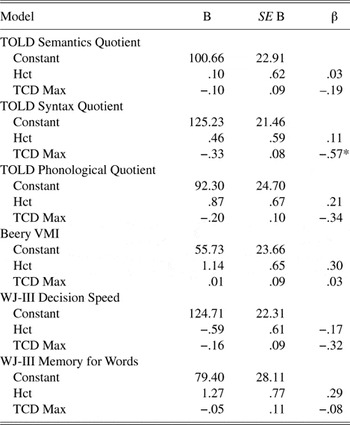
Results from hierarchical multiple regression analyses are summarized in Table 3. With Hct entered first as a covariate, TCD Max values accounted for variance in Syntax Quotient, F(2, 36) = 11.28, p = .00, R 2 = .39, and Phonological Quotient, F(2, 36) = 4.86, p = .01, R 2 = .21. After a Bonferroni correction was applied, TCD Max values predicted only Syntax Quotient. Regression analysis failed to reveal associations of TCD velocities with any of the other cognitive domains.
Summary of regression analyses examining associations of TCD velocities with cognitive outcomes

Note
For the Syntax Quotient, R 2 = .11 for Hct; DR 2 = .28 for the addition of TCD Max (p < .00). TCD Max = Transcranial Doppler maximum velocity; Hct = hematocrit; TOLD = Tests of Language Development, 3rd Edition; Beery VMI = Beery–Buktenica Developmental Test of Visual-Motor Integration; WJ-III = Woodcock–Johnson Tests of Achievement, 3rd Edition. *p < .001.
DISCUSSION
The present study investigated the relationship between cerebral blood flow velocity in the MCA, as measured by TCD, and language functioning in children with high-risk SCD. We assessed how elevated TCD velocities might affect specific language domains, rather than more global measures of verbal ability. We addressed limitations in previous studies by including a more representative sample of the pediatric sickle cell population and measuring cognitive functioning prior to any participants beginning transfusion therapy.
The frequency of abnormal and conditional TCD readings were similar to that of the Cooperative Study of Sickle Cell Disease, an investigation that sought to enroll a representative sample of sickle cell patients (Gaston et al., Reference Gaston, Smith, Gallagher, Flournoygill, West and Bellevue1987). We previously reported on a demographically –matched, community control sample (n = 54), who, on average, achieved standard scores of 94 (SD = 12), 95 (SD = 16), and 92 (SD = 15) on the Semantic, Syntax, and Phonological Quotients (Schatz et al., Reference Schatz, Puffer, Sanchez, Stancil and Roberts2009). The corresponding mean scores were lower for the present sample, suggesting an adverse effect of high-risk SCD on language skills that is not attributable to socio-environmental factors.
Consistent with the study hypotheses, performance on tests of syntax was related in the expected direction to TCD velocities; however, TCD velocities were not associated with semantic ability or with measures of other cognitive skills. Phonological ability showed a moderate correlation with TCD velocities, which did not persist with Bonferonni correction. The robust effect sizes demonstrated between TCD velocity and the syntax subtests suggest that this language domain is most vulnerable to cerebrovascular disruptions. This finding points to two possible explanations: a purely language impairment and/or a deficit in working memory related to language processing.
Increased TCD velocities may have a specific effect on syntactical processing by impairing functionality of the language-specific cerebral resources. Syntactical processing has been found to be critically dependent upon frontal brain regions (Brodmann’s Area 44) and also in the perisylvan area, which extends posteriorly into the parietal cortex (Uylings, Malofeeva, Bogolepova, Amunts, & Zilles, Reference Uylings, Malofeeva, Bogolepova, Amunts, Zilles, Brown and Hagoort1999). These areas are oxygenated by the MCA, the blood supply source that was assessed by TCD in this study. Weaknesses in syntax corresponding to higher TCD velocities may thus highlight the vulnerability of the frontal cortex and regions supplied by the MCA in SCD. Additionally, the present results are in agreement with previous findings of decreased VIQ in SCD, as it is possible that decreased syntactical ability may contribute to a lower VIQ, or that syntactical impairment may precede declines in semantic knowledge, with declines in semantic ability emerging with age. Furthermore, the present study found a moderate relationship between phonological skills and elevated TCD levels (r = .42, p < .01). This follows comparable findings in research with specific language impairments, such that deficits in lexical and morphosyntax skills are most often coupled with deficits in phonological skills (Leonard, Reference Leonard1998). Although the reasons behind having a specialized syntactical deficit remain unclear, the strong relationship between the two variables may have clinical utility, in that difficulties in syntactical ability may predict cerebrovascular problems in high-risk SCD, and, conversely, elevated TCD readings may predict decreased syntax ability.
Difficulties in both syntactical and phonological processing in SCD may also be related, in part, to altered short-term memory functions. According to the working memory model proposed by Baddeley and colleagues (Baddeley, Reference Baddeley1986, Reference Baddeley2000; Baddeley & Hitch, Reference Baddeley, Hitch and Bower1974), the phonological loop is responsible for the storage and rehearsal of verbal material. A dysfunctional phonological loop could therefore impair storage of multi-word utterances while abstract syntactic rules are being extracted, resulting in a syntax deficit (Laws, Reference Laws2004). Impairments in syntax ability could also result from a complex working memory or executive functioning deficit. Complex working memory, or the ability to hold and manipulate incoming information within attentional and processing constraints (Gathercole, Reference Gathercole1999), may be related to the deficits found in syntax processing. Thus, limitations in phonological storage or complex working memory could result in reduced repetition accuracy and syntactical understanding, skills that were assessed in the two syntax subtests of the TOLD. Given that the language subtests did not solely assess syntax, but also involved other cognitive processes such as phonological short-term memory and complex working memory, it is not possible to determine the specific processes responsible for the associations observed in this study. This sample generally performed well on a test of attention/working memory, Woodcock-Johnson (WJ-III) Memory for Words, and no relationship was observed between this test and TCD velocities. The WJ-III Memory for Words subtest most likely engaged phonological short-term memory. However, given that this subtest does not require manipulation of the word list, only repetition of words in the same order in which they were presented, it is less likely that complex working memory was engaged. Future studies are needed to better delineate the sources of language impairments related to elevated CBFV.
It was especially notable that TCD velocities showed weak associations with other cognitive outcomes. Specifically, two measures of attention/executive functioning showed little relationship to TCD. These findings contrast with previous literature suggesting a relationship between attention/executive functioning measures and increased velocities (Hill et al., Reference Hill, Hogan, Onugha, Harrison, Cooper and McGrigor2006; Kral & Brown, Reference Kral and Brown2004; Kral et al., Reference Kral, Brown, Nietert, Abboud, Jackson and Hynd2003). It is possible that our measures were not sensitive to the attention/executive functioning deficits that young elementary school children present and more sensitive measures are needed. However, the Decision Speed task showed the largest effect size in the Schatz et al. (Reference Schatz, Puffer, Sanchez, Stancil and Roberts2009) study, suggesting that decrements in processing speed may be related to other disease factors, such as disease subtype or anemia. Other TCD studies with pediatric sickle cell disease patients have shown associations with verbal memory (Kral et al., Reference Kral, Brown, Connelly, Cure, Besenski and Jackson2006). Clearly, more studies are needed that will elucidate the full extent of the neurocognitive correlates of elevated TCD velocities. Comprehensive evaluations that include tests of memory, executive functioning, and language, among other domains, will aid in the understanding of this relationship.
Hct levels were related to both TCD velocities and language testing, as is consistent with previous literature linking anemia and low cognitive scores in school-age children (Puffer et al., Reference Puffer, Schatz and Roberts2007; Schatz et al., Reference Schatz, Finke and Roberts2004; Steen et al., Reference Steen, Xiong, Mulhern, Langston and Wang1999). Although age was also related to TCD velocities, this association may be accounted for either by age-related physiological changes in blood flow or by disease progression. The lack of associations of age with cognitive testing is likely explained by the use of age-standardized test scores. Preterm birth has been shown in the literature to affect cognitive functioning in the general pediatric population (Bhutta, Cleves, Casey, Cradock, & Anand, Reference Bhutta, Cleves, Casey, Cradock and Anand2002; Peterson et al., Reference Peterson, Vohr, Staib, Cannistraci, Dolberg and Schneider2000), but it is possible that language skills may not be as sensitive to the effects of preterm birth as other cognitive domains. It is unclear as to why an association between platelet counts and cognitive outcomes was not found. Although our sample demonstrated higher platelet counts than the Bernaudin et al. (Reference Bernaudin, Verlhac, Freard, Roudot-Thoravel, Benkerrou and Thuret2000) sample, suggesting increased inflammatory disease, our children were seen at a relatively young age; hence, inflammatory consequences may not have persisted long enough to affect cognitive functioning. Relative to these other factors, elevation in TCD velocities was a robust predictor of neurocognitive dysfunction.
Limitations of this study include a relatively small sample size and less rigorous control over TCD recordings than was the case in several prior studies. Although all TCD examiners followed STOP protocol, the nature of TCD measurement allows for some subjective interpretation on the part of the examiner and reliability checks were not performed. Future studies might also decrease variance for the interval between TCD examination and cognitive assessment by performing both on the same day. Additionally, we were unable to collect MRI scans on all study participants, which limited our ability to identify those participants who had evidence of cerebral pathology. Future research might integrate different imaging techniques (MRA, MRI) to gain a greater understanding of the mechanisms underlying disease progression and its association with language impairment.
One of the study’s strengths is that it assessed a representative community sample of pediatric sickle cell patients and collected TCD data in a manner similar to many routine practice settings. Specifically, the sample consisted of individuals recruited through routine hematological health maintenance visits, with approximately 80% of children in this region regularly attending the clinics. By avoiding biases associated with selective recruitment of children with specific clinical complications (Cohen & Cohen, Reference Cohen and Cohen1984), this study provides information that clinicians may use in their routine care of pediatric SCD patients. Given that syntax ability was closely correlated with TCD velocities, syntax impairment may serve as an indicator of underlying pathology and of broader cognitive dysfunction. Although we are not able to specify a specific velocity elevation at which syntax impairment occurs, we recommend neurocognitive assessment, including examination of specific language processing skills, for SCD children with elevated TCD velocities.
In conclusion, the present study demonstrated the utility of assessing specific language domains, as opposed to global tests of language functioning, in conjunction with measuring TCD velocities. Syntactical ability was most closely related to CBFV in 5- to 8-year-old children with high-risk SCD. Syntax skills appear to be particularly sensitive to early signs of cerebrovascular dysfunction (i.e., increased CBFV) prior to cerebral infarction. The present study underscores the need for clinicians to recommend neuropsychological assessment when higher cerebral blood flow velocities are detected, due to the increased risk for cognitive dysfunction.
ACKNOWLEDGMENTS
The authors thank the families who volunteered for this research and Eve Puffer and Melita Stancil for help with data collection. This work was supported by the March of Dimes Birth Defects Foundation, Inc., Award #12-FY02-109 (Schatz).