Introduction
Over the last twenty years, providing protection and assistance to internally displaced persons (IDPs) has become a major concern for states, international organisations, and non-governmental organisations. Refugees, outside of their own state and unable to count on its protection, are provided protection through an international refugee regime based in law – particularly the 1951 Convention Relating to the Status of Refugees and its 1967 Protocol – and organisations – particularly the UN High Commissioner for Refugees (UNHCR). By contrast, IDPs, though displaced for similar reasons, do not have the same protections since they remain within their own state. Primary responsibility for their protection continues to rest with the territorial state.Footnote 1
Too often, however, the state may be unwilling or unable to act. In some cases, it is the state itself which deliberately creates displacement either for ethnic, religious, or political reasons, or as a means of counterinsurgency.Footnote 2 IDPs, moreover, are often in more precarious situations than refugees and other civilian victims of conflict, deprived of their rights and access to food and shelter.Footnote 3 Thus, some of the highest death rates recorded in humanitarian emergencies occur amongst IDPs.Footnote 4
Whereas IDPs were generally ignored during the Cold War, since 1990 the IDP situation has been internationalised as part of a broader shift in how states understand sovereignty and the state's relationship with its own citizens.Footnote 5 The clearest marker of this change has been the creation of a legally non-binding set of guiding principles on internal displacementFootnote 6 to provide a degree of international protection to IDPs by restating their rights which are embodied in existing international humanitarian, human rights and analogous refugee law.Footnote 7 These principles have not only been recognised by the international community, but are seen to mark an emerging norm with respect to the internally displaced – in 2005 UN Secretary-General Kofi Annan called the principles the ‘basic international norm’ for the protection of IDPsFootnote 8 while the same year the World Summit Outcome declaration referred to them as ‘an important international framework for the protection of internally displaced persons.’Footnote 9
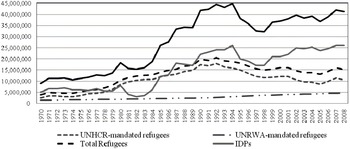
What has driven this change? One possible answer is numbers. As shown in Figure 1 below, while the overall number of refugees stabilised in the early 1990s and declined to 10.5 million by 2008, the numbers of IDPs has increased from 1.2 million in 1982 to 26 million in 2008.Footnote 10 And yet numbers cannot offer a complete explanation. Significantly greater numbers of displaced persons existed in Europe following the Second World War, when the estimated number of displaced was as high as 65 million.Footnote 11 Yet negotiations among states focused only on protecting refugees, not the internally displaced.Footnote 12
Total Displaced Persons, 1970–2008.Footnote 13

Growing IDP numbers in the early 1990s did lend credence to arguments put forth by international norm entrepreneurs that the plight of the internally displaced constituted a crisis situation which needed an international response. However, this is an atypical history of norm emergence for several reasons, one that suggests alternative mechanisms by which new norms can be promulgated at the international level.Footnote 14
Norm entrepreneurs are critical to the process of normative change because ‘they call attention to issues or even create issues by using language that names, interprets, and dramatizes them.’Footnote 15 These entrepreneurs succeed by framing new norms in such a way that the frame ‘resonates with broader public understandings and are adopted as new ways of talking about and understanding issues’Footnote 16 This allows them to ‘exercise influence and induce states to embrace new policy commitments inspired by norms.’Footnote 17
But norm entrepreneurs often have difficulties in gaining access. Real or perceived crises can be crucial because, by discrediting or pointing to the failure of pre-existing norm-governed understandings,Footnote 18 they force states to revaluate existing procedures. Outsiders who possess knowledge in the issue area can influence thestate decision-making apparatus and decision-makers become more receptive to new ideas.Footnote 19
In the case of IDPs, a consortium of NGOs used a perceived crisis – the growth in IDP numbers in the late 1980s and early 1990s – to gain support for an international response through the use of the UN as an institutional forum. But this only led to recognition of the problem. The next step was to create a new office within the UN, that of the Representative of the Secretary-General for Internally Displaced Persons, which succeeded in creating for itself an independent and expert legal authority on the issue.Footnote 20 The Representative, Dr. Francis Deng, used soft law – the non-binding guiding principles – as a mechanism to reframe the IDP issue. He did this in two ways: by pointing to the similarities of IDPs to refugees and other victims of conflict; and by grafting IDP protection on to existing international human rights, humanitarian, and refugee law. Consequently, this reframing of the IDP issue points to the salience of soft law as a useful mechanism – for IOs, NGOs, and norm entrepreneurs to increase receptiveness of states to new international norms.
However, how is it possible to tell if these guiding principles, as soft law, have contributed to the formation of a new norm? How can we tell if the principles have contributed to a change in state practice that one would anticipate from a new norm? Two methods will be used in this article: By examining how the principles have become institutionalised through recognition in international fore and in domestic legislation; and by exploring how state practice towards the internally displaced has changed. To test whether or not practice has changed, the article will examine one of the clearest new aspects of the principles, that against the forcible return of IDPs from camps or other resettlement areas to their homes when their lives may be in danger. While a clear norm exists with respect to the non-refoulement of refugees,Footnote 21 prior to the principles no similar right for IDPs was articulated. To determine if changes in state behaviour which can be attributable to the guiding principles have occurred, I focus on two similar cases of forcible return: the closure of the Kibeho camp in Rwanda in 1995, before the creation of the guiding principles, and the closure of the Znamenskoye camp in Russia in 2002, after their creation. While state practice was similar in both cases, in the Russian case, the government sought to justify its actions by arguing that the closures were in the best interests of the IDPs. Its statements, along with widespread international condemnation of the closures, suggest rhetorical instantiation of a norm of non-return for IDPs. These justifications were aimed at the international audience (I dismiss an alternative explanation that these actions were aimed solely at a domestic audience) and lend credence to the view that states have begun to recognise a norm of non-forcible return, even though this is anchored solely in soft law.
This article, consequently, examines the process by which a new norm concerning the protection of the internally displaced has begun to emerge. As such, it does not seek to prove that a norm has worked in the area,Footnote 22 but rather seeks to confirm the crucial assumptions of constructivism around norm emergence and the role of norm entrepreneurs through the use of a different mechanism for norm generation, that of soft law. I first turn to the role that soft law can play in this process before detailing why states, due to the efforts of norm entrepreneurs, recognised IDPs as an international problem in the 1990s and not before. I then look to the processes which lead to the creation of the guiding principles before detailing their institutionalisation and the effectiveness of the new ‘right’ against forcible return.
1. The power of soft law
In recent years, there has been increased focus on the power of international law as a norm-generating mechanism. Legalisation not only increases support for new or emerging norms but, through the effects of institutionalisation, it can mark the point when a new norm reaches a threshold or tipping point.Footnote 23 In addition, international law can create important reputational effects for states, particularly when it becomes enshrined at the domestic level in the state's ‘constitutional, regulative, or judicial systems.’Footnote 24
Can soft law have similar effects?Footnote 25 Certainly, as Kirton and Terbilcock note, soft law lacks ‘the legitimacy and strong surveillance and enforcement mechanisms offered by hard law’ and ‘while it promotes compromise, it may also promote compromised standards.’Footnote 26 Moreover, soft law has generally been seen as a preparatory step towards the creation of hard law.Footnote 27
And yet soft law can have several marked advantages over more traditional hard law. First, its more informal nature plays to the strength of other actors such as NGOs.Footnote 28 Second, as Abbott and Snidal note, it has a number of benefits in issue areas that directly challenge state sovereignty by lowering costs, expanding the range of available institutional arrangements, and facilitating compromise.Footnote 29 Thus, it can be effective when no agreement on hard law is possible.Footnote 30 Third, it can also allow for more timely action when governments are stalemated.Footnote 31 Fourth, it can serve to ‘reaffirm or further elaborate previously accepted general or vague norms found in binding or non-binding texts.’Footnote 32
In addition, a central property of soft law as a norm-generating mechanism is its ability to contribute to the internalisation of new norms within states by becoming entrenched in domestic legislation. Internalisation increases norm robustness and causes norms to ‘achieve a ‘taken-for-granted’ quality that make conformance with the norm almost automatic.’Footnote 33 This process is easier if norms resonate with prior understandings or if they emerge in a previously undefined area.Footnote 34 By the same token, if new norms are contested, their acceptance or rejection within domestic institutions can be crucial in determining how influential they will become.Footnote 35 Internalisation in domestic law serves a role in determining not only the influence of new norms and in maintaining compliance towards themFootnote 36 but also as a signal that a new norm has ‘achieved more than nominal domestic salience.’Footnote 37
This leads to two suggestions with respect to the power of soft law to assist norm entrepreneurs in generating new international norms. First, soft law may have a broader scope than hard law, working in areas where states, due to sovereignty concerns, would have distinct reservations over the creation of hard legal instruments or where negotiations would take too long. Second, soft law may be able to influence the domestic internalisation of new international norms by providing a ready-made set of standards that can then be more easily adopted by states in domestic legislation.
In the case of international protection for the internally displaced, Francis Deng, the Representative of the Secretary-General, deliberately choose not to pursue an international treaty for several reasons. The first was that existing treaties already did cover many of the rights of IDPs at least implicitly. His focus, rather, was to ‘consolidate the norms, focus attention, and, by so doing, serve an educational role.’Footnote 38 The principles provided an alternative through soft law, based in content that was grounded in international law: As Kälin notes, ‘it is possible to cite a multitude of legal provisions for almost every principle.’Footnote 39 In addition, there was the time element. A convention, which would need to be submitted for signature and ratification by states, would likely take years or decades to negotiate.Footnote 40
But critical to the success of this process has been a willingness on the part of states to accept the authority of the principles, to support their promotion, and to argue in favour of their adoption from the bottom up, primarily by recognition in domestic law.Footnote 41 The process by which this stage was reached is where I will now turn.
2. Internal displacement as an international problem
Throughout the Cold War, internally displaced persons were effectively ignored. Governments were expected to care for their own populations. When they failed to do so, or deliberately subjected their population to abuses, governments avoided condemnation by invoking their sovereign rights and arguing for non-interference. Therefore, whether or not someone had crossed an international boundary became crucial in determining whether or not they could be protected.
While the problem of internal displacement was recognised, the focus was on assistance rather than protection. As early as 1949, the Greek government approached the UN General Assembly for assistance to help its own population recovering from civil war. The government argued that people displaced internally by war should, like refugees, have access to international aid even if they did not need or receive international protection.Footnote 42 At the same time, India and Pakistan made similar arguments in favour of international assistance for those displaced by the 1947 partition of India. Both governments argued that ‘lack of legal protection was less of a problem for their internally displaced people than was sheer physical survival.’Footnote 43 However, the focus on assistance rather than protection meant that the problems of the internally displaced were seen as different from those of refugees and therefore not of international concern.Footnote 44
Internal displacement re-emerged as an issue in the early 1970s, when UNHCR began to assume responsibility for some IDP situations under its ‘good offices’ protocol, which allowed for the agency to provide assistance to groups which did not fall within the 1951 Refugee Convention definition of refugees. Even so, this did not represent a substantial change in international practice. While UNHCR might have responsibility for providing assistance to IDPs in some situations, it was almost always within a broader mandate of assistance provision to refugees and returnees or situations where the agency was requested to contribute its humanitarian expertise.Footnote 45 There was no recognition of the need to provide a protection framework for the internally displaced.
This ad hoc response pattern began to evolve in the late 1980s. A UN-sponsored Conference on the Plight of Refugees, Returnees and Displaced Persons in Southern Africa, held in Oslo in 1988, first raised the lack of an appropriate international institution or mechanism to ensure assistance to the five million IDPs in Angola and Mozambique. This prompted the General Assembly to request the Secretary-General to consider establishing a mechanism to coordinate relief for IDPs.Footnote 46 The next year, another conference, the International Conference on Central American Refugees, recognised that IDPs, in particular, required special assistance even though they remained subject to the jurisdiction and protection of their national authorities.Footnote 47
These conferences served to raise the profile of IDPs among states in the UN, who began to push for more coordinated action. This led, in 1990, to ECOSOC requesting the Secretary-General to initiate a review process.Footnote 48 In addition, the General Assembly assigned to all in-country Resident Coordinators the function of coordinating assistance to IDPs in the field. The next year, the UN created the post of Emergency Relief Coordinator to further improve the UN's ability to respond to emergency situations, including those involving displaced populations.Footnote 49 Even so, these were minor steps which might have done little had it not been for the Gulf War.
2 .1 IDPs and the Gulf War
The Gulf War was pivotal in increasing the exposure of the IDP problem both through the efforts of the international media and because it necessitated an international response. In the aftermath of the liberation of Kuwait, uprisings among the Kurdish and Shiite populations of Iraq were crushed by Saddam Hussein, causing massive displacement. Beginning in April, 1991, at least 1.5 million refugees fled Iraq and sought asylum in Iran and Turkey. An additional one million more were internally displaced in the north after Turkey closed its borders with Iraq.Footnote 50 The result was a humanitarian crisis of epic proportions, with a death rate of between 400 and 1,000 per day among the IDPs due to ‘hypothermia, exposure, exhaustion, and bacteria-ridden drinking water, which led to pneumonia, diarrhea, and cholera.’Footnote 51
This crisis was in full glare of the media who had been in the region to follow the Desert Storm operation, and stayed to report the subsequent uprisings.Footnote 52 Public pressure led to a major policy reversal inside the George H.W. Bush Administration. Whereas the US government had previously argued against intervening in Iraq, with the President suggesting that he did ‘not want to see US forces pushed into this situation, brutal, tough, and deplorable as it is,’Footnote 53 by 15th April he announced that he had directed ‘the US military to begin immediately to establish several encampments in northern Iraq.’Footnote 54
The President went on to single-handedly redefine potential reasons for intervention, noting that while ‘some might argue that this is an intervention into the internal affairs of Iraq […] I think the humanitarian concern, the refugee concern, is so overwhelming that there will be a lot of understanding about this.’Footnote 55 State Department officials later said that pressure for this change came from a number of sources, including ‘key European allies and Turkey, [Secretary of State] Baker [who had visited the region], Congress, the media, and the obvious suffering of the refugees.’Footnote 56 Beyond these statements, the Coalition also reinterpreted Security Council 688, which insisted that Iraq ‘allow immediate access by international humanitarian organizations to all those in need of assistance in all parts of Iraq’, to argue that the plight of the Kurds was ‘sufficiently threatening to international peace and security to justify outside military intervention and the creation of safe havens for them.’Footnote 57
This created a precedent for engagement in the protection and assistance of internally displaced populations; IDPs were recognised as a group with distinct needs and concerns. The crisis, the lack of an immediate UN response, and the need for a military intervention all highlighted ‘the deficiencies of the existing institutional framework […]’Footnote 58 More broadly, the intervention in Iraq, along with UN involvement in other IDP situations including Sudan in 1989 and Somalia in 1992 ‘highlighted both the possibilities and dangers of ad hoc responses […] The perception that the UN had fallen short of an appropriate response when faced with a rapidly unfolding and highly visible humanitarian emergency generated a new debate on access, intervention and humanitarian assistance at the UN, which set the stage for new approaches to internal displacement.’Footnote 59
3. The creation of the RSG's Office
While the UN had recognised that there needed to be a response to the IDP problem, there was no clear solution. Movement, rather, would come from several major international non-governmental organisations who served as norm entrepreneurs, including the Friends World Committee for Consultation, the World Council of Churches, and the Refugee Policy Group. These groups became mobilised for a simple reason: they wanted to find a solution to problems they had encountered in gaining access in the field to large numbers of the displaced who needed assistance and protection. After a conference in 1990, in which representatives of the UN and various diplomats ‘questioned whether this was an issue for the UN; that its magnitude and internal nature raised too many potential problems for the UN’, these NGOs considered options about where to raise the problem. Two options would not work: UNHCR's Executive Committee was primarily concerned with refugees, while the General Assembly was both a political body and less accessible to NGOs. This informal coalition was left with approaching the Commission on Human Rights (CHR).Footnote 60
Working with the International Committee of the Red Cross (ICRC) and UNHCR, this group prepared a draft resolution which called on the Commission to request the Secretary-General to prepare an analytical report on IDPs. As Bagshaw notes, the group did not expect that the issue would be taken up at that session of the Commission. Rather, ‘the statement was intended as a tool for engaging States in dialogue on the issue.’Footnote 61 However, the Austrian delegate, Christian Strohal, seized the initiative and agreed to put forward the resolution, rapidly gaining sixteen co-sponsors for it. The resolution was subsequently adopted by the CHR without a vote.Footnote 62
An important shift had occurred, driven by the actions of these NGOs, by the concerns of states, and by the growth of IDP situations. There was a growing perception that internal displacement was becoming a crisis and that change was necessary. However, there was no clear path to proceed along. Any actions to protect IDPs would directly challenge the principles of sovereignty, which, while under attack from the growing international human rights movement, were still formidable. Any solution therefore needed to either dismantle the norms surrounding sovereignty, or find a way around them.
In 1992, following the submission of the analytical report, the CHR requested the Secretary-General, Boutros Boutros-Ghali, to appoint a Representative of the Secretary-General on Internally Displaced Persons. He chose Francis Deng, who had served as the Minister of State for Foreign Affairs of the Sudan among other posts.Footnote 63 He was also an active academic who had coined the notion of sovereignty as responsibility.Footnote 64 This left him in an excellent position to talk to governments. As he notes:
In my dialogue with governments […] the first five minutes with the head of state is crucial to assure them of my recognition of the problem as internal and therefore under state responsibility. Having emphasized my respect for their sovereignty, I quickly move on to present the positive interpretation of sovereignty and the supportive role of international cooperation. Once I establish a cordial climate, candid and constructive dialogue can follow with little or no constraint in the name of sovereignty.Footnote 65
Therefore he was uniquely positioned to act as a norm entrepreneur. His efforts were also assisted by high officials within the UN system, including Sadako Ogata, the UN High Commissioner for Refugees,Footnote 66 and a number of NGOs including the US Committee on RefugeesFootnote 67 and the Norwegian Refugee Council (NRC). Deng also created a project within the Brookings Institution on Internal Displacement with Roberta Cohen, a senior fellow at the Brookings Institution and the former US Deputy Assistant Secretary of State for Human Rights.Footnote 68
Even with these arrangements, no clear institutional solution emerged within the UN to provide effective protection to IDPs. Deng initially floated a proposal to create a new UN agency to deal with the problem. However, political will was against this option, both because it duplicated existing arrangements and costs would be substantial, but also because it aroused opposition from governments and from other agencies.Footnote 69 Another alternative was to assign responsibility to an existing agency, most likely UNHCR. However, the very idea triggered ‘a turf war among UN agencies unwilling to yield more power and responsibility to UNHCR.’Footnote 70 The third option, which was undertaken between 1998 and 2004, was to strengthen collaborative relationships within the UN agencies system through the office of the Emergency Relief Coordinator and the Inter-Agency Standing Committee (IASC).Footnote 71 Within OCHA, an Internal Displacement Unit (IDU) was set up to improve operational coordination within the UN system. And yet, this solution proved to be problematic over time. A 2004 report found that ‘the UN's approach to the protection of [IDPs] is still largely ad hoc and driven more by the personalities and convictions of individuals on the ground than by an institutional, system-wide agenda.’Footnote 72 The same year, an independent review of the IDU found that it had not had a significant impact on the UN, had failed to get UN humanitarian and resident coordinators to follow its recommendations, and that it was not ‘effective in reporting egregious failures of the system.’Footnote 73
This triggered a two-fold institutional change within the UN. The IDU was upgraded to a division within OCHA and had its role modified to provide a more effective response to the most acute internal displacement situations. Dennis McNamara, an experienced humanitarian who had previously served as the head of UNHCR's Department of International Protection, was appointed as its head.Footnote 74 Further changes have since occurred, with the Internal Displacement Division and a Humanitarian Response Review commissioned by the ERC proposing that specific agencies within the UN system be made accountable for specific problem sectors or ‘clusters.’ UNHCR has been assigned the role as cluster lead for IDP protection, emergency shelter, camp management and coordination in a progressively expanding number of states.Footnote 75 This shift, in the words of Weiss and Korn, suggests that the outcome Deng proposed a decade earlier is being realised, with UNHCR becoming ‘a de facto lead agency for assisting and protecting IDPs […]’Footnote 76 which may be a viable long term solution to the institutional difficulties the UN has faced.
4. The guiding principles on internal displacement: a soft legal framework
While institutional mechanisms have had a mixed record in protecting the internally displaced, the creation of clear guidelines has not. Soon after his appointment, Deng was asked by the CHRFootnote 77 to study the status of the internally displaced in international law and ways in which to improve protection and assistance for them. To further this, two studies were prepared: one by the Austrian government under the direction of Professor Mandred Nowak, the other by Robert Goldman, an American legal expert. Following consultations with some 22 legal experts, including the chief legal officers of UNHCR, ICRC, and the International Organisation for Migration, Deng asked Walter Kälin, a Swiss professor of constitutional and international law at the University of Bern, to work with both groups to merge the two documents.Footnote 78
This team determined that existing international humanitarian and human rights law and analogous refugee law did provide substantial coverage for the internally displaced. However, there were also areas where existing law failed to provide sufficient protection:
Some weaknesses relate to the need for an expressed right to not be unlawfully displaced, to have access to protection and assistance during displacement, and to enjoy a secure return and reintegration. There are also gaps in legal protection relating to personal documentation for the internally displaced or restitution or compensation for property lost during displacement. And although there is a general norm for freedom of movement, there is no explicit right to find refuge in a safe part of the country nor an explicit guarantee against forcible return of internally displaced persons to places of danger.Footnote 79
These findings triggered an important change. Organisations which ‘had previously opposed the creation of a new instrument […] came to admit that the existence of such a protection gap nevertheless required some action.’Footnote 80 The principles served to ‘facilitate a better understanding and application of existing international law relevant to internally displaced persons and to stimulate enhanced international, regional and national responses to their needs.’Footnote 81 By basing the principles on existing international law, Deng also successfully grafted soft law on to a hard law foundation. Not only do the principles provide a minimum international standard but, by clearly enunciating the rights of IDPs prior to, during, and following displacement, as well as establishing that governments cannot deny access to their displaced populations, they also serve as a practical tool.Footnote 82 While the principles are not, in themselves, internationally-binding law, they have become widely accepted.Footnote 83 This can be seen in two ways: through their acceptance by international and regional intergovernmental bodies; and by their adoption into domestic law.
Within the UN system, both the UN General Assembly and the Commission on Human Rights have acknowledged the principles. The CHR was the first to do so – in 1998, amidst wrangling with several states which had concerns that the principles had not been considered by states,Footnote 84 the Commission took note of the principles.Footnote 85 Incremental changes in a succession of resolutions have gradually strengthened this support. In 2000, the CHR adopted stronger wording, welcoming that the Representative, as well as UN agencies and other organisations, was using the guiding principles.Footnote 86 In 2002 the CHR not only welcomed their dissemination and use by states, but also expressed its appreciation of them as an ‘important tool for dealing with situations of internal displacement.’Footnote 87 The General Assembly has passed similar language, welcoming the use and dissemination of the principles,Footnote 88 that they are an important tool for dealing with situations of internal displacement,Footnote 89 and encouraging UN agencies, regional organisations and NGOs to disseminate and apply them.Footnote 90 Regional and sub-regional organisations have also recognised the guiding principles and have disseminated and made use of them.Footnote 91
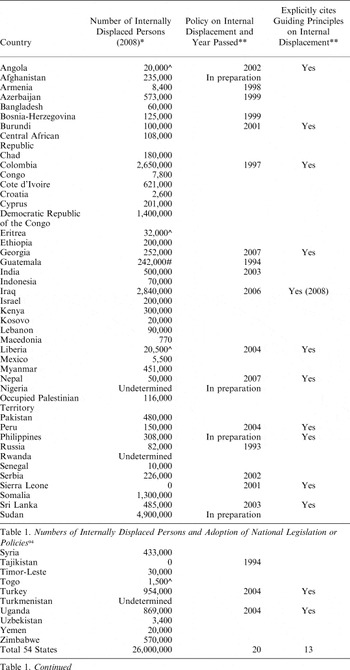
More notable in terms of state practice, as shown in Table 1 below, has been the move to enshrine parts or all of the guiding principles in domestic law. Some twenty countries, all with current or previous IDPs, have developed laws and policies with respect to internal displacement, all but four since the creation of the principles. Thirteen countries explicitly cite the guiding principles in either national policies or law.Footnote 92 The government of Iraq, for example, has declared that the guiding principles have become ‘part of international law.’Footnote 93 An additional four countries have policies or law in preparation. Combined, these countries have an IDP population of over 15.3 million or almost 60 per cent of the total global IDP population.
Numbers of Internally Displaced Persons and Adoption of National Legislation or Policies.Footnote 94

While ratification in national legislation is an important step, implementation of these policies may lag as the government may be unwilling or unable to meet its responsibilities due to continued conflict situations.Footnote 95 Yet legalisation provides important tools for actors at both the domestic and international levels to foster compliance. Colombia, for example, has one of the most encompassing legal frameworks for IDP protection. This ensures that failures to deal with IDP problems can be challenged in the Colombian Constitutional Court, and the court has gone as far as to rule the principles to be ‘supranational legislation.’Footnote 96 This has given the court power to criticise the government for failing to enforce existing legislation and for ‘often ineffective implementation at the departmental and municipal levels’ of policy.Footnote 97 In Uganda, the government was criticised by the Brookings Project and by domestic and international NGOs for a lack of political will to fully implement its 2004 IDP policy, or create conditions in which the policy would be effective.Footnote 98 These criticisms and international pressure led to a change with the Ugandan government earmarking $10 million in funding for the policy and adopting an emergency humanitarian plan.Footnote 99
A recent shift has been the development of binding legal instruments at the regional level. The eleven member states of the International Conference on the Great Lakes Region have adopted a Protocol on Protection and Assistance to Internally Displaced Persons which obliges states to accept the principles and incorporate them into domestic law.Footnote 100 In October 2009, the African Union Special Summit of Heads of State adopted the Convention for the Protection and Assistance of Internally Displaced Persons in Africa (the Kampala Convention) which is both a legally binding instrument for all of Africa and is based on the guiding principles. As of 31 December 2009, twenty states had signed the Convention which will enter into force after fifteen ratifications.Footnote 101
There has been some resistance to this process. China, Egypt, India and Sudan have been vocal critics of the soft law process that led to the creation of the guiding principles, which some suggestions that they fear ‘humanitarian action could be a cover for the interference of powerful countries in the affairs of weaker states.’Footnote 102 However, this opposition has generally centred on the form the guiding principles have taken, rather than their content or the need to provide protection to IDPs.
This raises an important question: despite opposition, why have international organisations, including consensus-based organisations such as the General Assembly and the CHR, and states been willing to support the principles? Their resolutions have all been adopted without a vote, even when criticisms were raised.Footnote 103 The reasons for the success are due to Deng's reframing of the issue and grafting of the principles onto existing international law.Footnote 104 Even so, have the guiding principles successfully changed state behaviour, a strong indication of an emerging norm?
5. A norm against forced return
One of the cornerstone rights embodied in the principles is that internally displaced persons, like refugees, have a right of non-refoulement: ‘Internally displaced persons have a) the right to seek safety in another part of the country […] and (d) the right to be protected against forcible return to or resettlement in any place where their life, safety, liberty or health would be at risk.’Footnote 105 Kälin has argued that this principle is well established ‘in the refugee law principle of non-refoulement, and in major human rights protections relating to torture and the deportation of aliens.’ While it is novel as applied to IDPs, he argues that states bear responsibility for violations of the non-refoulement principle in refugee law and for forcibly returning aliens to situations of danger and that similar reasoning can be applied to IDPs. Therefore, ‘it is clear that states bear an affirmative duty to insure internally displaced persons are not compelled to return to or be resettled in places where their lives or liberty are at risk.’Footnote 106
Forced repatriation of IDPs, fortunately, is rare. Much more common is governments ‘encouraging’ IDPs to return, rather than arbitrarily forcing them. Two cases, however, bucked this pattern: the closure of the Kibeho Camp in Rwanda in 1995, before the principles were created and the closure of the Znamenskoye camp in Ingushetia, Russia in 2002, after their creation. Both situations are similar in that the norm appears to have been rejected – forced repatriation did occur.
And yet, as Cortell and Davis have noted, the discourse used by a norm violating actor can be as important as the violation itself. The most salient norms will make actors ‘feel a strong need to justify or apologize for noncompliance’ such as in terms of extenuating circumstances.Footnote 107 In the Russia case, the government attempted to respond to international criticisms by cloaking their norm violation in public statements. They argued that the returns were for humanitarian reasons and denied the returns were involuntary. In so doing, they upheld the integrity of the incipient norm. The Russian government's actions, in other words, contributed to the development of the norm even as it was incompletely upheld in practice.
5 .1 Kibeho, Rwanda (1995)
The 1994 Rwandan genocide, which claimed the lives of approximately 800,000 people, produced close to two million displaced people. By September 1994 350,000 IDPs were still crowded into thirty-three camps, of which the largest – with 115,000 – was outside the town of Kibeho. The new Rwandan government suspected that these camps were providing sanctuary to people who had been implicated in the genocide,Footnote 108 and were being used to form anti-government militias.Footnote 109
The UN began a program to facilitate voluntary return in conjunction with NGOs, major donors and the Rwandan government through an Integrated Operations Centre (IOC). Militant Hutus, however, seeking to retain control over the camps, circulated reports that returnees were being arrested. These were coupled with stories of overcrowded prisons, illegal occupation of homes and a lack of confidence in judicial procedures. Thus, few IDPs wanted to return home.Footnote 110
The Rwandan government opposed the consent-based process advocated by the UN, arguing instead that security could only be established when concentrations of IDPs had dispersed.Footnote 111 The IOC eventually agreed to close the camps by ending food and relief distribution and transferring IDPs to their home communes. While force was not to be used, this still violated the principles of voluntary return.
Even so, the Rwandan government was not satisfied with even these arrangements. On 18 April 1995, Rwandan government forces moved to close the Kibeho camp by surrounding it and cutting off its food and water supply:
For the next three days, the concentration of 80,000 people on one hill and the rapid deterioration of humanitarian conditions resulted in panic and casualties when soldiers met stone-throwing with machine gun fire. On the fourth day, a large group of IDPs tried to break the cordon. The RPA (Rwandese Patriotic Army) opened fire on the crowd, killing several hundred people and causing a stampede which claimed more lives … UNAMIR (UN Assistance Mission in Rwanda) troops were present during the massacre but were ordered not to intervene […]Footnote 112
The Rwandan government faced worldwide condemnation. On 27 April, the government reacted by inviting western diplomats and NGO representatives to join President Bizimungu at the site. While claiming that an independent commission would be set up to investigate the incident, he also ordered the mass graves dug up. Based on that evidence, he claimed that rather than thousands of dead, there were only 338 victims. The international community failed to challenge the President on this, in part because of the guilt that the UN publicly admitted for not having stopped the genocide.Footnote 113
Kibeho rapidly disappeared from view. The Independent Commission's report, issued on 17 May 1995, indicated that the government could have taken steps to prevent the massacre. The report also noted the necessity of a body of guidelines applying to situations of internal displacement. The IOC had to create its own guidelines, which Kleine-Ahlbrandt argues were more easily compromised since they were self-created rather than external and authoritative.Footnote 114
While it recognised that a norm against forced repatriation can be inferred from the right to freedom of residence and movement, the Rwandan government did not consider itself bound to this right, and repeatedly invoked their sovereign right to address the security threat presented by the camps. A set of principles could have provided clarity and ‘could have helped foster an international consensus after they were violated in Kibeho, by providing the [Commission] with objective principles upon which to base its evaluation and conclusions.’Footnote 115 Médecins Sans Frontières has also noted ‘that nothing was done to oppose or denounce the massacre of displaced persons by the Rwandan army in an attempt to close down the camp. The massacres [at] Kibeho in Rwanda are […] tragic examples showing that international protection for displaced persons against violence committed by their own country's armed forces is illusory.’Footnote 116 In particular, the unwillingness on the part of other states to engage in a rhetorical instantiation of the norm by denouncing the violation suggests that it was in a very early stage of development.
5 .2 Znamenskoye, Russia (2002)
The renewal of conflict between the Russian Government and Chechen separatists in Chechnya in 1999 led to the displacement of 180,000 IDPs within Chechnya and to the neighbouring states of Ingushetia and Dagestan.Footnote 117 In June 2002, the Russian government decided to resettle all IDPs within the three states through a 20 point plan which would include forced repatriation. After a number of demarches by UN officials, including from the Secretary-General to President Vladimir Putin and from Olara Otunnu, the Special Representative of the Secretary-General for Children and Armed Conflict, the Russian government stated that all returns would be voluntary.Footnote 118 The US government also stressed in discussions with the Russian government that the return of the displaced to Chechnya must be voluntary, but noted that few IDPs were likely to return given the circumstances. As Steven Pifer, the American Deputy Assistant Secretary of State for European and Eurasian Affairs noted in a statement:
Russian authorities have assured us that [voluntary return] is the case, but the local pro-Moscow Chechen administration has undertaken a campaign to convince the displaced to return. As long as the security situation shows no improvement, however, most will not. In addition […] cuts in food and other programs in Ingushetia create pressure on Chechens to return despite the risky security situation.Footnote 119
In July, the government proceeded to shut down a camp in Znamenskoye, Ingushetia, which was home to 2,200 people. All tents were torn down, latrines shut down, and gas, water and electricity cut off. The IDPs were forcibly relocated to temporary locations in Grozny. Médecins Sans Frontières reported that: ‘It is obvious that this is not a voluntary movement […] Mothers in Znamenskoye told us they dread returning to Grozny as they fear for their lives, particularly for the lives of their sons.’Footnote 120 The UN quickly took action. Officials voiced their concerns over the poor conditions in the new sites.Footnote 121 Kenzo Oshima, the UN Emergency Relief Coordinator, made a public statement voicing concerns over the process and that the UN had reports indicating that ‘this relocation cannot be regarded as entirely voluntary.’Footnote 122
The Russian Government responded by justifying the closures for humanitarian reasons. The head of the pro-Russian government in Chechnya, Stanislav Iliasov, argued that ‘most of the tent cities where Chechen civilians had been forced to spend the last three winters were “not suitable for normal life.”’Footnote 123 The Russian government also continued to deny that the movements had been involuntary. In September 2002, a Council of Europe mission found that ‘although the authorities confirmed that all returns of internally displaced persons (IDPs) to the Chechen Republic, and in particular to Grozny, have taken place on a voluntary basis, serious concerns have been expressed by international organizations and NGOs in this respect.’Footnote 124
Since this period, Russian authorities have continued to pressure IDPs to return to Chechnya. They have, however, as a 2003 Human Rights Watch report notes, ceased directly closing the camps. Instead, they:
[…] started arbitrarily taking hundreds of displaced persons in the tent camps off camp registration lists, resulting in their eviction from government-sponsored housing. Without financial means to arrange for other housing, most of the deregistered people had no choice but to return to Chechnya. In addition, the authorities deliberately obstructed the efforts of humanitarian agencies to build alternative shelter for the displaced in Ingushetia.Footnote 125
This shift, Human Rights Watch argues, was caused by ‘international diplomatic and media outcry, in addition to logistical difficulties (lack of housing in Chechnya and problems with relocating thousands of people in the middle of winter), [which] ultimately prevented the closure of the camps […]’Footnote 126 In this case, the prompt action of the NGO community, the UN and other international organisations appears to have forced the Russian government to both deny and justify their initial actions and to also alter their overall policies.
5 .3 Was there a difference? Alternative explanations
Clearly, the Russian authorities' behaviour differed from that of the Rwandan authorities. The Rwandan government justified their actions due to pressing security needs, and ignored the few international protests by invoking national sovereignty and the need to protect their national security. Even more damning from the perspective of claims in favour of an incipient norm, the international community failed to response in any manner, including even simply denouncing the actions. By contrast, the Russian authorities at no point argued that national sovereignty allowed them to close the camps. Rather, they suggested that the camp closures benefited the IDP population. Further, by stating that all returns were voluntary, they were cloaking their norm violation in public statements that actually upheld the integrity of the norm, thus contributing to its development.
Russia, as a permanent member of the UN Security Council, can and does invoke national sovereignty and security issues with great regularity. There is clear evidence that the Chechen conflict had atrocities occur on both sides, and that the Russian government did little to protect the human rights of its own citizens. Nor has it attempted to explain away the conflict in any other way.
Based on this, their behaviour with respect to Znamenskoye is unusual. One explanation is that the actions at the time were based on domestic imperatives unrelated to international norms. While this is possible, it is unlikely for several reasons. First, while the security and military elites of Russia are not a unified group, they did ‘almost uncritically support [President] Putin's security and foreign policy’ and did not question government actions in Chechnya.Footnote 127 Second, public opinion in Russia remained supportive of government policy throughout this period, and the mass media generally followed the government's line on the nature of the conflict and the threat Chechnya posed to the rest of Russia.Footnote 128 Finally, following 9/11, President Putin effectively recast the Chechen conflict as a war against terrorism,Footnote 129 lessening the fear among Russian authorities that the West might attempt to intervene in the conflict. This fear was widespread after the intervention in Kosovo and had existed in spite of US Secretary of State Albright's assurances that ‘Chechnya was not Kosovo.’Footnote 130 Consequently, there appears to be no solely domestic reasons for the Russian actions, which lends credence to the view that the Russian government had implicitly recognised that a norm against the forcible repatriation of internally displaced persons existed and, consequently, that the guiding principles have had a norm-generating effect. Even though the evidence contradicted their account of the camp closure, the authorities continued to claim it was voluntary in order to not be perceived as violating a nascent norm.
Conclusion
Norms always emerge into contested space. In the case of the international protection of internally displaced persons, the problem originally arose soon after World War II. But the plight of the internally displaced was in conflict with norms surrounding sovereignty and non-interference in the internal affairs of states, with the result that no action was taken at the international level. In the late 1980s, as the scope of the problem grew, states, international organisations, and non-governmental organisations recognised that there needed to be some form of international response to a crisis situation. This led to a policy window which a group of NGOs were able to exploit, thereby creating an Office within the UN to deal with that problem.
Mere institutional construction, however, does not suggest the presence of an emerging norm. Using soft law, the Representative of the Secretary-General for Internally Displaced Persons, Dr. Francis Deng, was able to graft the problem of IDPs on to existing international law. The guiding principles which his mandate commissioned effectively restated international law as it applies to IDPs. They also sought to go beyond this, especially with regards to prohibitions against forcible repatriation. Crucially, this right is not recognised explicitly in international law. There is, however, evidence that the guiding principles have become an accepted framework for dealing with the problem of internal displacement, one which is taking on a normative resonance within the international community. This can be seen in the way the guiding principles are treated, recognised by a number of international organisations and adopted into domestic legislation, both indicators of norm internalisation. Moreover, this can also be seen in practice, in the reaction to the international community to the forced repatriation of IDPs in Russia, as well as the Russian government's own reaction. This led to international condemnation, but also to the government modifying its behaviour.
States, therefore, can no longer expect to hide behind sovereignty when dealing with the internally displaced. Rather, international recognition of the rights of the internally displaced has and will continue to alter state behaviour. Sovereignty is no longer a cloak for a state's unwillingness or inability to protect its own population.