Implications
The use of transgenic pigs in biomedical research has significantly increased in recent years, together with a growing attention towards welfare-related issues concerning these animals. The present experiment indicates that no differences were detectable between human decay-accelerating factor transgenic and conventional pigs with respect to some welfare indicators including spontaneous behaviour and responses to some behavioural tests. The refinement of experiments involving genetically modified pigs could be increased by applying to laboratory protocols the well-established experience accumulated on welfare assessment of intensively kept pigs based on animal parameters such as behaviour and hair cortisol.
Introduction
Despite the wide array of ethical implications, and regardless of the intended uses of genetically modified (GM) animals (i.e. biomedical production, animal models in research, aesthetic purposes and ordinary food production), there is no doubt that, to date, there is still a definite lack of reliable data on the effects of the transgenic status on the welfare level of animals involved. Ever since 1993, Broom stated that systematic and comprehensive studies on the welfare of transgenic animals were necessary (Broom, Reference Broom1993), and Sandøe and Holtug (Reference Sandøe and Holtug1993) pointed out that in an analysis of concerns raised about transgenic animals, animal welfare was the only one deemed ethically significant. In the following decades, the debate has focused on a broader concept of moral acceptability of animal biotechnologies and possible means to reach a consensus on this topic in which animal welfare is part of a wider scenario (Olsson and Sandøe, Reference Olsson and Sandøe2004; Lassen et al., Reference Lassen, Gjerris and Sandøe2006; Ormandy et al., Reference Ormandy, Dale and Griffin2011 and Reference Ormandy, Schuppli and Weary2013). In this framework, it is noteworthy that European citizens consider biotechnologies more acceptable when aimed at medical applications rather than to food production, regardless of the implications for animal welfare (Eurobarometer, 2010).
Animal welfare is, as it is well accepted, a multidimensional concept, and many criteria for welfare assessment of animals are presently in use, including environmental and managerial parameters (the so-called resource criteria) and animal-based criteria, comprising physiological and pathological outcomes (e.g. body conditions scoring, reproductive efficiency, longevity, immune suppression, corticosteroid levels, disease, injury) and behavioural responses (e.g. preferences, abnormal behaviours, emotional state). Animal criteria are generally deemed to be particularly appropriate for measuring the actual level of animal welfare (OIE, 2010). On the basis of these premises, the European Welfare Quality project (Welfare Quality®, 2009) has recently made available specific tools for welfare assessment at a farm level of cattle, pigs and poultry.
In the case of GM animals, welfare assessment protocols are in use for small mammals, for example, the Score Sheets (van der Meer et al., Reference van der Meer, Rolls, Baumans, Olivier and van Zutphen2001), the SHIRPA protocol (Rogers et al., Reference Rogers, Fisher, Brown, Peters, Hunter and Martin1997), and protocols by Jegstrup et al. (Reference Jegstrup, Thon, Hansen and Ritskes Hoitinga2003) and Wells et al. (Reference Wells, Playle, Enser, Flecknell, Gardiner, Holland, Howard, Hubrecht, Humphreys, Jackson, Lane, Maconochie, Mason, Morton, Raymond, Robinson, Smith and Watt2006). At present, no similar approaches are available for large animals, despite the fact that they are more and more used as transgenic laboratory animals. Literature dealing with the welfare assessment of GM and cloned pigs is fairly rare and mainly based on growth parameters, organ development and hematologic parameters (Tucker et al., Reference Tucker, Belcher, Moloo, Bell, Mazzulli, Humar, Hughes, McArdle and Talbot2002; Deppenmeier et al., Reference Deppenmeier, Bock, Mengel, Niemann, Kues, Lemme, Wirth, Wonigeit and Kreipe2006; Estrada et al., Reference Estrada, Sommer, Collins, Mir, Martin, York, Petters and Piedrahita2007). To the best of our knowledge, only in a few cases animal behavioural indicators were used to assess animal welfare: Archer et al. (Reference Archer, Friend, Piedrahita, Nevill and Walker2003) investigated the variability of behaviour among cloned animals, whereas Huber et al. (Reference Huber, Remuge, Carlisle, Lillico, Sandøe, Sørensen, Whitelaw and Olsson2012) carried out an extensive welfare assessment on transgenic pigs expressing green fluorescent protein that included the study of general health and development, social behaviour, exploratory behaviour and emotionality.
Since 1996, our research group is involved in pig transgenesis by sperm-mediated gene transfer (SMGT) that is based on the intrinsic ability of sperm cells to bind and internalize exogenous DNA molecules and to transfer them into the oocyte at fertilization (Sperandio et al., Reference Sperandio, Lulli, Bacci, Forni, Maione, Spadafora and Lavitrano1996). In this way, we obtained pigs transgenic for human decay-accelerating factor (hDAF), which has been shown to help overcome hyperacute rejection in xenotrasplantation (Lavitrano et al., Reference Lavitrano, Bacci, Forni, Lazzereschi, Di Stefano, Fioretti, Giancotti, Marfé, Pucci, Renzi, Wang, Stoppacciaro, Stassi, Sargiacomo, Sinibaldi, Turchi, Giovannoni, Della Casa, Seren and Rossi2002; Webster et al., Reference Webster, Forni, Bacci, Giovannoni, Razzini, Fantinati, Zannoni, Fusetti, Dalprà, Bianco, Papa, Seren, Sandrin, Mc Kenzie and Lavitrano2005). One of the peculiar characteristics of SMGT is that it does not require embryo and/or oocyte handlings but only male gamete washings (Lavitrano et al., Reference Lavitrano, Forni, Bacci, Di Stefano, Varzi, Wang and Seren2003).
The present research was carried out to investigate some welfare-related parameters of our hDAF transgenic pigs in comparison with their conventional close relatives (full sibs or half sibs all derived from the same boar). The study examined some animal criteria such as behavioural traits, social interactions, growth and cortisol level (as measured on swine hair). Further tests, comprising food preference and novelty tests, were carried out to get more information on hDAF transgenic animals taste and temperament.
Material and methods
Animals
The experiment was carried out in the facilities of the Department of Veterinary Medical Sciences of the University of Bologna, Italy, and it was conducted in observance of current Italian legislation implementing Council Directive 86/609 on the protection of animals used in experiments and Council Directive 2008/120 on pig protection. The experimental protocol was approved by the Ethical Committee of the University of Bologna and by the Italian Ministry of Health.
A total of 14 Large White (LW) female hDAF transgenic pigs (T) and 10 female non-transgenic (C-conventional) pigs from four litters were used. Each litter consisted at birth of 10 to 14 piglets. The selection criteria of litters was based on the presence, within the same litter, of hDAF transgenic or conventional female piglets in a 2 : 1 ratio to allow the formation of pens, to be videotaped for behavioural traits, containing three pigs of which at least one was either transgenic or conventional (see below). More specifically, three litters contained two conventional and four transgenic pigs, and one litter contained four conventional and two transgenic pigs. All pigs were from the same LW conventional boar, donor of the semen treated for SMGT, and from four LW conventional multiparous sows: therefore, all pigs were either full or half siblings. Transgenic hDAF animals were obtained by using SMGT, and characterizations at genomic DNA, RNA and protein levels were made according to standard protocols (Sperandio et al., Reference Sperandio, Lulli, Bacci, Forni, Maione, Spadafora and Lavitrano1996; Lavitrano et al., Reference Lavitrano, Bacci, Forni, Lazzereschi, Di Stefano, Fioretti, Giancotti, Marfé, Pucci, Renzi, Wang, Stoppacciaro, Stassi, Sargiacomo, Sinibaldi, Turchi, Giovannoni, Della Casa, Seren and Rossi2002). Tissues found positive at birth were still positive 6 to 12 months later. Pigs were weaned at 35 days of life and then reared, according to their litter of origin, into four collective pens placed in temperature-controlled rooms (22°C; RH 65%) equipped with a forced-air ventilation system and naturally illuminated. Pens were on a partially slatted floor, with a floor space of 1.20 m2 per pig. Each pen was equipped with a bite drinker and a collective stainless steel feeder, and environment was enriched by providing hanging chains and little amounts of straw. During daytime hours (from 0700 to 1900 h), pigs were manually ad libitum fed a commercial diet (CP 15.5%; DE 3220 kcal/kg). For each litter, the trial lasted 35 days. During the experiment, BW ranged from 50 to about 80 kg.
According to internal good husbandry rules for experimental animals, all pigs were daily individually monitored by a veterinarian for health following a classic protocol for clinical observation of pigs (Jackson and Cockcroft, Reference Jackson and Cockcroft2002) that included breathing rate, neurological signs, lameness, diarrhoea, pruritus, and abnormal body shape and skin appearance.
All pigs were individually weighed at the beginning and at the end of the trial.
Temperament and food preference tests
At 16 weeks of age (average BW: 50 kg), all pigs were subjected to fear and food preference tests. These same tests were repeated 4 weeks later. With respect to fear tests, a human approach test (HAT), a novel object test (NOT) and an open-door test (ODT) were conducted in the home pen according to van Erp-van der Kooij et al. (Reference van Erp-van der Kooij, Kuijpers, Schrama, van Eerdenburg, Schouten and Tielen2002). These tests were carried out consecutively, always in the same order (HAT–NOT–ODT). In the HAT, a person walked into the pen and stood still in the middle. In the NOT, a bright red bucket was put in the middle of the pen. For both tests, HAT and NOT, it was recorded how quickly animals made snout contact with the person or the bucket. In an ODT, the door of the pen was opened and how fast the pigs left their home pen and walked into the corridor of the compartment was recorded. Animals that touched the person or the bucket within 30 s received 10 points, within the next 30 s 9 points and so on, until after 5 min the test was ended. Animals that left the pen within 30 s received 10 points, within the next 30 s 9 points and so on, until after 5 min the test was ended. Pigs who did not make snout contact with the person or the bucket, or did not leave the pen within 5 min, received 0 points.
All animals were tested for food preferences according to the protocol drawn by Archer et al. (Reference Archer, Friend, Piedrahita, Nevill and Walker2003). The pigs were offered the following foods by hand: apples (delicious stark), bananas, saltine crackers, carrots and lemons. All foods were approximately the same size (3×3 cm). The food type was alternated after each offering until all foods were offered 10 times. The food preference was expressed on a 0 to 10 scale for each food, according to how many times the animals accepted each food offered. The tests were conducted by the same trained operator on the transgenic and concurrent controls to reduce environmental effects.
Behavioural traits and social interactions
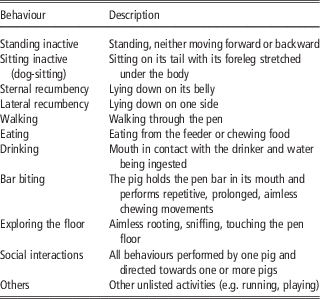
On the basis of the litter of origin, at the average BW of about 80 kg, pigs were allotted to smaller groups of three full sibs with homogeneous BWs per pen: two pens contained two conventional pigs and one hDAF transgenic pig (2C-1T), and six pens contained one conventional pig and two hDAF transgenic pigs (1C-2T). The experimental conditions were the same as those described above, except for a higher individual floor space allowance (about 2 m2 per pig). Each pig was identified by a painted symbol placed on its back. After 3 days of adaptation, all animals were videotaped over a 10-h period (from 0800 to 1800 h) for 4 consecutive days by means of a digital closed circuit system (Mesa, Arezzo, Italy). The cameras were mounted on a rail attached to the wall in front of each pen up to 3 m above the ground. Videos were examined by a single trained operator blind towards pig genotype, and different behaviours of each pig were assessed by scan sampling at 10 min intervals according to a predetermined ethogram (Nannoni et al., Reference Nannoni, Martelli, Cecchini, Vignola, Zaghini and Sardi2013) involving the main inactive (standing inactive, sitting inactive and lying) and active (eating, drinking, rooting, interacting with others) behaviours. Among abnormal behaviours, bar biting and dog-sitting were recorded (Table 1).
Description of the behaviours of the pigs

All behavioural patterns performed by one pig and directed against one or more pigs were, regardless of the situation, defined as social interactions (agonistic, i.e. aggressive, and non-agonistic, i.e. neutral, interactions). The study of social interactions was conducted following a predetermined scheme drawn according to Jensen (Reference Jensen1980) and Martelli et al. (Reference Martelli, Boccuzzi, Grandi, Mazzone, Zaghini and Sardi2010): parallel pressing, inverse parallel pressing, head-to-head (with and without bite), head-to-body (with and without bite) and levering have been assumed as agonistic interactions, whereas nose-to-nose, nose-to-body and nose-to-genital as non-agonistic ones. No recording of vocalization was made. Social interactions were recorded in continuous (all occurrence sampling) from 0800 to 1800 h by the same trained operator and analysed with a frame-to-frame technique.
Hair cortisol determination
At the end of the trial, cortisol level was assessed through a minimally invasive technique based on cortisol extraction from bristles. For this aim, the rump area of each pig was shaved to collect bristle samples. Samples were manually washed and treated as it has been described for Rhesus macaques (Davenport et al., Reference Davenport, Tiefenbacher, Lutz, Novak and Meyer2006), with some modifications related to the stronger structure of bristles. More specifically, hair samples were repeatedly washed in water and isopropanol to remove the external debris. Thereafter, they were dried, pulverized and 60 mg of the samples was weighed. Methanol was added to the samples, and the vial was incubated overnight at room temperature with continuous gentle agitation for steroid extraction. Methanol was then transferred to another vial, evaporated and stored at −20°C pending RIA analysis, which was performed according to Tamanini et al. (Reference Tamanini, Giordano, Chiesa and Seren1983).The levels of cortisol were expressed as pg/mg of hair shaft. Intra-assay and inter-assay coefficients of variation were 2.76% and 8.50%, respectively. The approximate limit of detection for our procedure was 0.21 pg/mg.
Statistical analysis
The experimental unit used was the animal. For continuous data collected at the beginning and at the end of the experiment (BWs and bristle cortisol), normality of data was assessed by the Kolmogorov–Smirnov test, and then Student’s t-test was applied to compare data from conventional and transgenic pigs.
Scores resulting from fear and food preference tests were analysed by Mann–Whitney’s U test.
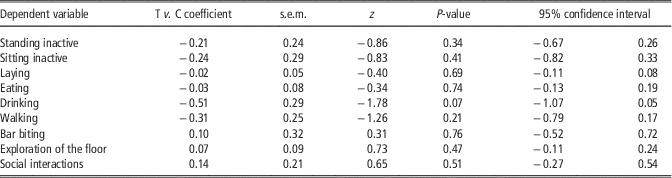
Owing to the differences in pen composition, resulting from the random births of conventional and transgenic pigs, the analysis of behavioural data was performed separately for the two pens containing two conventional and one hDAF transgenic pigs (2C-1T) and for the six pens containing one conventional and two hDAF transgenic pigs (1C-2T). Generalized linear mixed models were used to analyse the influence of pig genotype (C or T) on the behaviour of individual pigs and on the type of interaction between couples of pigs. As behaviours have been recorded as counts, Poisson regression models were used. Behaviours were used as dependent variables, and pig genotype as fixed effect variable (T v. C). The pig individual, the date of observation and the pen composition were added as random factors. The total number of observations has been used as exposure variable.
With regard to social interactions, the number of observed interactions was weighed to take into account the composition of each pen (i.e. in pens containing two conventional and one hDAF transgenic pig (2C-1T), the probability of interaction between two conventional pigs is equal to
 ${\textstyle{1 / 2}}$
than between C and T). Agonistic interactions were used as dependent variables and ‘couple genotype’ as fixed effect variable (TT v. CT and CT v. CC); the total number of interactions was added to the models as exposure, so that coefficients are interpreted as differences in the rate of agonistic interaction, given the number of total interactions. The pen and the date of observation were added as random factors.
The significance level was set at P<0.05.
The statistical software package used was Stata version 11.2 (StataCorp, 2009).
Results
No mortality occurred, neither daily clinical observations revealed any pathological findings. During the experimental period, the growth rhythm did not differ between the two genotypes (P>0.05): the initial BWs were 50.4±3.4 and 49.9±2.3 kg; the average daily weight gain was 0.82±0.16, and 0.85±0.11 kg/day for conventional and hDAF transgenic animals, respectively.
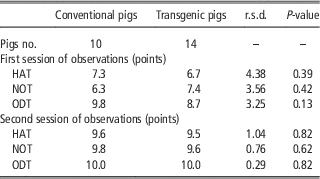
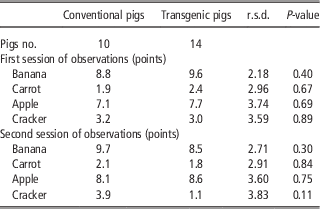
Table 2 shows the results of the temperament tests. No significant differences (P>0.05) were found between conventional and hDAF transgenic pigs with respect to the HAT, the NOT and the ODT. Regardless of the type of the animals (C v. T), scores obtained during the first test session (50 kg BW) were lower than those recorded in the second session (80 kg BW) with significant time-related (first v. second observational session) differences (P<0.01) for HAT and NOT scores. Food preferences were also not affected by the genotype of pigs (Table 3). Banana, followed by apple, were the most appreciated foods, whereas lemon was constantly refused by all pigs. No differences related to the session of observation were detected.
Temperament tests of transgenic pigs compared with their conventional close relatives (scores)

HAT=human approach test; NOT=novel object test; ODT=open-door test.
Food preference tests of transgenic pigs compared with their conventional close relatives (scores)

Lemon was constantly refused by all pigs.
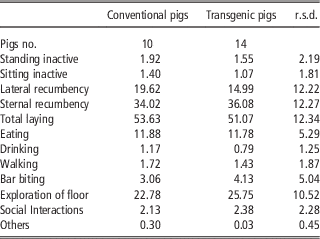
The different behaviours of pigs (expressed as a percentage of total observed behaviours) over a 10-h diurnal period are shown in Table 4. Lying (sum of sternal and lateral recumbencies) was the most frequent behaviour for both genotypes (more than 50% of total observations). Exploration of the floor was the second more frequently observed behaviour (on average 24% of total observations), followed by eating behaviour (12% of total observations). No significant differences between the behaviours expressed by hDAF transgenic and conventional pigs were detected (Table 5).
Behavioural traits (% of total observed behaviours) of transgenic pigs compared with their conventional close relatives

Results of the Poisson models on individual behaviours of transgenic (T) pigs in comparison with conventional (C) pigs

As far as social interactions are concerned, non-agonistic interactions were largely prevalent (69.7% of total observed interactions), with nose-to-body interaction being the most frequently observed behaviour (33.29% of total interactions), whereas head-to-head (without bite) was the prevalent agonistic interaction (18.76% of total interactions). The results of the Poisson regression model for agonistic interactions are reported in Table 6. No significant differences were detected in relation to the genetic type of the pigs.
Results of Poisson models on total agonistic interactions occurring between two individuals depending on the pen’s composition

1 Pens 2C-1T contained two conventional and one transgenic pig. Coefficients refer to interactions between a conventional and a transgenic pig (CT) compared with interactions between two conventional pigs (CC).
2 Pens 1C-2T contained one conventional and two transgenic pigs. Coefficients refer to interactions between two transgenic pigs (TT) compared with interactions between one conventional and one transgenic pig (CT).
The mean hair cortisol content of hDAF transgenic and control pigs was 4.58±1.38 pg/mg and 3.58±1.44 pg/mg, respectively, with no statistical differences (P>0.05) between groups.
Discussion
Fear tests are aimed to elucidate the coping style of animals facing unexpected events. The coping style can be defined as ‘a coherent set of behavioural and physiological stress responses which is consistent over time’ (Koolhaas et al., Reference Koolhaas, Korte, De Boer, Van der Vegt, Van Reenen, Hopster, De Jong, Ruis and Blokhyuis1999). Therefore, information obtained from fear tests can be of aid in assessing animal welfare status because it helps in predicting the stress response of the animal in subsequent situations. Results from the present research indicate that no differences were detectable between hDAF transgenic and conventional pigs in terms of behavioural responses, given a set of standardized circumstances (i.e. HAT, NOT, ODT tests).The higher scores obtained in the second test session by both genotypes for HAT and NOT are consistent with the results of van Erp-van der Kooij et al. (Reference van Erp-van der Kooij, Kuijpers, Schrama, van Eerdenburg, Schouten and Tielen2002) and they indicate that experienced animals were more willing to cope with unexpected events when compared with inexperienced and younger pigs that can be relatively easily scared. It should be noted that our scores, regardless of the test session, were higher than those recorded in the above-mentioned study (van Erp-van der Kooij et al., Reference van Erp-van der Kooij, Kuijpers, Schrama, van Eerdenburg, Schouten and Tielen2002), suggesting that pigs used in the present experiment had in general a low degree of susceptibility towards unexpected events. This fact could be probably ascribed to the high frequency of daily human–pig interactions to which these particular experimental animals have been subjected since the very beginning of their lives. Although the study of taste is not specifically relevant to welfare assessment, the reaction towards different food sources could bring, in our opinion, some further insights into the pigs’ sensory capacities. In this respect, our results fully agree with those reported by Archer et al. (Reference Archer, Friend, Piedrahita, Nevill and Walker2003) who tested the same ingredients and they indicate a strong predilection for apple and banana, as well as lemon aversion, therefore confirming the well-known preference of pigs for sweet taste (Diaz et al., Reference Diaz, Speer, Ashton, Liu and Catron1956).
As far as the main behavioural traits are concerned, lying (sternal and lateral recumbencies) is the most frequent behaviour in stabled pigs and it varies, over a 24-h period, from 60% of total observation for young piglets (Hay et al., Reference Hay, Vulin, Génin, Sales and Prunier2003) to 80% and more for 10-month old pigs with a BW of about 160 kg (Scipioni et al., Reference Scipioni, Martelli and Volpelli2009). Therefore, rest disruption is believed to negatively affect swine welfare (EFSA, 2007). Although the duration of lying bouts was not assessed, in the present study, all pigs, regardless of their genotype, spent more than one half of their diurnal time resting apparently undisturbed and this fact can be regarded as an indicator of a proper level of animal welfare. Accordingly, the behaviours that are indicative of poor welfare such as stereotypies (bar biting) and aggressions (Broom, Reference Broom1991) were observed at a very low extent in both groups. It should be noted that, all over the experimental period, pigs have not been subjected to any form of mixing between unfamiliar animals, thus reducing competitive behaviours and subsequent possible injuries. With respect to rooting behaviour, which, in agreement with Lyons et al. (Reference Lyons, Bruce, Fowler and English1995), accounted for about a quarter of the observations, it was mainly directed towards straw and feed residuals and it can be interpreted as the expression of a normal explorative need (Studniz et al., Reference Studniz, Jensen and Pedersen2007). On the whole, it can be concluded that no behavioural abnormalities were detected for both genotypes and all animals, regardless of their genotype, displayed a behavioural pattern typical of captive growing pigs. The absence of differences in fear tests and aggressiveness is in agreement with findings from Huber et al. (Reference Huber, Remuge, Carlisle, Lillico, Sandøe, Sørensen, Whitelaw and Olsson2012), who compared conventional and transgenic pigs expressing green fluorescent protein.
Interactions among pigs accounted, without significant differences between genotypes, for about 2% of total observed behaviours. The absence of significant differences in the number of aggressive behaviours occurring between the different genotypes confirms the basic behavioural similarity between conventional and hDAF transgenic animals.
No significant differences were found with respect to the level of hair cortisol, which is believed to be a chronic stress indicator, as it represents the summary of stressful events occurring over a certain period of time, and therefore gives long-term information both on humans and animals (Russel et al. Reference Russel, Koren, Rieder and Van Uum2012).
Conclusion
Given the growing attention towards well-being issues of GM pigs (Niemann et al., Reference Niemann, Kues and Carnwath2005; Ormandy et al., Reference Ormandy, Dale and Griffin2011), the present research was focused on some welfare-related traits of transgenic pigs used in human medical research. Our results, obtained from the comparison between hDAF transgenic pigs intended for xenotrasplantation and their conventional (i.e. not transgenic) close relatives (full sibs and half-sibs), indicate that no significant differences were detectable between the two genotypes with respect to growth traits, reactivity towards unexpected situations, food preferences, behavioural traits (including social interactions) and bristle cortisol level, therefore suggesting that, under the present experimental conditions, no significant undesirable effect occurred depending on the specific genetic modification.
Acknowledgement
The authors would like to thank the Section Editor and the two anonymous reviewers for their valuable comments and suggestions to improve the quality of the paper.
Financial Support
The research was funded by the Italian Ministry for Education, Universities and Research.