1. Introduction
Litigation on European and American support to Airbus and Boeing has arguably been the one with the highest-profile in WTO jurisprudence and has put pressure on the dispute settlement system with the longest dispute in WTO history, running since 2004 and not completed yet. At the time of writing, retaliation by both sides is a distinct possibility. With the US being recognized as having the right to impose tariffs on $7.5 billion worth of EU goods and the EU seeking authorization to impose around $10 billion on US goods, one wonders whether a settlement is the only possible solution to this case.Footnote 1 This article focuses on one of the latest legal steps of this saga, reviewing the Appellate Body decision in the implementation phase of the EC–Aircraft Footnote 2 dispute. Focusing on some of the key findings litigated before the Appellate Body, we assess whether they are legally and economically correct. We also speculate on the implications of these findings, in the context of the broader WTO case law, on the strength of current subsidy disciplines in the WTO. This provides us with a good opportunity to review the main economic theories explaining subsidy control and putting forward few general ideas and directions for law reform.
2. Economics of the Large Civil Aircraft industry
The large civil aircraft (LCA) industry is characterized by imperfect competition arising from a combination of several factors. First, the industry exhibits high barriers to entry, mostly due to set up costs and R&D requiring massive capital investments. These important fixed costs result in substantial increasing returns to scale and in a limited number of actors on the market (duopoly/oligopoly). First, only few companies are able to overcome the fixed cost of entry, in general with external support from the government, and may eventually grow sufficiently to lower their average cost of production to a level that ensures profitability. Secondly, the learning-by-doing process over the years triggers dynamic economies of scale, a critical and widely acknowledged feature of the LCA industry. According to Busch (Reference Busch2001), the learning elasticity in civil aircraft manufacturing has been estimated to 0.2, which means that doubling aggregate output would result in a 20% fall in unit cost. Similarly, Deutsche Airbus estimated that the time needed to complete wing joining of its first A321 could be divided by more than six with cumulated experience (from 25 to 4 days). Thirdly, the LCA industry exhibits substantial economies of scope as technology and factors of production are partially mobile across aircraft models. By producing new aircraft types, some production costs can be shared and/or reduced. This holds true not only on the producer side but also on the consumer side. Indeed, airlines also benefit from economies of scope, for example regarding training and maintenance when operating a standardized fleet. This is the reason why an aircraft model is rarely produced without being accompanied by ‘derivatives’ forming together an aircraft family (Knorr et al., Reference Knorr, Bellmann and Schomaker2012). The characteristics described above are market failures that violate the main assumptions of classic trade theory based on comparative advantages and differences in technologies/endowments. In such a context of imperfect competition, government interventions in favor of domestic producers might be economically justified to increase the national welfare.
To analyse such a situation, economic theory uses a ‘strategic’ trade policy framework, initially developed by Brander and Spencer (Reference Brander and Spencer1985), further extended, discussed, and applied to the aircraft industry in various papers (Krugman, Reference Krugman1987; Baldwin and Krugman, Reference Baldwin and Krugman1988; Fairchild and McGuire, Reference Fairchild and McGuire2010). The theory applies in a context where large established and experienced firms benefit from rents (extra profits resulting from a price above the marginal cost) that can be internationally shifted using domestic/export subsidies. However, as discussed in Pavcnik (Reference Pavcnik2002), shifting market shares and profits from foreign to domestic firms in the aircraft industry does not generate automatic benefits. In a Cournot competition setting (competition on the amount of output), Brander and Spencer (Reference Brander and Spencer1985) show that a subsidy to the domestic industry is a welfare-enhancing policy as it transfers rents from the foreign to the domestic firm, increasing the domestic firm's profits by more than the amount of the subsidy. In contrast, when firms compete in prices in a Bertrand model, Eaton and Grossman (Reference Eaton and Grossman1986) demonstrate that a tax is generally the optimal strategic policy. Finally, according to the Maggi (Reference Maggi1996) model, in which the mode of competition is endogenously determined, from a domestic point of view, capacity subsidies are welfare enhancing. As pointed out by Pavcnik (Reference Pavcnik2002), ‘anecdotal evidence points to firms competing in price’ (p. 738), questioning therefore the potential welfare gain of granting export subsidies in the LCA markets.
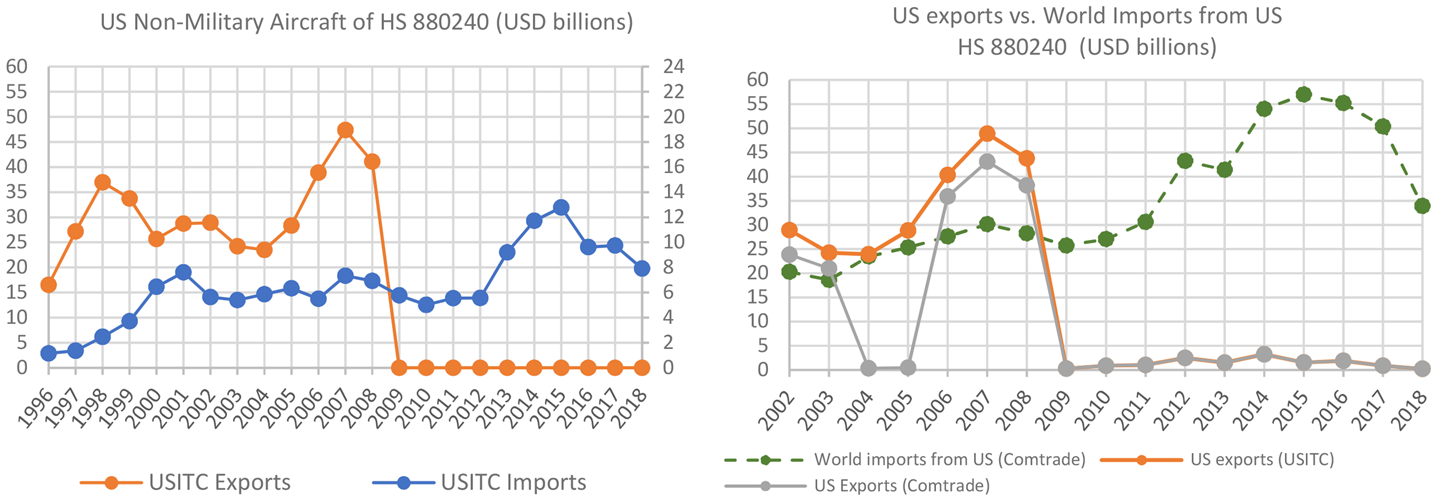
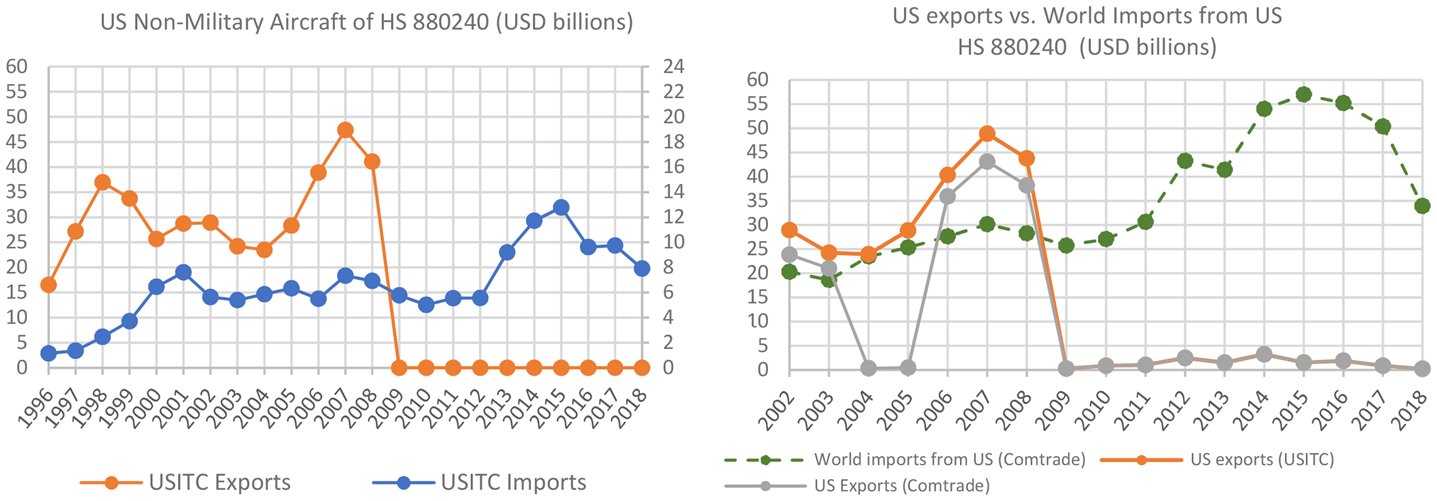
In such a context, where the models’ assumptions cannot be verified, it is natural to rely on empirical analysis to assess the impact of government subsidies on strategic interactions and profit shifting. Unfortunately, due to data limitations, such an exercise has never been carried out (Pavcnik, Reference Pavcnik2002). While an economic analysis has been conducted in the original panel, most of the data were kept confidential (CBI) and cannot therefore be assessed or further developed. To illustrate the difficulty obtaining relevant quality data in the aircraft industry, it can be noted that recent US export data have been restricted from 2009 onwards for the product of concern, that is, civil aircraft of HS 880240 (see left panel of Figure 1 below). While mirror trade statistics, i.e. the aggregated imports from the US reported by all US trading partners, could potentially be used to proxy US exports, such data suffer from serious shortcomings, as reflected by the discrepancies for years before 2009 where both US exports (from USITC or Comtrade) and partners’ imports from US are reported (right panel of Figure 1 below).
US Imports and exports of civil aircraft
Despite the data limitation, simulations were nonetheless carried out to estimate the impact of government support on domestic, foreign, and third country (rest of the world) welfare. Baldwin and Krugman (Reference Baldwin and Krugman1988) expand the model by Brander and Spencer (Reference Brander and Spencer1985) to account for consumption. They show that prices would be 40% higher in the absence of Airbus in the aircraft market. In contrast, Klepper (Reference Klepper1990) suggests that Airbus entry limited the ability of companies to benefit from economies of scale and therefore it had a negative impact on domestic welfare. Finally, Neven and Seabright (Reference Neven and Seabright1995) show that accounting for third producer may reduce the price reduction benefits associated with Airbus entry into the market.
As can be seen from the above discussion, although strategic trade policy is useful to analyse the economics of the LCA industry, it also suffers from shortcomings and limitations. Not only results vary depending on assumptions that cannot be systematically empirically tested (e.g. the type of competition seems to be related to price but there is no definitive answer), but the theory is also unable to properly reflect some major features of the LCA industry such as the lack of transparent information that remains an important issue. First, to make sound decisions, the government would need to have information on the profit of the company beneficiary of the subsidy, both with and without foreign competition, and to make sure that a strategic opportunity exists (Carbaugh and Olienyk, Reference Carbaugh and Olienyk2001).
The same reasoning applies to any business decision by economic players who are supposed to be fully aware of all strategic interdependences allowing them to anticipate any possible response(s) by competitors (Knorr et al., Reference Knorr, Bellmann and Schomaker2012). In addition, in the context of the WTO, possible retaliatory measures would also have to be endogenized.
Secondly, the WTO founding principles do not provide clear guidance regarding what the objective of trade liberalization should be. Mavroidis (Reference Mavroidis2005) argues that WTO rules tend to take the stance in favor of producers’ interests. Nevertheless, the way to adequately account for consumers’ surplus in trade disputes and to evaluate the desirability of domestic subsidies remains an open question. While political economy models often rely on government's objective functions, assigning weights to each welfare component motivating a politically interested decision (producers’ surplus, consumers’ surplus, and government revenues), these weights are challenging to compute in reality.Footnote 3 In addition, beyond the above-mentioned information on profit and competition, a government willing to maximize global welfare would require precise estimations of the demand function to compute the consumers’ surplus.
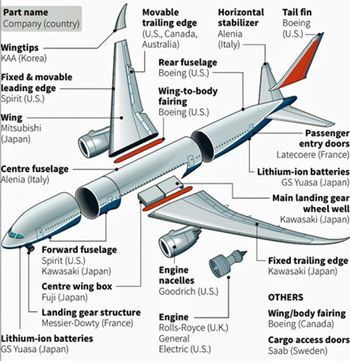
Finally, one of the major shortcoming of the literature is the incapacity to integrate the complexity of today's global value chains. As explained by Knorr et al. (Reference Knorr, Bellmann and Schomaker2012: 592), the LCA industry is not only characterized by huge fixed costs of entry, but also by a low degree of vertical integration. Both Boeing and Airbus essentially focus on R&D, design, and final assembly of LCA, and mostly rely on subcontractors to take care of other production stages.Footnote 4 The latter may be located in the domestic market, in the competitor market, or in third countries. For example, as Figure 2 shows, the foreign inputs used in the production of the B777 amount to 30%. For the B878, 65% of the airframe is manufactured by external suppliers from the US, Japan, and Italy. On the one hand, we can expect that the more internationalized the industry is, the more likely the subsidies granted domestically are to also benefit foreign players (consumers and/or producers), making it even more difficult for policy makers to assess the domestic impact of subsidies and assess their desirability from a global and/or national welfare point of view (see Figure 2 below). On the other hand, the international outsourcing strategy can allow to obtain international support, as has been the case in the past with Japanese and Italian government support to Boeing programmes (Pritchard and Macpherson, Reference Pritchard and MacPherson2004). In such internationalized industry, all offsetting effects resulting from the application of a subsidy make it highly challenging, if not impossible, to compute the net gain/loss for each economic agent.
787 Dreamliner Structure suppliers – Selected component and system suppliers
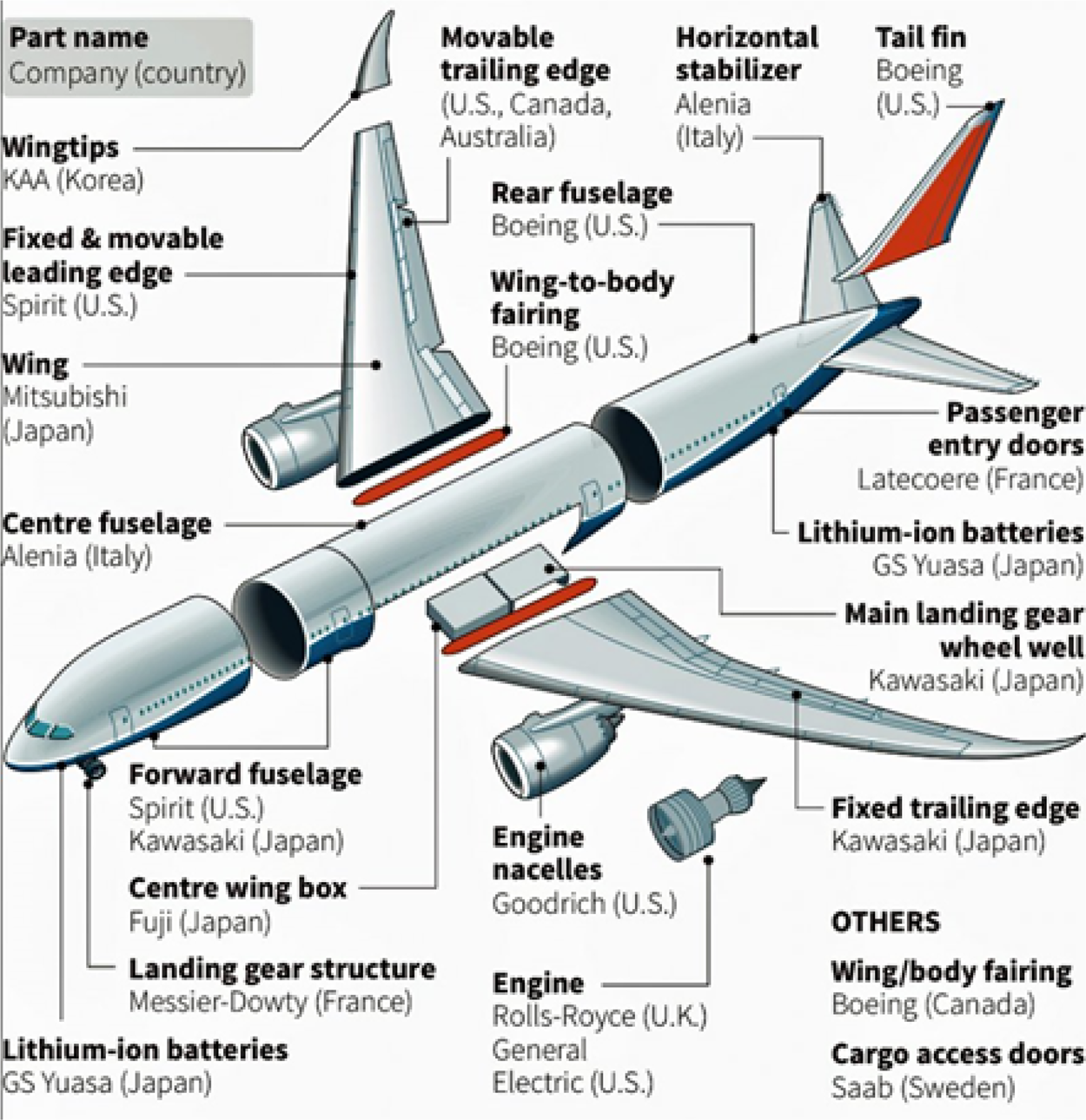
Considering the complexity of the aircraft sector, selected issues based on the Appellate Body report will be discussed while our contribution will be to reflect on the rationale of subsidy control, in the light of the findings of this report and within the broader context of the case law on WTO subsidy disciplines.
3. Original and Implementation Proceedings
In the original proceedings, the United States (US) claimed that the grant of various forms of specific subsidies to Airbus, producer of large civil aircraft (LCA), by the European Communities (hereinafter European Union or EU) and certain of its Member States were prejudicial to the interest of the US, most notably:
(a) ‘Launch aid’ or ‘member State financing’ (LA/MSF) for the A300, A310, A320, A330, A330-200, A340, A340-500/600, and A380 models of LCA,
(b) French and German government ‘equity infusions’ provided in connection with the corporate restructuring of Aerospatiale and Deutsche Airbus,
(c) Certain infrastructure and infrastructure-related measures provided by German and Spanish authorities, and
(d) Research and technological development (R&TD) funding provided by the European Communities and certain member States.Footnote 5
On appeal, the Appellate Body essentially upheld these findings, while reversing the original Panel's conclusion that the US had established that the German, Spanish, and UK LA/MSF for the A380 constituted prohibited export subsidies within the meaning of Article 3.1(a) of the SCM Agreement.
On 1 June 2011, the Dispute Settlement Body (DSB) adopted the Appellate Body report and the Panel report as modified by the Appellate Body. On 1 December 2011, the EU informed the DSB that it had taken ‘appropriate steps to bring its measures fully into conformity with its WTO obligations, and to comply with the DSB's recommendations and rulings’, referring also to the specific measures and relevant intervening events that, in its view, ensured compliance. The EU referred to inter alia: (a) the repayment and/or termination of LA/MSF, (b) the imposition of increased fees and lease payments on infrastructure support in accordance with market principles, and (c) ensuring that capital contributions and regional subsidies had come to an end and were no longer capable of causing adverse effects (Appellate Body Report, EC–Aircraft (21.5), para. 1.8).
On 9 December 2011, the United States requested consultations under Article 21.5 of the Dispute Settlement Understanding (DSU), stating that the ‘actions and events’ listed in the EU's notification did not withdraw the subsidies or remove their adverse effects as per under Article 7.8 of the SCM Agreement. Before the Panel, the United States had argued that the relevant subsidies found to have caused adverse effects within the meaning of Articles 5(c) and 6.3 of the SCM Agreement in the original proceeding continued to cause adverse effects and, in some cases, had even been expanded causing additional adverse effects. The EU, the US submitted, had thus failed to ‘take appropriate steps to remove the adverse effects or withdraw the subsidy’ as Article 7.8 of the SCM Agreement requires. The US finally claimed that certain measures constituted prohibited export and/or import substitution subsidies within the meaning of Articles 3.1 and 3.2 of the SCM Agreement (Appellate Body Report, EC–Aircraft (21.5), para. 1.10).
The Panel circulated its Report on 22 September 2016. It held that the US failed to demonstrate that the subsidies at issue were prohibited under Article 3 of the SCM Agreement. It, however, also found that the fact that the ‘ex ante lives’ of certain subsidies had ‘passively expired’ before the end of the implementation period did not amount to ‘withdrawal’ of those subsidies for the purpose of Article 7.8 of the SCM Agreement.Footnote 6 With respect to the ‘serious prejudice’ claims, the Panel found that the ‘product effects’ of the relevant LA/MSF subsidies were a ‘genuine and substantial’ cause of displacement and impedance of export under Article 6.3(b) of the SCM Agreement and of significant lost sales in certain global markets under Article 6.3(c). The Panel also concluded that the ‘product effects’ of the aggregated LA/MSF subsidies were ‘complemented and supplemented’ by the effects of the aggregated capital contribution subsidies and certain regional development grants, thus constituting a genuine cause of serious prejudice to the interests of the US. The Panel thus concluded that, by continuing to violate Articles 5(c), 6.3(a), 6.3(b), and 6.3(c) of the SCM Agreement, the EU and certain member States had failed to comply with the DSB recommendations and rulings, including the obligation ‘to take appropriate steps to remove the adverse effects or withdraw the subsidy’ under Article 7.8 of the SCM Agreement.Footnote 7
In their appeal, filed in October 2016, the EU and the US raised inter alia several issues of interpretation and application of the SCM Agreement, in particular of Articles 1.1(b), 3.1(b), 5(c), 6.3, 6.3, and 7.8.
4. Main Issues before the Appellate Body
A few significant substantive issues were raised and analysed in this implementation phase appeal.
First, the US challenge to the Panel's finding that the US failed to establish that certain member States LA/MFM measures constituted subsidies contingent upon the use of domestic over imported goods (so-called ‘import substitution’ or ‘local content’ subsidies), offered the Appellate Body the opportunity to further clarify the scope of the provision and of the test of de facto contingency applicable to import substitution subsidies. Secondly, the Appellate Body was asked to determine whether the Panel's interpretation and application of various market benchmarks for the purposes of the benefit analysis under Article 1(b) of the SCM Agreement was correct. Thirdly, the Appellate Body had to interpret the meaning of the remedy for actionable subsidies under Article 7.8 of the SCM Agreement and clarify in particular whether the Panel was correct in concluding that, even if the subsidy at issue had expired before the end of the implementation period, the implementing Member was still under an obligation ‘to take appropriate steps to remove the adverse effects’. Fourthly, one important issue raised before the implementation Panel, and rehearsed before the Appellate Body, was whether the ‘serious prejudice’ analysis of Article 6.3 requires that any subsidy received by the complainant's like industry be taken into due account. Fifthly, the Appellate Body further interpreted the methodology to define the relevant product market in the context of a serious prejudice analysis. Sixthly and finally, the Appellate Body was called to clarify the causation analysis with respect to ‘product effects’, ‘lost sales’, and ‘displacement’ and ‘impedance’ of imports.
5. Analysis of Issues of Particular Interest
The central part of the paper analyses some of the findings of the Appellate Body from three perspectives: first, whether they are sound from the point of view of legal interpretation, secondly whether they are in line with economic analysis, and finally whether they raise remarks that are more general concerning the effectiveness of subsidy control. This assessment, set within the context of the broader WTO case law, has also led the authors to ask questions of more general nature which focus on the rationale of the WTO system of subsidy control.
5.1 The Scope of the Prohibition of Import Substitution Subsidies: Appropriately Defined?
5.1.1 Are Domestic Subsidies and Import Substitution Subsidies the Same?
At the Panel level, the US had argued that the French, German, Spanish, and UK A350XWB LA/MSF contracts were inconsistent with Article 3.1(b) of the SCM Agreement because they granted subsidies contingent upon the use of domestic over imported goods. The Panel disagreed for two reasons. First, the factual evidence did not clearly indicate the existence of such a contingency. Secondly, the Panel set out that there was a clear distinction in WTO law between domestic subsidies and subsidies contingent on the use of domestic over imported goods. In so doing, the Panel drew a parallel between Article III:8(b) of the GATT, which excludes from the national treatment obligation ‘subsidies paid exclusively to domestic producers’, and Article 3.1(b) of the SCM Agreement which, as said, prohibits local content subsidies. In particular, the Panel understood Article III:8(b) of the GATT to ‘suggest … that the act of granting subsidies to firms so long as they engage in domestic production activities, without more, should not be equated to making those subsidies contingent on the use of domestic over imported goods and hence prohibited’.Footnote 8 The Panel also added that ‘the practice of providing subsidies to firms only so long as they engage in domestic production activity can and will many times … increase consumption of domestic goods’ thereby ‘limit[ing] competitive opportunities for relevant imported goods in certain markets’.Footnote 9 But, under WTO law, these ‘alterations in the conditions of competition’, are objectionable only if a contingency (whether in law or in fact) on the use of domestic over imported goods can be established.Footnote 10
Since the US seemed to argue that the contracts at issue were contingent on the use of domestic over imported goods because they conditioned the subsidies receipt on the production of domestic LCA goods, the Panel found that the ‘narrow and specific’ discipline of Article 3.1(b) of the SCM Agreement was not activated.Footnote 11
The Appellate Body was thus called to interpret Article 3.1(b) of the ASCM and, through this, define the scope of this prohibition and, at the same time, draw the line between it and the general disciplines for domestic subsidies.
Article 3.1(b) of the SCM Agreements reads:
Except as provided in the Agreement on Agriculture, the following subsidies, within the meaning of Article 1, shall be prohibited:
…
(b) subsidies contingent, whether solely or as one of several other conditions, upon the use of domestic over imported goods.
The Appellate Body immediately (at para. 5.55) made clear an important legal and policy point: the granting of a subsidy is not, in and of itself, prohibited or otherwise objectionable under the SCM Agreement. It is only when subsidies are made contingent upon export performance or upon the use of domestic over imported goods that they are prohibited, respectively under Article 3.1(a) and 3.1(b) of the SCM Agreement. All other (domestic) subsidies are permissible, unless they are found to be specific and, most importantly, determined to cause adverse effects within the meaning of Article 5 of the SCM Agreement. These few statements by the Appellate Body embody the balance of the WTO subsidy disciplines.
The Appellate Body then turned to the interpretation of the specific terms ‘contingent upon’ and ‘use’. After preliminarily noting that the legal standard for establishing contingency for import substitution subsidies is the same as that required for export subsidies, the Appellate Body repeated the consistent dictum that ‘contingent’ is synonymous of ‘conditional’ or ‘dependent for its existence on’, thus referring to a tight relationship between the subsidy and the use of domestic goods.Footnote 12 On its part, the word ‘use’ would signal the ‘consumption’, ‘incorporation’, or ‘utilization’ of a good.Footnote 13 Then the Appellate Body reconfirmed and built on the previous case law to equate the standard for de jure and de facto contingency which, in the words of the Geneva-based body, is a ‘single legal standard’.Footnote 14
Following again the path of the Panel, the Appellate Body further distinguished simple domestic subsidies from subsidies contingent on the use of domestic goods, drawing a parallel between the carve-out created by Article III.8(b) of the GATT and the prohibition of import substitution subsidies of Article 3.1(b) of the SCM Agreement. It did so by referring almost word by word to four paragraphs of its report in the US–Tax Incentives Footnote 15 dispute (see paras. 5.14, 5.15, 5.16, 5.17).Footnote 16 As noted, support of domestic production ‘can ordinarily be expected to increase the supply of the subsidized domestic goods in the relevant market, thereby increasing the use of these goods downstream and adversely affecting imports’.Footnote 17 The possibility that domestic subsidies, paid directly to input good producers, and local content subsidies, i.e. subsidies paid to producers using those input goods, may produce similar effects is indeed known in the literature.Footnote 18 Sykes (Reference Sykes2003), 19) notes:
a per unit subsidy to all domestic buyers of a good can be completely equivalent in its effects to an equal per unit subsidy to all domestic sellers – net output of domestic producers, net imports, and the net price to buyers will be exactly the same under competitive conditions.
This granted, the two measures of support are not necessarily the same in design and impact. There may be good economic and policy arguments for regulating the two types of subsidies differently.Footnote 19 Contrary to subsidies to domestic input producers, import substitution subsidies affect two markets (downstream and upstream) by their own design.Footnote 20 Most crucially, though indirect, the support to the upstream input industry happens through a condition expressly restricting foreign competition.Footnote 21 It is for this reason that both the Panel and the Appellate Body clarified the clear discriminatory nature of import substitution subsidies.Footnote 22
Thus, as the Appellate Body noted, it is clear that ‘subsidies that relate to the production of certain goods in a Member's domestic territory can ordinarily be expected to increase the supply of the subsidized domestic goods in the relevant market, which would have the consequence of increasing the use of domestic goods downstream’.Footnote 23 Similarly, if subsidies are granted for the production of both inputs and final goods, their effect largely depends on the total configuration of the factual circumstances (as noted by the Appellate Body, the existence of a multi-stage production process, the level of specialization of the subsidized inputs, the level of integration of the production chain).Footnote 24 In other words, the precise impact of the measure can only be evaluated through the assessment of the design, structure, and modalities of operation in its particular market.Footnote 25 The same should, arguably, apply also to the case of subsidies contingent on the location of economic activities such as those analysed in the US–Tax Incentives dispute. That being said, while it is true that all of these measures of support may produce the same effects as an import substitution subsidy, it is also true that none of them shares the same discriminatory nature and protectionist intent, which is what, in our view, justifies a different WTO regulation.Footnote 26
In other words, governments may design their support measures in various ways. They may directly subsidize production (of inputs and/or final goods). They may incentivize location of production and investment decisions. Finally, they may ensure the eligibility of a subsidy is contingent or conditional on the use of certain goods (import substitution subsidies). All these measures may or do impact input markets but, because of the operation of a legal requirement of sourcing inputs locally, it is only with import substitution subsidies that protectionist intent is clear and the discriminatory effect is direct.
5.1.2 The Meaning of Contingency in de Facto Analysis
If, then, it makes sense to distinguish from a regulatory perspective import substitution subsidies from domestic subsidies, and attach the sanction of prohibition only to the former because of their clear protectionist intent, what becomes crucial is the identification of the legal test which is used to differentiate between the two. The key legal language is ‘contingent upon’. But what does ‘contingent’ mean?
It is known that, in its early jurisprudence (Canada–Autos),Footnote 27 the Appellate Body expanded the scope of the prohibition by concluding that the provision covers not only de jure (or ‘in law’) but also de facto (or ‘in fact’) contingency on the use of domestic goods. From the point of view of evidence, de jure contingency is based on the very words, or by necessary implication from the words, of the law.Footnote 28 By contrast, de facto contingency can be inferred from the total configuration of the facts,Footnote 29 which may include consideration of the following factors: the design and structure of the measure, its modalities of operation, and the various factual circumstances.Footnote 30 Proving de facto contingency through this ‘holistic and case-specific assessment’Footnote 31 of all these and other factors is, using the words of the Appellate Body, ‘a much more difficult task’.Footnote 32
Granted the evidence to prove de facto contingency is by nature different, what is the legal standard which has to be used to make sense of this evidence? The Appellate Body consistently repeats that de facto contingency shares the ‘same’ legal standard of de jure contingency.Footnote 33 This statement is open to debate and indeed is misleading.Footnote 34 Arguably, it only makes sense to the extent that it means that we cannot have two completely and arbitrarily different tests – for example, one strict and one lenient – for the two types of contingency. But – this is our main contention – the two types of assessment have a different nature, if only because in one you look at the words of the law, in the other you assess the facts. Mavroidis (Reference Mavroidis2016a: 270) has highlighted the specific rationale of de facto contingency, as a device to capture policy circumvention. Despite contrary statements of ‘sameness’, this difference is also recognized by the Appellate Body when it states that the analysis of de jure and de facto contingency ‘should be understood as a continuum’.Footnote 35 If they are part of a continuum, logic dictates they cannot be the same. But, having highlighted the special nature of de facto analysis, what is then the legal standard to assess the total configuration of facts? What is the meaning of ‘contingency’ in this specific context?
We can immediately say that, after the EC–Aircraft (21.5) dispute, we are still unclear. Without definitely settling the issue, the Appellate Body seems to be hinting at a very strict legal test. By relying on the stated equivalence between the contingency standards for export and import substitution subsidies, the Appellate Body could have drawn on the more developed case law on export contingency and, in particular, the contingency test it had developed in the original proceedings of the same dispute. There it noted that export contingency can be determined by assessing whether ‘the granting of the subsidy [is] geared to induce the promotion of future export performance by the recipient’ and ‘provides an incentive to skew anticipated sales towards exports’, in a way that ‘is not simply reflective of the conditions of supply and demand in the domestic and export markets undistorted by the granting of the subsidy’.Footnote 36
Crucially, the compliance Appellate Body did not mention this test at all with the result that we are currently left in a limbo. Once again, by heavily repeating its dicta in the US–Tax Incentives dispute, the Appellate Body concluded its reasoning this way:
In light of the above, to the extent that no conditionality requiring the use of domestic over imported goods can be determined … In other words, the relevant question in determining the existence of contingency under Article 3.1(b) is not whether the eligibility requirements under a subsidy may result in the use of more domestic and fewer imported goods. Rather, the question is whether a condition requiring the use of domestic over imported goods can be discerned from the terms of the measure itself, or inferred from its design, structure, modalities of operation, and the relevant factual circumstances constituting and surrounding the granting of the subsidy that provide context for understanding the operation of these factors.Footnote 37
The final paragraph of the relevant part of the report seems to indicate a particularly high standard, as the emphasized words ‘condition requiring’ seem to hint at. This standard is arguably stricter than the ‘incentive test’ put forward for de facto export contingency analysis, pace any equivalence between the prohibitions of import substitution subsidies and export subsidies declared by the Appellate Body. Furthermore, and more importantly, as Buzard and Delimatsis (Reference Buzard and Delimatsis2018) note, the language of requirement seems to blur the distinction between de jure and de facto contingency.Footnote 38 This may not reflect the specific nature of a de facto analysis.
That being said, despite these laconic hints, we still do not know what the precise standard of contingency is for import substitution subsidies. The Appellate Body did not mention (to validate or exclude) the ‘incentive’ test developed in the context of the language of export contingency. There is indeed no policy or other reason that would justify a different test. The Appellate Body itself considered the two standards of contingency ‘equivalent’, even more it talked of a ‘single legal standard of contingency’.Footnote 39 The said omission may offer one ray of hope. While heavily drawing on its previous report in US–Tax Incentives for the interpretation of the import substitution subsidy prohibition, it did not crucially refer to one important paragraph of that report (para. 5.17) where, with a rather unclear language, it had excluded the possibility of using an ‘incentive-based’ test for the determination of contingency in the context of Article 3.1(b) of the SCM Agreement.Footnote 40 It will be for future cases to clarify this important point.
5.1.3 Demanding Proof, Narrow Scope?
The final remark takes another perspective and focuses on the objective consideration that the legal standard to prove contingency may be too demanding. This is particularly true if we consider the legal test the Appellate Body seems to be hinting at in this case, which is essentially repeating what it had already found in the previous US–Tax Incentives case. Buzard and Delimatsis (Reference Buzard and Delimatsis2018) have already noted that the proof of a condition ‘requiring’ the use of domestic goods in the context of a de facto assessment ‘is bound to be hardly – if ever – met by the complainant’ (page 343). If this is correct, the route of Part II of the SCM Agreement may be one that cannot be easily taken (and we leave aside any discussion about the lack of clarity with respect to the evidence that could be used to prove ‘requirement’ in a de facto assessment). Importantly, this conclusion may apply beyond the implications of the EC–Aircraft (21.5) dispute. In this respect, Hahn and Mehta (Reference Hahn and Mehta2013) note that even the ‘incentive-based’ standard the Appellate Body set out for proving de facto export contingency is very high.
In other words, not only is the line between measures that are definitely troublesome (and hence prohibited) and measures that are only potentially so (and hence only actionable) unclear but the legal threshold may also be too demanding from a potential complainant's perspective. This may mean that the scope of the prohibition is de facto narrow, and perhaps narrower than it could have been expected when the Uruguay Round was concluded. We will later assess whether this conclusion has some bearing on the assessment of the general impact of WTO subsidy disciplines.
5.2 The Remedy: Interpretation of ‘Remove the Adverse Effects or Withdraw the Subsidy’
5.2.1 The Findings of the Panel and the Appellate Body
One of the key issues debated before the Panel and the Appellate Body in this compliance proceedings focused on the interpretation of the remedy for those subsidies that have been found to cause adverse effects. This is an issue of great systemic importance because it gives a clear indication of how strong the legal system of subsidy control in the WTO is, at least from a formal point of view.
Article 7 on the ‘Remedies’ for actionable subsidies reads under paragraph 8:
Where a panel report or an Appellate Body report is adopted in which it is determined that any subsidy has resulted in adverse effects to the interests of another Member within the meaning of Article 5, the Member granting or maintaining such subsidy shall take appropriate steps to remove the adverse effects or shall withdraw the subsidy.
Before the Panel, the EU argued that it had no obligation to adopt compliance measures with respect to subsidies that had ceased to exist prior to the DSB's adoption of the panel and Appellate Body recommendations and rulings in the original proceedings on 1 June 2011.
The Panel rejected this argument and found the following:
it follows from the effects-based nature of the disciplines in Article 5 and the role that Article 7.8 is intended to play in bringing an implementing Member into conformity with its obligations under the SCM Agreement, that there may well be particular factual circumstances when the obligation to ‘take appropriate steps to remove the adverse effects’ or ‘withdraw the subsidy’ will apply to subsidies found to have caused adverse effects in an original proceeding, irrespective of whether those subsidies continue to exist in the implementation period.Footnote 41
The Panel therefore concluded that compliance can be achieved only if an implementing Member no longer causes adverse effects through the use of subsidies.Footnote 42 The Panel crucially noted that
[i]f it is true … that Article 7.8 articulates a compliance rule that is intended to clarify how an implementing Member found to have caused adverse effects through the use of subsidies is to restore conformity with its obligations under Article 5 of the SCM Agreement, it must follow that the obligation to ‘withdraw the subsidy’ should be interpreted in a way that does not undermine this intended outcome. This means that the passive ‘expiry’ events the European Union relies upon as the sole basis to demonstrate that it has ‘withdrawn’ the relevant subsidies for the purpose of Article 7.8 cannot be characterized as such, because the very same subsidies were found in the original proceeding to cause adverse effects over a period of time that followed the full or partial ‘expiry’ of almost all of those subsidies. Indeed, we cannot see how the end of the ex ante lives of the relevant LA/MSF and capital contribution subsidies before 1 June 2011 could alone bring the European Union and certain member States into conformity with their obligations under Article 5 of the SCM Agreement when even the European Union does not argue that the ‘expiry’ of those subsidies must have necessarily brought an end to their effects in the marketplace and, therefore, that their potential to continue to cause adverse effects has ceased to exist.Footnote 43
Based on this principle, while agreeing with the EU that most of the pre-A380 LA/MSF subsidies had expired before the adoption of the recommendations and rulings of the DSB in the original proceedings, the Panel concluded that the EU nonetheless remained under an obligation to withdraw these subsidies by removing their adverse effects.
The EU challenged these findings before the Appellate Body arguing that Article 7.8 provides an implementing Member with the option of either ‘to remove the adverse effects’ or ‘to withdraw the subsidy’, and that compliance could be reached by the withdrawal of a subsidy through its expiry. According to the EU, the interpretation of the Panel would not be in line with the canons of interpretation of Article 31 of the Vienna Convention of the Law of Treaties and would collapse the independent meaning of the substantive obligations under Article 5 of the SCM Agreement (which objects ‘adverse effects’) with the implementation obligations under Article 7 (which simply requires either to remove those effects or withdraw the subsidy). Moreover, by introducing a ‘uniquely exacting compliance obligation’ for actionable subsidies only, this interpretation would stand out from any other cases in WTO law where the withdrawal of other policy instruments (including prohibited subsidies) would be sufficient to achieve compliance even if lingering effects in the market place remain. This result would cause ‘significant systemic concerns’.Footnote 44
The Appellate Body essentially endorsed the interpretative reading of the EU.Footnote 45 It immediately paraphrased (para 5.362) the language of Article 7.8 underlining that ‘[t]he use of the word “or” … suggests that the Member concern may implement the recommendations and rulings of the DSB … by choosing either of these alternative pathways to achieve compliance’, i.e. either to remove the adverse effects or withdraw the subsidy. Other language in Article 7.8 would highlight the need that a subsidy still exists not only as a legal prerequisite but even as a practical condition to any outstanding compliance obligation. If it is clear that, hypothetically, an implementing Member ‘granting or maintaining’ a subsidy could comply, through the ‘withdrawal’ of that subsidy, by, for example, aligning ‘the terms of the subsidy with a market benchmark’ or, otherwise, by modifying ‘the terms of the subsidy such that it no longer qualifies as a subsidy’, it would not be clear to the Appellate Body how a subsidy that no longer exists could be modified. To be sure, rehearsing findings of the Panel, the Appellate Body noted that the adverse effects of the subsidy could be removed by adopting ‘WTO-consistent regulatory, policy or other initiatives that would alter the effects of a subsidy in the marketplace’.Footnote 46 But, fundamentally, as the word ‘or’ suggests, the decision to follow the route of the removal of the adverse effects is an option that is entirely left to the discretion of the implementing Member. The context of Article 7.8 would confirm this reading. Importantly, Article 5 and Article 7.8 would concern two related but distinct enquiries, the former pertaining to the determination of the existence of adverse effects and of any causal link between those and the subsidy, and the latter the compliance actions that Members could take. The Panel's analysis would blur the distinction between these two separate provisions. Crucially, the ‘source’ of inconsistency with WTO subsidy laws is the subsidy that causes the adverse effects. That would justify the fact that WTO disciplines permit Members to become compliant by ‘withdrawing it’. Article 7.8 would be concerned only with subsidies that a Member is ‘granting or maintaining’ in the implementation period, hence on the subsidies that continue to exist. Contextual reference to the DSU would confirm, according to the Appellate Body, that a ‘measure’ still needs to exist for compliance obligations to continue to exist. The Panel's reading of Article 7.8 ‘would effectively mean that countermeasures could be imposed under Part III of the SCM Agreement to counteract “injury to the domestic industry” … regardless of whether the subsidy at issue has been withdrawn’.Footnote 47 For these reasons, the Appellate Body thus concluded that ‘while expired subsidies can give rise to adverse effects, there is no requirement under Article 7.8 to remove these effects’.
5.2.3 Analysis
The question before the Panel and the Appellate Body was a critical one. The strength, or otherwise, of the remedies in case of non-compliance, is an important indicator of the degree of ‘legality’ and of the ambition of the legal system. This is the most immediate level of assessment of legal disciplines. There may be other, more sophisticated, levels, resorting for example to the analysis of different pulls and incentives for compliance, but this is the starting point.Footnote 48
From the point of view of legal interpretation, in our view, there is no correct (and, conversely, no incorrect) interpretation of the issue. The Panel (and the US) is right. The Appellate Body (and the EU) is equally right. The final answer (i.e. which position you take) turns on the degree of ambition of the legal system. This is a policy, not a legal, choice. It is for the legal system (and its Members) to decide how strong (or weak) they want the remedies to be in case any of the Member defects the rules.
With these premises in mind, while the Panel's interpretation arguably belongs to a pretty mature legal system, one that takes breaches, responsibility, and sanctions seriously, the Appellate Body's reading reflects a different type of legal system. Against the legal provisions at issue, looked in their ordinary meaning and set in their context and in the light of their purposes, the Appellate Body is arguably the weakest possible interpretation – and, also, the most deferential one vis-à-vis defaulting Members. The staunch stance prevailing in the WTO, which continually creeps out in the Appellate Body's reasoning, whereby remedies would never have any type of retrospectiveness (in clear deviance of the prevailing rule in public international law) is another good example of this deferential approach, and of the intentional choice for ‘weak’ remedies in the WTO.Footnote 49
The Panel had a point, especially if one takes the perspective of governments complaining in subsidy disputes. For them, the international problem of subsidies does not originate in the legitimate domestic policy choices of other governments but rather in the fact that those choices may cause negative spillovers to them. This is why the Panel's reasoning highlights the ‘effects’ as the true barycentre of WTO subsidy disciplines.
The language of ‘adverse effects’ is still unexplored. What does it mean? What effects is the provision referring to? What effects could be removed? Where should we stop?
One example of the type of issues that can be raised when one attempts to eliminate the effects of subsidies can perhaps be found in EU State aid law.Footnote 50 This control system is characterized by very strong remedies, also to guarantee the full effectiveness of the preventive control of the EU Commission (which must in principle be notified of all plans of State aid). It is known that illegal aid must be fully repaid (with interest). With respect to aid granted without the EU Commission's authorization, the Court of Justice of the European Union goes even beyond the obligation to withdraw the aid. It has thus been consistently held that national courts must draw all the necessary inferences, in accordance with their national law, as regards the validity of the measures giving effect to the aid, the recovery of financial support granted unlawfully, and any possible interim measures.Footnote 51
But, leaving aside for a moment this highly developed system of subsidy control, what about the removal of the economic effects of subsidies? What if, because of the illegal subsidy, the recipient could set up new business entities or introduce new lines of production? What does ‘remove the effects’ implicate in these cases? Can removing the effects mean that we could think of the behavioural or even structural remedies that are common in antitrust law? Should companies be dissolved and production units be put on the market? Should, more generally, the language even constitute the legal basis for making good the damage – these are certainly ‘effects’ – caused by the subsidy? As said, we are still stepping new ground and, though many of the scenarios depicted above may appear revolutionary, adjudicating bodies may well have to answer similar issues in future cases.
5.3 Issues Raised by Serious Prejudice Analysis
Article 5 of the SCM Agreement provides that no Member should cause, through the use of any specific subsidy, adverse effects to the interests of other Members. Article 6.3 then defines these cases of adverse effects as follows:
Serious prejudice in the sense of paragraph (c) of Article 5 may arise in any case where one or several of the following apply:
(a) the effect of the subsidy is to displace or impede the imports of a like product of another Member into the market of the subsidizing Member;
(b) the effect of the subsidy is to displace or impede the exports of a like product of another Member from a third country market;
(c) the effect of the subsidy is a significant price undercutting by the subsidized product as compared with the price of a like product of another Member in the same market or significant price suppression, price depression or lost sales in the same market;
(d) the effect of the subsidy is an increase in the world market share of the subsidizing Member in a particular subsidized primary product or commodity as compared to the average share it had during the previous period of three years and this increase follows a consistent trend over a period when subsidies have been granted.
The scenarios under (a), (b), and (c) were all at issue in the current implementation proceedings.
The following subsection will highlight selected issues raised by the serious prejudice analysis of the Appellate Body report. As discussed earlier, given the lack of available data, it will not provide new empirical analysis of various economic assessments.
5.3.1 Market Definition and Subsidized Product
The EU appealed the analysis of the Panel on the definition of the relevant product markets which is clearly the preliminary and fundamental step of the adverse effects assessment.
The Appellate Body upheld the Panel's finding regarding the definition of the three product markets used by the US to determine the adverse effects, notably (a) the global markets for single-aisle LCA, (b) the twin-aisle LCA market, and (c) the VLA market. Most crucially, according to the EU, ‘the nature and degree of competition, and not merely the existence of competition, is decisive for determining the scope of the relevant product market’ and ‘the mere existence of competition between two products is insufficient to group them into the same product market for purpose of conducting an adverse effect analysis’.Footnote 52
From an economic point of view, the cross-price elasticity (CPE) or elasticity of substitutions between the different products computed from an econometric approach assessing the causality and not only the correlation would be the valid measure to define a market of competitive products as defined above.
Interestingly, unlike other WTO covered agreements,Footnote 53 the ASCM agreement does not define ‘like product’ through concepts like competition or substitution. Instead, ‘like product’ is defined either as ‘identical’ or with ‘characteristics closely resembling those of the product under consideration’.Footnote 54 That said, the Appellate Body in EC–Aircraft (21.5) clearly noted that ‘two products are in the same product market when they are “sufficiently substitutable” so as to create competitive constraints on each other, or if they exercise “meaningful competitive constraints” on each other’.Footnote 55 In the slightly different context of Article III of the GATT, Horn and Mavroidis (Reference Horn and Mavroidis2004, p. 64) note that ‘the econometric estimate would say all we need to know about the CPE, and the CPE says all we need to know about the relationship between the two products’.
While noting that the EU did not argue that ‘the use of quantitative methods of analysis is required in each case’, the Appellate Body (like the Panel) did not see a reason ‘to preclude that a careful scrutiny of qualitative evidence may also be sufficient provided that it permits an informative and meaningful analysis of the relevant product markets’.Footnote 56 Despite acknowledging that ‘there is a critical relationship between product market definition and the causation analysis, in the sense that the tighter the market definition, the easier it may be to demonstrate causation, and conversely, the looser the market definition the more difficult it may be to demonstrate causation’,Footnote 57 the conclusion of the Appellate Body that qualitative analysis may be sufficient to identify the product market is all the more surprising.
The EU went even further by arguing that, on a broad approach of the term ‘market’, if the mere existence of competition is sufficient to identify the product markets, then all LCA would actually fall within one single market.Footnote 58 While the Appellate Body rejected the claim, the argument seems valid as most likely any LCA product pair would have a positive CPE. In the absence of specific criteria/thresholds, only a CPE equal to zero (no substitution) would lead two products to fall within separate markets.
Finally, it has to be noted that, in the context of the LCA industry, market definition and causality analysis are particularly complex given the existence of economies of scope as detailed in Section 2, which may lead to possible interaction across markets. As a simple illustration, let us assume that there are two aircraft types, D (domestic) and F (foreign), with derivative products defined as D1 and F1. Aircraft type D and F are direct substitutes while Aircraft type D and F1 fall into different product markets. In the presence of economies of scope, the production of F1 (within the product family of the F model), will reduce the cost of production of the aircraft model F directly competing with model D. Therefore, subsidies granted for the production of a foreign aircraft model (F1) can impact a different product market (D). Only an econometric analysis could help quantify these interactions by isolating (controlling for) the different aircraft models while computing the various cross-price elasticities.
The EC–Aircraft (21.5) dispute therefore suggests that general wordings such as ‘closely resembling’ are not appropriate to define the like product, and calls for the use of specific economic criteria (e.g. CPE thresholds) that should be computed whenever relevant data are available.
5.3.2 To What Extent, If Any, Should the Subsidization of the Like Product be Taken into Account in an Adverse Effects Analysis under Article 6.3(b)
The Appellate Body was asked to determine what is the role of Article 6.4 for the purpose of the serious prejudice claims under Article 6.3(b) and, most crucially, ‘to what extent, if any, should the subsidization of the like product be taken into account in an adverse effects analysis under Article 6.3(b)’. The first sentence of Article 6.4 reads:
For the purpose of paragraph 3(b), the displacement or impeding of exports shall include any case in which, subject to the provisions of paragraph 7, it has been demonstrated that there has been a change in relative shares of the market to the disadvantage of the non-subsidized like product (over an appropriately representative period sufficient to demonstrate clear trends in the development of the market for the product concerned, which, in normal circumstances, shall be at least one year) (emphasis added).
The Appellate Body immediately noted that the two provisions have different roles: Article 6.3(b) speaks to the question of whether there is a causal relationship between the subsidy and its effects, Article 6.4 speaks more directly of the relevant market phenomenon caused by the subsidy, that is ‘the displacement or impeding of exports’.Footnote 59 It further noted that Article 6.4 only includes one example of displacement or impedance of exports and by no means exhausts the events that are covered by Article 6.3(b). Hence, crucially, the Appellate Body concluded that there is nothing in Article 6.4 to dispense with the requirements to assess causation for the simple reason that this provision is not about causation. At the same time, there is nothing in Article 6.4 to indicate that a complainant is required to demonstrate, in each case, that its like product is not subsidized in order to show that the effect of the subsidy is displacement and/or impedance of its like product in a third country market.
After disposing of the Article 6.4 issue, the Appellate Body concluded its reasoning with an important statement regarding the counterfactual that is used in the serious prejudice analysis, which is of general importance but is also particularly apposite in the LCA sector where, as seen in section 2, state support is wide-spread: ‘[d]epending on the arguments and evidence that the parties put before a panel, it may be relevant for a panel to consider, as a part of its causation analysis, whether the like product of the complainant is subsidized’.Footnote 60
It is indeed of a crucial importance to take the possible offsetting effects of other subsidies into account in the analysis of impedance. In other words, the loss of market shares resulting from the EU subsidies should be evaluated by comparing the US sales that effectively occurred compared to a situation where the EU does not subsidize, while the US does, but not to a market where subsidies would be totally absent.Footnote 61 This is particularly important in sectors with high barriers to entry such as the LCA industry where the existence of companies on the market highly rely on massive government support.
5.4 Assessment of WTO Subsidy Laws: Do They Really Bite?
Taking stock of some of the key findings in this case (especially those on the standard of contingency and on the remedies), set in the broader context of WTO subsidy jurisprudence and practice, we raise a more general policy question: do WTO subsidy disciplines bite? This question is particularly topical because, at the time of writing, several countries suggest that WTO subsidy laws would not be sufficiently effective in capturing troublesome subsidies.Footnote 62
We should immediately clarify that the type of assessment underlying our analysis now is not about whether certain interpretations are legally correct or economically sound (which was the subject of the previous part of the paper), or about whether current WTO subsidy disciplines sufficiently constrain governments subsidies (which can only be subject to empirical analysis) but are rather tentative reflections about the policy significance of WTO subsidy disciplines for government subsidization. This analysis is preliminary to a re-assessment of the rationale for controlling subsidies at the international level.
5.4.1 The Rule on De Facto Import Substitution and Export Subsidies
Starting from the dispute examined in this paper, the picture that comes out is one of relatively high standards of proof. Take the interpretation of de facto contingency upon the use of domestic over imported goods. Though still unclear in its exact content, it is fairly obvious that the standard of proof hinted at by the Appellate Body (‘condition requiring’) is very high. We have concluded that it is possibly even higher than the incentive test for de facto export contingency. Whatever it may be, the route for prohibition of certain subsidies (which are objected without any need to prove any effect) is one that cannot be easily taken.
5.4.2 The Rule on Domestic Subsidies
The disciplines on actionable subsidies, and in particular the proof of adverse effects and causality, though largely sound from an economic perspective, are demanding too. It is not by chance that there are only three WTO subsidy cases (US–Cotton; US–Aircraft; EC–Aircraft) where claims of actionable subsidies have been put forward. Once again, the legal and economic tests and the standard of proof may be correct and appropriate. The practical result, however – especially if the disciplines on actionable subsidies are put together with those of prohibited subsidies – is that subsidies cannot be so easily challenged in the WTO.
5.4.3 Recognizing Governments’ Policy Space Implicitly
The flip side of the difficulty to win an actionable subsidy case would be the confirmation of the approach taken by the WTO with respect to subsidies. Since the only types of subsidies that the disciplines prohibit are export/import substitution subsidies, all other subsidies are permitted unless another country can prove adverse effects. Governments should be safe in the knowledge that the endless subsidies they adopt, of every shape and size, would not be objectionable under WTO subsidy law. This is the theory. The practice may be different though.
Think about this example. A government official is asked by her or his minister whether subsidy X is ‘legal’ under WTO law. This is the question: ‘is this measure legal’? How could she or he possibly assure her or his minister of the legality of the subsidy under the current rules of actionability? The only possible and accurate answer would be: ‘We can do it unless we are causing adverse effects to another government’. This is not the kind of answer that would be easily accepted. What would then be required is a complex self-assessment (by government and business alike) which, depending on the circumstances, may involve different product and geographic markets, and, in any event, is likely to require the collection and analysis of an extremely significant amount of data and information. And all this can only lead to a risk assessment, since nothing can exclude the fact that the assessment and/or the data underlying it are incorrect or incomplete. Finally, in any case, the assessment is likely to generate only probable, not certain, outcomes.
What, in other words, is currently missing in the WTO, is the explicit and clear legal recognition that certain types of subsidies are, under certain conditions, permitted. To be sure, this would not exclude issues of interpretation, and it may well be that any rule is prone to under- or over-inclusiveness. But you would have an express rule of permission. Under the current law, you can only infer implicitly that subsidies that do not satisfy the conditions of illegality of the system should not be objectionable.Footnote 63 And, as seen, this implies a complex self-assessment about probable scenarios and outcomes. To us, the practical and policy relevance of the difference is significant.Footnote 64
5.4.4 The Rules on Remedies
If we now move from the substantive to the remedial rules, it is known that the WTO system is particularly weak in this respect. We refer again to Mavroidis (Reference Mavroidis2016a). It may be true that the effectiveness of the WTO remedies depends on the persuasive power of the threat of countermeasures. This finding, however, only talks of the robustness and effectiveness of the remedies qua remedies.Footnote 65 It does not say anything about the actual content and scope of the remedies themselves. As we have seen, the Appellate Body EC–Aircraft (21.5) decision may have further contributed to the weakness of remedies in the subsidy context. The already mentioned mantra that, in the WTO legal systems, you cannot have reparation of the status quo ante, i.e. retroactive or some form of retrospective remedies, reinforces this conclusion.
5.4.5 Transparency and Governance
The ineffectiveness of transparency and governance of subsidies in the WTO is known.Footnote 66 The compliance record of notifications leaves much to be desired. The operation of the Committee on Subsidies and Countervailing Measures is sub-optimal. The Group of Experts has never been used. The Committee has never set up any of the auxiliary bodies that it would be entitled to create (see Article 24.2 of the ASCM). All this against a scenario where there is a great need for information and analysis of subsidies and their effects.
5.4.6 Conclusions
This overview of the WTO subsidy disciplines, prompted by the analysis of the Appellate Body report in the EC–Aircraft (21.5) dispute and set in its broader context, seems to indicate a system which is not very effective in regulating subsidies and in ensuring legal certainty for governments granting support.Footnote 67
This leads us to rethink the economic rationale for subsidy disciplines, to set it against these findings, and to then speculate about the various alternatives we could be faced with.
5.5 The Economic Rationale of Subsidy Disciplines
Following the above conclusion that the WTO law on subsidies does not seem to really bite, this section focuses on understanding the implications and/or possible causes of such a conclusion from an economic point of view based on the main existing theories of domestic subsidies and the rationale they offer regarding subsidy regulation in international trade agreements.
5.5.1 Domestic Subsidies and the Terms-of-Trade Theory
Under the terms of trade theory, domestic subsidies can benefit individual nations, large enough to have an influence on the world price, which applies therefore to the LCA industry case. More specifically, each government has incentives to unilaterally deviate from the efficient policy by increasing the import tariffs and capture the associated terms of trade gains. Therefore, in the absence of international cooperation, domestic efficiency would not be achieved.
While trade agreements imposing tariff discipline therefore allow to solve this prisoner's dilemma, the terms-of-trade theory also suggests that restrictions on domestic policies, such as taxes and subsidies, are not necessary to achieve domestic efficiency as long as market access negotiated through the tariff negotiations is secured. On the contrary, by preventing governments from using the first best policy instrument to address domestic market failures, restrictions on subsidies can lead to reductions in domestic welfare. Following this argument, and assuming that domestic government support granted to Airbus was necessary for the company to exist and overcome the fixed cost of entry while the initial absence of competition on the aircraft market can be characterized as clear market failure, a strict restriction on subsidies may not be desirable. In addition, Bagwell and Staiger (Reference Bagwell and Staiger2006) stress that such restrictions could hamper tariff negotiations whenever governments highly value the use of domestic subsidies. In other words, trade negotiations between the United States and the European Union could be affected by a domestic subsidy regulation considered as too stringent for either of the two countries to reach its industrial objectives in the LCA industry.
The GATT rules on domestic subsidies are in line with the terms of trade theory. Under the market-access preservation condition, the government can freely select its domestic policies as long as it does not erode the market-access level agreed upon during tariff negotiations. The government can therefore achieve domestic efficiency while causing no erosion to the foreign country's market access (see literature review by Lee, Reference Lee2016a).
As the restrictions on subsidies provided for in the SCM agreement do not find any economic justification in the terms-of-trade theory, some economists such as Bagwell and Staiger (Reference Bagwell and Staiger2006) have argued that the SCM agreement constituted a step backward in the multilateral trading system regulations. Other scholars challenged the assumptions of the model, in particular the perfect competition settings and the optimal decisions made by the governments. New theories were developed consistently with the regulations of the SCM agreement, providing economic rationale for a Deep Integration approach to domestic policies (i.e. domestic policies such as subsidies have to be regulated in order to achieve domestic efficiency).
The following subsections summarize the main points of two models on domestic subsidies following this new line of thinking.
5.5.2 Domestic Subsidies and Private Information
Lee (Reference Lee2016b) develops a 2-good 2-country terms-of-trade partial equilibrium model with two key features: (1) a domestic production subsidy might be legitimate if it is implemented to address a market imperfection leading to under-production, and (2) information is not fully transparent and the trading partner cannot assess whether the subsidy is legitimate or protectionist. These two key features fit well with the LCA industry where it appears clear from the discussion of Section 0 that private information is an issue. In our case, these features would imply that Airbus subsidies may be legitimate to address a market failure (e.g. lack of competition due to barriers to entry) and produce positive externalities, or they may have a protectionist intent. Boeing, however, would not be able to distinguish between the two scenarios.
Lee develops the conditions for an ‘optimal agreement’ and shows that the latter has to go beyond tariff negotiations. In particular, the author shows that although the use of subsidies has to be constrained, the optimality condition does not necessarily imply a total elimination of the subsidies. The latter are allowed along with positive tariffs under the condition that they do not affect the world price defined in the policy subset resulting from the trade negotiations. This can be achieved through a GATT market preservation rule and tariff restrictions. However, the model also suggests that in the presence of private information, constraining the use of domestic subsidies in trade agreements may generate additional benefits by further expanding market access beyond the tariff commitments, and, thus, raise the domestic welfare.
5.5.3 The Commitment Theory
Trade agreements can serve as ‘commitment’ tools for governments. In this context, regulating both import tariffs and domestic measures, such as subsidies, makes any ex-post lobbying pressures faced by the government ineffective (Maggi and Rodriguez-Clare (Reference Maggi and Rodriguez-Clare1998). Based on this theory, Brou and Ruta (Reference Brou and Ruta2013) offer an economic rationale to the SCM agreement. In a small open economy, where tariffs and domestic subsidies are distortionary, the optimal outcome is achieved when both policy instruments are set to zero. Therefore, an agreement restricting the use of import tariffs but not of subsidies leads to inefficiently high subsidies granted to the lobbying producers. To avoid this ‘policy substitution’ effect and maximizing welfare, a ‘deeper integration’ of domestic subsidies into the trade agreement is needed. In other words, both tariffs and subsidies shall be constrained by the agreement so that the lobby cannot influence the domestic subsidy. This can be done through a non-violation nullification or impairment complaint (NVC) such as contained in the GATT. However, the government faces an additional problem of credibility whose elimination requires stricter discipline such as the WTO serious prejudice rule allowing to challenge not only ‘new subsidies’ (imposed after the tariff commitment is made) but also those existing prior the agreement. Without such a rule, investments in the manufacturing sector that are made before the conclusion of the agreement may lead to a domestic welfare-reducing misallocation of resources.
In the LCA industry, policy substitution due to lobbying pressure is likely to occur, supporting the need for a NVC. The rationale underlying a stricter regulation under this model remains nevertheless unclear. While the countries involved do not suffer from significant governance problems that could imply credibility problems, the intrinsic characteristics of the LCA industry with irreversible investment decisions in the short-run suggest otherwise. Indeed, the possibility that subsidies were inefficiently high at the time of tariff commitments needs to be considered.
5.5.4 Conclusions
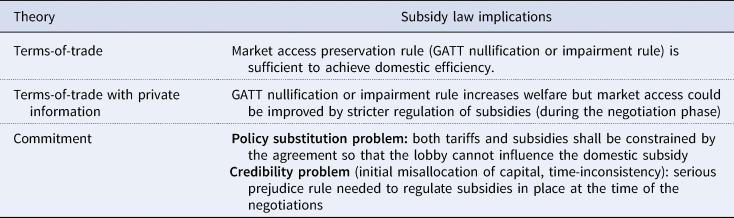
Table 1 summarizes the key implications for subsidy disciplines of the three main theories analysed above.
Main economic theories of subsidies and their subsidy law implications
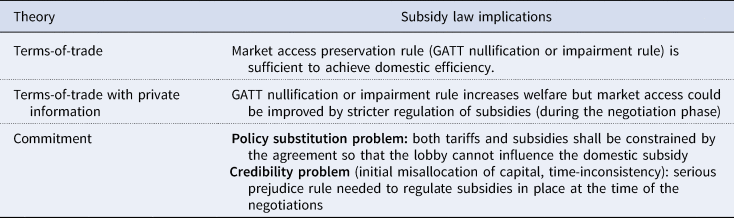
Similar to the strategic trade policy inability to capture all specificities of the aircraft sector, none of the three economic theories above can reflect all the complexities of subsidy regulation in practice. As pointed out by Sykes (Reference Sykes2003), while economic theory provides a rationale for non-violation complaints (terms of trade theory) and for the prohibition of export subsidies, there is a rather broad understanding that ‘the treatment of domestic subsidies under WTO law is far more problematic, in substantial measure because of the conceptual and practical difficulties in determining what constitutes an undesirable “subsidy” (pp. 1–2, emphasis in the original)’.
If we put together theory with policy and practice, and consider the EC–Aircraft (21.5) decision as a good example of the latter, it looks like the WTO subsidy disciplines do not seem to be stricter than those of the GATT and do not really seem to be able to constrain governments’ policy space (though this statement would need empirical support). This ‘lack of bite’ of the WTO subsidy laws can dampen the concern expressed by Bagwell and Staiger (Reference Bagwell and Staiger2006) whereby WTO subsidy law is more stringent in comparison to GATT law. Equally, it also seems to put into question the premise of the commitment theory. If subsidy laws do not bite, how can they tie government hands to the mast and help them keep special interest at bay?
Surely the WTO has introduced a clearer prohibition of export subsidies, but, as we have seen, the high standard set in the jurisprudence may mean that that prohibition is in the end more apparent than real. Subsidies that are not strictly prohibited are permitted but action against them may be very difficult.Footnote 68 The weakness of the remedy is also a fundamental element in this assessment, and an important signal leading towards the conclusion that the law is not very strong, unless it can be shown that the WTO law on subsidies has in any event acted as a deterrent on governments to provide distorting subsidies. This is an empirical question that requires an analysis going well beyond the remit of this paper.
The dilemma on how strict subsidy disciplines should be is at the origin of the rather ambiguous drafting of the ASCM, and the consequent jurisprudence mirrors the fact that there is no clear-cut underlying theory, definition of subsidy, or agreement on what kind of subsidies are desirable/undesirable.Footnote 69 Such ambiguity also covers the methodologies related to the measuring of the impact of subsidies on the recipient, as this case demonstrates. It may be argued that the Appellate Body cut short the story of measuring adverse effects as it is intrinsically difficult and complex to measure them. What solution could they have suggested in the absence of clear rules, guidelines, and methodologies on how to define criteria to evaluate benefits, adverse effects, serious prejudice, net/gross/desirable subsidies, and all possible offsetting effects?
Given the lack of a clear unified theory shaping the agreement, it is clear that further theoretical and empirical research is needed if unified objectives and methods are to be achieved that could possibly serve to revise/complement the ASCM towards an effective and efficient subsidy regulation. In order to do so, the most urgent need is, as discussed by Sykes (Reference Sykes2010), to define what we want to achieve. Several options can be found in the economic literature: market access preservation, free trade, industrial development, and safeguarding domestic production of key sensitive commodities or industrial products, domestic or global welfare maximization.
If domestic subsidy regulation was meant only to avoid the policy substitution effect following tariff commitments, the GATT system of nullification or impairment rule would be sufficient to preserve market access.Footnote 70 To reach free trade, a stricter discipline is needed so that any (non-desirable) subsidy, whether it be pre-existing or raised subsequent to the tariff commitments, can be challenged and removed. In this respect, Sykes (Reference Sykes2010) noted that a free trade objective is quite implausible in the multilateral system but more plausible in the case of the United States or the European Union where all internal barriers to trade are prohibited.
Excluding a strict reading of a free trade objective where any trade barrier would have to be removed independently of their welfare impact, rethinking the design of subsidy regulation raises the usual question: how do we determine what ‘good’ subsidies are? Perhaps Sykes (Reference Sykes2010) is right when he notes that the WTO rules might have been driven by an ‘increasing optimism on the part of negotiators about their ability to distinguish useful subsidies from protectionist subsidies’ (p. 498). In the dispute analysed in this paper, subsidies were found to explain ‘the very existence of Airbus’.Footnote 71 If this is correct, assessing the desirability of the subsidies in this case would require the ability to measure and balance the benefits of market competition for consumers against the loss for Boeing producers, which is clearly not an easy task.
This question of which subsidies are desirable remains central even if we are to adopt a general domestic/global welfare objective. While it is rational from a domestic point of view for governments to maximize national welfare, it may also be argued that the multilateral trading system and its rules should be aiming at increasing the welfare of every nation. That being said, a global welfare objective would require to assess the impact of subsidies in all concerned countries, at each level of the production chains. While we already face quite considerable difficulties to do so in the complainant and defendant market, and given the recurrent problem of data limitation, reaching such an exhaustive level of analysis seems quite unrealistic. We simply have to face the reality that we are confronted with a trade-off: the more inclusive the objective, the more complex it becomes to rely on the tools available to make a fair and precise assessment of trade policy options and of whether they will be effective in achieving the defined goals.
6. Conclusions: Towards an Alternative Discipline of Subsidies?
This article has reviewed the most significant findings of the Appellate Body in one of the most high-profile disputes in WTO jurisprudence. Our argument has been that this case is paradigmatic of the ‘perplexities of subsidies’, as the late John Jackson called them.Footnote 72 Set in the context of the broader jurisprudence, this analysis has prompted few provisional reflections on the strength of current WTO subsidy disciplines that go beyond the specificities of the LCA industry and led us to speculate that probably WTO subsidy laws do not have as much impact as some expected when the WTO came into existence.
The review of the main economic theories justifying subsidy control has confirmed this uneasiness and motivated a call for further research and discussion. This call is particularly appropriate since, at the time of writing, for the first time since the Uruguay Round, talks on law reform are hitting the headlines again. In the wake of the current US–China trade war, various initiatives (such as the US, EU, Japan ‘trilateral’)Footnote 73 have started to focus on reforming the WTO, and the rules on subsidies are at the top of the agenda. Only time will tell us whether (if any) the new rules that will emerge from these talks are clearer in the objectives they want to achieve, and effective in achieving them.