1. Introduction
Daron Acemoglu, Simon Johnson and James Robinson (Acemoglu et al., Reference Acemoglu, Johnson and Robinson2002: 1235, 1262) distinguish between two types of institutions: private property institutions where a ‘cluster of (political, economic and social) institutions ensure that a broad cross section of society has effective property rights’, and extractive institutions, ‘where the majority of the population faces a high risk of expropriation and holdup by the government, the ruling elite or other agents’. In a study of 91 countries from 1500 to 1995, they argue that ‘European colonialism caused an institutional reversal: European colonialism led to the development of institutions of private property in previously poor areas, while introducing extractive institutions or maintaining existing extractive institutions in previously prosperous places’. This institutional reversal caused a change in the fortunes of the various European colonies. The colonies that established institutions of private property flourished, while those colonies that established or maintained extractive institutions declined.
One area not included in Acemoglu, Johnson and Robinson's study was Israel/Palestine (Acemoglu et al., Reference Acemoglu, Johnson and Robinson2002).Footnote 1 This territory offers a fascinating case study of their hypothesis since both the types of institutions and the economic growth in the region experienced several changes between 1516 and 1948. In 1516, the Ottomans captured Palestine, along with the entire Middle East. Initially, Palestine prospered due to Ottoman rule, but by the end of the 16th century, the fortunes of the territory declined. In the middle of the 18th century there was a brief spurt of growth in the northern part of Palestine, but this faded by the end of the 18th century. Finally, in the middle of the 19th century, the economy of Palestine began to grow continuously, albeit slowly, and in the end of the period, 1918–1948, when the British ruled Palestine, the economy boomed.
Haim Gerber (Reference Gerber1982) has argued that the growth in the economy in Palestine that began in the middle of the 19th century was due to a change in institutions, and in this paper I will extend his argument back to the 16th century and forward to the 20th century. This longer perspective provides an interesting example of institutional reversals, and their effects on the economy. I believe that Palestine's economic history from 1516 to 1948 corroborates Acemoglu, Johnson and Robinson's thesis that economic growth is based on the quality and type of institutions in a country (Acemoglu et al., Reference Acemoglu, Johnson and Robinson2002). When Palestine's institutions were private property institutions the economy grew, but when the institutions were extractive, the economy languished.
The first section of the paper reviews the institutional changes in Palestine in the period from 1516 to 1948, and the second section reviews the economic growth in the period in order to determine whether the periods of growth and stagnation correspond to the changes in the institutional settings of the territory.
2. Institutional changes in Palestine from 1516 to 1948
In 1516, Selim I conquered Palestine from the Mamluks, which began the Ottoman rule of Palestine that would continue until 1917. During this period, Palestine, as defined by the British Mandatory borders, was never a distinct administrative unit within the Ottoman Empire.Footnote 2 Initially all of Palestine was within the province or vilayet of Damascus, and the territory was divided into several districts (sanjaqs): Jerusalem, Gaza, Nablus, Safad and Lajjun (lower Galilee). This administrative division of the land changed periodically during the Ottoman rule. For example, in 1660/61, the sanjaqs of Acre and Safad were incorporated into the vilayet of Sidon and in 1872, the southern half of Palestine became a separate administrative unit from Damascus, though on a lower level than a province, the mutasarriflik of Jerusalem (Abu-Manneh, Reference Abu-Manneh and Ben-Dor1978: 24; Singer, Reference Singer1994: 6; Gerber, Reference Gerber1998: 565). At the head of each province was a governor, the vali, and there was a governor for every district within a province, the sanjaq bey or mir liwa.
After their conquest, the Ottomans instituted their landholding system in Palestine. Most of the land, such as the fields around villages, was classified as miri land. This land was state land, and officially the peasants who worked on the land could not sell the land. Large tracts of miri land, even whole villages, timars, were given to Ottoman army officers (sipahis) as a reward for their services. Under the timar system, the sipahis were responsible for collecting the taxes on the land, but they had no ‘specific rights to lands or peasants except for services defined by the law’ and ‘they were prohibited from possessing and cultivating land reserved for the reaya (peasants)’ (Ze'evi, Reference Ze'evi1996: 91, 117). Land in cities was classified as mulk, private property, and the owners could sell their homes, as attested in numerous cases in the court documents (sijill) of Jerusalem in the 16th century (Cohen, Reference Cohen1994; Ze'evi, Reference Ze'evi1996: 131). The other types of land were waqf land, which had been dedicated by its owner for public welfare, mevat, waste lands, which could become mulk if cultivated, and metruka, public lands.Footnote 3
Although the peasants could not officially sell miri land, they were given the right to cultivate the land based on a perpetual lease, on condition that they worked the land and paid taxes. They were able to pass on their land rights to their male descendants. In addition, within miri lands, orchards, which constituted a large part of the fields in Palestine, were treated as private property since they necessitated a long-term investment, and they were able to be sold. In the sijill of Jerusalem in the 16th century there are records of sales of orchards of grapes, figs, almonds and olives (Cohen, Reference Cohen1994: 27, 32, 70, 71, 132, and 145). Furthermore, even with regard to fields, in the 16th century fictitious legal mechanisms were devised that allowed people to sell lands while formally maintaining that no sale had occurred. Dror Ze'evi notes that in Palestine:
The sultan's ownership remained in the realm of political or philosophical thought, having no direct bearing on the ground . . . Ownership of land, whether de facto or de jure was very widespread . . . People would sell their land, bequeath it, mortgage it or pawn it, with the possible exception of consecrating it as a waqf (Ze'evi, Reference Ze'evi1996: 130–135).
Accordingly, even though miri land was officially state land, it was functionally almost completely equivalent to private property.
The distinction between private property and extractive institutions depends crucially on the level of expropriation by the elites. In Palestine in the 16th century, the level of expropriation appears to have been limited.
Consider the policies of Selim's son, Suleiman the Magnificent, who ruled the Ottoman Empire from 1520 to 1566 and took a personal interest in Palestine. Suleiman invested in the infrastructure of Jerusalem by rebuilding the walls of the city, refurbishing the Dome of the Rock, and repairing the water system of the city. In 1552, Suleiman's wife dedicated a waqf in Jerusalem, which was the largest waqf in Palestine, and after her death, Suleiman enlarged the waqf by adding fields in Lebanon to the waqf's endowment. During Suleiman's reign, Palestine had relative peace from the Bedouins, who lived east of Palestine and in the south of Palestine, and who in the end of the Mamluk period had regularly raided the countryside.Footnote 4
Suleiman was known as the lawgiver for his efforts to impose a fair and equitable legal system, and in his decrees he would regularly state ‘my chief desire is to maintain the people in peace and wellbeing, the country in prosperity’ (Clot, Reference Clot1992: 74). Issawi (Reference Issawi1966: 23) notes that ‘at its height, in the fifteenth and early sixteenth centuries, the Ottoman Empire was probably the best-governed state the world had seen since the decline of Rome’. Furthermore, Clot (Reference Clot1992: 226) writes regarding the period of Suleiman: ‘It remains true that the Ottoman public authorities showed more concern for the fate and needs of the population than was ever shown in the countries of Christian Europe.’ These descriptions indicate that Suleiman did not pursue or condone extractive policies, which meant that de facto private property was preserved.
A second reason for designating Palestine in the 16th century as a period of private property institutions was the effective court system at that time. The head of the courts was the kadi, who was independent of the military-administrative officials. Court records from 1538 to 1563 in Jerusalem show that the kadi regularly intervened to prevent officials from imposing unauthorized taxes and defended the rights of minorities such as the Jews (Cohen, Reference Cohen1989: 6; Reference Cohen1994: 22). Amy Singer (Reference Singer1994: 122) notes that the kadis ‘kept military officials in line’. She also writes that, ‘[c]omplaints against judges, however, are rare in this period in Palestine, and those recorded concern the illegal appointment of deputy-judges (naibs), rather than abusive behavior against Ottoman subjects.’
A third reason for labeling the 16th century as one of private property institutions was survey registers (tahrir defter) that were compiled periodically in the century. These registers would list the number of households in each village, the goods produced in the village, and the level of taxation in order to assess the tax potential of each village. This assessment would limit the taxes that could be collected from the peasants. Inalcik (Reference Inalcik and Inalcik1994: 132) writes, ‘The purpose of surveying is made clear in the preambles of instructions to surveyors. It was with the intention, they assert, of protecting the reaya against abuses introduced by the local military.’Footnote 5 The survey registers are another indication of private property institutions since they reduced the possibility that the people would be subject to expropriation from the ruling elite.
One interesting example of the interaction between the kadi and the sipahis with regard to the survey registers was recorded in the sijill in 1541 concerning a village near Jerusalem whose villagers refused to pay taxes to their sipahi. The governor of the province ordered the kadi to check the survey register to determine what taxes were owed, and the kadi was authorized to jail those people who refused to pay (Mandaville, Reference Mandaville and Ma'oz1975: 520). This case shows how the survey registers were used to assess taxes, the authority of the kadi and inability of this particular sipahi to extract money from the peasants.
Therefore, in the 16th century the institutions in Palestine had a private property orientation. The peasants had de facto user rights to the land and the survey registers, the policies of Suleiman and the kadis limited the expropriation of the peasants. The people consequently developed the lands that they had acquired the right to cultivate.
In the last quarter of the 16th century the Ottoman Empire stopped expanding. Clot (Reference Clot1992: 302) notes that due to this change, ‘All the basic structures of Ottoman Turkey – financial, economic, social and institutional – were put in turmoil.’ One result of this turmoil was the downgrading of the sipahis and at the end of the 16th century tax collection in the Ottoman Empire began changing from the timar system to a tax farming system called iltizam.
Tax farming entailed auctioning to the highest bidder the right to collect the taxes, and initially the tax contracts were from one to three years. With the changeover, the tax famers, multezims, replaced the sipahis for being responsible for collecting taxes. Already by 1590, a Mansur Furaykh was a multezim in three sanjaqs in Palestine.Footnote 6 In Palestine, the complete changeover to the iltizam system was a slow process, but it was common for the sipahis and the waqfs to rent out their villages and farms to the highest bidder to collect the taxes, which was comparable with the tax farming system (Ze'evi, Reference Ze'evi1996: 36, 91, 120, 127).
One problem with this new tax collection system was that in Palestine in the 17th and 18th centuries there were no new survey registers, which made it difficult to oversee the tax farmers. In addition, tax farming has the potential to be an extractive institution because the cultivators are at the mercy of the capriciousness of the tax farmers who can unfairly tax them and reduce their incentive to develop their lands. In the Ottoman Empire, it developed into an extractive institution. Karen Barkey (Reference Barkey2008: 232) in a review of tax farming in the Ottoman Empire notes that despite efforts by Ottoman officials to supervise the system, ‘short-term contracts generated much abuse of the peasantry because tax farmers tended to maximize their benefits to the detriment of long term investment’.Footnote 7
Besides the change to tax farming, starting in the 17th century the Ottomans began to lose control over the governors in Palestine to stop them from oppressing the local population. With these two changes, the institutions in Palestine became extractive institutions in the 17th century. Ze'evi records one example of the extractive polices of the local leaders from an edict issued by the Porte in 1657 for the district of Jerusalem:
Even though they had paid their dues on time as requested, the villagers complained that the governors of the province and the district, and others of the governing elite had imposed new taxes on them, unsanctioned by royal edict . . . The edict ends with an order to stop this reprehensible conduct of officers and governors, but even the clerk who composed the edict knew, it seems, that these were ‘words in the wind’ as the local Arab saying goes. Governors and their henchmen ignored such edicts and went on inventing new taxes (Ze'evi, Reference Ze'evi1996: 149, 150).Footnote 8
Another example of extractive institutions is from the Fatwa of Khair al-Din al Ramli, which was compiled in 1670. Samir Seikalyin, in his study of the Fatwa, writes:
The peasantry in his area were practically ruined by a multitude of illegal taxes imposed by the timari or his deputy or by the official tax-assessor . . . It is not feasible or necessary to draw up a complete interpretive index of illegal taxes as they are presented in the Fatwa. It is sufficient to note that they represented imposts on almost every department of peasant life and livelihood: on peasant land, and on their agricultural implements; on their income, and on the conduct of their private lives . . . In reaction, there developed a massive movement away from the land, and parts of the sub-district (nahiyat) al-Ramlah and many regions beyond it, presented a dim picture of entire villages ruined by rapacity and injustice . . . Many peasants abandoned agriculture altogether and reverted to a nomadic existence among the tribes with whom they sought refuge from oppression (Seikaly, Reference Seikaly and Khalidi1984: 405, 406).
In the 1670s, the Ottomans began appointing outside governors as the sanjaq bey of the districts, and conditions in Palestine appear to have worsened. Ze'evi writes:
The cultivators fought to preserve what ownership rights they still had. This is evident from their insistence on recording transactions in the sijill, from their frequent requests for fatwas on question of land and ownership, and even from complaints to the Sublime Porte in Istanbul. In the course of the century they managed to retain their share of the ownership, but on the whole the portion of landed assets owned by villagers gradually decreased. Heavy taxation and cruel treatment often forced the fellahin off their land and compelled them to relinquish their claim to land and property (Ze'evi, Reference Ze'evi1996: 138).
As the seventeenth century drew to a close, frequent petitions were sent jointly by notables and other representatives of the population to the sultan's palace in Istanbul, to complain about injustice, irreligious behavior and corruption in local government. In most cases, the plaintiffs were disappointed, their complaints received dismissive responses, and the new governors were allowed to carry on (ibid.: 192, 193).
The unpopularity of the governor of Jerusalem due to his oppressive taxation led to a revolt in Jerusalem in 1703, which was stamped out in 1705 by Ottoman troops (Cline, Reference Cline2004: 221–225).
In addition, the local governors of the sanjaqs of Palestine in the 17th century, who were mostly from three families, the Ridwans, Turabays and Farrukhs, were able to establish alliances with the Bedouins to maintain relative security in the land. However, after they were replaced by outside governors, the Bedouins were able to roam free in the land, which added another level of expropriation of the peasants when they would raid villages (Ze'evi, Reference Ze'evi1996: 113, 114). Amnon Cohen (Reference Cohen1973: 185) writes: ‘The sanjaq of Nablus was particularly prone to the depredations of the Bedouin tribes in the area at the beginning of the (18th) century, and these attacks caused many of the sanjaq's inhabitants to abandon their villages and flee from the area.’ Similarly, Thomas Philipp writes:
In May 1697, Bedouins moved from the interior right up to Acre, where they took all available cattle and exacted monetary contributions. Even neighborhood villages were deserted because of Bedouin incursions. Further east, peasants and Bedouins fought regularly. Travelers from Acre to Jaffa were well advised to go by boat in order to avoid marauding Bedouins (Philipp, Reference Philipp2001: 96, 97).
In 1695, a new tax collecting system, malikane, was established in the Ottoman Empire (Cohen, Reference Cohen1973: 180, 181; Salzmann, Reference Salzmann1993: 401). With the new system, the tax collectors received the rights to collect taxes in the particular areas (mukata'as) for life based on an initial payment and a fixed annual payment. In theory, this system could have removed the problems of short-term tax farming since with lifetime contracts the tax collectors could adopt a long-run perspective and not abuse the peasants in order to maximize their revenue in the long run. However, in practice, Cohen notes that the malikane tax system was not an improvement in Palestine:
18th century Palestine is able to teach us that the malikane, far from being an improvement on previous tax-farming systems employed in the area, which it sought to replace, was in many respects decidedly worse. The local population was forced to surrender to the “owner” of the malikane a very large part of the increased income which it might have enjoyed as a result of any economic development. Very often, the lessee chose not to serve as the mutasarrif himself, preferring to sub-lease his mukata'a to a multezim. This, of course, defeated much of the purpose of the malikane and merely added another, totally redundant level to the existing tax-farming system in the area. While this made no difference to the treasury, as its own revenues were not in any way affected, the unfortunate population was saddled with an additional burden – that of filling the pockets of this multezim as well (Cohen, Reference Cohen1973: 190).Footnote 9
The tax farming system led to the rise of ayans, provincial political elites who amassed power independent of the Porte, in the Ottoman Empire in the 18th century (McGowan, Reference McGowan and Inalcik1994: 642, 658–663; Krämer, Reference Krämer2008: 59–63). Two prominent ayans in Palestine were the remarkable Dahir al-’Umar and the cruel Jazzar Ahmed Pasa.
Dahir began his career as the sheik of Tiberias and the tax farmer around Tiberias for the vali of Sidon. In the 1730s he extended his power throughout the Galilee, and in the 1740s he transferred his base to Acre, which he made into the principal port of Palestine. He controlled and developed the cotton trade between Palestine and France, and was the effective ruler of Northern Palestine until he was killed in 1775 at the approximate age of 85 years. Under Dahir's rule, there was a temporary reversal to private property institutions in northern Palestine. C. F. Volney, who toured Palestine in 1785, described Dahir's reign:
He restored security to the husbandman, who might now sow his corn, without fear of seeing the harvest destroyed or carried off by robbers. The excellence of the soil attracted cultivators, but the certainty of security, that blessing so precious to those who have lived in a state of continual alarm, was a still stronger inducement. The fame of Dahir spread through Syria, and Mahometan and Christian farmers, everywhere despoiled and harassed, took refuge, in great numbers, with a prince under whom they were sure to find both civil and religious toleration (Volney, Reference Volney1972: Vol. II, 98).
Philipp (Reference Philipp2001: 155) writes that ‘Dahir ordered his prefects and officials never to take more from the peasant than the legal miri tax’. And Dahir is said to have observed: ‘When the fellah is productive, the land will be fertile, and all the country with it will be prosperous. How often were the fellahs oppressed before, but my wealth suffices me when I see the peasants prosperous in my country.’
These descriptions of Dahir indicate that during his rule, the institutions were de facto private property institutions, but, alas, his rule was just a temporary aberration. Dahir was followed by Jazzar, who was appointed the vali and tax farmer of the vilalyet of Sidon, though he too was based in Acre. He ruled Northern Palestine, and occasionally all of Palestine, from 1775 until his death in 1804. With Jazzar the institutions in Palestine became extractive once again. Volney provides a description of Palestine in 1785 when Jazzar had been ruling for 10 years:
The Pasha may applaud himself for penetrating into the most hidden sources of private profits, by the clear sighted rapacity of his subalterns; but what is the consequence? The people denied the enjoyment of the fruit of their labor, refrain their industry to the supply of their necessary wants. The husbandman only sows to preserve himself from starving; the artist labors only to bring up his family; if he has any surplus, he carefully conceals it... In the districts exposed to the Bedouins, as in Palestine, the countryman must sow with his musket in his hand. Scarcely does the corn turn yellow, before it is reaped and concealed in matmoures, or subterraneous caverns. As little as possible is employed for seed corn, because they sow no more than is barely necessary for subsistence; in a word, their whole industry is limited to a supply of their immediate wants; and to procure a little bread, a few onions, a wretched blue shirt, and a bit of woolen much labor is not necessary. The peasant lives therefore in distress; but at least he does not enrich his tyrants, and the avarice of despotism is its own punishment (Volney, Reference Volney1972: Vol. II, 378, 413).
Cohen (Reference Cohen1973: 200) writes: ‘There is no doubt whatever that under Jazzar it (the tax burden) was far heavier than ever before, while the highly efficient system of collection instituted by the latter made evasion all but impossible.’
Sulayman succeeded Jazzar as the vali of the province of Sidon, and the Ottomans awarded him control of almost all of Palestine except for the sanjaq of Nablus. Sulayman was less violent than Jazzar, but he maintained Jazzar's extractive polices. In one instance his soldiers forced the peasants to plow their grain under and plant cotton (Philipp, Reference Philipp2001: 130). Philipp (Reference Philipp2001: 126) writes that under his rule, ‘peasants were driven to destitution and independent merchants – local and foreign – ceased to exist’.
In 1819, Sulayman was followed by Abdallah, and he was the last ruler to be based in Acre. The extractive institutions continued with Abdallah. In 1825, there was another revolt in Jerusalem against oppressive taxation, which Abdallah put down by bombarding Jerusalem with cannon fire (Cline, Reference Cline2004: 229). His reign ended in 1832 when Egyptian artillery destroyed Acre as part of Egypt's conquest of Palestine (Philipp, Reference Philipp2001: 78–92, 122–135). The Egyptians attempted to reform the institutions of Palestine, but their rule was quite brief. In 1840, Britain enabled the Ottomans to regain control of Palestine.
Initially with the return of Ottoman rule in 1840, security deteriorated due to local leaders trying to assert their powers and the weakness of the Ottoman army. By the 1860s, the Ottomans were able to establish their authority, and there were relatively peaceful conditions in Palestine from then up to the First World War. The increase in security marked a reduction in the extractive institutions of the country.
In addition, in 1839, Sultan Abdulmecid, who ruled from 1839 to 1861, began the Tanzimat program (1839–1876) to reform the Ottoman Empire. With European support, he sought to reform the bureaucracy, the judicial process, taxes and land tenure within the empire. One example of the bureaucratic reforms was the Vilayets law in 1864 and its amendment in 1871, which was an attempt to give the government in Istanbul greater control of the provinces (Yazbak, Reference Yazbak1998: 4, 28–31). The judicial reform was that for the first time non-Muslims were supposed to be treated equally with Muslims. The tax reform was an attempt to end the practice of tax farming by having taxes collected by salaried agents of the state (Shaw, Reference Shaw1975: 422). The land reform was the Land Code of 1858, which officially established private property since it allowed individuals to register land in their own names. In 1867, there was an additional development that permission was granted to foreigners to own land (Quataert, Reference Quataert and Inalcik1994: 856–863; Yazbak, Reference Yazbak1998: 223). All of these measures moved Palestine away from extractive institutions towards private property institutions.
An additional shift in that movement was that in the middle of the 19th century, European countries began to establish consuls in Jerusalem who provided legal protection to foreigners in Palestine. Britain established a consul in Jerusalem in 1839, Prussia in 1842, France in 1843, USA in 1844, Austria in 1849 and Russia in 1858. The basis for the consuls’ powers was the capitulations which were first agreed to by Suleiman in 1536 to the French. Over the years, the capitulations were extended to other countries, and the nature of the capitulations changed. Initially, the sultan could claim reciprocal advantages, and the capitulations had to be renewed with each new sultan. However, already in the 18th century, it was the Europeans who controlled ‘the degree and application of reciprocity’ and the privileges were extended to non-Muslim subjects in the empire and protégés of foreign governments (Clot, Reference Clot1992: 361; Naff, 1997: 99). Albert Hourani (Reference Hourani1991: 274) writes that in the 19th century, ‘Because of the influence of ambassadors and consuls, the capitulations were turning into a system by which foreigners were virtually outside the law.’
The improvement in security starting in the middle of the century, the judicial reform and the consuls spurred the immigration of foreigners to Palestine in the middle of the 19th century. In 1869, a group of German immigrants, Templars, started settlements in Haifa and Jaffa, and they would later add five more settlements before the First World War. Jews, mostly from Eastern Europe, also began to immigrate to Palestine. Initially, in the 1850s and 1860s, the focus of this immigration was to move to and die in Jerusalem, but starting in 1878 some of the Jewish immigrants became farmers. It is estimated that from 1850 to 1914, 84,000 Jews immigrated to Palestine, and by 1914 they had established 43 agricultural villages (Ruppin, Reference Ruppin1918: 29–31; Bachi, Reference Bachi1977: 79). In addition, in 1909 they founded the new city of Tel Aviv, just north of Jaffa.
Acemoglu, Johnson and Robinson distinguish between two different types of settlers: those who attempted to develop the land and those who just attempted to extract the resources from a country (Acemoglu et al., Reference Acemoglu, Johnson and Robinson2002). The first type is associated with private property institutions, while the second type is associated with extractive institutions. The Europeans who came to Palestine in this period were of the first type, and they did not extract resources since Palestine had almost no natural resources to extract. Accordingly, these immigrants are an indication of the changeover to private property institutions in Palestine. Moreover, it is uncertain whether they would have come to Palestine without this change in the type of institutions, as there was no significant immigration to Palestine in the 18th century and at the beginning of the 19th century.Footnote 10
Gerber has already noted this institutional change at the end of the Ottoman rule:
We suggest that three things may account for the change (economic growth), all of them of an institutional nature. The first has to do with the increased measure of law and order brought about by the Ottoman government in the latter half of the nineteenth century . . . Moreover, what may be termed the oppression level of the Ottoman administration went down considerably at the end of the Ottoman period, especially with regard to taxation. It is not so much that the government was now willing to relinquish part of the taxes it formerly squeezed from the populace; rather it was the elimination of the political power of the provincial governor, who in the past creamed off as much as three-quarters of the state's revenues. At the beginning of the twentieth century the provincial governor became an official living on a (modest) salary . . . While these two changes seem to be established facts, the third one is still in the nature of an hypothesis; there must have occurred a change in social norms, undoubtedly as a result of the Western impact (Gerber, Reference Gerber1982: 261).
Yet, even with these institutional changes, extractive institutions remained in Palestine. For example, despite the attempt at tax reform, tax farming continued to exist alongside direct taxation. For the entire Ottoman Empire, it has been estimated that prior to the First World War, 95% of all taxes were collected by tax farmers.Footnote 11
In addition, during the 19th century in Palestine the dominant system of land tenure was the musha system, and it is estimated that in 1914, 70% of the cultivated land in Palestine was musha land (El-Eini, Reference El-Eini2006: 292). With this system, the village as a whole had control of the surrounding land, and the individual farmer received a share of the land, which was reallocated every two to three years. It is not clear when this system began. Ze'evi (Reference Ze'evi1996: 146) notes that ‘the system was not very widespread’ in the 17th century in the district of Jerusalem, and was ‘very rarely referred to in sijill records’. Firestone (Reference Firestone1981, Reference Firestone and Gilbar1990) argues that the system developed in the 18th and 19th centuries due to the excessive tax burden on the peasants.
The musha system was an example of extractive institutions since the farmer would lose his plot of land every few years, which would reduce his incentive to invest in the land. An eyewitness in 1913 described the musha system in the following manner, ‘The lands were held in musha ownership. Every second year the fields were measured by stick and rope and distributed among the cultivators. Division of land always led to strife and bloodshed.’Footnote 12
Accordingly, in the middle of the 19th century, there was a process of change from extractive institutions to private property institutions; however, it was not a complete transformation due to the continuing existence of tax farming and the existence of the musha system. Furthermore, the Tanzimat program stalled and even regressed, as for example with regard to relations between Muslims and non-Muslims, under Sultan Abdülhamid II, who ruled from 1876 to 1909.
In 1914, the population of Palestine is estimated to have been from 689,000 to 798,000.Footnote 13 The First World War was a difficult period for Palestine, but the war ended with the UK in control of Palestine. The UK first ruled Palestine as a military administration, and then in 1920 a civilian administration was installed which governed Palestine as a Mandate territory under the League of Nations until 15 May 1948. The British were able to maintain security in the land except during the Arab revolt of 1936–1939, and the chaotic last year before the end of the Mandate. Approximately 483,000 Jews immigrated to Palestine during the Mandate period, and the total population at the end of 1947 was 1,970,400 (Bachi, Reference Bachi1977: 5, 79).
The switch to private property institutions continued and was accelerated by the British during the Mandate period. The British removed the practice of tax farming, and they attempted to end the musha system of land tenure. In 1923, a commission was appointed to study the musha system and it recommended that the land should be partitioned. This position was maintained throughout the Mandate period, and it is estimated that the amount of musha land declined from 70% of the cultivated land in 1914 to 25% by the end of the Mandate (El-Eini, Reference El-Eini2006: 292). In addition, the laws of the land were modernized with the adoption of English common law and equity. This was accompanied by the establishment of an honest and efficient judiciary, which Howard Sachar (Reference Sachar1976: 132, 133) argues was the Mandatory government's most impressive accomplishment.
This review of the institutions shows that there was a double reversal with regard to the quality of institutions in Palestine from 1516 to 1948. Initially from 1516 towards the end of the 16th century, the institutions had a private property orientation, while from the end of the 16th century until the middle of the 19th century, the first reversal transpired. The institutions became extractive with the exception of the period of Dahir's rule in the middle of the 18th century in Northern Palestine. Starting in the middle of the 19th century, the second reversal began with a slow movement to private property institutions. In the Mandate period, this reversal continued, and private property institutions became the dominant ‘rules of the game’. It now needs to be investigated whether these institutional reversals correspond with economic growth as argued by Acemoglu, Johnson and Robinson (Acemoglu et al., Reference Acemoglu, Johnson and Robinson2002).
3. Economic growth
The survey registers of the 16th century provide evidence of economic growth in Palestine in the century. Based on data from the registers, Cohen and Lewis (Reference Cohen and Lewis1978) note that after the Ottoman conquest of Palestine, the number of households in five of the six largest cities (Jerusalem, Hebron, Gaza, Ramle and Safed, but not Nablus) in the country increased by more than 100% by the middle of the 16th century, but then they all declined (except Nablus and Safed) by the end of the century. Cohen and Lewis (Reference Cohen and Lewis1978: 25, 26) note, ‘In terms of urban population the era of Suleiman the Magnificent was the golden age. It is from that time onwards, i.e. from the 1560's that the reverse tendency, that of recession, is clearly indicated.’ They credit this urban growth in the first half of the 16th century to ‘increasing security to both life and property, the absence of a rebellious and disorderly soldiery and a prospering economy’.
Singer (Reference Singer1994: 55–62) reviews the survey registers for the villages around Jerusalem in the 16th century, and found that ‘the production of the Jerusalem region expanded tremendously through 1560, according to the tax assessments made in the first four surveys’. For example, from 1545 to 1560, in 17 of 21 villages around Jerusalem for which there are data, the average tax assessment per adult male increased, and for all 21 villages on average the tax assessment per adult male increased by 64%. In both years, the tax assessments were calculated in the same manner, and hence the figures show that there was a per capita increase in output. Singer concludes that the increase in output was due both to the recovery from the Black Death and to the effects of the Ottoman rule.
The northern part of Palestine also experienced economic growth in the beginning of the 16th century. Harold Rhode in a review of the registers of the sanjaq of Safad in the 16th century writes:
During the first sixty years of Ottoman rule, conditions greatly improved and as a result, the sanjaq became more and more prosperous. Nevertheless, towards the end of the sixteenth century, the government became unable or unwilling to put down Bedouin revolts and local disturbances. The sanjaq of Safad then suffered a period of decline which more or less lasted until well into the nineteenth century (Rhode, Reference Rhode1979: 21).
Accordingly, the survey registers indicate that there was economic growth in the middle of the 16th century, which corresponds to our designation of the period as one of private property institutions.
The registers of the 16th century have also been used to show the decline or stagnation in Palestine from the end of the 16th century to the middle of the 18th century. Wolf-Dieter Hütteroth and Kamal Abdulfattah compared the villages from the 1596 register with the villages surveyed by the Palestine Exploration Fund (PEF) in 1880:
If we compare the situation in the 19th century with that of the 16th century, the contrast is striking. If the villages found on the PEF-maps are marked on the maps for the 16th century, many places remain unfilled. The density of settlement is far below that of the 16th century, the whole pattern has changed and the decline is significant: the settlement frontier has retreated, the density of villages is lower in most areas, the percentage of nomads is higher, but the towns have grown in number and relative importance and the average size of the remaining villages seems to be larger – according to the estimations given in the reports of the Palestine Exploration Fund (Hütteroth and Abdulfattah, Reference Hütteroth and Abdulfattah1977: 56).
This decrease in the number of villages implies a decrease in agricultural production, which was the mainstay of the economy in Palestine.
Roger Owen accepted their results:
While there was undoubtedly a great continuity of settled life in mountainous regions like those of Jabal Nablus,Footnote 14 elsewhere a large number of villages and even small towns, were abandoned by their inhabitants between the latter parts of the sixteenth and nineteenth centuries . . . The result was that much of what was the potentially the most fertile land in southern Palestine passed out of cultivation (Owen, Reference Owen1993: 5).
Yehoshua Ben-Arieh (Reference Ben-Arieh, Singer and Cohen1994: 259) repeated Hütteroth and Abdulfattah's approach with regard to the sanjaq of Jerusalem. He found, ‘A striking tendency toward regression and decline in the total number of villages. During the sixteenth century, the total number of permanent settlements counted in the five Ottoman censuses (registers) was 226, as compared with 155 in the 1870s. The last census alone (that of 1596–1597) recorded some 190 permanent settlements, a much higher figure than the one for the 1870s.’ This evidence corroborates Hütteroth and Abdulfattah's conclusions.
Gerber (Reference Gerber1979: 76–80), while noting ‘the meticulous mapping of the lost villages of Palestine after the sixteenth century’, rejects Hütteroth and Abdulfattah's interpretation of the PEF maps, and argues that there was no decline. However, even according to Gerber there was no growth in Palestine during this period. For example, he calculates that the population of Palestine only increased by 5,000 people from the middle of the 16th century until 1800. Gudrun Krämer (Reference Krämer2008: 135, 136) follows Gerber, but she admits that ‘around Gaza half of the villages seem to have disappeared after 1596’, and that ‘in the mid-nineteenth century, most villages lay in the hilly and mountainous area from the Galilee to Hebron, even though the coastal plains and the plain of Marj Ibn Amir were more fertile’.
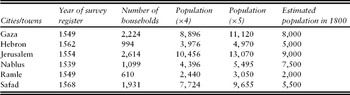
An additional method to evaluate the growth or lack thereof from the 16th century to the 19th century is to compare population estimates for the six largest towns in Palestine in the 16th century from the data compiled by Cohen and Lewis (Reference Cohen and Lewis1978) from the registers of the 16th century with estimates from Ben-Arieh (Reference Ben-Arieh and Ma'oz1975) of the population of these places in 1800. As mentioned above, the data in the registers are based on households, and hence to determine the population of the towns in the 16th century one must make an assumption about the number of people per household. Generally, the assumption is five to six people per household (Gerber, Reference Gerber1979: 59–62) but one can be conservative and calculate the population based on both four and five people per household. Table 1 shows the peak population for each town in the 16th century and even with an assumption of four people per household, for four of the six towns there was a decline in their population from the middle of the 16th century to 1800, which again indicates a lack of growth in Palestine for the period.
Population data for six cities/towns in Palestine

Source: Data for the 16th century from Cohen and Lewis (Reference Cohen and Lewis1978: 94, 111, 128, 140, 149, 161), and estimates for 1800 from Ben-Arieh (Reference Ben-Arieh and Ma'oz1975: 68).
Accordingly, a comparison of the data from the registers in the 16th century both with regard to the number of villages and the population of the towns with their corresponding data in the 19th century indicate that from the end of the 16th century until the beginning of the 19th century there was a decline in Palestine's economy, or at best the economy stagnated.Footnote 15 This lack of growth correlates with the extractive institutions in Palestine in the period.
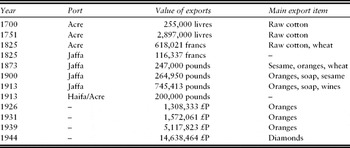
The only exception for the period from the end of the 16th century until the middle of the 19th century was the years of Dahir's rule. During his reign, the population of Acre, which in the beginning of the 18th century was 300–400 people, grew to 25,000. Exports of raw cotton from Acre to France increased from 255,000 livres in 1700 to 2,897,000 livres in 1751 (see Table 2). After Dahir's rule ended, the economic growth ended. Cohen (Reference Cohen1973: 203) estimates that due to the tax policies of Jazzar at least a quarter of the agricultural land in Northern Palestine was abandoned by the end of the 18th century. In the ensuing years under Suleyman and Abdallah's rule, Acre's population declined to 10,000 by 1830, the cotton trade all but ended, and Beirut replaced Acre as the main port in the area (Philipp, Reference Philipp2001: 128–135, 193–195).
Exports from Palestine for selected years from 1700 to 1944

Source: Data from 1700 to 1913 are exports per port and from 1926 to 1944 they are for the entire country. Data for 1700–1825 from Philipp (Reference Philipp2001: 197, 198, 212). Data for 1873–1913 from Gilbar (Reference Gilbar and Kushner1986: 192, 196, 197). Main export items for the years 1873 are from Schölch (Reference Schölch and Owen1982: 59). Data for 1926–1944 are from Statistical Abstract of Palestine (1944–45: 63, 74).
In 1839, there began a regular steamship service between Smyrna and Alexandria that stopped at Jaffa twice a month, and this enabled Palestine to join the worldwide expansion of international trade (Eliav, Reference Eliav1997: 126). This development would enable Palestine to start exporting oranges in the 1850s, but it also brought exports of British clothing to the area which harmed the local producers.Footnote 16 It was only at the turn of the 20th century that mechanical spinning and weaving began to be introduced in Palestine and prior to the First World War there was no factory that had more than 300 workers (Ruppin, Reference Ruppin1918: 46; Avitsur, Reference Avitsur and Ma'oz1975: 508). This delay in the arrival of the Industrial Revolution to Palestine made it difficult for the local producers to compete with foreign imports. Imports of textiles increased from £28,000 in 1879 to £260,000 in 1913 and they were the largest import item every year from 1886 through to 1913 (Gilbar, Reference Gilbar and Kushner1986: 194, 195, 199).
One industry that was able to withstand these imports was the soap industry which was centered in Nablus. This success was because the main ingredient in the production of soap, olive oil, grew abundantly in the region around Nablus, and most of the exports of soap were to Egypt, Anatolia and the Arabian Peninsula. The production of soap, which became the second most important export at the end of the 19th century after oranges, increased from less than 1,000 tons in the 1870s to 10,000 tons in 1913 (Gilbar, Reference Gilbar and Kushner1986: 199; Doumani, Reference Doumani1995: 182–187, 231, 232).
By the end of the 19th century the economy in Palestine was improving, and the evidence for this is from the increase in urbanization and exports. The urbanization rate, based on a level of 10,000 people, increased from approximately 13% in 1860 to 29% in 1910.Footnote 17 One example of this growth was the city of Jaffa. In 1800, its estimated population was 2,750, in 1860, 6,520 and in 1910, 43,000 (Ben Arieh, Reference Ben-Arieh and Ma'oz1975: 68; Bachi, Reference Bachi1977: 374). Jaffa's growth was primarily due to the growth of the orange industry. In 1859, the value of orange exports was £12,000 and this grew to £297,700 in 1913 (Gilbar, Reference Gilbar and Kushner1986: 200; Owen, Reference Owen1993: 176). Overall exports from Jaffa port increased from £247,000 in 1873 to £745,412 in 1913 (see Table 2). Furthermore, per capita exports increased from £0.53 in 1877 to £1.13 in 1913.Footnote 18
Gilbar (Reference Gilbar and Kushner1986: 193, 201) notes that the growth of the orange and soap industries was initiated by the private Arab sector and not the immigrants, though later on the German and Jewish immigrants also began to grow and export oranges. Both the orange and soap industries required a relatively large capital outlay since only large-scale soap factories were economical, and one needed to wait five years from the time the oranges groves were planted until there was a significant yield of fruit. Thus, both of these industries accord better with private property institutions than with extractive institutions, since with extractive institutions it would not have been worthwhile to make these investments.
Accordingly, the evidence presented here substantiates Gerber's (Reference Gerber1982) argument that the growth of the economy in Palestine at the end of the 19th century and the beginning of the 20th century was due to positive changes in the institutions in the country in conjunction with the increase in trade in the country. These two processes of economic growth and the movement towards private property institutions continued in the Mandate period.
British rule spurred the development of Palestine. Telephone services were established, roads, railroads and airfields were built, and in 1933 a deep-water port was constructed in Haifa. Tel Aviv and Haifa became the centers of industry and commerce in Palestine. Tel Aviv's population increased from 2,000 in 1915 to 183,200 in 1946 and Haifa's population grew from 18,000 in 1910 to 145,430 in 1946 (Bachi, Reference Bachi1977: 374, 375).
For the years 1922–1947, Jacob Metzer (Reference Metzer1998: 215, 242) has provided estimates of the growth of per capita income for both the Jewish and Arab communities in Palestine. According to his estimates, per capita net domestic product increased in the Jewish community at an annual rate of 4.39% and in the Arab community at an annual rate of 3.68%. Overall, combining Metzer's estimates for both communities, per capita income in Palestine increased at an annual rate of 4.9% from 1922 to 1947, which was the second highest growth in the world for the period after Venezuela (Maddison, Reference Maddison2007; Schein, Reference Schein2007).
Not all of this growth in the Mandate period was related to the change in institutions. For example, the economy in Palestine boomed from 1933 to 1935 when Jewish immigration peaked due to the rise of Nazi Germany, and these immigrants brought some of their money and technical skills to Palestine. Also, in the beginning of the Second World War, the economy again had great growth when Palestine became a major supplier of the British army in North Africa.
Thus, it is instructive to examine the period from 1927 to 1931 when the net Jewish immigration for all five years was just 7,829.Footnote 19 Yet, even during this period, which includes the beginning years of the Great Depression, per capita gross domestic product (GDP) in Palestine grew at an annual rate of 4.7%, which was the highest rate in the world amongst 48 nations in Maddison's (Reference Maddison2003) data. Exports increased 20% from 1926 to 1931 (see Table 2), even though world trade was plummeting due to the Depression. The main driver of this growth in the economy was the orange industry. The average annual number of cases exported from 1927 to 1931 was 2,354,260, which was 50% higher than the annual average for the years 1921–1926. In 1926, orange exports were 36% of total exports, and in 1931 this percentage increased to 46%Footnote 20. In 1930, Palestine was the third largest exporter of oranges in the world after Spain and Italy (Tolkowsky, 1930: 318, 319).
Again, the growth of the orange industry is a good example of the correlation between economic growth and private property institutions since an investor had to be sure that his property would not be expropriated for it to be worthwhile to invest in orange groves. During the period 1927–1931, there was a huge increase in investment in orange groves from 243,000 Palestinian pounds (P£) in 1926 to P£ 1,095,000 in 1931 (Metzer, Reference Metzer1998: 223). This figure includes foreigners who were also investing in the orange groves. For example, in 1928, Alfred Mond, who was one of the wealthiest men in England, formed two joint stock companies to grow oranges (Amit, Reference Amit2000: 94, 95). The investment in orange groves continued to grow after 1931, and was annually more than P£ 2,000,000 for the years 1933–1936.
With the huge investment in orange groves, production and exports of oranges increased throughout the 1930s, and 13,055,700 cases of oranges were exported in 1939. Altogether exports increased to P£ 5,117,769 in 1939, an increase of 225% from 1931 and oranges comprised 76% of the exports in 1939.Footnote 21 This growth in the orange industry in Palestine was independent of the large immigration that began in 1933 since it was based on the investment in groves that occurred prior to this immigration. Thus, the growth of the economy in Palestine in the Mandate period supports Acemoglu, Johnson and Robinson's thesis that private property institutions are associated with economic growth (Acemoglu et al., Reference Acemoglu, Johnson and Robinson2002).
4. Conclusion
In this paper I have attempted to identify four different periods in Palestine for the years 1516–1948 with regard to the type and quality of institutions in the territory. In the first period, from 1516 to the end of the 16th century, the institutions in the territory had a private property orientation. In the second period, from the end of the 16th century until the middle of the 19th century, the institutions became extractive, with the exception of the period of Dahir's rule in the Galilee in the middle of the 18th century. In the third period, from the middle of the 19th century until the First World War, there began a changeover to private property institutions but it was a slow change. Finally, in the fourth period, 1918–1948, the rate of changeover to private property institutions quickened. Based on this identification, Palestine experienced a double reversal of institutions from 1516 to 1948.
In addition, in Palestine there was a strong correlation between economic growth and the quality of the institutions as argued by Acemoglu, Johnson and Robinson (Acemoglu et al., Reference Acemoglu, Johnson and Robinson2002). The economy in Palestine was successful when there were private property institutions, while the fortunes of the territory stagnated when there were extractive institutions.
A final question is how unique was Palestine's experience from 1516 to 1948 as compared with its neighbors, Lebanon, Syria and Jordan? A brief and tentative answer is that while there were differences in degree, as for example the rate of growth during the years 1918–1948, on the whole the pattern of double reversals and economic growth is roughly similar. Further research is needed for a more complete and definitive answer.