In 2015, Mississippi producers planted 10,930 ha of sweetpotatoes, with an estimated direct value of $79.9 million (USDA 2016). In Mississippi, 20 to 25 cm long sweetpotato slips are planted into ridged rows 1 m apart from late spring through early summer and are harvested 3 to 4 months later. Sweetpotato yield and quality are limited by numerous pests and interference from weeds (Meyers and Shankle Reference Meyers and Shankle2015; Meyers et al. Reference Meyers, Jennings, Schultheis and Monks2010; Seem et al. Reference Seem, Creamer and Monks2003). However, weed control options in sweetpotato are limited.
Current weed management programs in sweetpotato rely heavily on the PRE herbicides flumioxazin, clomazone, and S-metolachlor. Graminicides are available for POST control of annual and perennial grass species. Although carfentrazone and glyphosate are registered for POST-directed applications, they are rarely used because POST-directed applications in sweetpotato are difficult to implement owing to the decumbent growth habit of the plant. Registration of an herbicide with POST activity for broad-leaved weed species would be beneficial for producers. Currently, broad-leaved weeds are managed with repeated between-row cultivation events and hand-removal.
Metribuzin inhibits photosynthesis at photosystem II and is registered for PRE and POST applications in numerous agronomic and horticulture crops including potato (Solanum tuberosum L.) (Shaner Reference Shaner2014). Freitas et al. (Reference Freitas, Sediyama, Sediyama, Ferreira and Sediyama1998) applied metribuzin to ‘Paulista’ sweetpotato at 0, 300, 600, and 900 gha−1 and reported that metribuzin application resulted in “no apparent sign of toxicity”. Glaze and Hall (Reference Glaze and Hall1990) evaluated 11 herbicides applied to ‘Georgia Jet’ sweetpotato at transplanting and reported that 0.3 to 0.4 kgha−1 metribuzin provided the most effective broad-leaved weed control and caused no serious injury in 1 of 4 years. In addition, marketable yield with metribuzin was no different than the hand-weeded check in 3 of the 4 years. Harrison et al. (Reference Harrison, Jones and Dukes1985) determined the responses of six sweetpotato cultivars to metribuzin at 0, 0.6, 1.1, 1.7, and 2.2 kgha−1. In general, sweetpotato injury increased and yield decreased with increasing rates of metribuzin. However, when metribuzin was applied at 0.6 kgha−1, sweetpotato yield in five of six cultivars was similar to that of the nontreated check (Harrison et al. Reference Harrison, Jones and Dukes1985). The sixth cultivar, ‘Caromex’, was the most susceptible to metribuzin injury, but yield was similar to that of the nontreated check in 1 of 2 years when metribuzin was applied at 0.6 kgha−1 (Harrison et al. Reference Harrison, Jones and Dukes1985). Meyers et al. (Reference Meyers, Jennings and Monks2013) reported that metribuzin applied 2 weeks after transplanting (WAP) at 140 gha−1 resulted in greater crop injury (20%), but greater weed control, than did 0.8 kgha−1 S-metolachlor in 1 of 2 years . However, this crop injury was transient, and marketable sweetpotato yield was no different than with S-metolachlor.
The objective of this research was to determine the influence of metribuzin applied lay-by on weed control and sweetpotato crop tolerance, yield, and quality.
Materials and Methods
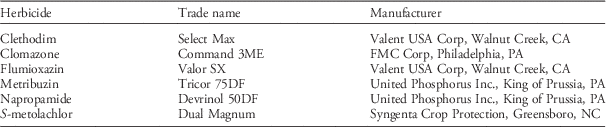
Field studies were conducted at the Pontotoc Ridge–Flatwoods Branch Experiment Station in Pontotoc, Mississippi in 2015 and 2016. Plots were three rows wide and 9.1 m long, with a between-row spacing of 1 m and in-row plant spacing of 30 cm. ‘Beauregard’ sweetpotato slips were mechanically transplanted on June 23, 2015, into a Falkner silt loam (fine-silty, siliceous, thermic Aquic Paleudalfs) with pH 6.3 and 1.3% organic matter. ‘Orleans’ slips were transplanted June 20, 2016, into a Falkner silt loam with pH 6.8 and 1.1% organic matter. With the exception of weedy and hand-weeded checks, all plots received flumioxazin at 107 gaiha−1 pretransplanting, followed by (fb) clomazone at 1,120 gaiha−1 immediately after transplanting (Table 1). The study area was cultivated on July 13, 2015, and July 15, 2016, and lay-by treatments consisting of S-metolachlor (800 gaiha−1), metribuzin (210 or 315 gaiha−1), metribuzin (210 gha−1) plus napropamide (1,120 gaiha−1), and metribuzin (210 gha−1) plus S-metolachlor (800 gha−1) were applied with a tractor-mounted CO2-pressurized sprayer calibrated to deliver 140 Lha−1 at 138 kPa and fitted with 8002 XR nozzle tips (Teejet 8002 XR, Teejet Technologies, Springfield, IL). The entire study area was treated with clethodim at 105 gaiha−1 plus 0.25% (v/v) nonionic surfactant on July 28, 2015, and July 13, 2016, to control emerged annual and perennial grasses. All herbicide applications were broadcast-applied. Weed-free check plots were hand-weeded weekly until vine closure and then as needed through harvest. The experimental design was a randomized complete block with four replications each year.
Herbicide name and manufacturer.

Data collected included crop injury and weed control at 2, 4, 6, 8, and 15 WAP on a scale of 0% (no crop injury, no weed control) to 100% (crop death, complete weed control). The center row of each three-row plot was harvested with a single-row chain digger on October 6, 2015, or October 14, 2016. The sweetpotato storage roots were hand-graded into the following categories: jumbo (≥8.9 cm in diameter), no. 1 (≥4.4 cm but <8.9 cm), canner (≥2.5 cm but <4.4 cm), and cull (misshapen roots) (USDA 2005). The roots were then weighed. Marketable yield was calculated as the aggregate of jumbo, no. 1, and canner grades.
Data were subjected to ANOVA by SAS (SAS/STAT® version 9.3, SAS Institute Inc, Cary, NC) Proc Mixed with the fixed effect of treatment and random effects of year and replication within year. Means were separated by Fisher’s protected LSD (P≤0.05). Visual sweetpotato injury and weed control rating data were arcsine square-root transformed before analysis. Nontransformed data are presented for discussion purposes. Yield data from hand-weeded and weedy checks were included in analysis; however, crop injury and weed control data from the checks were not included in data analysis due to zero variance.
Results and Discussion
Sweetpotato Tolerance
Due to a treatment by year interaction, data for sweetpotato crop injury were analyzed separately by year.
2015
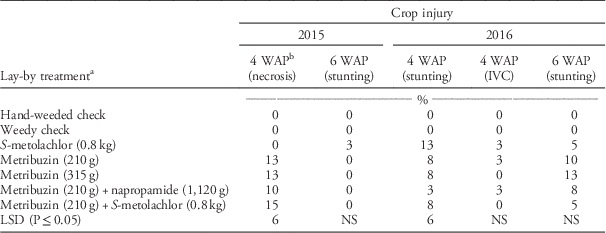
At 4 WAP, sweetpotatoes treated with metribuzin displayed 10% to 15% foliar necrosis (Table 2). Necrosis was transient, and by 6 WAP plots receiving metribuzin were indistinguishable from the hand-weeded check.
Sweetpotato crop response to lay-by herbicide treatments at Pontotoc, Mississippi, in 2015 and 2016.

a Lay-by treatments were broadcast-applied to ‘Beauregard’ sweetpotato 20 days after transplanting in 2015 and to ‘Orleans’ sweetpotato 25 days after transplanting in 2016.
b Abbreviations: IVC, interveinal chlorosis; NS, not significant; WAP, week after transplanting.
2016
At 4 WAP, sweetpotatoes treated with metribuzin exhibited 3% to 8% stunting and ≤3% interveinal chlorosis. In contrast to the results seen in 2015, symptoms were somewhat more persistent in 2016. At 6 WAP, stunting injury ranged from 5% to 13% for sweetpotatoes receiving metribuzin. By 8 WAP, no injury was visually evident in any plot (data not shown). Given that cultivars in the study differed between 2015 and 2016, the authors cannot be certain if the difference in symptom longevity was due to cultivar or the production environment within each year.
Weed Control
Due to a lack of treatment by year interaction, data for weed control were combined across 2015 and 2016. The predominant weed species in 2015 was redroot pigweed (Amaranthus retroflexus L.). In 2016, the predominant weed species were carpetweed (Mollugo verticillata L.), ivyleaf morningglory (Ipomoea hederacea Jacq.), horsenettle (Solanum carolinense L.), slender pigweed (Amaranthus viridis L.), and smooth groundcherry [Physalis longifolia (Nutt.) var. subglabrata (Mackenzie & Bush) Cronq.].
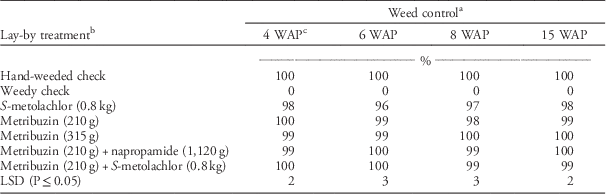
Season-long weed control was excellent (≤98%) for all herbicide treatments used in the study (Table 3). Although metribuzin at 315 gha−1, metribuzin plus napropamide, and metribuzin plus S-metolachlor at times provided statistically greater weed control than did the grower standard, S-metolachlor, differences were minimal (≤4% at any point during the study).
Effect of lay-by herbicide treatments on weed control at Pontotoc, Mississippi, pooled across 2015 and 2016.

a Predominant weed species in 2015, redroot pigweed; in 2016, carpetweed, ivyleaf morningglory, horsenettle, slender pigweed, and smooth groundcherry.
b Lay-by treatments were broadcast-applied to ‘Beauregard’ sweetpotato 20 days after transplanting in 2015 and to ‘Orleans’ sweetpotato 25 days after transplanting in 2016.
c Abbreviations: WAP, week after transplanting.
Sweetpotato Yield
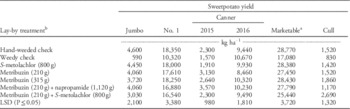
Jumbo, no. 1, marketable, and cull yield data lacked a year by treatment interaction and were analyzed across 2015 and 2016. However, canner yield did demonstrate a year by treatment interaction and was analyzed separately by year. Hand-weeded check plots yielded 4,600; 18,350; 28,770; and 1,520 kgha−1 of jumbo, no. 1, marketable, and cull grades, respectively (Table 4). Jumbo, no. 1, and marketable yields from all herbicide-containing treatments in the study were greater than those of the weedy check and were similar to those of the hand-weeded check. For all treatments, cull grade yield was similar to that of the hand-weeded check. Canner yield response differed between years. In general, canner yield was greater in 2016 (8,460 to 10,670 kgha−1) than it was in 2015 (1,570 to 3,570 kgha−1). In both years, canner yield in all treatments was similar to that of the hand-weeded check, with one exception: in 2015, sweetpotatoes receiving metribuzin plus napropamide yielded more canners (3,570 kgha−1) than did the hand-weeded check (2,300 kgha−1).
Effect of lay-by herbicide treatments on sweetpotato yield by grade at Pontotoc, Mississippi, pooled across 2015 and 2016.

a Marketable is the aggregate of jumbo, no. 1, and canner grades.
b Lay-by treatments were broadcast-applied to ‘Beauregard’ sweetpotato 20 days after transplanting in 2015 and to ‘Orleans’ sweetpotato 25 days after transplanting in 2016.
Weed control in the present study was generally excellent (≥98% through 15 WAP). Flumioxazin and clomazone herbicides applied to all noncheck plots were successfully activated by rainfall and/or irrigation. Unfortunately, at the time of lay-by herbicide applications 4 WAP, few weeds had emerged. This lack of weed pressure limited the ability of the researchers to determine the potential impact of metribuzin on POST weed control. However, the relative lack of weed pressure at lay-by allowed for a greater understanding of the effect of lay-by treatments on crop tolerance and yield data.
Sweetpotato displayed good crop tolerance to metribuzin broadcast-applied at lay-by. Although some foliar necrosis, interveinal chlorosis, and stunting injury was observed, it was transient and not evident after 6 to 8 WAP. Furthermore, crop injury did not translate into yield loss. Transient crop injury observed in the present study differs from that reported by Motsenbocker and Monaco (Reference Motsenbocker and Monaco1993), who reported >30% crop injury at harvest from metribuzin applied immediately after transplanting and at 3 WAP. However, Motsenbocker and Monaco (Reference Motsenbocker and Monaco1993) applied a higher rate of metribuzin, 1.1 to 2.2 kgha−1, than was used in the present study. Currently, sweetpotato producers lack POST broad-leaved weed control options. While in the present study some metribuzin lay-by treatments did statistically increase weed control compared to the current grower standard, the differential in weed control could potentially be far greater in years in which a rainfall event fails to activate flumioxazin and/or clomazone applications. Applications of metribuzin at 210 to 315 gha−1, alone or in combination with S-metolachlor or napropamide, appear to fit into a sweetpotato weed management program as a potential replacement for S-metolachlor alone, which provides no POST weed control.
Acknowledgements
We thank the crew at the Pontotoc Ridge–Flatwoods Branch Experiment Station for their help with transplanting, maintenance, harvesting, and grading: Trevor Garrett, Lane Jaggers, Jeff Main, Casey Moss, Jerry Sartin, Randy Swords, and Sam Tackitt.