Introduction
Gustav Wilhelm Körber (1817–1885), the noted 19th century German lichenologist, started his career as a teacher at the gymnasium in Wrocław in Poland (formerly Breslau in Prussia, Province Silesia) in 1842, and became a professor at the University of Wrocław in 1873. Systema Lichenum Germaniae (1855) and Parerga Lichenologica (1859–1865) are his most important and well-known publications. He also edited the exsiccate Lichenes selecti Germaniae (1858–1873); see Grummann (Reference Grummann1974). His herbarium is located in Leiden (Nationaal Herbarium Nederland, Leiden University branch). Further specimens are also in other herbaria (e.g., B, BM, H, M, MSTR, W, WRSL, see Grummann Reference Grummann1974).
On August 18th 1880, Körber sold his whole herbarium to W. F. R. Suringar, professor of botany at the University of Leiden between 1857–1898 and herbarium director from 1871. Körber's herbarium became part of the Rijksherbarium Leiden. Grummann (Reference Grummann1974) erroneously states that Körber sold his herbarium to the Dutch Botanical Society (KNBV) but in fact the Reichsherbarium (=Rijksherbarium) is specified in the purchase contract. Körber's herbarium comprised several exsiccate collections (e.g., Massalongo Lichenes italici, Stenhammar Lichenes Sueciae, Th. Fries Lichenes Scandinaviae rariores et critici) and two collections by Körber himself. The Haupt- or Allgemeine Sammlung consisted of 135 packages of main collections and the Typensammlung of 100 cartons and 32 boards (Cladonia spp.). Today, Körber's herbarium is not kept as a separate collection but is incorporated in the general lichen collection of the Leiden Herbarium (L). Specimens from the first part of Körber's collection (Hauptsammlung) are labelled as “KOERBER Stammherbar”, and those from the second one (Typensammlung) as “KOERBER Typenherbar”. Initially, Körber indicated in his offer that this last mentioned collection was unsaleable, but finally it was a component of the collection purchased, as stated in the transaction document, and sold for a total of 3000 Marks.
Körber's Typenherbar and its importance for lectotypification
The specimens of the Koerber Typenherbar are glued on small pieces of cardboard and usually labelled with shortened locality information (e.g., Sudeten). “Typen” in “Typenherbar” is not to be mistaken for typus in the sense of the International Code of Botanical Nomenclature. Instead, it contains well-developed sample(s) of each species (Körber in his offer, May 1880: “von jeder Species ein Repräsentant in besonders instructivem Exemplar”) and this collection was a reference herbarium used as a tool for identification. Such special herbaria of representative samples such as Körber's Typenherbar were common in the 19th century. Typenherbar specimens could represent type material, but it is not correct to regard them automatically as type material (cf. Wirth Reference Wirth1970). Therefore, not all specimens have the same importance in this respect.
A frequent origin of specimens in the Typenherbar collection is the result of fragmentation of specimens from the Stammherbar collection. It is rare to find a whole original specimen in the Typenherbar collection. Therefore, a fragment of the Stammherbar specimen present in the Typenherbar collection is potentially type material. Complete data on locality usually accompanies these Stammherbar specimens, making most of these more suitable for lectotypification. Moreover, such specimens often contain several pieces, while the specimen in the Typenherbar is often only one small piece (the size of the sample is also an important criterion when designating a lectotype). However, Typenherbar specimens are often well developed (the best and most ‘typical’ samples) and suitable for lectotypification for this reason. In several cases, it is possible to retrace the specimen from which the Typenherbar fragments were taken, with the original locality label. The character of the Typenherbar specimen (the substratum) usually indicates that it is a fragment of the Stammherbar specimen. It is not my intention here to select types or to perform lectotypifications. The following examples illustrate the various origins of Typenherbar specimens and complications with their interpretation, and are just some of the discrepancies that I encountered during my work in the Leiden herbarium which should be kept in mind in case of possible lectotypifications in the future, regardless of ‘holotype’ labels on specimens. However, herbarium specimens in other herbaria should, of course, also be taken into account by specialists performing nomenclatural studies.
-
1. The Typenherbar specimen was identified to be a fragment of a Stammherbar specimen that is original material: The Segestrella cruenta Körb. (=Sporodictyon cruentum) specimen (L-0399783) in the Stammherbar is labelled as ‘the holotype’ (locality “Riesengrund 1849, an Granit”). However, Swinscow & James published the new combination Polyblastia cruenta in Swinscow (Reference Swinscow1971: 110), where another Stammherbar specimen L-0793135 (the old number 910, 213-1364) is mentioned as the holotype specimen, locality: “an trocken Felsblocken (Granit) unweit der Petz … grund, am Wimmerbergs … 28 Jul. 1849”. Both localities are in accordance with the protologue (Risengrund and Petzkretscham in Aupagrund are the same valley). The Typenherbar specimen (L-0837136) labelled “Sudeten (Kbr)” is clearly a fragment of the Stammherbar specimen L-0793135, because both specimens have the same thallus colour and substratum character. The Stammherbar specimen L-0399783 does not have such a dark thallus, but the substratum rock is the same. According to Körber (Reference Körber1855: 336), he found this species only once on granite at the locality “am Fusse des Wimmerberges unweit des Petzkretschams im Riesengebirge im J. 1849”. Therefore, all specimens mentioned are in fact syntypes, and the Typenherbar specimen (L-0837136) from Leiden should be taken into consideration when selecting a lectotype in the future.
-
2. The Typenherbar specimen is only a fragment of a specimen in the Stammherbar, but is still potentially a better lectotype: Catillaria sphaeralis Körb. (=C. contristans) specimen (L-0056594) in the Typenherbar represents original material and is labelled “lectotype”, but without any further note or name. The other potential type specimens L-0056595 and L-0063110 in the Stammherbar are labelled as the isotypes. All specimens have the same moss as the substratum with intermixed squamules of Cladonia sp., and they very probably are duplicates of one collection. However, the specimen L-0063110 has the locality and additional original data concerning spores written by Körber on a label inside the envelope. Therefore, this could be the specimen from where the Typenherbar specimen was taken (the Stammherbar specimen L-0063110 contains only a few small fragments). The Typenherbar specimen is well preserved, because it is glued onto a small piece of cardboard. In contrast, the Stammherbar specimen is generally better developed, but loosely inserted in an envelope and it consists of several small fragments. Note: the specimen L-0837155 represents another original sample labelled “Rk 1859” (=“Riesengebirge, Schneekoppe”, see the locality abbreviations below), but the lichen is growing together with moss on rock.
-
3. The Typenherbar specimen is the only known original material: The Typenherbar specimen of Verrucaria (=Porina) sudetica Körb. (L-0837141), labelled Sudeten on the envelope and “Zehgrund ad rupes 1849” inside, is the only original material found in the Leiden herbarium. This is the reason why this Typenherbar specimen has an exceptional label with an unusually precise locality. Probably, it is the only original specimen available.
-
4. The Typenherbar specimen was identified to be a fragment of the Stammherbar specimen, which is not original material: The Typenherbar specimen of Arthonia sorbina Körb. (L-0837169) is clearly a fragment separated from the specimen L-0837168, which is not original material. Both specimens have the same character: substratum and style of cutting bark as well as identical lichen vegetation of accompanying species. Another specimen, L-0700385, represents original material and Sundin suggested in 1999 that this should become the lectotype, according to a note label inside the specimen, but the lectotypification has not yet been published; the name A. sorbina (=A. radiata) is not mentioned in the paper by Sundin & Tehler (Reference Sundin and Tehler1998). The exsiccate specimens distributed as Lichenes selecti Germaniae n. 20 Coniangium sorbinum represent further original material (this exsiccate is mentioned in the protologue) and therefore they are possible isolectotypes.
-
5. The Typenherbar specimen consists of several fragments of different origin: The specimen of Opegrapha (=Enterographa) zonata Körb. (L-0837144) consists of two fragments of different origin, which is obvious as they have a different colour and substratum. The small piece is clearly a fragment of the specimen L-0837147 as they have the same substratum and an atypical brown thallus colour. The large piece is probably a fragment of the specimen L-0837145 (topotype, but not original material). The specimen L-0837146 which is labelled as an isotype (probably by Torrente & Egea, but the holotype specimen is not cited in the monograph Torrente & Egea Reference Torrente and Egea1989), is in fact a topotype, because it is the specimen of the Lichenes selecti Germaniae, edited later. Two other specimens (L-0837142 and L-0837143) are syntypes, and one or two further syntypes can be found in the Wroclaw herbarium (one probably collected by Stein, in which case it would only be a topotype). Wirth (1970) considered the Typenherbar specimen L-0837144 to be the type, but he did not mention additional original material (only topotype specimens).
-
6. The Typenherbar and the Stammherbar specimens have different origins, but both represent original material. Laurer collected the Typenherbar specimen of Biatora laureri Körb. (L-0649877) in Riesengebirge. The Stammherbar specimen (L-0649876) is labelled Sudeten (v. Flotow). The protologue mentions material collected by both Laurer and Flotow in Riesengebirge. However, the name Biatora laureri (=Lecidea subgranatina) is a nomen illegitimum (Art. 53.1).
These are examples of specimens in the Typenherbar collection of various origin, indicating that such specimens have a different importance for lectotypification. Therefore, all accessible material should be checked before any nomenclatural evaluation.
General recommendations for typification of Körber names
-
1. To have all material from L and other relevant herbaria available, and preferably visit the herbarium L personally.
-
2. To compare the type locality in the protologue with data in Körber's Systema Lichenum Germaniae (Reference Körber1855) and Parerga Lichenologica (1859–1865) for possible further details.
-
3. To check all specimens regardless of ‘type’ labelling (incl. Typenherbar).
-
4. To check locality labels, even in the case of reduced use of locality and abbreviations (see below).
-
5. To sort out and annotate all type material.
-
6. To compare the type material in the Stammherbar (and/or the type specimens from other herbaria) with Typenherbar specimens in L, in order to trace the potential type material here.
-
7. To designate the lectotype with respect to quality and quantity of specimen.
-
8. It is recommended that curators and people administrating herbarium databases add literature references for basionym and typification when types are registered.
Körber's locality abbreviations/symbols on labels of specimens and their explanations
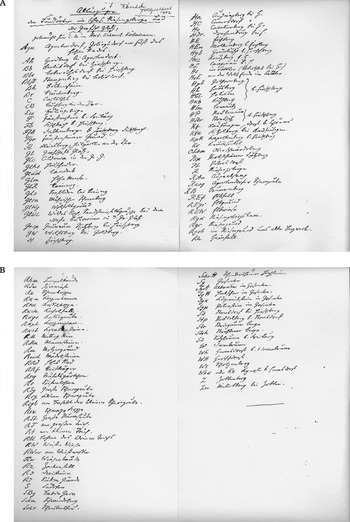
A list of symbols (often abbreviations), which Körber sometimes used instead of a locality on labels of his specimens (e.g. L-0063110 and L-0837155), is kept in the Leiden herbarium archive. A list of collection sites, that is explanations of these abbreviations/symbols, is written by Körber in “Old German script” (Kurrentschrift or Alte Deutsche Schrift, see Fig. 1). It is interesting that all Körber's handwritten letters concerning his herbarium (kept also in the Leiden herbarium archive) do not use this old type of handwriting (neither symbols nor abbreviations use the old type).
The original Körber manuscript with list of collection sites, abbreviations and their explanations for places in the Silesian part of the Giant Mts and Kłodzko County, as used in Koerber's lichen herbarium.

Even though Körber sold his herbarium to Leiden, other specimens labelled with only Körber's symbols could also be found in other herbaria. Körber's symbols often consist of the first letter or abbreviations of a locality name (several symbols are witty, see, e.g., RT and Rt or R3 and R7). However, it is impossible to identify the localities without Körber's original clue. A transliteration of Körber's original explanations is published here, together with the current Polish or Czech names of the localities and details of their situation. Arrangement: Körber's symbol (repeated letters have the same meaning, e.g., all localities beginning with R are from the Giant Mts, similarly Gl from Kłodzko County, H from Jelenia Góra surroundings, Sg from the Jeseníky Mts) – the original explanation written by Körber with an alternative German name for the original locality (e.g., Ah: Körber wrote Herdberg, but on some maps it is Heerdberg) or an itemized abbreviation (e.g., F: Körber wrote b. meaning bei) in square brackets=current name and location (localities on the border have both the Polish and the Czech name).
Note: A strict alphabetical order is used in the following list that sometimes deviates from Körber's original arrangement.
- Agn
-
Agnetendorf, Gebirgsdorf am Fuss des Hohen Rades=Jagniątków (village c. 13 km SW of Jelenia Góra city), Poland
- Ah
-
Herdberg [Heerdberg] bei Agnetendorf= Mt Żar (680 m, 1 km NE of Jagniątków village), Poland
- Bb
-
Berbisdorf bei Hirschberg= Dziwiszów (c. 5 km NE of Jelenia Góra city), Poland
- Bbr
-
Boberröhrsdorf bei Hirschberg= Siedlęcin (village c. 4 km NW of Jelenia Góra city), Poland
- BbSt
-
Stangenberg bei Berbisdorf= Leśnica hill (665 m, 1 km N of Dziwiszów village), Poland
- Bh
-
Bolkenhain=Bolków (town c. 27 km E of Jelenia Góra city), Poland
- Br
-
Brückenberg=Karpacz Górny (also Bierutowice, part of Karpacz town), Poland
- C
-
Carlsthal=Orle (hamlet 9 km ESE of Szklarska Poręba town), Poland
- CB
-
Buchberg an der Iser=Jizerka (hamlet in municipality Kořenov, Jizera Mts), Czech Republic
- Eu
-
Eulengebirge=Góry Sowie Mts (near Wałbrzych city), Poland
- F
-
Fürstenstein b.[ei] Freiburg=Książ near Świebozice (castle N of Wałbrzych city), Poland
- Fb
-
Fischbach b.[ei] Hirschberg=Karpniki (village 10 km SE of Jelenia Góra city), Poland
- Ffb
-
Falkenberge b.[ei] Fischbach=Sokole Góry (mountain ridge in the Rudawy Janowickie Mts SE of Jelenia Góra city), Poland
- Fgr
-
Fürstensteiner Grund=Park Książański (romantic park in valley near Książ castle N of Wałbrzych city), Poland
- Fl
-
Flinsberg [Bad Flinsberg], Heilquelle an der Iser=Świeradów Zdrój (spa c. 25 km W of Jelenia Góra city), Poland
- Gl
-
Grafschaft Glatz=Kłodzko County (historical region in Lower Silesia), Poland
- Glc
-
Cudowa in der Gr.[afschaft] G.[latz]= Kudowa Zdrój (spa c. 25 km E of Kłodzko city), Poland
- Glhs
-
Heuscheuer=Mt Szczeliniec (919 m, Góry Stolowe Mts W of Kłodzko city), Poland
- GlLd
-
Landeck=Lądek-Zdrój (spa c. 18 km SE of Kłodzko city), Poland
- Glm
-
Hohe Mense=Mt Vrchmezí/Góra Orlica (1084 m, Góry Orlickie/Orlické Mts), Poland/Czech Republic
- GlR
-
Reinerz [Bad Reinerz]=(spa c. 18 km SW of Kłodzko city), Poland http://en.wikipedia.org/wiki/Wikipedia:IPA_for_Polish
- Gls
-
Seefelder bei Rainerz=Torfowisko pod Zieleńcem (peat-bog nature reservation c. 6 km S of Duszniki-Zdrój town), Poland
- Glsn
-
Mährischer Schneeberg=Mt Śnieżnik Kłodzki/Králický Sněžník (1425 m), Poland/Czech Republic
- GlWg
-
Wölfelsgrund – Międzygórze (village c. 25 km SSE of Kłodzko city), Poland
- GlWL
-
Wildes Loch, Sandsteinfelsgruppe bei dem Dorfe bukowina in d.[er] Gr.[afschaft] Glatz=Błędne Skały (Wilde Löchern) near Bukowina Kłodzka (sandstone rock labyrinth in the Góry Stolowe Mts near Kudowa Zdrój spa), Poland
- Grsp
-
Grunauer Spitzberg bei Hirschberg= Stromiec hill N of Jeżów Sudecki village (551 m, Kaczawskie Góry Mts N of Jelenia Góra city), Poland
- GW
-
Wolfsberg bei Goldberg=Wilków (village 4 km S of Zlotoryja town), Poland
- H
-
Hirschberg=Jelenia Góra city, Poland
- Ha
-
Audienzberg bei H.[irschberg]= Wzgórze Partyzantów hill [another name: Kamienista hill] (412 m, W of Parkówa Góra hill, NE outskirts of the city), Poland
- HC
-
Cunnersdorf [Kunersdorf] bei H.[irschberg]=Jelenia Góra (SW outskirts), Poland
- Hc
-
Cavalierberg [Kavalierberg, Galgenberg] bei H.[irschberg]=Wzgórze T. Kościuszki hill (412 m, E outskirts of Jelenia Góra city), Poland
- Hdr
-
Drachenburg [Drachenberg] bei H.[irschberg]=castle ruins on Wzgórze Wandy hill (401 m, between Wzgórze T. Kościuszki hill and Paulinum castle, E outskirts of Jelenia Góra city), Poland
- HE
-
Eichberg=Dąbrowica (village 5 km ESE of Jelenia Góra city), Poland
- HEm
-
Molkenberg bei E.[ichberg]=Dąbrowa Boleslaviecka hill (462 m) near Dąbrowica village, Poland
- Hgb
-
Grünbusch [Grün-Busch] bei H.[irschberg]=forest on Zamkowa Góra hill between Dąbrowica and Jelenia Góra (c. 4 km ESE of Jelenia Góra city), Poland
- Hgl
-
Gelhornberg [Gellhornberg] b.[ei] Hirschberg=hill near manor house Dwor Czarne in Jelenia Góra (E outskirts of Jelenia Góra city), Poland
- Hh
-
Hausberg b.[ei] Hirschberg=Wzgórze Krzywoustego hill (373 m, N outskirts of Jelenia Góra city), Poland
- Hhl
-
Helikon b.[ei] Hirschberg=Siodło hill (468 m, N outskirts of Jelenia Góra city), Poland
- Hkb
-
Kuhberg b.[ei] Hirschberg=Parkowa Góra hill (382 m, near railway station, NE outskirts of Jelenia Góra city), Poland
- Hkz
-
Kreuzberg [Kramstaberg] b.[ei] H.[irschberg]=Wzgórze Zamkowe hill, park Paulinum (440 m, SE outskirts of the Jelenia Góra city), Poland [Note: there are further hills with the same German name Kreuzberg near Jelenia Góra city, eg. Wzgórze Kapliczna hill (418 m, N outskirts of Jelenia Góra city), Krzyżowa Góra (443 m) near Mysłakowice c. 7 km SE of of Jelenia Góra city or Krzyżnik near Podgórki village (12 km NE of Jelenia Góra city); a more distant but popular excursion aim is Krzyżna Góra Mt (654 m, Rudawy Janowickie Mts. c. 10 km ESE of Jelenia Góra city]
- HL
-
Langenau b.[ei] H.[irschberg]= Czernica (village c. 8 km N of Jelenia Góra city), Poland
- Hlm
-
Lomnitz=Łomnica (village c. 6 km SE of Jelenia Góra city), Poland
- HP
-
Paulinum b.[ei] Hirschberg=Paulinum castle in Jelenia Góra (SE outskirts), Poland
- Hs
-
im Sattler (Boberthal bei H.[irschberg])= in Borowy Jar (valley of Bobr river NW of Jelenia Góra city), Poland
- HsE
-
an der Weltende im Sattler=at Koniec Świata (place in Borowy Jar valley between Jelenia Góra and Siedlęcin), Poland
- HStr
-
Straupitz b.[ei] Hirschberg=Strupice (today NE part of Jelenia Góra city), Poland
- Kf
-
Kaufungen [Kauffung, Kaufung], Dorf b.[ei] Schönau=Wojcieszów near Swierzawa (town 18 km NE of Jelenia Góra city), Poland
- Kfk
-
Kitzelberg bei Kaufungen [Kauffung, Kaufung]=Mt Polom near Wojcieszów town (667 m, 18 km NE of Jelenia Góra city), Poland
- Kpll
-
Kapellenberg b.[ei] Hirschberg= Widok hill between Podgórki and Dziwiszów villages (515 m, 12 km NE of Jelenia Góra city), Poland
- Kr
-
Krummhübel=Karpacz (spa c. 14 km S of Jelenia Góra city), Poland
- Kz
-
Kynast b.[ei] Hermsdorf=Chojnik (ruin of castle S of Sobieszów village, c. 10 km SW of Jelenia Góra city), Poland
- Oschm
-
Ober Schmiedeberg=today SE part of Kowary (town c. 13 km SSE of Jelenia Góra city), Poland
- Psp
-
Probsthainer Spitzberg=Ostrzyca Proboszczowicka hill (501 m, 12 km SW of Zlotoryja city), Poland
- Pt (PL?)
-
Petersdorf=Piechowice (village c. 12 km SW of Jelenia Góra city), Poland
- R
-
Riesengebirge=Karkonosze/Krkonoše (Giant Mts, Sudeten Mts), Poland/Czech Republic
- RAa
-
Aupaabhang=Úpská jáma (S slope of Mt Śnieżka/Sněžka), Czech Republic
- Rasg
-
Agnetendorfer Schneegrube [Schwarze Schneegrube]=Czarny Kocioł (eastern part of Śnieżne Kotły cirque), Poland
- RB
-
Brunnenberg [Brunnberg]=Mt Studniční hora (1554 m), Czech Republic
- REf
-
Elbfall=Labský vodopád (Elbe waterfall), Czech Republic
- REgr
-
Elbgrund=Labský důl (cirque underneath the Elbe waterfall), Czech Republic
- REW
-
Elbwiese – Labská louka (plateau of the Elbe river spring), Czech Republic
- Rgk
-
Riesengebirgskamm=main border ridge of the Giant Mts, Poland/Czech Republic
- Rgr
-
Riesengrund=Obří důl (cirque on S slope of Mt Śnieżka/Sněžka), Czech Republic
- Rgrb
-
im Riesengrund und alten Bergwerk= in Obří důl cirque and at Kovárna (old mine in the Obří důl cirque), Czech Republic
- Rh
-
Hainfall=wodospad Podgórnej (waterfall in Przesieka village c. 10 km SW of Jelenia Góra), Poland
- Rhm
-
Hampelbaude – Strzecha Akademicka (1258 m, mountain chalet near Maly Staw lake), Poland
- RIw
-
Iserwiese=Hala Iserska/Velká Jizerská louka (peat-bog nature reservation in the Jizera Mts), Poland/Czech Republic
- Rk
-
Schneekoppe=Mt Śnieżka/Sněžka (1602 m, the highest peak of the Giant Mts), Poland/Czech Republic
- Rkch
-
Kochelfall=wodospad Szklarki (waterfall near E margin of Szklarska Poręba town), Poland
- Rkgr
-
Kesselgrube – Kotelné jámy (cirque on SE slope of Mt Kotel), Czech Republic
- Rkk
-
Kesselkoppe – Mt Kotel (1435 m), Czech Republic
- Rkm
-
Koppenkamm (Riesenkamm, Hauptkamm)=Czarny Grzbiet/Obří hřeben (main mountain crest of the Giant Mts
- Rkpl
-
Koppenplan=Równia pod Śnieżka/Úpská rašelina (peat-bog plateau W of Mt Śnieżka/Mt Sněžka), Poland/Czech Republic
- Rkst
-
Korallensteine=Paciorki (rocks between Jagniątków village and the Śnieżne Kotły cirque), Poland
- RM
-
Mittagstein=Mt Słonecznik (near Wielki Staw lake), Poland
- RMn
-
Mannsteine=Mt Czeskie Kamienie/Mužské kameny, Poland/Czech Republic
- Rm
-
Melzergrund=Kocioł Łomniczki (cirque on N slope of Mt Śnieżka/Sněžka), Poland
- Rmd
-
Mädelsteine=Mt Śląskie Kamienie/Dívčí kameny, Poland/Czech Republic
- RRd
-
Hohes Rad=Mt Wielki Szyszak/Vysoké kolo(1509 m), Poland/Czech Republic
- RRf
-
Reifträger=Mt Szrenica (1362 m), Poland
- Rrg
-
Teufelsgärtchen=Čertova zahrádka (important botanical locality in the Obří důl cirque), Czech Republic
- Rs
-
Seifenlehnen=Złotówka (valley of the Złoty Potok brook near Mały Staw lake), Poland
- RSg
-
Grosse Schneegrube=Wielki Kocioł Śnieżny cirque (central part of the Śnieżne Kotły cirque), Poland
- Rsg
-
Kleine Schneegrube=Mały Kocioł Śnieżny cirque (western part of the Śnieżne Kotły cirque), Poland
- Rsgb
-
am Basalt der Kleinen Schneegrube= on basalt rocks in Żleb basaltowy gully (Mały Kocioł Śnieżny cirque), Poland
- Rsk
-
Schwarze Koppe=Mt Czarna Kopa/Svorová hora (1411 m), Poland/Czech Republic
- RSt
-
Grosse Sturmhaube=Mt Śmielec (1424 m), Poland
- RT
-
am Grosssen Teich=near Wielki Staw lake, Poland
- Rt
-
am Kleinen Teich=near Mały Staw lake, Poland
- RtL (Rtl?)
-
Lehne des Kleinen Teichs=slope above Mały Staw lake, Poland
- RW
-
Weisse Wiese=Bílá louka (locality on N slope of Mt Studniční hora), Czech Republic
- Rw
-
Wiesenbaude=Luční bouda (1410 m, the oldest mountain chalet in the Giant Mts from 1625), Czech Republic
- RWw
-
am Weisswasser=near the Bílé Labe brook, Czech Republic
- Rz
-
Zackenfall [Zackelfall]=Wodospad Kamieńczyka (waterfall in the Giant Mts c. 4 km SW of Szklarska Poręba town, formerly Schreiberhau), Poland
- R3
-
Dreisteine=Pielgrzymy (1204 m, rocks N of Wielki Staw lake), Poland
- R7
-
Siebengründe=Sedmidolí [=Seven Valleys] (N slope of the Elbe cirque beneath of Mt Vysoké Kolo), Czech Republic
- S
-
Sudeten=Sudety (Sudeten Highlands, Sudetes, mountain area on border of the Czech Republic and Poland, mountain area of the historical land Silesia), Poland/Czech Republic
- SBg
-
Babia Gora=Mt Babia Gora (1722 m, c. 50 km SSW of Cracow city, 49°35′0″N, 19°32′0″E), Poland
- Schm
-
Schmiedeberg=Kowary (town c. 13 km SSE of Jelenia Góra city), Poland
- Schr
-
Schreibershau [Schreiberhau]=Szklarska Poręba (town c. 18 km SW of Jelenia Góra city), Poland
- SchrH
-
Schreibershauer [Schreiberhauer] Hochstein=Mt Wysoki Kamień (1058 m), Poland
- Sg
-
Gesenke=Jeseníky Mts, Czech Republic
- SgA
-
Altvater im Gesenke=Mt Praděd (1497 m), Czech Republic
- SgH
-
Hochschar im Gesenke=Mt Šerák (1351 m), Czech Republic
- Sgk
-
Köpernikstein im Gesenke=Mt Keprník (1424 m), Czech Republic
- Sgp
-
Peterstein im Gesenke=Mt Petrovy kameny (1446 m), Czech Republic
- St
-
Stonsdorf bei Hirschberg=Staniszów (village c. 4 km S of Jelenia Góra city), Poland
- Stp
-
Prudelberg b.[ei] Stonsdorf=Witosza hill (484 m, E of Staniszów village), Poland
- Str
-
Striegauer Berge – Wzgórza Strzegomskie (upland c. 20 km N of Wałbrzych city), Poland
- Strh
-
Strehlener Berge – Wzgórza Strzelińskie (upland c. 40 km S of Wrocław city), Poland
- Sz
-
Salzbrunn [Bad Salzbrunn] b.[ei] Freiburg=Szczawno-Zdrój near Świebozice (spa c. 3 km N of Wałbrzych city), Poland http://en.wikipedia.org/wiki/Wikipedia:IPA_for_Polish
- W
-
Warmbrunn [Bad Warmbrunn]= Cieplice Śląskie-Zdrój (spa, today SW part of Jelenia Góra city), Poland
- Wh
-
Hermsdorf b.[ei] Warmbrunn= Sobieszów (village, today SW part of Jelenia Góra city), Poland
- WH
-
Herischdorf=Malinnik (village, today S part of Jelenia Góra city), Poland
- Whk
-
Kynast bei Hermsdorf=Chojnik (ruin of castle S of Sobieszów village, c. 10 km SW of Jelenia Góra city), Poland
- Ws
-
Scholzenberg=Góra Soltysia hill (434 m, E of Cieplice Śląskie-Zdrój spa), Poland
- Z
-
Zobtenberg=Mt Ślęża (718 m, c. 35 km SW of Wrocław city near Sobótka village, holy place of the heathen tribes of the Lusatian culture from 7th century BC as well as during Christian times; 50°51′54·06″N, 16°42′31·74″E), Poland
- Zm
-
Mittelberg bei Zobten=Mt Wieżyca (415 m, N part of Mt Ślęża system), Poland http://en.wikipedia.org/wiki/Lusatian_culture
I am indebted to Gerard Thijsse, chief collection manager of the Nationaal Herbarium Nederland, Leiden University branch, for his help with my work in the Leiden herbarium, and for placing copies of documents concerning Körber's herbarium at my disposal. Thanks are due to several colleagues and friends for their assistance in deciphering handwriting: A. Igersheim (Wien), J. Píka (Zürich), J. Hadinec (Praha) and J. Zázvorka (Praha). The assistance of M. Kossowska (Wrocław) and I. Łaborewicz (Jelenia Góra) in providing current names and locations of Körber's localities is greatly appreciated. Mrs J. Forry kindly corrected the English. I am indebted to Mats Wedin (Swedish Museum of Natural History, Stockholm) for improving the clarity of the text. This project was supported by the Academy of Sciences of the Czech Republic (AV0Z60050516), Grant Agency of the Academy of Sciences of the Czech Republic (IAA600050712) and as a long-term research development project no. RVO 67985939. All support is acknowledged.