Art is not an end in itself, but a means of addressing humanity.
Pablo Picasso Footnote 1
Introduction
The capabilities of neuroscience and neurotechnology to assess and affect cognition, emotions, and behaviors are rapidly increasing. Neuroscientific information—and its meanings and implications—can influence, if not redefine, current and future visions of the human condition, the human being, consciousness and the “self.” Footnote 2 For example, the brain is increasingly identified as the source of the person, self, or soul (i.e., neuroessentialism). Neurotechnology is ever more being regarded as providing tools to acquire objective proof of subjective phenomena such as love (i.e., neurorealism). Neuroscience is being engaged to support political and/or social agendas (i.e., neuro of neurobiological processes involved in beliefs or cultural phenomena are being seen as seeking and demonstrating “biological proof” of cultural constructs.) Footnote 3,Footnote 4,Footnote 5,Footnote 6,Footnote 7 Moreover, when neuroscientific information is used as an explanation for social and health constructs that refer to the mind and the self, cultural constructs often become fused with and impose new meanings on neuroscientific information. Footnote 8,Footnote 9
These projected meanings, as well as the growing public salience of both neuroscientific capabilities and the potential for brain science to be employed toward utopian as well as dystopian ends, are increasingly portrayed in representations of neuroscience in fiction. Unlike news media, in which the cultural appropriation of neuroscientific understanding is more implicit, the narrative structure of fiction allows a more explicit representation of neuroscience’s place within cultural narratives. This grants neuroscientific references and portrayals in popular entertainment media—what we herein refer to as neuroscience fiction, or neuroS/F—the unique capacity to reinforce “meanings” acquired by neuroscientific information, and also to transform them. Footnote 10
We believe that neuroS/F may be seen as eidolá: a created likeness that can either accurately—or superficially, in a limited way—represent the essence (i.e., the eidos) of that which it depicts. Exposure to neuroS/F eidolá through movies, television, video games, comic books, and literature gives rise to a growing, but not yet explicitly articulated public awareness of, and sensitivity to, the issues, questions, and problems that are intrinsic to, defined by, and the focus of neuroethics. This awareness takes the form of emotionally salient images or fictional memes that serve as a reference for responding to cultural events and technological objects that are reminiscent of their fictional portrayal. These references can be potent, and can influence public attitudes (if not actions) toward enabling or limiting further neuroscientific developments. Therefore, we argue that it is necessary for neuroethics to address and confront how neuroS/F frames and influences public perceptions of, and orientation to, real or imagined neuroscientific achievements and their consequences. As neuroscience advances what is possible (or foreseeable), neuroS/F extends the horizon of what is conceivable within the public imagination. This is important because fictional representations are likely to set an emotional tone of public response to emerging neurotechnologies, and this may differ substantially depending on the context in which it is presented (e.g., medical vs. military neurotechnology). Imagined realities within the realm of neuroS/F may include brain–machine interfaces (BMI), memory and conscious experience manipulation, cognitive enhancement, neutrally augmented virtual reality, artificial intelligence (AI), and cyborgs (to name some of the most common). These representations—although fictional—can instill and/or exacerbate public misperceptions of the capacities and uses (and misuses) of neuroscientific tools and techniques.
NeuroS/F blurs the line between hard (neuroscientific) facts, soft (neuroscientific) oversimplifications, and outright fantasy, and, therefore, we argue that it is—and will be ever more—necessary to be mindful of the effects of such accurate and inaccurate portrayals of neuroscience and neurotechnology. However, distinguishing “neurofact” from “neurofiction” can be challenging, given the contingent and still tenuous understanding of the relationship of the brain to consciousness, the “mind,” and the “self.” This mandates a critical neuroethical consideration of neuroS/F so as to (1) problematize public perceptions and misperceptions of neuroscience, (2) establish the mutual empowerment gained by distinguishing “neurofact” from “neurofiction”, and (3) parse realistic public hopes and fears from sheer phantasma.
NeuroS/F Eidolá as Self-Contained Neuroethical Discourses
Fictional portrayals of neuroscience in movies, television, comic books, and literature are a major vector by which scientific information is transplanted into the public sphere. Others have examined news media portrayals of neuroscience to analyze how neuroscientific information is understood through the prism of cultural meanings and worldviews. Footnote 11 As in news media, the specific representations of neuroscience that reach public consciousness through fiction are resonant with prevailing social concerns and a cultural context. However, whereas news media are likely to attempt to accurately describe scientific information and portray it in a way that reinforces prevailing attitudes and cultural biases about the brain, mind, and self, neuroS/F engages a more dynamic interaction with prevailing attitudes and cultural biases. Whereas fiction may ultimately uphold the same or similar cultural constructs, the narrative structure also enables neuroS/F to challenge existing ideas, ideals, and expectations. Neuroscientific progress is often used in neuroS/F as a plot device for generating conflict, in which the outcome depends on the actions taken by the various characters who confront the science or its manifest effects. This permits works of neuroS/F to constitute self-contained neuroethical discourses in which the influence and impacts of technological advances are considered from a variety of perspectives.
For example, the premise of Joss Whedon’s 2009 neuroS/F television show, Dollhouse (Mutant Enemy Productions, Fox Network) challenges the way that personhood is related to a neuroessentialist view that the brain, mind, and self are synonymous. Almost every episode of Dollhouse explicitly engages in a reflexive discourse though various characters’ dialogue and actions, which are driven by their ethical judgments. Characters assume different attitudes toward the plight of the “dolls” who, although oblivious to the fact, have previously consented to surrender their minds and bodies for 5 years in exchange for desperately needed solutions to problems in their lives. During these contracted years, the dolls’ minds and personalities are repeatedly “wiped” and reprogrammed according to the requirements of clients, who rent them for specific missions. The central conflict of the show results when an anomaly causes the main protagonist, Echo, to retain fragments of memories after each personality wipe, leading her to develop increasing amounts of persisting self-awareness and personality. The show’s dialogue is rife with explicit neuroethical analyses of informed consent, self, agency, paternalism versus autonomy, and personhood as each character grapples with (or embraces) his or her complicity regarding the decreasingly morally ambiguous purposes for which the “dolls” are programmed.
The reimagined Battlestar Galactica (BSG) (Universal Cable Productions, Sci-Fi Network) is another example of a self-contained neuroethical discourse about notions of personhood and identity. The plot follows a star fleet of the small human population that remains after a genocide perpetuated by the Cylons, intelligent robots that rebelled, then evolved. In the more recently produced series, Cylons come in multiple forms, from “animal-like” military assault vehicles, to the original conscious robots, to evolved biomorphic “skin-jobs” who are outwardly indistinguishable from humans, with nervous systems that afford them not only consciousness, but also all the same capacities as a human being, including self-awareness, pain, emotions, and even spirituality. As in Dollhouse, the main characters in BSG (who are both human and Cylon) each grapple with moral and ethical judgments as their individual perceptions of the Cylons’ personhood undergo revisions as a result of plot events. In this way, neuroethical commentary in neuroS/F assumes an allegorical form. Reflecting on these allegories permits concrete reflection by neuroscientists and neuroethicists about whether the often-dystopian scenarios are plausible, and if so, how to avoid them.
Beyond relatively superficial readings of the technological content of neuroS/F as utopian or dystopian, more complex psychohistorical dynamics of neuroS/F’s embedded discourse can be probed by symbolic analysis of the neurotechnical eidos itself. Klaus Benesch Footnote 12 and David Channel Footnote 13 have explored the notion that technology functions as “a site where various sociocultural discourses converge” and a means for “symbolically coming to terms with the modern environment.” Footnote 14 Technology has origins in, and effects upon, the way that individuals and cultures conceive of the world and humanity’s place in it. When sufficiently revolutionary technologies become newly dominant as metaphors for worldly phenomena, semantic constructs such as nature, humanity, or life may be restructured such that new worldviews are spawned, with consequences that propagate throughout society.
For example, Channel asserted that applying the clockwork as a symbol for natural phenomena gave rise to a mechanical (as opposed to an organic) worldview, which paved the way for the emergence of industrialized society. Footnote 15 Similarly, applying cognitive technology (e.g., computers) as a symbol for intelligent phenomena has given rise to a computational/systems worldview, the effects of which on society are only just emerging. In this paradigm, Benesch argues, the newer model does not entirely replace the old, nor is there a clear-cut distinction between them. Footnote 16 Instead, the restructuring of semantic concepts gives rise to sociocultural tension that manifests as culturally important discursive imagery; namely, eidolá.
Because technology is so essential to neuroS/F themes and plot, the discursive property of technology becomes fundamental to neuroS/F. Consequently, just as the use of technology as metaphors for natural worldly phenomena may restructure semantic constructs and thereby change the trajectory of sociocultural development, the symbolic use of neuroS/F eidolá as allegories for sociopolitical or cultural phenomena may restructure technological constructs and thereby alter the trajectory of technological development. This generates and sustains neuroethical responsibility for monitoring neuroS/F eidolá and the sociocultural context from which—and into which—the ideas of eidolá are allegorically projected.
Core Thematic Foci of NeuroS/F Eidolá
As has been noted, Footnote 17 neuroscientific advances can undermine the conceptual stability of semantic constructs, inclusive of humanity, personhood, identity, self, reality and free will. The concepts that neuroS/F has the greatest potential to refine, if not redefine, established technologies whose implications call such constructs into question as the core thematic foci of neuroS/F eidolá. Such neuroS/F eidolá tend to assume four principal themes:
-
• Mind control
-
• Machine consciousness and cybernetics
-
• BMIs and implants
-
• Neural enhancement and psychoneural evolution
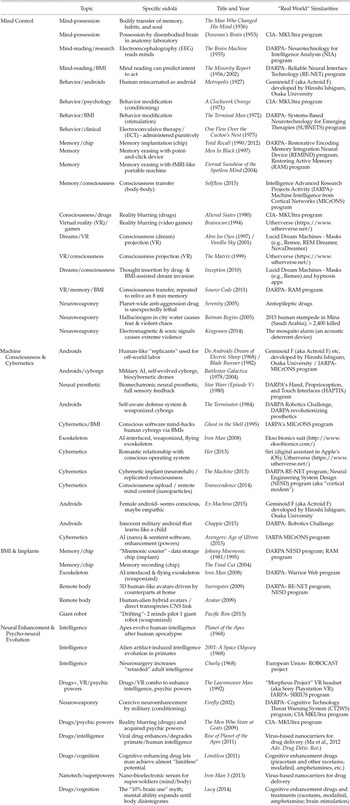
Examplar neuroS/F films from each category, along with the specific eidolic forms and real-world technologies bearing at least superficial resemblance to the eidolá are listed in Table 1, and are as follows.
NeuroS/F Films with Thematic Content About Brain Science and Neurotechnology

For a review of DARPA technologies mentioned, see Note 45, Miranda et al., 2015.
Mind control eidolá encompass all psychobehavioral and neurointerventional tools for extrinsically detecting, projecting, and/or imposing brain/mind activity subserving behavior, intention, and/or experience as contained in scope and degree within the bounds of natural and phenomena (e.g., memories, consciousness, imagination, dreams, hallucinations, intentional and involuntary behavior). Among these eidolá, thematic content tends to segregate according to the neural function targeted (e.g., memory, consciousness or dreams, violent or intentional behavior) and/or form of technology used to invoke effects (e.g., sonic or electromagnetic signal, psychological conditioning, drugs, games, neurostimulation, virtual reality interface, nanoparticles). In general, mind control eidolá all tend to question the reality either of one’s experiences, autonomy, or identity. These questions express anxiety (if not paranoia) about the reality of self-autonomy versus external control by an “other.” Three forms of modern mind control eidolá are dominant in neuroS/F: memory manipulation; lucid dreams and virtual realities; and neuroweapons (see Table 1).
Machine consciousness and cybernetics eidolá encompass embodied AIs (e.g., androids or conscious robots), disembodied cybernetic beings with uploaded or reconstructed human consciousness, cybernetic organisms comprised of organic and biomechatronic parts (i.e., “cyborgs”) including created beings, “evolved” androids (e.g., the cylons in the 2004 BSG), and humans with automated biomechatronic implants. The forms assumed by these eidolá generally question boundaries and meaning(s) of natural intelligence, humanity, and personhood, differing only by the degree of embodiment, and the nature and extent of the intelligence of the organisms depicted. These eidolá tend to be complex, marked by moral ambiguity, and present utopian or dystopian visions of the future. The archetypal expression emerged with the cyberpunk film Blade Runner (1982), which was adapted from Philip K. Dick’s 1968 novel, Do Androids Dream of Electric Sheep? According to Klaus Benesch’s exceptional analysis, cybernetic bodies are “projected mirror images of technological man” that serve as the “other” of human identity against which we” reassure [our] own subjectivity. Footnote 18 This particular iteration of metaphorical identity crisis is ongoing, as most recently shown in the eidolá of the 2015 film, Ex Machina. The premise of Ex Machina is relatively simple: a talented coder’s employer invites him to perform the Turing test on an artificially intelligent android created in a secret project. In this guise, Ex Machina explores the humanity and inhumanity of emotional manipulation from three orientations: a psychopathic creator, an intelligence imprisoned in a female body, and the interviewer who is vulnerable to manipulation by the others but maintains the illusion of his own agency. In doing so, the film raises questions about how the nature of mind, empathy, and agency contribute to establishing concepts and ideals of humanity.
BMIs and implants eidolá encompass systems that interface between brains and external hardware, software, and/or “wetware,” enabling directed control of biological, mechanical, or biomechanical objects such as surrogate bodies, vehicles, and other machines, by human nervous systems. These eidolá express clear utopian and dystopian expectation for applied neuroS/T, and their relatively straightforward symbolic implications of BMIs leave room for a greater thematic emphasis on questions concerning acceptable versus unacceptable contexts and applications of neuroscience. In the Iron Man (2008) franchise, for example, neuroethical dilemmas explicitly arise from the military-industrial contexts in which Tony Stark is developing the exoskeleton technology. The film’s plot implicitly questions whether science funded by the military can ever yield unambiguous outcomes, given the pervasive dual-use potential and the vested financial and global power structures of the techniques and technologies that are developed. In contrast, Surrogates (2009) features a society in which people protect their safety by interacting with one another and the rest of the world through remote-controlled surrogate bodies, and does not reference military contexts. Instead, its allegorical structure is more concerned with neuroethical questions about what constitutes a meaningful life.
Neural enhancement and psychoneural evolution eidolá encompass technology- or physical system-assisted enhancement of neurocognitive functions beyond the scope or typical capacities of the individual as constrained by species (e.g., human, nonhuman primate, rodent) or other inborn limitations (e.g., to intelligence). These eidolá probe the boundaries and limits of humanity, not in reference to an “other,” but to ourselves. In one sense, enhancement themes are no longer concerned with the difference between humans and machines; having acknowledged that machine capabilities are not just theoretically but demonstrably superior to human cognitive capacities in several realms, these eidolá explore the implications and consequences of human self-transcendence. The film Charly (1968), based on the short story and subsequent novel Flowers for Algernon by Daniel Keyes, is a neuroenhancement parable that focuses on an intellectually-disabled adult (Charly) who undergoes brain surgery that temporarily increases his intelligence to that of a genius, but relatively soon after, the effect wanes, and his intellect slowly deteriorates to its former level baseline. Consequently, Charly and his loved ones must adjust to new perceptions of social relationships and the sense of alienation resulting from persisting memories of the way things used to be. Charly captured the 1960s social sense of inward and outward disorientation associated with individual identity, empowerment, and loss, engendered in part by research into psychedelics, cultural trends, and themes (i.e., “tuning out,” “antiestablishmentism,” the antiwar movement). More recent enhancement eidolá, as in the film Limitless (2011), revisits the theme of disorientation as a consequence of “mind expansion,” in this case through the use and effects of the (fictional) nootropic drug “NZT.” Whereas Charly’s disorientation exists relative to memories of his past, the Limitless protagonist Eddie’s disorientation is relative to his experience of almost boundless mental capabilities—and the power it yields—in the present, and the exigencies and contingencies of finding and obtaining the source of ever-increasing power. It also offers both explicit and implicit suggestions of the effect of neuroscience on social constructs of normality, and what such a new, neuroscientifically enabled “normality” might imply for human achievement and conduct on levels that range from the personal, through the corporate, to the political. In these ways, Limitless questions if people can harness the present power of brain science to find a socially sustainable course forward—or whether the headlong rush to enhancement will lead to personal—and social—ruin.
On Historicity and Neuroethical Responsibility
The functions of technologies and their eidolá are more than analogous; they are inextricable and in a sense, equivalent. Technology is an iterative endeavor that is carried out “in the sphere of human culture and across time.” Footnote 19 Technology is not neutral, but is an intentional activity aimed at achieving individual, community, and/or societal ends. Footnote 20 Inasmuch as eidolá are dynamic manifestations of applied knowledge purposefully developed and presented to bring “into existence of things that could either exist or not,” Footnote 21 they too qualify as technology, in the Aristotelian sense, and those who craft them are therefore technologists. Eidolá can be seen as a higher-dimensional technology that functions to reflect and project intentional cultural objects into the future. Therefore, representations of technology—as eidolá—are no more neutral or separable from the ideals and values of the makers than is the technological eidos itself. Rather, as artifacts inextricable from “sociocultural (and political) frameworks…[that] respond to temporal contingencies and exigencies, and contribute to (if not create) them,” Footnote 22 science and technology (S/T) eidolá possess a similar degree of temporal reflexivity as their S/T eidos. In other words, science fiction eidolá play a transitional role in the “concept to commodity” cycle, and anchor this process to the sociocultural context of the time. Footnote 23 Examples of this can be found in neuroS/F films such as The Minority Report (2002), which explicitly inspired both engineering and consumer demand to “bring into existence” that which was depicted (i.e., touch screens and holographic displays). Considering the revolutionary changes in social customs and technological orientation introduced by the advent of touch-screen smartphones, these examples illustrate one mechanism by which highly effective eidolá can rapidly, extensively, and profoundly alter the sociocultural sphere that produced them and in which they are embedded.
Technology-driven instability of concepts such as life, reality, or humanity are simultaneously reflected in and implicitly interrogated by an eidolon’s thematic content. The prevalence of different eidolá and their fictional contexts are influenced by the way that the zeitgeist filters the specific anxieties about—and interpretation of—the implications for society of neurotechnologies that have captured the collective imagination. For example, the more paranoid spirit of the 1950s, 1970s, and 2000s encouraged film depictions of mind control eidolá, wherein suspicion and fears about loss of control—allegorized by the neurotechnology—were directed at institutional sources of social paranoia (i.e., the alien-other, the establishment, and the other-within, respectively Footnote 24 ).
On one level, this signifies a neuroethical responsibility to consider potential real-world effects of dystopian neuroS/F eidolá. On another, it bespeaks a neuroethical responsibility to consider how neuroS/F interacts with heuristics that shape S/T as a social force. We argue that historicity analysis of neuroS/F is essential to derive a retrospective framework for understanding the present manifestations and contingencies of neuroS/F eidola, as well as the lingering effects of prior circumstances. This approach frames the temporally embedded and reflexive sociocultural context of neuroS/F as intersecting cultural-scientific sentiments and worldviews from which various eidolá are projected and received. This gives rise to a perspective from which we can identify public sentiment toward neuroS/T, and assess its impact on current and future neuroS/T development and application(s).
Historically, neuroS/F eidolá evolved from, evolved with, and evolved public attitudes toward and understanding of, neuroscience and neurotechnological advancements. The earliest examples emerged from the horror genre, and featured scientists bestowing consciousness toward ethically questionable ends. H.G. Wells’s The Island of Dr. Moreau (1896) Footnote 25 featured a scandalized scientist who imparts human-like morphological capacities to animals through vivisection-enabled brain-based alterations. The salience of its motifs is rooted in the controversy over vivisection, which originated in that era and remains vivid today. Subsequent reiterations of this story over the last century touch on the same neuroethical questions about acceptable means and ends for neurotechnological intervention in living beings. Similarly, Mary Shelley’s Frankenstein (1818), Footnote 26 once taken up as an indictment of slavery, has since provided an ethical critique of scientific and medical overreach, writ large. Frankenstein’s “monster” raises questions about the ethical obligations of scientists who seek to create entities capable of consciousness, self-awareness, and emotion. In both of these examples, the stories express anxieties and moral ambiguities rooted in a shifting boundary between what might be considered “natural” versus what might be considered “unnatural.”
The 1927 film, Metropolis, widely considered to be the first true science fiction film, expresses the tension between technophilic and technophobic attitudes toward inexorably encroaching mechanization and commercialization. Footnote 27 According to Benesch, this conflict is embedded in discursive imagery based on the capital/labor conflict of that era, in which the “uses and the control of technology” both above and below ground are represented metaphorically and topologically as “firmly stratified according to class and social status.” Benesch asserts that the seductive and potentially revolutionary power of technology—and the expressed need for humanity to subjugate it—are symbolically embedded in the form of a female android. Footnote 28 By symbolizing men’s reckoning with technology using imagery embedded in gender-biased religious iconography (i.e., Eve, the temptress) and social domination of the working many by the elite few, Metropolis established an enduring hostile attribution bias toward technology, with eidolic symbolism in the form of sexualized female androids, cyborgs, and cybernetic entities that have been stably replicated in neuroS/F to date.
Following Metropolis’s implicit acknowledgment that sociocultural power structures are reflected and projected through technology, The Man Who Changed his Mind (1936 film; also referred to as The Brainsnatcher) symbolically questioned humanity’s moral fitness to control technology. A British film parable about the temptation to misuse brain science to serve human motivations of greed and violence, the eidolic form of a “rogue scientist” embodies human cravings for power in his use of a “new” scientific method of “mind transference” to control others.
According to Fred Kaplan, the cultural-scientific spirit that followed from the mechanized and scientific juggernaut of the Second World War was marked by escalating social tensions and a “twin precipice—the prospect of infinite possibilities and instant annihilation” which accompanied the proliferation of technology into daily life. Footnote 29 Representations of the brain and new neurological techniques and technologies (such as clinical encephalography) in science fiction served mainly as props onto which postwar fears of disintegration and loss of control—especially with regard to the consequences of scientific advancement—were projected. For example, in the film Donovan’s Brain (1953), a scientist who uses the brain of a cadaver for research purposes finds that the brain begins to exert control over him. Rather than expressing anxiety about neurology and brain science directly, films such as The Brain Machine (1955), in which an electroencephalograph (EEG)-like device registers brain activity that reveals an amnesic patient to have the mind of a violent psychopath, were metaphoric expressions of social fears about “the enemy other invading from within,” Footnote 30 which was essential to the spirit of conformity, authority, and paranoia that became ever more prominent with the escalating Cold War.
The 1960s were a time of social transformation, optimism, and disillusionment. By the early 1960s, neuroS/F representations of fears of mind control became increasingly explicit, rather than metaphorical, and 1950s cultural paranoia and suspicion aimed at the “other” was redirected towards “authority”. For example, The Manchurian Candidate (1962) featured a novel brainwashing technique that enabled mind control by the Chinese, who used it to extend their reach into the highest levels of government. These eidolá gained power from lingering McCarthyism and public paranoia about communist agents in government posts. As the decade progressed, other neuroS/F films echoed increasing hope engendered by technological achievements in outer space in eidolá of scientifically enabled ventures in “inner space,” such as that portrayed in the film Fantastic Voyage (1966) in which a team of scientists and physicians are miniaturized and injected into a living human body to use a laser, at that time, a state-of-the-art technology to “microsurgically” operate on a blot clot within the brain.
The 1970s saw a “gentling” and “gentrification” of technology that had been developed during the prior decade. NeuroS/F films assumed the form of morality plays about what happens if/when things go wrong. Anthony Burgess’s novel, and the 1971 Stanley Kubrick film adaption of A Clockwork Orange depict the moral consequences of coerced psychological reconditioning on free will, personal identity, and the capacity to lead a meaningful life. Michael Crichton’s novel, and the subsequent 1972 film The Terminal Man portrayed the inadvertent side effects of intense pleasure and escalating craving that result from an intended attempt at therapeutic brain stimulation. The 1970s “crisis of confidence,” marked by jadedness toward the moral and ethical probity of previously inviolable established institutions—that is, medicine, and government Footnote 31,Footnote 32 — was a wellspring for neuroS/F eidolá marked by similar social cynicism. As neuroS/F began to more closely resemble recognizably real-world technologies in the 1970s, there began to be reflection in the eidolic representation of public sentiment about specific neuroscientific subjects. For example, the dystopian portrayal of electroconvulsive therapy (ECT) in One Flew Over The Cuckoo’s Nest (1975) both reflected and fostered social unease, if not fears, about both attempts at medical “mind control,” and psychiatry as a practice. Many of these attitudes persist in current social views toward the field, and the resurgent research and use of “brain stimulation” techniques and technologies. Footnote 33,Footnote 34
The 1980s marked a turning point for neuroS/F in its association with the “cyberpunk” genre. Cyberpunk is characterized by alienated loner antihero protagonists in postindustrial dystopian worlds where multinational corporations, AIs, and a high-tech underworld vie for power. This resonated with the 1980s zeitgeist of “style over substance” and “greed is good,” as well as society’s increasingly pervasive use and dependence on technology that extended human cognitive abilities, such as calculators and personal computers. Footnote 35 NeuroS/F eidolá became more varied, detailed, speculative, and prophetic. Representatively, William Gibson’s iconic cyberpunk novel Neuromancer Footnote 36 projected and predicted neurotechnologies in forms determined by sociocultural values associated with the capitalism that motivated their development (e.g., the pursuit of cosmetic perfection and competitiveness through technology-driven functional enhancement). From Neuromancer onward, neurotechnology eidolá have addressed recreational use of neurotropic drugs, cosmetic neurological procedures, immersive pornography, brain implants that enable sensory enhancement and instantaneous acquisition of knowledge and skill, and BMI that allow access to others’ mental states and experiences.
The 1980s established neuroS/F archetypes of the intentional or unintentional misuse—and runaway effects—of neurotechnology in morally questionable endeavors, and these representations continue to reappear in current works. For example, eidolá of virtual realities that are used to manipulate consciousness for espionage or socioeconomic control purposes originated with cyberpunk, and have appeared in many films, including (but not limited to) Brainscan (1994), Johnny Mnemonic (1995), The Matrix (1999), Vanilla Sky (2001), Inception (2010), and Source Code (2011).
Setting the Tone for Public Reactions
As eidolá, neuroS/F portrayals of neuroscience may be considered as phantoms or apparitions of reality, which have been conjured by a mutually interpretive process between producers and audiences that render them, receive them, and project them back at one another. As a result, neuroS/F representations are never independent of the cultural context shared by the creator and audience. Given that neuroS/F serves to generate public awareness of neuroethical issues fostered in and by the use of neurotechnology, such awareness shapes and is shaped by the larger cultural realm in which the science and the fiction are embedded. Accordingly, neuroS/F plots and characters, their moral and ethical dilemmas, and the outcomes of their decisions and actions establish public emotional orientations toward the real-world developments that inspired the fictional representations. An example of this is the aforementioned public attitude toward brain stimulation and psychiatry elicited by the play and film One Flew Over the Cuckoo’s Nest. This demonstrates how resonance with the social attitudes can both be influenced by neuroS/F eidolá, and can render neuroS/F eidolá extremely salient.
A more recent example of neuroS/F eidolá influencing public discourse can be seen in the ubiquitous reference to the Terminator films in the Wall Street Journal’s coverage of the letter signed by scientist Steven Hawking and technologists Elon Musk and Steve Wozniak, calling for a ban on autonomous weapons. One Wall Street Journal article on the subject opened with “Paging Sarah Conner!” Footnote 37 while another’s opening sentence warned, “The risk of robot wars popularized in science fiction series like ‘The Terminator’ may be closer than we think…” Footnote 38 The discourse about that letter has become a discourse about the science fiction analogies themselves. For example, the head of AI Google DeepMind noted in his response to media coverage of the letter, “...whether it’s Terminator coming to blow us up or mad scientists looking to create quite perverted women robots, this narrative has somehow managed to dominate the entire landscape…” Footnote 39 Such media-hastened awareness that technological developments are increasingly coming to resemble concepts previously considered to be purely science fiction highlights the opportunity and need for neuroethicists to join writers, filmmakers, scientists/technologists, and journalists already engaged in the discourse. Footnote 40
Neuroethical reflection on neuroS/F yields insights into the generation and implications of utopian versus dystopian expectations for neuroscience applications. Footnote 41,Footnote 42,Footnote 43,Footnote 44 NeuroS/F can help to generate public meanings for neuroscientific knowledge by expressing views and expectations of the material represented.
In general, dystopian representations tend to outnumber utopian representations of neuroscience in film and television, perhaps because darker contexts are more conducive to thrilling plot conflicts. As shown in Table 1, military applications of neurotechnology have been portrayed far more frequently than medical applications. This may be related to the fact that a number of rather dramatic and well-publicized neurotechnological advances in recent years have been funded by the Defense Advanced Research Projects Agency (DARPA), Footnote 45 although S/F representations of brain science in military contexts achieved iconic status prior to DARPA program successes. Still, these powerful (and often dystopian) associations are often facilitated by media announcements of neurotechnological advances, which frequently employ images or direct references to movies or television series to capture public interest. These thereby become eidolic reference points that serve to guide reaction to new technologies.
For example, the following quotes are representative of many online commentaries to the DARPA announcement of ATLAS, an advanced new humanoid robot (May 2013):
The futuristic video featuring ATLAS is complete with techno jams and shows of robotic agility and strength. If you are terrified that the Terminator will soon be upon us, this video will come as no comfort. Footnote 46
When you take a step back, ATLAS’s exposed joints and skeleton looks like something out of sci-fi film, like an early model Cylon,—and there’s a reason for that... Footnote 47
Until relatively recently, BSG and Terminator lacked serious competition as ubiquitous and extremely salient neuroS/F portrayals of AI, cyborgs, and BMIs. Therefore, Skynet and Cylons were frequently referenced in media coverage of anything related to AI, autonomous robotics, or neural prosthetics. Not surprisingly, ongoing publicity of advances in AI indicate that these fictional works have played an enormous role in setting the emotional tone of the public’s response to potential military neurotechnology. Footnote 48,Footnote 49,Footnote 50,Footnote 51,Footnote 52 Although examples of AI-themed movies serving this discourse are particularly germane at present, several other neuroscience topics are also widely represented in neuroS/F. Table 1 lists neuroS/F themes that are related to real-world technological developments or products, and illustrates the breadth of utopian and dystopian representations that may be referenced and/or evoked to potentially influence public emotions and attitudes.
Memory function and manipulation of conscious experiences are neuroscientific concepts that are also frequently represented in neuroS/F. Three films, Men in Black (1997), Eternal Sunshine of the Spotless Mind (2004), and Total Recall (1990, 2012) have become highly resonant eidolá in and for contemporary discussions of memory modification techniques and technology. However, compared with neuroscientific advances in BMIs and AI research in the last decade, neuroscientific understanding of memory and consciousness has made relatively less progress. Consequentially, technologies in films such as Eternal Sunshine of the Spotless Mind and Inception (2010) tend to be more highly speculative or simply outright fantasy. However, this allows greater latitude for more inwardly directed and abstract reflections about how ever-evolving neuroscientific knowledge can affect individual and social constructs of self and identity. Therefore, whereas neuroS/F about AI, cyborgs, and BMIs most commonly reflect and set the tone for reactions to technology, neuroS/F works about memory and the nature of conscious experience tend to reflect—and establish attitudes toward—conceptions of what is essential to acceptable definitions of what it means to be a human and/or person.
NeuroS/F as Eidolá: A Reciprocal Neuroethical Discourse
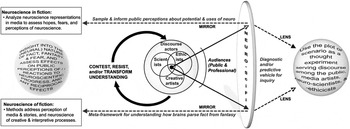
In that neuroS/F can serve both as a vehicle and means for neuroethical contemplation, we believe that it can be regarded as a Foucouldian discourse in which scientists, neuroethicists, creative artists (of various media), and their audiences could participate as “discourse actors” to contest, resist, and/or transform popular neuroscientific and neuroethical understanding. Footnote 53 Accordingly, we propose that neuroethics can engage neuroS/F reflectively and reflexively. As shown in Figure 1, neuroS/F can serve as a diagnostic (reflective) and/or predictive (refractive) lens for neuroethical inquiry, for example, by using a work’s plot as a thought experiment to ponder the possibilities, trajectories, and implications of neuroscientific research and the use of its findings and tools in various social settings. NeuroS/F can also serve as a mirror in which to assess any effects on and of public perceptions of, and reactions to, neuroscientific progress. In this way, neuroS/F can be used to sample public perceptions about the potential uses and misuses of neuroscience (i.e., by examining the neuroscience in fiction), and also become a meta-framework for understanding how brains parse fact from fantasy (i.e., by examining the neuroscience of fiction). The discourse thereby becomes reflexive, as its outcome is mirrored back to influence writers, scientists, and ethicists to evoke response and reaction. Neuroethics can shape these eidolá; neuroethical focus on the interaction between neuroscience and society enables a vantage point from which to assess and guide the ways that neuroscience is portrayed in fiction, and how audiences perceive and reflect upon brain science and its implications. Footnote 54
Neuroscience fiction as reciprocal neuroethical discourse. As discussed in the text, we propose two ways that neuroethics can engage neuroS/F. (1) Reflectively, as a diagnostic and/or predictive vehicle for inquiry (e.g., the plot/scenario as a thought experiment); and/or (2) Reflexively, as a meta-framework to afford understanding of the neuroscience of fiction and inform interpretations of neuroscience in fiction.

This has a number of important implications for critical neuroethical considerations, both of neuroS/F and in neuroS/F. Disentangling audience fears and fantasy will require neuroscientific understanding of what influences cognitive distinctions between fact and fantasy, and means for leveraging that information to communicate that boundary to audiences within the fictional work, or though other vectors for communicating commentary about fiction. Critical reflection on neuroS/F is mandatory to heighten the neuroscientific and neuroethics communities’ awareness of how entertainment media effect lay public perceptions of neuroscience and neurotechnology. To this end, neuroethical analyses of films, television series or episodes, and popular literature are required to establish neuroS/F as eidolá. In this regard it will be vital to convey the difference between “neurofact” from “neurofiction” and to communicate the fictional as a “message vehicle.” We believe that as in the eidolá of classical Greek theater, this needs to be explicit.
Toward these ends, the past few years have seen the growth of several forums devoted to engaging filmmakers, lay audiences, and scientists to explore the reality, potential, and impossibility of portrayals of science (including neuroscience) in film and television. One such forum at Arizona State University (ASU), the Center for Science and the Imagination (CSI) (http://csi.asu.edu/), provides a form that such dialogues may take. For example, in December 2015, ASU-CSI hosted an event, “Total Recall Double Feature,” in which they screened the 1990 and 2012 versions of the film Total Recall, which was followed by faculty presentations that linked themes in the movie to their research. Footnote 55 Another notable example is the National Academy of Science (NAS) Science and Entertainment Exchange (SEE), a program that works in conjunction with the Directors’ Guild of America (DGA) to connect “... entertainment industry professionals with top scientists and engineers to create a synergy between accurate science and ... storylines in... film and TV. ” Footnote 56 The resource page of the NAS-SEE website provides links to entertainment blogs and resources; science, engineering, and medicine blogs; various National Academies’ resources and National Research Council reports; and nonprofit science foundations and public broadcasting programs. The linked resources enable filmmakers, fiction writers, and the public to easily access accurate information about scientific realities, and what is and is not scientifically possible (or even feasible). One of the resources provided is a series of YouTube videos of Emory University professors discussing real-world scientific research, and whether certain neuroS/F portrayals are, or could be, really possible. Footnote 57
Interactive virtual forums, such as Reddit.com, have also been used to instill dynamic dialogues among scientific experts, cinematic writers/directors, and their audiences. In one notable example, Alex Garland, the writer/director of the film Ex Machina, Murray Shannahan, the AI expert who was both referenced in the film and served as an advisor during its production, and another AI advisor on the film, scientist Adam Rutherford, jointly hosted an “Ask Me Anything” discussion about the movie. Footnote 58 Over the course of the session, they discussed (among other topics) their interpretation of, and expectations for, strong AI as portrayed in the film. Overall, the conversation was casually instructive, and directed the audience toward the literature on philosophy of mind to more deeply explore concepts that served as inspiration for the film. Footnote 59 Also, film and literature discussions have become prominent features of annual meetings of the Society for Neuroscience, International Neuroethics Society, and the Neuroethics Network, Footnote 60,Footnote 61,Footnote 62 and are employed in a number of neuroethics curricula to provide bases for speculative discussion about current and future directions and effects of brain science in society. Footnote 63
As shown in Figure 1, such discussions and forums allow critical reflection on neuroS/F that can “contest, resist, and transform” Footnote 64 public views and understanding of neuroscience and neuroethics, but discourse of this kind should be and remain a dynamic and ongoing process. Works of neuroS/F are frequently remade as new technological capabilities, neuroscientific knowledge, and/or cinematography/computer-generated images render previous depictions outdated and quaint, even when the subjects remain speculative. “Rebooted” films, franchises, and series provide an opportunity for critical analysis of the evolution of both the science and the eidolá over time.
These and other such analyses can be approached in three ways relevant to neuroethical inquiry. First, the reciprocity of effect of imaginary depictions on real-world neurotechnological development can be assessed and evaluated. Footnote 65,Footnote 66 Second, changing sociocultural expectations of neuroscience and its uses can be tracked over time. Third, and perhaps most germane to this discussion, the actual process of social interpretation of neuroscience can be analyzed to reveal shifts in heuristics, ideas, and attitudes.
Conclusion
There are two ways to spread the light: To be the candle, or the mirror that reflects it.
Edith Wharton Footnote 67
In this article, we posit that self-contained discourses in neuroS/F facilitate its use as both a source and a means of neuroethical contemplation. By engaging artists, scientists, ethicists, and the public in illustrative discourse, neuroS/F serves as eidolá, and can generate meanings and messages to be conveyed about neuroescientific knowledge, tools, and effects, and the neuroethical issues that such developments can foster. Analyses of the neuroscience of fiction, and of neuroscience in fiction are representative of the two traditions of neuroethics in that such evaluations may be reciprocally informative in ways that clarify the scientific and social meanings of neuroscience, and also the roles neuroS/F can play in the process by which such meanings are acquired. The engagement of neuroethicists with other discourse actors about neuroS/F is critical to fully appreciate and interpret the anthropological, philosophical, social, and scientific meanings assigned to neuroscientific advances. It has been said that fiction both represents and transcends societal boundaries, and as such, neuroS/F as eidolá can offer visions of brain science that reflect the hopes and fears of particular publics, and that can be shared to offer cross-cultural insights to catalyze the exchange of ideas on a global scale. This creates a nexus to conjoin multidisciplinary, international perspectives of neuroethical analyses of eidetic issues inherent to and derivative from the engagement of brain science on the world stage. We believe that current and proposed methods of neuroethics are well suited for such address and interpretations, and can support more finely grained contemplation of the role of neuroS/F in shaping public views and attitudes toward brain science.