Introduction
The Kassapa Saṃyutta of the Pāli Saṃyutta-nikāya (abbreviated SN) is represented in Chinese by a collection entitled 大迦葉相應 Dajiashe Xiangying (Skt. Mahākāśyapa Saṃyukta) in two versions, one in the Za Ahan Jing 雜阿含經 (Saṃyuktāgama, abbreviated SA, Taishō vol. 2, no. 99), the other in the Bieyi Za Ahan Jing 別譯雜阿含經 (Additional Translation of Saṃyuktāgama, abbreviated ASA, Taishō vol. 2, no. 100). This saṃyutta in the Pāli version and its counterpart 相應 xiangying (saṃyukta) in the two Chinese versions are collections of various discourses on the subject of the Venerable Mahākāśyapa, ‘Kāśyapa the Great’ (P. Mahākassapa, 大迦葉 Dajiashe), one of the Buddha's most eminent monk-disciples. He was well-known for his observance of ascetic practices during the Buddha's lifetime and as chairman of the first Saṅgha council (saṃgīti) soon after the Buddha's death.
In this article I first briefly examine the textual structure of the three versions. Then I compare the main teachings contained in them, making use of new editions of SA: Yin Shun's Za Ahan Jing Lun Huibian 雜阿含經論會編 [Combined Edition of Sūtra and Śāstra of the Saṃyuktāgama] (abbreviated CSA) and the Foguang Tripiṭaka Za Ahan Jing (abbreviated FSA).Footnote 1 This will reveal similarities and significant differences in structure and doctrinal content, thus advancing the study of early Buddhist teachings in this area.
1. Textual structure
The Pāli Kassapa Saṃyutta (no. 16) is located in the Nidāna Vagga (Causal Condition Section) of SN. The two corresponding Chinese versions in a collection entitled 大迦葉相應 Dajiashe Xiangying (Mahākāśyapa Saṃyukta, Connected with Kāśyapa the Great) contained in SA and ASA were translated from now lost Indic-language originals. In the CSA edition the SA version bears the title Dajiashe Xiangying supplied by the editor, Yin Shun. In earlier editions of SA, xiangying/saṃyukta titles are lacking and the beginning and end of each saṃyukta have to be inferred from the sūtra contents. This SA version's Dajiashe Xiangying (i.e., counterpart of the Pāli Kassapa Saṃyutta) is located in the Path Section (道品誦 Daopin Song) in the SA tradition.Footnote 2 The corresponding ASA version's Dajiashe Xiangying is located in the sixth fascicle (卷 juan) of Taishō no. 100, where it is the first fascicle of the Second Section (二誦第一 Er Song Di Yi) of ASA.Footnote 3 The Kassapa Saṃyutta/Dajiashe Xiangying pertains to the vyākaraṇa-aṅga (P. veyyākaraṇa-aṅga) portion of SA/SN, according to Yin Shun.Footnote 4
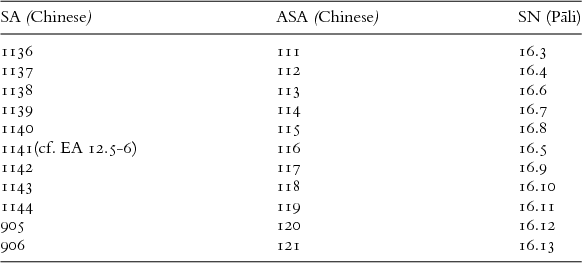
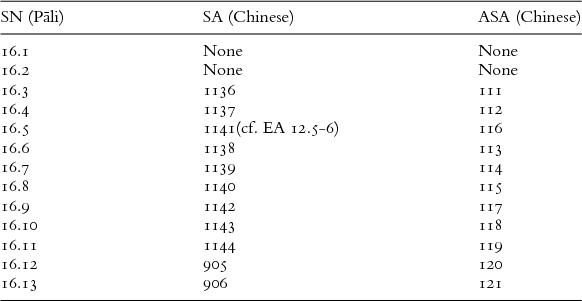
The Pāli Kassapa Saṃyutta comprises thirteen discourses (SN 16.1-13), whereas its Chinese counterparts, both the SA and ASA versions, have eleven discourses (SA 1136–1144, 905–906; ASA 111–119, 120–121). The Pāli version has two more discourses than either of the two Chinese versions. The three versions thus contain almost the same number of discourses. The full set of Chinese-Pāli and Pāli-Chinese counterparts is shown in Tables 1 and 2.
Chinese-Pāli correspondences of the Dajiashe Xiangying/Mahākāśyapa Saṃyukta (= SN 16. Kassapa Saṃyutta)

Pāli-Chinese correspondences of the Kassapa Saṃyutta (= Dajiashe Xiangying)

As indicated in Table 1, two discourses (i.e., SA 905–906 = ASA 120–121) of the SA and ASA versions are out of order with regard to the structural arrangement. The rearrangement of the discourses indicated in Table 1 is according to the CSA version. As is indicated in the two tables, one discourse of the SN version (SN 16.5 = SA 1141 = ASA 116) does not match up with the structural sequence of the two Chinese versions. Also, two SN discourses (SN 16. 1–2) have no SA and ASA counterparts. Consequently, the SA and ASA versions are structurally closer to each other than to the SN version.Footnote 5
2. Disagreements on some teachings contained in the three versions
A few useful studies on Mahākāśyapa have been published.Footnote 6 In the following I will discuss only the principal disagreements on certain teachings presented in the three versions of Mahākāśyapa Saṃyukta under six topics: (1) The Buddha asking Mahākāśyapa to give a Dharma talk, (2) Dhuta practice, (3) Mahākāśyapa's image of long beard-and-hair and sharing a seat with the Buddha (4) “Women are foolish”: Ānanda's response to Mahākāśyapa, (5) After death, and (6) Five things that lead to the disappearance/non-disappearance of the true Dharma.
(1) The Buddha asking Mahākāśyapa to give a Dharma talk (SA 1138 = ASA 113 = SN 16.6)
The three versions (SA 1138Footnote 7 = ASA 113Footnote 8 = SN 16.6Footnote 9 ) report in common how the Buddha advises Mahākāśyapa to give a Dharma talk to certain bhikṣus (monks), because the Buddha himself should also do so. However, Mahākāśyapa declines the Buddha's advice. This is because Mahākāśyapa considers that those bhikṣus are difficult to teach and do not accept instruction. He then gives an example: Bhaṇḍa (a pupil of Ānanda) and AbhiñjikaFootnote 10 argue with each other over which of them can know more and better about the Dharma. Having heard of this quarrel from Mahākāśyapa, the Buddha then asks a certain bhikṣu to call those two bhikṣus to come and see him. The two bhikṣus then come to meet the Buddha. During their conversation with the Buddha, they gradually come to understand that the main purpose of learning the Dharma is not for that kind of quarrelling. They make a confession and ask for forgiveness of their mistakes. In this story shared by the three versions three issues need to be addressed, namely the following.
(I) In the SA version, after Mahākāśyapa tells the Buddha about the quarrel of the two bhikṣus in order to decline the Buddha's advice to give a Dharma talk to the bhikṣus, this is recorded:
At that time, the Venerable Ānanda was standing behind the Buddha, fanning the Buddha with a fan. He addressed the Venerable Mahākāśyapa: “Please stop [such judgment]. Be patient. The young bhikṣus have little wisdom, have poor wisdom”. The Venerable Mahākāśyapa [then] responded to the Venerable Ānanda: “You should keep quiet. Do not make me question you in the Saṅgha (Assembly)”. Then the Venerable Ānanda remained silent.Footnote 11
The corresponding ASA version has this:
At that time, Ānanda was waiting upon the Blessed One, fanning the Buddha with a fan. Then Ānanda said to Kāśyapa: “Stop, stop [such judgment]. Listen to my confession. Such bhikṣus, newly entered into the Buddha-Dharma, are ignorant, lacking wisdom, lacking full understanding [of the Dharma]”. Then the Venerable Kāśyapa said to Ānanda: “You should stop [talking], Ānanda; you should not utter such biased words in the Saṅgha.Footnote 12
The Pāli counterpart does not record such a conversation between Ānanda and Mahākāśyapa. Also, the above-mentioned comments in the two Chinese versions aimed directly at Ānanda by Mahākāśyapa in the presence of the Buddha are not entirely the same. Nevertheless, the two Chinese versions here reveal that Ānanda, in dealing with Mahākāśyapa, is not in a superior position, and that the two seem to have some personal disagreement within the Saṅgha.
(II) The SA version reports the Buddha as asking the two bhikṣus about their quarrel thus:
“Are you two treating the teachings, namely Sūtra, Geya, Vyākaraṇa, Gāthā, Udāna, Nidāna, Avadāna, Ityuktaka/Itivṛttaka, Jātaka, Vaipulya, Adbhuta-dharma, and Upadeśa Footnote 13 that are spoken by me, just for arguing with each other regarding who can know more and better?” The two monks then replied to the Buddha: “No, we are not doing that, Venerable Sir”.Footnote 14
The corresponding ASA version records thus:
“When you comprehend the teachings, namely Sūtra, Geya, Vyākaraṇa, Gāthā Footnote 15 , Udāna, Nidāna, Ityuktaka, Jātaka Footnote 16 , Vaipulya Footnote 17 , Adbhuta-dharma,Footnote 18 Upadeśa, and Avadāna,Footnote 19 that is, the twelve collections spoken by me, do you read them thoroughly and usefully for the purpose of arguing who knows more and better?” The two bhikṣus then replied to the Buddha: “No. The twelve collections do not have such a teaching indeed, Venerable Sir”.Footnote 20
The teachings of the Buddha in these two Chinese texts refer to the twelve aṅgas. Their Pāli counterpart does not mention this; it only refers to Dharma or to Dharma-Vinaya (PTS II, p. 205). This list of the twelve aṅgas in the two Chinese versions likely belongs to a later addition/development of the texts.
(III) The sequence of the twelve aṅgas in the two Chinese versions is also not the same, as the following table shows:

In ASA 113 Avadāna is at the bottom of the list, whereas in SA 1138 it is located in seventh place, after Nidāna. This suggests that the two versions preserve different listings of the aṅgas. Thus, they probably do not belong to the same school.Footnote 21
To summarise, three issues have been addressed here:
-
(I) The two Chinese versions portray Mahākāśyapa, in the presence of the Buddha, as being in a superior position to Ānanda regarding the quarrel between the two bhikṣus, and they seem to have some personal issues within the Saṅgha.
-
(II) The two Chinese texts refer to the teachings of the Buddha in terms of the twelve aṅgas, whereas their Pāli counterpart refers to it as the Dharma or Dharma-vinaya. The list of twelve aṅgas in the two Chinese versions is likely to be a later addition/development of the texts.
-
(III) Also, the sequence of the twelve aṅgas differs in the two Chinese versions. This suggests that these two versions belong to two different traditions.
(2) Dhuta practice (SA 1141 = ASA 116 = SN 16.5; cf. EA 12.5-6)
SA 1141Footnote 22 and ASA 116Footnote 23 mention the following three practices: forest dwelling, wearing rag-robes, and eating almsfood. These are regarded as dhuta, ‘ascetic practices’. They are found in the Pāli counterpart, SN 16.5.Footnote 24 This section will discuss this situation in the three versions.
SN 16.5 reports the Buddha as, on one occasion, advising Mahākāśyapa that, being now old, he should wear robes offered by householders, accept meals given on invitation, and dwell close to him (the Buddha). But Mahākāśyapa declines the Buddha's advice, and states that he has long cultivated and praised the following nine practices:
Being a forest dweller (āraññako), an almsfood eater (piṇḍapātiko), a rag-robe wearer (paṃsukūliko), a triple-robe user (tecīvariko), a person who is of few wishes (appiccho), contented (santuṭṭho), secluded (pavivitto), aloof from society (asaṃsaṭṭho), and energetic (āraddhaviriyo).
Mahākāśyapa also says that he has cultivated and praised the above-mentioned nine practices in recognition of two benefits, namely: for his own present happiness and for later generations who may follow his example, leading to their welfare and happiness.
Having heard what Mahākāśyapa has said, the Buddha then expresses agreement with him, and says the practices are certainly for the good, welfare, and happiness of both devas and humans, out of compassion for the world. In the Pāli version, however, the Buddha names not all nine practices but just three practices (PTS II, p. 203):
Therefore, Kassapa, you wear hempen rag-robes (paṃsukūlikāni) that are cast off, walk for alms (piṇḍapātāya), and dwell in the forest (araññe).
On the other hand, the two Chinese counterparts (SA 1141 and ASA 116) do not record entirely the same contents as the Pāli version (SN 16.5), and the two Chinese versions themselves are not entirely the same either, as the following shows.
(a) Both SA 1141 and ASA 116 do not mention all of the nine practices indicated in SN 16.5. They instead mention only three practices: forest dwelling (阿練若 alianruo), wearing rag-robes (糞掃衣 fensaoyi) and eating almsfood (乞食 qishi).Footnote 25
The three practices in the Pāli version are included in the nine practices mentioned by Mahākāśyapa. However, the Pāli version presents the three practices as a group found only in the Buddha's final response to Mahākāśyapa, who points out the importance of the nine practices to the Buddha.
(b) The three practices in the two Chinese versions (nine in the Pāli version) have the two benefits stated by Mahākāśyapa in response to the Buddha's advice and question. The contents of the two benefits in the two Chinese versions are in principle similar to the Pāli version, although the wording differs among the three versions. Nevertheless, the main issue is that the Buddha's responses to the two benefits presented by Mahākāśyapa are clearly not the same in the three versions, as follows.
SA 1141 records the Buddha as responding to Mahākāśyapa thus:
The Buddha told Kāśyapa: “Good, good, Kāśyapa. You have been for a long time [practising so] for the good, welfare, and happiness of sentient beings, out of compassion for the world, for the welfare and happiness of devas and humans”.Footnote 26
The Buddha told Kāśyapa: “If someone condemns the dhuta practice, then he condemns me. If someone praises the dhuta practice, then he praises me. Why? This is because I have long praised the dhuta practice. Therefore, Kāśyapa, one should praise the person who practises forest dwelling, wearing rag-robes, and eating almsfood”.Footnote 27
The corresponding ASA 116 says this:
The Buddha praised Kāśyapa: “Good, good. If practising so, you have been a long time for the good, welfare and happiness of the multitude, out of compassion for the world.Footnote 28
If some śramaṇa or brahmin (brāhmaṇa) condemns the dhuta practice, he condemns me. If someone praises the good of the dhuta practice, he praises me. Why? This is because I have used countless ways under different conditions to praise the good of establishing the dhuta practice as the best of all practices. From now on you should practise dhuta, and praise the one who is able to practise dhuta.Footnote 29
Thus, the SA version indicates that the practices are for the benefit of both devas and humans, which is similar to the SN version, whereas the ASA version does not mention devas (天 tian). Also, both the SA and ASA versions mention the term dhuta ‘an ascetic practice’, which is not found in the SN version. According to the SA and ASA versions, the term dhuta refers to the three practices: forest dwelling, wearing rag-robes, and eating almsfood.Footnote 30
To sum up, the nine practices presented as a group of practices by Mahākāśyapa in the Pāli version are not shared in common with the two Chinese versions. Only the three practices (forest dwelling, wearing rag-robes, and eating alms-food) as a group are shared in common in the three versions. Both the SA and SN versions say the three practices are for the benefit of both devas and humans, whereas the ASA version does not include the devas. Finally, the SN version does not use the term dhuta for the nine and three practices; only the two Chinese versions use the term dhuta for the three practices. It is likely that the three practices regarded as dhuta mentioned only in the SA and ASA versions represent the earlier content of the notion of dhuta in Early Buddhism.Footnote 31
(3) Mahākāśyapa's image of long beard-and-hair and sharing a seat with the Buddha (SA 1142 = ASA 117 = SN 16.9)
SA 1142Footnote 32 = ASA 117Footnote 33 = SN 16.9Footnote 34 report in common how the Buddha on one occasion explains to the bhikṣus what great attainments Mahākāśyapa has achieved in terms of his dhyāna (P. jhāna) and supernormal knowledge (P. abhiññā), abilities similar to those of the Buddha himself. However, two issues need to be addressed here regarding the three versions. Only the two Chinese versions record that Mahākāśyapa has the image of long beard-and-hair, and was invited by the Buddha to share a seat with him, as the following shows.
SA 1142 and ASA 117 record in common that one day Mahākāśyapa, having kept long (長 zhang) beard-and-hair (鬚髮 xufa) and worn dirty rag-robes (弊納衣 binayi/衣被弊壞 yibei bihuai), comes to visit the Buddha. At that time, there arise in the minds (心 xin) of some bhikṣus, thoughts of disrespect (念 nian) regarding Mahākāśyapa's appearance, thus:
-
SA1142: Who is this bhikṣu who wears dirty rags? He comes here without proper appearance [referring to his long beard-and-hair] and without proper clothing [referring to his wearing dirty rags].Footnote 35
-
ASA117: This venerable one does not know what is the proper manner of being a monk. He wears dirty rags. Also, his beard-and-hair are long. His manner is improper.Footnote 36
Knowing what the bhikṣus have been thinking about Mahākāśyapa's appearance, the Buddha then invites Mahākāśyapa to come and sit next to him (i.e., to share “half a seat”, 半座 banzuo, with the Buddha).Footnote 37 However, Mahākāśyapa says to the Buddha: “I am your disciple and you are my teacher”, and sits down to one side. Then the Buddha, before the other bhikṣus, explains how great are the achievements of Mahākāśyapa in terms of dhyāna and supernormal knowledge, attainments similar to those of the Buddha himself.
In this story both Mahākāśyapa having an image of keeping long beard-and-hair and being invited by the Buddha to share a seat with him are not found in the Pāli counterpart, SN 16.9.
Also, the major issue here is the appearance of Mahākāśyapa with long beard-and-hair described in the two Chinese versions. This physical appearance of Mahākāśyapa is not allowed in the Bhikṣu Saṅgha. It is likely that the presentation of this image of Mahākāśyapa in the two Chinese texts reflects the traditional Chinese Mahāyāna image of the Aluohan (阿羅漢 = Arhant) superimposed by the translators.
(4) “Women are foolish”: Ānanda's response to Mahākāśyapa (SA 1143 = ASA 118 = SN 16.10; cf. SA 1144 = ASA 119 = SN 16.11)
SA 1143Footnote 38 = ASA 118Footnote 39 = SN 16.10Footnote 40 report in common how Ānanda and Mahākāśyapa go together to the quarters of bhikṣuṇīs (Buddhist nuns), where Mahākāśyapa gives a Dharma talk to them. However, after the talk, a certain bhikṣuṇī Footnote 41 expresses displeasure, asking how Mahākāśyapa can give a Dharma talk in the presence of Ānanda. She describes this action as just like a needle-peddler wanting to sell a needle to a needle-maker. Overhearing this statement by the displeased bhikṣuṇī, Mahākāśyapa asks Ānanda: “Am I the needle-peddler and you the needle-maker?”
According to the Pāli version, Ānanda replies thus:
Be indulgent, Venerable Kassapa! Women are foolish (Khamatha bhante Kassapa. Bālo mātugāmo).
According to the SA counterpart, Ānanda replies:
Please stop [saying that]! Be patient, because this foolish old woman is of little wisdom, through being not well cultivated. (且止。當忍。此愚癡老嫗。智慧薄少。不曾修習故。)
And according to the ASA version, his reply is this:
Stop, stop [saying that], Venerable sir! [She] is [like] a little child (孾 ying), foolish, of little wisdom; there is no need to blame [her]. [I] hope, Venerable sir, that you will accept her (其 qi) confession. (止止尊者。孾愚少智。不足具責。唯願大德。聽其懺悔。)
Thus, the Pāli version has Ānanda responding to Mahākāśyapa with “women are foolish,” while the two Chinese versions have him describing just the woman in question as foolish.
A rather different situation is found in the next set of sutra parallels in the saṃyukta: SA 1144 = ASA 119 = SN 16.11. As before, the two Chinese versions have Ānanda saying:
-
SA 1144: Please stop [saying that], Venerable Mahākāśyapa! Be patient, Venerable Mahākāśyapa! This (此) foolish old woman has no wisdom in her nature. (且止。尊者摩訶迦葉。忍之。尊者摩訶迦葉。此愚癡老嫗無自性智。)
-
ASA 119: This (此) bhikṣuṇī has naive understanding, just like a little child. I hope, Venerable sir, that you will accept her (其) confession. (此比丘尼。稚小兒智。猶如孾孩。唯願大德。聽其懺悔。)
However, the Pāli parallel, SN 16.11, contains no counterpart for this wording.
According to these two Chinese texts (SA 1144 and ASA 119), the main reason for Ānanda's response to Mahākāśyapa is the latter's report that he has overheard a bhikṣuṇī Footnote 42 maliciously expressing displeasure when Mahākāśyapa, who had formerly been a heterodox practitioner (外道 waidao, aññatitthiyapubbo), calls Ānanda a boy (童子 tongzi/小兒 xiao'er, kumāraka).
To sum up, in the two sets, SA 1143 = ASA 118 = SN 16.10 and SA 1144 = ASA 119 = SN 16.11, only the Pāli SN 16.10 has Ānanda make the generalising statement “women are foolish”; the Chinese versions (SA 1143 = ASA 118 and SA 1144 = ASA 119) have him clearly refer only to the particular woman in question as foolish. It is possible that the translators of the Chinese versions deliberately added the word “this” (此/其), feeling that the original meaning might offend Chinese women at the time (4th-5th century ce).Footnote 43
(5) After death (SA 905 = ASA 120 = SN 16.12)
SA 905Footnote 44 and ASA 120Footnote 45 both report how certain heretical teachersFootnote 46 come and ask Śāriputra about the four questions: After death does the Tathāgata exist, not exist, both exist and not exist, or neither exist nor not exist? Śāriputra tells them each of these four questions has not been declared by the Buddha. Those heretical teachers are unhappy and dissatisfied with his replies and leave. Śāriputra then comes to tell Mahākāśyapa about this event, and asks him why these questions have not been declared by the Buddha. Mahākāśyapa then explains the reason to him. By contrast, the Pāli version, SN 16.12,Footnote 47 does not mention the heretical teachers, but reports only Śāriputra (P. Sāriputta) coming to ask Mahākāśyapa the four questions about the existence of a Tathāgata after death. Mahākāśyapa tells Śāriputra that these questions have not been declared by the Buddha, and explains to him why. Mahākāśyapa's explanations to Śāriputra, as recorded in the three versions, are not entirely the same. The following discusses these issues.
According to SN 16.12, Mahākāśyapa explains the matter to Śāriputra thus (PTS II, p. 223):
Why, friend, has the Blessed One (the Buddha) not declared this (avyākataṃ) (i.e., each of the four questions about the existence of the Tathāgata after death)?
Because it is unbeneficial, does not belong to the fundamentals of the noble life (brahmacāriya), does not lead to disenchantment (nibbidāya), to fading away of desire (virāgāya), to ceasing (nirodhāya), to peace (upasamāya), to direct knowledge (abhiññāya), to enlightenment (sambodhāya), to Nirvāṇa (nibbānāya). Therefore, the Blessed One has not declared this.
And what, friend, has the Blessed One declared?
The Blessed One, friend, has declared: This is suffering, this is the origin of suffering, this is the cessation of suffering, and this is the way leading to the cessation of suffering.
And why, friend, has the Blessed One declared this?
Because this is beneficial, belongs to the fundamentals of the noble life, leads to disenchantment, to fading away of desire, to ceasing, to peace, to direct knowledge, to enlightenment, to Nirvāṇa. Therefore, the Blessed One has declared this.
Thus, this Pali version presents merely a practical reason for not declaring each of the questions about the existence of the Tathāgata after death.
According to the two Chinese versions, Mahākāśyapa explains to Śāriputra thus:

Accordingly, regarding the questions whether after death the Tathāgata exists, does not exist, both exists and does not exist, or neither exists nor does not exist, the two Chinese versions provide identical analytic-psychological explanations on the issues, although having a few differences in wording. Their explanations are essentially that the Tathāgata is one whose craving has ceased, whose mind is well liberated from attachment to existence and non-existence of the five aggregates (material form, feeling, perception, activities, and consciousness); therefore the four questions are not to be declared by the Buddha. Also, the meaning of the four non-declarations is regarded as profound, deep, immeasurable, and related to the uncompounded nirvāṇa, the cessation of suffering. On the other hand, the Pāli version focuses more on the practical value for the cessation of suffering or the attainment of enlightenment, without giving any explanation of the questions regarding what happens after death.
(6) The five things that lead to the disappearance/non-disappearance of the true Dharma (SA 906 = ASA 121 = SN 16.13)
SA 906Footnote 58 = ASA 121Footnote 59 = SN 16.13Footnote 60 specify five factors that lead to the non-disappearance (or disappearance) of the true Dharma. The five specified in the SA and ASA versions are similar, but slightly different from those in the SN version. The following discusses this teaching in connection with the notion of deterioration (hāyana, 濁 zhuo).
According to the SN version, the five things for which monks (bhikkhū), nuns (bhikkhuṇī), male lay followers (upāsakā), and female lay followers (upāsikā) dwell with respect are: 1. the teacher (satthar), 2. the teaching (Dhamma), 3. the assembly (sangha), 4. the training (sikkhā), and 5. concentration (samādhi). The SA version refers to monks dwelling with respect and support (供養 gongyang) for: 1. the Buddha/teacher, 2. the teaching, 3. the training, 4. the instructions, and 5. the followers of the holy life who are praised by the Buddha. The ASA version is similar to the SA version, but does not explicitly refer to only the monks dwelling with respect and support towards the five factors.
One issue at the beginning of these three texts needs to be addressed. The SA and ASA versions mention the notion of five deteriorations (濁), which are not found in the Pāli counterpart, SN 16.13.
The five deteriorations, according to the SA version, are deterioration of lifespan (命濁 mingzhuo), deterioration of afflictions (煩惱濁 fannaozhuo), deterioration of kalpa (劫濁 jiezhuo), deterioration of living beings (眾生濁 zhongshengzhuo), and deterioration of view (見濁 jianzhuo). The ASA version differs slightly from the above as regards sequence, placing deterioration of living beings before deterioration of kalpa.Footnote 61 The Buddha in the SA and ASA texts tells Mahākāśyapa that because of these deteriorations, more precepts are made (制戒 zhijie) by the Buddha; however, because the precepts are well pursued by fewer monks, the true Dharma (正法 zhengfa) disappears and a counterfeit of the true Dharma (像法 xiangfa) appears. The meaning of the five deteriorations is not explained in these two Chinese texts.Footnote 62
In these five deteriorations only one item, deterioration of living beings, is mentioned in the Pāli counterpart, SN 16.13. There the Buddha instructs Mahākāśyapa thus:
It happens thus, Kāśyapa. When living beings (sattesu) are deteriorating (hāyamānesu) and the true Dharma (saddhamma) is disappearing, there are then more precepts (sikkhāpadāni ‘training rules’), and few monks are established in knowledge (aññāya). Kāśyapa, there is no disappearing of the true Dharma unless a counterfeit of the true Dharma (saddhammapaṭirūpakaṃ) arises in the world. But when a counterfeit of the true Dharma arises in the world, then there is a disappearing of the true Dharma.Footnote 63
The meaning of ‘living beings are deteriorating’ in this Pāli version is also not explained.
The corresponding two Chinese versions, as stated above, give only the names of the five deteriorations without any details. Consequently, questions arise regarding the antiquity of the components of the doctrine of deterioration (hāyamāna 濁) in all three versions.
Conclusion
The Pāli Kassapa Saṃyutta has two more discourses (SN 16.1-2) than the two Chinese versions. Only these two Pāli discourses lack Chinese counterparts. Structurally the two Chinese versions are much closer to each other than to the SN version.
As for the contents, this comparative study of the three different versions has focused on some principal disagreements presented in them. The comparison has revealed the following main points:
-
(1) Both the SA and ASA versions record a conversation indicating that Mahākāśyapa is in a superior position to Ānanda as regards the two bhikṣus’ quarrel in the presence of the Buddha. Their Pāli counterpart does not have such a conversation. These two Chinese versions may indicate that Mahākāśyapa and Ānanda had some personal disagreements within the Saṅgha.
-
(2) Both the SA and ASA texts refer to the teaching of the Buddha in terms of the twelve aṅgas, whereas their Pāli counterpart refers to it as Dharma or Dharma-vinaya. The list of twelve aṅgas in the two Chinese versions is likely to be a relatively late addition or development of the text.
-
Also, the sequence of the twelve aṅgas differs in the two Chinese versions. This suggests that the two do not belong to the same tradition.
-
(3) The following nine practices as a group of trainings for Buddhist monks mentioned by Mahākāśyapa in the Pāli version are not shared in common with the two Chinese versions:
Being a forest dweller, an almsfood eater, a rag-robe wearer, a triple-robe user, a person who is of few wishes, contented, secluded, aloof from society, and energetic.
-
(4) Only the three practices that form a group of trainings, i.e., forest dwelling, wearing rag-robes, and eating almsfood, which are mentioned by the Buddha himself in the three versions are shared in common.
-
Also, the SA and SN versions say that these three practices are for the benefit of both devas and humans, whereas the ASA version does not mention devas.
-
(5) The Pāli version does not use the term dhuta for the nine and three practices. Only the two Chinese versions use the term dhuta for the three practices. It is likely that the three practices regarded as dhuta mentioned only in the SA and ASA versions are an early stage in the development of the contents of dhuta in early Buddhism.
-
(6) Mahākāśyapa's image of keeping long beard-and-hair and his being invited by the Buddha to share a seat with the Buddha, are both present in the Chinese versions but not in the Pāli version.
-
Also, regarding the appearance of Mahākāśyapa - long beard-and-hair – this is not allowed in the Bhikṣu Saṅgha. This physical appearance of Mahākāśyapa is likely to reflect the Chinese Mahāyāna traditional image of an Aluohan (阿羅漢 = Arhant) that has been superimposed by the translators.
-
(7) The Pāli text SN 16.10 has the statement “women are foolish” made by Ānanda to Mahākāśyapa, whereas the two Chinese versions, SA 1143–4 and ASA 118–9, refer to only the particular bhikṣuṇī in question as being foolish.
-
It is possible that the translators of the two Chinese versions deliberately portrayed the event in this way by adding the word “this” (此/其), in order to avoid offending Chinese women of that period.
-
(8) Regarding the four questions - After death does the Tathāgata exist, not exist, both exist and not exist, or neither exist nor not exist? - the Pāli version provides no answers, but shifts the focus to questions that are of value for the cessation of suffering or the attainment of enlightenment. In contrast, the two Chinese versions offer equivalent analytic-psychological explanations on the questions about after death, although containing some different expressions.
-
(9) The two Chinese versions mention the five deteriorations without giving any details, whereas the Pāli version only mentions one of the five deteriorations (namely, deterioration of living beings) without any explanation. The notion of deteriorations is certainly not clearly presented in either the Pāli version or the two Chinese versions. Thus, the antiquity of the components of the deteriorations doctrine is questionable.
Overall, this study has revealed some substantial disagreements among the three versions in major teachings on the subject of the renowned monk, the Venerable Mahākāśyapa.
Abbreviations
- ASA
-
Bieyi Za Ahan Jing [Additional Translation of Saṃyuktāgama] (T 2, no. 100)
- CSA
-
Yin Shun's Za Ahan Jing Lun Huibian [Combined Edition of Sūtra and Śāstra of the Saṃyuktāgama] (3 vols, 1983)
- EA
-
Ekottarikāgama (T 2, no. 125)
- FSA
-
Foguang Tripiṭaka Za Ahan Jing (Saṃyuktāgama) (4 vols, 1983)
- PED
-
Pali-English Dictionary (edited by Rhys Davids and Stede)
- PTS
-
Pali Text Society
- SA
-
Saṃyuktāgama (T 2, no. 99)
- SN
-
Saṃyutta-nikāya (PTS edition)
- T
-
Taishō Chinese Tripiṭaka (The standard edition for most scholarly purposes)