1. Introduction
Many epistemologists find it intuitive that coherence is truth-conducive. However, it has not yet been possible to turn this plausible intuition into an exact claim without facing serious objections or counterexamples. The problem of truth-conduciveness of coherence has been investigated in a long, open, and ongoing debate.Footnote 1 For instance, if the truth-conduciveness of coherence is understood as the claim that more coherent sets of statements (propositions, beliefs, scientific hypotheses, etc.) are always more likely to be true than less coherent ones, the thesis is obviously false. For, “a well-composed novel is usually not true, and yet it may still be highly coherent—perhaps far more so than reality in itself” (Olsson Reference Olsson2002, 247). Since the thesis, ‘more coherent sets have higher probability’, is not true as such, the general strategy in the literature has been to argue that the thesis becomes true once restricted to sets satisfying suitable conditions. However, the nature—and even existence—of such conditions is highly controversial.
This paper takes a different approach by focusing not on the probability, but rather on the confirmation of coherent sets. This will lead to a sense in which coherence is truth-conducive—a sense that is less ambitious than the claim that ‘coherence increases probability’, but which is mathematically well-defined.Footnote 2 We define a property, confirmation transmission, to mean that if some evidence confirms a given hypothesis, and this hypothesis is sufficiently coherent with other hypotheses, then the evidence also confirms these other hypotheses. While such confirmation transmission is intuitively plausible, we will give a formal analysis of it. Our truth-conduciveness is thus a conditional one: Coherence is truth-conducive conditional on evidence confirming a member of the set. Our findings establish a link between Bayesian theories of confirmation and coherence (for Bayesian confirmation theory, see, for instance, Eells and Fitelson Reference Eells and Fitelson2000; Fitelson Reference Fitelson2001).
Specifically, we define confirmation transmission as a property of the degree of the coherence of sets, as given by some probabilistic coherence measure (as opposed to some absolute, i.e., ungraded, notion of coherence). Among the different coherence measures recently proposed in the literature, some, but not all, satisfy confirmation transmission. In particular, we prove that Olsson's measure satisfies a strong form of confirmation transmission; Fitelson's measure satisfies a weaker form of confirmation transmission; and Shogenji's measure violates even the weaker property. We show that if a coherence measure satisfies different confirmation transmission properties, then coherence becomes, in well-defined ways, truth-conducive and relevant to scientific methodology. But we do not argue that our confirmation transmission properties are in all circumstances essential requirements on a coherence measure, since a measure may be used for a different purpose than confirmation transmission.
In Section 2, we introduce the formal framework and the notion of a coherence measure, and we define and discuss the coherence measures referred to in this paper. In Section 3, we show that the coherence of a set of hypotheses (e.g., a theory) can be used to ascertain the confirmation of the set by evidence: If some element of a set is confirmed and the set is sufficiently coherent, then confirmation is ‘transmitted’ to the other members of the set and to their conjunction. In Section 4, we show that confirmation transmission can be used to justify the method of indirect confirmation. In Section 5, we discuss a special case of the method of indirect confirmation, and we distinguish the method of indirect confirmation from a relation of indirect confirmation. Section 6 contains the conclusions of the paper.
2. Probabilistic Measures of Coherence
Intuitively, a set of statements is coherent if its members ‘hang together’. For instance, it seems coherent to claim that it's summer and that it's hot, but incoherent to claim that it's winter and that it's hot. What notion of coherence underlies this intuition? C. I. Lewis (Reference Lewis1946) argued that a set is coherent in case each of its members is (probabilistically) supported by the conjunction of all remaining members. Other authors also emphasize that, unlike the notion of consistency, coherence is a matter of degrees. While the (in)consistency of a set is a purely logical notion, the (in)coherence of a set is often taken to depend on a state of uncertainty. Uncertainty can be represented by probabilities.
Recently, a number of probabilistic coherence measures have been proposed, each of which accounts for different intuitions. A coherence measure is a function that assigns to each (finite, nonempty) set of statements a real number, interpreted as the degree of coherence of that set. The proposed measures contrast with each other in that they induce significantly different coherence orderings.
More precisely, consider a standard language of formal logic (with at least the connectives ¬, ∧, ∨). Coherence measures are defined relative to a given finitely additive Kolmogorov probability function P on the language. A formula E is said to (incrementally) confirm a formula H if and only if
 $P(E) > 0$
and
 $P(H\vert E) > P(H) $
.
The probability measure P can be given different interpretations, left largely open by the literature on coherence. Although our mathematical results do not depend on the particular interpretation of P, their epistemological relevance rests on the assumption that P is not fully known to the agent. If P were fully known, the agent would, for instance, not need to use the method of indirect confirmation to ascertain that an evidence E confirms a hypothesis H: She could find this out directly by checking whether
 $P(H\vert E) > P(H) $
. By contrast, under our interpretation of P, the agent may be at first not aware that E confirms H, but aware that E confirms some hypothesis related to H, from which the agent might then infer that E also confirms H. (This is the method of indirect confirmation.)
A coherence measure is a function C that maps every finite, nonempty set S of formulae with positive probability to a number
 $C(S) \in \mathbf{R}$
. Thus
 $C\thinspace{:}\thinspace \mathstrut{\cal S} \rightarrow \mathbf{R}$
, where
 is the set of all finite, nonempty sets S of formulae H with
 $P(H) > 0$
.Footnote 3
To exemplify our confirmation transmission properties, we focus on the coherence measures proposed by, respectively, Shogenji Reference Shogenji1999, Olsson Reference Olsson2002, and Fitelson Reference Fitelson2004. Let us now introduce these measures and briefly discuss some of their advantages and potential problems.
• Shogenji defines the coherence of a set
 $S\in \mathstrut{\cal S} $
as
In the case of a binary set$S=\{ H,\,H^{*}\} $
, the coherence
$C_{S}(\{ H,\,H^{*}\}) $
equals
$P(H\wedge H^{*}) / P(H) P(H^{*}) $
. This, in turn, equals
the ratio-measure of the support that H gives to H*, and of the support that H* gives to H. So, for binary sets,$C_{S}$
successfully captures the above-mentioned intuition by C. I. Lewis, which connects coherence to mutual support. Shogenji obtains his measure by generalizing
to nonbinary sets. His measure ranges over the interval [0, ∞). Shogenji interprets S as simply ‘coherent’ if$C_{S}(S) > 1$
and ‘incoherent’ if
$C_{S}(S) < 1$
. If S is inconsistent, then
$C_{S}(S) =0$
(minimal coherence). If S consists of probabilistically independent formulae,
$C_{S}(S) =1$
. As pointed out by Bovens and Hartmann (Reference Bovens and Hartmann2004, 52), the Shogenji coherence of pairwise equivalent statements can be lower than that of nonequivalent statements. This may appear unnatural. If one wants to assign maximal coherence to sets of pairwise equivalent statements, one may prefer Olsson's measure.
• Olsson proposes to define the coherence of a set
$S\in \mathstrut{\cal S} $
as
The measure ranges over the interval [0, 1]. While Shogenji's measure interprets coherence as mutual support, Olsson's measure interprets it as an agreement among the statements in S. The agreement is considered as maximal in the case of pairwise equivalent statements, as reflected by the maximal coherence of 1. The agreement is considered as minimal if S is inconsistent, as reflected by the minimal coherence of 0. Since Olsson's measure is not sensitive to mutual support, the coherence of two positively dependent statements can be lower than that of two negatively dependent statements. Another possibly undesirable feature is that the coherence of a set S can never increase by adding a new statement, even if this statement ‘fits’ the other statements well. Bovens and Hartmann (Reference Bovens and Hartmann2004, 50) give the example of the set containing the two statements ‘my pet, Tweety, is a bird’ and ‘my pet, Tweety, cannot fly’. Intuitively, this set should become more coherent by adding the statement ‘my pet, Tweety, is a penguin’.• Fitelson defines the coherence of a set
$S\in \mathstrut{\cal S} $
as the average degree to which conjunctions of nonempty subsets
$S_{1}\subseteq S$
are supported by conjunctions of other nonempty subsets
$S_{2}\subseteq S\backslash S_{1}$
. Specifically, he definesFootnote 4
where is the set of all pairs
$(S_{1},\,S_{2}) $
of nonempty subsets
$S_{1},\,S_{2}\subseteq S$
, with
$S_{1}\cap S_{2}=\emptyset $
(there are exactly
$\vert \mathstrut{\cal R} \vert =n(2^{n-1}-1) $
such pairs), and F is Kemeny and Oppenheim's Reference Kemeny and Oppenheim1952 measure of factual support; specifically
interpreted as −1 if$P(H) =0$
or
$P(K) =0$
, and as 1 if
$P(\neg H) =0$
and
$P(K) > 0$
.Footnote 5 For instance, for a binary set
$S=\{ H,\,H^{*}\} $
, we have
$\mathstrut{\cal R} =\{ (\{ H\},\,\{ H^{*}\}),\,(\{ H^{*}\},\,\{ H\}) \} $
, and so
Fitelson's measure ranges over the interval [−1, 1]. If S consists of pairwise inconsistent formulae, then$C_{F}(S) =-1$
(minimal coherence). If S consists of pairwise equivalent formulae, then
$C_{F}(S) =1$
(maximal coherence). If S consists of probabilistically independent formulae, then
$C_{F}(S) =0$
. Like Shogenji's coherence measure, Fitelson's aims to reflect the level of mutual support. It does so in a more fine-grained way than Shogenji's, and is thus more sensitive to the relations between parts of S. A potential disadvantage over Shogenji's measure is that logically inconsistent sets of statements may be assigned a higher coherence than logically consistent sets. For further discussion, see again Bovens and Hartmann (Reference Bovens and Hartmann2004, 51–53).







 is the set of all pairs









3. Confirming a Theory by Confirming Its Parts
It is well-known that the confirmation of individual members of a set of statements does not entail confirmation of the entire set, i.e., confirmation of the conjunction of its members. In particular, if a theory is interpreted as a set of (scientific) hypotheses,Footnote 6 and some of the hypotheses are individually confirmed, it does not in general follow that the theory as a whole is confirmed.
It is even easy to construct cases, within or outside science, in which evidence confirms each member of a set of statements, yet disconfirms their conjunction. We give two examples.
First, assume Anne has two lovers, Peter and Sam, who don't know of each other. Yesterday there was a party, and suppose that a meddlesome person's theory says that Peter and Sam both were at this party. Now, that person finds out that Anne was at the party. This is evidence for both parts of the theory: It increases the probability that Peter was at the party, and it increases the probability that Sam was at the party. But, it decreases the probability of the entire theory, because Anne would never have gone to a party where both of her lovers are present.
Second, consider a physical experiment that involves two sources. Most likely, none of the sources emits a particle in a certain period of time; but each source may, with a small probability, emit either an electron or a positron in the period of time. A physicist is interested in whether it is true that both sources emit an electron; so, she wants to know whether the first source emits an electron (H) and the second source emits an electron (H*). She observes two photons (E), indicating an annihilation. Annihilation is possible only if the two sources do emit particles, but particles of opposite charges (one emits an electron, the other a positron). Hence the observation E confirms H and confirms H*, yet disconfirms
 $H\wedge H^{*}$
.
In general, are there conditions on a set S under which it is justified to consider S as confirmed by an evidence E that confirms a member of S? We show that sufficiently high coherence of S is such a condition (not a necessary condition, of course). But ‘sufficiently high’ with respect to which coherence measure C? There are many plausible ways to measure coherence, but the claim ‘sufficiently high coherence transmits confirmation’ doesn't hold for all of them. Below, we prove, as an example, that the claim does hold for a particularly elementary coherence measure: Olsson's measure (defined above).
We now define two properties satisfied by some, but not all, coherence measures C.Footnote 7
Confirmation Transmission (CT). For any formulae E, H such that E confirms H, there exists a (nontrivial)Footnote 8 coherence threshold
 $c=c_{E,H}\in \mathbf{R}$
such that, for any set
 $S\in \mathstrut{\cal S} $
containing H with coherence
 $C(S) \geq c,\,E$
confirms each member of S.
Confirmation Transmission to the Conjunction (CTC). For any formulae E, H such that E confirms H, there exists a (nontrivial)Footnote 9 coherence threshold
 $c=c_{E,H}\in \mathbf{R}$
such that, for any set
 $S\in \mathstrut{\cal S} $
containing H with coherence
 $C(S) \geq c$
(and
 $P(\wedge _{H^{*}\in S}H^{*}) > 0$
), E confirms the conjunction
 $\wedge _{H^{*}\in S}H^{*}$
.
In this section, (CTC) is the main focus. A useful step towards proving that a coherence measure satisfies (CTC) is to first show that it satisfies (CT), and that it has the natural property that the coherence of a set never decreases if we add to the set the conjunction of its members (for instance, the coherence of the set {`I am young', `I am happy'} is smaller than or equal to that of the set {`I am young', `I am happy', `I am young and I am happy'}). The reason is given by the following result:
Theorem 1. Every coherence measure C satisfying (CT) and
 $C(S\cup \{ \wedge _{H\in S}H\}) \geq C(S) $
for every
 $S\in \mathstrut{\cal S} $
with
 $P(\wedge _{H\in S}H) > 0$
also satisfies (CTC) (and each possible coherence threshold
 $c_{E,H}$
in (CT) is a possible coherence threshold
 $c_{E,H}$
in (CTC)).
Proof. Assume C satisfies (CT) and the inequality
 $C(S\cup $
 $\{ \wedge _{H\in S}H\}) \geq C(S) $
for every
 $S\in \mathstrut{\cal S} $
with
 $P(\wedge _{H\in S}H) > 0$
. Let E confirm H, and let
 $c_{E,H}$
be as given in (CT). To show (CTC), consider any set
 $S\in \mathstrut{\cal S} $
such that
 $H\in S$
,
 $P(\wedge _{H^{*}\in S}H^{*}) > 0$
, and
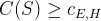 $C(S) \geq c_{E,H}$
. Hence
 $C(S\cup \{ \wedge _{H^{*}\in S}H\}) \geq C(S) $
, and so
 $C(S\cup \{ \wedge _{H^{*}\in S}H\}) \geq c_{E,H}$
. Hence, by (CT), E confirms each member of
 $S\cup \{ \wedge _{H^{*}\in S}H\} $
, in particular
 $\wedge _{H^{*}\in S}H$
. This proves (CTC).
 $\blacksquare $
We now apply Theorem 1 to Olsson's coherence measure
 $C_{O}.$
As shown in the appendix,
 $C_{O}$
satisfies (CT). Since
 $C_{O}$
also satisfies the inequalities in Theorem 1 (as
 $C_{O}(S) =C_{O}(S\cup \{ \wedge _{H\in S}H\}) $
for each
 $S\in \mathstrut{\cal S} $
with
 $P(\wedge _{H\in S}H) > 0$
), it follows that
 $C_{O}$
satisfies (CTC):
Theorem 2. Olsson's coherence measure
 $C_{O}$
satisfies (CT) and (CTC), with coherence threshold in both cases given by
 $c_{E,H}=1/ [ 1+P(E\vert H) -P(E) ] $
.
Note that the coherence threshold
 $c_{E,H}=1/ [ 1+P(E\vert H) -P(E) ] $
is the higher, the less dependent E and H are in the sense that
 $P(E\vert H) -P(E) $
is smaller. As expected, when
 $P(E\vert H) -P(E) $
tends to 0 (independence),
 $c_{E,H}$
tends to 1 (maximal coherence).
To illustrate the importance of (CTC) for the confirmation of sets, suppose that
 $S\in \mathstrut{\cal S} $
is the set of points of the charge in a law suit. Each
 $H\in S$
has been confirmed by some witness reports. Should one consider the whole charge
 $\wedge _{H^{*}\in S}H^{*}$
as confirmed by each witness report? This depends on how coherent the charge
 $\wedge _{H^{*}\in S}H^{*}$
is, as measured by some coherence measure C satisfying (CTC) (for instance, Olsson's measure). More precisely, each witness report E confirming a hypothesis H such that
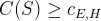 $C(S) \geq c_{E,H}$
also confirms the entire charge
 $\wedge _{H^{*}\in S}H^{*}$
; whereas each witness report E confirming a hypothesis H such that
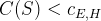 $C(S) < c_{E,H}$
may or may not confirm the entire charge
 $\wedge _{H^{*}\in S}H^{*}$
.
Now consider a scientific theory represented by a set S of hypotheses. Assume an evidence E is found for a particular member H of S. If the evidence is deductive, i.e., if H logically entails E, then the conjunction
 $\wedge _{H^{*}\in S}H^{*}$
also entails E; hence E also confirms the conjunction
 $\wedge _{H^{*}\in S}H^{*}$
. However, evidence is often not deductive in science. If evidence is not deductive, it may be unclear whether or not confirmation is transmitted to the conjunction. In biology, low-level descriptive theories often take the form of a collection of generalizations.
Consider, for instance, a theory S about shellfishes. S consists of only two hypotheses, H and H*, where H is the generalization
 $\forall x(Rx\supset Tx) $
and H* is the generalization
 $\forall x(Rx\supset T^{*}x) $
. Here, R, T, and
 $T^{*}$
are properties. R is the property of being a shellfish from a particular species, T is the property of having a particular digestive system, and
 $T^{*}$
is the property of having a particular nervous system. Thus H states that every shellfish from the relevant species has the particular digestive system, and H* states that every shellfish from the relevant species has the particular nervous system. Assume further that the evidence E consists of large amounts of a certain type of seaweed regularly observed in regions inhabited by the relevant species of shellfish, but not observed elsewhere. Suppose, finally, that the digestion of such seaweed requires the particular digestive system under consideration. Then, it is plausible that E confirms H. However, it may be unclear how E relates to H* and
 $H\wedge H^{*}$
: E could, for instance, disconfirm H* and
 $H\wedge H^{*}$
in case the large amounts of seaweed are atypical for a living environment of shellfish with the particular nervous system. Does E confirm the conjunction
 $H\wedge H^{*}$
? As we have seen, we can deduce the confirmation of
 $H\wedge H^{*}$
if H and H* are sufficiently coherent, as measured by a coherence measure satisfying (CTC). Plausibly, whether the coherence threshold is exceeded depends on scientific background knowledge about shellfishes, which is reflected in the probability function P.
It should be emphasized, however, that a high enough coherence of a set S is sufficient, but not necessary, for transmission of confirmation from a member of S to the conjunction of S. Indeed, if E confirms H, then E can also confirm the conjunction of a highly incoherent set S containing H. For instance, assume that S is very incoherent and that H entails E. Then
 $\wedge _{H^{*}\in S}H^{*}$
also entails E, and hence is confirmed by E.
There is an interesting way to weaken the condition (CT) and (CTC) so that it becomes satisfied by more coherence measures. The idea is to allow the coherence threshold
 $c_{E,H}$
to depend on the size of the set S. For instance, the new condition (CT) is: For any formulae E, H such that E confirms H, there exists to each number
 $n\in \{ 1,\,2,\,\ldots \} $
a (nontrivial) coherence threshold
 $c=c_{E,H,n}\in \mathbf{R}$
such that, for any set
 $S\in \mathstrut{\cal S} $
of size n containing H with coherence
 $C(S) \geq c,\,E$
confirms each member of S. We conjecture that Fitelson's measure
 $C_{F}$
, which violates (CT), satisfies the modified condition (CT).
4. A Rationale for the Method of Indirect Confirmation
While in the last section we focussed on the confirmation of sets of hypotheses, we now turn to the confirmation of a single (scientific) hypothesis via indirect confirmation. This is a second sense in which confirmation transmission is relevant to scientific methodology.
It is a scientific practice to consider a hypothesis H* as confirmed by evidence E if E confirms some other hypothesis H related to H*. This is called the method of indirect confirmation (e.g., Laudan and Leplin Reference Laudan and Leplin1991). The method is used in cases where it is not immediately obvious that E confirms H*, but it is clear that E confirms H (for instance because E is a logical consequence of H, possibly together with auxiliaries). As explained below, the method of indirect confirmation was, for example, used to argue that magnetic striping on ocean floors confirms the climate change hypothesis. The method of indirect confirmation was also proposed as a way to decide between empirically equivalent theories. Laudan and Leplin (Reference Laudan and Leplin1991) argue that two empirically equivalent theories need not be empirically underdetermined, as one of them may have more indirect support than the other (see also Hoefer and Rosenberg Reference Hoefer and Rosenberg1994).
But what exactly does it mean that H and H* are ‘related’? Defining ‘related’ in logical terms (either by
 $H\vDash H^{*}$
or by
 $H^{*}\vDash H$
) is inappropriate, since E can confirm H without confirming H*.Footnote 10 Let us therefore interpret ‘related’ as ‘sufficiently coherent’. This allows us to provide a formal justification of the method of indirect confirmation: If E confirms H, and the coherence
 $C(\{ H,\,H^{*}\}) $
is sufficiently high (where C is some coherence measure satisfying confirmation transmission (CT)), then E confirms H*.
Note that this argument appeals to (CT) only in the special case of the binary set
 $S=\{ H,\,H^{*}\} $
. So the argument remains true even if C does not satisfy (CT), but instead satisfies only the following less demanding notion of confirmation transmission:
Weak Confirmation Transmission (CT*). For any formulae E, H such that E confirms H, there exists a (nontrivial)Footnote 11 coherence threshold
 $c=c_{E,H}\in \mathbf{R}$
such that, for any formula H* with
 $P(H^{*}) > 0$
and coherence
 $C(\{ H,\,H^{*}\}) \geq c,\,E$
confirms H*.
As our formal account of the method of indirect confirmation requires only (CT*) (and not (CT)), it is open to more coherence measures, including Fitelson's and Olsson's coherence measures:
Theorem 3.Footnote 12 Fitelson's and Olsson's coherence measures both satisfy (CT*), with coherence threshold given by, respectively,
 $c_{E,H}=1/ [ 1+P(E\wedge H) -P(E) P(H) ] $
and
 $c_{E,H}=1/ [ 1+P(E\vert H) -P(E) ] $
.
Our earlier comments on the threshold for Olsson's measure apply similarly to the threshold of Fitelson's measure: it is the larger, the nearer E and H are to being independent (in the sense that
 $P(E\wedge H) -P(E) P(H) $
is smaller), and it tends to 1 (maximal coherence) as
 $P(E\wedge H) -P(E) P(H) $
tends to 0 (full independence).
Interestingly, the coherence threshold
 $c_{E,H}$
given for Fitelson's measure is strictly higher than that given for Olsson's measure, because

(by
 $P(H) < 1$
). The coherence threshold
 $c_{E,H}$
to a given coherence measure C is of course not unique: If (CT*) is satisfied with a particular threshold
 $c_{E,H}$
, it is also satisfied with any (nontrivial) higher threshold. So, the threshold given for Fitelson's measure is also a valid threshold for Olsson's measure. However, there is a general interest in using a small threshold among the various valid thresholds, so as to capture more cases of confirmation transmission.
Shogenji's coherence measure
 $C_{S}$
, however, does not satisfy (CT*), and hence
 $C_{S}$
cannot be used to formalize the method of indirect confirmation.
Theorem 4.Footnote 13 Shogenji's coherence measure
 $C_{S}$
does not satisfy (CT*) (provided that there exist three pairwise inconsistent formulae with positive probabilities).Footnote 14
Let us give a historical example of indirect confirmation. The so-called ‘continental drift theory’ (H) states, roughly, that the Earth's surface is composed of a number of oceanic and continental plates that move in time as they float on top of the asthenosphere. The theory was not accepted until the 1960s, when it was strongly confirmed by the systematic observation of magnetic striping on ocean floors (E). Briefly, on both sides of midocean ridges, wide stripes of magmatic rock with alternating polarity were observed. It was already established by then that the Earth's magnetic polarity reversed at certain geologic times and that, as new magma wells up out of a rift, it gets magnetized in the direction of the Earth's magnetic polarity at that time. So, magnetic striping was interpreted as providing a record of a spreading movement of the ocean floor over time: a confirmation of the continental drift theory.
The continental drift theory is coherent with the climate change hypothesis (H*), whereby the climate of continents has varied throughout geologic time. H* was a plausible, but little confirmed, hypothesis before the 1960s. The discovery of magnetic striping was taken to confirm the climate change hypothesis. As argued in Laudan and Leplin (Reference Laudan and Leplin1991), this was a case of indirect confirmation: E confirms H* as H* is closely related with H, which is confirmed by E.Footnote 15 A formal explanation that E indeed confirms H* would be that E confirms H and
 $C(\{ H,\,H^{*}\}) \geq c_{E,H}$
for some coherence measure C satisfying (CT*) (for instance, Olsson's or Fitelson's, but not Shogenji's, measure).
Let us be more concrete. Suppose, first, that we use Olsson's coherence measure. We assume that
 $P(E\vert H) =.9$
(given the truth of the continental drift theory, magnetic striping on the ocean floors is very probable), and that
 $P(E) =.3$
(magnetic striping is much less probable unconditionally, i.e., without knowing in the 1960s whether there is continental drift). The threshold for Olsson's coherence measure is then given by

So, to ascertain that E also confirms the climate change hypothesis H*, it is sufficient to verify that

Now assume we use Fitelson's coherence measure. In addition to our assumptions on
 $P(E\vert H) $
and P(E), suppose that
 $P(H) =.2$
(the continental drift theory was little probable in the 1960s without having observed any magnetic striping). Then, the coherence threshold for Fitelson's measure is given by

So, to ascertain that E also confirms the climate change hypothesis
 $H^{*}$
, it is sufficient to verify that
 $C_{F}(\{ H,\,H^{*}\}) $
exceeds this threshold.
5. The Method of Indirect Confirmation versus a Relation of Indirect Confirmation
It is worth discussing a special case in which the condition for confirmation transmission is particularly simple—a case to which Shogenji and one referee drew our attention. Assume that H (the hypothesis confirmed by E) screens off E from H*. That is, E and H* are probabilistically independent conditional on H and also conditional on ¬H:

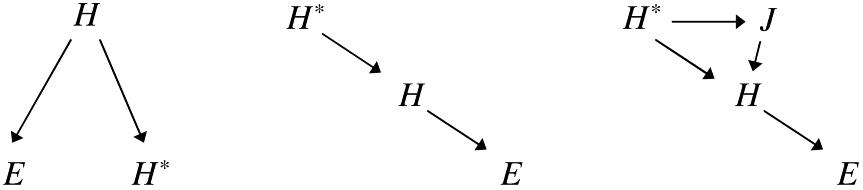
This screening off relation is often assumed to hold if E is related to H* only through H.Footnote 16 Figure 1 shows three examples of such relations, represented by directed acyclic graphs, whose nodes contain variables (events) such as H, E, H*. Usually, each arrow is given a causal interpretation and indicates a (probabilistic) effect of a variable on another.
Three causal networks in which E is indirectly related to H* through H.

In the first graph, H affects E and H*; the effect on E is positive because
 $P(E\vert H) > P(E) $
, and the effect on H* may or may not be positive. In the second graph, H* affects H, which affects E. In the third graph, H* affects H directly as well as indirectly through J, and H affects E.
For instance, Bovens and Hartmann (Reference Bovens and Hartmann2004, chap. 4) analyze cases of confirmation by using graphs similar to the second one in Figure 1. One may interpret their procedure as indirect confirmation.
Shogenji (Reference Shogenji2003) proves an important result about the transitivity of confirmation in the case of screening off. This result can be stated as follows. According to Shogenji, a set
 $S\in \mathstrut{\cal S} $
is ‘coherent’ if
 $C_{S}(S) > 1$
; so, a binary set
 $S=\{ H,\,H^{*}\} $
is (Shogenji-)coherent just in case H and H* are positively dependent (
 $P(H\wedge H^{*}) > P(H) P(H^{*}) $
), i.e., if the two hypotheses confirm each other.
Theorem 5. If E confirms H and H screens off E from H*, then E also confirms H* if and only if H and H* are (Shogenji-)coherent.
Interestingly, while Shogenji's coherence measure
 $C_{S}$
fails to satisfy our confirmation transmission properties (CT), (CTC), (CT*), by Theorem 5 Shogenji-coherence transmits confirmation in the case of screening off. So, if we modify (CT*) by restricting the quantification over H* to hypotheses that are screened off from E by H, then Shogenji's coherence measure
 $C_{S}$
does satisfy the modified (CT*) with coherence threshold
 $c_{E,H}> 1$
. Moreover, the (Shogenji-)coherence of H and H* is not only a sufficient, but also a necessary condition for confirmation transmission.
In a private communication, Shogenji suggested that the notion of indirect confirmation requires that E gives ‘no direct evidential support’ to H*, such as in Figure 1. This is certainly a plausible requirement to define a relationof indirect confirmation. By contrast, we have focused on the method of indirect confirmation, or more explicitly the method of ascertaining indirectly that E confirms H*—a purely epistemological concept.Footnote 17 What is indirect here is not the actual relation between E and H*, but our method of ascertaining that E confirms H*. The method of indirect confirmation is not restricted to cases in which E is causally related to H* only through H; it is open to the frequent cases in which H does not screen off E from H*. This includes cases in which H and H* (or both) are not events but (scientific) laws or axioms of a theory. In such cases, it seems less natural to assume H screens off E from H*, because graphs such as those in Figure 1 are usually introduced to model causal effects between events.
6. Conclusion
The literature on coherence is far from being in agreement about how to measure the coherence of a set (of statements, scientific hypotheses, etc.). One of the reasons is that the role of coherence is controversial. Despite attempts to argue that the coherence of a set can, under suitable conditions, imply that the set is probable, none of the coherence measures in the literature reflects this claim in any straightforward and general way. In this paper, we have shown that, in the different context of the confirmation of hypotheses, coherence can be given a simple and mathematically well-defined significance, which is reflected in some of the coherence measures proposed so far, and probably in many other ones that have still to be stated. Specifically, we introduce three notions of confirmation transmission, (CT), (CTC) and (CT*), and show that Olsson's measure satisfies all of them, Fitelson's measure satisfies (CT*), whereas Shogenji's measure violates all three conditions. Satisfaction or violation of our conditions is not a reason to accept or reject a coherence measure in general. Indeed, if the purpose is not confirmation transmission, one may prefer Shogenji's and Fitelson's measures over Olsson's measure, for instance on the grounds that they always assign a higher coherence to a positively dependent set than to an independent set (see Fitelson Reference Fitelson2003).
The relevance of our confirmation transmission properties for scientific methodology is that they provide formal rationales for two standard procedures: the method of confirming a theory by confirming its parts, and the method of indirect confirmation. Indeed, if coherence is defined in accordance with (CTC), evidence confirming a part of a sufficiently coherent theory also confirms the theory as a whole. Moreover, if coherence is defined in accordance with (CT*), evidence confirming a hypothesis sufficiently coherent with another hypothesis also confirms the latter hypothesis.
Appendix: Proofs
Proof of Theorem 2
We need only show the claim relating to (CT), as this claim implies the one relating to (CTC) by using Theorem 1.
Let E and H be any formulae such that E confirms H, i.e.,
 $P(H\vert E) -P(H) > 0$
. Put
 $c\mathrel{\mathop:}= 1/ [ 1+P(E\vert H) -P(E) ] $
. Consider any set
 $S\in \mathstrut{\cal S} $
such that
 $H\in S$
and
 $C_{O}(S) \geq c$
. We have to show that E confirms each member
 $H^{*}\in S$
. If
 $H^{*}=H$
, then E confirms H* by assumption. Now assume
 $H^{*}\in S\backslash \{ H\} $
. We show that

1. We begin by proving an inequality. By the definition of
 $C_{O}$
,
 $C_{O}(\{ H,\,H^{*}\}) \geq C_{O}(S) $
. So
 $C_{O}(\{ H,\,H^{*}\}) \geq c$
, or

Consider the formula K defined as
 $(H\wedge \neg H^{*}) \vee (\neg H\wedge H^{*}) $
. We have

So

By solving this inequality for
 $P(K) $
, we have

Now using the inequality (A1), we obtain

and hence

2. We next show that
 $D^{*}\geq 0$
(the proof of
 $D^{*}> 0$
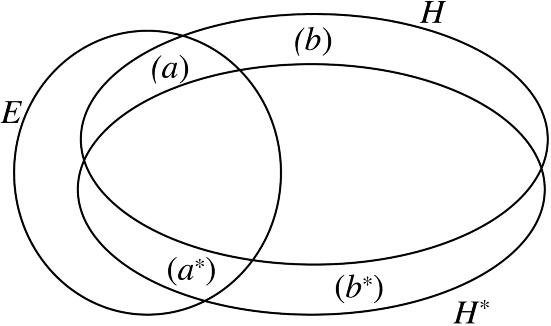
follows in part 3). As indicated in Figure 2, we define

The set of worlds corresponding to E, H, H*, respectively (the probabilities of certain regions are indicated in parentheses).

With this notation in place, we can write

So,
 $D^{*}=P(H^{*}\vert E) -P(H^{*}) $
can be written as follows:

To prove that
 $D^{*}\geq 0$
, it is thus sufficient to show that the last expression is nonegative, i.e., that

To prove that
 $Q\geq 1$
, note first that

Note that

with K as defined above. So, by (A2),


3. We finally show that
 $D^{*}> 0$
. To derive
 $D^{*}> 0$
, it is sufficient to show that one of the weak inequalities used in the proof of
 $D^{*}\geq 0$
(see Parts 1 and 2) holds, in fact, in the strict sense. We distinguish three cases:
Case 1:
 $a=b=a^{*}=b^{*}=0$
. Then the inequality (A2) holds in the strict sense, as
 $P(K) =a+b+a^{*}+b^{*}=0$
and
 $P(E\wedge H) -P(E) P(H) > 0$
(since E confirms H).
Case 2:
 $b^{*}> 0$
. Then the inequality in (A6) holds in the strict sense.
Case 3:
 $a> 0$
or
 $b> 0$
or
 $a^{*}> 0$
. Then the inequality in (A3) holds in the strict sense.
 $\blacksquare $
Proof of Theorem 3
The claim about Olsson's measure
 $C_{O}$
follows from Theorem 1, because (CT) implies (CT*). To show that Fitelson's measure
 $C_{F}$
satisfies (CT*) with the claimed threshold, consider any formulae E and H such that E confirms H, and put
 $c\mathrel{\mathop:}= 1/ [ 1+P(E\wedge H) -P(E) P(H) ] $
. Further, consider any formula H* with
 $P(H^{*}) > 0$
such that
 $C_{F}(\{ H,\,H^{*}\}) \geq c$
. We have to show that E also confirms H*. We derive the following inequality analogous to (A2):

where K is again defined as
 $(H\wedge \neg H^{*}) \vee (\neg H\wedge H^{*}) .$
This inequality implies that E confirms H* by an argument analogous to steps 2 and 3 in the proof of Theorem 2.
By definition,

We have
 $P(H^{*}) < 1$
, since otherwise
 $C_{F}(\{ H,\,H^{*}\}) =\frac{1}{2}[ 0+1] =\frac{1}{2}$
, violating
 $C_{F}(\{ H,\,H^{*}\}) \geq c$
. So both
 $P(H) $
are
 $P(H^{*}) $
strictly between 0 and 1. Hence

Putting
 $\alpha \mathrel{\mathop:}= P(H^{*}\vert \neg H) $
and
 $\beta \mathrel{\mathop:}= P(H\vert \neg H^{*}) $
, we thus have

Since

and

we have

So, by (A8),

As by assumption
 $C_{F}(\{ H,\,H^{*}\}) \geq c$
, it follows that

Taking inverses, we obtain

which implies (A7), as desired.
 $\blacksquare $
Sketched Proof That
$C_{F}$
Violates (CT)

To see why
 $C_{F}$
violates (CT) (if the language contains three pairwise inconsistent formulae E, F, G with positive probabilities), let E confirm H but not confirm H*, where
 $P(H\wedge H^{*}) > 0$
(such E, H, H* exist by assumption on the language). Suppose for contradiction that there is a (nontrivial) threshold
 $c_{E,H}$
such that, for all sets
 $S\in \mathstrut{\cal S} $
, if
 $H\in S$
and
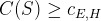 $C(S) \geq c_{E,H}$
, then E confirms each member of S. Let
 $H_{1}$
,
 $H^{*}_{1}$
,
 $H_{2}$
,
 $H^{*}_{2}$
,
 $H_{3}$
,
 $H^{*}_{3}$
, … be distinct formulae such that each of
 $H_{1}$
,
 $H_{2}$
,
 $H_{3}$
, … is equivalent to H and each of
 $H^{*}_{1}$
,
 $H^{*}_{2}$
,
 $H^{*}_{3}$
, … is equivalent to H*. For each
 $n\in \{ 1,\,2,\,\ldots \} $
consider the set
 $S_{n}\mathrel{\mathop:}= \{ H,\,H^{*},\,H_{1},\,H^{*}_{1},\,\ldots,\,H_{n},\,H^{*}_{n}\} $
. By definition of
 $C_{F}$
,
 $C_{F}(S_{n}) $
is the average of all terms of the form
 $F(\wedge _{K_{1}\in S_{1}}K_{1},\,\wedge _{K_{2}\in S_{2}}K_{2}) $
, where
 $(S_{1},\,S_{2}) $
ranges over
 $\mathstrut{\cal M} _{n}$
, the set of pairs of disjoint nonempty subsets of
 $S_{n}$
. Note that, depending on
 $S_{1}$
,
 $\wedge _{K_{1}\in S_{1}}K_{1}$
is equivalent either to H, or to H*, or to
 $H\wedge H^{*};$
similarly, depending on
 $S_{2}$
,
 $\wedge _{K_{2}\in S_{2}}K_{2}$
is equivalent either to H, or to H*, or to
 $H\wedge H^{*}$
. One easily verifies that, as n increases, the proportion of pairs
 $(S_{1},\,S_{2}) $
in
 $\mathstrut{\cal M} _{n}$
for which
 $\wedge _{K_{1}\in S_{1}}K_{1}$
and
 $\wedge _{K_{2}\in S_{2}}K_{2}$
are each equivalent to
 $H\wedge H^{*}$
tends to 1 as n tends to infinity. So the proportion of pairs
 $(S_{1},\,S_{2}) $
in
 $\mathstrut{\cal M} _{n}$
for which
 $F(\wedge _{K_{1}\in S_{1}}K_{1},\,\wedge _{K_{2}\in S_{2}}K_{2}) =1$
tends to 1 as n tends to infinity. It follows that
 $C_{F}(S_{n}) $
tends to 1 as n tends to infinity. Therefore, by
 $c_{E,H}< 1$
,
 $C_{F}(S_{n}) \geq c_{E,H}$
for sufficiently large n. Yet E does not confirm all members of
 $S_{n}$
since E does not confirm H*. ▪
Proof of Theorem 4
By assumption, there exist three pairwise inconsistent formulae E, F, G with positive probabilities. Define H to be the formula
 $E\vee F$
. Then E confirms H. For a contradiction, assume that
 $C_{S}$
satisfies (CT*), and let
 $c=c_{E,H}$
be a corresponding coherence threshold. By the nontriviality of the threshold (see Footnote 8),

where the last equality holds because

is at most
 $1/ P(H) $
, and exactly
 $1/ P(H) $
in case
 $H^{*}=H$
. We have

Using (A9), it follows that
 $C_{S}(\{ H,\,F\}) > c$
. So, by (CT*), E also confirms F. But this is false, since E is inconsistent with F. ▪