Introduction
Policy interest in knowledge of rights
Concern about citizens’ lack of knowledge of their rights and the implications of this on civic engagement are not new. Professional legal bodies in a number of jurisdictions have pressed for the need to ‘educate laymen to recognise their problems’ since at least 1974 (Whitler, Reference Whitler1974), with advocates of improved legal capability amongst citizens going so far as to suggest that the first duty of a lawyer was to educate people as to their rights (Silberman, Reference Silberman1970). These sentiments have precipitated a variety of ‘Public Legal Education’ (PLE) initiatives, often spearheaded by grassroots movements operating on a local level. Global evidence of the PLE movement, as Grimes (Reference Grimes2008) describes, can be seen in Canada, where PLE is said to have emerged in the late 1960s; in Australia, where it has been considered a duty of Community Legal Advice Centres for over thirty years; in the United States, where initiatives such as ‘Streetlaw’ originated in 1972;Footnote 1 and India and South-East Asia where non-governmental organisations have often played a leading role in its instigation. In England and Wales, calls for the development of a nationally coordinated PLE initiative emerged in 2004 (Advice Services Alliance, Citizenship Foundation and the Legal Action Group, 2004, 2005), culminating in 2006 when the then Department for Constitutional Affairs (DCA)Footnote 2 announced a Public Legal Education and Support (PLEAS) Task Force with the intent of creating a coherent focus and identity for public legal education (PLEAS Task Force, 2007).
PLE is an umbrella term used to describe targeted initiatives promoting public awareness and understanding of individual rights, the law and the legal system (PLEAS Taskforce, 2007).Footnote 3 More specifically, it is said to comprise two (often interconnected) endeavours – ‘rights based education’ and ‘self-help’ (Giddings and Robertson, Reference Giddings and Robertson2003; Lawler et al., Reference Lawler, Giddings, Robertson, Buck, Pleasence and Balmer2009). Rights-based PLE, whether delivered within the curriculum or outside of it,Footnote 4 seeks to empower the individual to better identify and assess potential legal problems. This type of education may play a role in preventing inaction by inculcating a sense of awareness as to what might constitute a breach of one's rights; ensuring that individuals know where to look for help and information; and promoting recognition of the need to act on issues before they worsen. In complement to this, self-help PLE aims to provide information and advice that is problem specific (Lawler et al., Reference Lawler, Giddings, Robertson, Buck, Pleasence and Balmer2009). In some cases, this may enable certain individuals to handle their civil justice problem alone or alternatively draw attention to the need for professional advice. Often, this form of PLE is delivered using technology, via websites and hotlines. Considered a ‘just-in-time’ intervention, it aims to provide a layman's guide to the law and how to resolve particular problems at the point at which problems arise (Giddings and Robertson, Reference Giddings and Robertson2003).
In England and Wales, policy efforts aimed at improving public legal knowledge have involved both ‘rights-based education’ and ‘self-help/just-in-time’ initiatives. Efforts to address the former have included increased citizenship education compulsorily embedded in the English curriculum since 2002Footnote 5 and Ministry of Justice (MOJ) support of Public Legal Education (PLE) initiatives through the part funding of the Public Legal Education Network (PLEnet).Footnote 6 Curriculum initiatives have focused primarily on an understanding of citizenship but have not been developed so as to include an understanding of where to go for help or what to do in respect of particular legal problems (see further Kearns, Reference Kearns1995; Kisby and Sloam, Reference Kisby and Sloam2009). Schools wishing to incorporate these issues are aided by websites such as PLEne (www.plenet.org.uk), which provides resources for use with students on broader rights issues and their handling.
Policy has also attempted to facilitate access to ‘just-in-time’ information, primarily through resources published online and available from third sector websites such as those of Shelter, AdviceNow, Money Advice Trust and government affiliated websites, including the Office of Fair Trading and National Debtline websites. The self-help materials produced by these organisations, including resources relating to divorce, claiming compensation and addressing debt (to name but a few) are published on the PLEnet website and constitute PLEnet's primary cache of self-help information. Alongside this, recent years have seen the availability of ‘self-help’ legal toolkits produced by the public and private sector with the intent of providing guidance to enable individuals to handle their legal problems alone. Examples include DIY divorce packages in the United Kingdom;Footnote 7 self-help probate kits in Australia (Lawler et al., Reference Lawler, Giddings, Robertson, Buck, Pleasence and Balmer2009); and employment dispute resolution kits in Canada (Ministry of Labour, 2010). Further technical innovations include the free software created by the Idaho ‘Access to Justice’ project, enabling the courts and legal service sectors to design customer friendly web-based interfaces for document assembly (Kirby, Reference Kirby2008).Footnote 8
In the public sector, PLE has been seen as a way of bringing about government savings, by promoting awareness among citizens about the need to act quickly in addressing problems that may otherwise spiral out of control. Longer-term aspirations posit PLE as capable of enabling people to handle their legal problems in a self-sufficient manner, ultimately reducing dependence on publicly funded advice services (Sommerlad, Reference Sommerlad2004; Pleasence et al., Reference Pleasence, Balmer, Buck, O'Grady and Genn2004; Buck et al., Reference Buck, Pleasence and Balmer2005; Giddings and Robertson, Reference Giddings and Robertson2003). Thus, the emergence of PLE has been consistent with public sector efforts to reduce spending or, as Baker and Barrow (Reference Baker and Barrow2006) describe it, the ‘rationing’ of resources. Such financial motivations have been the catalyst behind a number of legal aid policy changes in the last decade, examples of which include capped budgets, means testing and, more recently, a wide scale reform of the legal aid system in England and Wales (Ministry of Justice, 2011). When implemented, the reform programme will see the removal of a number of areas of legal advice currently in scope, including advice relating to welfare benefits, most debt, housing, private family, education, employment and immigration.Footnote 9 In addition, the reform programme seeks to designate telephone-based communication as the sole legal advice gateway for certain categories of law, with the expectation that this will be broadened to include additional categories in the futureFootnote 10 (Ministry of Justice, 2010b, 2011). While Baker and Barrow (Reference Baker and Barrow2006) suggest that rationing in the legal sector should be intended to distribute resources in a manner proportionate to need, and the Ministry of Justice contend that these reforms intend to preserve access to justice for the most needy (Ministry of Justice, 2011), this has not been the consensus of a number of social justice agencies. Many who provided written submissions to the legal aid reform consultationFootnote 11 raised questions about the continued viability of a range of advice providers and the impact of a large-scale reduction in the availability of publicly funded legal advice (Justice for All, 2011). Such concerns highlight that in an environment where access to free legal help is unavailable for all but a narrow range of circumstances, PLE (particularly legal self-help) may be even more important in securing access to justice.
Yet PLE's potential is not limited to realising public sector spending savings, it is also linked to a further social policy goal – the attainment of ‘active citizenship’. This concept, which is predicated on a full appreciation of one's rights and responsibilities, is a suggested path to achieving social inclusion (Social Exclusion Unit, 2001).Footnote 12 Whilst understandings of ‘citizenship’ have evolved over time, definitions still acknowledge Marshall's (Reference Marshall1950, Reference Marshall1964) initial conceptualisation of knowledge of rights and responsibilities as a critical element of civil and social participation (see e.g. Miller, Reference Miller2000; Johansson and Hvinden, Reference Johansson, Hvinden, Hvinden and Johansson2007; Kotkas, Reference Kotkas2010; Sommerlad, Reference Sommerlad2004). Empirical research has yet to fully explore the extent of the relationship between social inclusion, active citizenship, knowledge of rights and competency in dealing with legal problems. However, an interconnection has been suggested (Buck et al., Reference Buck, Pleasence and Balmer2008) based on the argument that citizenship can only derive from an understanding of one's rights and knowledge of how to enforce them.
In the Australian context for example, PLE has been considered one element of a broader strategy through which social inclusion might be realised (NACLC, 2009). Yet simultaneously, self-help materials such as probate kits have been viewed cautiously, with commentators suggesting that users do not see the kits as a means to ‘active citizenship’ or legal knowledge acquisition but, rather more simply, as a process to follow in order to achieve a legal outcome (Lawler et al., Reference Lawler, Giddings, Robertson, Buck, Pleasence and Balmer2009). Hesitation also remains in respect of rights-based PLE, particularly in its current format, with suggestions that curriculum-based citizenship education focuses largely on top-down political knowledge transition (Kisby and Sloam, Reference Kisby and Sloam2009) without focusing on the engagement of individual rights (Kearns, Reference Kearns1995; Kisby and Sloam, Reference Kisby and Sloam2009).Footnote 13 Moreover, adult rights education for those not exposed to citizenship classes during their schooling has largely been overlooked. In part, this may be explained by PLE's failure to secure the same allocation of resources as is seen in the remit of, for example, financial capability training (Financial Services Authority, 2004, 2006, 2009). In spite of the potential attributed to PLE, debate remains as to how in practice it functions as a route to legal self-sufficiency or civic engagement, particularly for those with a poor understanding of the law and their rights.
The extent of lack of knowledge of rights
Research has previously highlighted the paucity of knowledge possessed by citizens with regard to specific legal issues and processes (e.g. Barlow et al., Reference Barlow, Duncan, James and Park2005; Caseborne et al., Reference Casebourne, Regan, Neathey and Tuphy2006; Genn et al., Reference Genn, Lever, Gray and Balmer2006). Such studies, concentrated primarily in England and Wales, have examined particular areas of law and particular population groups. In the area of employment law, research has shown vulnerable workersFootnote 14 more frequently lack knowledge of their rights at work (Casebourne et al., Reference Casebourne, Regan, Neathey and Tuphy2006). In family law, both Barlow et al. (Reference Barlow, Duncan, James and Park2005) and Tennant et al. (Reference Tennant, Taylor and Lewis2006) found a lack of knowledge amongst those co-habiting as to their rights. Genn et al.'s (Reference Genn, Lever, Gray and Balmer2006) work on tribunal users also demonstrates that knowledge of processes appears low, particularly in relation to challenging decisions.
Studies have further highlighted a lack of knowledge among certain populations, with Ruck et al. (Reference Ruck, Keating, Abramovitch and Koegl1998) illustrating weak understandings of universal rights amongst adolescents and children. Research in England and Wales also indicates poorer levels of knowledge amongst younger citizens (Youth Access, 2002). Level of educational attainment is thought to play a role (Parle/IARS, 2009), but international studies also indicate a connection between social class and knowledge of rights, notably Williams and Hall's (Reference Williams and Hall1972) study in Texas, which established a link between higher social status and a greater likelihood of knowing one's rights. In addition, Buck et al. (Reference Buck, Pleasence and Balmer2008) suggested a nexus between individual ‘know-how’ in resolving civil justice problems, socio-economic status and educational attainment. Those without any formal education were most likely not to take action, while those who handled their problems alone were more likely to have higher degrees and higher incomes, and were less likely to be publicly renting.
Buck et al.'s (Reference Buck, Pleasence and Balmer2008) research highlighted the potential for targeted public legal education initiatives in promoting public awareness of appropriate strategies to address problems, yet also indicated the need for further investigation. As recognised by Saunders (Reference Saunders1975), little is known about how it is people acquire knowledge of the law and their rights, making it difficult to discern the role that social policy interventions may play in addressing knowledge gaps. Gies (Reference Gies2008) has suggested that much of the responsibility for informing the public as to the law has fallen to the media. It is a theory affirmed by Saunders’ (Reference Saunders1975) earlier research in relation to the public's knowledge of family law, where print and broadcast media were found to play the most significant role in informing the public and, as Robbennolt and Studebaker (Reference Robbennolt and Studebaker2003) contend, influencing their litigiousness when compared to sources such as family, friends or public officials. Conversely, Barkun (Reference Barkun1973) has suggested sociological origins, stating that knowledge of the law is acquired through legal socialisation. This latter explanation raises obvious implications for the socially excluded, where non-acquisition of legal knowledge may have particular consequences.
The impact of lacking knowledge of rights
A lack of knowledge of rights has been associated with poor handling of civil justice problems in past studies (Balmer et al., Reference Balmer, Buck, Patel, Denvir and Pleasence2010; Buck et al., Reference Buck, Pleasence and Balmer2008) with research indicating some connection between knowledge and action. Despite the fact that civil legal issues are commonplace (Pleasence, Reference Pleasence2006; Genn, Reference Genn1999), knowledge of where to go for help in relation to such problems, the proximity of advice providers and the type of help that providers may offer still remain low amongst some groups (Buck et al., Reference Buck, Pleasence and Balmer2007; Day et al., Reference Day, Collard and Hay2008; Patel et al., Reference Patel, Balmer and Pleasence2008). Worryingly, it is suggested that vulnerable groups are typically lacking knowledge of rights, less likely to take action or seek advice when faced with a civil justice problem and more likely to repeat the same behavioural patterns when later facing similar problems (Casebourne et al., Reference Casebourne, Regan, Neathey and Tuphy2006; Genn et al., Reference Genn, Lever, Gray and Balmer2006; Buck et al., Reference Buck, Pleasence and Balmer2007).
There are many reasons why people fail to take action when confronted with a problem, including perceptions of problem severity (Pleasence et al., Reference Pleasence, Balmer, Buck, O'Grady and Genn2004) and the cost/benefit of doing so (Kritzer, Reference Kritzer2008), yet it is also true that not knowing how to handle legal problems may lead to incorrect judgements regarding both problem severity and the need for action (Buck et al., Reference Buck, Pleasence and Balmer2008). Beyond education-orientated explanations, personality may also be relevant, with Genn et al. (Reference Genn, Lever, Gray and Balmer2006) suggesting that behavioural characteristics such as determination and confidence play a role.
Previous studies, the most pertinent of which is that of Buck et al. (Reference Buck, Pleasence and Balmer2008), have focused more generally on the connection between particular problem-solving strategies and the extent to which problem-solving objectives are met, that is the association between action and outcome. Yet, in assessing the importance, relevance and content of PLE, whether curriculum-based or adult-orientated, what is needed is an understanding of the links between knowledge, action and outcome. Beyond the theoretical significance that Marshall (Reference Marshall1950, Reference Marshall1964) attributes to knowing one's rights, there has not as yet been any attempt to understand whether knowledge of rights actually helps people solve their problems, helps to promote legal self-sufficiency or reduces reliance upon professional advice providers. This is the contribution our study makes, adding a practical understanding of the importance of knowledge of rights and consequently the role that PLE may have to play.
Aims
This study draws on national household survey data to explore the social and demographic determinants of lacking knowledge of rights when faced with civil justice problems. It explores what people wish they had known when faced with problems and addresses whether knowledge of rights is related to meeting problem resolution objectives. It does so in order to determine the practical importance of knowledge of rights, that is whether knowledge of rights can promote legal self-sufficiency and/or reduce reliance upon professional advisors. This research delivers an understanding of whether improving knowledge of rights is likely to bring about improved self-sufficient problem-handling and whether aiming for increased knowledge (through for example, rights-based PLE) is a realistic objective in light of the socio-demographics and problem-types experienced by the knowledge poor.
It is first hypothesised that lack of knowledge of rights is higher amongst those with socio-demographic characteristics and problem types chiefly associated with social deprivation and exclusion; second, that those without knowledge of rights take action to resolve their problems less frequently; thirdly, that when they do take action their strategy demonstrates a greater reliance upon the attainment of professional advice indicated by higher numbers obtaining advice or trying but failing to obtain advice; and, fourthly, that where those without knowledge do handle their problem alone, they do so with less self-reported success than those who report having knowledge of their rights.
Methods
The English and Welsh Civil and Social Justice Survey (CSJS)
Data in the present study comes from the English and Welsh Civil and Social Justice Survey (CSJS), a nationally representative survey of the adult population of England and Wales, providing detailed information on people's experience of, and response to, civil justice problems (Pleasence, Reference Pleasence2006). The CSJS is a substantially developed form of Genn's (Reference Genn1999) Paths to Justice survey.
The CSJS sample was drawn by randomly selecting residential addresses from 504 postcode sectors, spread throughout England and Wales. A total of 10,537 adult respondents, living in 6,234 households, were interviewed face-to-face in their own homes between January 2006 and January 2009.Footnote 15 Interviews were arranged and conducted by BMRB Social Research. The mean interview duration was twenty-five minutes, though interviews could be considerably longer if civil justice problems were identified.
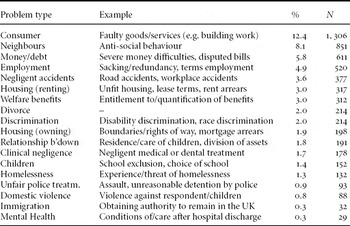
All respondents completed a screening interview which asked if they had experienced a problem in the past three years that had been ‘difficult to solve’ in each of eighteen distinct problem categories. For the two most recent problems identified in each category, respondents were askedFootnote 16 to indicate the nature of the problem, how they responded to it and whether, and from where, they had sought advice. The interview was carefully constructed to limit the problems reported to those to which legal principles can be applied. Problem categories are listed in Table 1, along with examples of the 106 constituent problem types and the proportion of respondents reporting having experienced one or more problems in each category.
Percentage and number of CSJS respondents reporting one or more problems of each category and examples of constituent problem types

All respondents were asked for a wide range of information about themselves and the household in which they resided.
If a respondent had experienced at least one problem, they progressed to a follow-up interview, which addressed further aspects of a single problem. This follow-up section included questions designed to examine issues around knowledge of rights, including whether respondents felt they had knowledge of their rights and whether there was anything they wish they had known at the time of the problem that would have helped them deal with it.
Analysis
First, a multilevel binary logistic regression was fitted to predict knowledge of rights on the basis of a range of social and demographic predictors as well as problem type. A multilevel model (Goldstein, Reference Goldstein2003) was used in order to correctly model the hierarchical structure of the dataset. In the CSJS, all adults within households were interviewed, resulting in respondents nested within households. The multilevel model fitted was a random intercept model that allowed the probability of knowing one's rights to vary across households.Footnote 17
Second, responses to the open question of what respondents ‘wish they had known at the time of the problem’ were analysed, extracting some common patterns of response.
Third, a multinomial multilevel logistic regression model was fitted in order to explore the relationship between knowledge of rights and the strategy adopted (did nothing, handled alone, obtained advice, tried and failed to obtain advice and tried failed and handled alone) when faced with problems. Again a multilevel model was used in order to reflect hierarchical structure, with strategies nested within respondents, and respondents within households. This was followed by a descriptive analysis of common sources of advice for those with, and those without knowledge of rights. All multilevel models were fitted using Markov Chain Monte Carlo methods within MLwiN, with deviance and deviance information criteria (DICFootnote 18) presented below the tables.
Finally, two multinomial logistic regression models were fitted to explore whether meeting objectives (in three categories: met completely, met in part, did not meet at all) with respect to problems was related to knowledge of rights (model 1) and, importantly, whether knowledge and strategy interacted in predicting meeting objectives (model 2). This aimed to quantify the relationship between knowledge and meeting objectives and assess whether knowledge appeared to be more important when handling the problem alone rather than obtaining advice. All statistical models were fitted using MLwiN (Rasbash et al., Reference Rasbash, Charlton, Browne, Healy and Cameron2009b).
Results
Who lacked knowledge of rights and processes and for what problems?
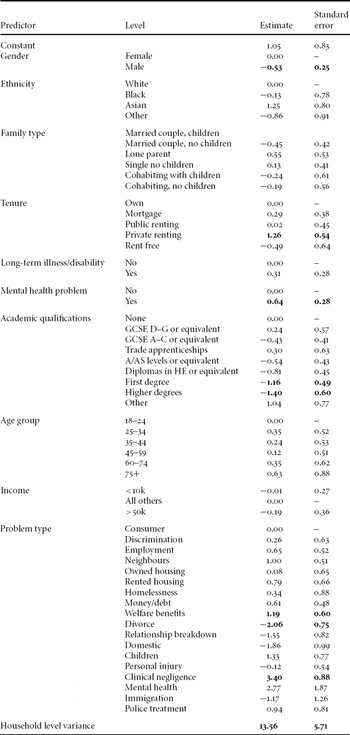
Respondents were asked ‘At the time of the (problem descriptor), did you know what your legal rights were relating to this problem?’ Of 2,095 respondents, 1,357 (64.8 per cent) suggested that they did not know their rights. However, the percentage lacking knowledge varied for particular groups and problem types. Table 2 shows the results of a multilevel binary logistic regression model predicting lacking knowledge of rights when faced with a problem on the basis of a range of social and demographic predictors and rights problem type. Percentages below were derived from the model holding other variables constant.
Multilevel binary logistic regression model predicting lack of knowledge of rights on the basis of a range of social and demographic predictors and problem type (statistically significant terms are in bold)

Notes: Deviance = 1,874.7, DIC = 2,645.8. (This compares to deviance = 1,917.6 and DIC = 2,535.0 for a parsimonious model with ethnicity, family type, long-term illness or disability, age group and income removed.)
Tenure had an impact on knowledge of rights, with those renting privately least likely to know their rights (73.6 per cent), and significantly less likely than those who owned their homes. Those reporting mental health issues were also significantly less likely to know their rights with 70.7 per cent lacking knowledge compared to 61.7 per cent of other respondents.
Those with higher degrees were most likely to report they knew their rights, and significantly more likely than those without any educational qualifications, as were those with first degrees. The percentage lacking knowledge of rights generally fell as highest academic qualifications increased, with 70.2 per cent lacking knowledge of rights amongst those without qualifications, 74.1 per cent of those with O-levels grade D–G or equivalent, 66.1 per cent for O-levels grade A–C or equivalent, 66.7 per cent for trade apprenticeships, 62.6 per cent for A/AS levels or equivalent, 62.5 per cent for those with diplomas in higher education or similar, 60.4 per cent for first degrees and only 50.4 per cent for those with higher degrees.
For family type, lone parents were least likely to know their rights, though using them as a reference category in the model showed differences fell short of statistical significance. Age group and income group had relatively little impact on knowledge once other variables had been controlled for.
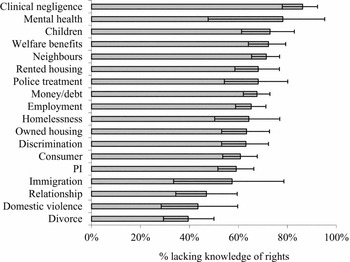
There was significant variation in knowledge of rights by problem type, with particularly high rates lacking knowledge for clinical negligence, welfare benefits problems and problems with neighbours. In contrast, those reporting divorce felt they knew their rights far more often. Figure 1 shows the percentage lacking knowledge of rights by problem type simulated from the model in Table 2 (that is controlling for other variables by simulating using representative proportions of each category of other predictor variables).
Percentage suggesting they lacked knowledge of their rights by problem type, simulated from the model in Table 2

What respondents wish they had known
Following the questions on knowledge of rights, respondents were asked ‘Is there anything you wish you had known at the time you experienced the (problem descriptor) that would have helped you to deal with it?’ While 64.0 per cent of respondents said ‘nothing’, of the remainder ‘my rights/formal processes’ accounted for 12.8 per cent of respondents with ‘that I should get advice’ making up 5.2 per cent. Figures are best viewed in conjunction with the responses to open-ended questions, where respondents typically stated either what they wish they had known or what they wished they had done.
For those who wished they had known something, responses tended towards those who wanted advice and guidance through the process, and those who desired factual information. Replies falling into the ‘advice/guidance’ category indicated a lack of awareness as to where to seek advice. Many respondents wished they had known about the existence of particular agencies or services (e.g. Citizen's Advice Bureaux) and had not found it so difficult to efficiently identify the right adviser, indicated by statements such as ‘I wish it had just been one source . . . no agency was able to help me in one go’ and ‘[I wish I had known] who I should speak to rather than being pushed from pillar to post’. Those who desired a greater availability of factual information spoke of a need for greater knowledge of the law; individual rights and entitlements; and court processes and time limits, presented in non-legalistic ‘plain English’. Process-orientated information was also desired, including the procedure for appealing a decision and initiating action. These responses were often coupled with a desire for a greater understanding of individual rights and entitlements, illustrated by statements such as ‘(I) should have found out about my legal position before ending the contract’. Interestingly there were also some who wished they had not used a solicitor because having understood the procedure they realised that ‘. . . it was so simple’.
Those who wished they had done something different included: those who would have done nothing, those who would have been more proactive, those who would have sought/used a different legal representative, those who would have tried a different approach, those who were unsure and those who felt that the outcome would have remained the same irrespective. Some who would have done nothing felt that the problem could have been resolved by common sense or that they knew as much as they needed to. Of far greater frequency were responses in which the individual expressed regret that they had not adopted a more proactive approach before the problem escalated. Of those who detailed what they would have done, responses varied from those who would not have bothered taking action and would not bother to do so again, to those who would not be deterred by efforts made to ‘fob them off’ in their endeavour to resolve the problem.
Implications of lacking knowledge of rights
Knowledge and broad problem-solving strategy
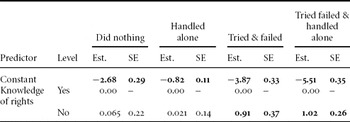
Table 3 shows output from a multilevel multinomial logistic regressionFootnote 19 modelling broad problem-solving strategy by whether or not respondents felt they had knowledge of rights.
Multilevel multinomial regression output modelling broad problem-solving strategy (with obtained advice as a reference category) on the basis of whether or not respondents felt they had knowledge of their rights (statistically significant terms are in bold)

Note: Deviance = 4033.4, DIC = 4685.4.
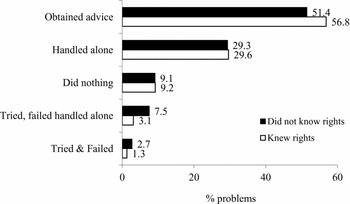
Compared to the reference outcome category (obtaining advice), lacking knowledge of rights related to a significant increase in the likelihood of trying but failing to obtain advice and particularly trying, failing, then handling the problem alone. Figure 2 shows broad problem strategy adopted by whether or not respondents suggested they knew their rights. As shown, those without knowledge of rights had a lower percentage obtaining advice and higher percentages trying but failing to obtain advice or trying, failing, then handling the problem alone.
Broad problem-solving strategy adopted by knowledge of rights

Knowledge, strategy and meeting objectives
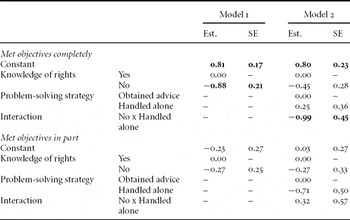
Table 4 presents two multinomial logistic regression models predicting whether or not respondents met their objectives with regard to their problem ‘completely’, ‘in part’ or ‘not at all’ (reference category) on the basis of knowledge of rights alone (model 1) and knowledge of rights, strategy and their interaction (model 2). Note that, as a reduced number of respondents progress to being asked about objectives (e.g. problems must be concluded and those doing nothing are excluded), strategy is restricted to ‘obtained advice’ and ‘handled alone’.
Multinomial logistic regression models predicting the extent to which respondents met their objectives when faced with rights problems (‘completely’ and ‘in part’ compared to the reference category ‘not at all’) on the basis of knowledge of rights alone (model 1) and knowledge of rights, problem-solving strategy and their interaction (model 2) (statistically significant terms are in bold).

Note: Nagelkerke R2 = 0.035 for model 1 and 0.057 for model 2.
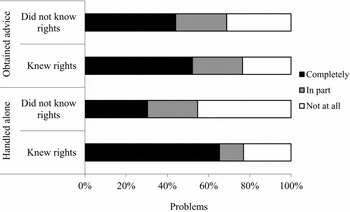
As model 1 shows, those lacking knowledge of rights were slightly less likely to meet their objectives in part (though this term was non-significant) when compared to not meeting objectives at all and significantly less likely to meet objectives in full. As derived from the model, those with knowledge of rights met their objectives ‘completely’ 55.6 per cent of the time, ‘in part’ 19.7 per cent of the time and ‘not at all’ 24.7 per cent of the time, compared to 36.7, 23.9 and 39.4 per cent for those without knowledge of rights. Accounting for strategy (model 2) revealed a more complex picture. Lacking knowledge of rights where respondents obtained advice related to a decrease in meeting objectives completely compared to not meeting them at all, though this was non-significant. However, where respondents lacked knowledge and handled alone rather than obtained advice, a significant decrease in the likelihood of completely meeting objectives was observed (when compared to not meeting objectives at all). Essentially, lacking knowledge of rights had little impact on meeting objectives where advice was obtained and a significant impact where respondents handled alone. Figure 3 illustrates this, showing the extent to which respondents met their objectives by strategy and knowledge of rights (derived from model 2 in Table 4). As can be seen, where respondents handled alone, those without knowledge of rights were less than half as likely than those who knew their rights to meet their objectives in full (65.3 vs. 30.4 per cent).
Extent to which respondents met their objectives when faced with rights problems by problem-solving strategy adopted and whether or not they felt they had knowledge of their rights

Discussion
The majority of CSJS survey respondents suggested that they did not know their rights when faced with a civil justice problem, with lack of knowledge related to both demographics and problem type. Groups who lacked knowledge disproportionately included those reporting mental health problems, those privately renting and those without formal educational attainment. Knowledge of rights was particularly poor for problems related to clinical negligence, welfare benefits and neighbours. Reflecting upon their experiences of problem resolution in the open-ended questions posed, some respondents professed a desire for greater knowledge of advice providers, the legal dimensions of the problem and the processes through which resolution could be achieved. Many wished they had taken action sooner or persisted with obtaining advice. However the majority said there was nothing they wished they had known that would have helped them solve their problem. The broad strategy adopted by respondents was not strongly related to knowledge of rights, with fairly similar levels obtaining advice, handling alone and doing nothing whether or not rights were known. Knowledge did however relate to outcome, with those who lacked knowledge of rights less likely to meet their objectives in full. Failing to meet objectives was reported far more frequently by those without knowledge of their rights who tried to handle their problem alone. However, those without knowledge of their rights who obtained advice did not report such high rates of failing to meet their objectives.
Who lacks knowledge?
As hypothesised, those lacking knowledge of rights were more likely to be facing simultaneous social problems associated with deprivation and exclusion. This was illustrated by lower levels of knowledge among those with lower educational attainment and mental illness and, to a lesser degree, those with low income, and among lone parents. Although the impact of low income and age did bear some influence, these factors were less critical than anticipated, distinguishing our results from those of Youth Access (2002) in respect of age, and Buck et al. (Reference Buck, Pleasence and Balmer2008) in respect of income. Our findings correspond with those of Williams and Hall (Reference Williams and Hall1972) whose study in Texas illustrated a link between low social status and less knowledge of the law, given that the characteristics of our knowledge-poor group (lower educational attainment, mental illness, tenure) are arguably indicative of low social status/social deprivation.
Increased knowledge for problems such as divorce may lend support to Gies (Reference Gies2008) and Saunders's (Reference Saunders1975) findings. With divorce rates increasing, it suggests that social discourse and/or media coverage may play a role in raising public awareness of certain issues and the individual rights engaged. Interestingly, the problems where knowledge was poor, namely welfare benefits, neighbours problems and clinical negligence, are problem categories identified as being disproportionately experienced by those with social problems and, potentially, those experiencing social exclusion (Pleasence, Reference Pleasence2006; Buck et al., Reference Buck, Pleasence and Balmer2005). This corresponds to Barkun's (Reference Barkun1973) idea of legal knowledge being acquired through socialisation. Where socialisation is limited to interaction with groups similarly lacking in knowledge, or where isolation occurs (as may be particularly relevant for those with mental illness), the ability to acquire legal knowledge may be compromised.
The fact that educational attainment plays a role in the acquisition of rights is certainly not surprising. Somewhat more surprising, given the inclusion of citizenship in the curriculum, is that younger people were somewhat less likely to know their rights. However, this is an outcome in keeping with the previous studies of Ruck et al. (Reference Ruck, Keating, Abramovitch and Koegl1998) and Youth Access (2002) and may be explained by the nature of citizenship education in schools (Kearns, Reference Kearns1995; Kisby and Sloam, Reference Kisby and Sloam2009) or uncertainty regarding the manner in which knowledge of rights are acquired (Saunders, Reference Saunders1975).
Knowledge of rights and strategy
Interestingly, contrary to our hypotheses, those who lacked knowledge of rights did not demonstrate a lesser impetus to act on their problem compared to those with knowledge. However, it is possible that they varied in their reasons for inaction. Inaction amongst those with knowledge may have been more likely to have represented a pragmatic choice given the characteristics of their problem. Conversely, those without knowledge may have been more likely to fail to act as a direct result of their lack of knowledge. This would fit in with some of the themes emerging from the verbatim responses in which respondents wished they had known their rights to a greater degree and the 13 per cent who reported that having known their rights would have helped them solve the problem. It would also fit with previous findings (Buck et al., Reference Buck, Pleasence and Balmer2008) attributing a degree of inaction (44 per cent in the case of employment law) to a lack of knowledge of rights. Yet given the similar numbers of those with knowledge still failing to take action, there must also be other explanations for inaction. This might include Kritzer's (Reference Kritzer2008) cost/benefit argument and Pleasence et al.'s (Reference Pleasence, Balmer, Buck, O'Grady and Genn2004) suggestion that inaction is related to perceptions of problem severity.
Surprisingly, those without knowledge of their rights were less likely to obtain advice (57 v. 51 per cent). However, looking in total at those who ‘obtained advice’, ‘tried and failed’ and ‘tried, failed and then handled alone’ cumulatively, percentages were comparable (62 per cent for those without knowledge of rights compared to 61 per cent for those with knowledge of rights). Evidently, demand for an advisor is similar whether or not individuals had knowledge of rights, but those with knowledge of rights demonstrated slightly greater success obtaining advice. Again this fits in with both the verbatim responses where individuals wished they had known about particular sources of advice and Buck et al.'s (Reference Buck, Pleasence and Balmer2008) findings suggesting that vulnerable respondents were more likely to choose an inappropriate advice-seeking strategy. A lack of knowledge of advisors, or success identifying a correct advisor may also be explained by Balmer et al.'s (Reference Balmer, Buck, Patel, Denvir and Pleasence2010) findings which detail that those without knowledge of rights sought advice more frequently from general and non-problem specific providers, such as the CAB or Local Council where knowing the problem was ‘rights-based’ would not have been a pre-requisite.
The fact that respondents without knowledge of rights were just as likely to choose to handle a problem alone is an important finding that contradicts our hypothesis. It may be that a lack of knowledge of rights leads to a misperception as to the severity of the problem or the need to obtain help (Buck et al., Reference Buck, Pleasence and Balmer2008). It may equally be explained by behavioural characteristics, which, as Genn et al. (Reference Genn, Lever, Gray and Balmer2006) suggest, lead some people to have greater confidence in handling their problem alone. The fact that those with knowledge of their rights, a group more likely to have higher education, sought advice and handled alone at similar rates to those without knowledge of rights is surprising. It challenges the presupposition that knowledge of rights brings about a greater likelihood that an individual will elect to handle their problem without recourse to advisors.
In respect of success, as hypothesised, knowledge of rights was linked to a greater likelihood of meeting problem objectives ‘completely’ both when the problem was handled alone and when advice was sought. It would appear that knowledge of rights may better equip individuals to choose an appropriate strategy that maximises their likelihood of a successful outcome. It is interesting that those who did not have knowledge of rights met their objectives less than those with knowledge, even when advice was sought. Though differences were relatively small, we might have expected that the process of seeking advice would put respondents on an even footing in terms of meeting objectives. Even though this finding fell short of statistical significance, it may nonetheless be indicative of the complex nature of the problems experienced by those without knowledge (e.g. clinical negligence, welfare benefits) or their capacity to absorb and apply advice provided given their likely personal characteristics (e.g. mental illness and lower educational qualifications) which may compromise attainment of objectives even where advice is sought. It may also be that their poor knowledge led to unrealistic objectives. More importantly, for those without knowledge of rights, obtaining advice did however produce a much higher likelihood of meeting objectives, compared to those handling the problem alone. This is a crucial (if unsurprising) finding, for it suggests that, for the knowledge poor, obtaining advice plays a large part in ensuring that they are able to successfully resolve their problem.
Conversely, those who had knowledge of rights were somewhat more likely to be successful meeting objectives when handling their problem alone rather than when seeking advice, yet it is unlikely that this can be solely attributed to knowing their rights, or, as was previously mentioned, to the nature of advice provided. It may be that their problems were simpler or more familiar, and/or their expectations lower. This would reconcile with previous research suggesting that those with more severe problems are more likely to seek professional advice (Pleasence et al., Reference Pleasence, Balmer, Buck, O'Grady and Genn2004). It may further be attributable to the characteristics of those with knowledge, who handled the problem alone, where previous research identifies ‘self-helpers’ as educated and typically experienced in administrative procedures (Lawler, et al., Reference Lawler, Giddings, Robertson, Buck, Pleasence and Balmer2009).
Our results add a more nuanced understanding of the impact of knowing one's rights to the existing body of research. Findings suggest that knowledge of rights does not appear to be associated with a particular advice-seeking preference, but may play a role in aiding individuals to select an appropriate course of action; that those lacking knowledge fare less well when handling the problem alone; and that they fail to obtain the advice they seek more often. However, a lack of knowledge is only one characteristic within a broader range of factors that potentially account for the less favourable outcomes experienced by this group. Those who lack knowledge of rights are a population group more likely to be facing a broad range of issues, including complex problems, disadvantageous personal circumstances indicative of social deprivation and (potentially) poorer knowledge of advice providers.
Policy implications
Knowledge of rights does not in itself produce self-sufficiency or negate the need for continued access to advice services. However, acquiring knowledge of rights may produce an improved ability to select an appropriate problem-handling strategy and may coexist with or lead to a greater awareness of advice providers. For this reason, there is merit to be had in continued rights-based education, but we would argue that this education must be targeted at both adults as well as children and should be more pragmatically focused to include day-to-day rights-orientated issues that individuals are likely to face. In time, sufficient acquisition of knowledge of rights may lead to an improved ability to utilise self-help resources. However, it would be impractical to expect that every individual should come to acquire knowledge of their rights with respect to the broad range of civil issues they may face. In many instances, obtaining professional advice will remain critical.
Self-help PLE will remain restricted to certain users in respect of certain problems, namely those who already have a good understanding of their rights and/or the personal capacity to handle problems alone. Such problems are more likely to be straightforward in nature, where parties are on an even footing and are working towards a mutually agreeable solution that simply needs to be legally enshrined (as has been demonstrated with legal toolkits in the areas of probate, see further Lawler et al., Reference Lawler, Giddings, Robertson, Buck, Pleasence and Balmer2009). Devising self-help material that is of use to this group of people is informed by our verbatim responses, which indicated demand for ‘plain English’ information on court procedures, time limits, initiating legal action, and appealing decisions.
Whether or not knowledge is possessed, advice is still central to the resolution strategy of the majority of our respondents. Clearly access to advice is of continued importance even for informed litigants who Giddings and Robertson (Reference Giddings and Robertson2001) note may otherwise have ‘nowhere to go’. If the rationing of access to advice is based on Baker and Barrow's (Reference Baker and Barrow2006) suggestion of distribution to those most vulnerable, our results highlight that those without knowledge of rights are the most vulnerable, primarily because they more often lack higher education, suffer from mental illness, face disputes against entities with a resource and power imbalance (e.g. welfare benefit agencies and NHS trusts) and report higher levels of dissatisfaction when advice is not obtained. Knowledge of rights (or rather its absence) may therefore be a useful (if fairly crude) proxy measure of legal advice need.
Our findings are of relevance in any jurisdiction where rights-based PLE and self-help is considered capable of supporting or justifying any process of legal aid rationing. Findings are of particular importance in England and Wales given the planned reduction in legal aid scope, much of which has been justified on the basis of the litigant's ability to present their own case and/or their ability to resolve their issue without seeking legal advice (Ministry of Justice, 2010a). With a number of agencies forewarning that recently announced legal aid reforms herald a significant reduction in access to legal advice services, we would anticipate that in the coming years ‘just-in-time/self-help’ PLE will become even more important in promoting access to information where otherwise there would be none.
It is worrying therefore that there have been no efforts made to safeguard the continued development of self-help resources. The majority of the PLE material available to individuals is provided on a voluntary basis by charitable advice organisations such as Shelter, AdviceNow, AgeUK and the Money Advice Trust where the future provision of such material will be contingent upon their continued existence. The non-availability of such material is an issue of even more concern given current efforts to scale back the level of information and assistance the government provides online. The recent cost-cutting decision to converge www.communitylegaladvice.org.uk into www.justice.gov.uk sees the loss of self-help tools and advice search functions from a website intended (at least in part) to make a contribution to the provision of legal information online (Legal Services Commission, 2010).
With limited access to self-help information and access to advice in only a select number of circumstances, it is difficult to see how the government's ‘Big Society’ vision in which citizens ‘take more responsibility in solving the problems they face’ (Cabinet Office, 2010) can be realised by those without the ability to pay for access to legal help. The risk posed is that citizens will simply do nothing, or feel there is nothing they can do about the civil justice problems they face, an outcome which would produce recognised personal detriment (Balmer et al., Reference Balmer, Buck, Patel, Denvir and Pleasence2010). How it may come to impact longstanding social policy considerations regarding social inclusion and ‘active citizenship’ remains an important issue for future research. Further research must also pursue a deeper understanding of the cohort who lack knowledge of their rights and the personal issues they face which prejudice their chance of successful civil justice problem resolution. More must also be known about the process of self-help, its appropriateness in relation to certain problem-types and the extent to which successful self-help is also dependent upon a good understanding of legal processes.