

The Characteristics and Measurement of Negative Problem Orientation
The success of social problem solving largely depends on one's problem orientation in general and the given problem, problem solving as a process, and how effective as problem-solvers we regard ourselves (e.g., D'Zurilla, Nezu, & Maydeu-Olivares, Reference D'Zurilla, Nezu and Maydeu-Olivares2002; Frauenknecht & Black, Reference Frauenknecht and Black2010; Strough & Keener, Reference Strough, Keener, Verhaeghen and Hertzog2013). National and international research (e.g., Eskin, Reference Eskin2013; Kasik, Reference Kasik2015) show that if one's orientation is negative — for example, he/she believes that the given problem is unsolvable and that nothing can be done for a solution — the likelihood of unsuccessful problem solving increases. Our problem orientation is primarily influenced by family socialisation, and negative orientation is mostly defined by one's mother's (or carer's) negative orientation and problem-solving behaviour (e.g., Nezu, Wilkins, & Nezu, Reference Nezu, Wilkins, Nezu, Chang, D'Zurilla and Sanna2004). It is also proven that one's negative orientation during childhood and adolescence may bear long-term effects on academic and professional success and the quality of one's social connections, and may play a significant role in the development of feelings of hopelessness, stress, and depression (e.g., Eskin, Reference Eskin2013; Frauenknecht & Black, Reference Frauenknecht and Black2010).
A number of theoretical models have been developed to analyse social problem solving (e.g., D'Zurilla et al., Reference D'Zurilla, Nezu and Maydeu-Olivares2002; Crick & Dodge, Reference Crick and Dodge1994; Frauenknecht & Black, Reference Frauenknecht and Black2010). According to D'Zurilla et al. (Reference D'Zurilla, Nezu and Maydeu-Olivares2002), social problems induce a complex (cognitive-emotional-behavioural) and mostly conscious process, the aim of which is the solution of the problem as well as the reduction and cancellation of uncomfortable feelings and thoughts caused by the problem. This process is regarded as social problem solving, and it is divided into two subprocesses (orientation and solution). Orientation includes one's sensitivity toward the problem and dedication to solving it, as well as self-efficacy, which can be positive (adaptive) or negative (maladaptive, dysfunctional). During the solution process, the problem is defined and alternative modes of solution are sought and evaluated to consider the possible outcomes. When it is decided which mode of solution to use, this is followed by implementation (solution). D'Zurilla et al. (Reference D'Zurilla, Nezu and Maydeu-Olivares2002) distinguished three general problem-solving styles (rationality, impulsivity, avoidance), which may all combine in one problem situation, based on the characteristics of the situation, the problem, and who is involved. Our problem-solving style becomes more and more situation- and person-specific with age, and our problem solving is more and more defined by our past experiences (in the form of habits, examples, and often-used techniques) that influence our problem solving as unconscious processes during both the orientation and solution phase (Frauenknecht & Black, Reference Frauenknecht and Black2010).
In the orientation phase, our thinking is based on a positive or negative motivation-emotion basis (D'Zurilla & Nezu, Reference D'Zurilla and Nezu2007). The central item in this is self-efficacy, ‘one's belief in his/her ability to attain a certain level of achievement and this influences such events that bear an impact on others’ lives’ (Bandura, Reference Bandura and Ramachaudran1994, p. 71), or, in other words, one's belief that in a problem situation we can reach the desired effect with our actions, and we can influence our decisions and ambitions toward the solution as well as our efforts regarding the given action. Frauenknecht and Black (Reference Frauenknecht and Black2010) believe that self-efficacy means the verification of one's intentions, aims, and personal possibilities within a social problem. Maydeu-Olivares and D'Zurilla (Reference Maydeu-Olivares and D'Zurilla1996) distinguished three dimensions of negative orientation (negative self-efficacy, pessimistic approach to the problem, low level of frustration tolerance) and five dimensions of positive orientation (the interpretation of the problem as a challenge, one's faith in positive outcomes, positive self-efficacy, positive thoughts related to the time and energy invested into the solution, one's belief in the need for a solution and that it cannot be avoided).
D'Zurilla and Maydeu-Olivares (Reference D’ Zurilla and Maydeu-Olivares1995), as well as D'Zurilla, Nezu, and Maydeu-Olivares (Reference D'Zurilla, Nezu, Maydeu-Olivares, Chang, D'Zurilla and Sanna2004), claim that questionnaires are the most appropriate measurements to comprehensively detail social problem solving, while film and story analyses are less appropriate due to strong emotional involvement, which lowers reliability. One part of the questionnaires enables the measurement of the complete process of problem solving (orientation and solution), while the other part enables the measurement of a given subprocess (e.g., emotion-based modes of solution, avoidance). The Problem-Solving Inventory (PSI; Heppner, Reference Heppner1988), Social Problem-Solving Inventory — Revised (SPSI-R; D'Zurilla et al., Reference D'Zurilla, Nezu and Maydeu-Olivares2002) and Social Problem-Solving Inventory for Adolescents (SPSI-A; Frauenknecht & Black, Reference Frauenknecht and Black2010) all have good reliability indexes, are internationally well known, and are often utilised among adolescents. The Negative Problem Orientation Questionnaire (NPOQ, originally in French: Gosselin, Ladouceur, & Pelletier, Reference Gosselin, Ladouceur and Pelletier2005; English version: Robichaud & Dugas, Reference Robichaud and Dugas2005) is one of the most often-used questionnaires that is capable of measuring adults and negative problem orientation within one factor.
PSI measures negative and positive orientation with only one factor (Problem-solving confidence) where the item that expresses negative orientation (the feeling of uncertainty in a problem situation) is listed as an inverted one among the items that contain positive orientation (trusts oneself; can solve the problem; the individuals sees him/herself as a persistent and creative problem-solver). Positive and negative orientation can be measured by separate factors (Positive problem orientation, Negative problem orientation) in the SPSI-R. The items of negative orientation express a cognitive-emotional set while the items of positive orientation primarily express a cognitive approach set; thus, the statements in the questionnaire related to positive orientation touch on beliefs and the ones related to negative orientation touch on emotions. The items of negative orientation express that the problem itself, the decision-making process, the attempt and the possible failure of its solution, all entail negative emotions (dread, fear, nervousness, uncertainty, redundancy). The statements of positive orientation include that the individual sees a social problem as a challenge; he/she faces the problem; begins thinking through how to solve it right away; he/she is persistent to find the best solution; does not give up if he/she cannot solve it at first.
The factor that expresses orientation in the SPSI-A (Problem orientation) contains three subfactors: thoughts, emotions, and behaviour. The frequency of some of the forms of avoidance (e.g., postponement, neglecting, waiting) can be measured with the items of the avoidance factor. The emotions and thoughts factors both contain items that express positive and negative orientation. The items that have negative content, similar to the SPSI-R, express a feeling of discomfort at the beginning of, during, and at the end of the problem-solving process, in contrast to the items that have positive content (the need to solve the problem, the possibility of a positive outcome, hoping for a successful outcome).
The statements in the the NPOQ focus on the cognitive elements of negative orientation (e.g., detected threat, lack of self-efficacy, negative consequences). To measure the convergent and discriminative validity of the NPOQ, the adult version of the SPSI-R was used and, based on the results, the Negative problem orientation factor of the SPSI-R and the NPOQ measure similar constructs (even when the NPOQ measures the cognitive components of negative problem orientation to a higher degree and the emotional character of problem-solving to a lesser degree).
Based on research carried out with the SPSI-R by Chang et al. (Reference Chang, D'Zurilla and Sanna2004), negative orientation is followed by impulsivity (emotion-based, expressing negative emotions, often hasty, rather concentrated on oneself, less empathic) or avoidance (running away from the problem, abandoning the situation, postponing the solution) to a higher degree than positive orientation, which shows a strong correlation with rationality (concentrates on facts, weighing in on the alternatives, taking consequences into consideration) among adolescents and adults alike. It is less frequent that negative orientation is strongly connected with rationality and that positive orientation is strongly connected with impulsivity or avoidance.
Between 2009 and 2016, several analyses (cross-sectional, longitudinal, and comparative) were carried out with the SPSI-R and SPSI-A among 8- to 18-year-olds and university students (e.g., Kasik, Reference Kasik2015; Kasik & Gál, Reference Kasik, Gál, Molnár and Vígh2016; Kasik & Guti, Reference Kasik and Guti2015; Kasik, Gáspár, Guti, & Zsolnai, Reference Kasik, Gáspár, Guti, Zsolnai and Newton2016). Based on these analyses, negative orientation related to social problems and their solutions is more typical from age 10–11 and the frequency of positive orientation decreases. Negative orientation is the most typical among 13- to 15-year-olds in the age group of 10- to 18-year-olds, and its connection with avoidance strengthens from age 13–14. It was among the boys that a rare sample was observed where negative orientation is combined with a high degree of rationality and, as a third component, avoidance joins them. Based on this string of connections (negative orientation-rationality-avoidance), it may be hypothesised that negative orientation has characteristics that are positive for the individual, and thus the process does not end (immediate avoidance with strong impulsivity), and avoidance does not follow negative orientation immediately (avoidance becomes part of a conscious, thought-out decision). Based on this, we may suppose that negative problem orientation is not always dysfunctional because in certain cases this system of connections and its manifestation in one's behaviour may also bear positive outcomes (or at least the individual hopes so), which may be a significant function of self-protection.
Aims
In 2016, the Negative Orientation Questionnaire (NEGORI) was developed based on theoretical models, with the items expressing negative orientation from the presented and partly used questionnaires, and a system of categories of the reasons for negative orientation, in order to measure negative orientation. With the data collected in 2016, an exploratory factor analysis (EFA) was carried out and the connection between the factors was examined, along with age- and gender-related differences. With the data collected in 2017, a confirmatory factor analysis (CFA) was carried out, as well as structural equation model (SEM), to show the causal dependences between the (endogenous and exogenous) dimensions. Using the EFA and CFA, the aim of the current study was to develop a multifactor questionnaire that enables a more detailed examination of interpersonal problems and negative orientation toward their solution. Furthermore, age and gender differences were also revealed in this sample, and the results of the completed SPSI-R (D'Zurilla et al., Reference D'Zurilla, Nezu and Maydeu-Olivares2002) were used to examine the convergent and discriminative validity of the NEGORI.
Method
Sample and Data Collection
The first data collection took place in 2016 and the second in 2017 (with a repeated data collection). The first data collection was carried out in autumn 2016 among 12-, 15- and 18-year-olds (M 12 = 12.13, SD 12 = .78; M 15 = 15.07, SD 15 = .45; M 18 = 18.11, SD 18 = .51) who were primary and secondary school students; 952 students were involved in the research (n 12 = 310, n 15 = 301, n 18 = 341; n girls: 12,15,18 = 56, 54, 58%). Based on the recorded background variables, the distribution of mothers’ highest educational qualification (Hungarian system: 8 years of primary school, vocational school certificate, technical college certificate, grammar school certificate, college/university degree) in the three age groups was similar (χ2 = 21.19 p = .25).
The other data collection was carried out on a sample of 835 students (n 12 = 290, n 15 = 270, n 18 = 275) in spring 2017 (M 12 = 12.05, SD 12 = .76; M 15 = 15.12, SD 15 = .41; M 18 = 17.98, SD 18 = .62; n girls: 12,15,18 = 55, 56, 57%). In this case, another data collection was carried out after two weeks. Again based on mothers’ highest educational qualification, the three subsamples did not differ significantly from one another either (χ2 = 20.23 p = .29).
The data collection was carried with the headmasters’ and parents’ consent in all cases, who were all informed about its content and aim. The data collection took the time of one lesson in all cases.
Statistical Analysis
The EFA was carried out with the SPSS 24 program, and for the CFA, Mplus 6.11 was used (Muthén & Muthén, Reference Muthén and Muthén2010). The principal axis factoring (PAF) method was used in the EFA with ‘promax’ (Kappa = 4) rotation (factor load ≥ .4). To determine the usability of the data in the factor analysis, the Bartlett test and the Kaiser-Meyer-Olkin (KMO) indicator were used.
In the CFA, weighted least squares, mean and variance-adjusted (WLSMV) approximation was used as well as theta parameterisation (Muthén & Muthén, Reference Muthén and Muthén2010). The fitness of the model was examined with the Tucker-Lewis Index (TLI) — relative fit index — with one non-centrality-based fit index, the comparative fit index (CFI) and two absolute fit indexes (root mean square error of approximation [RMSEA] and standardised root mean square residual [SRMR]). Based on the literature, the appropriateness of the model is indicated by values above .9 and .95 for the CFI and TLI, and values lower than .06 or .08 for RMSEA (Byrne & Stewart, Reference Byrne and Stewart2006).
Cronbach's alpha was chosen as the indicator of the reliability of internal consistency which, according to Nunnally (Reference Nunnally1978), is acceptable from a value of .7. Age-related differences were examined with an analysis of variance (ANOVA) and gender differences were examined by independent sample t tests. Pearson's r was used in the correlation analysis.
Measurements
The convergent and discriminative examination of the NEGORI was done with SPSI-R (D'Zurilla et al., Reference D'Zurilla, Nezu and Maydeu-Olivares2002). The questionnaire consists of 25 items and the statements are grouped into five factors: Positive orientation, Negative orientation, Rationality, Impulsivity, Avoidance (for their contents, see introductory paragraphs). The statements are evaluated on a 5-point scale (1 = absolutely not true for me to 5 = absolutely true for me). Based on national research, the factor structure of the questionnaire is completely the same as the original English version's factor structure and measures wellbeing among 11- to 18-year-olds. Its reliability index (Cronbach's alpha) is above .76 at all ages (for more detail about the national cross-sectional and longitudinal studies, see Kasik, Reference Kasik2014; Kasik, Nagy, & Fűzy, Reference Kasik, Nagy and Fűzy2010).
Pilot Study: The Development Process of the NEGORI (Negative Orientation Questionnaire)
Although we had collected a lot of information about the characteristics of negative problem orientation in adolescence, the tools used (i.e., SPSI-R, SPSI-A) were only able to analyse the mentioned dimensions, and in order to carry out a correlation analysis with other psychological factors, their conclusions would only relate to these other factors. A 6-month development program (Gál & Kasik, Reference Gál, Kasik, Molnár and Vígh2017; Kasik & Gál, Reference Kasik, Gál, Molnár and Vígh2016) carried out among adolescents (12- to 13-year-olds) also showed that negative orientation toward social problems and their solutions show more in the background than the results of previous questionnaires tell us, and that these are strongly connected with other psychological and social factors (e.g., high degree of anxiety, often feeling excluded, insufficient adaptation to one's peers).
In order to find out the background of negative orientation from the adolescents themselves, a pilot data collection was carried out with the involvement of some of the students who participated in our earlier longitudinal research carried out with SPSI-R (Kasik, Reference Kasik2014, Reference Kasik2015, Reference Kasik2016). In the longitudinal study (N = 180), the problem solving of 12-year-old students was analysed over three years; it was in the second year that we were able to shed more light on why the then 13-year-olds (n = 52) would not like to or did not want to solve their interpersonal problems. Those students who were involved in the pilot research reached a high (4.2 or higher out of 5) average in the negative orientation factor in both years. They had to answer two questions: (1) How do you usually feel: would you like to solve your social problems? (2) If not, why not? With the second question, we were able to reveal the problem and the reasons for not dealing with its solution.
Based on the theory of reason attribution (e.g., Heider, Reference Heider2003), the answers contained both external (situational) and internal (personal) reasons. Blaming the other person, a lack of another person's initiation, and the effect of model people are, for example, external reasons. The fear of the negative outcome of solving the problem, the positive consequences that brings relief or negative self-efficacy (projecting the unsuccessful solution) can be regarded as internal reasons. Two of the categories completely matched with the contents of two items of negative problem orientation in the SPSI-R (the individual does not deal with the problem because of the bad feeling and negative self-efficacy caused by failure). At the same time, several categories were defined, which the questionnaire-based research did not provide information about in terms of their contents. These include habit/pattern (e.g., ‘Because I saw my parents doing this.’), waiting/initiation (e.g., ‘Because I am waiting for the other one to initiate’), the source of the problem (e.g., ‘Because it is not my fault’) and not dealing with problem-solving as being something positive (e.g., ‘Because this is how things will be good for me’).
Based on the categories of the pilot research, our group of psychologists and assessment and evaluation researchers created eight theoretical factors and attributed 5–6 statements to these. In addition to this, 49 12-year-olds, 51 15-year-olds and 48 18-year-olds were asked to formulate five statements for each theoretical factor created (students were given detailed information about their contents). This was needed in order to expand the information received from the adolescents in the pilot research because only students with high negative orientation values were asked to formulate statements in that research.
The statements written down by the experts and the students were finalised by the taskforce. The final questionnaire contains 40 statements that are the completions for the sentence that begins as follows: ‘I do not want to solve my problem because . . .’: (1) failure/fear of shame (5 items, e.g. ‘. . . this way I cannot fail in trying to solve it’), (2) negative self-efficacy (5 items, e.g. ‘. . . I am certain that I cannot solve it’), (3) negative outcome (5 items, e.g., ‘. . . I am afraid that it might have negative consequences’), (4) positive outcome (5 items, e.g., ‘. . . this is what makes me calm’), (5) the source of the problem (5 items, e.g., ‘. . . it is not my fault’), (6) habit, pattern (5 items, e.g., ‘. . . my mother does not deal with her problems either.’), (7) redundancy (5 items, e.g., ‘. . . there is no point in solving it’), (8) waiting (5 items, e.g. ‘. . . I am waiting for the problem to solve itself’). The statements were evaluated on a Likert scale (0 = not typical of me at all to 4 = absolutely typical of me).
Results
The Structure of NEGORI – the Results of the EFA (2016)
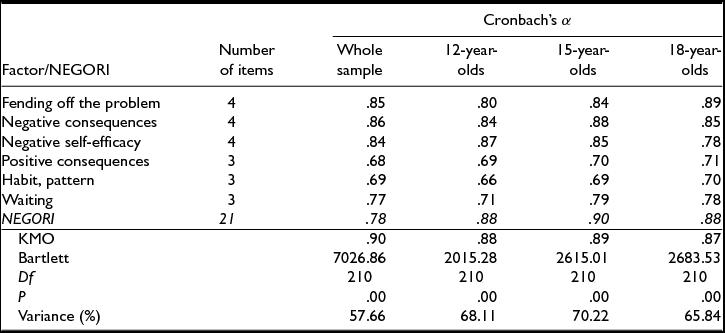
An EFA was carried with the data from the 2016 data collection. Based on the analysis, the same six factors were distinguished at all three ages: (1) Fending Off the Problem (four items), (2) Negative Consequences (four items), (3) Negative Self-Efficacy (three items), (4) Positive Consequences (three items), (5) Habit, Pattern (three items), (6) Waiting (three items). The validity and reliability indexes of the factors and the NEGORI (in the case of the whole sample and the age groups) are summarised in Table 1.
Results of the EFA and Reliability (N = 952)

The statements of Fending Off the Problem express that the individual would not like to deal with his/her problems because he/she thinks that he/she did not cause them (e.g., ‘. . . because I am usually not responsible’). The statements of Negative Consequences express that with regard to problem solving, the individual takes short- and long-term negative personal and social consequences into consideration, which cause negative feelings (e.g. ‘. . . I am afraid that it will end badly’). The statements of Negative Self-Efficacy express the individual's belief that he/she cannot or is not able to solve his/her problems, finds him/herself incapable of it and thus has a negative attitude towards the problem and its solution (e.g. ‘. . . I am certainly unable to solve the problem’). In the case of the statements of Positive Consequences, the individual thinks that not dealing with the problem has positive consequences for him/her and brings a relief to him/her: he/she will not be nervous or sad (e.g., ‘. . . this is what makes me calm’). In light of the statements of Habit, Pattern, it is the individual's environment that provides the pattern not to deal with his/her problems (e.g., ‘. . . we do not usually do this at home’). In terms of the statements of Waiting, the individual expects his/her problems to solve themselves; therefore, he/she is passive, does not see him/herself as an active problem-solver (e.g., ‘. . . it will somehow solve itself’).
The System of the Connections Between the NEGORI Factors (2016)
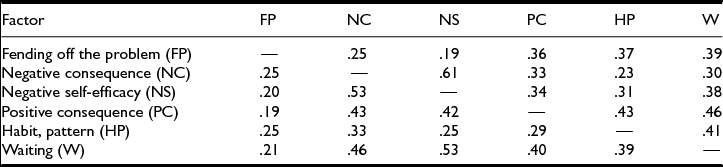
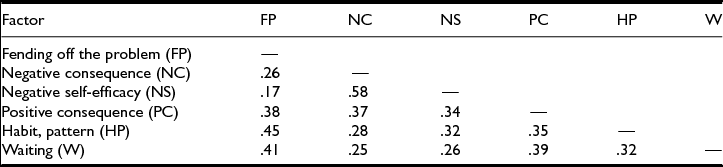
The intercorrelation values of the NEGORI factors as per age are summarised in Tables 2 and 3. In all three age groups, the connections are significant, positive, and between .17 and .61. At all three ages, the values between Negative Self-Efficacy and Negative Consequence are the highest (above r = .50). Among 12-year-olds, the connection between Fending Off the Problem and Positive Consequence is the weakest and among 15- and 18-year-olds it is the connection between Fending Off the Problem and Negative Self-Efficacy (below r = .20).
Correlations of the Factors: Lower Part: 12-year-olds (n = 310); Upper Part: 15-Year-Olds (n = 301)
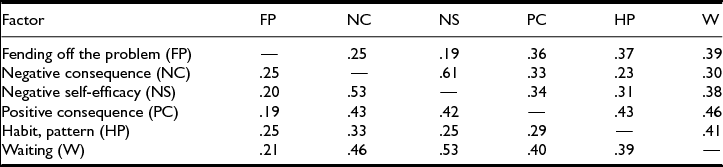
Note: p < .001 in all cases.
Correlations of the Factors: 18-Year-Olds (n = 341)
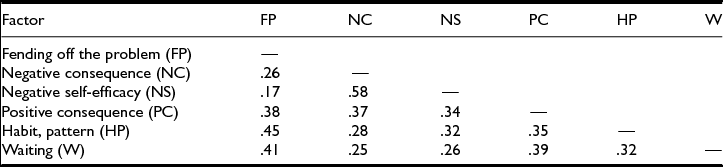
Note: p < .001 in all cases.
Age and Gender Differences (2016)
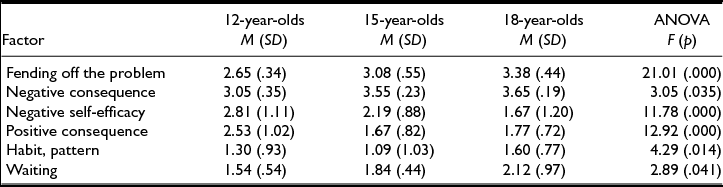
Age-related differences were identified in the case of all six factors of the NEGORI, from which we can only deduce changes through the cross-sectional study (Table 4). The average scores of age samples differ significantly in the case of Negative Self-Efficacy and show a tendency of decrease with the advancement of age [(12) > (15) > (18)]; the scores of Positive Consequence also show a decrease [(12) > (15, 18)], but in the case of this factor, the two older age groups do not distinguish significantly. In contrast, Negative Consequence and Fending Off the Problem are together more significant among 15- and 18-year-olds than 12-year-olds [(12) < (15, 18)], and 18-year-olds also attained a higher score on the factors of Habit, Pattern and Waiting [(12, 15) < (18)]. Standard deviation values are lower in the case of Fending Off the Problem and Negative Consequence at all three ages and, in the case of Waiting, they are lower among 12- and 15-year-olds than in the case of other factors and at other ages, which points to a lesser degree of individual variation within the given age group.
Age Related Differences As Per Factor (N = 952)
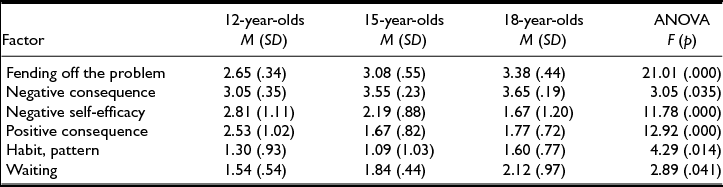
Note: M = mean, SD = standard deviation, ANOVA = analysis of variance.
There was no significant difference between 12-year-old boys’ and girls’ results in any of the factors. Among the 15-year-olds, boys gained a higher average score in the case of Fending Off the Problem (boys: M = 3.25, SD = .23; girls: M = 2.96, SD = .34, t = 2.77, p = .006) and Habit, Pattern (boys: M = 1.35, SD = .39; girls: M = .83, SD = .28, t = 2.51, p = .011), while girls’ average score was higher in the case of Negative Consequence (boys: M = 3.15, SD = .20; girls: M = 3.65, SD = .21, t = -2.24, p = .026). Among the 18-year-olds, it was also the boys who gained higher scores in Negative Self-Efficacy (boys: M = 1.95 SD = .27; girls: M = 1.41, SD = .23, t = 1.67, p = .045) and Fending Off the Problem (boys: M = 3.70, SD = 1.03; girls: M = 3.12, SD = 1.22, t = 2.51, p = .039).
Results of the CFA and SEM (2017)
The factor structure of NEGORI was tested on the data collected in 2017 with CFA. The fitness of the model was satisfactory; the CFA carried out with the six factors separated during the 2016 EFA also shows satisfactory fitness indexes: 12: χ2 = 289.98, p < .001, df = 174, χ2/df = 1.67, CFI = .92, TLI = .90, RMSEA = .05 (p = .25), SRMR = .06; 15: χ2 = 237.12 p < .001, df = 174, χ2/df = 1.36, CFI = .97, TLI = .96, RMSEA = .04 (p = .98) SRMR = .05; 18: χ2 = 285.65, p < .001, df = 174, χ2/df = 1.64, CFI = .95, TLI = .94, RMSEA = .04 (p = .88), SRMR = .05; whole sample: χ2 = 386.4, p < .001, df = 174, χ2/df = 2.22, CFI = .96, TLI = .95, RMSEA = .04 (p = 1.00), SRMR = .04.
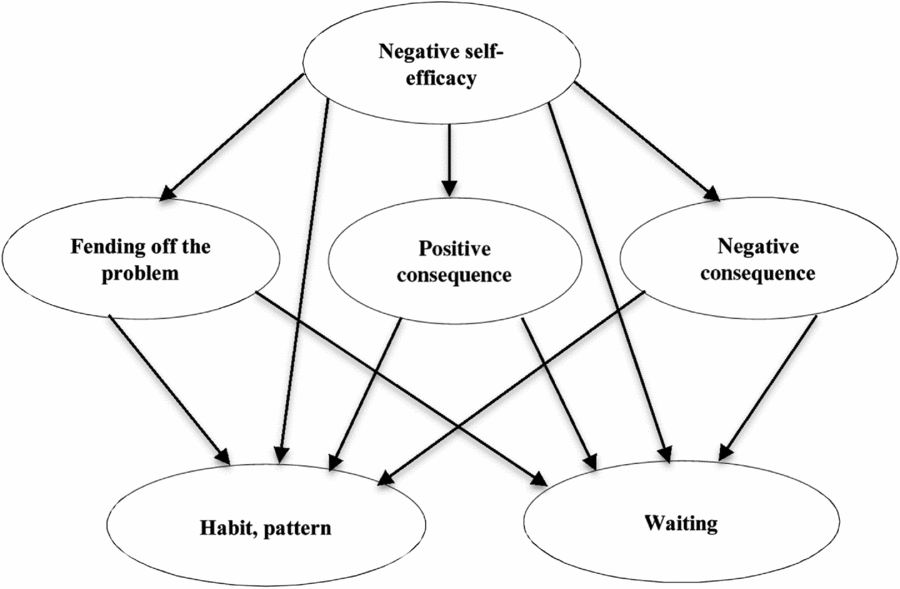
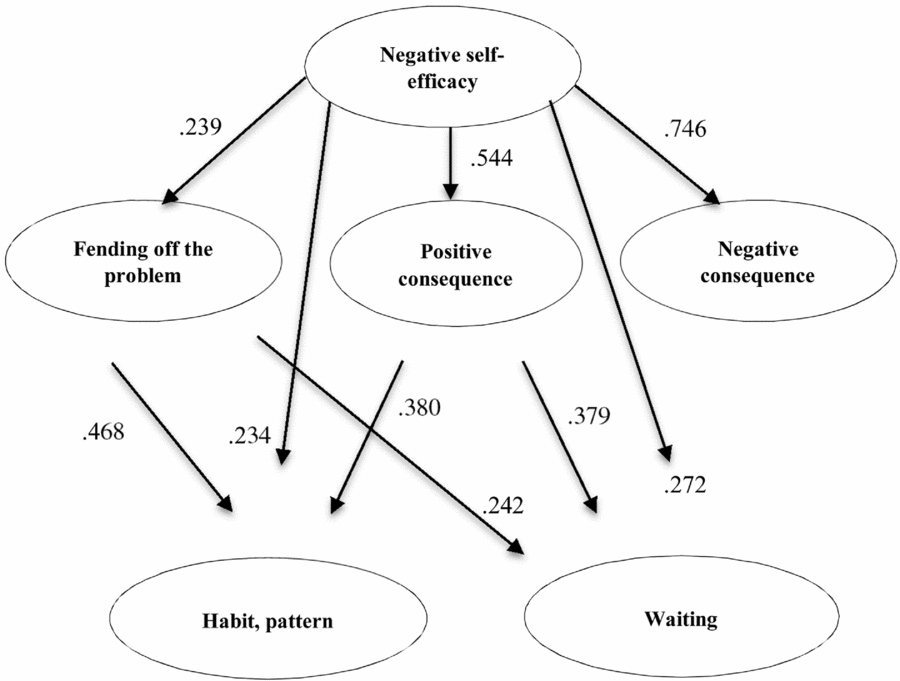
SEM was used to describe the system of connections between the factors and theoretical model of the effects the variables have on one another (Figure 1) with the data from the second collection. Based on the research that has been carried out so far and the intercorrelational coefficients revealed in this research, it was hypothesised that the central latent variable of the model was Negative Self-Efficacy, which directly effects all factors, and that Fending Off the Problem, Negative Consequence and Positive Consequence directly affect the Habit, Pattern and Waiting variables.
The theoretical model of the connection of the variables.

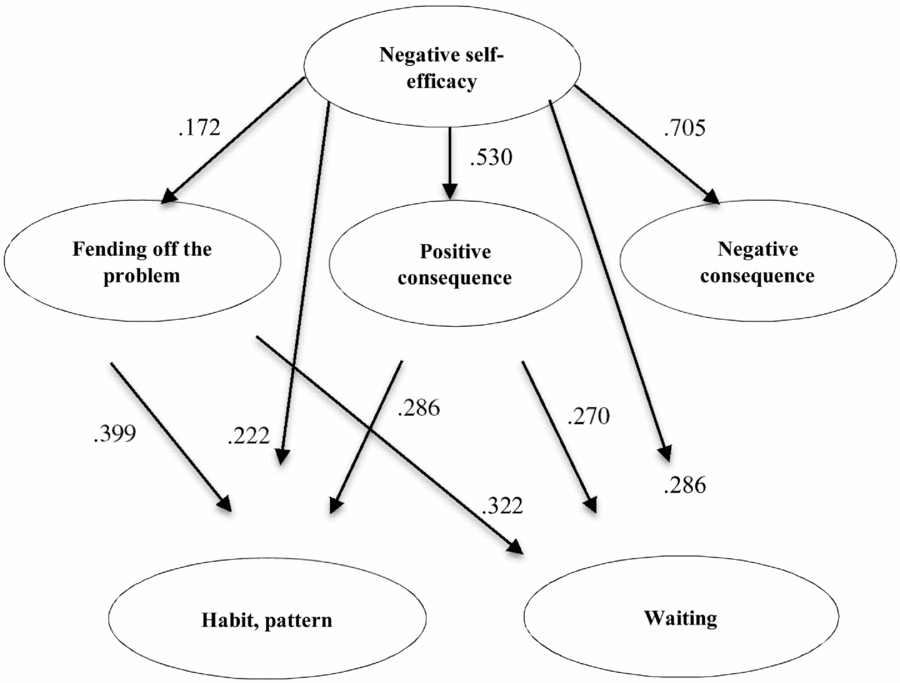
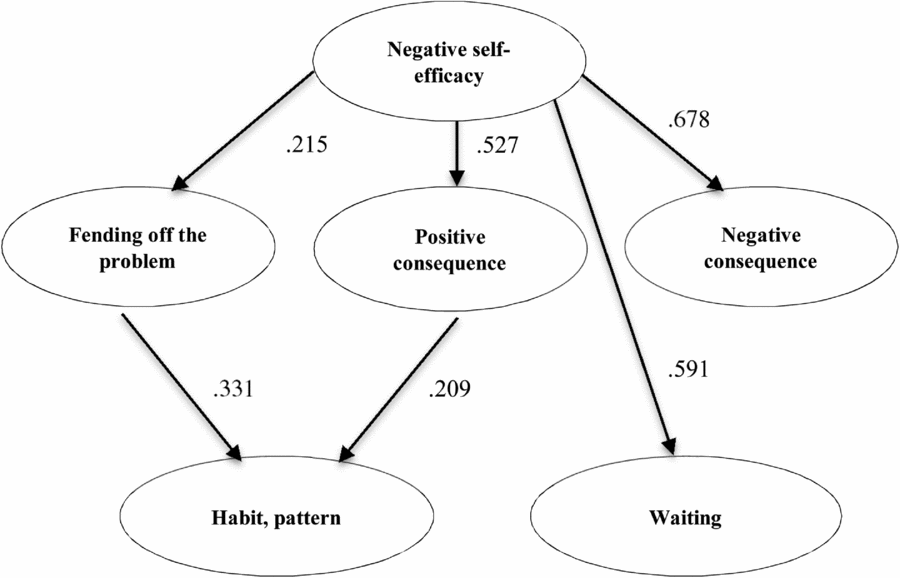
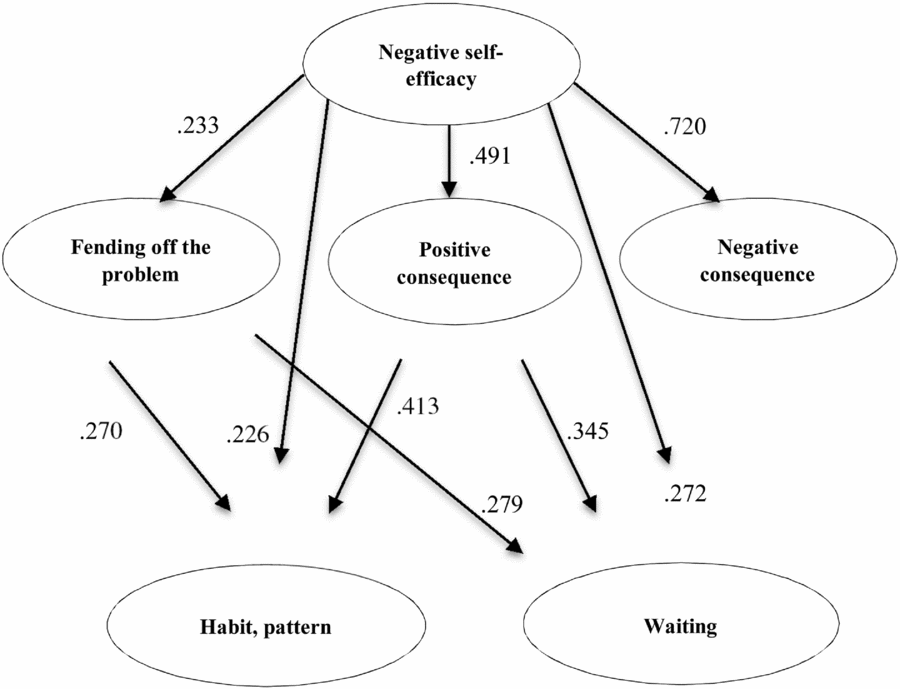
The fitness of the theoretical model was satisfactory: 12: χ2 = 319.49, p < .001, df = 176 χ2/df = 1.81, CFI = .90, TLI = .88, RMSEA = .06 (p = .67), SRMR = .08; 15: χ2 = 266.44, p < .001, df = 176, χ2/df = 1.51, CFI = .95, TLI = .94, RMSEA = .04 (p = .87), SRMR = .07; 18: χ2 = 325.71, p < .001, df = 176 χ2/df = 1.84, CFI = .93, TLI = .92, RMSEA = .05 (p = .48), SRMR = .05; whole sample: χ2 = 466.06, p < .001, df = 174, χ2/df = 2.68, CFI = .94, TLI = .93, RMSEA = .04 (p = .98), SRMR = .06. At the same time, more imputed relationships were not significant, and therefore these were deleted. The fitness thus received is satisfactory; it is consistent with the theoretical model in the whole sample (Figure 2) and in all age subsamples (Figures 3–5): 12: χ2 = 272.54, p < .001, df = 132, χ2/df = 2.06, CFI = .92, TLI = .90, RMSEA = .06 (p = .14), SRMR = .08; 15: χ2 = 266.44, p < .001, df = 176 χ2/df = 1.51, CFI = .95, TLI = .94, RMSEA = .04 (p = .87), SRMR = .07; 18: χ2 = 327.80, p < .001, df = 177 χ2/df = 1.85, CFI = .93, TLI = .92, RMSEA = .05 (p = .48), SRMR = .05; whole sample: χ2 = 466.06, p < .001, df = 176 χ2/df = 2.64, CFI = .94, TLI = .93, RMSEA = .04 (p = .98), SRMR = .06.
The results of the SEM (whole sample, N = 835).

The results of the SEM (12-year-olds, n = 290).
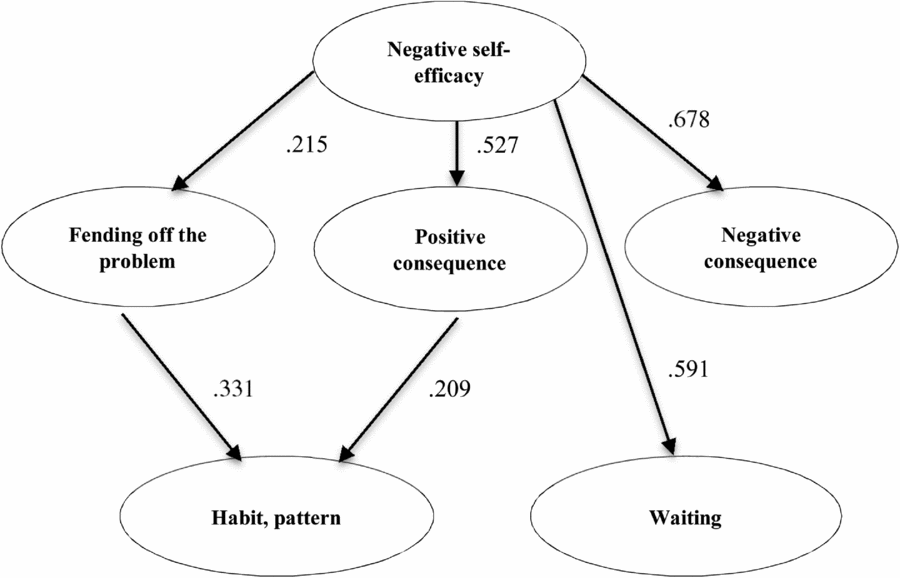
The results of the SEM (15-year-olds, n = 270).

The results of the SEM (18-year-olds, n = 275).
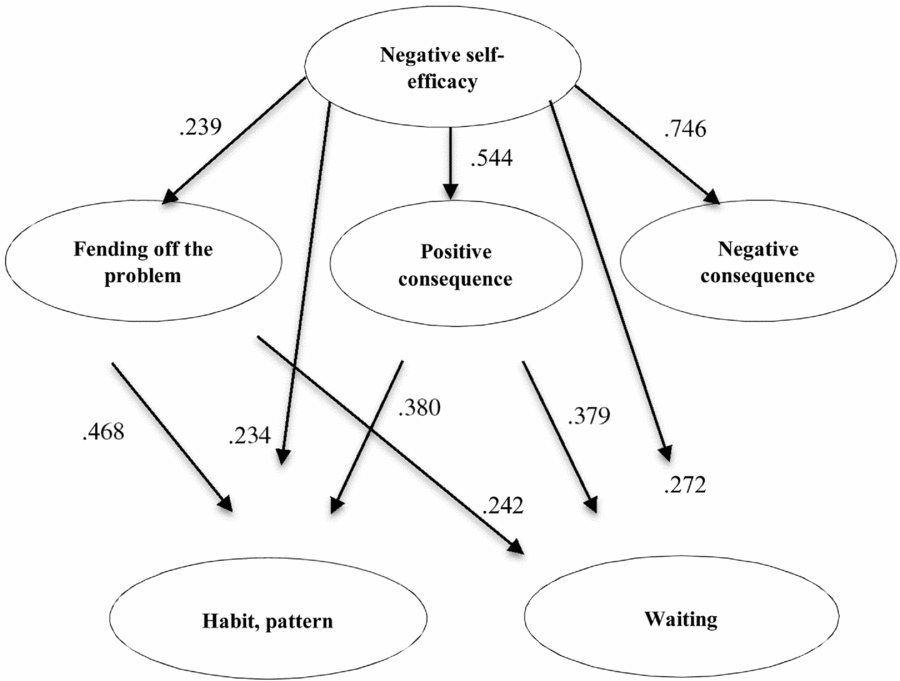
In accordance with the theoretical model, in the case of the whole sample, Negative Consequence has no significant effect on Habit, Pattern and Waiting. Negative Self-Efficacy directly affects the latent variables of Fending Off the Problem, Negative Consequence, Positive Consequence and Waiting in all three age samples (Figures 2–4); Positive Consequence and Habit, Pattern were predicted by Fending Off the Problem. This system of prediction is supplemented by the direct effect of (1) Fending Off the Problem on Waiting, Positive Consequence and Waiting, (2) Negative Self-Efficacy on Habit, Pattern in the sample of 15-year-olds. In the case of 15- and 18-year-olds, the models are nearly identical; the values of the estimations do not differ greatly from one another in the two models. Negative Consequence is only predicted by Negative Self-Efficacy in all three age samples and, in contrast to the theoretical model, this latent variable has no significant effect on other latent variables.
The Connection Between the Data from the Second and the Repeated Collection (2017)
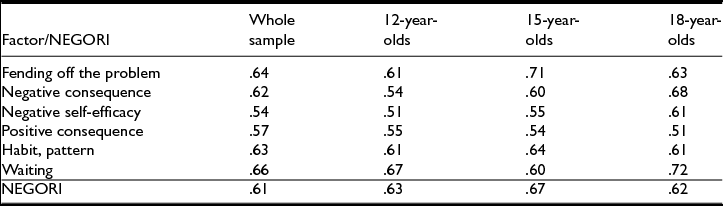
Upon the second 2017 data collection, a repeated measurement was also carried out (due to the fact that the results from the second and the repeated measurement are identical, the latter will not be disclosed in detail). The connection between the data was analysed by correlation analysis (Table 5). The correlation values in the case of the factors are between .51 and .72; in the case of the whole questionnaire (in age order), they are .63, .67, and .62.
The Correlations Between the First and the Repeated Measurement in 2017 (N = 835)
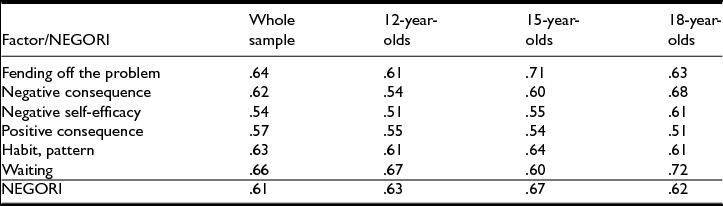
Note: p < .05 in all cases.
Age and Gender Differences (2017)
The analyses carried out on the data collected in 2016 and 2017 showed age-related differences that were completely the same, and hence the 2017 data will not be described here. Based on the 2016 and 2017 data, Negative Self-Efficacy and Positive Consequence both point to a tendency to decrease, while the tendency to increase with the advancement of age can be hypothesised for Negative Consequence, Fending Off the Problem, Habit, Pattern and Waiting. The differences revealed in 2016 were also identified, and in the 2017 sample, 15-year-old boys gained the highest score not only for Fending Off the Problem and Habit, Pattern, but for Waiting too (boys: M = 1.39, SD = .35; girls: M = .90, SD = .34, t = 2.45, p = .015).
Convergent and Discriminative Validity — The Connection Between NEGORI and SPSI-R (2017)
The analysis of the convergent and discriminative validity of the NEGORI was carried out on the data from the second collection (2017) for which we used SPSI-R (positive orientation, negative orientation, rationality, impulsivity, avoidance). In the SPSI-R factors, students gained a similar score in all three age groups that the earlier cross-sectional and confirmatory longitudinal studies identified. The gradual decrease of positive orientation, the increase of negative orientation, avoidance and rationality, and the constantly high value of impulsivity is characteristic between the ages of 12 and 18 (see Kasik, Reference Kasik2014, Reference Kasik2015). Table 6 shows the results of the correlation analysis as per age.
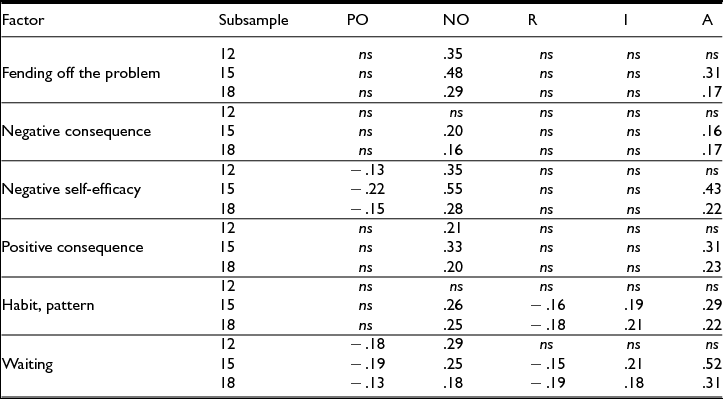
The Connection Between the Factors of NEGORI and SPSI–R (N = 835)

Note: PO = Positive orientation, NO = Negative orientation, R = Rationality, I = Impulsivity, A = Avoidance. Pearson r; p < .01.
Positive orientation has a negative significant connection with Negative Self-Efficacy and Waiting in all three age groups (Table 6). Negative orientation has a positive connection with all NEGORI factors and in almost all age groups; of these, the values concerned with the factors of Fending Off the Problem and Negative Self-Efficacy are the highest among 12- and 15-year-olds. The factor of Avoidance bears no significant connection with any NEGORI factor among 12-year-olds; however, it does so with 15- and 18-year-olds. The connection between the factors of Avoidance, Waiting and Negative Self-Efficacy are the strongest among 15-year-olds. Rationality and Impulsivity has a significant connection only with the factors of Habit, Pattern and Waiting (the former is negative, the latter is positive) among 15- and 18-year-olds.
Discussion
Development of the NEGORI
The negative orientation factor of the SPSI-R contains statements that express negative self-efficacy, little belief in the solution, that the solution is something unnecessary, little estimation of the consequences, the negative connection between the solution and the future, and the difficult nature of dealing with the frustration caused by the solution. Based on earlier research carried out with the questionnaire, the gradual increase of negative orientation between age 12 and 18 is typical. In the pilot study, areas related to negative orientation showed up individually or as a subcategory, based on the categorisation of 13-year-old students’ responses; however, several other categories were also separated with content that earlier questionnaire-based research did not provide information about. These include problem solving based on patterns (i.e., the behaviour of a model person), the absence of dealing with the problem regarded as something positive (i.e., not dealing with the problem will be good for him/her), and waiting for the other person to initiate the solution of the problem (i.e., he/she is not to blame, thus he/she is not the one who should initiate the solution). In addition to low self-efficacy, little belief in the solution of the problem and feeling that the solution is unnecessary, there seemed to be a low level or lack of taking responsibility, the fear of an unsuccessful solution, and a sense of escaping the shame caused by an unsuccessful solution present in the background (Kasik, Reference Kasik2016), and this was confirmed by the results of the pre- and post-measurement results of the six-month development program (Gál & Kasik, Reference Gál, Kasik, Molnár and Vígh2017).
The results of the pilot research unequivocally supported the assumption that in order to understand negative problem orientation, fields other than the ones covered by the questionnaires should also be taken into consideration. The categories of reasons revealed in the pilot largely contributed to the development of the NEGORI. Based on the analysis of the factor structure of the original, 40-statement questionnaire, the final 21-item NEGORI has good reliability indexes in all three age groups. The six factors partially cover the fields that measure negative orientation in the PSI, SPSI-R and SPSI-A, and most categories of the pilot measurement. The results of the CFA confirmed the six-factor model in all three ages. The ‘I do not want to solve my problem because . . .’ statement beginnings most likely account for the fact that the connections between the NEGORI factors are positive in all age groups. Based on the analysis of the convergent and discriminative validity, the negative orientation factor of the SPSI-R is in a positive connection with all NEGORI factors at almost all ages, which was confirmed by other tools that also measure negative orientation (e.g., Robichaud & Dugas, Reference Robichaud and Dugas2005). One of the reasons for this is the content overlap of the items of negative orientation and the NEGORI factors.
Results of the SEM
The results of the SEM largely confirmed what had previously been theorised about the connection between the variables in the whole sample and in all age groups. The system of connections shows that negative self-efficacy can be regarded as the central component of negative problem orientation even in 12-year-olds, which affects the initiation or their rejection of the solution of the problems, the fear of negative consequences, and that an individual attributes positive consequences to not beginning the problem solving. All this, directly or indirectly, shapes and forms problem-solving habits, while experiences create patterns, and we wait for the problem to either solve itself or for the initiation of another person to solve it without our participation.
Age-Related Characteristics
Upon examining the age-related characteristics, the same differences were identified in both samples; therefore, the 2017 data confirms the 2016 data. The results gained from the NEGORI factors give more detail about the age-related characteristics obtained with the SPSI-R (e.g., Kasik, Reference Kasik2014, Reference Kasik2015) because, based on the NEGORI, the age-related variations of negative self-efficacy related to the problems and their solutions show a tendency to decrease [(12) > (15) > (18)]. However, taking negative consequences into consideration has a more powerful presence, and one's degree of belief in positive consequences may decrease. Supposedly, these together feed negative self-efficacy. Negative orientation as a pattern, and waiting and fending off the problem increase with age, and the manifestation of these are caused by effects of socialisation; that is, family members’, and teachers’ and peers’ negative orientation affects students’ orientation of this sort. Fending off the problem (‘It's not my fault, therefore I do not have to do anything’) can be linked to taking responsibility, but it poses the lack of interpreting and seeing through the problem and the relations within the problem. Based on the data, waiting is in correlation with avoidance as a problem-solving style, which was also confirmed by the result of the validity test. Based on Scheier, Weintraub, and Carver (Reference Scheier, Weintraub and Carver1986), as well as Chang and Sanna's (Reference Chang and Sanna2001) research, the orientation and behaviour of those in one's direct environment (family, peers) significantly shapes high negative self-efficacy. Pessimistic adolescents take few possible solutions into account, and more often than not they make decisions based on their feelings, the result of which is usually the avoidance of solving the problem. This system of connections is also reflected in the results of the validity test: the Habit, Pattern and the Waiting factors have a negative connection with the rational problem-solving style, and have a positive one with impulsivity and avoidance. The increasingly definitive nature of these two factors support Frauenknecht and Black's (Reference Frauenknecht and Black2010) findings that claim that problem solving, with its orientation and solution processes alike, is more and more defined by past experiences in the form of habits and patterns with the advancement of age.
Gender Differences
No significant differences were identified for any of the factors among 12-year-old girls and boys during either the 2016 or the 2017 research. In earlier longitudinal research carried out with the SPSI-R, it was also found that significant differences in the measured fields can be identified from age 13–14 (Kasik, Reference Kasik2015). Negative orientation measured with one factor is more typical of girls, according to previous studies. The NEGORI gives a more detailed picture in this sense as well, which is also different because in the Fending Off the Problem and Habit, Pattern factors, boys’ values are higher (and also in the Waiting factor in the 2017 research), while girls’ values are higher in the case of Negative Consequence. In the pilot research, fear of negative consequences recurred exclusively in girls’ responses, which reflects the research data that claims that it is more typical of girls that others’ opinions (and the requirements formulated within these) define the mode of the solution of problems and conflicts more, and that their approach is more emotion based (e.g., Grusec & Davidov, Reference Grusec, Davidov, Grusec and Hastings2007; Ladd, Reference Ladd2005). However, it is in contrast with the results of the pilot research that it was not girls but boys who gained a higher score in the Habit, Pattern factor; based on this, following a pattern is more typical of them. According to Frauenknecht and Black (Reference Frauenknecht and Black2010), it is mainly the effect of one's family that is difficult to change (if the individual feels the need to do so at all) because the everyday negative experiences that are lived through together feed negative attitude, and the correlation values also show that negative orientation itself, and with it avoidance, are interpreted as beneficial. This can be viewed as a viable short-term solution (e.g., the tension caused by the problem decreases), but it may be dysfunctional in the long term because problems may arise later and they usually have a detrimental effect on social relations (Laplanche & Pontalis, Reference Laplanche and Pontalis1994).
Among 18-year-olds, boys’ values again are higher in the case of Negative Self-Efficacy and Fending Off the Problem. Gender difference is the opposite of the data from the pilot research in the case of Fending Off the Problem; however, it must be considered that in the pilot study it was students themselves who formulated the reasons for their negative orientation (and they were 13 years old at the time), while during the completion of the questionnaire, students had to evaluate given statements. Based on the pilot study, it is more typical of girls to see another person as the source of the problem and to wait for them to initiate the solution, which is in connected with taking responsibility retrospectively and by rationally weighing in on the future (Szabó, Zsadányi, & Szabó Hangya, Reference Szabó, Zsadányi and Szabó Hangya2015); more details of this are definitely needed in the future.
Limitations and Future Research
Although the NEGORI can be considered to be able to shed light on fending off the problem, negative and positive consequence, negative self-efficacy, habit and pattern, and waiting as reasons for negative orientation, further studies are needed in order to refine the questionnaire on the one hand, and to analyse the data in more detail on the other hand. Upon completion, the students could think of problems or problematic situations related to anyone; therefore, it would be useful to create the person-specific version of the NEGORI (as in the case of SPSI-R; Kasik, Reference Kasik2015), which would require changing the statements in the Habit, Pattern factor because these contain family, peers and teachers as models. It would also be important to shed light on the connection between the NEGORI and other fields, such as anxiety, general self-efficacy, coping, self-evaluation, and the aforementioned responsibility taking. The results of these correlation analyses will also contribute to make school development programs for children and adolescents that focus on problem solving even better, and to be able to concentrate on the solution-defining orientation as well by taking more personal characteristics into consideration, in addition to problem-solving styles.
Financial Support
The project was supported by National Research, Development and Innovation Office, Hungary (K16-119591).