
Introduction
Traditionally, many scholars have conceived the history of science as beginning with the Greeks, who explicitly set out to define and describe ‘nature’, in both its fantastical and mundane registers (French Reference French1994: 9–12; Mayor Reference Mayor2000: 3). Yet other peoples in the past, including those far beyond the Mediterranean, also sought to understand the natural phenomena surrounding them using a combination of first-hand observation, emic rationality and local legends (Mayor Reference Mayor2005). The world of the ancient Maya, with its tropical jungles, highlands and myriad waterways, encompassed a diversity of flora and fauna that begged both rational and mythical explorations. Building upon studies of ways in which the Maya directly interacted with their non-human counterparts (Thornton Reference Thornton2011; Götz & Emery Reference Götz and Emery2013), this article examines how they perceived and appropriated largely unfamiliar creatures that existed at and beyond the margins of the known world. Specifically, the ways the inland Maya imagined sharks and their aquatic world are the main focus here. How did sharks move, physically and conceptually, from the coasts to the jungles of the Maya world?
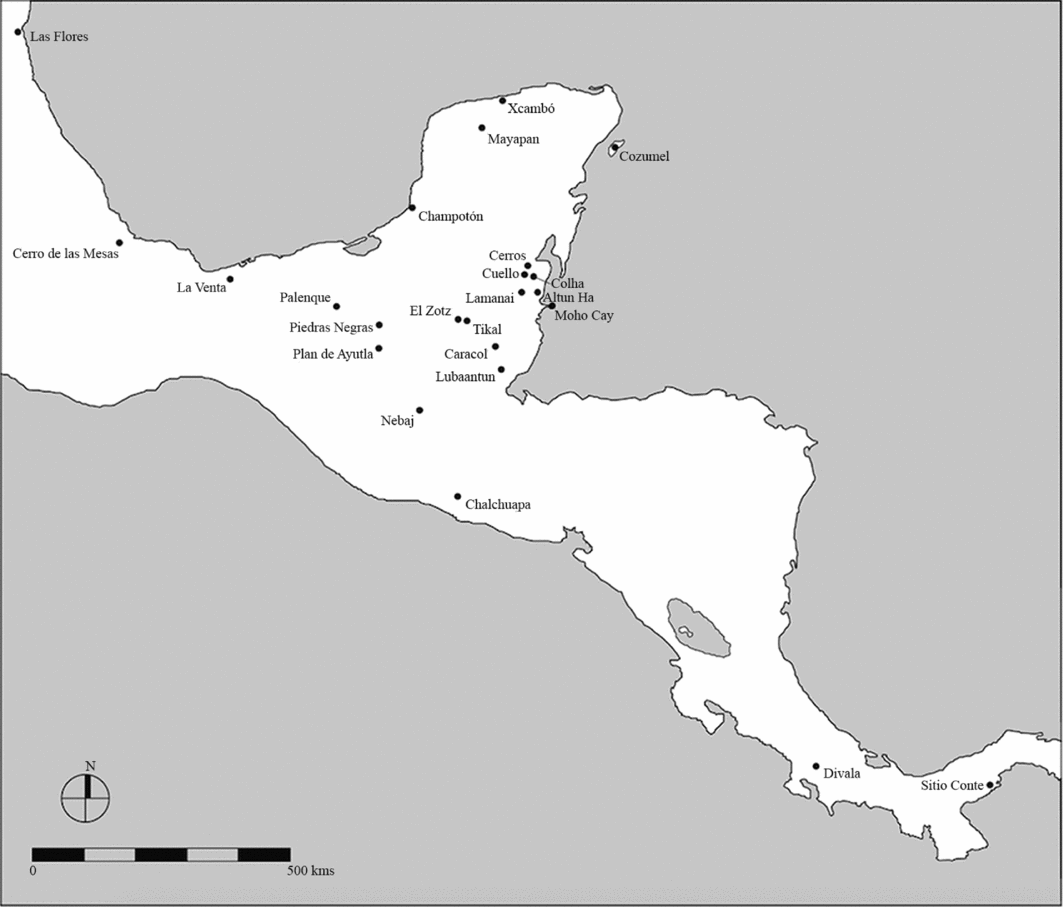
Sharks are represented at coastal Maya sites, but are also found far into the interior—at considerable distances from the seas and rivers where they might be sighted or hunted. They appear in indigenous Mesoamerican art as early as the first millennium BC and as late as the fifteenth century AD (Finamore & Houston Reference Finamore and Houston2010: 19), often as stylised, exaggerated beings. Teeth have been recovered from archaeological sites from the western Caribbean island of Cozumel, to Panama and El Salvador in the east, and employed in iconography from Palenque, in Chiapas, Mexico, to Lamanai, in Belize. Stories, images and actual pieces of sharks travelled inland over great distances (Figure 1).
Map of Mesoamerica showing sites where shark remains have been found.

The varying lines of evidence presented here—ethnohistorical accounts, archaeological finds and iconography—broadly underscore the importance of examining human-animal interactions at multiple levels. Such interactions occur in the physical world, through hunting, butchery, acquisition and display, but also in more ephemeral realms, in myth and imagination. The Maya conceptualised, commodified and experienced sharks—both real and fantastical—in ways that simultaneously maintained a sense of wonder with natural phenomena, while serving grander cosmic purposes. Whether as trade goods, implements of sacrifice or primordial monsters, sharks moved fluidly through the Maya world, both overland and undersea.
Predators and prey: hunting sharks
The presence of sharks in inland Maya art and archaeology, whether as individual teeth or severed jaws, points to active hunting. Sharks lack the air bladders possessed by other fish; they cannot adjust their buoyancy in the water and must swim continuously. Sharks thus sink when they die, generally prohibiting the passive, post-mortem collection of their remains.
Historical accounts suggest a variety of possibilities for specific shark-hunting strategies. In one example near Cuba, Hernándo Colón, son of Christopher Columbus, describes an intriguing method of fishing for turtles and sharks from canoes, using remoras (sucker-fish):
Their manner of fishing was so strange and new to our men [. . .] they had ty'd some small fishes they call Reverso by the tail, which run themselves against other fish, and with a certain roughness they have from the head to the middle of the back, they stick fast to the next fish they meet; and when the Indians perceive it, drawing their line, they hand them both in together [. . .] and we have seen them fasten upon vast sharks (Gudger Reference Gudger1919: 447).
Edward Herbert Thompson, an American archaeologist and diplomat in Yucatán, provided a recollection of his participation in a late-nineteenth century hunt for shark liver oil. Despite its small size and seeming vulnerability, Thompson's account suggests the Maya dugout may have been well-suited to this purpose: “the little canoe danced like a cork on troubled waters, responding lightly to jerking pulls that would have been dangerous to a clumsier, heavier craft” (Thompson Reference Thompson1932: 33–34). According to Thompson, two native Maya fishermen embedded large hooks in bait, allowing the sharks to tire themselves out by struggling once they had been hooked, before finally drawing near and killing the creatures using a lance, mallet and a well-placed blow to the head.
In colonial times, sharks were hunted for their teeth and their oil-rich livers, but their meat was consumed only as a last resort. John Lloyd Stephens (Reference Stephens1993: 462) describes Spanish sailors fishing for sharks, which they call the “enemies of the Christians”, only if provisions grew short. Hooked sharks were hoisted aboard, their entrails were removed, and the rest of the fish immediately discarded overboard. Martin Tovilla, writing in 1630 of his voyage from Spain to Verapaz, describes catching a 5.2m-long shark containing three live tuna fish and many bones of men and other animals. Sharing the meat among the soldiers and sailors, with scraps to spare, Tovilla declared that “for fresh meat it was tough” (Feldman Reference Feldman2000: 60).
Shark meat and shark liver oil might have been transported and consumed at inland sites (de Borhegyi Reference de Borhegyi1961: 280–81), but these would leave no direct archaeological traces (sharks are cartilaginous fishes, lacking an inorganic component to their bones; only their teeth and occasional vertebrae survive). Certain factors make the transport of fresh shark meat to inland sites unlikely. As a result of their physiology, sharks retain urea in their blood and tissues. The urea begins to break down when a shark dies, imparting a strong smell and odour to the meat and becoming toxic in high concentrations. The problem can be solved by rapidly bleeding out a freshly caught animal and washing the carcass with seawater or soaking the meat in a weak acid solution, such as citrus juice (Musick Reference Musick and Musick2005). Even if shark meat was traded and consumed far from the sea, butchery and preparation must have taken place at coastal sites in order to avoid potential toxicity.
Other perishable parts and pieces were perhaps more valuable. In medical treatises on the New World, Nicolás Monardes (in 1574) and Francisco Ximénez (in 1615) both described the uses for little stones found in the heads of sharks (statoconia of the shark's endolymphatic duct (Tester et al. Reference Tester, Kendall and Milisen1972: 266)), which can be crushed and administered as a powder to aid those who cannot urinate, or to dissolve stones in the kidneys and bladder. According to Monardes, this technique was something “well inquired and well known by the Indians” (de Asúa & French Reference de Asúa and French2005: 107).
Deposits from the deep: shark teeth in Maya offerings
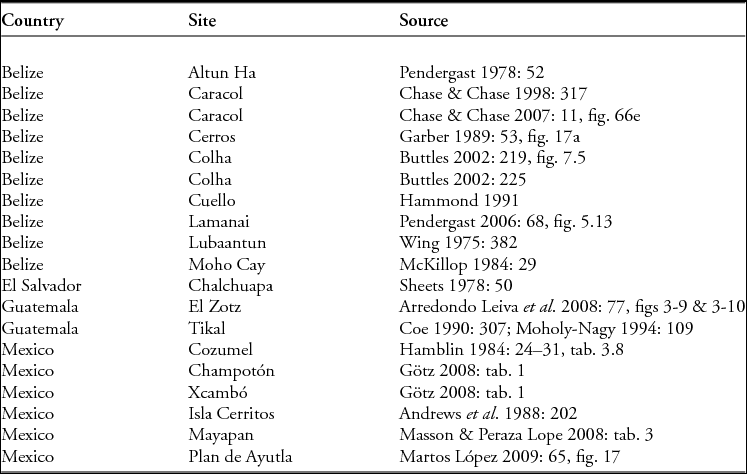
Regardless of how they were acquired, sharks travelled from the sea to the jungle not only figuratively, but literally as well. De Borhegyi (Reference de Borhegyi1961: tab. 1) compiled an initial list of shark remains recovered from archaeological contexts in Mesoamerica. Focusing on shark teeth (although vertebrae are also recovered), his catalogue includes individual examples from residential areas at Postclassic Mayapan, in Yucatán, and from Late Classic caches at Piedras Negras, Guatemala, as well as examples from beyond the traditional borders of Mesoamerica, in Costa Rica and Panama. Some additions to de Borhegyi's Reference de Borhegyi1961 table (Figure 1) include shark teeth and vertebrae recovered from sites in Belize, El Salvador, Guatemala and Mexico (Table 1).
Some additions to de Borhegyi's (Reference de Borhegyi1961: tab. 1) list of shark remains recovered from Maya sites.

Sharks, particularly their teeth, are found incorporated into deposits in Mesoamerica from Late Formative times (c. 1700–1500 BC). At the Olmec site of El Manatí in Veracruz, Mexico, a cylindrical wooden baton or sceptre, painted red and with a shark tooth embedded in one end, was recovered among offerings deposited at a natural spring (Arnold Reference Arnold2005: 12). A Protoclassic (c. AD 100–300) burial at Chiapa de Corzo contained 56 shark teeth positioned around the shaft area of an obsidian lance (Lowe & Agrinier Reference Lowe and Agrinier1960: 40, 85). Similarly, in Panama, Lothrop (Reference Lothrop1950: 14) described lances studded with the teeth of sharks and other fishes. These early examples may foreshadow much later uses observed in the sixteenth century by the Spanish Bishop Diego de Landa, who described “bows and arrows which they carried in their quivers, pointed with flints or the very sharp teeth of fishes” (Tozzer Reference Tozzer1941: 121).
More common are small quantities of individual teeth found in buried offerings, and especially lidded caches. Guderjan (Reference Guderjan2004: 37–38) argues that Early Classic dedicatory offerings of paired lip-to-lip bowls, recovered at the site of Blue Creek, Belize, were filled in successive levels, recreating the Maya cosmos. The lowest level of the inferior bowl was filled with materials representing the Primordial Sea, the next level with earth elements and finally, the domed lid of the superior vessel represented the heavens above. The shark teeth incorporated into caches throughout the Maya area were probably obtained, understood and deposited alongside other marine exotics as symbolic representations of the faraway, mythic sea. The process of ordering such deposits was, itself, a creative act: a recreation of the cosmic original. In a creation myth detailed in Palenque's Temple XIX (see below), the upper and lower jaws of a primordial sea monster are split apart to form the heavens and the earth. Opening a cache vessel replicated this specific kind of creation—an act of separation rather than joining (Martin Reference Martin2004: 6).
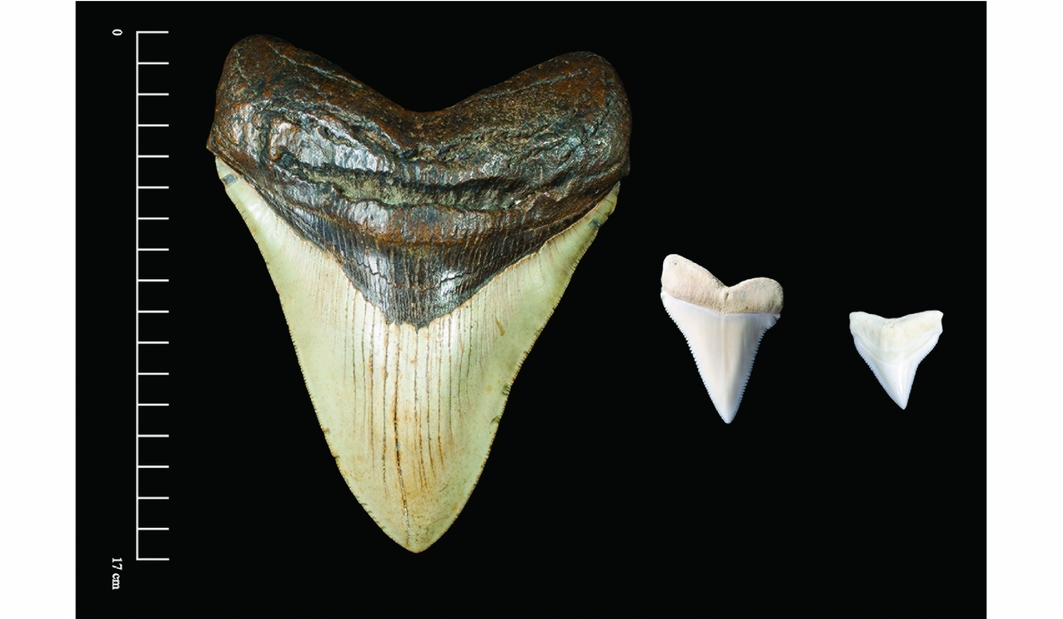
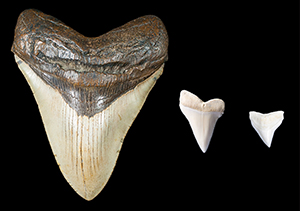
A few examples of recovered shark teeth stand out. The first are two offerings made in temples at Palenque, which included fossil teeth from the species Carcharocles megalodon, an extinct shark measuring up to 18m in length and appropriately named “big tooth” (Pimiento & Clements Reference Pimiento and Clements2014: 1), whose remains are found in inland fossil beds throughout Central America (González-Rodríguez et al. Reference González-Rodríguez, Espinoza-Arrubarrena, Gonzáslez-Barba, Arratia, Schultze and Wilson2013: fig. 5). In addition to those documented by de Borhegyi, Cuevas García (Reference Cuevas García, Laporte, Arroyo and Mejía2008: 669) reported a total of 13 fossilised shark teeth and 7 fossilised shark vertebrae at Palenque, with the teeth primarily encountered in votive offerings beneath temple floors, but also in funerary contexts. A cache found beneath the ballcourt at the nearby site of Plan de Ayutla also included a fossilised megalodon tooth (Martos López Reference Martos López, Golden, Houston and Skidmore2009: 65). Megalodon teeth are nearly three times the size of those from modern great white sharks and roughly five times the size of an average bull shark's teeth (Figure 2; Gottfried et al. Reference Gottfried, Compagno, Bowman, Klimley and Ainley1996).
Comparison of Charcharocles megalodon tooth (left) with that of a modern great white shark (centre) and a bull shark (right).

Another surprising item on de Borhegyi's list is an Early Classic (c. AD 300–600) deposition of 54 perforated teeth at the highland, inland site of Nebaj, most probably from a bull shark. Although bull shark teeth are known elsewhere, archaeologically and in iconography, the quantity of teeth recovered at Nebaj is unusual. The teeth all have two slightly cone-shaped perforations and are interspersed with “Spondylus shell spangles” as part of a band found behind the head of an individual in tomb 1, mound 2 (de Borhegyi Reference de Borhegyi1961: 281).
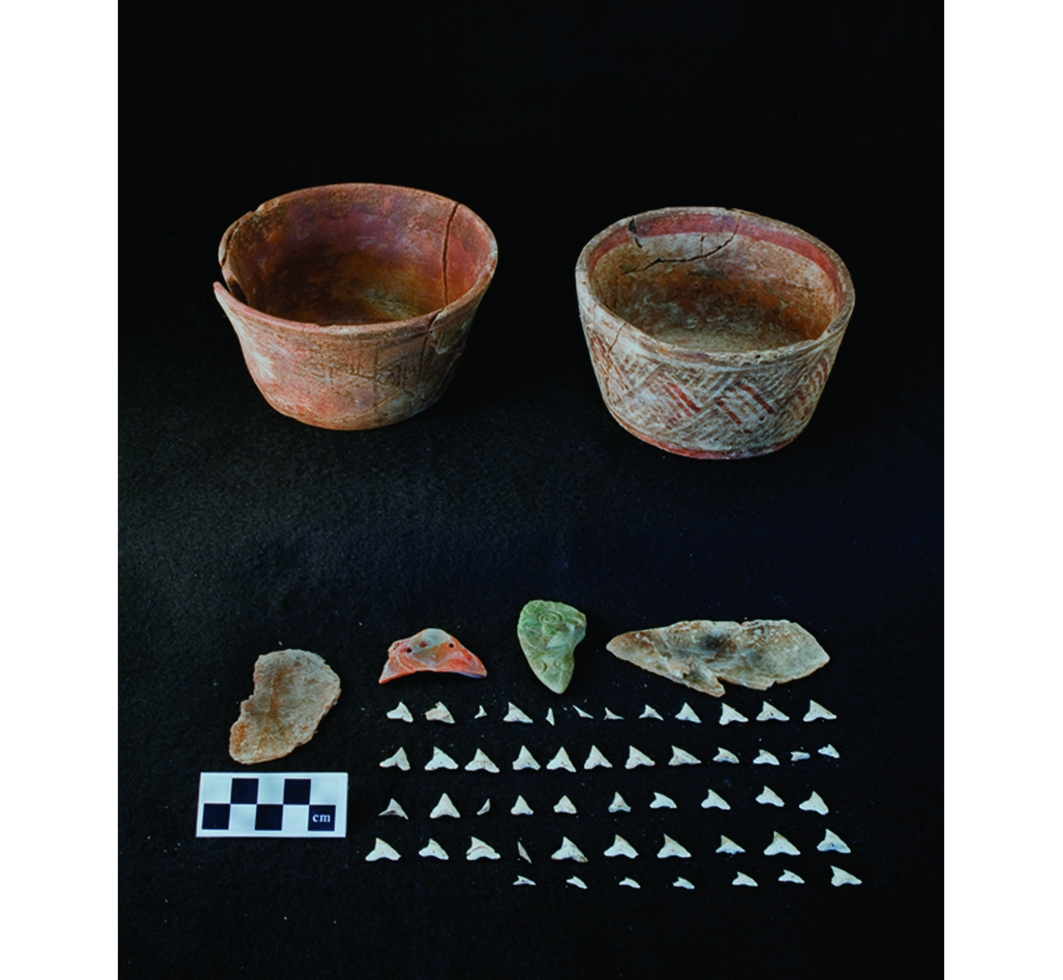
A separate large collection of shark teeth, recovered from a Late Classic (c. AD 725–800) ceramic cache at El Zotz, included 51 specimens of mostly complete teeth and a number of fragments, comprising 47 individual teeth in all. Along with the teeth, the lip-to-lip polychrome bowls also included a Spondylus shell pendant, a drill-carved greenstone figurine and crushed, unidentifiable faunal remains, all covered by two plates of muscovite mica (Figure 3). The cache was found in the fill of the basal platform beneath structure L7–11, El Zotz's tallest temple-pyramid (Arredondo Leiva et al. Reference Arredondo Leiva, Houston, Walker, Leiva and Houston2008: 77–84). The layers of shark teeth and Spondylus beneath the greenstone figurine, the faunal remains and the mica between two lip-to-lip vessels follow the pattern of Maya caches as recreations of their cosmos. The cache's placement in the foundational layer of Str. L7–11 transformed the pyramid into a symbolic mountain, the structure itself mimicking the cache's replication and encapsulation of the world, only at a larger scale (Taube Reference Taube and Ragavan2013).
Late Classic (c. AD 650–750) cache from El Zotz, Petén, Guatemala, showing two polychrome vessels, two muscovite mica plates, a carved greenstone figurine, a Spondylus shell pendant and the upper teeth of a requiem shark, probably all from a single individual. Photograph by Stephen Houston.

The teeth from the El Zotz cache belong to a requiem shark, possibly a dusky shark (Carcharhinus obscurus). They are all broadly triangular, with serrated edges and slightly oblique outlines, suggesting that they were taken from the upper jaw only. The high degree of similarity among the teeth suggests that they all came from a single individual (dusky sharks possess between 29–32 teeth per row in the upper jaw). Shark teeth are widely variable, not only among different species, but among individuals of a single species too, making it unlikely that such a homogeneous set would have been collected from multiple individuals (Castro Reference Castro2011: 444–48). Although rarely noted in archaeological reports, other examples of shark teeth from cached offerings also predominantly comprise the upper teeth of requiem sharks (de Borhegyi Reference de Borhegyi1961: 283; Buttles Reference Buttles2002: 225–27). The exclusion of the lower jaw may be unintentional, but the upper teeth of requiem sharks are serrated for cutting and tearing, while the lower teeth are narrow and pointed to hold prey in place. The serrated teeth may have been intentionally chosen by the Maya for ritual bloodletting, as was the case with the saw-like edges of more commonly found (and more brittle) stingray spines (Benson Reference Benson1988).
Xook: sharks in Maya imagery
Although the Maya word for shark, xook (pronounced ‘shōk’), has been proposed as the origin of the English term (Jones Reference Jones, Robertson and Fields1985; Castro Reference Castro2002), there is at least one attestation of the word ‘shark’ that pre-dates European-American contact by almost half a century. The word is found in the correspondence of Thomas Bekynton, secretary to King Henry VI and Bishop of Bath and Wells, in a letter dating to July 1442 (Nicolas Reference Nicolas1828: 10–11): “Friday, at sea, in a calm, about seven in the evening, as we thought, a fish, called a shark, pursued the ship”. That sharks were known to Europeans prior to contact in the Americas is further evidenced by the existence of early words for shark in Spanish (marrajo and cazón) and Portuguese (marraxo). The now-common term tiburón, of Carib origin, was initially adopted to differentiate between the small sharks observed in Europe and the larger sharks of the Caribbean (Corominas & Pascual Reference Corominas and Pascual1983: 484–86; Castro Reference Castro2002: 250).
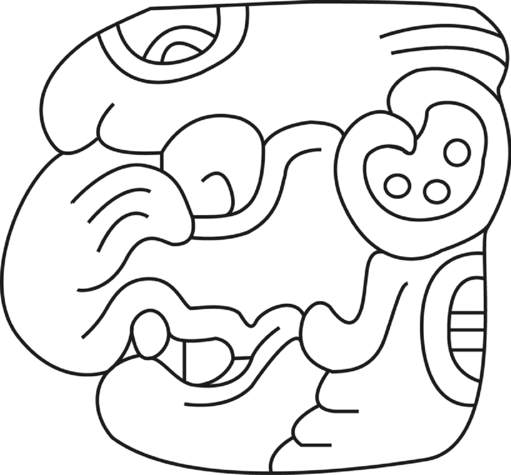
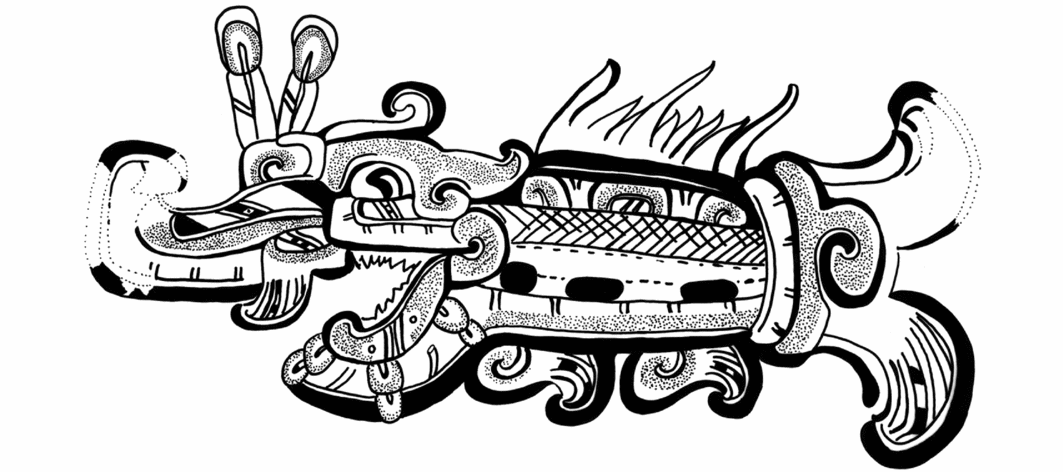
Among the Maya, the word xook is known from Classic-period texts, rendered as a logograph and with phonetic complements to guide pronunciation (Figure 4), as well as fromcolonial dictionaries of Mayan languages (Thompson Reference Thompson1944). Classic Maya rulers associated themselves with the powerful, semi-divinity of sharks by incorporating the creatures into their names, such as Tikal's dynastic founder, Yax Ehb Xook (“First Step Shark”) and Ix K'abal Xook (“Lady Shark Fin”), an eighth-century queen of Yaxchilan (Stone & Zender Reference Stone and Zender2011: 203).
Classic Maya logograph for xook (after Stone & Zender 2010: 203).

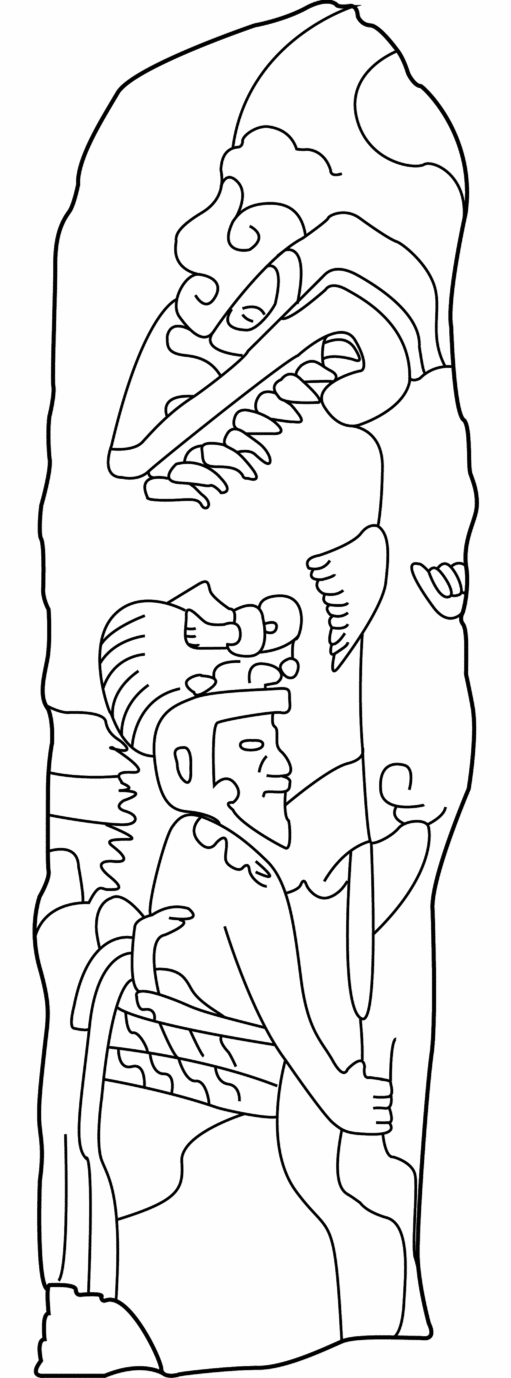
Sharks appear far earlier in Mesoamerican imagery than they do in texts. In Olmec art, they are represented from the first millennium BC, as seen on monument 58 from San Lorenzo, Veracruz (Taube Reference Taube, Finamore and Houston2010a: 262) or monument 63 from La Venta, Tabasco (Figure 5). Monument 63 may be an early version of a deeply rooted Mesoamerican legend, known as the Cipactli myth, in which supernaturals battle and best a primordial shark monster to create the world (Arnold Reference Arnold2005: 17). The name Cipactli (‘spiny one’) comes from a Postclassic Central Mexican telling, which appears in the Codex Vaticanus B and illustrates the sea monster struggling against the god Piltzintecuhtli. The Popol Vuh, the colonial-period K'iche’ Maya creation story, features an incident related to the Aztec myth, in which the monstrous being is known as Sipak, a name derived from the Nahuatl word Cipactli. Although this sea monster often possesses many characteristic shark features, it is also a fantastic image, combining the essential elements of other ferocious beings into one epic, piscine-crocodilian opponent (Taube Reference Taube, Finamore and Houston2010b: 204, 209).
Monument 63 from La Venta, showing an Olmec version of the story involving a mythical human vs sea monster battle (after Clark et al. Reference Clark, Guernsey, Arroyo, Guernsey, Clark and Arroyo2010: fig. 1.7c).

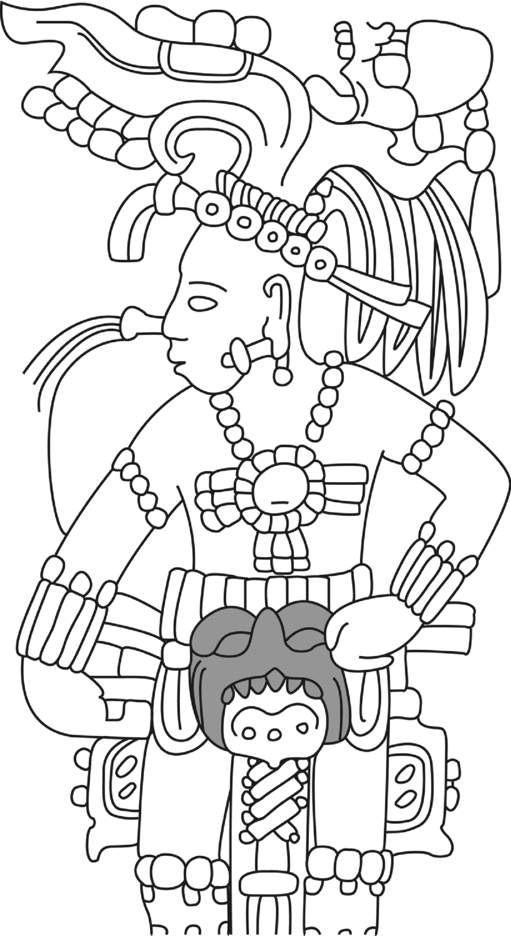
Earlier versions of the narrative, concerning the origins of rain, wind and maize, appear in multiple forms of Maya art. The xook logograph represents the ferocious fish in general, and specifically names the mythical monster (Houston & Martin Reference Houston and Martin2012). A painted mural at the site of Mayapan, dating to the late fourteenth or early fifteenth century AD, depicts the same mythical scene: a shark, belly-up, run through by a harpoon, blood droplets issuing from its mouth into the water (Taube Reference Taube, Finamore and Houston2010b: 204–205). Other examples illustrating the primordial legend include a plaque from Campeche, carved from a Caribbean conch, which shows the Maize God emerging from, or perhaps riding a shark, the butt of a spear protruding between the pointed teeth of the creature's open jaws (Finamore & Houston Reference Finamore and Houston2010: pl. 87; Taube Reference Taube, Finamore and Houston2010a: 262). One vessel, from northern Petén or southern Campeche, shows two deities pursuing a shark, piercing its mid-section with a flint-tipped spear (Finamore & Houston Reference Finamore and Houston2010: pl. 80). An incised vase illustrates the same hunt, although the deities are shownspearing their prey from canoes (Stone & Zender Reference Stone and Zender2011: fig. 50.4). Another polychrome vessel depicts a young Wind God emerging from the mouth of a shark, blood flowing from the creature's wounds, along with a caption that includes the phrase “the shark is speared” (Stone & Zender Reference Stone and Zender2011: 203). In related imagery, an infant Maize God is born from the open jaws of the dying shark, an event seemingly referenced by Maize God impersonators in Maya art, who often prominently display a shark's head at the groin (Figure 6; Houston Reference Houston, Finamore and Houston2010: 77; Stone & Zender Reference Stone and Zender2011: 203). Intriguingly, the maw displayed includes only the upper jaws of a shark, perched above a Spondylus shell (as a receptacle for blood), recalling the predominance of upper teeth in cached offerings. This correlation between iconography and artefacts raises the possibility that only the upper jaws of sharks, prized for their cutting edges, were transported inland. Indeed, it is possible that the Maya of the interior jungles never saw a complete pair of shark jaws, only the upper half.
Shark jaws (shaded) worn over the groin in impersonation of the Maya Maize God, as depicted on a carved slab found east of Copán's Great Plaza (after Taube Reference Taube, Robertson and Fields1985: fig. 9a).

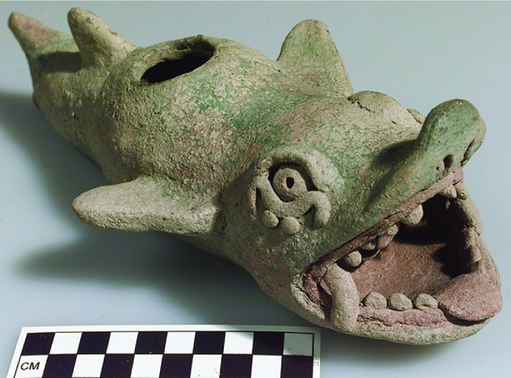
Some Maya representations of sharks are naturalistic, suggesting direct observation and close contact with the live fish. An effigy vessel in the National Museum of the American Indian, for example, depicts a shark with carefully crafted anatomical details (Figure 7; although see the description of this vessel as a “mythic crocodilian figure” in Pendergast Reference Pendergast, Pendergast and Andrews2006: 68). Recovered from Lamanai, Belize, the vessel shows the creature with accentuated nostrils, placed on the underside of its snout (rather than below the eyes, a clear difference between sharks and other fish). The first dorsal fin is, appropriately, larger than the second. The primary dorsal fin serves as a small lid to the effigy vessel, which contained three shark teeth, along with shell inlays, beads and pendants, and chert bifaces. On either side of the shark's open mouth, two tubes curve downward, perhaps illustrating the distinctive fleshy barbels of the nurse shark (Ginglymostoma cirratum). Nurse sharks are commonly found in the waters of Chetumal Bay, in northern Belize, and were probably familiar sights to the inhabitants of Lamanai, although live shark sightings would still have required a journey of almost 90km (facilitated by river travel).
A naturalistic shark effigy vessel from Lamanai, Belize. National Museum of the American Indian, Smithsonian Institution (9/1594). Photograph by NMAI Photo Services.

Stone and Zender (Reference Stone and Zender2011: 203) suggest that the logograph for xook and full-figure variants of that sign are realistic portraits of the bull shark (Carcharhinus leucas), with its blunt snout, hooked eye, serrated and triangular teeth, and numerous facial and body fins (Figure 4). Although it may perhaps seem surprising that such faithful representations of sharks occur at inland sites, the bull shark is unique in its ability to penetrate fresh water. It can often be found hundreds of kilometres from the sea, travelling inland along river pathways, including the Usumacinta River along the Guatemala-Mexico border or the Lake Izabal-Rio Dulce system of eastern Guatemala (Thorson et al. Reference Thorson, Cowan and Watson1966).In other cases, the observable physicality of real sharks blends with, or diverges from figurative understandings of their form. An early depiction on a polychrome plate from the Petén area of Guatemala (c. AD 250–350) shows a highly stylised version of a shark (Figure 8; Finamore & Houston Reference Finamore and Houston2010: pl. 30). Its bifurcated tail with unequal lobes, and its pair of stiff pectoral fins are features generally suggestive of shark anatomy (as opposed to the symmetrical tails of, and smaller, more flexible fins of, fish), while the creature's open mouth shows its rough, jagged dentition with a single larger tooth at the front and centre of its upper jaw. The main tooth is marked with an iconographic element often seen on depictions of polished jade celts, and used to convey a hard, shiny and precious quality to the materials it marks (Taube & Ishihara-Brito Reference Taube, Ishihara-Brito, Pillsbury, Doutriaux, Ishihara-Brito and Tokovinine2012: 145).
An Early Classic tetrapod plate shows a highly stylised version of a shark, emphasising a single, central tooth. Drawing by James Doyle.

The single, triangular shark tooth is also employed as a distinguishing characteristic of particular Maya deities. At Palenque, Mexico, a god known simply as GI is part of a triad of primordial deities at the heart of that site's creation myth. A bench in Palenque's temple XIX recounts a bloody conquest between GI and a supernatural, crocodilian beast, a local version of the Cipactli myth, in which the earth and sky are fashioned from the jaws of the defeated, beheaded creature (Stone & Zender Reference Stone and Zender2011: 53). GI is often depicted with a single shark tooth as a central incisor, along with swirling fish eyes and barbels or fins on his cheeks (Finamore & Houston Reference Finamore and Houston2010: pls 25 & 90). At El Zotz, one of three versions of the Maya Sun God displays a shark tooth as his central incisor, with droplets of blood falling from his mouth (Taube & Houston in press). This nocturnal, blood-drinking Sun God sinks into the ‘fiery pool’ of the western sea at sunset (Finamore & Houston Reference Finamore and Houston2010). The sanguine droplets flowing from his mouth and the sunset-red, salty sea highlight an association between the strong saline taste of both fluids, perhaps another allusion to the Cipactli myth in which the great sea monster is speared and slain, making the ocean a realm of blood, violent conflict and dangerous beasts (Taube Reference Taube, Finamore and Houston2010b: 209).
Although sharks lose and regrow their teeth consistently throughout their lives, the lost teeth generally sink to the ocean floor, washing up on beaches only occasionally via tricks of the tide. Fossilised shark teeth such as those recovered from caches at Palenque and Plan de Ayutla are, however, more likely to be found as individual elements because they sank to the ocean floor when the seas covered much of the land mass exposed today. It is little wonder that these and other shark teeth—in the case of megalodon, each one larger than the span of an average adult man's hand—captured the Maya imagination and became prominent attributes of gods and monsters. Individual megalodon teeth would not only have epitomised the qualities of hardness and shininess cued in Maya depictions of sharks, but also provide a potential explanation for the emphasis on the single large tooth (such as that depicted in examples of Palenque's ancestral deity, GI). Moreover, if the teeth from extant sharks were commonly transported inland as singular elements, the Maya in the jungles of Chiapas may have logically suspected that enormous, single-toothed sharks continued to dominate the seas (for a broader discussion of perceptions of megalodon fossils in the Americas, see also Mayor Reference Mayor2005: 137, 211). In associating fossilised shark teeth with primordial sea monsters, the Maya may have been well ahead of their time. It would be almost a millennium before Europe's burgeoning biologists would similarly tie megalodon teeth from Malta, known as ‘tongue stones’, to large sharks from the distant past (Moore Reference Moore1993: 107).
Conclusion
Although sharks lived at the geographic boundaries of the Maya world, they are conspicuous in art and other forms of narrative from both the near and distant past. Marine sharks would have been relatively rare for most of the Classic Maya, yet they were obviously present on the coasts, and also as mythical beasts in the imagination. For the inland Maya of the Yucatán peninsula, the sea marked the limits of the land in all directions, a fabled home to supernatural deities and energies. Sharks were associated with blood, pain and danger worthy of consideration and depiction, but from a safe distance (Houston Reference Houston, Finamore and Houston2010: 77). “Suspended between the mundane and the miraculous” (Daston & Park Reference Daston and Park1998: 14), sharks populated the wonder-filled margins and unknown edges of the natural world.
Big, toothy and terrifying, sharks lurked beyond the borders of mainland Mesoamerica, but loomed large in the imaginations of its inhabitants. Yet notions of ferocious fish and dangerous deities with shark attributes were based in part on physical evidence—great stone teeth found in the earth (Gottfried et al. Reference Gottfried, Compagno, Bowman, Klimley and Ainley1996; Cuevas García Reference Cuevas García, Laporte, Arroyo and Mejía2008: 669; Martos López Reference Martos López, Golden, Houston and Skidmore2009: 65; González-Rodríguez et al. Reference González-Rodríguez, Espinoza-Arrubarrena, Gonzáslez-Barba, Arratia, Schultze and Wilson2013: fig. 5), or carefully transported sets of sharp, serrated jaws—combined with legends and interpretations exchanged along the same networks that brought physical marine exotica from coastal to inland Maya communities. In an analogous example from Medieval Europe, Pluskowski (Reference Pluskowski2004: 300–305) describes how narwhal tusks from Greenland were appropriated as unicorn horns in the British Isles, Scandinavia and the Baltic. The tusks were significant objects of trade, but knowledge of their origins was limited to mercantile and courtly circles, further obscured by each successive exchange. Sharks were hunted, butchered, transported, interred in caches, affixed as attributes of gods and kings, depicted in painted murals, on ceramic vessels and through carved reliefs. They held different meanings along the coasts, in the jungles and even within the palaces of the Maya world. Tracing these creatures in deposits and depictions not only evidences the introduction and movement of marine elements through overland trade routes, but also illustrates the pathways along which ideas about these animals travelled and changed.
Acknowledgements
This topic began as an informal presentation at Brown University's Joukowsky Institute for Archaeology and the Ancient World, and took its current form thanks to the support of a J.M. Stuart Fellowship at the John Carter Brown Library. Drafts were improved by the comments and insights offered by Stephen Houston, Felipe Rojas, Andrea Flores, Sarah Craft, James Osborne, Mary Clarke, Daniel Finamore, Norman Hammond and an anonymous reviewer, and I am grateful to them for their suggestions. The National Museum of the American Indian, James Doyle and Stephen Houston generously provided images.