INTRODUCTION
The great white shark, Carcharodon carcharias (Linnaeus, 1758) is a cosmopolitan species inhabiting coastal and temperate waters, from the surface to a depth of 1800 m (Compagno, Reference Compagno1984). Its occurrence in the Mediterranean Sea and adjacent waters, has always been of particular concern because of its predatory reputation (e.g. De Maddalena, Reference De Maddalena2000; Barrull & Mate, Reference Barrull and Mate2001; Soldo & Jardas, Reference Soldo and Jardas2002; Morey et al., Reference Morey, Martínez, Massutí and Moranta2003; Serena, Reference Serena2005; Storai et al., Reference Storai, Vanni, Zuffa and Biagi2005). Even a single dorsal fin patrolling off the coasts near human settlements is worthy of headlines in the newspapers, a valuable data source of historical records of the great white shark. In his pioneering work for the clarification of the status of C. carcharias in Turkish waters, Kabasakal (Reference Kabasakal2003) reported on the historical records of the great white shark, incidentally caught by tuna hand-liners in the Bosphoric and Marmaric waters off İstanbul City. Following this first account, several historical and recent records of the great white shark, reported by Kabasakal (Reference Kabasakal2008), Kabasakal & Gedikoğlu (Reference Kabasakal and Gedikoğlu2008), and Kabasakal et al. (Reference Kabasakal, Yarmaz and Gedikoğlu2009), have further verified the contemporary occurrence of this apex predator in Turkish waters. Today it is well documented that C. carcharias, which previously inhabited the Sea of Marmara, is now an occasional visitor of the north Aegean waters off the Turkish coasts.
In the present paper I report on a historical record of C. carcharias from the Bosphoric waters, northern extention of the Sea of Marmara. Furthermore, in light of the available data, I discuss the possible reasons of extinction of the great white shark from the Marmaric waters, as well as the possibility of promoting the survival of C. carcharias in the Turkish Aegean Sea.
REMARKS
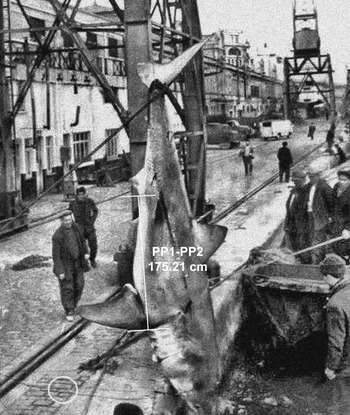
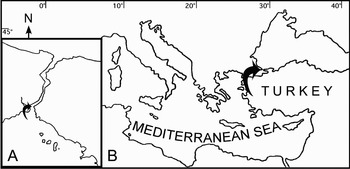
The great white shark shown in Figure 1 was caught by a tuna hand-liner in the Bosphorus Strait (Figure 2) in late March 1968. In order to estimate the length of the specimen, morphometric measurements developed from the photograph were used to compare the length of the shark with known lengths of objects, which appear in the photograph (De Maddalena et al., Reference De Maddalena, Zuffa, Lipej and Celona2001; Morey et al., Reference Morey, Martínez, Massutí and Moranta2003). The pavement stones, which appeared on the same plane with the shark on the left (Figure 1), were chosen as the reference object for estimation of length. I eventually visited Karaköy Harbour to examine the exact place where the shark had been photographed after its landing. The pavements of the harbour have sides measuring ~30 cm. Measurements of the great white shark used in this work are based on Compagno (Reference Compagno1984), which are as follows: total length with caudal fin in depressed position (TOT), precaudal length (PRC) and prepelvic–prepectoral space (PP1–PP2). Relations between the dimensions used in this work follow De Maddalena et al. (Reference De Maddalena, Zuffa, Lipej and Celona2001). The photograph of the specimen is kept in the archives of the Ichthyological Research Society, İstanbul. According to De Maddalena et al. (Reference De Maddalena, Zuffa, Lipej and Celona2001), the PP1–PP2 distance of their large white shark was 31.73% of TOT and 40.39% of PRC. The PP1–PP2 distance of the present specimen was estimated to be 175.21 cm, corresponding to 551 cm TOT and 433 cm PRC. Due to lack of claspers, the present specimen was assumed to be a female.
The great white shark, Carcharodon carcharias (Linnaeus, 1758), caught in the Bosphoric waters in late March 1968. White perpendicular line between the horizontal lines indicating the proportion PP1–PP2 (Compagno, Reference Compagno1984); pavement stones bordered by a white circle on the left of specimen were the reference objects used for the estimation of PP1–PP2.

(A) Map showing the locality of the capture of the Bosphoric great white shark; and (B) location of the Bosphorus Strait and Sea of Marmara.

Old records of apex predators, like the great white shark, can provide valuable information to researchers, tracing the historical distributional ranges of large carnivorus fish. Previous studies by Fergusson (Reference Fergusson, Klimley and Ainley1996) and Kabasakal (Reference Kabasakal2003, Reference Kabasakal2008) show that the Mediterranean distribution of C. carcharias covered the Sea of Marmara and its northern extention, the Bosphorus Strait, until the mid-1980s. In the Mediterranean, encounters with the great white shark are most common at insular sites and in association with pelagic fisheries for large teleosts such as tuna or swordfish (Barrull & Mate, Reference Barrull and Mate2001; De Maddalena, Reference De Maddalena2000; Morey et al., Reference Morey, Martínez, Massutí and Moranta2003). The long Bosphoric and Marmaric coasts of İstanbul City have clear similarities to the sites where great white sharks are commonly observed in the western and central Mediterranean. Moreover, the Marmaric coast of İstanbul City—consisting of several islands and small bays—seems to have been a habitat congenial to C. carcharias in the past. Until the collapse of the fishery, Bosphoric and north-eastern Marmaric waters were the areas of the most intensive tuna fishing in the Sea of Marmara. Between the 1950s and the late 1970s, almost all of the tuna fishermen in the Bosphoric and Marmaric waters were hand-liners. During this period, tuna fishing was an artisanal fishery in the mentioned area and the great white shark was a seldom but regular by-catch. However, the introduction of purse seining into the Sea of Marmara at the beginning of the 1980s caused the decline of tuna populations in the Marmaric waters, and eventually the disappearance of the great white shark. The last observation of the great white shark was recorded off Cape Kapıdağı, southern Sea of Marmara, in 1985 (Kabasakal, Reference Kabasakal2003). Similar relationships between tuna and great white sharks were noted in other areas of the Mediterranean, such as in the Catalonian Sea (Barrull & Mate, Reference Barrull and Mate2001), the Adriatic Sea (Soldo & Jardas, Reference Soldo and Jardas2002) and around the Balearic Islands (Morey et al., Reference Morey, Martínez, Massutí and Moranta2003).
CONCLUSIONS
Today, Carcharodon carcharias seems to be extinct from the Sea of Marmara; however, recent studies show that the great white shark still occurs in the Aegean waters of Turkey (Kabasakal & Gedikoğlu, Reference Kabasakal and Gedikoğlu2008; Kabasakal et al., Reference Kabasakal, Yarmaz and Gedikoğlu2009). In order to promote the survival of this vulnerable shark off the Turkish Aegean coasts, we should learn from the extinction of the great white shark in the Marmaric waters. It is very important to continue collecting new and historical data on the occurrence of great white sharks from Turkish waters. This will, in time, broaden our knowledge of this apex predator in Turkish waters, as well as in the eastern Mediterranean.