Introduction
Paediatric obstructive sleep apnoea hypopnea syndrome (OSAHS) is characterised by recurrent airway obstruction resulting in snoring, gasping and apnoeic events. Currently, polysomnography is the accepted ‘gold standard’ diagnostic technique, as recommended by the American Academy of Pediatrics.Reference Marcus, Brooks, Draper, Gozal, Halbower and Jones 1 – Reference Thurnheer, Bloch, Laube, Gugger and Heitz 3 However, because it is costly, has a low acceptance rate, and is time-consuming and laborious, with poor compliance in children, it is difficult to perform polysomnography in all cases of suspected paediatric OSAHS. Paediatric OSAHS diagnosis has therefore been based on clinical parameters such as medical history, a physical examination, lateral cephalometric radiography, nasopharyngoscopy, acoustic immittance and pure tone audiometry. Moreover, a diagnosis is often based on subjective judgement, resulting in an inexact evaluation. Therefore, this study aimed to identify a simple, accurate diagnostic method for analysing and screening clinical parameters in children with OSAHS.
Materials and methods
Patients
This study included 311 patients (216 boys, 95 girls) who were referred to the Department of Otolaryngology, General Hospital of Shenyang Military Area Command, with suspected paediatric OSAHS between June 2008 and July 2014. Patient selection criteria were: (1) complete clinical data, including a medical history, physical examination, lateral cephalometric radiography, acoustic immittance and polysomnography data; (2) age less than 14 years; (3) no craniofacial structural abnormalities; and (4) no cardiorespiratory function impairment or psychiatric disorders.
Clinical parameters
Clinical parameters potentially related to paediatric OSAHS based on clinical experience were screened, including sex, age, body mass index (BMI), history of snoring or gasping, history of nasal obstruction, history of running nose, palatine tonsil size, adenoid to nasopharynx ratio measured by lateral cephalometric radiography, and tympanogram type based on acoustic immittance and polysomnography. Parameters other than age, BMI and adenoid to nasopharynx ratio were assigned specific values as follows: sex (male = 1, female = 0); history of snoring or gasping (neither = 0, snoring alone = 1, both snoring and gasping = 2); history of nasal obstruction (present = 1, absent = 0); history of running nose (present = 1, absent = 0); palatine tonsil size (grade 0 (absent) = 0, grade I (internal limit of the palatine tonsil does not cross the palatopharyngeal arch) = 1, grade II (internal limit of the palatine tonsil is located between the palatopharyngeal arch and the retropharyngeal wall midline) = 2, grade III (internal limit of the palatine tonsil touches or crosses the retropharyngeal wall midline) = 3, unilaterally); tympanogram type (A = 0, C = 1, B = 2, unilaterally); and polysomnography result (OSAHS = 1, no OSAHS = 0).
Analysis of clinical parameters
Patients were randomly divided into two groups: a study group (210 patients) and a validation group (101 patients). Differences in clinical parameters between groups were assessed to ensure their comparability. Correlations between the apnoea–hypopnea index and multiple clinical parameters (age, BMI, history of snoring or gasping, history of nasal obstruction, history of running nose, palatine tonsil size, adenoid to nasopharynx ratio, and tympanogram type) were explored in the study group. Based on a cut-off point of 5 for the apnoea–hypopnea index, the study group was divided into OSAHS and non-OSAHS groups and between-group differences in clinical parameters were analysed. Thereafter, these clinical parameters were regarded as independent variables. The polysomnography result was considered a dependent variable based on whether it met the OSAHS diagnostic criteria. Regression analysis was performed to further define the relationship of the polysomnography result with the clinical parameters in the study group and to establish the regression equation. Patients were diagnosed according to this equation in both the study and validation groups, and results were compared with those obtained by polysomnography. Correlations between the sets of two results were determined in both groups. Finally, a simple diagnostic scale was developed based on the regression equation, and all 311 patients were diagnosed using this scale. The correlation between diagnoses based on the scale and on polysomnography findings for all 311 patients was determined.
Statistical analysis
Statistical analysis was carried out using SPSS statistics software version 16.0 (Chicago, Illinois, USA). Statistical significance was set at a p value of less than 0.05. Firstly, differences between the study and validation groups were analysed. The Student's t-test was used to analyse quantitative data and the χ 2 test was used to analyse qualitative data present as binomial classification variables. The Wilcoxon test was used to analyse qualitative data present as ordinal categorical variables. Secondly, correlations between the apnoea–hypopnea index and multiple clinical parameters were explored in the study group. Pearson's correlation test was used when both parameters were quantitative variables, and Spearman's correlation test was used when they were not. Thirdly, differences in clinical parameters between OSAHS and non-OSAHS groups were analysed. The Student's t-test was used for quantitative data, the χ 2 test was used when qualitative data were present as binomial classification variables and the Wilcoxon test was used for qualitative data present as ordinal categorical variables. Finally, stepwise logistic regression analysis was performed to determine the relationship between polysomnography data and clinical parameters in the study group.
Results
The cohort comprised 216 boys and 95 girls with an average age of 6.4 years (range 2–14 years). The mean BMI was 17.6 kg/m2 (range 11.3–37.0 kg/m2) and the mean apnoea–hypopnea index value was 8.5 (range 0.1–67.1). The mean lowest oxygen saturation value was 68 per cent (range 20–94 per cent).
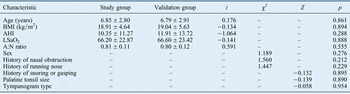
The study group comprised 210 patients (148 boys, 62 girls) and the validation group comprised 101 patients (66 boys, 35 girls). There was no significant difference in clinical data between the study and validation groups (p > 0.05; Table I). Pearson's and Spearman's correlation analyses showed that the apnoea–hypopnea index correlated significantly with a history of snoring or gasping (r = 0.253, p < 0.001), palatine tonsil size (r = 0.329, p < 0.001) and tympanogram type (r = 0.146, p < 0.05; Table II).
Differences in clinical data between the study and validation groups

Data are mean ± standard deviation. AHI = apnoea–hypopnea index; LSaO2 = lowest oxygen saturation; A = adenoid; N = nasopharynx
Study group: correlation between the apnoea–hypopnea index and clinical parameters

Y = years; BMI = body mass index; A = adenoid; N = nasopharynx; AHI = apnoea–hypopnea index
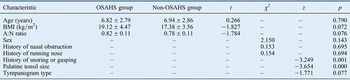
There were significant differences in history of snoring or gasping (z = −3.249; p < 0.01) and palatine tonsil size (z = −3.654, p < 0.001) between the OSAHS (158 patients) and non-OSAHS (52 patients) groups in the study group (Table III).
Clinical data analysed by the presence or absence of obstructive sleep apnoea hypopnea syndrome

Data are the means ± standard deviation. OSAHS = obstructive sleep apnoea hypopnea syndrome; A = adenoid; N = nasopharynx
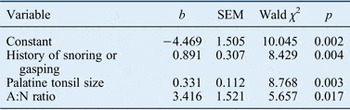
Stepwise logistic regression analysis revealed significant correlations between polysomnography data and a history of snoring or gasping (b = 0.891, p < 0.01), palatine tonsil size (b = 0.331, p < 0.01) and the adenoid to nasopharynx ratio (b = 3.616, p < 0.05) when using the equation: Y = −4.469 + 0.891 X 1 + 0.331 X 2 + 3.416 X 3, where Y = log-odds of polysomnography, X 1 = history of snoring or gasping, X 2 = palatine tonsil size and X 3 = adenoid to nasopharynx ratio (Table IV). According to statistical theory, paediatric OSAHS can be diagnosed when Y is greater than 0. When Y is less than or equal to 0, a diagnosis of paediatric OSAHS cannot be made. Correlation between the Y value (as determined by the equation) and the polysomnography result was 76.2 per cent in the study group (Table V). To further verify the accuracy of the equation, the values of X 1, X 2 and X 3 for the validation group were substituted into the equation. The correlation between Y values and polysomnography data in the validation group was 78.2 per cent (Table V).
Stepwise logistic regression of polysomnography and clinical parameter data

A = adenoid; N = nasopharynx
Study and validation groups: correlation between the Y value and polysomnography result

PSG = polysomnography
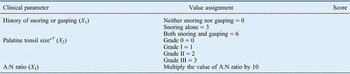
Next, the regression equation was transformed to simplify the equation and formulate a diagnostic scale for clinical application. The cut-off value of Y (Y = 0) was first substituted into the equation. After multiplying both sides of the equation by 3 and transferring the constant to the left of the equation, all figures in the equation were rounded to the nearest integer. Finally, the following simplified criterion was derived: 3 X 1 + X 2 + 10 X 3, where a value of more than 13 predicts OSAHS. The diagnostic scale based on the simplified equation was formulated (Table VI), in which a score of greater than 13 was used to diagnose paediatric OSAHS. When the diagnostic scale was used to diagnose OSAHS in all 311 patients, scores were found to correlate with polysomnography data.
Diagnosis using the simple equation

When using this table for diagnosis, the score for each clinical parameter (X 1 , X2 and X 3 ) is calculated using the clinical parameters in the second column and added to column three. The three scores are then added together to calculate the gross score. A gross score of greater than 13 indicates a diagnosis of paediatric obstructive sleep apnoea hypopnea syndrome.*Tonsil size is calculated separately on each side. †Grade 0, absent; grade I, internal limit of the palatine tonsil does not cross the palatopharyngeal arch; grade II, internal limit of the palatine tonsil is located between the palatopharyngeal arch and retropharyngeal wall midline; grade III, internal limit of the palatine tonsil touches or crosses the retropharyngeal wall midline. A = adenoid; N = nasopharynx
Discussion
In general, paediatric sleep-disordered breathing mainly includes primary snoring, upper airway resistance syndrome and OSAHS. OSAHS is the commonest form of sleep-disordered breathing, and adenotonsillar hypertrophy is the primary cause of OSAHS in children.Reference Greenfeld, Tauman, DeRowe and Sivan 4 Paediatric OSAHS greatly affects a child's quality of life and progression can lead to serious complications. It is linked to a number of health-related and behavioural problems such as daytime sleepiness, enuresis, cardiovascular problems, poor growth, hyperactivity, academic difficulties and attention issues.Reference Gozal and Kheirandish-Gozal 5 , Reference Capdevila, Kheirandish-Gozal, Dayyat and Gozal 6 Therefore, early diagnosis is the key to successful paediatric OSAHS treatment.
Studies have demonstrated that although approximately 20 per cent of all children might experience intermittent snoring during sleep, only 1–4 per cent suffer from paediatric OSAHS.Reference Lumeng and Chervin 7 , Reference Wang, Elkins, Keech, Wauquier and Hubbard 8 Thus, a diagnostic based only on the clinical symptom of snoring is inaccurate. Currently, polysomnography is the gold standard for diagnosing paediatric OSAHS. It is unaffected by subjective factors and can help determine the type and severity of respiratory disorder and guide surgery. However, polysomnography equipment is relatively expensive, and the examination needs to be carried out overnight. Thus, the procedure is both time-consuming and laborious. Most importantly, the examination may be difficult to perform in children because of poor compliance. Therefore, clinicians may base a diagnosis of paediatric OSAHS on clinical parameters, such as medical history, physical examination, lateral cephalometric radiograph and acoustic immittance. However, a diagnosis mainly based on subjective judgement is inaccurate, and a simple, accurate diagnostic method is needed.
It was suggested that the obstructive sleep apnoea 18-items (OSA-18) questionnaire could be used to help diagnose paediatric OSAHS.Reference Constantin, Tewfik and Brouillette 9 However, a poor correlation between the obstructive apnoea–hypopnea index obtained by full-night polysomnography and OSA-18 scores has been reported.Reference Borgström, Nerfeldt and Friberg 10 For example, Baldassari et al. found that neither the obstructive apnoea–hypopnea index nor the rapid eye movement apnoea–hypopnea index correlated with the total OSA-18 score.Reference Baldassari, Alam, Vigilar, Benke, Martin and Ishman 11 Moreover, correlations between the apnoea–hypopnea index and individual clinical parameters such as clinical symptoms, BMI, tonsil size and adenoid size, have been assessed but were found to be poor.Reference Goldstein, Sculerati, Walsleben, Bhatia, Friedman and Rapoport 12 For example, Valera et al. reported that tonsillar hypertrophy correlates with more severe apnoea in preschool-aged children but not in school-aged children.Reference Valera, Avelino, Pettermann, Fujita, Pignatari and Moreira 13 Goldstein et al. reported that clinical assessment of OSAHS in children, including a standardised history, physical examination and review of a tape recording of breathing during sleep, is a sensitive (92.3 per cent) but not a specific (29.4 per cent) method for OSAHS diagnosis.Reference Goldstein, Sculerati, Walsleben, Bhatia, Friedman and Rapoport 14 Therefore, a simple, accurate method for clinical diagnosis does not currently exist.
The present study included all clinical parameters used in previous studies and assigned specific values to each. All children were divided into study and validation groups. All data for the study group were subjected to statistical analysis and result was validated in the validation group. In the study group, the apnoea–hypopnea index correlated significantly with a history of snoring or gasping, palatine tonsil size and tympanogram type. However, the reason for a weak correlation between the apnoea–hypopnea index and the adenoid to nasopharynx ratio might be insufficient sample size. Another possibility is that the bilateral mandibular angle did not overlap when lateral cephalometric radiography was performed, resulting in inaccurate measurement. When study group was subdivided into OSAHS and non-OSAHS groups, significant between-group differences were identified in history of snoring or gasping and palatine tonsil size. These two clinical parameters were therefore identified as important diagnostic factors. Stepwise logistic regression analysis was subsequently used to define a diagnostic scale according to the transformed equation. Correlation between the polysomnography and scale results was 77.8 per cent. Thus, because of its low cost, simple methodology and high success rate, the diagnostic scale is an effective screening tool for the clinical diagnosis of paediatric OSAHS when polysomnography cannot be accomplished.
-
• Polysomnography is the ‘gold standard’ method for diagnosing paediatric obstructive sleep apnoea hypopnea syndrome
-
• Problems can prevent its use in all children and a subjective diagnosis is often made
-
• The newly-developed diagnostic scale can be used for clinical screening when polysomnography cannot be performed
In addition, there were clearly more boys than girls included in the study. Although sex was not found to be an important diagnostic factor in paediatric OSAHS, further investigation is warranted.
Conclusion
This diagnostic scale is an effective screening tool for diagnosing paediatric OSAHS in the clinic when polysomnography cannot be accomplished, but is unsuitable for assessing the severity of the condition.